Late Night Retro Television Reviews: Highway to Heaven 1.4 “The Return Of The Masked Rider”


Welcome to Late Night Retro Television Reviews, a feature where we review some of our favorite and least favorite shows of the past!  On Thursdays, I will be reviewing Highway to Heaven, which aired on NBC from 1984 to 1989.  The entire show is currently streaming on Tubi and several other services!

This week, Jonathan and Mark clean up a troubled neighborhood!

Episode 1.4 “The Return of the Masked Rider”

(Dir by Michael Landon, originally aired on October 3rd, 1984)

This week, Jonathan and Mark end up a gym in a city.  Jonathan applies for a job as a cut man.  The gym’s owner, Mau Mau (Stoney Jackson), is doubtful because Jonathan can’t give him any references to call but then Jonathan magically heals a cut over a boxer’s eye.  Jonathan gets the job and just in time because this neighborhood needs to be protected.

The problem is that the neighborhood is being ruled by Thumper (Darin Taylor) and the Satan’s Helpers.  Everyone in the neighborhood is scared of the Satan’s Helpers and who can blame them when the gang literally identifies with Satan?  I mean, they’re not only fans of Satan but they’re helping him as well!  Anyway, the statewide boxing championship is coming up and Thumper is going to be fighting another neighborhood boxer, Joey (Chip MacAllister).  The Satan’s Helpers demand that Joey throw the fight and to make sure that Joey does so, they kidnap his grandfather (Hank Rolike)!

Mark suggests that Jonathan just “zap” the gang members and bring an end to the whole thing but Jonathan explains that their mission is not to take out the gang.  Their mission is to encourage the other residents in the neighborhood to take back the streets, “like the Guardian Angels!”  You heard it, folks.  God supports vigilantism.

Luckily, Morton Clay (John Agar) lives in the neighborhood as well.  Morton was once a movie star, playing the Masked Bandit.  Now retired and nearly forgotten, Morton lives in an apartment building with several of his former co-stars.  Jonathan encourages Morton and his friends to put on their old costumes and march down to the headquarters of the Satan’s Helpers.  The rest of the neighborhood is so amazed by the parade of old timey heroes, that they follow.

The Satan’s Helpers are so intimidated by sight of the entire neighborhood gathered together that they decide to stop helping Satan and they release the grandfather.  Yay!  Meanwhile, at the boxing match, Joey refuses to take a dive and he knocks out Thumper.  Yay!  The neighborhood is saved.

When people refer to Highway to Heaven as being a campy show, they are probably referring to episodes like this one.  Undoubtedly, the episode is well-intentioned.  Watching it, you can tell that Michael Landon was hoping that this episode would inspire people to take pride in the neighborhoods, just like the Masked Bandit and his friends!  But the episode’s extremely earnest approach feels a bit naïve.  There’s nothing particularly intimidating about the Satan’s Helpers and it certainly doesn’t help their credibility that they’re scare off by a bunch of elderly people wearing costumes.

Next week, Mark and Jonathan break into the country music world!
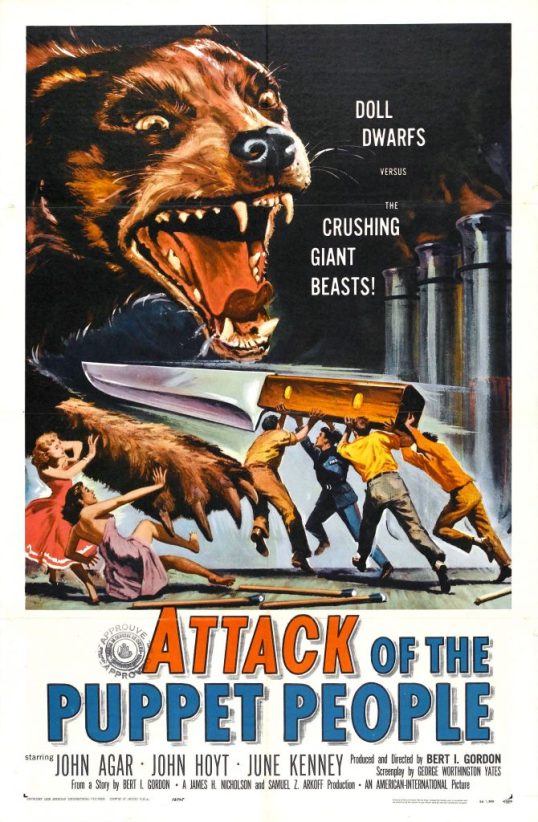
Horror Film Review: Attack of the Puppet People (dir by Bert I. Gordon)


At the start of the 1958 film, Attack of the Puppet People, Sally Reynolds (June Kenney) is looking for a job.  Fortunately, Dolls, Inc. is hiring!  Dolls, Inc. is owned by Prof. Franz (John Hoyt), who is the world’s greatest dollmaker.  In fact, he’s got an entire display case full of very lifelike dolls.  Why, the dolls are so authentic that it almost seems as if they could be alive.  Is it possible that Franz had been shrinking people and then sticking them in his display case?

It’s not only possible but it’s also exactly what Franz has been doing.

Soon, Sally and her boyfriend, Bob (John Agar), have been shrunk down to dollsize and are living with the other dolls in the display case.  It turns out that Prof. Franz’s motives aren’t really malicious.  He just tends to get lonely and he’s decided that they best way to keep people around is to shrink them and then imprison them.  Fortunately, getting shrunk doesn’t seem to lead to any health complications or anything like that.  It just means that you’re now very small and vulnerable to dogs and cats.

Franz even allows the dolls to come out of the display case at night.  Much like the toys from Toy Story, the Doll People throw a party every night and pretend to just be inanimate objects whenever anyone steps into the store.  That said, the puppet people don’t necessarily want to spend the rest of their lives on display.  Can they figure out how to escape from the store and how to reverse the shrinking process?

It’s a pretty silly film but then again, what else would you expect from something called Attack of the Puppet People?  There are a few amusing scenes where the puppet people have to deal with maneuvering around and dealing with giant furniture and, at one point, a really big door knob.  And, of course, there’s the inevitable scene in which a curious dog spots two of the puppet people trying to make their escape.  It’s a 50 B-movie, dumb but undeniably fun.  John Hoyt appears to be having a lot of fun as the doll-loving mad scientist and John Agar is his usual stolid but oddly likable self.

Attack of the Puppet People was directed by Bert I. Gordon, who also did The Amazing Colossal Man and War of the Colossal Beast.  (At one point, Bob and Sally got to a drive-in that’s show The Amazing Colossal Man and Gordon shares a few minutes of his previous film.)  Gordon specialized in films about giant lizards, giant insects, giant ants and sometimes even giant people.  In fact, his nickname was “Mr. Big,” both because of his initials and the subject matter of his films.  Attack of the Puppet People is a unique Gordon film in that it deals with shrinking instead of growing.  It’s also one of his more entertaining films.  Bert I. Gordon, incidentally, is still with us.  He turned 100 years old on September 24th.

Film Review: King Kong (dir by John Guillermin)


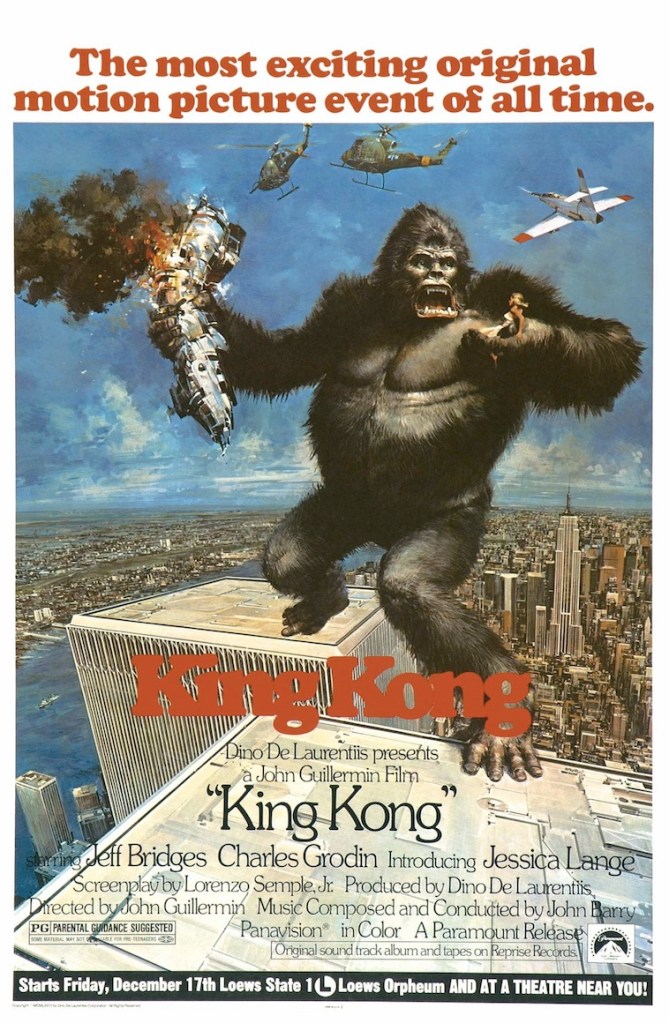
The 1976 remake of King Kong is the version of the great ape’s story that no one ever seems to want to talk about.

Everyone, of course, continues to appreciate the original King Kong from 1933, with its charmingly dated but still somewhat effective special effects. The Japanese King Kong films have their fans, even if it still annoys me that two endings were made for the original King Kong vs. Godzilla. The Peter Jackson-directed remake from 2005 had many admirers, including me. The monsterverse Kong certainly has many fans, as is indicated by the fact that Godzilla vs Kong is the first box office hit of the post-pandemic era. King Kong is a beloved character and yet the 1976 version of his story never seem to get as much attention as all the others.

Some of that, of course, is because the 1976 version of King Kong is often described as not being very good. It tells the same basic story as the first King Kong but there’s a few key differences. The expedition to the hidden island is no longer made up of a film crew. Instead, everyone has a separate backstory that doesn’t really make much sense. Fred Wilson (Charles Grodin) is an energy company executive who is looking for a new source of oil. Jack Prescott (Jeff Bridges) is a long-haired hippie environmentalist type who stows away on Wilson’s ship. Prescott apparently thinks that there’s some sort of ancient primate living on the island. Meanwhile, Dwan (future great actress Jessica Lange, making her film debut) is an aspiring actress who is discovered in a life raft, floating out in the middle of the ocean. It turns out that Dwan (that’s not a typo, that’s her name) has escaped from the yacht of a sleazy film producer. Nobody on the ship seems to be surprised when Dwan suddenly shows up in her life raft and Dwan doesn’t seem to have any hesitation about accompanying a bunch of strangers to previously unexplored island. That’s the type of film this is.

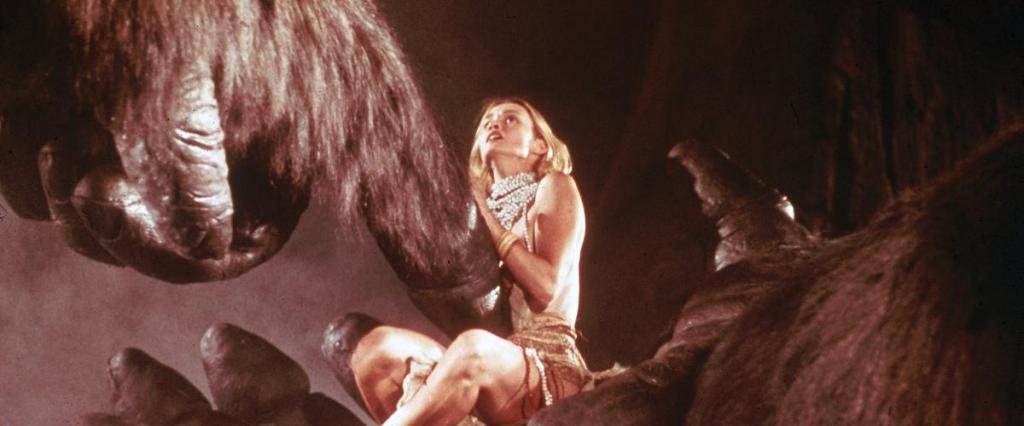
After a considerable amount of time, during which Dwan falls in love with Jack and Fred spends a lot of time looking generally annoyed, the island is discovered. As you can already guess, Dwan is kidnapped by the island’s natives, and she’s rescued by a giant ape who falls in love with her after she punches him in the nose and says, “Put me down, you male chauvinist pig ape!” In some shots, Kong is obviously a man in a rubber suit. In others, he’s just as obviously an animatronic model. Unfortunately, the animatronic version of Kong sometimes appears to kind of be leering whenever he looks down at Dwan in the palm of his hand, which bring a definite element of ickiness to a few of the scenes in which Kong carries Dwan across the island.

I would have started praying too.

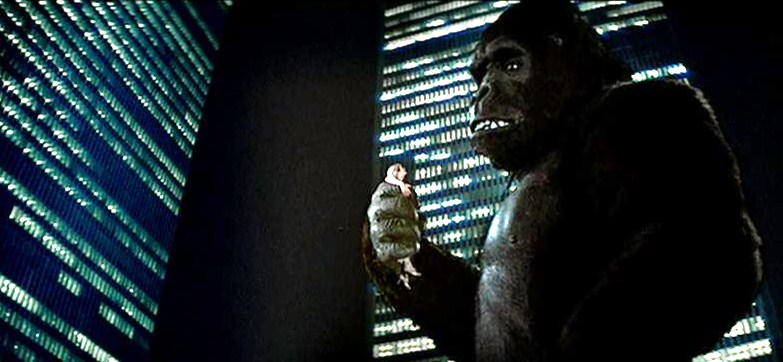
Eventually, just as in the original film, Kong ends up a prisoner in New York. This time, when he escapes, grabs Dwan, and goes on a rampage, he ends up climbing the Two Towers. This leads to scenes of helicopters and fighter planes all firing at the Two Towers, which is a bit difficult to watch today. I remember a few years ago, one of our local stations actually broadcast this version of King Kong on September 11th and it definitely did not feel right.

The 1976 version of King Kong was a hit at the box office and was nominated for three Academy Awards. It won the the award for Best Visual Effects, sharing the Oscar with Logan’s Run. That said, King Kong wasn’t exactly popular with critics, either at the time of its release or today. To a certain extent, it’s understandable why this version of King Kong is so frequently criticized. The script takes a deliberately campy approach to material that, in order to have any real emotional impact, needs to be played straight regardless of how silly the story might seem. Charles Grodin never seems to be sure whether the film is a drama or a comedy. Jeff Bridges is likable but a bit too naturally mellow for his role. Jessica Lange made her film debut in King Kong, famously beating out Meryl Streep for the role. Despite the fact that the film was a box office hit, the reviews of Lange’s performance were so negative that she didn’t work for three years after appearing in the film. (She spent that time studying acting. She went on to win a Tony, two Oscars, and three Emmys so take that, critics.)

And yet, I kind of like this version of King Kong. When taken on its own very silly terms (and not as a remake of a legitimate classic), it’s definitely entertaining. Even the fact that Grodin, Bridges, and Lange are all miscast kind of works to the film’s advantage. You can’t help but appreciate that all three of them are trying so hard to be convincing in roles that they shouldn’t have been playing. For all the criticism of Jessica Lange’s performance, she actually does as well as anyone could with some of the dialogue that she gets stuck with. It’s not easy to pull off a scene where you explain to a giant ape that the relationship is never going to work because you’re a city girl and he’s a …. well, he’s a giant ape. But Lange manages to deliver the lines without laughing and that couldn’t have been easy. Lange’s then-inexperience is obvious whenever she’s having to react to or interact with the other actors but she does fine when she’s having to talk to a guy in a rubber suit or a big animatronic head. (Let’s see Meryl Streep pull that off.) Though it seems to take forever for Kong to actually get captured, the film picks up once he’s transported to New York. If you can look past the awkwardness of how the film uses the Twin Towers, the scenes of Kong rampaging through the city have an over-the-top grandeur that’s both ludicrous and compelling. By the time he reaches the top of the World Trade Center, you will totally be on his side. That’s the way it should be.

This remake of King Kong is deeply, deeply silly but, sometimes, that’s exactly what you’re looking for.

Star in the Dust (1956, directed by Charles F. Haas)


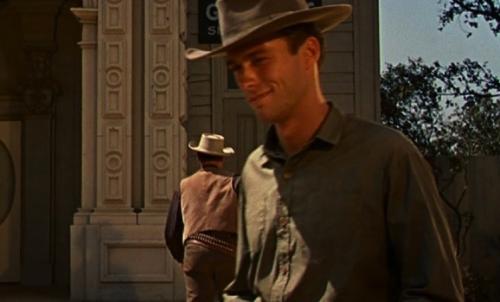
The time is the late 1800s and the place is the town of Gunlock.  Gunlock is split between the ranchers and the farmers, with the ranchers eager to buy all of the land around the town and the farmers refusing to sell.  Trying to keep the peace is Sheriff Bill Jorden (John Agar), who not only wants to keep war from breaking out in Gunlock but who also wants to live up to the example of his legendary father.

There’s a prisoner in the Gunlock city jail.  Sam Hall (Richard Boone) is a notorious gunman who has been convicted of killing three farmers.  He’s due to hang at sunset but everyone in town believes that Sam will somehow escape the executioner.  (They’re even taking bets down at the local saloon and casino.)  Everyone knows that Sam was hired by the ranchers but Sam has yet to name which rancher specifically invited him to come to town.  The farmers want to lynch Sam.  The ranchers want to break him out of jail and arrange for him to be killed in the resulting firefight.  Meanwhile, Sheriff Jorden insists that he’s going to carry out Sam’s sentence by the letter of the law.  Complicating matters for Jorden is that he’s engaged to Ellen Ballard (Mamie Van Doren), the sister of the main rancher, George Ballard (Leif Erickson).

I was really surprised by Star in the Dust, which turned out to be far better than I would normally expect a John Agar/Mamie Van Doren western to be.  Though Agar, Boone, and Van Doren get top-billing, Star in the Dust is really an ensemble piece, with several different people responding to the possible hanging of Sam Hall in their own way.  Sam’s girlfriend, Nellie Mason (Colleen Gray), tries to figure out a way to keep Sam alive.  One of the ranchers, Lew Hogan (Harry Morgan), is morally conflicted about whether or not to honor his word to help Sam escape, especially after he finds out that Sam tried to rape his wife (Randy Stuart).  Even the old deputies (played by James Gleason and Paul Fix) get a few minutes in the spotlight before the shooting begins.  The town of Gunlock comes to life and everyone, from the villains to the heroes, has a realistic motivation for reacting in the way that they do to Sam’s pending execution.

Mamie van Doren’s role is actually pretty small.  She doesn’t have enough screen time to either hurt or help the film overall.  John Agar is as stiff as always but, for once, it works for his character.  Sheriff Jorden isn’t written to be a bigger-than-life John Wayne type.  Instead, he’s just a small town lawman trying to do his job and keep the peace.  Not surprisingly, the film is stolen by Richard Boone, who brings a lot of unexpected shading and nuance to the role of Sam Hall.  Hall may be a killer but he has his own brand of integrity and, if he’s going to die, he’s determined to do it his way.

Produced by the legendary Albert Zugsmith, Star in the Dust is a surprisingly intelligent and well-acted B-western.  If you watch carefully, you might even spot Clint Eastwood playing a ranch hand named Tom who wants to know if he should put money down on Sam Hall being hanged.  Though he was uncredited in this tiny role, Star in the Dust was Eastwood’s first western.

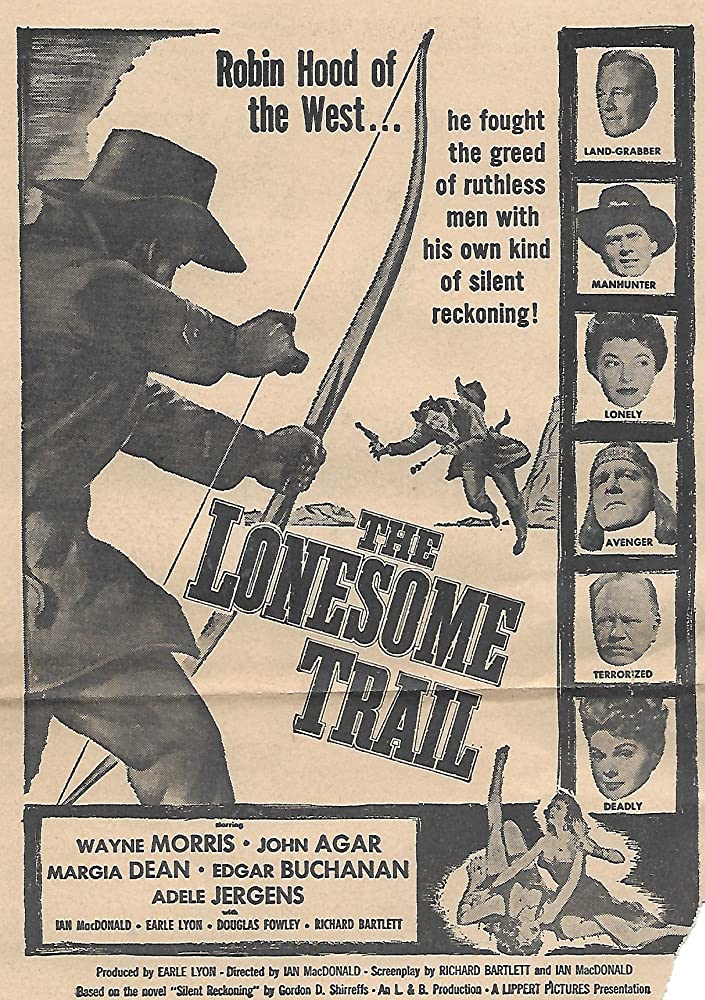
The Lonesome Trail (1955, directed by Richard Bartlett)


Returning home from the Civil War, Johnny Rush (John Agar) discovers that his family’s land has been confiscated by corrupt rancher Hal Brecker (Earle Lyon, who co-wrote the script).  With the aid of corrupt Sheriff Baker (played by Richard Bartlett, who also directed the film), Brecker has taken over the entire town.  Honest ranchers like Charley Bonesteel (Douglas Fowley) are giving up their land and heading out of town.  Meanwhile, Dan Wells (Edgar Buchanan) has managed to hold onto his land by offering up his daughter, Pat (Margia Dean), as Brecker’s bride.  Since Johnny’s in love with Pat, he’s not happy about this development.

Johnny wants to take on Brecker but the local bartender, Dandy Don (Wayne Morris), talks him out of it.  Realizing that there’s nothing he can do alone, Johnny tries to leave town but, as he rides out, he’s ambushed by Baker.  Though Johnny survives the ambush, his shooting hand is injured.  Fortunately, Indian Chief Gonaga (Ian MacDonald, the script’s other writer) and Charley are on hand to teach Johnny how to fight with a bow and arrow.  Johnny goes on to become an old west Robin Hood, using his newly learned archery skills to fight the greedy land grabbers and protect the poor land-owners.

The Lonesome Trail is a low-budget, grade Z western that is slightly saved by the novelty of seeing John Agar fighting off the bad guys with a bow and arrow.  The film is clearly set up to be a western version of the Robin Hood saga, complete with a corrupt sheriff, a greedy landlord, and an archer who has just returned from war.  Errol Flynn and Olivia de Havilland could have really made something out of this story back in 1938.  Unfortunately, to say that John Agar is no Errol Flynn is putting it lightly.  There’s nothing “merry” about John Agar’s performance.  He looks genuinely miserable in the majority of this scenes.  Agar is just as stiff as usual but the bow and arrow is just enough of a twist to make his confrontations with Brecker’s men more interesting than the typical gunfights that usually wrapped these films up.  Otherwise, this is another forgettable Robert Lippert-produced western, though old pro Edgar Buchanan does give a good performance as a man desperate enough to offer up his daughter in order to keep his land.


Jet Attack (1958, directed by Edward L. Cahn)


At the height of the Korean War, American scientist Dean Olmstead (Joseph Hamilton) is flying being enemy lines when he’s shot down over North Korea.  Because Olmstead had just created a new type of radar technology and he didn’t bother to leave behind any notes to explain to anyone else how the technology works, it’s imperative that he be rescued from a North Korean POW camp before the Russians brainwash him and take the technology for themselves.

Captain Tom Arnett (John Agar!), Lt. Bill Claiborn (Gregory Walcott, star of Plan 9 From Outer Space!!), and unconvincing beatnik Chick Lane (Nicky Balir) parachute behind enemy lines.  They meet up with both the local rebels and Tanya Nikova (Audrey Totter), a Russian nurse who is secretly a double agent and an anticommunist.  She’s also Arnett’s former lover and helped him escape the last time that he was being held prisoner by the communists.  (Arnett was also in charge of the flying escort that was supposed to keep Olmstead from getting shot down so, given his past history of failing and getting captured, Arnett may not be very good at his job.)  Working with Tanya and Capt. Chon (Victor Sen Young), Arnett ad Claiborn set out to rescue Olmstead from the KGB’s Col. Kuban (Robert Carricart).

Jet Attack is a z-grade war film that features a ton stock footage that you’ll probably recognize from other 50s war films.  As a result, the look of the jets often change from shot to shot and one North Korean airplane has “California Air National Guard” prominently written on its tail.  I know that some right-wingers like to refer to California as being “Commiefornia” but accusing the state of siding with the enemy during the Korean War is taking things too far.  The only thing that looks cheaper than the stock footage is the footage that was actually shot for the movie.  (The stock footage at least includes some pretty cool explosions.)

John Agar started his career co-starring with John Wayne and marrying Shirley Temple but, by the time Jet Attack was made, his star had dimmed considerably.  Whether he was appearing in a major production or a cheap film like Jet Attack, Agar was always reliably dull.  Here, he’s regularly outshined by co-star Gregory Walcott who, despite being best-known for appearing in films like Plan 9 From Outer Space, could actually act and show a hint of emotion on screen.  Probably the best thing about this film is Audrey Totter, who, despite an unfortunately attempt at a Russian accent, plays her role with more conviction than the script really deserves.  As Chick Lane, Nicky Blair also deserves some credit for telling the North Koreans that their attempts to torture him are “squaresville.”

The most surprising thing about Jet Attack is that it wasn’t produced by Howard Hughes.  With its emphasis on planes and evil commies, it feels like a Hughes film.  It’s a dull and workmanlike film but bad movie buffs will want to see it just to witness John Agar getting acted off the screen by Gregory Walcott and Audrey Totter.

Flesh and the Spur (1956, directed by Edward L. Cahn)


When farmer Matt Ransom (John Agar) is murdered for his horse and his gun, his twin brother Luke (also John Agar) sets out to get revenge.  He knows that his brother’s murderer was a member of the infamous Checkers Gang.  Because the gun that the killer stole was one of two identical pairs specially made for the twins by their father, Luke knows that all he has to do is find the outlaw who is carrying a gun that looks just like his.  During Luke’s search, he meets several others who have their own reasons for wanting to destroy the Checkers Gang.  Luke teams up with a beautiful Native American woman named Willow (Marla English), a snake oil salesman named Windy (Raymond Hatton), and a mysterious but deadly gunman named Stacy Doggett (Mike “Touch” Connors).

This B-level Western is best known for a scene where a group of rogue Indians tie Willow to an anthill in order to punish her for “traveling” with the white man.  The scene was not originally in the script.  It was added after a poster was designed that featured Willow bound to a stake.  While the scene was undoubtedly enjoyed by the teenage boys who the film was marketed towards, it feels out-of-place in the movie.  Some of the problem is that, while shooting the scene, the ants refused to go anywhere near Marla English and would instead run away whenever they were dropped on English’s feet.  After spending several minutes tied to a stake and having ants poured on her, English said, “Look, you’ve got six ants there.  Isn’t that enough?”  Marla English retired from acting shortly after appearing in this film.

Flesh and the Spur is a B-western through and through but it has a few good moments, like the scene where Luke and Stacy check out a saloon’s gun rack to see if anyone has hung up Matt’s gun.  Touch Connors is convincingly deadly as Stacy and there’s a good twist with his character at the end of the film. Marla English gives such a good performance as Willow that it’s too bad that the ants may have played a part in her early retirement from acting.  Unfortunately, John Agar is just as dull and colourless as always and he was obviously too old to be playing someone like Luke, who is meant to be a naive neophyte.

Flesh and the Spur may not be a classic but there’s enough there to keep western fans entertained.

Film Review: Miracle Mile (dir by Steve De Jarnatt)


Last night, as I was watching the 1988 film, Miracle Mile, I found myself thinking about the fact that this film literally could not be made today.

No, it’s not because the film itself is about the treat of nuclear war.  Though nuclear war may no longer be as much of a cultural obsession as it apparently was back in the 80s, the fact of the matter is that the U.S., Russia, the UK, France, and China all still have nuclear weapons.  Pakistan, India, and North Korea all claim to have nuclear weapons.  It’s believed that Israel also has a few.  Iran is apparently working on developing an arsenal.  It’s estimated that there are currently 13,865 nuclear weapons in existence, 90% of which are divided between the U.S. and Russia.  That’s not even counting the threat of a terrorist group setting off a nuclear device.  In short, the threat of nuclear war is still very much a real one.

Instead, what truly makes Miracle Mile stand out as a film of its time, is the fact that almost the entire plot revolves around the character of Harry (played by Anthony Edwards) answering a Los Angeles pay phone at four in the morning.

Why is Harry answering a pay phone at 4 in the morning?  It’s because, earlier, he met Julie (Mare Winningham) at the La Brea Tar Pits and they fell instantly in love.  After spending most of the afternoon together, they made a date to meet at the local diner where Julie worked as a waitress.  Julie’s shift ended at midnight.  Harry went home to get a quick nap before picking her up.  Unfortunately, a power failure — one that was largely caused by Harry carelessly tossing away a cigarette — resulted in Harry’s alarm not going off.  At midnight, while Julie was standing outside the diner, Harry was asleep.

Harry doesn’t wake up until well-past 3 a.m.  After hastily getting dressed, Harry drives down to the diner.  When he arrives, he bumps into a tree and three rats fall off the branches and land on his car, which is a bit of an ominous omen.  (After watching the movie, I did a Google search and discovered that it’s actually not uncommon for rats to hang out in palm trees after dark.  I had no idea.  I’m glad I don’t live near any palm trees.)

By the time Harry arrives, Julie’s already gone.  From the payphone outside the diner, Harry calls Julie and leaves an apologetic message on her answering machine.  (Julie sleeps through it.)  Within minutes of Harry hanging up, the pay phone rings again.  Harry answers it, expecting to speak to Julie.  Instead, he finds himself talking to a panicked soldier who was trying to call his father but who dialed the wrong area code.  The soldier says that a war is about to break out and that everyone is going to die.  Suddenly, Harry hears what sounds like a gunshot.  Another voice gets on the phone and tells Harry to go back to sleep and forget about the call.

Of course, the reason why this story couldn’t take place in 2020 is pretty obvious to see.  No one uses pay phones anymore.  If the movie were made today. Harry would have just Julie on his own phone and then waited for her to call him back.  The soldier would never have misdialed his father’s area code.  Harry never would have gotten the message that the world was about to end and most of the subsequent events in Miracle Mile never would have happened.  Harry would have just sat in the diner and had a cup of coffee and waited for Julie to call until the inevitable happened.  In 2020, that would have been the movie.

So, let’s be happy that this film was made in 1988. during the time when pay phones were everywhere, because Miracle Mile is an excellent film.  Miracle Mile starts out as a romantic comedy, with Anthony Edwards and Mare Winningham making for an incredibly adorable couple.  Then, after Harry answers that pay phone, the movie grows increasingly grim as Harry desperately tries to make his way to Julie and arrange for the two of them to board a plane that a mysterious woman (Denise Crosby) has charted for Antarctica.  The problem, of course, is that in order to reach Julie, Harry is going to need the help of the type of people who are typically up and wandering around at 4 in the morning in Los Angeles.  Several people die as Harry tries to make it to Julie and, smartly, the film doesn’t just shrug off their deaths.  For the majority of the film, Harry isn’t even sure if there’s actually going to be an attack and it’s possible that he’s not only panicking over nothing but that he’s causing others to panic as well.  People are dying because of that phone call and Harry doesn’t even know whether it was real or not.  Even when full scale rioting breaks out, Harry doesn’t know if it’s because the world’s ending or because of a bad joke that he took seriously.  Transitioning from romantic comedy to dark comedy, Miracle Mile eventually becomes a nightmare as it becomes obvious that, even if Harry does reach Julie, escaping the city is not going to be easy.  The sun is rising and the truth is about that phone call is about to revealed….

Miracle Mile is a film that will get your heart racing.  On the one hand, Anthony Edwards and Mare Winningham have such a wonderful chemistry and they’re both just so damn likable that you want them to find each other and stay together.  Even if it means running the risk of being incinerated in a nuclear explosion, you want Harry and Julie to be with each other.  At the same time, you watch the movie with the knowledge that, even if they do manage to reunite, it might not matter because the world’s going to end.  Remarkably, almost everyone who Harry talks to about the phone call believes him when he says that a war is about break out.  Almost all of them have a plan to escape and, as a viewer, you get so wrapped up in the film that it’s only later that you realize that none of their plans made any sense.  Hiding out in Antarctica?  How exactly is that going to work?  Antarctica’s not exactly a place to which you impulsively move.  If there is truly no way to escape the inevitable, perhaps we should just be happy that Julie and Harry found love, even if it was right before the apocalypse.

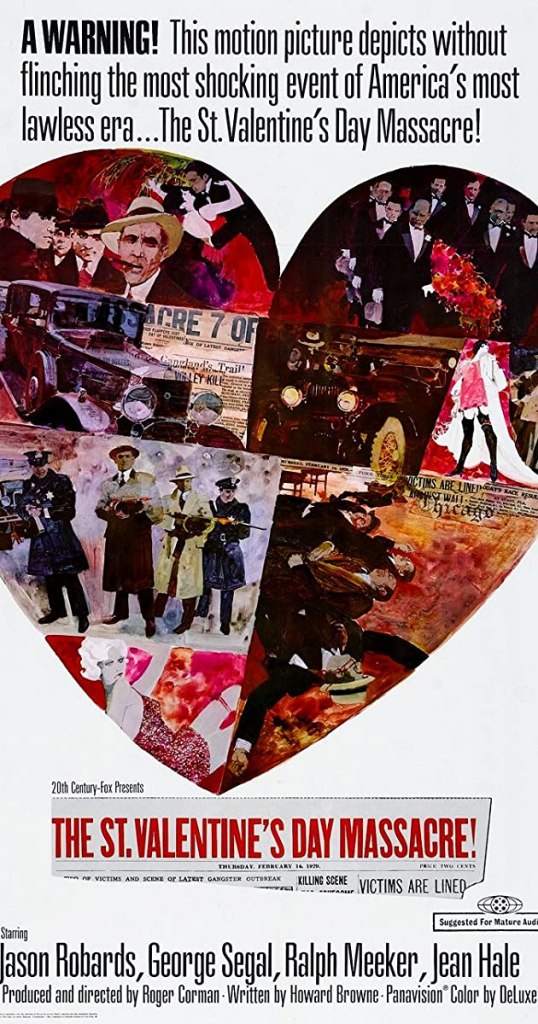
An Offer You Can’t Refuse #18: The St. Valentine’s Day Massacre (dir by Roger Corman)


On February 14th, 1929, seven men were murdered in a garage in Chicago, Illinois.  Five of the seven men were known to be associates of gangster George “Bugs” Moran.  The other two men were considered to be innocent bystanders, a mechanic and a dry cleaner who just happened to enjoy hanging out with gangsters.  Though no one was ever convicted of the crime, it was well-known that the murders were carried out on the orders of Al Capone.

In many ways, the St. Valentine’s Day Massacre was a turning point in America’s relationship with organized crime.  Before the massacre, Capone had become a bit of a folk hero.  He knew how to talk to the press and he was viewed as merely breaking a law (in this case, prohibition) that most people opposed in the first place.  However, after the murders, public opinion soured on Capone.

Some of it was the brutality of the crime.  It’s been said that over five hundred bullets were fired in that garage, all to kill seven defenseless men who were lined up against a wall.  Grisly pictures of the victims were released to the press.  Perhaps if the seven men had been carrying weapons and had been involved in a shootout with their murderers, the public’s reaction would have been different.  But this was a cold-blooded execution.

Personally, I think the fact that the killers disguised themselves as cops also played a role in the public’s outrage.  It was a very calculated move on the part of the killers and it highlighted just how much planning went into the St. Valentine’s Day Massacre.  As well, it undoubtedly made people paranoid.  If a bunch of killer could dress up like cops, who knew who else they could dress up as?

Finally, I think that Capone’s biggest mistake was carrying out the crime on Valentine’s Day.  You don’t murder people on a holiday.  Anyone should know that.  If Capone had waited until February 20th, he probably could have gotten away with it.

The 1967 film, The St. Valentine’s Day Massacre, details the rivalry between Capone and Moran, starting with them fighting for control over the Chicago rackets and ending with the title event.  Moran is played by Ralph Meeker while Jason Robards plays Capone.

Now I know what you’re probably thinking.  Perennial WASP Jason Robards as Al Capone?  That may sound like odd casting and, let’s just be honest here, it is.  However, it actually kind of works.  Robards may not be convincingly Italian but he is convincingly ruthless.  Add to that, one of the major subplots of the St. Valentine’s Day Massacre is that, even as the head of the Chicago Outfit, Capone still feels like an outsider in the world of organized crime because, while he is Italian, he isn’t Sicilian.  Capone feels as if Lucky Luciano and all of the major New York crime bosses look down on him and one reason why he’s so ruthless about taking over Chicago is that wants to show Luciano that he can be just as effective a crime lord as any Sicilian.  Capone feeling out of place in the Mafia is reflected by Robards initially seeming to be out of place in a gangster film.  By the end of the movie, of course, Capone has proven himself and so has Jason Robards.

Robards isn’t the only familiar face to be found in The St. Valentine’s Day Massacre.  Though this film was released by 20th Century Fox, it was directed by Roger Corman and Corman fills the production with members of his stock company.  Dick Miller, Jonathan Haze, and Jack Nicholson all have small roles as gunmen.  Bruce Dern plays the unlucky mechanic who enjoys hanging out with gangsters.  Buck Taylor, Leo Gordon, and Joe Turkel all have small roles.  John Agar plays Dion O’Bannon and is gunned down in his flower store.  Though not members of the Corman stock company, George Segal and David Canary plays brothers who work for Moran.  There’s a lot of characters wandering through this film but Corman makes sure that everyone gets a chance to make an impression.

It’s a good gangster film.  Though he was working with a larger budget than usual, Corman still brought his exploitation film aesthetic to the material and the end result is a violent, melodramatic gangster film that looks really impressive.  The film’s recreation of 1920s Chicago is a visual delight and looking at the well-dressed and stylish gangsters walking and driving down the vibrant city streets, you can understand why organized crime would have such a draw for some people.

The St. Valentine’s Day Massacre is a classic gangster film and a classic Corman film.  It’s an offer you can’t refuse.

Previous Offers You Can’t (or Can) Refuse:

  1. The Public Enemy
  2. Scarface
  3. The Purple Gang
  4. The Gang That Could’t Shoot Straight
  5. The Happening
  6. King of the Roaring Twenties: The Story of Arnold Rothstein 
  7. The Roaring Twenties
  8. Force of Evil
  9. Rob the Mob
  10. Gambling House
  11. Race Street
  12. Racket Girls
  13. Hoffa
  14. Contraband
  15. Bugsy Malone
  16. Love Me or Leave Me
  17. Murder, Inc.


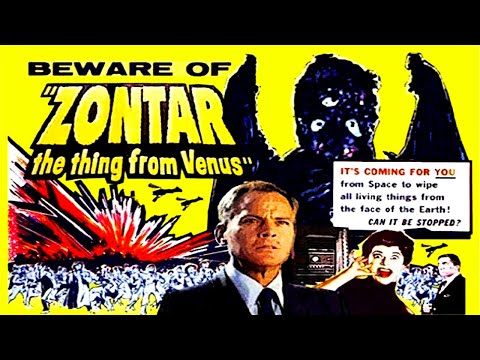
Film Review: Zontar, The Thing From Venus (dir by Larry Buchanan)


Look, I get it.  Not everyone is as crazy about watching the Oscars as I am.  Some of you have absolutely no interest in watching the Oscar tonights and right now, you’re saying, “If only there was something else to watch!”  I hear you and I’m here for you.

And fear not!

There is something else for you to watch!  Just go to YouTube and look up Zontar, The Thing From Venus!  You can watch the whole movie three times in a row while everyone else is watching the Oscars.  Don’t ever say that I didn’t do anything for you.

What is Zontar, The Thing From Venus?  It’s a film from 1966 and it was directed by Texas’s own Larry Buchanan!  It tells the story of what happens when a creepy scientist named Keith (Tony Huston) manages to contact a big, three-eyed bat named Zontar.  Zontar’s from Venus and it wants to rule the world.  Keith thinks that humanity could benefit from being conquered by a ruthless alien warlord.  So, Kieth arranges for Zontar to come to the Earth.  While Zontar hides out in a cave, it manages to shut down everyone’s electricity and, using a bunch of smaller, flying bats, it also possesses almost an entire town.  Keith thinks it’s great but that’s because Keith is an idiot with fascist tendencies.

You know who isn’t impressed by Zontar and all of his high-and-mighty rhetoric?  Another scientist named Dr. Curt Taylor (John Agar).  Dr. Taylor knows that Zontar is up to no good but how can he stop him?  Well, he’s not going to do it by driving a car because Zontar’s knocked out America’s electrical systems.  So, instead, he rides a bike from location to location.  Seeing John Agar awkwardly trying to balance himself on a bike is more than worth the price of admission.

(Of course, since this is on YouTube, the price of admission is only your immortal soul and your internet privacy.)

Anyway, if all of this sounds familiar, that’s because Zontar is a remake of an earlier Roger Corman film called It Conquered The World.  For some reason, in the 60s, American International Pictures gave Larry Buchanan a handful of money and told him, “Go direct some crappy remakes of some of our best films.”  Zontar is probably the best known of Buchanan’s remakes and it’s also probably the most fun.

I mean, don’t get me wrong.  It’s nowhere near as good as It Conquered The World but, at the same time, it doesn’t have the slow spots that show up in most of Buchanan’s other films.  The story moves fairly briskly and Buchanan keeps the picture in focus and, considering some of Buchanan’s other movies, that’s a bit of a minor triumph.  Zontar is an impressive monster.  In fact, I’d say that batty Zontar is probably a more effective creation than the smiling crab that showed up in It Conquered The World.  Finally, you get to see John Agar trying to ride a bicycle and that’s always an entertaining sight.

Zontar is enjoyably dumb.  If you want to kill 80 minutes but you don’t want to have to do any thinking, watching Zontar is definitely one way to do it.