A Movie A Day #186: Joysticks (1983, directed by Greydon Clark)


It’s Porky’s in an arcade!

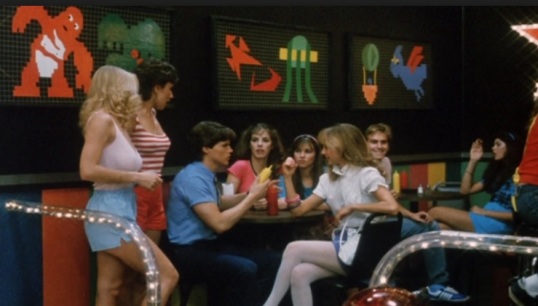
Every gamer knows how accurate this is.

Jeff Bailey (Scott McGinnis) is the manager of the hottest (and only) arcade in town.  His grandfather owns the place and Jeff is everyone’s friend but he does not play any of the games.  When he was younger, he was caught getting it on with his girlfriend in an arcade.  She was sent out of town and Jeff was left so traumatized that he swore he would never touch another joystick.  However, he may have to go back on his pledge because the local evil businessman (Joe Don Baker) is determined to take over the arcade and he has recruited King Vidiot (Jon Gries) to help him do it.  In between Jeff getting laid and King Vidiot scheming, there are all the usual teen sex comedy hijinks.  Just like in real life, the arcade is perpetually full of hot, single girls wearing bikinis.  A hot dog gets stuck between a pair of breasts.   Pacman is played by a topless video game groupie.  Inevitably it all leads to a training montage and a showdown between Jeff and King Vidiot, with whoever gets the highest score at Super Pacman winning control of the arcade.

King Vidiot was the height of 80s fashion.

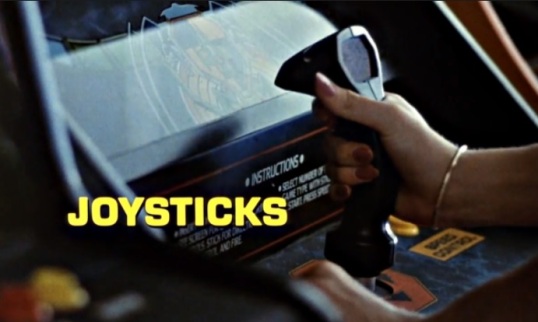
Joysticks is as dumb as it sounds but it is also a lot of fun, especially if you want to see what life was like before everyone had internet access and their own home gaming console.  The movie is full of classic games, from Pac-Man to Satan’s Hollow.  The best thing about the arcade is that the final video game duel is played with giant, floor-mounted joysticks.  I’m not sure they would work well in real life but they look extremely cool.

Check out those joysticks!

For those wondering, at no point does Joe Don Baker play Pacman during Joysticks.  If he had, the end result would have been a classic for all time.

Grab that joystick, Joe Don. You know you want to.

Joysticks?  I wonder if that title was supposed to have a double meaning.

Arcade Life, 1983

Insomnia File No. 15: George Wallace (dir by John Frankenheimer)


What’s an Insomnia File? You know how some times you just can’t get any sleep and, at about three in the morning, you’ll find yourself watching whatever you can find on cable? This feature is all about those insomnia-inspired discoveries!

George Wallace

If, after watching Promise last night, you discovered that you were still suffering from insomnia, you could have watched the very next film that premiered on TCM.  That film was the 1997 biopic, George Wallace.

Like PromiseGeorge Wallace was originally made for television.  Also, much like Promise, George Wallace is a character study of a conflicted man who makes many people uncomfortable and it’s also well-acted by a cast of veteran performers.  That, however, is where the similarities end.  Whereas Promise was ultimately a rather low-key and human drama, George Wallace is an epic.  Clocking in at nearly 3 hours and telling a story that spans decades, George Wallace attempts to use one man’s life story as a way to tell the entire story of the civil rights movement.

That’s a tremendously ambitious undertaking, especially for a film that had to conform to the demands of 1990s television.  Therefore, it’s probably not surprising that the movie, as a whole, is uneven.  It’s not a bad movie but, at the same time, it doesn’t quite work.

First off, we need to talk about who the historical George Wallace was.

(Here’s where I get to show off my amazing history nerd powers.  Yay!)

George Wallace served a total of four terms as governor of Alabama.  A protegé of a populist known as “Big Jim” Folsom, Wallace first ran for governor in 1958.  He campaigned as a moderate who supported integration and, as a result, he was defeated by the KKK’s endorsed candidate, John Patterson.  (Oddly enough, a fictionalized version of Patterson was the hero of the classic and racially progressive 1955 film, The Phenix City Story.)  When Wallace ran again in 1962, he ran as an outspoken segregationist and defeated his former mentor, Jim Folsom.  Infamously, Wallace is the governor who stood in the schoolhouse door and announced that Alabama would never accept integration.  Unable to succeed himself, Wallace arranged for his wife, Lurleen, to be elected as governor.  Lurleen subsequently died in office, succumbing to cancer while Wallace was running for President as the candidate of the American Independent Party.  (As of this writing, Wallace is the last third party presidential candidate to carry any states.)  Reelected governor in 1970, Wallace married Folsom’s niece and made another presidential run.  However, after a string of primary victories, that campaign was cut short when Wallace was shot and crippled by Arthur Bremer.  (Bremer would serve as the inspiration for Robert De Niro’s Travis Bickle in Taxi Driver.)  Confined to a wheelchair, Wallace served as governor until 1978 and, in 1976, ran for President one final time.  After being out of office for four years, he was elected Governor for one final term in 1982.  Late in life (and, it should be pointed out, long after integration had been generally accepted as the law of the land), Wallace renounced his segregationist past and publicly apologized for standing in the schoolhouse door.  During his final campaign for governor, he won a majority of the black vote and he proceeded to appoint more blacks to state positions than any governor before him.

George Wallace lived a long, dramatic, and interesting life and he’s still a very controversial figure.  Who was the real George Wallace?  Was he a political opportunist who used racism to further his career?  Was he truly a racist who saw the error of his ways and repented or did he only pretend to renounce his former beliefs once they were no longer popular?  And, even if Wallace was sincere in his regret, did he deserve to be forgiven or should he always be remembered as the villainous caricature that Tim Roth portrayed in Selma?  If we forgive or make excuses for the actions of a George Wallace, do we run the risk of diminishing the success and importance of the civil rights movement?

And I, honestly, have no answers to those questions.  Unfortunately, neither does George Wallace.  But before we get into that, let’s consider what does work about this film.

George Wallace opens in 1972 with Wallace campaigning in Maryland.  Wallace is played by Gary Sinise and his second wife, Cornelia, is played by a very young Angelina Jolie.  Sinise and Jolie both give brilliant performances, perhaps the best of their respective careers.  Sinise plays Wallace as a calculating and charismatic politician who is also a very angry man.  Throughout every second of his performance, we are aware of Wallace’s resentment that his political success in Alabama has potentially made him unelectable in the rest of the country.  Watching Sinise as Wallace, you see a man who believes in himself but doesn’t necessarily like the person that he’s become.  Meanwhile, Jolie plays Cornelia like a Southern Lady MacBeth and watching her, I remembered how, at one time, Angelina Jolie really did seem like a force of nature.  The Angelina Jolie of George Wallace is the wild and uninhibited Jolie of the past (the one who once said, “You’re in bed, you’ve got a knife, shit happens.”), as opposed to the safe and conventional Jolie of the present, the one who is currently directing rather stodgy movies like Unbroken and By The Sea.

After Wallace is shot, the film goes into flashback mode.  We watch as Wallace goes from being a liberal judge to being the segregationist governor of Alabama.  Mare Winningham plays Lurleen Wallace while Joe Don Baker plays Big Jim Folsom.  They all do a pretty good job but the flashback structure is so conventional (and so typical of a made-for-tv biopic) that it makes the film a bit less interesting.

There’s also a character named Archie.  Played by Clarence Williams III, Archie is literally the only major black character in the entire film.  He is portrayed as being a former convict who has been hired to serve as Wallace’s valet.  While Wallace plots to thwart the civil rights movement, Archie stands in the background glowering.  At one point, he’s even tempted to kill Wallace.  However, after Wallace is shot, Archie helps to take care of him.  The film suggests that being shot and subsequently cared for by Archie is what led to Wallace renouncing his racist views.  (The film also suggests that Wallace was never that much of a racist to begin with and, instead, was just so seduced by power that he would say whatever he had to say to win an election in Alabama.)

At the end of the film, we’re informed that almost everyone in the film was real but that Archie was fictional.  The problem, of course, is that the film is suggesting that the fictional Archie is responsible for the real-life Wallace both rejecting racism and apologizing for the all-too real consequences of racism.  The film ends with the realization that the filmmakers were so convinced that audiences would not be able to accept an ambiguous portrait of a public figure that they created a fictional character so that Wallace could have a moment of redemption.

(It also doesn’t help that a film about civil rights only features one major black character and that character is a fictional valet who doesn’t get to say much.)

In the end, the film doesn’t seem to be certain what it’s trying to say about Wallace and the meaning of his dramatic life.  That said, I enjoyed watching George Wallace because of the acting and because, as a history nerd, I always enjoy seeing historical figures portrayed on-screen, even if the filmmakers don’t seem to be quite sure what they’re tying to say about them.

George Wallace was directed by John Frankenheimer, a good director who, it appears, was constrained by the demands of 1990s television.  If George Wallace were made today, it would probably air on HBO and would probably be allowed to take more of a firm stand one way or the other on Wallace’s character.  That said, it would probably also be directed by Jay Roach who, to put it lightly, is no John Frankenheimer.

Anyway, George Wallace doesn’t quite work but it’s definitely interesting.  Watch it for Gary and Angelina!

Previous Insomnia Files:

  1. Story of Mankind
  2. Stag
  3. Love Is A Gun
  4. Nina Takes A Lover
  5. Black Ice
  6. Frogs For Snakes
  7. Fair Game
  8. From The Hip
  9. Born Killers
  10. Eye For An Eye
  11. Summer Catch
  12. Beyond the Law
  13. Spring Broke
  14. Promise

Embracing the Melodrama Part II #46: Walking Tall (dir by Phil Karlson)


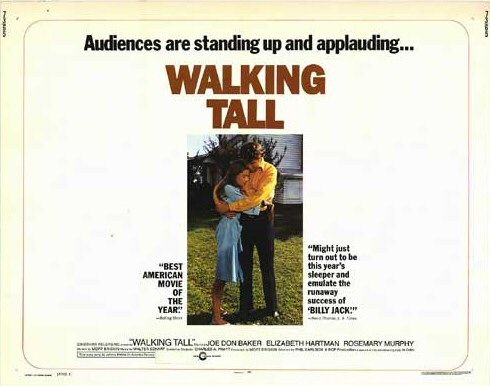
Walking_Tall_(1973_film)About 50 minutes into the 1973 film Walking Tall (not to be confused with the 2005 version that starred Dwayne Johnson), there’s a scene in which newly elected sheriff Buford Pusser (Joe Don Baker) gives a speech to his deputies.  As the deputies stand at attention and as Pusser announces that he’s not going to tolerate any of his men taking bribes from the Dixie Mafia, the observant viewer will notice something out-of-place about the scene.

Hovering directly above Baker’s head is a big, black, almost phallic boom mic.  It stays up there throughout the entire scene, a sudden and unexpected reminder that — though the film opens with a message that we’re about to see the true story of “an American hero” and though it was filmed on location in rural Tennessee — Walking Tall is ultimately a movie.

And yet, somehow, that phallic boom mic feels oddly appropriate.  First off, Walking Tall is an almost deliberately messy film.  That boom mic tells us that Walking Tall was not a slick studio production.  Instead, much like Phil Karlson’s previous The Phenix City Story, it was a low-budget and violent film that was filmed on location in the south, miles away from the corrupting influence of mainstream, yankee-dominated Hollywood.  Secondly, the phallic implications of the boom mic erases any doubt that Walking Tall is a film about men doing manly things, like shooting each other and beating people up.  Buford does have a wife (Elizabeth Hartman) who begs him to avoid violence and set a good example of his children.  However, she eventually gets shot in the back of the head, which frees Buford up to kill.

As I said earlier, Walking Tall opens with a message telling us that we’re about to watch a true story.  Buford Pusser is a former football player and professional wrestler who, after retiring, returns to his hometown in Tennessee.  He quickly discovers that his town is controlled by criminals and moonshiners.  When he goes to a local bar called The Lucky Spot, he is unlucky enough to discover that the bar’s patrons cheat at cards.  Buford is nearly beaten to death and dumped on the side of the road.  As Buford begs for help, several motorists slow down to stare at him before then driving on.

Obviously, if anyone’s going to change this town, it’s going to have to be Buford Pusser.

Once he recovers from his beating, Buford makes himself a wooden club and then goes back to the Lucky Spot.  After beating everyone up with his club, Buford takes back the money that he lost while playing cards and $50.00 to cover his medical bills.  When Buford is put on trial for armed robbery, he takes the stand, rips off his shirt, and shows the jury his scars.  Buford is acquitted.

Over his wife’s objections, Buford decides to run for sheriff.  The old sheriff, not appreciating the competition, attempts to assassinate Buford but, instead, ends up dying himself.  Buford is charged with murder.  Buford is acquitted.  Buford is elected sheriff.  Buford sets out to clean up his little section of Tennessee.  Violence follows…

On the one hand, it’s easy to be snarky about a film like Walking Tall.  This is one of those films that operates on a strictly black-and-white world view.  Anyone who supports Buford is good.  Anyone who opposes Buford is totally evil.  Buford is a redneck saint.  It’s a film fueled by testosterone and it’s not at all subtle…

But dangit, I liked Walking Tall.  It’s a bit like a right-wing version of Billy Jack, in that it’s so sincere that you can forgive the film’s technical faults and frequent lapses in logic.  Walking Tall was filmed on location in Tennessee and director Phil Karlson makes good use of the rural locations.  And, most importantly, Joe Don Baker was the perfect actor to play Buford Pusser.  As played by Baker, Pusser is something of renaissance redneck.  He’s a smart family man who knows how to kick ass and how to make his own weapons.  What more could you ask for out of a small town sheriff?

In real life, Buford Pusser died in a mysterious car accident shortly after the release of Walking Tall.  Cinematically, the character of Buford Pusser went on to star in two more films.

James Bond Review: The Living Daylights (dir. by John Glen)


Addendum: It was brought to my attention that Maryam and Olivia d’Abo are actually cousins, rather than sisters.  This was corrected.  

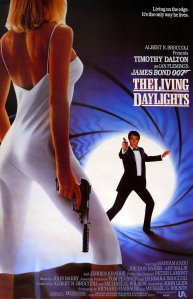
The Shattered Lens continues it’s coverage of all things Bond with 1987’s The Living Daylights. Timothy Dalton was once approached to play 007 after Connery left the franchise the first time, but being only 22 at the time, he considered himself a bit too young for the role. It was only after Roger Moore’s final role in A View to a Kill that he reconsidered and brought on as Britain’s superspy. What I liked about Dalton as Bond was that he was very cold and direct. There was nothing stylish about him, nor did he really try to be (aside for the usual Bond quip). For me, there was sense of darkness to the character. Dalton’s Bond felt like someone just a second away from doing damage to someone, but not exactly caring about how smoothly it was done. This may be partially why I’ve liked Craig so far in his films.

Below is the trailer for The Living Daylights. It makes chuckle how the word “Dangerous” gets thrown on screen every now and then.

The Living Daylights deals with a Russian plot to kill spies. General Gogol in the Roger Moore films was replaced with General Pushkin (John Rhys-Davies, Sallah from the Indy Films and Gimli from Lord of the Rings), and MI6 believes they are behind the recent deaths of agents during a training mission. Bond is asked to help eliminate a sniper for a defecting Soviet named Koskov (Jeroen Krabbe), but upon realizing that the sniper is a woman, he deliberately misses, shooting the frame of the gun and catching the sniper off guard. Bond manages to get Koskov out of Russia via a tube system, but Koskov is later kidnapped again.

We come to find that Koskov’s defection was a fake and that he’s working with an arms dealer (played by Joe Don Baker, who would later return to the Bond Franchise in Goldeneye as a different character), smuggling Opium and arms. Bond locates the sniper, who turns out to be Koskov’s girlfriend Kara (Maryam d’Abo) and poses a friend to Koskov to get closer to him. Granted, this ends up with Kara falling in love with James and we all know where that goes. d’Abo wasn’t bad as a Bond girl, but arguably her cousin, Olivia was more popular at the time.

Q Branch supplies Bond with a few fun gadgets. Back in the 80s, one fad were these keychain finders that would beep when you whistled or made a sound. 007 receives one of these with both an explosive and a smoke gas pellet inside. It’s pretty much the same setup that Connery had in From Russia With Love, placed in a more “modern day” casing (well, as modern as 25 years ago). Bond is also given an Aston Martin V8 Volante, and after all the Lotus editions in the Moore films – perhaps with the exception of the one that doubled as a sub, that one was awesome – it’s really wonderful to see the franchise return to it’s automotive roots. The car is outfitted with missiles, lasers in the hubcabs, on board skis and the all important self destruct system. As with all of Bond’s toys, he doesn’t manage to return this to Q.

From an action point of view, there isn’t a great deal in The Living Daylights. That’s a fantastic snow chase early on, and a fight on an airplane so popular that it was mimicked in the videogame Uncharted 3: Drake’s Deception. Neither of these try to be too over the top and work to great effect, but there are also a number of slow pacing moments that frankly had me wanting to fast forward through the film. I thought the sequence with the desert was drawn out just a little too much, lending to my notion that whenever a James Bond film uses the desert as a filming location, the movie just isn’t as strong in my eyes. Others, of course, may disagree. What the film does do well is establish Dalton as the new Bond. It doesn’t make fun of who he is compared to who came before in the way Her Majesty’s Secret Service did and just gives you an action sequence that says “Take it or leave it, this is who we’re running with”. I like to think it worked well. One could say it becomes the template for all of the “new 007” films

The Living Daylights notes a few changes in the Bond style. It would be the last film ever scored by long time Bond musician John Barry. The Dalton film after this, License to Kill was actually done by the late Michael Kamen (Robin Hood, Die Hard), and everything after that was either done by Eric Serra (The Professional, Goldeneye) or David Arnold (Stargate and Independence Day). A new, younger Moneypenny is introduced after Lois Maxwell’s departure, but I kind of hoped there would have been more time to see the chemistry grow there.

Overall, for a film that had to introduce a new James Bond to audiences, The Living Daylights does so with the 007 style we all know and love. It’s does downshift during the film to concentrate on the love story, but I felt Timothy Dalton’s dark and cold approach to the signature character adds a lot to the story overall.

The theme song to the film is a stand out by the band A-ha (who was popular with their song, Take On Me), and it’s orchestrated version is used heavily in the film. Tomorrow, we’ll visit License to Kill, where Bond goes rogue.

A Quickie With Lisa Marie: True Grit (directed by Joel and Ethan Coen)


True Grit is probably the most straight-forward film that has ever come from the irony-laced imaginations of Joel and Ethan Coen.  Perhaps that’s appropriate since the movie is essentially an homage to that most All-American of all movie genres, the western.

Taking place in 1878, True Grit tells the story of Mattie Ross, a 14 year-old girl (Hailee Stienfeld) whose father is killed by a drifter named Tom Chaney (Josh Brolin).  Tom flees into Oklahoma so Mattie goes to Ft. Smith, Arkansas and hires alcoholic, one-eyed U.S. Marshal Rooster Cogburn (Jeff Bridges) to track Chaney down.  Cogburn agrees and teams up with a Texas ranger named LeBouef (Matt Damon) who is also looking to capture Chaney for an unrelated crime (and to pick an equally unrelated reward).  The three of them form an unlikely and uneasy alliance as they search the harsh wilderness for Chaney, who has hooked up with outlaw Ned Pepper (Barry Pepper).  Along the way, reality proves itself to be far less prosaic and ideal and justice turns out to be far less straight forward than Mattie had originally assumed.

As you might expect from a Coen Brothers film, there’s a lot of moral ambiguity on display.  Cogburn is a former outlaw who is mainly motivated by his own greed while LeBouef is an arrogant blowhard.  Meanwhile, the nominal villains often show more humanity than our “heroes.”  Even Tom Chaney appears to be more overwhelmed than evil.  This is a western where the “good guys” ambush their enemies and shoot them in the back.  Throughout the film, the Coens contrast the beautiful cinematography of Roger Deakins and Carter Burwell’s traditional score with the brutality and violence on-screen.

True Grit is a remake of a 1969 film and Jeff Bridges is getting a lot of attention for taking on a role that was originally played by John Wayne.  I haven’t seen the original film so I can’t say if Bridges gives a better performance than Wayne.  However, to be honest, Bridges probably gives the least interesting performance in the entire film.  I know that a lot of people are raving about his work here but I think those raves are more about the actor and less about the performance itself.  When people look back on this movie, they won’t remember Rooster Cogburn as much as they’ll remember Jeff Bridges wearing an eyepatch and slurring his words like your alcoholic cousin on the 4th of July.  Bridges gives a good enough performance but there’s nothing here that couldn’t have been done just as well (or better) by either Tommy Lee Jones or Joe Don Baker.

If anything, the movie belongs to Steinfeld who gives a wonderfully focused performance as Mattie and who serves as the perfect audience surrogate.  As the two main villains, Brolin and Pepper both give excellent performances and the fact that both of them are almost likable only serves to make them all the more effective as “bad” guys.

True Grit is a good movie because the Coen Brothers aren’t capable of doing any less.  Technically, it’s probably one of the best films of 2010.  Still, the movie left me vaguely disappointed.  For what it is — a straight genre piece — it’s a superior work of craftsmanship.  However, from the Coens, I’ve come to expect a bit more. 


6 More Wonderful Trailers


Here’s the latest installment of my series on some of my favorite grindhouse and exploitation trailers.

1) Death Has Blue Eyes This is actually a really, really bad Greek movie, a movie that is not only generally incoherent but deadly dull as well.  Of course, some of my reaction has to do with the fact that I’ve only seen a scratchy, fuzzy version of it on an imported VHS tape.  This film is also known as The Para-Psychics but I think Death Has Blue Eyes sounds so much better, don’t you?

2) Massacre Mafia Style — I haven’t seen this movie and, unlike Death Has Blue Eyes, coming across the trailer didn’t fill me with any real desire to track it down.  I really don’t even care much for the trailer but I’m including it here because its just so over-the-top and violent.  How many people get killed over the course of this trailer?  I lost count.

\

3) The Boogeyman (1980) — This is actually a pretty good and atmospheric little horror film.  Not to be confused with the terrible Barry Watson movie that came out a couple of years ago.

4) The Pack — This trailer once again establishes that I am right to be scared of dogs.  According to my paternal grandmother, Joe Don Baker is somehow related to me but I’ve never been sure how.   I’ve always been more interested in just how exactly grandma became a Joe Don Baker fan.

5) Switchblade Sisters — One of the ultimate “girl gang” films and a perfect example of how a movie can both be grindhouse and feminist at the same time.  I love this movie.

6) Strange Behavior — Finally, let’s wrap up this installment with the trailer for one of the greatest film’s ever made, 1981’s Strange Behavior (a.k.a. Dead Kids).