Brad reviews THE FIRM (1993), starring Tom Cruise!


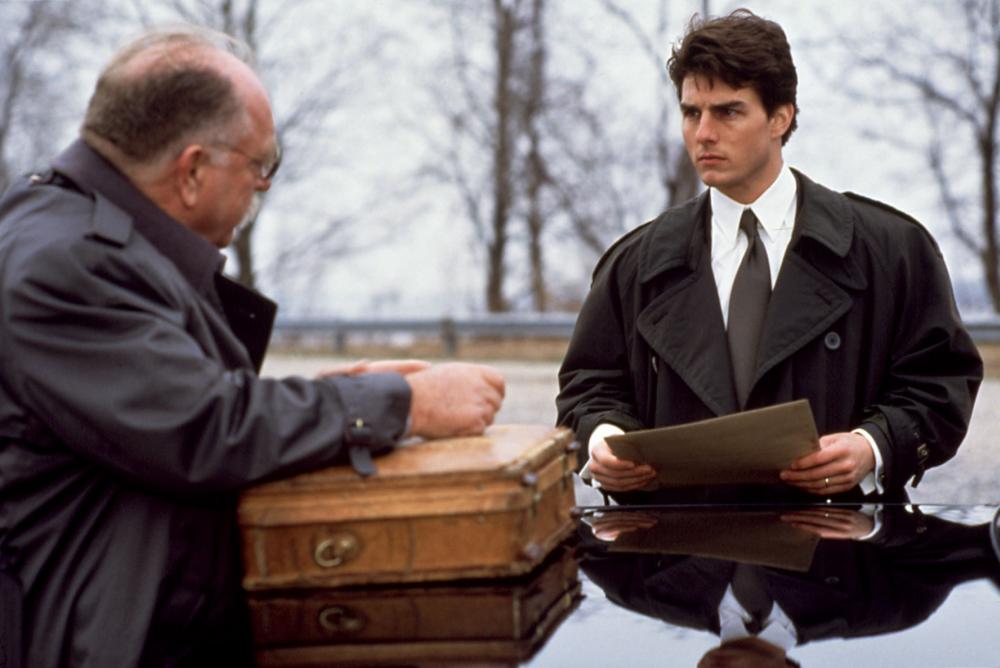
In honor of Tom Cruise’s 63rd birthday, I decided to watch THE FIRM, which is based on the 1991 novel from author John Grisham. Cruise stars as the brilliant Harvard law graduate Mitch McBride, who convinces his wife Abby (Jeanne Tripplehorn) to move to Memphis, TN, so he can join the prestigious Memphis law firm of Bendini, Lambert & Locke. With the help of his veteran mentor Avery Tolar (Gene Hackman), Mitch seems to be excelling at his job, and everything is just so perfect. Unfortunately, the good times don’t last as Mitch starts to notice some suspicious stuff going on with the firm, beginning with the mysterious deaths of two of his fellow attorneys. He’s soon approached by FBI agents, led by Wayne Tarrance (Ed Harris), who tell him that there are nefarious deeds taking place at the firm, including the laundering of money for the Chicago mob. When Mitch starts questioning the activities of the firm, he finds himself the subject of blackmail and intimidation from the firm’s security officer William Devasher (Wilford Brimley) because the firm will do anything to protect its secrets. Mitch is soon caught between betraying his corrupt employers, who are threatening to kill him, and the FBI, who is pressuring him to expose the firm’s criminal activities. Not wanting to lose his life, go to jail, or get disbarred, Mitch devises an extremely risky plan to outsmart the firm and the FBI, but is even he brilliant enough to pull this one off?!

Back in the early 90’s, it seemed that every other movie being released was adapted from a John Grisham novel, and the very first of those adaptations was THE FIRM in 1993. Extremely successful at the box office, THE FIRM grossed over $270 million worldwide, setting the stage for five new movies based on Grisham novels over the next five years. THE FIRM was not only financially successful, it’s also an extremely effective movie that showcases a 30-year-old Tom Cruise at his very best. Director Sydney Pollack crafted a creepy and paranoid thriller, using a slow-burn buildup that relies on Cruise’s ability to believably go from naïve and starstruck at the beginning, to scared and desperate during the middle portion of the film, and ultimately to resourceful and intelligent at the end, as he navigates the dangerous situations he finds himself in. It’s a dynamic, intense performance, and even with a huge supporting cast of excellent actors around him, Cruise dominates every frame of this film. Other performances that stand out to me are Jeanne Tripplehorn as Mitch’s wife Abby, Wilford Brimley as the firm’s enforcer, Gary Busey and Holly Hunter as a private investigator and his administrative assistant from Little Rock, and David Strathairn as Mitch’s jailbird brother in Arkansas. Gene Hackman is good in his role as Mitch’s corrupted mentor Avery Tolar, but his character is not one of my favorites from the legendary actor. His character has accepted his corruption and learned to cope with it over the years through alcohol and womanizing, just so he can keep making the money. He knows better and that’s the part that ultimately makes him the most pathetic. Ed Harris is also good in the film as the FBI Agent, but his character is kind of an asshole, and it’s fun to see Mitch outsmart him.

I also like the Memphis, Tennessee locations showcased in THE FIRM, locations that I’ve been to many times, such as Beale Street, Mud Island, and The Peabody Hotel. Early in the movie, Cruise’s character flips right along with the “Beale Street flippers,” popular Beale Street entertainers who perform nightly for tips. I’ve given them some of my cash over the years! And the chase sequence that starts at Mud Island and spills over into downtown Memphis is one of the most exciting parts of the movie. My home state of Arkansas even gets in on the action when Mitch meets FBI agent Wayne Tarrance at the Southland Greyhound Park located in West Memphis, Arkansas. The greyhound race track no longer exists at that location, as the final dog race was held on December 31, 2022. The site has now become the Southland Casino, one of three operating casinos in Arkansas, with the other two being the Oaklawn Casino in Hot Springs and The Saracen Casino in Pine Bluff. I also like the fact that the sleazy private investigator, played by Gary Busey, is from Little Rock, Arkansas. I commute to Little Rock daily to work at my accounting and tax firm, and it’s fun imagining that there could be an “Eddie Lomax” somewhere around here.

THE FIRM may not be a perfect film… some fat could have been trimmed out as it runs for over two and a half hours, a lot of time for a “thriller;” and while effective on paper, I also can’t help but wonder if the resolution would have worked quite as well in real life as it’s portrayed in the film. I still love the movie and consider it to be one of Tom Cruise’s best. I revisit it quite often, and I’m glad his birthday gave me another excuse to watch it again today!

The Unnominated #17: Honkytonk Man (dir by Clint Eastwood)


Though the Academy of Motion Picture Arts and Sciences claim that the Oscars honor the best of the year, we all know that there are always worthy films and performances that end up getting overlooked.  Sometimes, it’s because the competition too fierce.  Sometimes, it’s because the film itself was too controversial.  Often, it’s just a case of a film’s quality not being fully recognized until years after its initial released.  This series of reviews takes a look at the films and performances that should have been nominated but were, for whatever reason, overlooked.  These are the Unnominated.

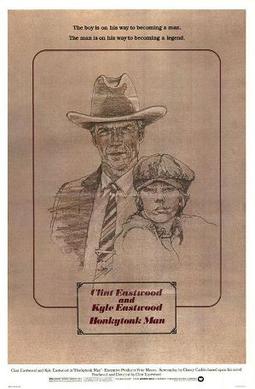
1982’s Honkytonk Man was a Clint Eastwood film that I had never heard of, until I came across it on Prime.  I decided to take a chance and I rented it.  I’m glad that I did because it turned out to be one of Eastwood’s best films.

Clint stars as Red Stovall, a country singer turned farmer during the Great Depression.  Kyle Eastwood stars as Red’s nephew, 14 year-old Whit “Hoss” Wagoneer.  When Red gets an opportunity to perform at the Grand Old Opry, he decides to head for Tennessee.  Since Red is dying of tuberculosis and barely knows how to drive a car, he is accompanied by Grandpa Wagoneer (John McIntire) and Whit.  Whit may be young but he knows how to drive and soon, he’s driving Red and Grandpa across the country.  When a highway patrolman (Tim Thomerson) stops them, he says that Whit is too young to drive.  After watching a speeding Red struggle to keep the car in the right lane, the patrolman pulls up beside them and says, “Let the kid drive.”

Honkytonk Man features an unexpected performance from Eastwood.  Typically, we think of Eastwood’s characters as being the epitome of cool.  Red is definitely not that.  Red is a screw-up, someone who gets arrested while trying to steal chickens and who frequently gets conned by those that he meets during his journey.  When the car breaks down in Arkansas, Red is too busy drinking to remember to catch the bus to Tennessee.  He spends the night with a hitchhiker named Marlene (Alexa Kernin).  The next morning, Whit wakes Red up and informs him that he only has a few minutes before the next bus leaves.  Marlene announces that she’s pregnant.  “HOLD THE BUS!” Red yells as he hastily puts on his clothes.

That said, Whit loves his uncle and the two Eastwoods, Clint and Kyle, both give excellent performances in Honkytonk Man.  In fact, his performance here is probably the best that Clint Eastwood has ever given.  Clint plays with his own image here.  Initially, the film almost feels like a satire of Clint’s hypermasculine persona.  (There is one scene where Eastwood handles a gun but it doesn’t play out the way that you might expect it to.)  But, as the film progresses and Red’s illness grows worse, we start to understand Red and his way of looking at the world.  Red is flawed but he loves his nephew and he loves music and, in the end, what’s important is not whether or not his song were recorded but instead that he spent his final days with Whit.  The film may start out as a comedy but it ultimately becomes a meditation on aging and how one faces the inevitability of death.

As a director, Eastwood takes his time.  He lets the movie play out slowly, with the casual pace of country story.  It’s a film full of wonderful performance and beautiful visuals and it more than earns our patience.  Wisely, Eastwood the director realizes that this story really isn’t about Red.  The story is about Whit (or Hoss, as he asks to be known) and his experiences with his uncle.  Whit worships his uncle but he also comes to learn that the most important thing is to be able to respect yourself.  In this film, Clint Eastwood knows the story that he’s telling and he knows exactly how to tell it.

Honkytonk Man went unnominated as far as the Oscars are concerned.  In the year when the well-intentioned but dramatically inert Gandhi dominated the awards and the nominations, Honkytonk Man was forgotten.  That’s a shame.

Previous Entries In The Unnominated:

  1. Auto Focus 
  2. Star 80
  3. Monty Python and The Holy Grail
  4. Johnny Got His Gun
  5. Saint Jack
  6. Office Space
  7. Play Misty For Me
  8. The Long Riders
  9. Mean Streets
  10. The Long Goodbye
  11. The General
  12. Tombstone
  13. Heat
  14. Kansas City Bomber
  15. Touch of Evil
  16. The Mortal Storm

The TSL Grindhouse: Mitchell (dir by Andrew V. McLaglen)


I come here to defend Mitchell.

First released in 1975, Mitchell does not have a great reputation.  It’s often described as being one of the worst of the 70s cop films and Joe Don Baker’s performance in the lead role is often held up to ridicule.  A lot of that is due to the fact that Mitchell was featured on an episode of Mystery Science Theatre 3000.  Last year, for my birthday, my friend Pat McCurry actually hosted a showing of the MST 3K version of Mitchell.  I laughed all the way through it.  It was a funny show and most of the jokes uttered by Joel and the Bots landed.  That said, I wish they hadn’t been so hard on Joe Don Baker.  Baker was an outstanding character actor, one whose good ol’ boy persona sometimes kept people from realizing just how fiercely talented he actually was.

Here’s the thing with Mitchell.  Just because a film is snarkable, that doesn’t mean that it’s a bad film.  Just because there are moments in a film that inspire you to talk back to the screen, that doesn’t make it a bad film.  Some of the most enjoyable films that I’ve ever watched were enjoyable specifically because they were made to inspire the audience to talk back to the characters.  Whatever flaws you may want to find in Mitchell, it’s an entertaining film.  The plot may be impossible to follow but who cares?  When you’ve got Joe Don Baker, John Saxon, and Martin Balsam all in the same film, does the plot really matter?

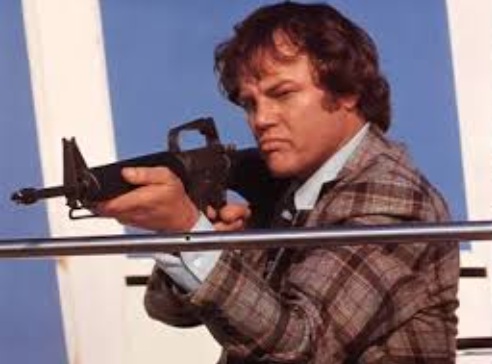
This is a film that you watch for the personalities involved.  Balsam plays a wannabe drug lord who always seems to be somewhat annoyed.  Someone once describes Bernie Sanders as always coming across as if he was about send his meal back to the kitchen because it was too cold and that’s a perfect description of Balsam’s performance in Mitchell.  John Saxon plays a sleazy rich guy who murders a burglar and then tries to cover up his crime.  Saxon is calm, cool, collected, and completely confident that his wealth will get him out of anything.  And then you’ve got Joe Don Baker as Mitchell, wearing an ugly plaid suit, drinking beer the way that I drink Diet Coke, and continually pretending to be dumber than he actually is.  There’s an interesting subtext to these three characters and how they interact.  Saxon and Balsam play criminals who are both rich and who both think they can get away with anything because they’ve got money.  Mitchell is a complete and total slob, a guy with a cheap apartment, a cheap suit, and absolutely no refinement at all.  Mitchell uses his good old boy persona to get the bad guys to continually underestimate him.  He ultimately turns out to be smarter and actually more ruthless than any of them.

Joe Don Baker throws himself into the role of Mitchell and there’ actually a lot of intentional humor to be found in his performance.  Baker doesn’t play Mitchell as being a supercop.  Instead, he plays Mitchell as being a blue collar guy who gets absolutely no respect.  Even when he’s on a stakeout, a random kid starts arguing with him.  (Mitchell loses the argument.)  Mitchell’s a jerk who busts his hooker girlfriend (Linda Evans) for having weed on her but he’s also the only one who could stop Balsam from doing whatever it is that Balsam thinks he’s trying to do.  (Again, don’t spend too much time trying to understand the plot.)  Mitchell’s super power is that he’s a slob who doesn’t give up.  To paraphrase Road House‘s Dalton, he plays dumb until it’s time not to be dumb.

As I said, it’s an entertaining film.  Where else are you going to see a not particularly high-speed chase between two station wagons?  Where else are you going to see John Saxon in a dune buggy or Joe Don Baker in a helicopter or Martin Balsam as the captain of a yacht?  Where else are you going to see a film that features its hero saying, “Yep, that’s grass,” before arresting his lover?  Mitchell is fun and entertaining and I’ll always defend both the movie and its star.

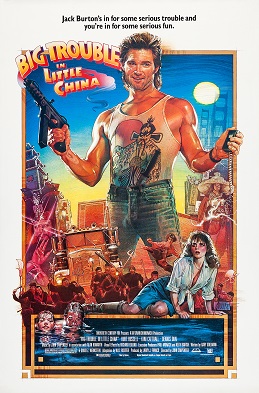
Big Trouble In Little China (1986, directed by John Carpenter)


Jack Burton (Kurt Russell) is not a complicated person.  He drives a truck for a living.  He’s loyal to his friends.  He likes a good beer and a pretty girl.  He tries to do the right thing so when the fiancée of his best friend, Wang Chi (Dennis Dun), is kidnapped, he teams up with Wang to rescue her.  And when Jack’s truck gets stolen after he runs over an evil, ancient Chinese sorcerer named Lo Pan (James Hong), Jack just wants to get his truck back.  Instead, Jack finds himself in the middle of an ancient battle between good and evil as Lo Pan searches for a green-eyed woman to sacrifice so that he can defeat a curse that was put upon him centuries ago.

Big Trouble In Little China is one of John Carpenter’s most exuberant films.  It mixes kung fu action with special effects and a good dose of physical humor from Kurt Russell.  When Lisa and I watched this movie a few months ago, Lisa commented that this film was Kurt Russell’s “Bruce Campbell movie,” and the more I think about it, the more I agree.  Russell plays Jack with a mix of cockiness and klutziness that should be very familiar to anyone who has followed the adventures of Ash Williams.  While Dennis Dun gets to do the typically heroic stuff that you would expect from the star of a movie like this, Russell is just someone who wants to get his truck back and who is consistently weirded-out by the magic around him.  Carpenter makes sure that the movie is full of action as he pays tribute to the kung fu films that he watched when he was still in film school. James Hong is great villain and the rest of the cast, including Kim Cattrall as lawyer Gracie Law, all match the energy of Russell, Hong, and Dun.  Complete with flying swordsmen, demons with glowing eyes, and a lightning-wielding warrior that probably inspired Mortal Kombat‘s Raiden, Big Trouble In Little China is a fun slice of 80s action.

Unfortunately, the film was not appreciated when it was first released.  Stung by the critical reaction to the film, Carpenter abandoned working for the studios and instead become an  independent filmmaker.  Big Trouble In Little China, however, has stood the test of time and has become better appreciated with age.  Today, it’s rightly viewed as one of Carpenter’s best films.

Retro Television Review: Miami Vice 2.9 “Bushido”


Welcome to Retro Television Reviews, a feature where we review some of our favorite and least favorite shows of the past!  On Mondays, I will be reviewing Miami Vice, which ran on NBC from 1984 to 1989.  The entire show can be purchased on Prime!

This week, a man from the past returns to haunt Castillo.

Episode 2.9 “Bushido”

(Dir by Edward James Olmos, originally aired on November 22nd, 1985)

This week’s episode opens with yet another intricately plotted drug bust going awry.  This time, a dealer ends up dead, a DEA Agent ends up knocked out and tied up in a bathroom, and $50,000 goes missing.  Watching the tapes of the bust, Castillo is shocked to spot a familiar face on the scene.  Castillo says that Jack Gretsky (Dean Stockwell) was his partner when he was working for the CIA in Vietnam.  Gretsky has long been thought dead but there he is, on tape and ruining Castillo’s bust.

Realizing that Gretsky was sending him a message, Castillo decides to deal with the situation personally.  After visiting two CIA agents (Jerry Hardin and Tom Bower) who work out of an adult novelty shop, Castillo tracks Gretsky down to a Buddhist temple.  The two of them talk.  Gretsky reveals that he’s married to a Russian woman and that he has a son.  He asks Castillo to watch over them if anything happens to him.  The stoic Castillo agrees and then gives Gretsky a hug.  Castillo says that he has to arrest Gretsky.  Gretsky says he knows and then pulls a machine gun, forcing Castillo to kill him.  The CIA agents are happy to no longer have to deal with Gretsky.

A day later, the coroner’s office calls Vice and says that Gretsky was terminally ill with cancer and probably only had a few days left to live.  When Crockett and Tubbs go to tell Castillo, they find his badge and a note sitting in the office.  Castillo is fulfilling Gretsky’s final wish and protecting his wife (Natasha Schneider) and his son, Marty (Robin Kaputsin).  Castillo sees it as being a part of the samurai code by which he lives his life.  Meanwhile, a rogue CIA agent named Surf (David Rasche, giving a wonderfully unhinged performance) is working with the KGB to track down Gretsky’s family.

Directed by Edward James Olmos, Bushido is a wonderfully odd episode.  With a combination of skewed camera angles and deliberately eccentric performances from Dean Stockwell and David Rasche, this episode plays out with the relentless intensity of a fever dream.  (The opening drug bust even features Zito burying himself in the sand and using a straw to breathe until its time to emerge and knock out one of the bad guys.  It’s weird but it’s great.)  Olmos contrasts Castillo’s trademark stoicism with the more verbose characters played by Stockwell and Rasche and, as a result, Castillo emerges as an honorable man who hides his emotions because he knows that’s the only way to survive in his world.  To fall in love like Jack or to get cocky like Surf can only lead to one’s downfall.

After a few uneven episodes, Bushido is a nice reminder of what Miami Vice was capable of at its best.

Late Night Retro Television Reviews: Highway to Heaven 1.5 “Song of the Wild West”


Welcome to Late Night Retro Television Reviews, a feature where we review some of our favorite and least favorite shows of the past!  On Thursdays, I will be reviewing Highway to Heaven, which aired on NBC from 1984 to 1989.  The entire show is currently streaming on Tubi and several other services!

This week, Jonathan and Mark go country!

Episode 1.5 “Song of the Wild West”

(Dir by Victor French, originally aired on October 17th, 1984)

This week’s episode of Highway to Heaven has a country music theme as Mark’s car ends up breaking down outside of a country-western bar.

I have to admit that I had mixed feelings about this theme.  Quite frankly, country music is not my type of music.  As I’ve explained in the past, my musical tastes run the gamut from EDM to more EDM.  Country music has just never really done much for me, though I’ve done a line dance or two.

That said, I grew up all over the Southwest.  I live in Texas.  I’m a city girl but I knw what it’s like to walk through the high grass on a humid day.  I know what it’s like to be woken up at sunrise by the sound of a rooster.  I’ve ridden horses.  I once milked a cow but I really didn’t enjoy it at all.  I know the country and I like the people who live out in the country and, though I’m meant to live in a city, I still feel a bit of nostalgia whenever I see a farmhouse or a muddy pickup truck.  This episode did have a legitimate country feel, which I appreciated.

Jonathan actually had a handful of missions in this episode.  First off, he had to help Trudy Swenson (Joan Kjar) win the bar back from Nick Claybourne (Clifton James), the blowhard who won the bar in a rigged poker game from Trudy’s husband.  Secondly, he had to help gas station owner Tim Higgins (Jerry Hardin) come to terms with the musical ambitions of his teenage daughter, Sara (Michele Greene).  And finally, he had to help Sara reunite with her mother, an alcoholic country music star named Pasty Maynard (Ronee Blakely).  And he had to do all this while also working as a bartender at the bar.  Not only did Jonathan have to solve everyone’s emotional problems but he had to convince the local drunk to drink a cup of coffee as opposed to ordering another shot.

Mark doesn’t do much this week and I assume that’s because Victor French also directed the episode.  As a result, everything pretty much falls on Jonathan and it almost feels as if he’s been given too much to do.  Throughout the episode, he’s rushing back and forth between Tim, Trudy, and Patsy.  Add to that the fact that the action stops for a minutes at a time so that Patsy and Sara can perform and you end up with an episode that feels a bit overstuffed.

This episode didn’t really work for me.  I could appreciate the fact that the episode did a good job capturing the country milieu but country music just doesn’t do much for me.  And this episode had a lot of country music.

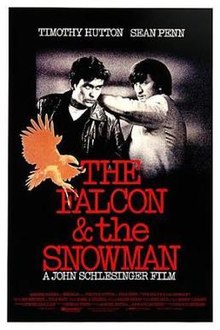
18 Days of Paranoia #4: The Falcon and the Snowman (dir by John Schlesinger)


http://www.youtube.com/watch?v=y8HE_mHphZk

The 1985 film, The Falcon and the Snowman, tells the story of two friends.  They’re both wealthy.  They’re both a little bit lost, with one of them dropping out the seminary and the other becoming a drug dealer who is successful enough to have a lot of money but inept enough to still be treated like a joke by all of other dealers.

Chris Boyce (Timothy Hutton) is the son of a former FBI agent (Pat Hingle).  He has a tense relationship with his father.  It’s obvious that the two have never really been sure how to talk to each other.  While his father is sure of both himself and his country, Chris is far more sensitive and quick to question.  While his father plays golf and attends outdoor barbecues, Chris becomes an expert in the sport of falconry and spends a lot of time obsessing about the state of the the world.  While his father defends Richard Nixon during the Watergate investigation, Chris sees it as evidence that America is a sick and corrupt country.  Because his father doesn’t want Chris sitting around the house all day, he pulls some strings to get Chris a job working at the “Black Vault,” where Chris will basically have the ability to learn about all sorts of classified stuff.

Daulton Lee (Sean Penn) was Chris’s best friend in school.  Daulton’s entire life revolves around cocaine.  He both sells and uses it.  He’s managed to make a lot of money but his addiction has also left him an erratic mess.  Daulton’s father wants to kick him out of the house.  Daulton’s mother continually babies him.  Chris and Daulton may seem like an odd pair of friends but they’re both wealthy, directionless, and have a difficult time relating to their fathers.  It somehow seems inevitable that these two would end up as partners.

Chris Boyce and Daulton Lee, together …. THEY SOLVE CRIMES!

No, actually, they don’t.  Instead, they end up betraying their country.  (Boooo!  Hiss!  This guy’s a commie, traitor to our nation!)  After Chris discovers that the CIA has been interfering in the elections of America’s allies (in this case, Australia), he decides to give information to the Russians.  Since Daulton already has experience smuggling drugs over the southern border, Boyce asks Lee to contact the KGB the next time that he’s in Mexico.  Despite being a neurotic and paranoid mess, Lee manages to do just that.

Of course, as Chris soon comes to discover, betraying your country while working with a greedy drug addict is not as easy as it seems.  While Chris wants to eventually get out of the treason game, marry his girlfriend (Lori Singer), and finish up college, Daulton wants to be James Bond.  The Russians, meanwhile, soon grow tired of having to deal with Lee and start pressuring Chris to deal with them directly….

And it all goes even further downhill from there.

Based on a true story, The Falcon and the Snowman tells the story of how two seemingly very different young men managed to basically ruin their lives.  Boyce’s naive idealism and Lee’s drug-fueled greed briefly makes them a powerful duo but they both quickly discover that betraying your country isn’t as a simple as they assumed.  For one thing, once you’ve done it once, it’s impossible to go back to your normal life.  As played by Hutton and Penn, Chris and Daulton are two very interesting characters.  Boyce is full of righteous indignation and sees himself as being a hero but the film hints that he’s mostly just pissed off at his Dad for never understanding him or caring that much about falconry.  Daulton, meanwhile, is a lunatic but he seems to be aware that he’s a lunatic and that makes his oddly likable.  At times, it seems like even he can’t believe that Chris was stupid enough to depend on him.  The film provides a convincing portrait of two men who, because of several impulsive decisions, find themselves in over their heads with no possibility of escape.

The Falcon and the Snowman is an entertaining and occasionally thought-provoking time capsule of a different age.  If the film took place in 2020, Daulton would be hanging out with the Kardashians and Chris would probably be too busy working for the Warren campaign to spy for America’s enemies.  If only the two of them had been born a few decades later, all of this could have been of avoided.

Previous Entries In The 18 Days of Paranoia:

  1. The Flight That Disappeared
  2. The Humanity Bureau
  3. The Privates Files Of J. Edgar Hoover

Film Review: The Hot Spot (dir by Dennis Hopper)


As befits the title, the 1990 film, The Hot Spot, is all about heat.

There’s the figurative heat that comes from a cast of characters who are obsessed with sex, lies, and murder.  There’s the literal heat that comes from a fire that the film’s “hero” sets in order to distract everyone long enough so that he can get away with robbing a bank.  And, of course, there’s the fact that the film is set in a small Texas town that appears to be the hottest place on Earth.  Every scene in the film appears to be drenched by the sun and, if the characters often seem to take their time from getting from one point to another, that’s because everyone knows better than to rush around when it’s over a hundred degrees in the shade.  As someone who has spent most of her life in Texas, I can tell you that, if nothing else, The Hot Spot captures the feel of what summer is usually like down here.   I’ve often felt that stepping outside during a Texas summer is like stepping into a wall of pure heat.  The Hot Spot takes place on the other side of that wall.

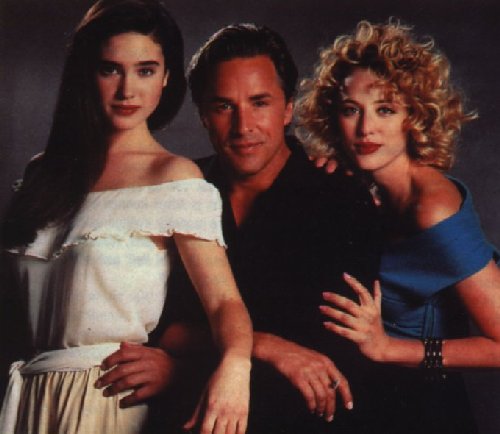
The Hot Spot is a heavily stylized film noir, one in which the the traditional fog and shadows have been replaced by clouds of dust and blinding sunlight.  Harry (Don Johnson) is a drifter who has just rolled into a small Texas town.  Harry’s not too bright but he’s handsome and cocky and who needs to be smart when you’ve got charm?  Harry gets a job selling used cars, though he actually aspires to be a bank robber.  Harry finds himself falling in love with Gloria (Jennifer Connelly), a seemingly innocent accountant who is being blackmailed by the brutish Frank Sutton (William Sadler).  Meanwhile, Harry is also being pursued by his boss’s wife, Dolly (Virginia Madsen), an over-the-top femme fatale who is just as amoral as Harry but who might be a little bit smarter.  Complicating matters is that, while Harry’s trying to rob a bank, he also ends up saving a man’s life.  Only Dolly knows that Harry isn’t the hero that the rest of the town thinks he is.  She tells him that she’ll keep his secret if he does her just one little favor….

The Hot Spot was directed by Dennis Hopper (yes, that Dennis Hopper) and, from the start, it quickly becomes apparent that he’s not really that interested in the film’s story.  Instead, he’s more interested in exploring the increasingly surreal world in which Harry has found himself.  The Hot Spot plays out at a languid pace, which allows Hopper to focus on his cast of small-town eccentrics.  (My particular favorite was Jack Nance as the alcoholic bank president who also doubles as the town’s volunteer fire marshal.)  The film is so hyper stylized that it’s hard not to suspect that every character — with the possible exception of Harry — understands that they’re only characters in a film noir.  For instance, is Dolly really the over-the-top femme fatale that she presents herself as being or is she just a frustrated housewife playing a role?  Is Gloria really an innocent caught up in a blackmail scheme or is she just smart enough to realize that the rules of noir requires her to appear to be Dolly’s opposite?  And is Harry being manipulated or is he allowing himself to be manipulated because, deep down, he understands that’s his destiny as a handsome but dumb drifter in a small town?  Do any of the characters really have any control over their choices and their actions or has everyone’s fate been predetermined by virtue of them being characters in a film noir?  In the end, The Hot Spot is more than just a traditional noir.  It’s also a study of why the genre has endured.

It’s a long and, at times, slow movie, one that plays out at its own peculiar pace.  As a result, some people will be bored out of their mind.  But if you can tap into the film surreal worldview and adjust to the languid style, The Hot Spot is a frequently entertaining and, at times, rather sardonic slice of Texas noir.

Cannes Film Review: Missing (dir by Costa-Gavras)


The 1982 film Missing takes place in Chile, shortly after the American-backed military coup that took out that country’s democratically elected President, Salvador Allende.

Of course, the film itself never specifically states this.  Instead, it opens with a narrator informing us that the story we’re about to see is true but that some names have been changed “to protect the innocent and the film.”  The film takes place in an unnamed in South America, where the military has just taken over the government.  Curfew is enforced by soldiers and the sound of gunfire is continually heard in the distance.  Throughout the film, dead bodies pile up in the streets.  Prisoners are held in the National Stadium, where they are tortured and eventually executed.  Women wearing pants are pulled out of crowds and told that, from now on, women will wear skirts.  The sky is full of helicopters and, when an earthquake hits, guests in a posh hotel are fired upon when they try to leave.  About the only people who seem to be happy about the coup is the collection of brash CIA agents and military men who randomly pop up throughout the film.

Again, the location is never specifically identified as Chile.  In fact, except for the picture of Richard Nixon hanging in the American embassy, the film never goes out of its way to point out that the film itself is taking place in the early 70s.  If you know history, of course, it’s obviously meant to be Chile after Allende but the film itself is set up to suggest that the story its telling is not limited to one specific place or time.

Charlie Horman (John Shea) is an American who lives in the country with his wife, Beth (Sissy Spacek).  Charlie is a writer who occasionally publishes articles in a local left-wing newspaper.  In the aftermath of the coup, Charlie is one of the many people who go missing.  All that’s known is that he was apparently arrested and then he vanished into the system.  The authorities and the American ambassador insist that Charlie probably just got lost in the confusion of the coup and that he’ll turn up any day.  Even though thousands have been executed, everyone assumes that Charlie’s status as an American would have kept him safe.  As brutal as the new government may be, they surely wouldn’t execute an American….

Or, at least, that’s what Ed Horman (Jack Lemmon) believes.  Ed is Charlie’s father, a businessman from New York who simply cannot understand what’s going on.  He can’t understand why his son and his daughter-in-law went to South America in the first place.  He can’t understand why his government is not doing more to find his son.  And, when he eventually arrives in South America himself, Ed cannot understand the violence that he sees all around him.

Working with Beth, Ed investigates what happened to his son.  At first, Ed blames Beth for Charlie’s disappearance and Beth can barely hide her annoyance with her conservative father-in-law.  But, as their search progresses, Beth and Ed come to understand each other.  Beth starts to see that, in his way, Ed is just as determined an idealist as Charlie.  And Ed learns that Charlie and Beth had good reason to distrust the American government…

Costa-Gavras is not exactly a subtle director and it would be an understatement to say that Missing is a heavy-handed film.  The Embassy staff is so villainous that you’re shocked they don’t all have mustaches to twirl while considering their evil plans.  When, in a flashback, Charlie meets a shady American, it’s not enough for the man to be a CIA agent.  Instead, he has to be a CIA agent from Texas who heartily laughs after everything he says and who brags on himself in the thickest accent imaginable.  When Charlie talks to an American military officer, it’s not enough that the officer is happy about the coup.  Instead, he has to start talking about how JFK sold everyone out during the Bay of Pigs.

As the same time, the film’s lack of subtlety also leads to its best moments.  When Beth finds herself out after curfew, the city turns into a Hellish landscape of burning books and dead bodies.  As Beth huddles in a corner, she watches as a magnificent white horse runs down a dark street, followed by a group of gun-toting soldiers in a jeep.  When Ed and Beth explore a morgue, they walk through several rooms of the “identified” dead before they find themselves in a room containing the thousands of unidentified dead.  It’s overwhelming and heavy-handed but it’s also crudely effective.  While the film itself is a bit too heavy-handed to really be successful, those scenes do capture the horror of living under an authoritarian regime.

(Interestingly, Missing was a part of a mini-genre of films about Americans trapped in right-wing South American dictatorships.  While you can’t deny the good intentions of these films, it’s hard not to notice the lack of films about life in Chavez’s Venezuela or the political dissidents who were lobotomized in Castro’s Cuba.)

Missing won the Palme d’Or at the 1982 Cannes Film Festival (an award that it shared, that year, with the Turkish film Yol) and it also received an Oscar nomination for best picture of the year.  (It lost to Gandhi.)

A Movie A Day #208: War Party (1988, directed by Franc Roddam)


On the hundredth year anniversary of a battle between the U.S. Calvary and the Blackfeet Indians, the residents of small Montana town decide to reenact the battle and hopefully bring in some tourist dollars.  The white mayor (Bill McKinny) and the sheriff (Jerry Hardin) both think that it is a great idea.  Even the local Indian leader, Ben Cowkiller (Dennis Banks, in real-life a founder and leader of the American Indian Movement), thinks that it will be a worthwhile for the Indians to participate.  The Calvary’s guns will be full of blanks.  The Indians will play dead.  However, as the result of a bar brawl the previous night, one of the local rednecks, Calvin Morrisey (Kevyn Major Howard), shows up with a gun full of bullets.  After he shoots one of the Indians, Calvin ends up with a tomahawk buried in his head.  Three Indian teenagers, Warren (Tim Sampson), Skitty (Kevin Dillon), and Sonny (Billy Wirth), flee into the wilderness.  Thirsty for revenge, a white posse heads off in pursuit.

War Party is an underrated and surprisingly violent movie.   Franc Roddam brings the same sensitivity to his portrayal of alienated Indians that he brought to portraying alienated Mods in Quadrophenia.  Though, at first, Kevin Dillon seems miscast as an Indian, he, Wirth, and Sampson all give good performances, as does Dennis Banks.  The movie is often stolen by M. Emmett Walsh and Rodney A. Grant, playing renowned trackers who are brought in to help the posse chase down the three youths.  That Grant’s character is a member of the Crow adds a whole extra layer of meaning to his role. Even though the setup often feels contrived and heavy-handed and anyone watching should be able to easily guess how the movie is going to end, War Party still packs a punch.