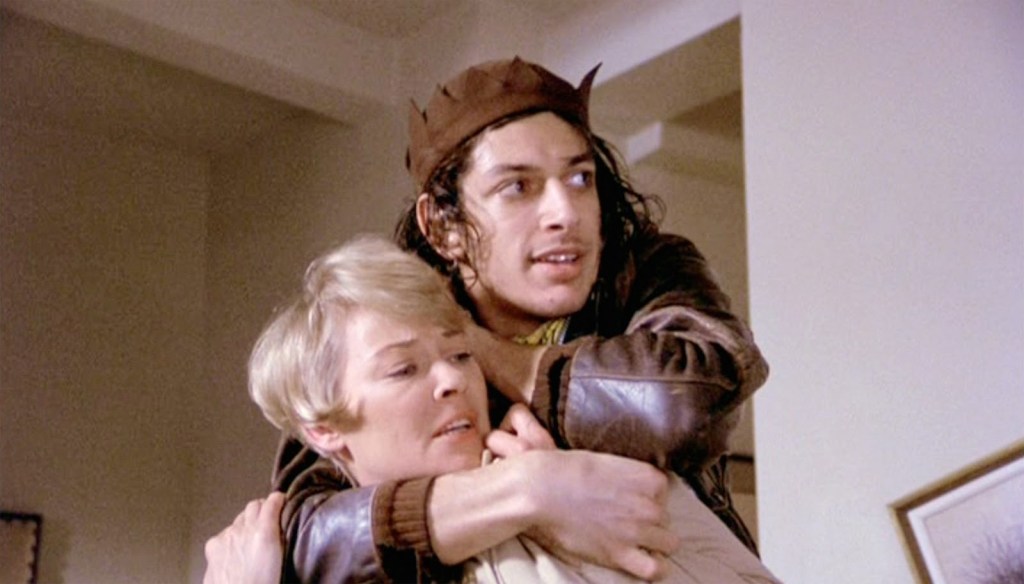
I’ve been a fan of Jeff Goldblum for most of my life. The man has had an amazingly successful career, starring in some of the most financially profitable films ever made, like JURASSIC PARK and INDEPENDENCE DAY!! One of the main reasons that Goldblum is extra special to me, however, is because of his small roles as bad guys in two different Charles Bronson movies in the 1970’s. First, he played one of the thugs who breaks into Paul Kersey’s apartment and assaults his wife and daughter in the original DEATH WISH (1974). Second, he plays a thug who, along with Robert Englund and another less famous guy, tries to rob and assault Raymond St. Ives in the film ST. IVES (1976). I’ve loved telling people about his appearances in these two films for decades, and I don’t see any reason to stop now.
To celebrate Jeff Goldblum’s birthday on the Shattered Lens, I’ve included an “overly edited” video of his appearance in ST. IVES, if nothing else so you could also see the young Robert Englund (Freddy Krueger). I wish I could share the full scene, but this is all I could find on YouTube. Anyway, happy birthday, Jeff! I hope it’s been a great one!
1992’s The Player tells the story of Griffin Mill (Tim Robbins).
It’s not easy being Griffin Mill. From the outside, of course, it looks like he has the perfect life. He’s a studio executive with a nice house in Hollywood. He’s young. He’s up-and-coming. Some people, especially Griffin, suspect that he’ll be the president of the studio some day. By day, he sits in his office and listens to pitches from respected screenwriters like Buck Henry. (Henry has a great idea for The Graduate II!) During the afternoon, he might attends dailies and watch endless takes of actors like Scott Glenn and Lily Tomlin arguing with each other. Or he might go to lunch and take a minute to say hello to Burt Reynolds. (“Asshole,” Burt says as Griffin walks away.) At night, he might go to a nice party in a big mansion and mingle with actors who are both young and old. He might even run into and share some sharp words with Malcolm McDowell.
But Griffin’s life isn’t as easy as it seems. He’s constantly worried about his position in the studio, knowing that one box office failure could end his career. He fears that a new executive named Larry Levy (Peter Gallagher) is after his job. Two new screenwriters (Richard E. Grant and Dean Stockwell) keep bugging him to produce their downbeat, no-stars anti-capitol punishment film. His girlfriend (Cynthia Stevenson) wants to make good movies that mean something. Even worse, someone is sending Griffin threatening notes.
It doesn’t take long for Griffin to decide that the notes are coming from a screenwriter named Dave Kahane (Vincent D’Onofrio). Griffin’s attempt to arrange a meeting with Dave at a bar so that Griffin can offer him a production deal instead leads to Griffin murdering Dave in a parking lot. While the other writers in Hollywood mourn Dave’s death, Griffin starts a relationship with Dave’s artist girlfriend (Great Scacchi) and tried to hide his guilt from two investigating detectives (Whoopi Goldberg and Lyle Lovett). Worst of all, the notes keep coming. The writer, whomever they may be, is now not only threatening Griffin but also seems to know what Griffin did.
After spend more than a decade in the industry wilderness, Robert Altman made a critical and commercial comeback with The Player. It’s a satire of Hollywood but it’s also a celebration of the film industry, featuring 60 celebrities cameoing as themselves. Everyone, it seems, wanted to appear in a movie that portrayed studio execs as being sociopathic and screenwriters as being whiny and kind of annoying. The Player both loves and ridicules Hollywood and the often anonymous men who run the industry. Largely motivated by greed and self-preservation, Griffin may not love movies but he certainly loves controlling what the public sees. In the end, only one character in The Player sticks to her values and her ideals and, by the end of the movie, she’s out of a job. At the same time, Griffin has a social life that those in the audience can’t help but envy. He can’t step out of his office without running into someone famous.
The Player is one Altman’s most entertaining films, with the camera continually tracking from one location to another and giving as a vision of Hollywood that feels very much alive. Tim Robbins gives one of his best performances as Griffin Mill and Altman surrounds him with a great supporting cast. I especially liked Fred Ward as the studio’s head of security. With The Player, Altman mixes melodrama with a sharp and sometimes bizarre comedy, with dialogue so snappy that the film is as much a joy to listen to as to watch. That said, the real attraction of the film is spotting all of the celebrity cameos. (That and cheering when Bruce Willis saves Julia Roberts from certain death.) Altman was a director who often used his films to explore eccentric communities. With The Player, he opened up his own home.
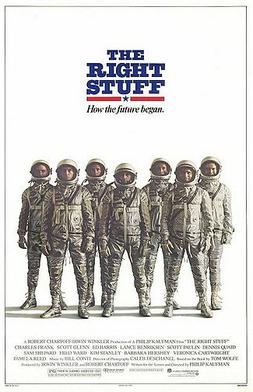
There’s a brilliant scene that occurs towards the end of 1983’s The Right Stuff.
It takes place in 1963. The original Mercury astronauts, who have become a symbol of American ingenuity and optimism, are being cheered at a rally in Houston. Vice President Lyndon Johnson (Donald Moffat) stands on a stage and brags about having brought the astronauts to his supporters. One-by-one, the astronauts and their wives wave to the cheering crowd. They’re all there: John Glenn (Ed Harris), Gus Grissom (Fred Ward), Alan Shephard (Scott Glenn), Wally Schirra (Lance Henrisken), Deke Slayton (Scott Paulin), Scott Carpenter (Charles Frank), and the always-smiling Gordon Cooper (Dennis Quaid). The astronauts all look good and they know how to play to the crowd. They were chosen to be and sold as heroes and all of them have delivered.
While the astronauts are celebrated, Chuck Yeager (Sam Shepard) is at Edwards Air Force Base. Yeager is the pilot who broke the sound barrier and proved that the mythical “demon in the sky,” which was whispered about by pilots as a warning about taking unnecessary risks, was not waiting to destroy every pilot who tried to go too fast or too high. Yeager is considered by many, including Gordon Cooper, to be the best pilot in America. But, because Yeager didn’t have the right image and he had an independent streak, he was not ever considered to become a part of America’s young space program. Yeager, who usually holds his emotions in check, gets in a jet and flies it straight up into the sky, taking the jet to the edge of space. For a few briefs seconds, the blue sky becomes transparent and we can see the stars and the darkness behind the Earth’s atmosphere. At that very moment, Yeager is at the barrier between reality and imagination, the past and the future, the planet and the universe. And watching the film, the viewer is tempted to think that Yeager might actually make it into space finally. It doesn’t happen, of course. Yeager pushes the jet too far. He manages to eject before his plane crashes. He walks away from the cash with the stubborn strut of a western hero. His expression remains stoic but we know he’s proven something to himself. At that moment, the Mercury Astronauts might be the face of America but Yeager is the soul. Both the astronauts and Yeager play an important role in taking America into space. While the astronauts have learned how to take care of each other, even the face of government bureaucracy and a media that, initially, was eager to mock them and the idea of a man ever escaping the Earth’s atmosphere, Chuck Yeager reminds us that America’s greatest strength has always been its independence.
Philip Kaufman’s film about the early days of the space program is full of moments like that. The Right Stuff is a big film. It’s a long film. It’s a chaotic film, one that frequently switches tone from being a modern western to a media satire to reverent recreation of history. Moments of high drama are mixed with often broad humor. Much like Tom Wolfe’s book, on which Kaufman’s film is based, the sprawling story is often critical of the government and the press but it celebrates the people who set speed records and who first went into space. The film opens with Yeager, proving that a man can break the sound barrier. It goes on to the early days of NASA, ending with the final member of the Mercury Seven going into space. In between, the film offers a portrait of America on the verge of the space age. We watch as John Glenn goes from being a clean-cut and eager to please to standing up to both the press and LBJ. Even later, Glenn sees fireflies in space while an aborigines in Australia performs a ceremony for his safety. We watch as Gus Grissom barely survives a serious accident and is only rescued from drowning after this capsule has been secured. The astronauts go from being ridiculed to celebrated and eventually respected, even by Chuck Yeager.
It’s a big film with a huge cast. Along with Sam Shepherd and the actors who play the Mercury Seven, Barbara Hershey, Pamela Reed, Jeff Goldblum, Harry Shearer, Royal Dano, Kim Stanley, Scott Wilson, and William Russ show up in roles both small and large. It can sometimes be a bit of an overwhelming film but it’s one that leaves you feeling proud of the pioneering pilots and the brave astronauts and it leaves you thinking about the wonder of the universe that surrounds our Earth. It’s a strong tribute to the American spirit, the so-called right stuff of the title.
The Right Stuff was nominated for Best Picture but, in the end, it lost to a far more lowkey film, 1983’s Terms of Endearment. Sam Shepard was nominated for Best Supporting Actor but lost to Jack Nicholson. Nicolson played an astronaut.
In the old west, a cowboy named Emmet (Scott Glenn) teams up with a reformed outlaw named Paden (Kevin Kline) and they bust Emmet’s wild younger brother, Jake (Kevin Costner), out of jail. After Mal (Danny Glover) helps the three of them escape from a posse, they all end up going to the town of Silverado, where all four of them have business. Emmett and Jake want to protect their sister from the corrupt son (Ray Baker) of a cattle baron who was previously killed by Emmett. Mal wants to save his sister Rae (Lynn Whitfield) from an evil gambler (Jeff Goldblum). Paden discovers that Cobb (Brian Dennehy), his former partner-in-crime, is now the sheriff of Silverado and working for the cattle barons. When Paden tries to protect the new settlers (including Rosanne Arquette), it leads to a confrontation with his former partner.
In the 80s, when he wasn’t directing films like The Big Chill and The Accidental Tourist, Lawrence Kasdan specialized in paying homage to the films of Hollywood’s golden age. He started his directorial career with Body Heat, a modern film noir. He worked on the screenplays of both Empire Strikes Back and Raiders of the Lost Ark. With Silverado, Kasdan tried to resurrect the western.
Silverado is a traditional western with a few modern touches, like casting Jeff Goldblum as a gambler and John Cleese as the sheriff who wants to execute Kevin Costner. Silverado also has more humor than a typical western, largely thanks to Kevin Kline. Silverado starts out as a comedy before turning serious and grim once the four heroes finally reach Silverado.
Kasdan’s love of the genre is obvious in every frame of Silverado but, in trying to tell multiple stories at once, the movie spreads itself too thin. I like that Kasdan tried to shake things up by casting actors who most people wouldn’t expect to see in a western but both Kevin Kline and Brian Dennehy seem miscast in their roles and their final confrontation never becomes the epic moment that it needs to be. Scott Glenn and Kevin Costner are far more believable in their roles. Danny Glover is also believable but his character is underused.
Silverado was obviously a labor of love for Kasdan and it shows that, if nothing else, Kasdan understood the appeal of the genre and the beauty of the wide open frontier. The movie has its flaws but fans of westerns will appreciate his effort.
Due to the catastrophic wildfires currently burning in California, Tte Screen Actors Guild dispensed with their usual big nominations announcement and instead sent out a simple press release their morning.
Here are the SAG’s film nominations. The SAG is a usually pretty good precursor so the folks who were celebrating the victory of the Brutalist on Sunday night have a bit less to celebrate today. That said, the 2,0000-person nominating committee appear to have really liked The Last Showgirl. Let’s keep Pamela Anderson’s Oscar hopes alive!
Outstanding Performance by a Male Actor in a Leading Role
ADRIEN BRODY / László Tóth – “THE BRUTALIST”
TIMOTHÉE CHALAMET / Bob Dylan – “A COMPLETE UNKNOWN”
DANIEL CRAIG / William Lee – “QUEER”
COLMAN DOMINGO / Divine G – “SING SING”
RALPH FIENNES / Lawrence – “CONCLAVE”
Outstanding Performance by a Female Actor in a Leading Role
PAMELA ANDERSON / Shelly – “THE LAST SHOWGIRL”
CYNTHIA ERIVO / Elphaba – “WICKED”
KARLA SOFÍA GASCÓN / Emilia/Manitas – “EMILIA PÉREZ”
MIKEY MADISON / Ani – “ANORA”
DEMI MOORE / Elisabeth – “THE SUBSTANCE”
Outstanding Performance by a Male Actor in a Supporting Role
JONATHAN BAILEY / Fiyero – “WICKED”
YURA BORISOV / Igor – “ANORA”
KIERAN CULKIN / Benji Kaplan – “A REAL PAIN”
EDWARD NORTON / Pete Seeger – “A COMPLETE UNKNOWN”
JEREMY STRONG / Roy Cohn – “THE APPRENTICE”
Outstanding Performance by a Female Actor in a Supporting Role
MONICA BARBARO / Joan Baez – “A COMPLETE UNKNOWN”
JAMIE LEE CURTIS / Annette – “THE LAST SHOWGIRL”
DANIELLE DEADWYLER / Berniece – “THE PIANO LESSON”
ARIANA GRANDE / Galinda/Glinda – “WICKED”
ZOE SALDAÑA / Rita – “EMILIA PÉREZ”
Outstanding Performance by a Cast in a Motion Picture A COMPLETE UNKNOWN
MONICA BARBARO / Joan Baez
NORBERT LEO BUTZ / Alan Lomax
TIMOTHÉE CHALAMET / Bob Dylan
ELLE FANNING / Sylvie Russo
DAN FOGLER / Albert Grossman
WILL HARRISON / Bobby Neuwirth
ERIKO HATSUNE / Toshi Seeger
BOYD HOLBROOK / Johnny Cash
SCOOT MCNAIRY / Woody Guthrie
BIG BILL MORGANFIELD / Jesse Moffette
EDWARD NORTON / Pete Seeger
ANORA
YURA BORISOV / Igor
MARK EYDELSHTEYN / Ivan
KARREN KARAGULIAN / Toros
MIKEY MADISON / Ani
ALEKSEY SEREBRYAKOV / Nikolai Zakharov
VACHE TOVMASYAN / Garnick
CONCLAVE
SERGIO CASTELLITTO / Tedesco
RALPH FIENNES / Lawrence
JOHN LITHGOW / Tremblay
LUCIAN MSAMATI / Adeyemi
ISABELLA ROSSELLINI / Sister Agnes
STANLEY TUCCI / Bellini
WICKED
JONATHAN BAILEY / Fiyero
MARISSA BODE / Nessarose
PETER DINKLAGE / Dr. Dillamond
CYNTHIA ERIVO / Elphaba
JEFF GOLDBLUM / The Wonderful Wizard of Oz
ARIANA GRANDE / Galinda/Glinda
ETHAN SLATER / Boq
BOWEN YANG / Pfannee
MICHELLE YEOH / Madame Morrible
Outstanding Action Performance by a Stunt Ensemble in a Motion Picture
DEADPOOL & WOLVERINE
DUNE: PART TWO
THE FALL GUY
GLADIATOR II
WICKED
Over the next 5 days, I will discuss Charles Bronson’s DEATH WISH series in chronological order. This series has brought me countless hours of entertainment over the last 40 years, so enjoy and let me know your thoughts!
“Don’t ever make a death wish, because a death wish always comes true!” – I’ve always thought this was kind of a corny saying on the original DEATH WISH trailer, but as one of the world’s biggest Charles Bronson fans, I still hold the original DEATH WISH (1974) in extremely high regard. This is the 70’s revenge classic that made Bronson a box office superstar in his home country, while simultaneously influencing the way vengeance was depicted on screen for decades to come. DEATH WISH is one of the most underrated and influential films from a decade that was full of great films.
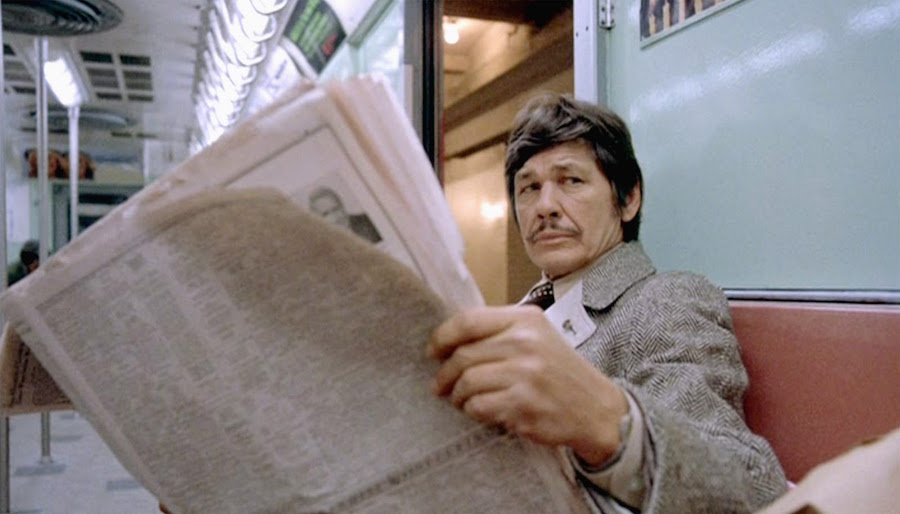
If you’re reading this review, I’d be about 99% positive that you know the basic story of the film. Charles Bronson plays Paul Kersey, a conscientious objector whose wife is killed and whose daughter is raped by a group of criminal thugs in New York City. When the police are incapable of providing justice, Kersey turns into a sidewalk vigilante and stalks the streets and subways of New York, luring thugs to mug him so he can shoot them with his 32-caliber Colt Police Positive pistol. Vincent Gardenia plays detective Frank Ochoa, who’s put in charge of finding the vigilante and putting an end to his one-man mission of justice.
It’s been 50 years since DEATH WISH was released into theaters and it’s hard to fathom just how controversial the film was in its time, especially since I wasn’t even 1 year old when it was released. The graphic rape scene that kicks off the events of the film, combined with the vigilante subject matter, turned off so many big stars, including Jack Lemmon, Henry Fonda and George C. Scott. This opened up the door for Charles Bronson who didn’t have any such misgivings. They just didn’t understand what a nerve the film would touch with the filmgoing public, who were tired of their cities being overrun by violent criminals. The movie became an audience participation movie unlike any others of the time with cheering in the seats every time Kersey offed another criminal. The controversial film became one of the top box office hits of the year and the biggest of Bronson’s career.
DEATH WISH was the fourth of six films directed by Michael Winner and starring Charles Bronson. In typical Winner fashion, the film has some strange touches, but the director is extremely effective in building the motivation for vigilante justice that was required for the film to thrive. He handles the action sequences well, and his cast is outstanding. Bronson & Gardenia are perfect in the lead roles, and the lovely Hope Lange has the brief, infamous role as Kersey’s brutalized wife. Stuart Margolin is especially memorable as the Arizona businessman who gives Kersey his gun. There are also a number of actors in small roles who were not well known when the movie was made who would go on to successful film careers. The biggest is Jeff Goldblum who has the most memorable role of the three muggers who attack Kersey’s wife and daughter at the beginning of the film. It’s a brief, but no holds barred performance for sure. Oscar winning actress Olympia Dukakis has a small role as a cop who expresses her frustration about the amount of leg work expected of her by Detective Ochoa. And finally, Christopher Guest has one scene as a young cop who finds the wounded vigilante and recovers his gun.
On a personal note, this film holds a special place in my heart as the first Charles Bronson film I ever saw. It was probably in 1984 or ‘85, and I stayed up with my dad to watch the late movie on our local TV station. The movie happened to be DEATH WISH. As bad things were happening to Kersey’s family at the beginning of the film, my dad told me not to worry, that “Charles would get them.” That intrigued me and let me know that Bronson had a reputation that preceded him. From that point forward, I wanted to rent a Charles Bronson film every time we went to the video store. And the rest, as they say, is history!
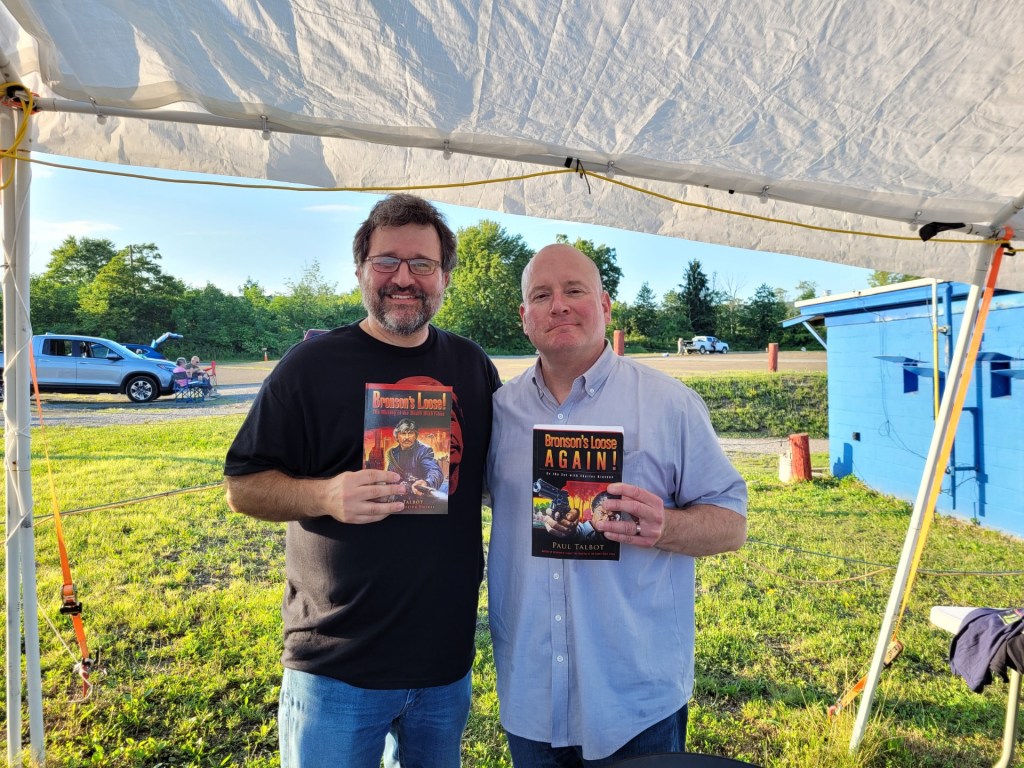
BONUS: The definitive book about the DEATH WISH film series was written by my friend, author and film historian Paul Talbot. The name of the book is BRONSON’S LOOSE: THE MAKING OF THE DEATH WISH FILMS. If you have any interest in Charles Bronson, the DEATH WISH series or Cannon Films, I can’t recommend Paul’s books more highly.
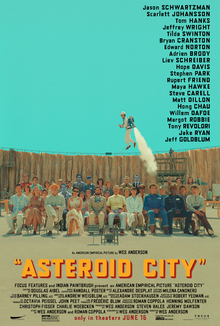
Asteroid City opens with black-and-white footage of Bryan Cranston, wearing a suit and speaking in the authoritative tones of someone who has made his living on television. Cranston informs us that we are about to see a televised production of a play by the famed but enigmatic playwright named Conrad Earp (Edward Norton).
The play, which is seen in stylized color, opens with Augie Steeback (Jason Schwartzman) driving his family through the desert. He is taking his son, Woodrow (Jake Ryan), to a Junior Stargazers convention that is being held at Asteroid City, a tiny town that is best-known for being the location of an impact crater. Along for the ride are Augie’s three daughters, who are all pretending to be witches. What Augie hasn’t told his children is that their mother has died, her cremated remains are in a Tupperware container, and that they will be moving in with their wealthy grandfather (Tom Hanks).
There’s not much to the town of Asteroid City. There’s a motel that’s managed by a man (Steve Carell) who sells land deeds out of a refurbished Coke machine. There’s a diner. There’s a group of helpful cowboys, led by the polite and helpful Montana (Rupert Friend). There’s a mechanic (Matt Dillon) who is called into duty when Augie’s car breaks down. The Junior Stargazer convention is the event of the year for Asteroid City. Young geniuses from all around the country have descended on the town and have brought their parents. One of them, Dinah (Grace Edwards), is the daughter of actress, Midge Campbell (Scarlett Johansson). When an alien (played, at one point in the film, by Jeff Goldblum) shows up and steals the town’s meteorite, General Gibson (Jeffrey Wright) declares a quarantine. Some people handle the lockdowns better than others. Augie takes pictures and thinks about his wife. Midge rehearses for her next role, one that is centered around her character dying. The genius children play a memory game that they realize will never end because they’re all geniuses. A teacher (Maya Hawke) tries to teach her students about the Milky Way, just to discover that the kids only want to talk about the alien. One of the fathers (Liev Schreiber) ends up with a useless plot of desert land and the death ray that his son recently invented.
Throughout it all, Bryan Cranston appears in black-and-white footage that gives us a look into what went on behind the scenes during the production of Asteroid City. The director (Adrien Brody) was a lech. The actor playing Augie struggled to understand what the play was about and who his character was meant to be while the actress (Margot Robie) hired to play his wife ended up in another play after her scenes were cut from Asteroid City. Only once does Bryan Cranston’s host appear in the color sections of Asteroid City, just to sheepishly admit that he’s not supposed to be there before ducking off camera.
Even if his name wasn’t in the opening credits, the viewer could probably easily guess that this is a Wes Anderson film. It features all of Anderson’s trademarks, all of the things that viewers will automatically love or hate depending on how they feel about Anderson’s quirky aesthetic. It’s a visually impressive, pop art-flavored, all-star comedy with an undercurrent of profound melancholy, one in which the fanciful strangeness of the alien’s “invasion” is compared and contrasted with the very real-life strangeness of how humans deal with life, loss, death, and uncertainty. Scenes of clever wordplay are mixed with scenes in which we see Augie still very much struggling to come to terms with the death of his wife and the actor Augie very much struggling to understand what is actually going on in his character’s head. As far as recent Anderson films go, Asteroid City is not quite as humanistic as Rushmore or Grand Budapest Hotel but, at the same time, it’s still more accessible than The French Dispatch.
If you’re not a fan of Anderson’s style, this film won’t convert you. That said, I am a fan of Anderson’s style and I absolutely loved Asteroid City. As with so many of Anderson’s films, the main focus is on how we try to deal with the uncertainties of life by trying to maintain an illusion of control over every aspect of our lives. Playwright Conrad Earp writes because that way he can have a world that follows his own rules. The actors follow a script that tells them how to react to everything that happens around them. In the play, the Junior Stargazers fall back on science while Augie’s father-in-law falls back on religion and Augie’s daughter convince themselves that spells will bring back or, at least, protect their mother. Even General Gibson falls back on his belief in the government and the military to deal with the sudden appearance by the alien. The alien is the unknowable and his arrival reminds everyone that life is unpredictable, regardless of how much you try to control your own story. Indeed, while the film takes place in the 50s and is full of comments about the Red Scare and atomic bomb testing, it’s hard not to see Asteroid City as being a commentary on the recent COVID lockdowns and the debate over whether people could ever go back to living the way that they did before the pandemic. Much as with the Coen Brothers’s similarly stylized A Serious Man, the ultimate message seems to be that the only way to deal with the unpredictability of life is to embrace it.
It’s also a very funny film, one that is full of small details that reward repeat viewing. If one focuses on the background characters, it quickly becomes apparent that there are actually several stories unfolding in the film and, much as with life, the viewer just has to be willing to look for them. (I particularly enjoyed the romance between The Teacher and Montana.) Jason Schwartzman is compelling as both Augie and the actor playing Augie and Scarlett Johansson plays both Midge and the actress playing Midge with the perfect amount of cool detachment. To the film’s credit, none of the character’s become caricatures. They remain individuals, regardless of how bizarre the film’s story may sometimes seem. Everyone gets a moment to reveal a little depth, from Jeffrey Wright’s sincere (if misplaced) faith in the lockdown policy to the moment when Tom Hanks’s previously unsympathetic father-in-law reveals that he’s as much in mourning as Augie. The all-star cast also includes Tilda Swinton, Liev Schrieber, Stephen Park, Willem DaFoe, Hong Chau, and Margot Robbie and all of them add to the film’s portrait of quirky but ultimately relatable humanity.
Again, with this film, it undoubtedly helps to already be familiar with and to like Wes Anderson’s way of doing things. If you’re not a fan of his film, this one probably won’t change your mind. That said, for those of us who do enjoy his style, this is Anderson at his best.
As some of our regular readers undoubtedly know, I am involved in a few weekly live tweets on twitter and I hope to continue to be until the site finally becomes unusable. (It’s going to happen eventually so enjoy it while you can!) I host #FridayNightFlix every Friday, I co-host #ScarySocial on Saturday, and I am one of the five hosts of #MondayActionMovie! Every week, we get together. We watch a movie. We tweet our way through it.
Tonight, at 10 pm et, #FridayNightFlix has got 1988’s Earth Girls Are Easy, starring Geena Davis and Jeff Goldblum!
If you want to join us this Friday, just hop onto twitter, start the movie at 10 pm et, and use the #FridayNightFlix hashtag! It’s a friendly group and welcoming of newcomers so don’t be shy.
Earth Girls Are Easy is available on Prime and Tubi! See you there!
It looks like life found a way yet again to bring us another Jurassic World film. This time around, the dinosaurs appear to be out and everywhere on the planet. It’s like someone at Universal saw Mission Impossible: Fallout and said “How about we try all of that, but with Dinosaurs?!”
Motorcycle chases? Check, now with dinos.
Issues on a flight? Check, now with dinos.
I’ll admit though that I’m excited for this one. I’ve always wanted to see a Jurassic Park scenario where Dinosaurs reached the mainland, and The Lost World was possibly the closest we had there. It’s also cool to see that Blue (everyone’s favorite Raptor) has a little one of her own!
This third film brings back both Sam Neill and Laura Dern, reprising their roles as Alan Grant and Ellie Sattler. Jeff Goldblum and B.D. Wong are back as well with the Jurassic World cast, Bryce Dallas Howard, Chris Pratt, Isabella Sermon, Daniella Pineda, Justice Smith, and Omar Sy. Dichen Lachman (Netflix’s Altered Carbon) and Mamoudou Athie (Underwater) are new to the series.
Jurassic Park Dominion premieres in theatres June 10, with Colin Trevorrow returning as Director.
Actually, though, the song itself isn’t about Jeff Goldblum. It’s about about someone who is a “little like a younger Jeff Goldblum.” The video, however, is all about Jeff Goldblum and Geena Davis.


 Through the Shattered Lens