October Positivity: Love On The Rock (dir by Matt Shapira)


2021’s Love On The Rock definitely has something going for it.  It was filmed on the island of Malta.

Malta is a beautiful island nation, sitting between Sicily and North Africa.  I spent the summer after I graduated high school in Europe and Malta was one of the many beautiful places that I visited.  Along with its gorgeous architecture and the beaches, Malta is also known for being the island where St. Paul and St. Luke were shipwrecked for three months.  Paul, it’s said, healed every sick person on the island.

Love On The Rock may be a comedic action film with a religious subtext but, far more importantly, it’s a bit of a travelogue as well.  David A.R. White plays Colton Riggs, a former Chicago cop who moved to Malta after the death of his wife.  He has his own boat and he makes his living giving tours.  (He even has a pre-recorded narration that he plays while navigating the boat.)  This allows for several scenes that give us a chance to take in the stunning beauty of the island.  Colton also has a friend named Rev. Yearwood (Jeff Fahey), who oversees a church that overlooks the ocean.  Again, the view is lovely.

As for the plot, it has to do with the search for a serum that can, in theory, cure any and all diseases.  International criminal Claudio Fairbanks (Steven Bauer, who appears to have been dubbed by someone else) wants control of the serum so he sends his associates to raid the Maltese laboratory where it’s being developed.  One technician gets away, carrying a vial of the serum with him.  Wounded during his escape, the dying man secretly hides the vial on Colton’s boat.

Claudio sends his people, led by Halston Hallstrom (Matthew Marsden), to find the serum.  Meanwhile, the head of the CIA (Jon Lovitz …. wait, Jon Lovitz?) sends Josie (Lauriane Gillieron) to Malta to seduce Colton and discover if he knows where the serum is.  Of course, Josie actually does fall in love with Colton and eventually, Colton does find the serum and it all ends with a surprisingly laid back confrontation between the bad guy and the good guys.

The film is also a comedy and it’s got a religious message as well.  (Josie is offended when Colton acts surprised that a spy would also be religious.)  Surprisingly enough, it’s actually pretty adroit when it comes to juggling all of its different genres.  David A.R. White and Laurianne Gillieron make for a cute couple and both of them turn out to have good comedic timing.  For that matter, I also liked the performance of Nathalie Rapti Gomez, who played a trigger-happy mercenary named Plaza and who gave an entertainingly unhinged performance.  In the end, even that stuff that shouldn’t have worked — like casting Jon Lovitz as a spymaster — actually did work.  Maybe Lovitz should be the next James Bond.

Love On The Rock is an entertaining and unpretentious action spoof.  If nothing else, it’s worth seeing for the beauty of Malta.

October Positivity: Beckman (dir by Gabriel Sabloff)


2020’s Beckman is one of the most violent faith-based films I’ve ever seen.

Usually, when a religious film is full of death and violence, it’s apocalypse-themed.  The rapture has happened.  The Anti-Christ is in power.  All bets are off.  Beckman, however, is not an apocalypse-themed film.  Instead, it’s a John Wick rip-off, one in which the Wick-character also happens to be a preacher.

David A.R. White plays Beckman, a former contract killer who stumbled into a church and meets Rev. Philip (Jeff Fahey).  Philip converts Beckman, baptizing him and showing him that even a viscous killer can be redeemed.  (A Vietnam vet, Philip killed eleven people during the war and it still haunts his nightmares.  Incidentally, Jeff Fahey deserves roles in better movies.)  When Philip grows sick and dies, Beckman takes over as the church’s pastor.  When Philip’s runaway niece, Tabitha (Brighton Sharbino), shows up at the church, Beckman adopts her as his daughter.

One year later, all Hell breaks loose.  Gunmen working for rich cult leader Reese (William Baldwin, looking like someone cosplaying Alec for Halloween) storm the church and they kidnap Tabitha.  Beckman snaps.  He goes back to his old ways, leaving a trail of bodies throughout Los Angeles as he searches for Tabitha.  The film becomes a cross of Taken and John Wick with a religious angle tossed in as well.  Beckman kills but he constantly hears a voice in the back of his head telling him that he needs to reject his anger.

Beckman does indeed kill a lot of people and I have to admit that it bothered me a bit, just how casual the film got about killing.  It made the film’s ending, with Beckman suddenly realizing that he doesn’t need to kill everyone, feel rather hollow.  Reese is an Jeff Epstein-like madman who kidnaps teenage girls and makes them a part of his cult.  He associates with human traffickers.  And yet, when Beckman has a chance to kill him, Beckman suddenly realizes that he doesn’t want to lower himself to Reese’s level.  Okay, what about all the people Beckman killed beforehand?  I mean, if you’ve already killed 12 people, you might as well take out the worst of them all.

(It reminded me a bit of how Cecil B. DeMille would always be sure to include plenty of sin in the first half of his films so that audiences could enjoy themselves before the second half became all about chastity and redemption.  The film portrays a countless number of deaths but still wants its message to be Thou Shalt Not Kill.  It feels a bit hypocritical.)

Beckman takes a lot of its cues from John Wick and there are a few effective fight scenes.  The film is also divided into chapters and there’s a lot of time jumps, showing that the filmmakers have, at the very least, seen at least one Tarantino film.  But the film itself lacks the self-aware humor and the shameless style that made the John Wick films memorable.  David A.R. White is not a bad actor but he’s better at light comedy than at killing people.  The film ends with what appears to be the promise of a sequel but I’m not sure how many more people Beckman can kill while still claiming to be a preacher.

Retro Television Review: Miami Vice 5.2 “Redemption In Blood”


Welcome to Retro Television Reviews, a feature where we review some of our favorite and least favorite shows of the past!  On Mondays, I will be reviewing Miami Vice, which ran on NBC from 1984 to 1989.  The entire show can be purchased on Prime!

This week, Sonny Burnett continues his reign of terror!

Episode 5.2 “Redemption in Blood”

(DIr by Paul Krasny, originally aired on November 11th, 1988)

When last we checked in with Miami Vice, Sonny thought he was a drug lord named Sonny Burnett and he was firing his gun at Tubbs, who he had just recognized as a cop.  This episode reveals that Sonny didn’t shoot Tubbs.  Instead, he aimed at a wall, firing while Tubbs made his escape.

Working with the psychotic Cliff King (Matt Frewer), Sonny takes over his late boss’s drug empire and continue to fight a war against El Gato (Jon Polito).  El Gato is meant to be a “flamboyant” drug dealer, which is a polite way of saying that Polito overacts through the entire episode.

The show hedges its bets by having Cliff commit all of the murders while Sonny rises to power.  In fact, when Sonny catches Cliff torturing two of El Gato’s men, Sonny orders Cliff to stop and then offers them jobs in the Burnett operation.  Amazingly, over the course of the entire three-episode Burnett arc, Sonny manages to get through the whole thing only killing people in self-defense.  Even the cop that he killed at the end of the previous season was a dirty cop who had been sent to kill him.  I get that the show couldn’t take Sonny totally over to the dark side but it’s still hard to believe that Burnett took over the Miami underworld without getting his hands a bit more dirty than he did.

A car bomb (courtesy of El Gato) knocks Sonny unconscious and, when he wakes up, he suddenly starts to remember who he actually is.  Finally realizing that his name is Crockett, Sonny turns himself into the Vice Squad and is promptly arrested while Kate Bush sings, “Don’t give up.”  Sonny tells Castillo, Switek, and Tubbs that he’s ready to acccept the consequences of whatever he did during his previous bout of amnesia.  But then Sonny escapes custody and sets up both Cliff and El Gato for a great fall so I guess he wasn’t totally ready to turn himself in and head off to prison.

Tubbs, who now trusts Sonny, helps him take out Cliff King and the Burnett organization.  Sonny shoots Cliff to save Tubbs.  With Tubbs dangling off of a walkway, Sonny pulls him back up to safety.  Sonny then goes back to his mansion where he and his girlfriend (Debra Feuer) are taking hostage by a gun-wielding El Gato.  “Where is the safe?” El Gato demands.  Sonny tricks El Gato into thinking the safe is in the room where he keeps his pet panther.  (Apparently, all drug lords were given either a tiger, a panther, a cheetah, or a leopard.)  El Gato gets mauled to death as the episode ends.

This episode suggests that Sonny is going to be let off the hook because he finally remembered he was.  I don’t really think that it would really work like that.  Sonny has multiple warrants out and he also killed a cop, albeit a corrupt one.  If Sonny isn’t on trial in next week’s episode, I’m going to be a little annoyed.

This episode ended the Burnett trilogy about as well as it could be ended.  The idea that all Sonny needed was to survive a second near-fatal explosion made me smile.  What if El Gato hadn’t tried to blow him up?  I guess it’s a good thing that he did!  While Polito went overboard, Matt Frewer gave a very good performance as the villainous Cliff King.  It’s a bit of a shame that he died so dramatically because Cliff would have made a good recurring villain.

This episode was definitely better than anything from season 4.  It’ll be interesting to see how the rest of season 5 plays out.

October Positivity: Marriage Retreat (dir by David Christiaan)


In 2011’s Marriage Retreat, Jeff Fahey and Victoria Jackson play marriage counselors.

Seriously, that’s bring to mind some wonderful images, doesn’t it?  I would pay money for a film where Jeff Fahey plays a Dr. Phil-type psychiatrist who has his own television show where he yells at his guests and tell them that they’re not worth his time.  Fahey would totally knock that role out of the park.  As for Victoria Jackson, her eccentric screen persona would seem to make her the perfect companion for Fahey.  Fahey is known for intensity.  Jackson is known for being in her own private world.  They’re a good combination!

And Fahey and Jackson are the best things about Marriage Retreat.  Admittedly, Victoria Jackson doesn’t really get to do too much but she has a few good scenes with Fahey.  Fahey, for his part, dominates the entire film.  Marriage Retreat may be a lightweight and ultimately rather light-headed comedy but Fahey doesn’t give a lightweight performance.  Fahey delivers all of his lines with that hard-driving intensity of his and, when someone complains about being married, Fahey’s glare tells you all you need to know.  If the film’s message was that being a bad husband results in dealing with the wrath of Fahey, many husbands would immediately shape up.

Unfortunately, the rest of the film doesn’t really live up to the performances of either Fahey and Jackson.  The majority of the film deals with three boring couples who all go on a marriage retreat.  They stay at what appears to be a summer camp and they discuss why their marriages are falling apart.

For instance, Mark (David A.R. White) says that he’s not ready to be a father and he’s come up with all sorts of financial excuses to justify not starting a family.  Do you think Jeff Fahey’s going to let him get away with that?  No way!  Plus, Mark’s wife (Andrea Logan White) is already pregnant so Mark better stop whining and step up.

Bobby Castle (Tommy Blaze) was a successful businessman but then he blew all of his money in some unwise investments.  Now, Bobby is addicted to gambling online and his wife (Caroline Choi) is thinking of leaving him.  Bobby is such a degenerate gambler (to quote Joe Pesci in Casino) that he even finds a way to get online at the camp so that he can continue to play poker on the Internet.  The man needs help!

And finally, James Harlow (Matthew Florida) needs to grow up, especially since he’s about to become a father…. wait, a minute, I thought that was Mark’s problem.  Well, no matter.  Grow up, James!

The men are all immature and Jeff Fahey calls them out on it while Victoria Jackson tells the wives that they need to remember that God made them second and their job is to support their husbands …. wait, what?  Oh, wait — this is another faith-based movie about marriage.  The recurring theme in these films is that, no matter how much the husband screws up, it’s still ultimately the fault of the wife for not being understanding and supportive.  Yeah, okay, then.  There’s a difference between being supportive and being a doormat.

Anyway, the problem with this film is that I didn’t really care about the married couples.  But I did enjoy watching Jeff Fahey do his thing.

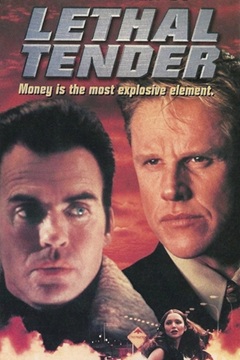
Lethal Tender (1997, directed by John Bradshaw)


Montessi (Kim Coates) and his men have taken over a water filtration plant, are holding hostages, and keep threatening to poison the water supply.  Rogue cop David Chase (Jeff Fahey) and Melissa Wilkins (Carrie-Anne Moss) sneak around the plant and try to stop the terrorists.  David Chase is set up to be a John McClane type but instead, he only kills one terrorists and then lets everyone else do most of the work.  Of course, the whole water filtration hostage situation is just a distraction so Mr. Turner (Gary Busey) can steal a bunch of bonds.  Busey sits behind a computer for most of the movie, lending his name but not much else.

A good cast is wasted in what is definitely one of the worst of the many Die Hard rip-offs to come out in the 90s.  There’s not enough action, with Jeff Fahey as a passive hero and even the great Kim Coates reduced to standing around and doing a lot of yelling for most of his time on screen.  Gary Busey is the big star here but it’s obvious that he was only on the set for a few hours and his plan for stealing the bonds never makes sense.  Whenever anyone questions his plans, he says that it involves computers.  In the 90s, I guess that was enough.

Watching this last night, I realized that I had seen it on Cinemax back in the day.  It didn’t make much sense back then either.

Silverado (1985, directed by Lawrence Kasdan)


In the old west, a cowboy named Emmet (Scott Glenn) teams up with a reformed outlaw named Paden (Kevin Kline) and they bust Emmet’s wild younger brother, Jake (Kevin Costner), out of jail.  After Mal (Danny Glover) helps the three of them escape from a posse, they all end up going to the town of Silverado, where all four of them have business.  Emmett and Jake want to protect their sister from the corrupt son (Ray Baker) of a cattle baron who was previously killed by Emmett.  Mal wants to save his sister Rae (Lynn Whitfield) from an evil gambler (Jeff Goldblum).  Paden discovers that Cobb (Brian Dennehy), his former partner-in-crime, is now the sheriff of Silverado and working for the cattle barons.  When Paden tries to protect the new settlers (including Rosanne Arquette), it leads to a confrontation with his former partner.

In the 80s, when he wasn’t directing films like The Big Chill and The Accidental Tourist, Lawrence Kasdan specialized in paying homage to the films of Hollywood’s golden age.  He started his directorial career with Body Heat, a modern film noir.  He worked on the screenplays of both Empire Strikes Back and Raiders of the Lost Ark.  With Silverado, Kasdan tried to resurrect the western.

Silverado is a traditional western with a few modern touches, like casting Jeff Goldblum as a gambler and John Cleese as the sheriff who wants to execute Kevin Costner.  Silverado also has more humor than a typical western, largely thanks to Kevin Kline.  Silverado starts out as a comedy before turning serious and grim once the four heroes finally reach Silverado.

Kasdan’s love of the genre is obvious in every frame of Silverado but, in trying to tell multiple stories at once, the movie spreads itself too thin.  I like that Kasdan tried to shake things up by casting actors who most people wouldn’t expect to see in a western but both Kevin Kline and Brian Dennehy seem miscast in their roles and their final confrontation never becomes the epic moment that it needs to be.  Scott Glenn and Kevin Costner are far more believable in their roles.  Danny Glover is also believable but his character is underused.

Silverado was obviously a labor of love for Kasdan and it shows that, if nothing else, Kasdan understood the appeal of the genre and the beauty of the wide open frontier.  The movie has its flaws but fans of westerns will appreciate his effort.

The Films of 2024: Horizon: An American Saga: Chapter One (dir by Kevin Costner)


Horizon: An American Saga: Chapter One is the rather unwieldy title of the first part of what Kevin Costner has said will be an epic four-part movie about the settling of the American frontier.

It’s very, very long.

It has a running time of three hours, during which time a lot of characters are introduced and a lot of plotlines are initiated but, because this is the only first chapter, none of them come to a close.  In fact, as the film ends, it’s still a mystery as to how some of the characters are even related.  I watched all three hours and I took my ADD meds this morning so you can be assured that I was actually paying attention.  That said, I still struggled to keep track of who everyone was or even where they were in proximity to each other.  Indeed, it was only towards the end of the film that I realized that several years were supposed to have passed over the course of the first chapter’s running time.

That’s not to say that the film is a disaster.  While it’s not quite the nation-defining epic that Costner obviously envisioned it as being, it’s also not quite the cinematic atrocity that several critics made it out to be.  It’s a throwback of sorts, to the epic westerns of old.  As such, the film features taciturn gunslingers, a woman with a past, dangerous outlaw families, fierce Indian warriors, and a wise Indian chief who has dreamed of the coming of the white man.  The film is full of actors — like Michael Rooker, Sienna Miller, Sam Worthington, Danny Huston, Will Patton, James Russo, Dale Dickey, and Kevin Costner himself — who feel as if they belong to a different era of filmmaking.  Just about everyone in the film is heading to the settlement of Horizon, which sits in Apache territory.  Despite the efforts of the Indians to kill every settler who shows up, they keep coming.  As one army officer explains it, the Indians have made the mistake of thinking that the settlers will come to believe the land is cursed while the settlers, all of whom are full of American optimism, instead chose to believe that the previous settlers were unlucky but that the next wave of settlers will make it work.  Costner has the right visual sensibility for a western.  The film reveals a director who is obviously in love with the Western landscape and the film is at its best when it simply frames the characters against the beauty of the frontier.  But when it comes to actually telling a compelling story, he struggles.  There are a lot of moving parts to the first chapter of Horizon and the problem is not that they don’t automatically connect but instead that Costner never gives us any reason to believe that they’ll ever connect.  There are no visual clues or bits of dialogue to assure the viewer that everything they’re watching is going to eventually pay off.  Costner asks his audience to have faith in him and remember that he directed Open Range and Dances With Wolves while forgetting about The Postman.

The first hour, which features a brutal raid on the settlement by a group of Indians, is the strongest.  It really drives home the brutality of what we now call the old west.  In the style of Michael Cimino’s The Deer Hunter, Costner closely observes the individual customs of the film’s settlers and carefully introduces several appealing characters who leave the viewer feeling as if they’ve met a very special and very unique community of people.  That makes it all the more devastating when the majority of those characters are subsequently wiped out with casual cruelty in a raid led by the Indian warrior Pionsenay (Owen Crow Shoe).  (Later — much later — a tracker played by Jeff Fahey will show similar brutality while wiping out a group of Apaches.)  The first hour establishes the frontier as being beautiful but also dangerous and it also drives home the mix of determination, desperation, and even madness that led so many to follow Horace Greeley’s advice and “Go west!”  Though the film was shot in early 2023, the brutality of the raid brought to mind the terrible images of the October 7th attacks on Israel.  The subsequent scenes in which Pionesenay and his followers ridiculed those in the tribe who wanted peace mirrored the current schism that’s driving apart the worldwide Left.  The U.S. Army, for their part, arrives a day late and can only offer up not-so subtle condescension.  The surviving settlers, however, remain determined to make a home for themselves.

The second hour focuses on Hayes (played by Costner), who rides into a mining town and gets involved with a family of outlaws who are looking for the woman who shot their father.  The second hour is a bit more of a traditional western than the first hour, though some of the violence is still shockingly brutal.  (Even being comedic relief won’t save you in this film.)  Abbey Lee gives a good performance as the woman with a past and a baby and Kevin Costner is  …. well, he’s Costner.  He could play this type of role in his sleep.

The third hour is a mess, introducing a wagon train and featuring a miscast Luke Wilson as the leader of the settlers and Jeff Fahey giving a strong performance as a ruthless tracker.  The third hour meandered as a whole new set of characters were introduced and I was left to wonder why the film needed new characters when the characters from the first two hours were perfectly adequate.  It was during the third hour that I started to really get impatient with the film and its leisurely approach to storytelling.

The film ends with a montage of what we can expect from the next few chapters of Horizon and I will say that the montage actually looked pretty cool.  That’s because the montage was almost totally made up of action scenes, with none of the padding that caused Chapter One to last an unwieldy three hours despite only having 90 minutes worth of story.  Still, one has to wonder if we’ll actually get to see the next three chapters.  The first chapter bombed at the box office and didn’t exactly excite critics.  Costner is producing and financing the films himself and I doubt he’ll give up on them.  The Horizon saga will be completed but will it made it to theaters or will it just end up on streaming?  Personally, I think the whole thing would work best as a miniseries but who knows?  (If Horizon was airing on Paramount, it would probably be a Yellowstone-style hit.)  All I really do know is that Chapter Two has yet to be released.  And that’s a shame because, for all of Chapter One‘s flaws, I’d still like to see how the story turns out.

Retro Television Review: Miami Vice 3.1 “When Irish Eyes Are Crying”


Welcome to Retro Television Reviews, a feature where we review some of our favorite and least favorite shows of the past!  On Mondays, I will be reviewing Miami Vice, which ran on NBC from 1984 to 1989.  The entire show can be purchased on Prime!

Welcome to season 3!

Episode 3.1 “When Irish Eyes Are Crying”

(Dir by Mario DiLeo, originally aired on September 26, 1986)

The third season of Miami Vice opens with Gina saving the life of Sean Carrone (a very young Liam Neeson).

Carrone is a former commander in the IRA, a man who has lost two brothers during the Troubles and who killed his first British solider when was fourteen but who now says that he has renounced violence and is instead a believer in peace.  When he gives a lecture in Miami, Gina, Zito, and Switek attend because they’ve gotten a hot tip from Izzy that an arms deal is going to occur afterwards.  Instead, a teenage gunman attempts to assassinate Sean and Gina is forced to use deadly force to save Sean’s life.

Gina is put on administrative leave after the shooting, which gives her plenty of time to pursue her new romance with Sean!  A jealous Crockett doesn’t trust Sean and it turns out that Crockett’s correct when it becomes apparent that Sean and his American benefactor (Paul Gleason) are looking to purchase Stinger missiles from arms dealers Max Kilzer (Walter Gotell, who played the head of the KGB in several Bond films) and Eddie Kaye (Jeff Fahey).  With the dubious help of a haughty British MI6 agent (Daniel Gerroll), Crockett and Tubbs try to uncover Sean’s plans.  Along the way, Tubbs gets to try out another fake accent, Crockett spends some time as Burnett without anyone noticing that Sonny Burnett looks and talks exactly like Sonny Crockett, and Eddie Kaye finds time to blow up Sonny’s beloved car.

On the plus side, this episode had a wonderful group of guest stars. When one episode finds substantial roles for Liam Neeson, Jeff Fahey, Paul Gleason, and Walter Gotell, it’s pretty good guess that the episode is going to be worth watching.  All four of them give memorable performances.  Liam Neeson is, of course, the star attraction here but I also enjoyed Jeff Fahey’s turn as a half-crazed bayou arms dealer who is first seen wearing a t-shirt that reads, “Kill Them All.”  I also appreciated that this episode gave everyone in the cast something to do.  During season 2, it was easy to forget that Gina and Trudy were even on the show.

That said, as I watched this episode, I couldn’t help but feel that it was missing the energy that made the first two seasons stand out.  If the first season was tough and gritty and the second season was surreal and often shocking, the third season got off to a rather comfortable start.  Don Johnson and Phillip Michael Thomas both seemed a little bit too relaxed in their roles as Crockett and Tubbs.  The third season opener played out like a well-0iled machine and that was the problem.  It was almost too efficient, with little of the spontaneity that ran through the previous two seasons.

It’s something that happens to every series.  The first two seasons are all about experimenting and taking chances and finding the right tone.  By the time the third season rolls around, the formula is in place and things can start to feel a little mechanical.  That was how I felt about this episode.  The supporting cast carried the drama while the main cast went through the motions.  That said, the episode did what a season premiere should do.  It re-introduced the viewer to the characters, it had enough violence to keep action fans happy, and it announced the show was back.  We’ll see how season 3 plays out over the next few weeks.

Horror Film Review: The Lawnmower Man (dir by Brett Leonard)


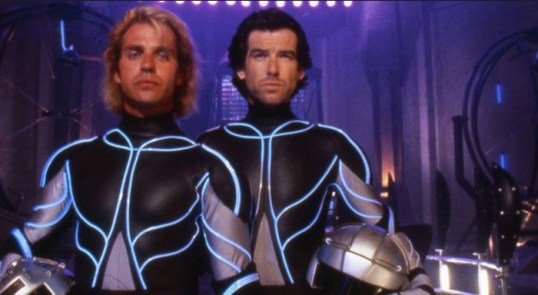
The 1992 horror/sci-fi hybrid, The Lawnmower Man, tells the story of two men.

Dr. Lawrence Angelo (played by Pierce Brosnan) is a scientist who is experimenting with ways to make less intellectually inclined people smarter. Dr. Angelo is kind of a burn out. You can tell he has issues because he needs to shave, he’s always sitting in the dark, and he’s never without a cigarette. You look at Dr. Angelo and you just imagine that he smells like smoke, bourbon, and lost dreams.

Jobe (Jeff Fahey) is the kind-hearted but intellectually disabled man who lives in a shack and spends his time mowing everyone’s lawn. Hence, he’s known as the …. wait for it …. THE LAWNMOWER MAN!

Together, Dr. Angelo and Jobe solve crimes!

No, not really. Instead, Dr. Angelo decides to experiment on Jobe. This leads to Jobe not only becoming smarter but also quicker to anger. Soon, Jobe is developing psychic abilities. He can move things with his mind. He can magically set people on fire. Basically, he can do whatever the script needs for him to do at the moment. Jobe is soon tormenting everyone who once bullied him. Father McKeen, the pervy priest, gets set on fire. Jake, the gas station attendant, is put into a catatonic state. An abusive father get run over by a lawnmower.

Dr. Angelo knows that Jobe is out-of-control and that the experiment has to be reversed. However, the sinister group behind Angelo’s research wants to use Jobe as a weapon because …. well, because they’re evil and that’s what evil people did back in 1992. Jobe, however, has other plans. He wants to become pure energy so that he can rule over a virtual world….

Or something like that. To be honest, it’s kind of difficult to really figure out what’s going on in The Lawnmower Man. The movie shares its name with a Stephen King short story but it has so little in common with its source material that King reportedly sued to get his name taken out of the credits. (Considering some of the films that King has allowed himself to be associated with, this is kind of amazing.) The film tries to be a satire, a slasher film, a conspiracy film, and a technology-gone-crazy film all in one and the end result is one big mess.

Along with all of that, The Lawnmower Man is also a time capsule of when it was made. A good deal of the film takes place in Jobe’s virtual reality universe, which looks a lot like a mix of Doom and Second Life. I imagine the film’s special effects may have seen impressive way back in the 20th Century but, seen today, they’re rather cartoonish, if occasionally charmingly retro.

On the plus side, the film does have an interesting cast. Pierce Brosnan is never convincing as burn-out but he tries so hard that he’s still fun to watch. Underrated actors like Jenny Wright, Geoffrey Lewis, Dean Norris, and Troy Evans all get a chance to show what they can do in minor roles. Finally, you’ve got the great Jeff Fahey, giving a far better performance than the script perhaps deserves. Though the film may be a mess, there’s something undeniably fun watching Jeff Fahey’s Jobe go from being meek to being a megalomaniac.

It’s a silly film and not one that’s meant to be watched alone. This is a film that has to be watched with a group of your snarkiest friends. Watch it the next time you’re looking for an excuse to avoid doing the yard work.

Quick Review – Grindhouse (dir. by Robert Rodriguez & Quentin Tarantino)


The following was posted on 4/6/2007 from my LiveJournal on Grindhouse (which is celebrating it’s 15th Anniversary). I’ll admit I respect Death Proof a bit more now than I did back then:

Gotta write fast. Have to jump into shower and head for work.

I got into the movie theatre at about 8pm, and spent the hour talking with a pair of film students from the School of Visual Arts. At 9 (an hour before the movie), the rest of the sold out crowd appeared. I was officially 3rd in line. Sweet. 🙂 I didn’t my preferred seat (the single one on the right reserved for patrons coming in with someone in a wheelchair), but did get a seat in the empty row (meaning I could stretch my legs, even better).

The short of it: Grindhouse is paying one low price for 2 bad movies, on purpose. You get 3 great built in trailers, and two mini movies. Between the two mini movies, I loved “Planet Terror” (the Rodriguez one) more than “Death Proof” (The Tarantino film), simply because Death Proof had too much of Tarantino’s conversational style that all of his films have. It’s like you’re listening to a conversation that absolutely doesn’t tie itself to any of the storyline’s major points. It’s just “cool” stuff, but I literally almost fell asleep until Kurt Russell showed up on screen. I think that if one knows to expect this from Tarantino, it comes across better. It’s like watching both Kill Bill volumes back to back. The first one’s cool and action packed, and the second one has some action (the chase scene alone in Death Proof had me wondering how they did that), but is so slow before getting there, you want to sigh.

Being a Charmed Fan, it was great to see Rose McGowan again, and there were so many cameos to laugh at. Fergie has a cameo, and Michael Biehn’s (“Hicks” from Aliens, Navy Seals) even in this. Where did they dig up these guys?

Grindhouse is easily a party film. I’d go see it again in the theatre, but I don’t see myself getting the DVD. It takes you back about a good 30 years, and does that really well. There are missing reels, serious jump cuts in the film and the sound sometimes cuts out. 🙂 In that sense, it’s really beautiful. The audience laughed and applauded, though there were some that at the end were like “Man, that sucked.” In the 60’s and 70’s, Grindhouse movies were pretty bad. I guess it’s like watching one of those old Hammer films, mixed in with a cheap horror flick. You have to walk into this movie not expecting “The Departed” for it to work. Just have fun with what you’re seeing and remember, this is what your parents sometimes saw in the movies (it should be noted that my parents went to something of a Grindhouse once – the movie they went to see was Night of the Living Dead. The other movie that was in the show was John Carpenter’s “Halloween”, which freaked my Dad out).

The music in particular is really great. Robert Rodriguez, Chingon, and a few friends come up with a sound for Planet Terror that’s in essence a John Carpenter like sound. If you have access to the Itunes Music Store, give it a listen (I bought it). Plus, if you’re a fan of some of the older movies out there, you’ll find references to some of Carpenter’s films in there (for example, one of the songs from “Escape from New York” is actually used in the film). The same occurs with the soundtrack from “Creepshow” – The story with the drowned couple. There are also tons of older Tarantino/Rodriguez references in there. One fellow actually yelled out a line, word for word, from what was on screen. It took me a second to realize the line came from “From Dusk Till Dawn”. Sweet.

The in betwen trailers are absolutely fantastic. If I were to get the DVD, it would probably be for this reason alone. You can tell that Rob Zombie, Edgar Wright (Shaun of the Dead) and Eli Roth (Hostel) really had fun with their pieces.

So, Grindhouse is worth seeing in theatre at least once with a bunch of friends, but know what you’re walking into. The movie can get gross at times and no young kid should even be brought near to this (we got carded to actually get into the theatre, and a Weinstein Rep. was on hand after the film to let us take surveys). Also before the movies, one of the teaser trailers is for Rob Zombie’s “Halloween”. I haven’t been so excited for a horror film like this since Zack Snyder’s version of “Dawn of the Dead”. This looks really good, and I’m wondering what Michael Myers is going to look like when someone like Tyler Mane (Sabretooth from the first X-Men movie) is playing him. That’s going to be creepy.