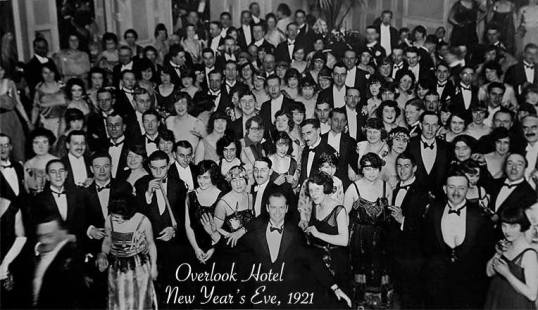
What better way to end 2014 than through one of my favorite scenes from Kubrick’s film adaptation of The Shining.
For those who have watched the film they understand the impact of this scene. For those still needing to see this classic piece of horror filmmaking then what better way to open up the new year than making a resolution to finally sit down and watch The Shining.
Little Shop…Little Shop of Horrors…Little Shop…Little Shop of Terrors…
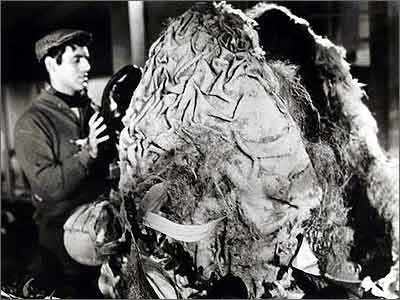
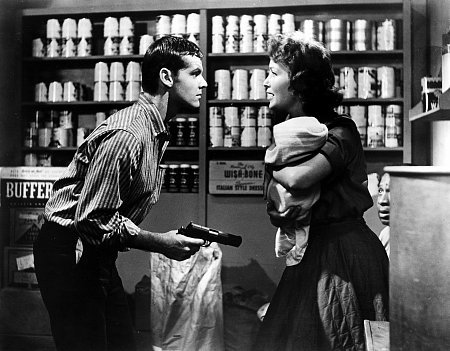
Watching the original 1960 Little Shop of Horrors is another Halloween tradition here at the Shattered Lens. And why not? It’s a lot of fun! Everyone always mentions the fact that Jack Nicholson pops up in an early role but, for me, the entire film is stolen by the great Dick Miller.
Incidentally, when I was 19, I was a dancer in a community theater production of Little Shop of Horrors. I really should have been cast as Audrey.
For our latest entry in the 44 Days of Paranoia, we take look at the film that the Academy named the best picture of 2006, Martin Scorsese’s The Departed.
The Departed takes the plot of the 2002 Hong Kong film Infernal Affairs and transports it to Boston. For years, crime lord Frank Costello (Jack Nicholson) has ruled South Boston with an iron fist. However, police Captain Queenan (Martin Sheen) and his assistant, Sgt. Dignan (Mark Wahlberg) think that they have finally found a way to take Costello down. They recruit police academy trainee Billy Costigan (Leonardo DiCaprio) to go undercover and infiltrate Costello’s organization. To help establish his cover, Costigan drops out of the academy and does time in prison on a fake assault charge.
Meanwhile, Costello has an agent of his own. Years earlier, Colin Sullivan (Matt Damon) was specifically recruited and trained by Costello to become a mole inside the Massachusetts State Police. Sullivan soon finds himself also working under Queenan.
While the amoral Sullivan finds it easy to deal with his dual role of being both a cop and a criminal, the far more emotionally unstable Costigan has a much more difficult time of it. Not helping is the fact that Costello turns out to be a legitimate madman who spends half of his time dismembering people and the other half serving as a secret informant to the FBI. While Sullivan smoothly works his way up the ranks, Costigan pops pills and becomes more and more paranoid.
Eventually, both Costigan and Sullivan are ordered to uncover the double agents in their respective organizations. What they don’t realize is that, even as they both attempt to learn the other’s identity, they are both seeing the same woman, psychiatrist Madolyn (Vera Farmiga.)
In the scene below, which happens to be my favorite from the entire film, Costigan and Madolyn make love after Madolyn assures Costigan that she doesn’t have a cat. That makes sense when you consider that Costigan is essentially a rat.
I have to admit that, as much as I did appreciate certain parts of the film, I was still disappointed the first time I saw The Departed. It wasn’t so much that the movie itself was bad as much as it was the fact that it didn’t live up to the standard set by previous Scorsese films. The film seemed to somehow be both conventional and overly busy at the same time, with the constantly moving camera and the propulsive soundtrack feeling more like they were more the result of a director trying to be like Scorsese than Scorsese himself. While I appreciated the comedic relief of Alec Baldwin’s performance as Queenan’s rival on the force and I thought that Matt Damon made a compelling villain, both Leonardo DiCaprio and Martin Sheen seemed to have been bitten by the overacting bug. It was hard not to feel somewhat disappointed that, after waiting for over three decades to be honored by the Academy, Scorsese finally won his Oscar for The Departed.
However, with subsequent viewings, The Departed has grown on me. Once I was freed up from the expectations that come from watching a Scorsese film for the first time, I was able to enjoy The Departed for what it actually was, a very well-made and entertaining crime drama that occasionally flirted with being something more.
Watching The Departed for a second time, I was better able to appreciate the sly humor of Jack Nicholson’s performance. As played by Nicholson, Frank Costello becomes both the devil incarnate and a somewhat pathetic relic who is incapable of understanding that his time has passed. Watching Nicholson for a second time also led to me better appreciating Martin Sheen’s performance. Since Nicholson and Sheen are meant to the equivalent of the angel and the devil sitting on Damon and DiCaprio’s shoulders, it was necessary for Sheen to be as virtuous as Nicholson was demonic.
By the time that I watched The Departed for the third time, it was a lot more obvious to me that the entire film was, more or less, meant to be a satire. What Nicholson’s criminal empire and Sheen’s police force have in common is that neither one of them works the way that they’re supposed to. If there’s anything to be learned from the film, it’s that nothing means much of anything. (The Coen Brothers would be proud.)
Finally, after multiple viewings, it becomes obvious that The Departed is very much a Scorsese film. Even if his direction isn’t quite as showy as viewers have come to expect, there’s still enough little touches and details that remind us that this film was made by a master. To cite the obvious example that everyone cites, just watch for the X’s that always somehow manage to appear on the wall or the carpet before anyone in the film dies. With multiple viewings, It also became obvious to me that even if this film was set in Boston and not New York and even if the characters were Irish and not Italian, this film was still thematically pure Scorsese, dealing with themes of guilt, identity, punishment, and martyrdom.
Like all worthwhile films, The Departed is one that grows better with subsequent viewings.
Our latest entry into the 44 Days of Paranoia is a dark masterpiece. Based on a script by Robert Towne, directed by Roman Polanski, and starring Jack Nicholson, 1974’s Chinatown is one of the greatest films ever made.
Chinatown takes place in 1940s Los Angeles. Private Investigator Jake Gittes (Jack Nicholson) is hired by a woman (Diane Ladd) who claims that her name is Evelyn Mulwray. She wants Gittes to follow her husband, Hollis, and discover whether he’s having an affair. Gittes gets some pictures of Hollis with a young woman (Belinda Palmer) and hands them over to Evelyn.
The next day, the pictures are published on the front page of the newspaper and Gittes is confronted by another woman (Faye Dunaway) who explains that she — and not the woman who hired him — is the actual Evelyn Mulwray. Gittes then learns that Hollis has turned up dead, drowned in a reservoir.
Gittes suspects that Hollis was murdered and launches his own investigation. This eventually leads Jake to Hollis’s former business partner, Noah Cross (John Huston). Noah also happens to be the father of Evelyn and he offers double Gittes’s fee if Gittes will track down Hollis’s younger girlfriend.
As his investigation continues, Gittes discovers that Hollis’s murder was connected to both the continued growth of Los Angeles as a city and a truly unspeakable act that occurred several years in the past. Nobody, it turns out, is what he or she originally appears to be. To say anything else about the plot would be unfair to anyone who hasn’t seen Chinatown before.
Since I first started reviewing films for this site, one of the things that I’ve discovered is that it’s actually easier to review a bad film than a good film. It’s easier to be snarky and cynical about the latest film from Michael Bay or Roland Emmerich than it is to explain why a film works. There’s a famous saying about pornography: “I don’t know what it is but I know it when I see it,” and sometimes that’s the way I feel whenever it comes time to try to review a great film.
Consider Chinatown. At its heart, Chinatown is an homage to the old film noirs of the 40s and 50s. Now, I have to admit that I’ve lost track of how many noir homages I’ve seen. It seems like every director has to make at least one hard-boiled, morally ambiguous detective film. Chinatown has all of the familiar elements — the hero is a private investigator, Evelyn Mulwray initially appears to be a classic femme fatale, the dialogue is appropriately cynical, and the plot is full of twist and turns. Even the film’s theme of political conspiracy serves to remind us that most noirs used their detective stories as a way to explore the hidden underbelly of American society.
And yet, with Chinatown, Polanski, Nicholson, Towne, and producer Robert Evans took all of those familiar elements and used them to create one of the greatest films ever made.
Why is Chinatown such a great film?
Some of the credit has to go to Jack Nicholson who, in the role of Jake Gittes, gives perhaps his best performance. As I mentioned above, Gittes is, in many ways, a stock character but Nicholson brings so much nuance and depth to the role that it doesn’t matter. Nicholson’s trademark cynicism and sarcasm are both to be found here but he also brings a cocky recklessness to the role. Gittes is such a charismatic and likable hero and so confident in himself that it makes the film’s ending all the more shocking.
As good as Nicholson is, he’s matched at every turn by John Huston’s Noah Cross. Noah Cross is one of the most vile characters to ever appear on-screen, which is why Huston’s rather courtly performance is all the more disturbing. When Gittes confronts Noah about the worst of his many crimes, Cross simply responds that a man is never sure what he’s capable of until he does it. Huston delivery of the lines leave us with little doubt that Noah believes every word of what he’s just said.
In the end, though, most of the credit has to go to Roman Polanski’s direction and Robert Towne’s script. Towne’s script provides a genuinely challenging and thought-provoking mystery, while Polanski’s stylish direction keeps the view continually off-balance and unsure of who is telling the truth. Reportedly, Polanski and Towne had a contentious relationship, with Polanski changing the ending of Towne’s script to make the film much more downbeat. In the end, Polanski made the right choice. The film ends the only way that it possibly could.
Originally, we were going to feature an Italian film called Dawn of the Mummy today. It’s the world’s only zombie/mummy hybrid and you guys would have loved it! Or maybe not. I have to admit that I don’t really love it. It’s actually a pretty bad movie but, at the same time, how many times do you get to see a movie that features both a mummy and zombies?
However, last night, the YouTube account that was hosting Dawn of the Mummy was deleted.
AGCK!
So, instead of showing you Dawn of the Mummy, we’re going to show you the original Little Shop of Horrors. It’s true that we featured Little Shop last Halloween but, oh well. It’s a fun little movie, especially when you consider that Roger Corman filmed it in 3 days. Jack Nicholson gets all the attention for playing a masochistic dental patient but I think the best performance is given by flower-eating Dick Miller.
From 1960, enjoy the original (non-musical) Little Shop of Horrors!
(However, speaking of the musical, I was in a community theater production of Little Shop of Horrors when I was 19. I so should have been cast as Audrey but instead, I was just a member of the “ensemble.” Bleh! Anyway, our director showed us the original Little Shop of Horrors and I was the only member of the cast to understand that Corman’s film was superior to the musical version. That said, I still tear up whenever I hear “Somewhere that’s green.”)
I have to admit that I’m not a huge Western fan. In fact, I can probably count the number of westerns that I’ve actually enjoyed on one hand. However, at the same time, those westerns that I did enjoy also happen to be some of my favorite films of all time. When done poorly, a western can be nearly unwatchable. When done right, however, nothing beats a good western.
Case in point: 1966’s The Shooting.
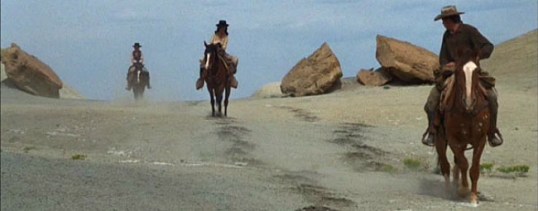
The Shooting tells the story of Willett Gashade (played by Warren Oates), a former bounty hunter who now makes his living a miner. At the start of the film, he returns to his camp after being gone for several days. At the camp, he discovers one man dead, one man missing, and one sole survivor, the good-natured by simple-minded Coley (Will Hutchins). The panicky Coley explains that the camp was attacked by an unseen gunman and says that it was because the missing man had apparently ridden down “a man and a little person” in a nearby town. How any of this relates to the rest of the film is open to interpretation.
For that matter, the entire film is open to interpretation. That’s one reason why I love it.
The next day, an unnamed, black-clad woman (Millie Perkins) appears at the camp. She hires Gashade and Coley to lead her to a town that lies some distance away, on the other side of an inhospitable desert. Gashade is suspicious of the haughty woman but the far more trusting Coley takes a liking to her immediately.
As Gashade and Coley lead the Woman across the desert, there are hints both obvious and subtle that all is not as it seems. The Woman, at one point, demands to be led in the wrong direction. At another point, the woman suddenly shoots and kills her horse. Eventually, the three of them are joined by Billy Spears (played by a young but already sardonic Jack Nicholson), a well-dressed gunman whose sinister smile does little to hide an obvious sadistic streak and who takes a cruel enjoyment out of taunting and bullying Coley. It all leads to a shockingly violent and deliberately enigmatic conclusion that raises more questions than it answers.
As directed by Monte Hellman (one of the best directors of the 60s and 70s), the film is less concerned with conforming to the rigid expectations of the western genre and, instead, uses the genre as a way to explore the American culture of violence. With its cynical dialogue and its stark imagery of a harsh journey through a seemingly endless desert, it’s little surprise that The Shooting is considered to be an existential western.
Fortunately, The Shooting contains a quartet of fine performances that hold the viewer’s interest, even when the story runs the risk of becoming incoherent. Millie Perkins, who made her film debut playing the title role in 1959’s The Diary of Anne Frank, brings an air of genuine menace to the role of the Woman while Will Hutchins provides the movie with a much-needed heart. The main appeal of the film, of course, is to see two iconic actors performing opposite each other and neither Warren Oates nor Jack Nicholson disappoints. Of the two, Nicholson (who co-produced the film with Hellman) has the showier role and he is obviously having a lot of fun playing such an unrepentant villain. Meanwhile, Warren Oates comes across like a hard-boiled film noir hero who has somehow found himself trapped in a western.
Needless to say, with its deliberately obscure storyline and its refusal to provide a traditional conclusion, The Shooting is not a movie for everyone. However, for those willing to take a chance, The Shooting can be a very rewarding film.
“Starring Academy Award nominee Jack Nicholson…” Actually, this film features at least 3 Academy Award nominated performers — Nicholson, Bruce Dern, and Diane Ladd.
2) Cry Baby Killer (1958)
Speaking of Jack Nicholson, here’s proof that even the most iconic stars had to start somewhere. This was Nicholson’s film debut.
3) The Delinquents (1957)
This juvenile delinquent film was directed by Robert Altman, who would later direct films like M*A*SH, Nashville, The Player, Short Cuts, Gosford Park, and The Company.
4) The Cool and the Crazy (1958)
The 50s were a wild time to be a teenager, apparently.
5) The Narcotics Story (1958)
“It’s a story of the young and innocent…” They’re young and innocent only be the standards of the decadent 50s!
6) The Pusher (1960)
And, of course, you can’t have the narcotics story without …. The Pusher!
Last night, I turned over to TCM and I watched the 1968 film Head.
Why Was I Watching It?
Though Head was a notorious box office bomb when it was released in 1968, it has since become notorious as one of the most incomprehensible movies ever made. Every book that I’ve ever read about film or pop culture in the 1960s makes mention of Head. Not only was the film written by a pre-Easy Rider Jack Nicholson, but the film also featured The Monkees literally acting out against their stardom by committing career suicide by appearing the film that was apparently conceived while Nicholson and director Bob Rafelson were tripping on LSD. I’ve read about Head in dozens of books and I’ve seen it described as being “a surreal masterpieces,” “an incomprehensible, pretentious mess,” and “a total head trip of a film.” Having now seen the film, I can say that’s all true.
I do have to admit that before I saw Head, I didn’t know who the Monkees were. Don’t get me wrong — I knew that there was a band in the 60s called The Monkees and I knew that they had their own TV show. Thanks to the fact that The Brady Bunch Movie played on cable for like two months straight earlier this year, I knew which one was Davey Jones. But, that was about it. Even after seeing Head, I’m still not really sure I could tell you which was one was Mickey Dolenz and which one was Peter Tork. I also have to admit that I spent the first half of the film referring to Michael Nesmith as the “Texan with the sideburns.”
Fortunately, I watched Head with two wonderful groups of people on twitter — the TCM Party and the Drive-In Mob. They came together last night and provided a very entertaining live tweet session devoted to the film. Unlike me, they actually knew one Monkee from another and following their tweets helped me survive the film’s rough first half. To all of them, I say “Thank you for the education.”
What’s It About?
That’s not an easy question to answer but I’ll try.
The Monkees jump off a bridge and plunge into the psychedelic waters below but they’re saved from drowning by a bunch of mermaids. This, of course, leads to the four members of the groups finding themselves in scenes from a war film, a boxing film, a western film, and eventually they discover that they’re actually dandruff on the head of actor Victor Mature. Ultimately, they end up wandering around on a studio backlot where they’re menaced by veteran scary actor Timothy Carey and an ominous black box that seems to intent on trapping them. The Monkees react to this by running for their lives, complaining to Jack Nicholson and Bob Rafelson about the script, and telling everyone that they meet that they’re just actors in a film. Eventually, it appears that the Monkees don’t have any options left beyond committing public suicide but Rafelson has other ideas…
What Worked?
If you’re as obsessed with pop cultural history as I am, Head is one of those films that simply you have to see. Even if you find the film to be totally incomprehensible and just a tad bit pretentious, Head is a valuable artifact of its time. Head is a film that could have only been made in the late 60s and it epitomizes everything about the age that produced it. It’s like a cinematic Pompeii.
Now, I have to admit that most of the enjoyment I got out of the first half of the film came more from my own curiosity as a secret history nerd than from the film itself. However, the second half of the film is often times genuinely entertaining. The satire is a bit sharper and the overall theme (i.e., the struggle to maintain your own unique individuality in a world that demands conformity) starts emerge from the film’s mix of surreal images.
For me, the film really picked up with Davy Jones’ performance of Daddy’s Song:
The woman dancing with Davy Jones was Toni Basil, who choreographed all the dance numbers in this film.
Here’s another sequence that I particularly enjoyed. This came towards the end of the film and, as I said on twitter, who doesn’t enjoy a little psychedelic dancing?
What Did Not Work?
While Head had all the virtues of its time, it also had all the flaws. It’s a definite hit-and-miss affair, with the stronger (and occasionally insightful) moments uneasily balanced with plenty of sequences that dragged. As you may have guessed, Head is the type of film that’s brilliant if you’re in the mood for it but it’s rather annoying if you’re not.
“Oh my God! Just like me!” Moments
I would have loved to have been Toni Basil, dancing with Davy Jones in the Daddy’s Song number.
Lessons Learned
Watching Head, I realized that I had discovered this year’s perfect Christmas present. I’m going to get a 100 copies of Head on DVD and give them out to everyone I know. That way, I’ll have an excuse to call everyone up in November and tell them, “Don’t worry, I’m giving you Head for Christmas.” I think, if nothing else, that’ll make me a very popular girl come December.
On Thursday night, my twitter timeline briefly exploded when it was reported that legendary filmmaker Roger Corman had just passed away. I immediately jumped over to Wikipedia and I saw that Roger Corman was officially listed as being newly deceased. Quickly, I jumped back over to twitter and I tweeted, “R.I.P. to one of the most important figures in American film history — the legendary Roger Corman.” I then sent out another tweet in which I pointed out that this meant that two of the men who has played senators in The Godfather, Part II — G.D. Spradlin and Roger Corman — had died this year and within months of each other.
Immediatly, one of my twitter friends tweeted back, “If only real Senators would die as quickly.”
“Agck!” I thought to myself, “how do I respond to that? If I get all offended or humorless, I might lose a follower. If I say yes, that’s a good point, I might end up getting put on some sort of super secret government list…”
Even as I worried about my future as a subversive, I was thinking to myself that the best way I could pay tribute to the late Roger Corman was to devote my next edition of Lisa Marie’s Favorite Grindhouse and Exploitation trailers to his memory. Yes, I decided, the next edition would have be all Corman, a celebration of the man, his life, and his movies…
And then it turned out that Roger Corman wasn’t dead. Turns out that some idiot journalist named Jake Tapper tweeted that Corman was dead and that’s what set off a chain reaction of false assumptions and early tributes. However, Roger Corman is still alive but you know me. Once I get an idea in my head, I have to see it through. Letting things go is not one of my talents.
So, with that in mind, here are 6 trailers in tribute to Roger Corman, who is not dead.
1) The Trip (1967)
In 1967, Roger Corman directed this film in which Peter Fonda plays a tv director who drops acid and ends up having a really bad trip. The script was written by Jack Nicholson and Dennis Hopper plays a random guru guy. Bruce Dern is in it too. As far as drug movies go, The Trip is actually pretty good though it does indulge in some of the standard Renaissance Faire imagery that all movies seem to use whenever attempting to visualize an acid trip.
2) St. Valentine’s Day Massacre (1967)
I recently saw this movie, Roger Corman’s first “studio” film. I have to admit that I thought it was a little bit slow but it had some fun performances and Jack Nicholson gets a memorable cameo where he explains why he dips his bullets in garlic.
3) The Intruder (1962)
In 1962, Roger Corman and William Shatner teamed up to make this look at racism and the people who exploit it.
4) The Raven (1963)
This is one of Corman’s famous Poe films.
5) The Wild Angels (1966)
Peter Fonda again. In this seminal biker film, Fonda again costars with Bruce Dern. Fonda’s girlfriend is played by Nancy Sinatra who, by the way, is one of the few celebs on twitter who will not only follow back but who will also actually respond to her followers.
6) It Conquered The World (1956)
Finally, let’s end things off with some truly old school Corman — It Conquered the World! This was Corman’s 3rd film as a director and his first major success.
Here’s to you, Roger Corman! Thank you for the movies and congratulations on still being with us.