To be honest, when it comes to bad movies, 2010’s Birdemic is kind of overrated.
I mean, yes — it is such an amazingly inept film that you do have to watch it at least once. And yes, I do occasionally still find myself singing that “hanging out with my family” song to myself.
But compared to something like The Room or April Rain, Birdemic is actually a pretty dull film. I’ve watched it maybe four or five times and it’s always been with a bit of reluctance. The Room, on the other hand, is a film that you can watch over and over again.
(Or, at least you could until The Disaster Artist came out. As brilliant as The Disaster Artist was, I kinda lost interest in The Room after watching it. Incredibly, I haven’t gone to one showing of The Room this year. Actually. now I’m feeling guilty about that. I guess I’ll have to watch The Room sometime tonight. Anyway….)
That said, there are a few scenes from Birdemic that are always good for a laugh. Personally, I enjoy this one. Just watch those birds attack!
4 Shots From 4 Films is just what it says it is, 4 shots from 4 of our favorite films. As opposed to the reviews and recaps that we usually post, 4 Shots From 4 Films lets the visuals do the talking.
Yesterday, we paid tribute to Jean Rollin. Today, we pay tribute to another master of Eurohorror with….
4 Shots From 4 Jess Franco Films
The Awful Dr. Orloff (1961, dir by Jess Franco)
Count Dracula (1970, dir by Jess Franco)
A Virgin Among The Living Dead (1971, dir by Jess Franco)
Today’s horror on the lens comes to us all the way from Canada!
In the 1990 film, The Final Sacrifice, a lot of stuff happens. In fact, the plot is almost as hard to follow as the plot of Raiders of the Living Dead. There’s a cult leader named Satoris, who is always wearing a suit. There’s a bunch of professional wrestlers who wear masks and are always running through the woods. There’s a teenager who looks like a cross between Anthony Perkins and Roddy McDowall. He’s being chased by the cultists but, fortunately, he meets a guy with a mullet. Together, they meet a wiley old prospector and they all work together to discover a lost city or something like that.
That said, The Final Sacrifice is kinda fun, especially if you’re a fan of Candian exploitation films like I am. It might not make much sense but at least it’s weird and that surely must count for something.
I have to admit that I was a little bit hesitant about watching the 2007 film, Diary of the Dead.
It wasn’t that I don’t like zombie movies. In fact, it was the complete opposite. I love zombie films and Night of the Living Dead is one of my favorites. George Romero, of course, went on to make several sequels to Night of the Living Dead. Dawn of the Dead, Day of the Dead, and Land of the Dead are certifiable horror classics. However, I had heard mixed things about the two zombie films that Romero directed after Land of the Dead. Seeing as how Diary of the Dead was Romero’s second-to-last film before he passed away in 2017, I was worried that I would watch the film and discover that I hated it. I didn’t want experience anything that would tarnish Romero’s cinematic legacy. It didn’t help my expectations that Diary of the Dead is a found footage film and the conventions of the found footage genre tend to get on my last nerve.
(Seriously, nothing makes me throw a shoe at a screen quicker than the sound of someone in a horror movie saying, “Are you filming this?”)
But you know what?
I did watch Diary of the Dead and it’s actually not bad. It may not reach the heights of Romero’s other zombie films but it’s definitely a worthwhile companion piece. It opens with news reports about the start of the zombie apocalypse, meaning that Diary of the Dead is meant to take place at roughly the same time as Night of the Living Dead. (Never mind that Diary of the Dead is full of references to YouTube and blogs and other things that most people probably couldn’t even imagine when Night of the Living Dead first came out.) A group of film students are in the woods, filming a terrible mummy movie when they first hear reports of the dead coming back to life. Some say that there’s no way it could be true. Others say that something must be happening but surely the dead aren’t actually coming back to life. They soon discover that the dead have indeed returned.
We follow the students as they travel across Pennsylvania, trying to find a place that’s safe from the Dead and discovering that there’s literally no such place left in America. Along the way, they also discover that the government has no intention of telling the people the truth about what’s happening. In fact, a group of national guardsmen turn out to be just as dangerous as the zombies. In their efforts to survive, the students are forced to rely on an underground network of bloggers and video makers.
Diary of the Dead has all of the usual zombie mayhem that you would expect from a film like this but, at the same time, it’s got a lot more on its mind than just the dead returning to life. Much as he did with Land Of The Dead, Romero uses Diary of the Dead to comment on the state of America under the Patriot Act. With the government using the zombie apocalypse as an excuse to suspend civil liberties and increase their own power, the film’s characters are forced to depend on new and independent information sources. It’s not hard to see the parallel that Romero is making between the War on the Living Dead and the War on Terror. As well, making all of the characters film students allows for some discussion about whether or not horror films should simply concentrate on being scary or whether they should also attempt to deal with real-world issues. The film leaves little doubt where Romero came down on that issue.
On the negative side, Diary of the Dead struggles a bit to overcome the limitations of its low budget and none of the characters are as compelling as Ben in Night of the Living Dead or Fran in Dawn of the Dead. At times, you find yourself wishing that Diary of the Dead featured just one actor who was as into their role as Duane C. Jones or Ken Foree were in Night of the Living Dead and Dawn of the Dead, respectively. But Diary of the Dead still features enough zombies and enough of Romero’s trademark political subtext to be an acceptable addition to Romero’s vision of the apocalypse.
What happens when an oil company discovers new, undefined organic matter in the arctic circle?
Well, first off, they mishandle it and it ends up turning into a prehistoric, killer ape-man.
Secondly, it’s time for a corporate cover-up!
Fortunately, the world’s greatest (if unluckiest) journalist, Carl Kolchak, is on the case!
Anyway, this is an okay episode of Kolchak. If I don’t seem as enthused about it as I’ve been about some of the previous episodes, it’s because a killer, prehistoric ape-man just isn’t as much fun as a Cajun demon or a killer robot. Still, this episode has a nicely done, underground tunnel-set climax. Seriously, you can’t go wrong with an underground tunnel.
This episode originally aired on January 17th, 1975.
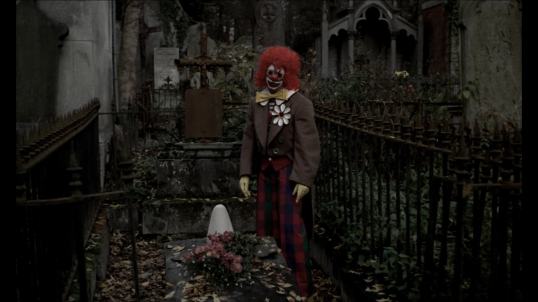
Today’s horror scene that I love comes from the 1972 French film, The Iron Rose. In this scene, directed by the great Jean Rollin, Francoise Pascal dances in a cemetery. Why is she dancing? Perhaps she is celebrating the fact her lover has just suffocated inside of the crypt that she locked him in. Perhaps she’s just happy that a clown came by earlier and lay some flowers on a grave. One can never be sure. This entire sequence is Rollin at his best.
This is one of Rollin’s most enigmatic films, which is saying something when you consider just how dream-like the average Rollin film is. It was Rollin’s fifth film and his first to not involve vampires.
4 Shots From 4 Films is just what it says it is, 4 shots from 4 of our favorite films. As opposed to the reviews and recaps that we usually post, 4 Shots From 4 Films lets the visuals do the talking.
Today, I pay tribute to my favorite French director with….
Artie Logan (Charlie Schlatter) is a wannabe James Dean who keeps getting kicked out of school because he is such a rebel. His father, a judge, gives Artie one more chance. Artie can either enroll at Fairfield College or he can go to jail. Artie chooses Fairfield, where he meets and falls for the beautiful and popular Tally Fuller (Josie Bissett). However, no sooner does Artie show up for their first date than someone sets Tally on fire and crashes through a window. Artie is the number one suspect but Detective P.J. Decker (Christopher Walken) still gives him 24 hours to solve the murder and clear his name. Artie investigates and discovers that Tally was not the innocent, all-American girl that everyone thought she was. This leads to a nudity-filled flashback that explains why All-American Murder was an HBO mainstay in the 90s. It also leads to other people being murdered by snakes and hand grenades.
Despite some bloody murders and the presence of Walken and Joanna Cassidy in potentially interesting supporting roles, All-American Murder fails because it asks us to accept Charlie Schlatter as being a charismatic rebel. When Joanna Cassidy tells him that he’s a “renegade,” not even she sounds like she believes it. The murder mystery is intriguing but Artie is so obnoxious that you want him to go to prison whether he’s guilty or not.
All-American Murder was directed by Anson Williams, who is best known for playing Potsie on Happy Days. The Fonz could have framed Ralph Malph for this murder in half the time that it takes Artie to solve it.
You have to love the utter shamelessness that was often displayed by the Italian horror directors of the 70s and 80s.
Consider this:
In Italy, both Sam Raimi’s Evil Dead and Evil Dead 2 were huge hits. Evil Dead was released under the name Las Casa so, of course, Evil Dead 2 was called La Casa 2.
Now, imagine that you’re Umberto Lenzi, a veteran Italian filmmaker who has directed everything from thrillers to westerns to war movies to gangster dramas. Over the decades, you’ve followed the trends. Whatever genre was popular at the time is the genre that you worked in. It’s now the late 80s and, even though the Italian film industry is in decline, Italian horror movies are still popular enough to make money. So, that’s what you now make. You’ve made cannibal films. You’ve made giallo films. You’ve made zombie films. Now, it’s time to make a haunted house film.
And how do you make sure that people will spend their money to see your haunted house film?
You call it La Casa 3.
Sure, your film has close to nothing to actually do with either one of the Evil Dead films. I mean, there is a deserted house and a scary basement and a message on a tape recorder but otherwise, your film is definitely not a part of the Evil Dead universe. For that matter, your own rather staid directorial style is absolutely nothing like Sam Raimi’s.
Who cares? Just call your movie La Casa 3 and make some of that Evil Dead money for yourself!
Of course, when the film is released in other countries, the name is going to have to be changed. After all, no one outside of Italy knows the significance of La Casa. In some territories, La Casa 3 is actually released under the name Evil Dead 3! However, in the United Sates, it’s known as Ghosthouse.
As for the film itself, it opens with a murder and ends with a lesson about why you should be careful when crossing the street. The film deals with a guy who spends all of his time in his apartment, listening to radio frequencies. He hears someone screaming for help so he drags his girlfriend with him in a search for the source of the scream. When she suggests that maybe it was a prank, he says, “That wouldn’t be ethical!”
Anyway, their search eventually leads them to an abandoned house in New England. If the house looks familiar, it’s because it’s the exact same house that Lucio Fulci used for The House By The Cemetery. It’s a pretty good location, too. Almost all of Ghosthouse’seerie moments are due to the fact that the house is just naturally spooky. Anyway it turns out that the house was the scene of a brutal murder. If you enter the house, you might run into a little girl who is holding a scary clown doll. As quite a few characters discover over the course of this film, the little girl will kill you just as soon as look at you.
As prolific as Umberto Lenzi was, he never really developed a signature style. As opposed to the work of other Italian genre directors — like Dario Argento, Mario and Lamberto Bava, Lucio Fulci, Sergio Martino, Anthony Margheriti, and so many others — it’s rare that you ever watch an Umberto Lenzi film and think to yourself, “That is such an Umberto Lenzi moment. Only Umberto Lenzi could have made this film work.” As a result, Lenzi’s filmography tends to be a bit more uneven than the work of some of his contemporaries.
If you accept a film like Nightmare City as being an example of Lenzi at his most memorable and something like TheHitcher In The Dark as being Lenzi at his most forgettable, Ghosthouse is somewhere in the middle, between those two extremes. It has lots of atmosphere and those looking for gore will get what they’re looking for. At the same time, it doesn’t really add up to much beyond random people coming to the house, seeing something weird, and then dying. If you’re a fan of horror that doesn’t demand much from the audience, Ghosthouse is a diverting enough waste of time. If you’re looking for something deeper, I’d suggest rewatching The House By The Cemetery.






 Through the Shattered Lens