Horror Film Review: Poltergeist (dir by Tobe Hooper)


The 1982 film Poltergeist tells the story of the Freeling family.

There’s Steven the father (Craig T. Nelson) and Diana the mother (JoBeth Williams).  There’s the snarky teenager daughter, Dana (Dominique Dunne), who has a surprisingly good knowledge of the local motel scene.  There’s the son, Robbie (Oliver Robins), who is scared of not only a big ugly tree but also a big ugly clown doll that, for some reason, sits in his bedroom.  And then there’s the youngest daughter, Carol Ann (Heather O’Rourke).

They live in a planned community in Orange County, sitting just a few miles away from the cemetery.  (Or so they think….)  They’ve got a nice house.  They’ve got nice neighbors.  They’ve got a nice dog.  They’re getting a pool in the backyard.  There are hints that Steven and Diana may have once done the whole rebellion thing.  They still occasionally get high, though they do it with a smugness that somehow manages to make marijuana seem less appealing.  But, for the most part, Steven and Diana are happy members of the establishment.  Steven sells real estate and is a favorite of his boss, Mr. Teague (James Karen).  Diana is a stay-at-home mom who doesn’t get upset when some unseen spirit rearranges all the furniture in the kitchen (seriously, that would drive me crazy).  They’re the type of family that falls asleep in front of the TV at night, which is a bit of a mistake as Carol Ann has started talking to the “TV people.”

Strange things start to happen.  As mentioned earlier, furniture starts to rearrange itself.  Whenever Carol Ann sits down in the kitchen, an unseen force moves her across the floor.  Diana, for whatever reason, thinks this is the greatest thing ever.  Then, on the night of a big storm, the big ugly tree tries to eat Robbie and Carol Ann goes into a closet and doesn’t come out.  Though Carol Ann has vanished, the Freelings can still hear her voice.  Apparently, she’s been sucked into another dimension and she’s being encouraged to go into the light.

Of course, this leads to the usual collection of paranormal researchers moving in.  The house decides to pick on one unfortunate guy and he ends up not only eating maggot-filled meat but also imagining his face falling apart over a sink.  A medium named Tangina (Zelda Rubinstein) comes by and reprimands Steven and Diana for not doing exactly what she says.  Of course, it turns out that Tangina isn’t quite as infallible as she claims to be….

To me, Poltergeist is the epitome of a “Why didn’t they just leave the house” type of film.  Don’t get me wrong.  I understand that once Carol Ann vanished, Diana and Steven had to stay in the house to rescue their daughter.  I’m talking about all the stuff that went on before the big storm.  Seriously, if a ghost started moving furniture around in the kitchen, I’m leaving the house.  At the very least, I’m not going to take my youngest daughter and invite the ghost to push her around the kitchen.  Even stranger is that, at the end of the film, the Freelings still don’t leave the house even though the situation with Carol Ann has been resolved.  They hire a moving truck and make plans to leave but, instead of spending a night in a hotel, they instead decide to spend one more night in a house that’s apparently possessed by Satan.

Poltergeist is famous for bringing together two filmmakers who really seem like they should exist in different universes.  Steven Spielberg produced while Tobe Hooper directed.  It seems like it’s impossible to read a review of Poltergeist without coming across speculation as to how much of the film should be credited to Spielberg and how much should be credited to Hooper.  It must be said that the film does occasionally feel like it’s at war with itself, as if it can’t decide whether to embrace Spielberg’s middle class sensibilities or Hooper’s counter-culture subversiveness.  On the one hand, the emphasis on special effects and the early scenes where the Freelings watch TV and Steven gets into a remote control fight with his neighbor all feel like something Steven Spielberg would have come up with.  On the other hand, the obvious joy that the film takes in tormenting the Freelings feels more like Tobe Hooper than Steven Spielberg.  Or take the film’s finale, where the special effects are pure Spielberg but the scene of Diana getting assaulted in bed and then thrown around her bedroom feels like pure Hooper.  Really, it’s the mix of two sensibilities that make the film compelling.  Poltergeist’s planned community is appealing but it’ll still kill you.

Anyway, I like Poltergeist.  I certainly prefer the original to the remake.  It’s a silly film in many ways but it’s still effective.  Once you get over how stupid Diana acts during the first part of the film, JoBeth Williams gives a strong performance as a mother determined to protect her children.  And Craig T. Nelson gives a classic over the top performance, especially towards the end of the film.  Just listen as he screams, “Don’t look back!”  That said, my favorite performance comes from James Karen, who is perfectly sleazy as the outwardly friendly, cost-cutting land developer.

Poltergeist is still a good, scary film.  And, if anyone wants to play a lengendary prank this Halloween, show it to someone who has a fear of clowns.
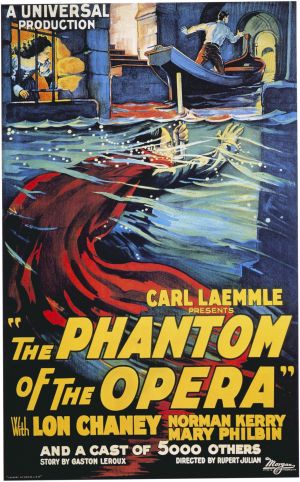
Horror on the Lens: The Phantom of the Opera (dir by Rupert Julian)


Today’s horror movie on the Shattered Lens is both a classic of silent era and one of the most influential horror films ever made.  It’s one that I previously shared in 2013, 2015, and 2106 but it’s such a classic that I feel that it is worth sharing a second (or fourth) time.

First released in 1925, The Phantom of the Opera is today best known for both Lon Chaney’s theatrical but empathetic performance as the Phantom and the iconic scene where Mary Philbin unmasks him. However, the film is also a perfect example of early screen spectacle. The Phantom of the Opera was released during that period of time, between Birth of the Nation and the introduction of sound, when audiences expected films to provide a visual feast and Phantom of the Opera certainly accomplishes that. Indeed, after watching this film and reading Gaston Leroux’s original novel, it’s obvious that the musical was inspired more by the opulence of this film than by the book.

This film is also historically significant in that it was one of the first films to be massively reworked as the result of a poor test screening. The film’s ending was originally faithful to the end of the novel. However, audiences demanded something a little more dramatic and that’s what they got.

Music Video Of The Day: Halloween All Year by The Orwells (2012, dir by ????)


Halloween All Year sounds like a great idea to me!

Or, at least, it does until you actually pay attention the lyrics of this song, the majority of which involve a knife and a body on the ceiling.  Actually, now that I think about it, I guess part of the appeal of Halloween is that you actually have to wait for it.  You wait for 9 months and then suddenly, it’s the greatest 31 days of the year!

As for the video, I like it because it has a prom gone wrong feel to it.

Enjoy!

Horror Film Review: Jacob’s Ladder (dir by Adrian Lyne)


The 1990 film Jacob’s Ladder asks the question, “Who is Jacob Singer?”

Is Jacob (played by Tim Robbins), a soldier serving in Vietnam who has just been severely wounded in an enemy attack and who is now barely clinging to life in a helicopter?

Is Jacob a withdrawn postal worker who lives in 1970s New York with his girlfriend, Jezzie (Elizabeth Pena), and who is haunted by horrifying visions of faceless, vibrating figures and viscous demons?  This Jacob is haunted by ill-defined past incidents.  Whenever he gets depressed, Jezzie is quick to demand that he snap out of it and that he stop thinking about anything other than the present day.  This Jacob can only watch as all of his old friends either sink into paranoia or die.  He hears rumors that they all may have been part of some sort of experiment involving LSD.  He’s sure that he served in the army but when he attempts to hire an attorney, he’s informed that the army has no record of him ever having served in combat and that they say he was discharged for psychological reasons.

Or is Jacob the husband of Sarah (Patricia Kalember) and the father of Gabe (Macaulay Culkin — yes, that Culkin)?  This is the Jacob who occasionally wakes up in bed with his wife and tells her that he’s been having the weirdest dream, one where he was living with “that crazy woman” from the post office, Jezebel?

Which one of these three realities is the truth for Jacob?  At times, Jacob himself doesn’t even seem to be sure.  Perhaps the one thing that you can be sure about in this movie is that whenever Jacob closes his eyes, he’s going to reopen them and discover that he’s in a different time and place.  Jacob spends almost the entire film trying to work out what’s happening in the present, what’s happening in the past, and what’s just happening in his head.

And, to be honest, it all gets a bit pretentious at times.  The film’s script has a lot on its mind.  In fact, it might have a little bit too much going on.  No sooner have you soaked in what the film has to say about denial and acceptance than you’re suddenly getting a crash course in MK-ULTRA and other mind-control conspiracy theories.  Whenever Jacob isn’t seeing demons and faceless apparitions, he’s being kidnapped by government agents.  There’s so much going on that this film can get a bit exhausting.

Fortunately, the film itself is such a triumph of style that it doesn’t matter that the script is a bit of a mess.  Director Adrian Lyne does a great job bringing Jacob’s nightmarish world to life.  Jacob seems to live in a world where the skies are permanently overcast and the streets are always wet after a recent storm.  When Jacob makes the mistake of walking down a subway tunnel, Lyne frames it as if Jacob is literally following a tunnel into Hell.  When a subway train rushes by Jacob, we catch disturbing glimpses of featureless faces facing the windows.  When Jacob sees a demon at a party, Lynne films the moment so that, just like Jacob, it takes us a few minutes to realize what we’re seeing.  And when Jacob is kidnapped and taken to a Hellish hospital, the scene is nightmarish in its intensity.

Tim Robbins gives a great performance as the emotionally withdrawn and haunted Jacob.  (In fact, he’s so good that it makes it all the more sad that he really hasn’t had a decent role since he won an Oscar for 2003’s Mystic River.)  He’s matched by Elizabeth Pena, who constantly keeps you wondering if Jezzie truly cares about Jacob or if she’s just another part of the conspiracy that seems to have taken over his life.

Jacob’s Ladder is an intensely effective, if somewhat messy, horror film.  Apparently, like almost every other horror film released in the 20th century, it’s currently being remade, with the remake due to released on February 9th.  Just in time for Valentine’s Day!

Horror Film Review: Ghost Ship (dir by Steve Beck)


Way back when we first started this year’s horrorthon, Arleigh shared a horror scene that he loved.  That scene was the opening few minutes of the 2002 horror-at-sea film, Ghost Ship.

That scene featured a few dozen wealthy cruise ship passengers all getting bisected by a thin wire cord.  While a young girl named Kate (Emily Browning) watches, everyone on the ship’s dance floor literally falls to pieces.  Torsos slip off of legs.  Bodies split in half.  The captain’s head literally splits in two.  While gallons of blood gush everywhere, people vainly try to reattach their limbs.  Actually, some of them can’t even figure out which limb belongs to them.  By the time everyone’s collapsed, there’s a lot of arms and legs to sort through.

In short, it’s an absolute mess.  I wouldn’t want to be the person assigned to clean up after all that.

It’s also a rather brilliant opening, one that only takes a minute to go from romance and sophistication to bloody dismemberment.  It’s definitely the one moment that everyone remembers about Ghost Ship, which is a bit of a problem because, once that scene is done, there’s still 85 minutes of film to sit through.  Ghost Ship‘s opening is so shocking and visceral that there’s no way that the rest of the film can live up to it.

As for the rest of the film, it deals with a boat salvage crew.  Gabriel Byrne is Murphy, the captain.  Julianne Margulies is Maureen Epps, whose name might as well be Ellen Ripley.  Ron Eldard is Dodge, who is in love with Epps.  And then there’s Karl Urban, Isiah Washington, and Alex Dimitriades, who are all playing characters who you know are going to be doomed as soon as you see them.  When they’re told by a pilot named Jack Ferriman (Desmond Harrington) that he’s spotted a ghost ship in international waters, they set out to claim it for themselves.

Of course, what Jack has spotted is the same cruise ship where, forty years before, everyone was chopped in half.  After Murphy, Epps, and the crew board the ship, they discover a large amount of gold.  They also end up seeing a lot of ghosts, including the young girl from the start of the movie.  To their credit, the crew decides to leave the ship as quickly as they can.  Unfortunately, after their tugboat explodes, escape appears to be impossible and it becomes obvious that they have been lured to the cruise ship for a very specific purpose.

The film encourages us to wonder what the ship wants from the salvage crew but the answer to that question is never really in doubt.  For that matter, it’s not really a shock when it turns out that one member of the boarding party isn’t what he claims to be.  Despite being a bit predictable, Ghost Ship isn’t a bad film.  It has a reputation for being disappointing but actually it’s an atmospheric and competently directed horror film.  Though the characters are all thinly drawn, the talented cast does their best to try to bring them to life.  If the film ultimately doesn’t seem to work as well as it should, it’s largely because nothing that follows can match the power of that opening.  You watching the film waiting for a scene that’ll match that opening scene and when it never comes, it’s hard not to be disappointed.


Horror on TV: Kolchak: The Night Stalker 1.12 “Mr. R.I.N.G.” (dir by Gene Levitt)


Tonight on Kolchak….

After annoying his editor one too many times, Carl Kolchak has been assigned to write obituaries.  However, you can’t keep a good reporter down and, when Kolchak comes across the mysterious death of a scientist, Kolchak decides to investigate on his own.  Kolchak’s defeated vampires, werewolves, Cajun demons, and serial killers.  How will he do against something made by the government?

This episode originally aired on January 10th, 1975.

Enjoy!

Linda Blair In Oz: Fatal Bond (1992, directed by Vince Monton)


Fatal Bond is another Australian exploitation flick starring Linda Blair.

In this one, Linda plays a hairdresser named Leonie.  When a drifter named Joe (Jerome Ehlers) crashes a birthday party that Leonie’s attending, it’s lust at first sight.  Even though Joe is a violent womanizer who steals milk and headbutts anyone who looks at him crossly, Leonie still takes him home with her.  Soon, Joe is crashing in Leonie’s bedroom and Leonie is providing Joe with an alibi whenever the police come looking for him.  (Joe says that he has a lot of parking tickets.)  When one of Joe’s one night stands turns up dead, Leonie starts to suspect that Joe might be responsible.

Like Dead Sleep, Fatal Bond features Linda Blair as an American who lives in Australia and who has bad taste in men.  While Linda Blair has never been a great actress, she’s almost always brings grit, determination, and a will to survive to her roles.  Unfortunately, none of that is on display in Fatal Bond, where she’s such a pushover that she lets Joe take over her life.  There’s not really much to the whole serial killer storyline either, especially not when the murderer’s identity will be obvious to anyone watching.  There’s also another subplot in the movie about Joe searching for his brother, who has gone missing.  Fatal Bond doesn’t know if it’s a Linda Blair thriller or a standard Australian crime film.

Don’t be fooled by the sexy cover art.  I love a good Linda Blair movie but Fatal Bond was just boring.  If you do see the film, keep an eye out for Joe Bugner, the former heavyweight boxer who once fought Muhammad Ali.  Bugner has a small role as a lowlife criminal in Fatal Bond.  His partner-in-crime is Mel’s younger brother, Donal Gibson, stepping into a role that was originally earmarked for Russell Crowe.


Horror Scenes That I Love: Craig T. Nelson Freaks Out In Poltergeist


Admittedly, this is a pretty short scene.  It’s only 16 seconds, taking from the much longer climax of 1982’s Poltergeist.

That said, this is one of the greatest over-the-top moments in cinematic history.  Craig T. Nelson basically acts the Hell out of accusing his boss of …. well, you’ll see….

(Also, give some praise to the one and only James Karen, heroically bugging out his eyes there at the end.)

4 Shots From 4 Haunted Films: The Haunting, Poltergeist, The Conjuring, Crimson Peak


4 Shots From 4 Films is just what it says it is, 4 shots from 4 of our favorite films. As opposed to the reviews and recaps that we usually post, 4 Shots From 4 Films lets the visuals do the talking.

Today, the Shattered Lens gets a little bit spooky with….

4 Shots From 4 Haunted Films

The Haunting (1963, dir by Robert Wise)

Poltergeist (1982, dir by Tobe Hooper)

The Conjuring (2013, dir by James Wan)

Crimson Peak (2015, dir by Guillermo Del Toro)

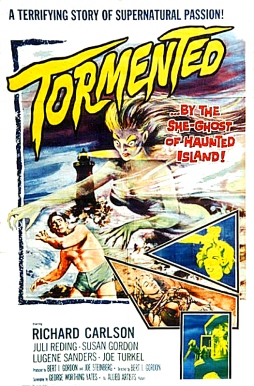
Horror on the Lens: Tormented (dir by Bert I. Gordon)


Halloween is the perfect time for a good ghost story and, with that in mind, here is today’s movie.

Released in 1960 and directed by Bert I. Gordon, Tormented tells the sad story of Tom Stewart (Richard Carlson).  Now, Tom might look like a pretty regular guy but we know that he’s a little bit crazy because he’s a jazz pianist and you know how dangerous those beatnik-types are.  Tom is happily engaged to Meg but one day, his ex-girlfriend Vi shows up.  Vi is obsessed with Tom and swear that she’s going to end his engagement.

So, naturally enough, Tom throws her off of a lighthouse.

Problem solved, right?

Not quite.  Vi may be dead but she’s not out of Tom’s life.  Instead, her disembodied head tends to pop up at random moments and taunt Tom.  Meanwhile, Tom is having to deal with Meg’s suspicious sister and a beatnik (Joe Turkel, who years later played Lloyd the Bartender in The Shining) who is determined to collect the $5 that he claims Vi owes him.

Between the beatniks and the raging ocean and the disembodied head popping up whenever it’s least convenient, Tormented is a lot of fun and the perfect film for some retro Halloween fun.