Day Three of the week-long horror-themed “Song of the Day” feature brings us one of the greatest pieces of film music ever composed. I’m talking about the score for John Carpenter’s remake of The Thing from Another World. The remake retains only the first two words of the original’s title, and that alone speaks volumes.
At first listen, one might mistake this music as being composed by John Carpenter himself—an accomplished film composer in his own right, known for scoring most of his own films. Its similarity to his iconic Halloween theme and even his earlier work on Assault on Precinct 13 makes the connection understandable. But one would be wrong to assume Carpenter had a hand in writing it. For the first time, Carpenter allowed someone else to compose the score, and for the task he selected none other than the Italian maestro Ennio Morricone.
By the time he collaborated with Carpenter on this sci-fi horror masterpiece, Morricone was already firmly established as one of the great masters of film composition. Audiences knew him best for his legendary work on Sergio Leone’s “spaghetti westerns” as well as numerous classics of Italian cinema. While Morricone’s full score for The Thing deserves a complete discussion of its own, I’ll focus on the one track that most powerfully captures the themes of horror, isolation, dread, and paranoia that make Carpenter’s film such a landmark: “Humanity (Part II).”
The piece opens with a heartbeat-like sequence that pulses steadily through most of its length. Strings layer on top of this rhythm, creating a mournful, dirge-like quality, while the bass thump lurks ominously just beneath the surface, as though danger is present but unseen. For much of its runtime, the music exudes a stark sense of emptiness, forcing the listener into the same suffocating isolation as the characters onscreen, stranded in the vast Arctic wasteland. The repetition and looping structure almost feel like a trap, with no release or resolution, mirroring the crew’s paranoia as suspicion and fear close in tighter than the snowstorms outside. Each cycle draws the listener deeper into a psychological cage, heightening the dread with its unrelenting stillness.
It isn’t until the final two minutes that the track breaks from its oppressive restraint. Here, Morricone channels Carpenter’s trademark minimalism with unsettling synthesizer tones, jagged and piercing against the steady backdrop. The music shifts from mournful to dissonant, almost alien, capturing the horrifying essence of the creature in its most grotesque form. This sharp intrusion is not just an auditory shock but a symbolic transformation—the moment when the lurking horror finally emerges from shadow into focus, confirming that the paranoia has been justified all along. It is this careful build, held back until the very end, that demonstrates Morricone’s mastery at fusing Carpenter’s sensibilities with his own, delivering a piece that is both restrained and devastatingly effective.
There’s a reason so many film aficionados cite Carpenter’s The Thing as one of their all-time favorites. Its reputation owes much to Carpenter’s skill as a filmmaker and editor, but Morricone’s score plays an equally crucial role in shaping the film’s atmosphere. “Humanity (Part II)” stands as one of the finest pieces of horror film music ever written.
The second song in the week-long special edition of the “Song of the Day” feature I’ve chosen the main theme to the infamous and controversial Italian horror film Cannibal Holocaust from Italian filmmaker Ruggero Deodato. The song is part of the film score composed wholly by Italian film composer Riz Ortolani.
The main theme to this greatest of film in the cannibal horror subgenre always take new listeners by surprise. For a film which shows some extreme examples of violence towards people and animals the theme is actually quite gentle and serene with just a hint of sadness in the suite. This theme really doesn’t prepare the viewer for what they’re about to see (though anyone watching Cannibal Holocaust for the first time should at least have an inkling what the film will be about just from the title alone).
It’s a testament to Ortolani’s talents that he was able to create a synth-based theme which has only gotten more popular with the passage of time. The theme could almost be considered the unofficial theme to the glory days of grindhouse cinema of the 70’s and 80’s. It’s even become the theme song to the greatest film (both long and short form) ever made: Treevenge. Just watch for yourself right below and you’ll understand why I say it’s the greatest thing ever put on film.
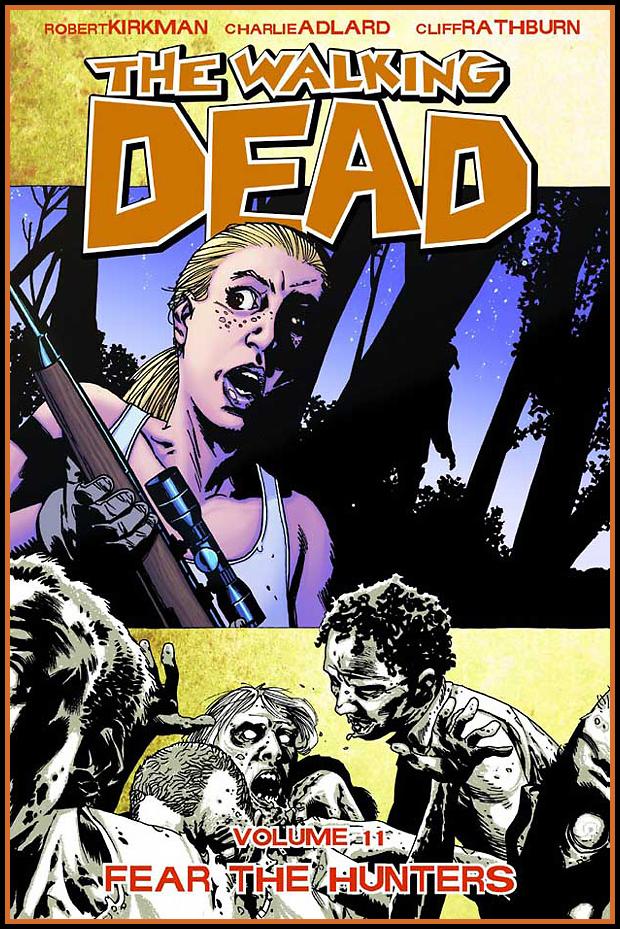
There’s always been one constant in Robert Kirkman’s award-winning and fan favorite comic book series for Image Comics. The Walking Dead is not all about the zombies which dominate the background and always present an ever-looming danger to the survivors. No, the series has always been about the characters of the survivors and how they’ve had to cope with the apocalyptic setting that’s turned their world upside down. While the ever-present danger of the zombies have inflicted on Rick Grimes and his band of survivors their fair share of casualties it always falls to other human survivors to take the greatest toll on everyone.
Volume 11 of The Walking Dead has been titled “Fear the Hunters” and that is quite an apt title to the story-arc which dominates this volume. Collecting issues 61 thru 66, this volume brings the danger of other humans to the forefront. We’ve spent the last two volumes dealing with the ramifications and after-effects of the Governor’s attack on the prison and the subsequent fleeing of Rick and those who remain in his group. We’ve seen how the loss in life has finally taken enough of a toll on Rick that it’s started to manifest itself and he’s not sure how to deal with it. His son Carl has also shown that he’s had to grow up fast in this new world. While it’s definitely shown him to be a hardened survivor it has also shown how humanity and innocence has no place in this new world. Either one grew up fast to deal with the problem or become victim to it. Carl has chosen to be the former even if it means he’s trodding down a dark path his own father has tried to shield him from.
“Fear the Hunters” will end up taking several more original members from Rick’s group. All three deaths had a sense of inevitability to them but now they died still doesn’t diminish the shock of Kirkman once again proving that no one’s truly safe. The fact that Carl becoming used to all the violence around him was directly responsible for one of the deaths remains one of the most shocking sequences in a series full of them. It definitely brings up a possibility that father and son may one day come at crossroads when something will put them at odds with each other.
The one other thing about this volume which brings the darker side of humanity to the forefront is the aforementioned “Hunters” themselves. A band of human survivors whose will to survive has taken them past the precipice of whatever human decency they had left and brought them to a place which has made them worse than the zombies around them. They harass, terrorize and inflict damage on Rick and his people to the point that Rick’s own retribution once the two groups have finally come face-to-face for the final time will probably shock some readers. Readers who may still believe that decency and humanity still has a place in a world which has none.
As I read this story-arc I came to the conclusion that if I was in Rick’s shoes I don’t know if I would’ve done what he did. To say that his actions (though only hinted at in the illustrations) went beyond the pale would be an understatement. But I did understand why he did what he did and also why those who went with him either assisted or didn’t stop it. I feel like this story-arc has finally shown how those who have disapproved of Rick’s methods to keep the group alive have finally come to their very own conclusion that he has taken it upon himself to do some evil to protect the group and that it has taken a toll on him. The rest are now willing to take their share of this if just to help relieve Rick of some of the guilt he carries with him for his past actions.
This volume has been one of the strongest one in the series and shows why Frank Darabont and Gale Anne Hurd fell in love with the series to adapt it for tv. The Walking Dead is all about the characters and has tapped into a rich source of material about how people in general deal with adversity and how some rise above it while most fail in their attempts to remain human. Rick and those with him remain on the precipice but so far has kept enough of their decency not to go over it the way the “Hunters” obviously had done so. But they remain balanced on a razor’s edge and sooner or later Rick or someone he’s close to will go over and that would make a tragic situation that readers will have to deal with whether they want it to happen or not.
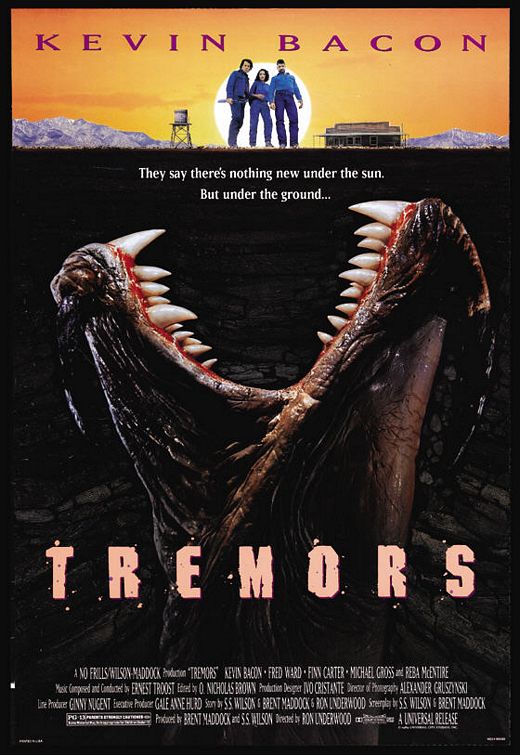
I just happened to catch one of my favorite creature-feature films on cable this morning and I had forgotten just how much fun this film was and is to still watch. I am talking about 1990’s horror-comedy Tremors by director Ron Underwood (who would follow it up with the very successful and funny City Slickers a year later) and starring the comedic duo of Kevin Bacon and Fred Ward. I was still in high school when I saw this in the theaters and even then this film had me from the get-go.
Tremors is a throwback to all the Saturday matinee creature-features and monster mash films that were huge during the 50’s and through the 60’s. It’s plot was simple enough that even a little kid could keep up with what was going on. We had a small, rundown mining town in the middle of nowhere (it always happens to be one of those small desert or valley towns which dotted the landscape once the national interstate was completed) whose fortunes have seen better days, hell better decades from the looks of it. The town has its cast of characters with Fred Ward and Kevin Bacon’s roles of Earl and Val the two main leads. We even get long-time genre actor Victor Wong in a supporting role as the town’s only store owner and also it’s two-bit hustler always looking to find a new way to make a buck. One of the funniest roles goes to Michael Gross (the dad in the 80’s hit family show Family Ties) who, with Reba McEntire as his wife, play some crazy-ass survivalists who try fighting off the creatures of this feature the giant, underground worms the survivors have dubbed “Graboids” for their propensity to grab people and animals with prehensile tentacle like appendages which shoot out from their mouths.
No, Tremors wasn’t some live-action version of the ever popular hentai, though I wouldn’t be surprised if the writers of the film were subconsconsciously influenced by them. What the film ended up being was one of the funnier horror comedies which ended the 80’s and announced the 90’s. It was also one of the last few great non-CGI creature features to come out of Hollywood. The Graboids were definitely animatronic and rubber-suited props, but they moved and looked real that one didn’t question whether they were real or not. It would be these creatures who would end up the stars and highlight of this film (the ensemble cast a good second) and follow-up sequels would and could never live up to it. It didn’t help that the sequels ended up using too much CGI which just ruined the illusion built-up by the original.
So, if you ever feel bored and suddenly see that one of the many basic cable channels are showing this little horror-comedy gem from the 1990’s I recommend you watch it with snacks and drinks on hand. There are many ways to make one stop being bored by watching something on the “Tele” and I say Tremors is one of those ways.
Scott Stewart’s film about the Biblical Apocalypse was one film that I was very hyped to see in the first weeks of 2010. I had heard some very good buzz about it when a red band sizzle reel was shown in at 2009 San Diego Comic-Con. This was Stewart’s first major work (he had made a smaller film in 2000 called What We Talk About When We Talk About Love) and with his background in the special effects industry I thought that this film of his would at least be a feast for the eyes. I knew going in what to expect from something about God, Angels, the Apocalypse and uneding amounts of guns and ammo. So, it was with a profound disappointment when I finally saw Legion and, despite my low expectations, was roundly disappointed with everything about it.
Legion is about God deciding that he’s had enough of humanity’s bullshit and shenanigans (a term I would put on this film) and turned his angelic hosts loose upon the world to start things new. This was God’s version of shaking the Etch-a-Sketch that is the world. He has his two favorite Archangels in Michael and Gabriel leading the vanguard of this Apocalypse with Michael tasked with making sure a baby doesn’t get born before the divine enema has been completed. Well, Michael being the introspective sone decides that he still has faith in humanity and refuses to do God’s bidding. We see Michael go through removing his wings (which also unlocks the very BDSM God collar all the angels wear) then find a huge cache of weapons inside a toy company warehouse. Seems removing the wings makes him human and minus all the cool angelic powers. He says something about the Apocalypse having started then makes off towards Bethle…I mean the diner out in the Nevada desert to protect the prophesized baby who will save humanity.
Yeah, the premise for Legion sounds awesome on paper. Militant angels led by badass Archangels like Gabriel about to go “Terminator” on mankind. The story itself was like a mish-mash of some of the best cult fantasy/horror of the past. There’s some of the cool Christopher Walken film Prophecy in the plot and, of course, one cannot but see some parallels with Cameron’s Terminator. Plus, we have a humanized Archangel Michael with guns and guns and guns to battle his former brethren with his coterie of human sidekicks to help out. The trailer for this was very cool and full of action. A trailer which pretty much had all the cool parts in this film. One can watch the trailer and actually enjoy Legion more than when they watch the film itself.
For a filmmaker with a special effects background the film looked pretty lifeless with action sequences that lacked any sort of memorable action. The dialogue wasn’t awful, but everyone’s performance made it sound worse than it really was. Even Bettany in the lead role of Michael looked tired and bored with his role (a sign the film was going downhill and downhill fast). The possessed humans who made up the bulk of the opposing force against the good guys were uninteresting with the exception of Doug Jones’ “Ice Cream Man” character shown in the trailer. A scene the trailer pretty much showed almost in its entirety. That character was on the screen for less than two minutes then gone.
I actually think that people should just watch the trailer for Legion then pop into their dvd player Prophecy and Terminator. Doing that will pretty much give them the whole story of Legion and have a kick-ass time doing so. This was a film that looked good to great on paper, but once they actually started writing the script and started filming went down the septic tank. It’s films like these that makes one shout “shenanigans” at all those involved in its making. I think Kyle Broflowski would agree with me.
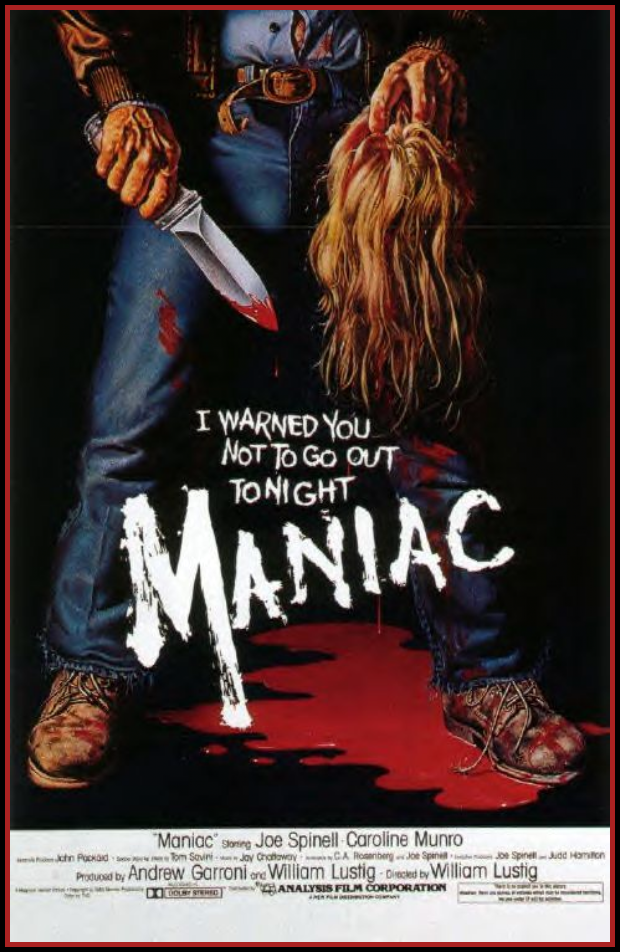
The newest flick to make “The Daily Grindhouse” is the controversial slasher/splatter offering from one of the 1980’s masters of the American grindhouse cinema. William Lustig’s Maniac definitely fits the criteria of what makes a grindhouse flick.
Lustig’s flick helped start the so-called “splatter film” subgenre in horror. While more mainstream (and I used that term very loosely) horror like Friday the 13th and Black Christmas brought the “slasher film” genre to the public eye it was the release of Maniac which gave “splatter” the notoriety it craved. It was a flick which was released by it’s distributor as unrated since they refused to let the MPAA screen it for certification knowing the it would automatically get the dreaded “X-Rating”. This rating would kill off any attempt for it to get shown in cinema theaters (even some owners of grindhouse theaters would deny to screen it). But it was a colleague of special effects and make-up artists (also an actor in Maniac) who gave Lustig and it’s distributor the backdoor way to get the flick seen.
George A. Romero’s classic epic zombie film Dawn of the Dead was released unrated and it still made quite the box-office haul that it gave future filmmakers a way out of the MPAA’s X-Rating hell. Maniac would get the same treatment and, while it didn’t get quite the box-office success as Romero’s zombie opus, it did make enough coin to be become one of Lustig’s moderate successes.
The flick was controversial not just for the decision to release it unrated but also for the label of misogyny it received from film critics who did see it. It didn’t help Lustig’s cause that the film was practically about a pyschotic and schizophrenic man who murders and scalped beautiful women to help decorate the mannequins he kept in his home. This flick was the grindhouse version of Hitchcock’s Psycho (to me a film that would be grindhouse if not for Hitchcock being the filmmaker thus given classic status by the elite cineaste crowd) and where Hitchcock kept the violence as something to be imagined Lustig went for the jugular and showed everything.
The most controversial scene would forever be the slow-motion sequence of Joe Spinelli’s killer, Frank Zito, taking a shotgun and shooting Tom Savini’s character point-blank in the head. The scene was so horrific and realistic in its execution that people left the theater right after the scene ended thinking even worse things were to be shown for the next hour (acclaimed film critic Gene Siskel left right after that scene). Tom Savini’s experience as a combat photographer during the Vietnam War gave him the necessary know-how to create the “Disco Boy Scene” so realisticly and which made him one of the early “fathers of the splatter genre”.
Maniac would propel Lustig to cult-status in the horror genre not because of the quality of his work, but for how he pulled no punches in showing the violence in his films even if got him labeled misogynistic and exploitative in mainstream cinema. His flicks were average for the most part, but they were definitely grindhouse in that they spoke to the most base denominator and that’s sex and violence sells and he didn’t sugarcoat it.
In 2008 a little film from Sweden swept through the film festivals and earned a rightful and well-deserved place in many film critics and film circles “best of 2008” and “top ten” lists. This was Swedish filmmaker’s film adaptation of the John Ajvide Lindqvist vampire novel, Let The Right One In. It was a vampire film that appealed not just to horror genre fans hungry for a vampire film that was the polar opposite of the current “Twilight” vampire craze. Horror fans wanted something that wasn’t watered down and emasculated to better appeal to the tween girl set. So, Alfredson’s vampire film was embraced by these horror fans and when news came that the rights to the novel was licensed by British-studio Hammer Film and an American-remake was set for production the reaction was decisively negative.
Fans of the original Swedish film were quite protective of the film and saw any plans to remake it for the North American audience as a cynical cash-grab. Their argument was that the original film was such a great one that there should be no need to remake it. Why fix something that wasn’t broken was another point made. It didn’t help the side of those supporting the remake that Matt Reeves was chosen to direct the remake. Reeves was better known as J. J. Abrams friend (some would say Reeves owes his success to Abrams and that he was coattailing the successful producer-director) and the director of the POV monster film, Cloverfield.
As strident fans of the original continued to vent and complain about the remake already failing (despite not an inch of film being shot) the producers were gradually filling the roles in the remake with some very interesting names. Fresh off her break-out performance in Kick-Ass was Chloe Grace Moretz taking on the role of Abby (the vampire child in the original was named Eli) with Kodi-Smit McPhee (The Road) taking on the role of the young boy Owen who befriends her. One name after the other filled out the cast with some very good veteran actors from Elias Koteas to Richard Jenkins (taking on the role of Abby’s Renfield).
Matt Reeeves’ version of Lindqvist novel from Alfredson comes from using the novel itself as the base for the screenplay Reeves himself wrote for the remake. While Let Me In shares many similarities in characters and situations from the original Swedish film, Reeves film does use more of the themes and details from the novel than Alfredson did for his adaptation. Let Me In definitely has enough about it which will distinguish itself from its Swedish counterpart and stand on its own.
The film switches locales from a suburb of in Sweden to a snowy Los Alamos, New Mexico (yes, it does snow in New Mexico). We learn quickly that Owen has become quite the loner due to the constant bullying by classmates. He spends time alone in the plaza area of the apartment complex he lives in with his mother (played by Carla Buono who we never fully see). He fantasizes of getting back at those who have and still bullying him even to the point that he buys a small pocketknife and practices his retribution on one of the trees in the plaza. It’s during one of his nighttime practices with the pocketknife that he first encounters Abby. There’s a certain wariness during their encounter with Abby proclaiming that Owen will not become a friend. But in time the two do become friends with Abby becoming quite protective of Owen once learning about the bullying he has to endure on a daily basis.
The change in Abby’s relationship with Owen doesn’t sit well with Abby’s Renfield. He asks Abby never to see Owen again as he goes out to procure Abby more fresh blood (a previous attempt goes awry forcing Abby to go out into the night to hunt). It’s in the scenes between Abby and Jenkins character that we see more of the duo’s relationship mirroring the novel’s. The novel explores the theme of pedophilia and while Reeves adaptation wasn’t quite obvious about it there are clues and small character interactions which hint at this pedophilic relationship which the Swedish original never really touched upon.
It’s in these small character interactions that Reeves’ film begins to differentiate itself from Alfredson’s version. The narrative between the two films still remain the same, but Reeves’ version explores the darker themes in the novel source while Alfredson concentrates more on the growing relationship between the two primary characters. These differences could be seen in how Reeves films Abby’s attacks while hunting her prey to be more animalistic (though at times the CGI seems too apparent when Abby attacks) and Abby’s subtle manipulation of Owen. I say manipulation because Abby seems very intent on trying to befriend and put Owen at ease despite the earlier comment that they will never be friends. Not to mention her Renfield admitting to Abby that he has gotten tired of what he has done to keep Abby safe and that maybe he wants to get caught to just end it all.
The film moves along quite leisurely but with a sense of growing dread not just between Owen and his bullies, but between Abby, her Renfield and those suspecting the duo. Owen gets caught in the lives of these two newcomers and soon gets confronted by Abby’s true nature and his own reaction to this. It’s a reaction that at first shows Owen fearing Abby and wanting to escape the growing bond between the two of them, but seeing how Abby’s been nothing but helpful to Owen he chooses to remain at her side. Abby rewards Owen’s protective nature by saving Owen from a near-deadly encounter with the school bullies at the school swimming pool.
This is the one sequence in Reeves’ film which many fans scrutinized to no end. The original film shot the scene with an almost arthouse eye despite the obvious violence involved. It was a scene where Alfredson filmed it as “less is more” and let the audience’s imagination run wild. Reeves’ does the same but adds his own stylistic touches to the sequence. not too much to make it so different from Alfredson’s version, but enough that it’s not a shot-for-shot copy. Again Reeves’ chose to show Abby’s violent predator aspect in this scene, but still keeps the focus of the scene on Owen as he struggles underwater. It’s only once he is out that we see — just as he does — the aftermath of Abby’s promise to protect Owen.
The question remains whether this American-remake stands up to the original. In terms of storytelling it more than holds it own from the original film and at times actually surpasses Alfredson’s version. This Reeves version journeys through the darkside more than the original film. It definitely strips away much of the arthouse sensibilities of Alfredson’s film which made it such a beauty to watch even if at times the narrative became more than too slow to keep one’s attention. Reeves’ adaptation doesn’t ramp up the pacing of the film, but keeps it moving forward even if at a gradual pace. When violence does occur in the remake it happens quickly and with a sense of brutality that the original film fails to deliver. The remake doesn’t linger on the gore and violence, but does show enough of it to remind everyone in the audience that this is a horror film first and foremost.
If there was one quibble to be made about this remake its that Reeves relies too much on CGI to show Abby at her most dangerous. Each attack made by Abby was shot at a wide-angle and we see every move but with each move done using CGI which gives it too much of an artificial look to it. It’s a testament to Moretz’ performance as she switches from a friendly Abby when interacting with Owen during their time together at night to one of a predator older than anyone in the film doing what was necessary to attain the blood needed to survive. Reeves could definitely have used less CGI and went for a more natural approach using sudden edits to show the ferocious nature of Abby’s attacks.
The film’s cast does a great job with the roles given to them. While it was Moretz’s and McPhee’s performances as Abby and Owen that keeps the audience’s attention and keeps it from wavering it’s the supporting cast around them which provides the glue. Koteas as the detective who begins to suspect Abby as having to do more with the attacks than previously mentioned was very good, but in the end it was Richard Jenkins in the Renfield role who would steal every scene he’s in. His character’s fatalistic acceptance of his role when it came to Abby was palpable. We watch him do horrible things to people and to himself, but we also get a sense that he couldn’t stop on his own if he wanted to. He has been doing the role of blood procurer for Abby for so long that he doesn’t know what else to do. I will say that Jenkin’s with the garbage bag mask when out hunting for victims will be the images that will stick to people’s minds long after they’ve left the theater. Some will even unconsciously check the back seat of their cars at night before getting in.
In the end, this remake of Let The Right One In doesn’t feel, look and sound like the cash-grab that cynical fans of the original have proclaimed it to be. Matt Reeves does a great job in adapting more of the novel in his version and using some of the darker themes in that source to allow his film to stand on its own when compared next to Alfredson’s version. The performances by everyone involved was wonderful and keeps the story’s slow pacing from losing the audience. While this remake doesn’t have the arthouse quality of the original film it does have a certain grittiness to its look which lends quite well in pointing out how brutal the narrative really was not just in physical violence but in how one of the two leads manipulates the situation to benefit it’s survival even if there was some genuine affection between Abby and Owen. In the end, Abby gets everything and continues to exist for another boy’s lifetime.
Fans so vocal of their negative attitudes towards this film will not have their minds changed, but those keeping an open-mind will be rewarded with one of the better horror films of the year. If the original Swedish adaptation never existed I’m quite sure that all the accolades heaped on Tomas Alfredson’s film would be given to Matt Reeves instead. A remake should never be discounted because its one of an original that’s already lauded for its quality. There’s been bad remakes but thankfully Let Me In is not one of them.
Hentai: slang for the Japanese term “hentai seiyoku” which literally means sexual perversion. A word used by Western fans of anime to signify anime/manga as being of the pornographic variety.
In 1990, during my junior year of high school, I was introduced to a form of animation unlike anything I had known before—the darkly imaginative and transgressive world of hentai. While explicit Japanese media had existed long before, the particular title that marked my first encounter with the genre was Chōjin Densetsu Urotsukidōji. The work did not simply define hentai; it transformed how adult animation would be viewed by audiences in both Japan and the West.
Prior to its release, erotic or explicit manga had long circulated quietly within Japan, often categorized separately from mainstream entertainment. Yet when mangaka Maeda Toshio’s Chōjin Densetsu Urotsukidōji was adapted into animation by director Takayama Hideki in the late 1980s, something shifted. The result was a film that combined the grotesque, the apocalyptic, and the erotic into a single overwhelming experience. Takayama’s adaptation was not content to merely illustrate Maeda’s ideas—it amplified them into a fever dream of violence and desire that pushed the medium into territory rarely explored in animation.
This era in Japanese media was also defined by strict obscenity laws. Direct depictions of genitalia or explicit intercourse were prohibited, both in live-action and animation. To circumvent these limitations, artists employed mosaics or invented visual metaphors. Takayama approached the problem with disturbing creativity: he replaced human anatomy with monstrous, tentacle-like appendages. These served a dual purpose—they satisfied censors while reinforcing the story’s occult and otherworldly atmosphere. Inadvertently, this gave rise to one of the most infamous tropes in hentai culture: “tentacle rape.” What began as a method of evading censorship evolved into a symbol of perversion, horror, and fascination.
Though Maeda initially regarded Takayama’s interpretation as excessively cruel and sadistic, he expressed admiration for the director’s ability to explore the darker undercurrents of his story. In time, Maeda’s own works would adopt similar motifs, blending eroticism with the supernatural. His later projects—including Yōjū Kyōshitsu Gakuen, Adobenchā Kiddo, and the enduring Injuu Gakuen La Blue Girl—refined the sensibilities born from Urotsukidōji, mixing violence, humor, and demonic imagery. These works often shifted in tone but never strayed far from the genre’s defining combination of horror and sexual excess.
Chōjin Densetsu Urotsukidōji can best be described as a collision of disparate influences: the mythic nihilism of H. P. Lovecraft, the explicit confrontational style of Larry Flynt, and the occult transgression of Aleister Crowley, all underscored by the philosophical cruelty associated with the Marquis de Sade. The film’s narrative combines apocalypse with pornography, constructing a universe where gods, demons, and humans become locked in violent and erotic cycles of destruction and rebirth. It is both a nightmare and a spectacle, a work that examines desire as an extension of cosmic chaos.
Watching the OVA as a seventeen-year-old was an experience of shock and bewilderment. Nothing in my understanding of animation prepared me for it. The optimism and adventure of series like Robotech, Starblazers, and Voltron stood in stark contrast to the nihilistic intensity of Urotsukidōji. If such a term had been common at the time, “culture shock” would have described it perfectly. Yet beyond my initial disorientation, I recognized something compelling beneath the shock value—a strange vision that treated eroticism not as mere indulgence but as a reflection of human fear and fascination.
Takayama’s film succeeded because it used obscenity as both spectacle and metaphor. The sexualized violence was horrifying, but it also emphasized the collapse of moral order within its world. The boundaries between sensuality and monstrosity blurred, suggesting that both sprang from the same primal source. In this way, Urotsukidōji transformed its limitations into aesthetic strength. Censorship forced invention, and invention created symbolism: the tentacle became an image of corruption, domination, and inhuman desire.
When Urotsukidōji began circulating in the West through VHS imports in the early 1990s, it acquired immediate notoriety. For many international viewers, the notion that animation could contain such extreme imagery was almost unthinkable. Western audiences, accustomed to animation as a medium for children or adolescent adventure, suddenly encountered a work that combined cinematic brutality with mythology and eroticism. Owning or viewing it became an act of curiosity and defiance. Accessing such media often meant seeking imported tapes or attending small conventions—a process that only heightened its sense of exclusivity and taboo.
Not everyone perceived Urotsukidōji as art. Its reputation became divisive; for some, it represented the most exploitative and grotesque tendencies of Japanese culture, while to others, it was a bold exercise in creative freedom. Regardless of one’s stance, its influence was undeniable. The film inspired countless imitators, establishing a visual and thematic template for subsequent hentai and “erotic horror” animation. Even as later works diversified into comedy, fantasy, and romance, the long shadow of Urotsukidōji remained.
There is also a deeper irony in its legacy. The same adaptation Maeda once criticized expanded the reach and visibility of his creation beyond what any manga publication could have achieved. The collaboration between artist and director—however fraught—produced a convergence of imagination that shaped both the erotic and horror dimensions of modern anime. In a broader sense, it demonstrated that the animated form could explore the same depths of transgression, myth, and existential dread that live-action cinema often reserved for its most daring auteurs.
Seen through this lens, Urotsukidōji becomes more than a piece of pornographic shock cinema. It emerges as a cultural artifact—one that reflects how desire, repression, and fantasy intersect within specific historical and artistic contexts. The work exposes how censorship and creativity can collide to produce unexpected invention, and how audiences, whether through fascination or outrage, help define a genre’s legacy.
For those of my generation, encountering Urotsukidōji was a defining moment that reshaped perception. It suggested that animation could express not only beauty and adventure but also the darker instincts of the human psyche. What began as disbelief evolved into a kind of reluctant respect for its ambition. Beneath the grotesque imagery lay a thematic depth that continues to invite examination—questions about power, violation, and the thin line separating horror from desire.
Today, both Maeda Toshio’s manga and Takayama Hideki’s adaptation occupy a controversial yet essential place in the history of Japanese media. They are remembered not only for their sensational content but for their cultural and aesthetic audacity. The story of Chōjin Densetsu Urotsukidōji endures because it refuses simplification—it is at once abhorrent and visionary, obscene yet strangely philosophical.
From the most ardent anime historian to the casual viewer, its reputation persists. Whether reviled or revered, Urotsukidōji remains the ultimate symbol of hentai’s origins and its infamous reach. It stands as both a warning and a testament: that art, when unfettered by convention and driven by instinct, can explore places society dares not name.
Sadly, this DVD is now out-of-print and the people selling it on Amazon want you to pay something like $80.00 for it. That’s a shame because The Candy Snatchers is, arguably, one of the greatest films ever made. This is one of those movies that I desperately need to review but I’m still struggling to find the right words to express just how brilliant this movie is.
This trailer doesn’t really do justice to Django Kill which, quite frankly, is probably the strangest, most surreal western ever made. Yes, this film is even stranger than El Topo. However, I still like the pop art feel of this trailer.
Also known as The Nights of Terror, this is one of the more infamous examples of the Italian zombie genre. To be honest, this is an amazingly trashy, stupid movie but once you start watching, you can not turn away. This is another film I’ve been meaning to review for a while as I think it’s actually the most political of all the Italian zombie films. People tend to get some caught up with the whole incest subplot that they miss the whole Marxist subtext. And yes, the movie does include a title card that contains the word “profecy.”
I love this trailer. It is such a relic that I almost feel like it should be put in a time capsule. Plus, that whole “She corrupted the morals…” tag line is just so priceless.
When this 1975 movie was released on DVD, it was titled Boss. Well, that’s only half of the original title. I’ve never seen this movie (as the only westerns that interest me are Italian-made) but this trailer has always stuck with me because of the whole “Did I just hear that?” factor. However, after I first saw this trailer, I did some research and discovered that the movie was actually written and produced by the film’s star, Fred Williamson. So, that makes me a bit more comfortable with it.
Inferno is Dario Argento’s 1980 sequel to Suspiria. Inferno seems to bring out the extreme reactions in Argentonians — it’s either loved or hated. I happen to love it.
Below is one of the film’s best known sequences, the one where Irene Miracle ends up taking a surreal swim through a basement. To me, this sequence is almost Fulciesque in it’s dream-like approach (punctuated, of course, by one sudden grotesque shock at the end). Lucio Fulci’s The Beyond, which is often compared to Inferno, featured a similarly flooded basement.
Words of warning: This scene lasts 6 and a half minutes. Also, the first few minutes are nearly ruined by Keith Emerson’s bombastic score. Fortunately, once Miracle takes her fateful dive, Mr. Emerson is silenced.



 Through the Shattered Lens