“Rooted in medieval fears of Genghis Khan and the Mongolian invasions of Europe, the Yellow Peril combines racist terror of alien cultures, sexual anxieties, and the belief that the West will be overpowered and enveloped by the irresistible, dark, occult forces of the East”- Gina Marchetti, Romance and the Yellow Peril: Race, Sex, and Discursive Strategies in Hollywood Fiction (University of California Press, 1994)
First, a brief history lesson: The Yellow Peril was a particular brand of xenophobia that spread in the late 19th/early 20th century. Named by (of all people) Kaiser Wilhelm II of Germany, and given credibility during the Boxer Rebellion of 1900, this “fear of the unknown” basically said those “inscrutable” Chinese were going to come over and slaughter all the good white Christians and rape their women. Popular culture of the times played on these fears by depicting villainous Oriental characters as barbaric, opium-smoking deviants who…
I had high hopes for Pride and Prejudice and Zombies, the just-released film which, like the novel upon which it is based, attempts to combine Jane Austen and The Walking Dead. The source material was good. The cast — with Lilly James as Elizabeth Bennet, Jack Huston as Wickham, and Matt Smith as Parson Collins — was impressive. The trailers looked great, promising a combination of zombies, ornate costumes, and a very British sense of humor. Sadly, however, the ultimate film is a bit of disappointment.
Actually, it’s more than just a bit of a disappointment. It is a HUGE disappointment. To have so much promise and then to turn out so bland — well, it’s enough to make you wonder if maybe zombies have become so common place in popular culture that they’re no longer as interesting as they once were. Don’t get me wrong, as a symbol of the impossibility of escaping death, zombies are great nightmare fuel. But, when you see them in a relatively bloodless PG-13 film like this, you realize that it takes more than just a few random zombies to make an effective horror film.
Plotwise, Pride and Prejudice and Zombies is exactly what it says it is. It tells the same basic story as Pride and Prejudice, with the exception being that England is now under siege from zombies, the Bennet sisters have now been trained in how to kill zombies, Mr. Darcy (played by Sam Riley) is now Col. Darcy and he’s an expert at tracking down zombies and killing them, and Wickham is now more than just a cad, he’s a cad who wants to help the undead overthrow the living. As I typed all that out, I realized I was probably making the film sound a lot more fun than it actually is. And really, the movie should be fun but it’s not.
Director Burr Steers never manages to capture the proper tone for telling this story. The satire is never as sharp as it needs to be. The scenes that are meant to pay homage to Austen try a bit too hard to capture Austen’s style without contributing any of her insight and the romance between Elizabeth and Darcy is sabotaged by the fact that Sam Riley and Lilly James had absolutely no chemistry together. The scenes with the zombies are bland, largely because this is a PG-13 rated film and bloodless zombies aren’t particularly scary. A typical episode of The Walking Dead is more graphic than anything you’ll see in Pride and Prejudice and Zombies.
Which is not to say that there aren’t a few moments when Pride and Prejudice and Zombies kind of works. It has moments but they’re isolated and they never really come together to build any sort of narrative momentum for the film as a whole. Sam Riley is a bit of a dud as Darcy but Lilly James, Jack Huston, and especially Matt Smith all give good performance. (Smith, in particular, is so good as Collins that I would like to see him play the role in an actual adaptation of Pride and Prejudice.) Early on in the film, there’s a fun scene where the Bennet sisters destroy a horde of zombies and it actually strikes the right balance between comedy and horror. Before that, we get the traditional scene that we get in all Austen adaptations, of the Bennet sisters preparing for a ball and, in between lacing up corsets and discussing whether they will all be able find husbands, they also carefully conceal the daggers and knives that they will be carrying just in case they happen to run into any of the undead. It’s one of the few scenes that suggests what Pride and Prejudice and Zombies could have been if it had only found a consistent tone.
For that matter, I also liked the animated opening credits, which wittily explained how the zombies first appeared in England and, not surprisingly, suggested that it was all the fault of the French. And the film also had a fairly effective scene that shows up in the middle of the end credits and suggested what would might happen if Pride and Prejudice and Zombies 2 is ever put into production.
But ultimately, even those moments that worked only left me frustrated that the rest of the film did not. For all of its potential, Pride and Prejudice and Zombies disappoints.
Apparently, Ulli Lommel is taking a break from making low-budget serial killer biopics to make another sequel to his 1980 film, The Boogeyman! This sequel will be titled Boogeyman: Reincarnation, which is an improvement over the previous Boogeyman sequel, Revenge of the Boogeyman.
(As a film blogger writing about Ulli Lommel, I am now contractually obligated to point out that Revenge of the Boogeyman was largely made up of flashbacks to the first Boogeyman film.)
Now, here at the Shattered Lens offices, we have a long-running debate going over whether Ulli Lommel or Uwe Boll is the worst director of all time. Usually, I pick Lommel but let’s give credit where credit is due. Both The Boogeyman and The Devonsville Terror had plenty of spooky atmosphere. They certainly were far better than Curse of the Zodiac or any of Lommel’s more recent films.
(As a film blogger writing about Ulli Lommel, I am now contractually obligated to point out that Curse of the Zodiac is the worst film ever made.)
And the trailer for Boogeyman: Reincarnation may not look great but it doesn’t look as bad as most of Lommel’s films. In fact, I would even say that Boogeyman: Reincarnation looks almost good enough to be mistaken for a Bill Rebane film!
Anyway, here’s the trailer for Boogeyman: Reincarnation, which has no release date but which will probably end up on Netflix at some point in the future.
We celebrate the 6th year anniversary of the site and we continue a yearly holiday ritual over here at Through the Shattered Lens. I present to all of you readers, visitors and passer-byes the greatest holiday film ever created since forever, ever.
It is a film full of joy and happiness. Of giving and sharing with loved ones that which matters most. This is a film that best describes what Through the Shattered Lens stands for and works towards.
It even has a scene straight out of a Disney classic.
So, from all of us at Through the Shattered Lens….
So, I finally got a chance to watch Bait, the second episode of Ash vs. Evil Dead, and you know what? It will probably never happen because this isn’t exactly a traditional awards-bait show and, if the somber and ultraserious Walking Dead can’t get any Emmy love, I doubt that Ash vs. Evil Dead will ever do any better. But, seriously, Mimi Rogers totally deserves an Emmy for her performance in Bait.
I’m not sure which category she would win for. I guess Best Actress in a Comedy Series, though I think it’s a bit too simplistic to say that Ash vs. Evil Dead is just a comedy. It’s true that Ash vs. Evil Dead is full of funny moments and Bruce Campbell can make me laugh just by narrowing his eyes but, at the same time, there’s some pretty dark stuff going on in this “comedy.” And the Deadites are genuinely scary! It’s not just the makeup and the voices. There’s also the fact that they come to us in the form of the people that we love and, more often than not, they reveal the inner demons of our loved ones.
I mean, think about it. What if you had to choose between becoming a zombie or becoming a Deadite? I think I’d rather be a zombie. After all, a zombie is just a walking body. You may recognize the body but you know that the soul and the mind are no longer there. If I became a zombie, you could shoot me in the head without worrying about hurting my feelings. In fact, I wouldn’t even know that I was a zombie. And, if someone I loved became a zombie, I’m pretty sure that I could put them down if I had to. Because, again, a zombie is just a body without a personality. I mean, zombies can’t even talk!
But Deadites — oh my God! No way would I want to become one of those. Deadites still have a personality. You can’t shut them up. Up until they start drooling and talking in that evil voice, Deadites can still act like human beings. That false hint of lingering humanity would make it impossible for me to kill a Deadite.
I guess that’s why we’re lucky to have Ash Williams around. Ash is infamous for not being particularly smart but, as the Evil Dead franchise continually reminds us, his stupidity is his greatest strength. Ash doesn’t get caught up in the specifics. He doesn’t worry about the why. Instead, he just does what he has to do. He’s a blue-collar hero, in his way.
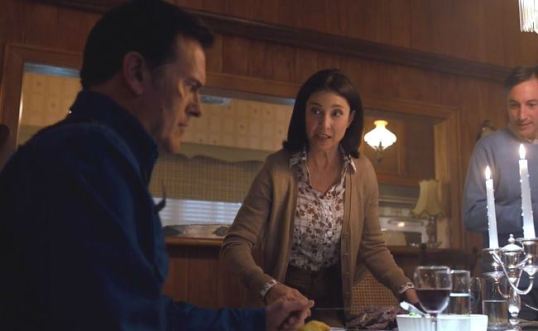
As for the 2nd episode of Ash vs. Evil Dead, it featured Ash and Pablo saving Kelly from her Deadite mom, played by Mimi Rogers. It took Ash a while to convince Kelly that her mom was actually a Deadite. In fact, Kelly didn’t really believe it until her mom stabbed her father in the eye with a fork.
What made this episode especially memorable was that Kelly’s mom was almost as scary when she was normal as when she was a Deadite. The scene where Ash, Pablo, Kelly, and the parents had an awkward dinner together was full of cringe-worthy moments. It was obvious that there were problems in the family even before mom killed dad. Becoming a Deadite allowed Kelly’s mom the chance to express her true feelings towards everyone.
Fortunately, Ash was there with his trusty chainsaw.
And, happily, he’ll be back on Saturday as well!
Which is good because Ash Williams may be our only hope…
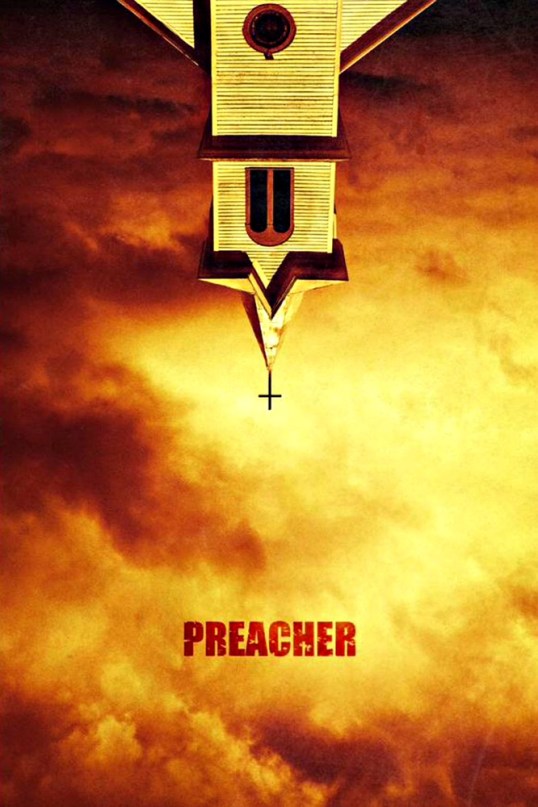
Preacher the comic book that came out in 1995 and became the title that everyone gravitated to to balance out all the superhero titles that were coming out from Marvel, DC, Image and every small publisher in-between. The book was written by Garth Ennis and drawn by Steve Dillon. It was the book that took on the institutions of the Church, government and family in the most irreverent and blasphemous way one could think of at the time.
The book had been talked of within Hollywood since it’s release as one title that producers (seems all of them at one time or another) wanted to adapt for the big-screen. It wasn’t a superhero title so there was no need to worry about trying to adapt tights-wearing heroes and villains. Yet, the book’s subject matter which tended to go into the extreme at times became something that kept the title from being adapted.
After almost two decades of futile attempts to get Preacher up onto the big-screen it took the star-power of one big-screen star (Seth Rogen) to finally get the book adapted, but not on the big-screen, but on the small-screen to become part of AMC’s stable of unique series titles (The Walking Dead, Better Call Saul, Into the Badlands).
So, fans of the books only have until 2016 to wait for their dreams of Preacher finally coming to live-action life and non-readers will finally see what all the hype has been all about.
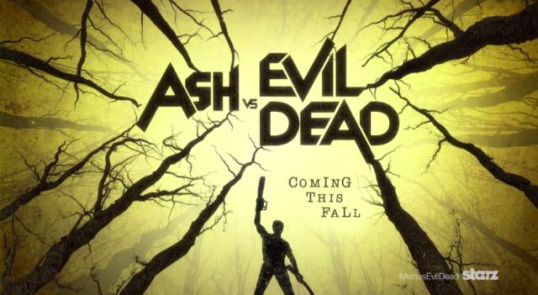
Last night, like all good horror fans, I sat down and I watched the premiere of the new Starz show, Ash vs. Evil Dead!
And it was groovy!
Okay, I’m sorry. I imagine that I am one of about 100,000 reviewers who started a review of Ash vs. Evil Dead by saying that it was groovy. That is probably the most obvious thing that I could have possibly said and, as someone who prides herself on being both an original and a contrarian, I should be deeply ashamed.
But I’m not. Because, seriously — groovy was the perfect description for this show. Even if it wasn’t the catch phrase of both Ash Williams and Bruce Campbell, it would still be just the right word to use. After all, when Ash vs. Evil Dead was first announced, I know that a lot of people were worried that the show would somehow fail to live up to the legacy of the Evil Dead. They were worried that Starz would attempt to unnecessarily update the concept or that they would go The Walking Dead route and come up with a dark drama about a grim-faced Ash Williams trying to survive in a world that has been overrun by Deadites.
Well, after seeing the premiere episode, the world does seem to be in danger of being overrun by Deadites but Ash Williams is anything but grim-faced. Perhaps he should be, since it’s all kind of his fault.
When the first episode of Ash vs. Evil Dead opened, we discovered that Ash was living in a trailer park and that actually seemed rather appropriate. We also discovered that Ash is no longer encouraging people to “Shop smart. Shop S-mart.” No, instead he’s working at Value Mart. His co-worker, Pablo (Ray Santiago) looks up to Ash even before Ash tells him about what happened during the first two Evil Dead films. His other co-worker, Kelly (Donna Delorenzo), is a lot less impressed by Ash but he certainly likes her.
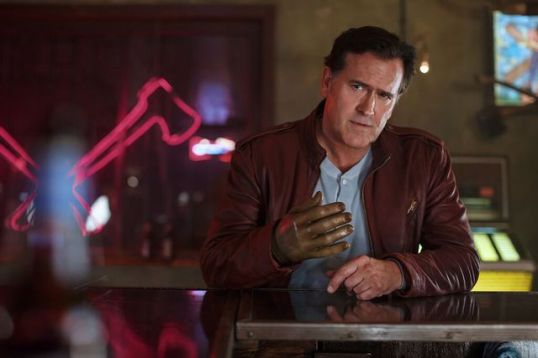
What does Ash spend his time doing? Well, he likes to go down to the local bar and make up stories about why he has a “rosewood” hand. And, during the first few minutes of the episode, he keeps seeing people suddenly transformed into Deadites. Even when he’s at work, he ends up getting attacked by an apparently possessed doll, a scene that allows Bruce Campbell to show off his flair for physical comedy.
Why are the Deadites back? Simply put, they’re back because Ash fucked up. That shouldn’t really be a surprise to anyone because that’s kind of what Ash does. (Fortunately, he’s played by Bruce Campbell so we love him anyway.) In this case, Ash was stoned and he decided to impress a one night stand by reading the Necronomicon Ex Mortis.
(If Ash actually learned from his mistakes, he just wouldn’t be Ash.)
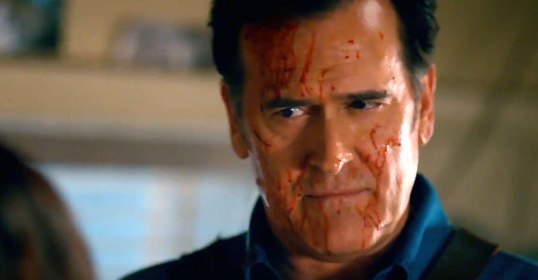
One thing I liked about the first episode of Ash vs. Evil Dead is that it didn’t waste any time getting right to what everyone wanted to see. It opened with the assumption that, if you were watching, you already knew about the twisted history of Ash and the Deadites. This episode was directed by Sam Raimi and it was full of everything that you could possibly want — cray camera angles, insane tracking shots, slapstick comedy, and blood. And I do mean a lot of blood. Whenever the episode threatened to get too serious, Bruce Campbell popped up with another bit of physical comedy or a strangely inspired line reading. Whenever things threatened to get too silly, a Deadite would suddenly show up and start screaming. (The Deadites are always scary, regardless of how much comedy may be going on around them.) Raimi and Campbell struck a perfect balance between comedy and horror.
I imagine that, for many, the premiere’s big applause scene came when Ash and his chainsaw met in mid-air. It was a perfect moment and hopefully, the rest of the series will follow the premiere’s lead.
Because if it does, this show is going to be really …. groovy.
What better way to end another month of horror here at Through the Shattered Lens than with a showing a the greatest music video ever made (not even a contest or a question). No matter what one’s personal opinion of Michael Jackson as a person there’s no denying the genius talent the man had and this video just speaks to the horror fan even if one was not into his music.
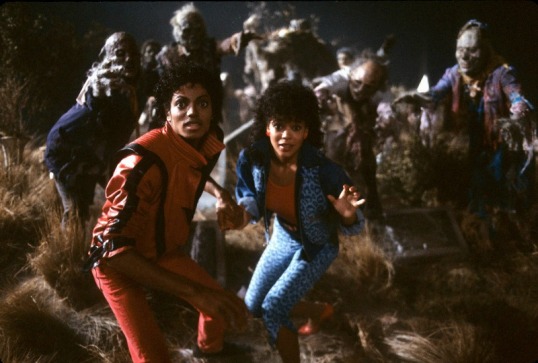
It has a werewolf (though here it’s a werecat), 50’s horror trope of the girl in distress, zombies, John Landis directing, Vincent Price with one of the best spoken word performance in a music video…and did I say zombies courtesy of make-up FX guru Rick Baker.
A music video that was more a short film plus horror musical, Thriller would become a cultural phenomenon that spread across the globe. It didn’t matter whether one lived in the US or the furthest corner of Mongolia. Everyone saw and enjoyed this music video. Even it’s detractors could only nitpick flaws from the final product.
Oh yeah, it has ZOMBIES!
Hope everyone had a great, happy and safe Halloween!
Thriller
It’s close to midnight, and something evil’s lurkin’ in the dark Under the moonlight, you see a sight that almost stops your heart You try to scream, but terror takes the sound before you make it You start to freeze, as horror looks you right between the eyes You’re paralyzed
‘Cause it’s a thriller, thriller night And no one’s gonna save you from the beast about to strike You know it’s thriller, thriller night You’re fighting for your life inside a, killer, thriller tonight, yeah
You hear the door slam, and realize there’s nowhere left to run You feel the cold hand, and wonder if you’ll ever see the sun You close your eyes, and hope that this is just imagination Girl, but all the while, you hear a creature creepin’ up behind You’re outta time
‘Cause it’s a thriller, thriller night There ain’t no second chance against the thing with the forty eyes, girl (Thriller, thriller night) You’re fighting for your life inside a killer, thriller tonight
Night creatures call and the dead start to walk in their masquerade There’s no escaping the jaws of the alien this time (They’re open wide) This is the end of your life
They’re out to get you, there’s demons closing in on every side (boom!) They will possess you, unless you change that number on your dial Now is the time, for you and I to cuddle close together, yeah All through the night, I’ll save you from the terror on the screen I’ll make you see
That it’s a thriller, thriller night ‘Cause I can thrill you more than any ghoul would ever dare try (Thriller, thriller night) So let me hold you tight and share a killer, diller, chiller thriller here tonight
‘Cause it’s a thriller, thriller night Girl, I can thrill you more than any ghoul would ever dare try (Thriller, thriller night) So let me hold you tight and share a (Killer, thriller)
I’m gonna thrill you tonight
(Vincent Price voiceover)
“Darkness falls across the land The midnight hour is close at hand Creatures crawl in search of blood To terrorize your neighborhood And whosoever shall be found Without the soul for getting down Must stand and face the hounds of hell And rot inside a corpse’s shell”
I’m gonna thrill you tonight (Thriller, thriller) I’m gonna thrill you tonight (Middle of the night, thriller) I’m gonna thrill you tonight Ooh, babe, I’m gonna thrill you tonight Middle of the night, babe
(Vincent Price voiceover)
“The foulest stench is in the air The funk of forty-thousand years And grizzly ghouls from every tomb Are closing in to seal your doom And though you fight to stay alive Your body starts to shiver For no mere mortal can resist The evil of the thriller”
Wow. It’s hard to believe that is going to be my final televised horror of the year. (Though I imagine this feature will return in October of 2016 — just in time for election season!) Well, let’s get right to it!
For our final televised horror, I have selected a classic episode of The Twilight Zone. In Nightmare at 20,000 Feet, William Shatner is a man who, though being scared of flying, finds himself on an airplane. And guess what he sees out on the wing?
This episode was written by one of Arleigh’s favorite writers, the great Richard Matheson. It was directed by Richard Donner and originally aired on October 11th, 1963.
Enjoy Nightmare at 20,000 Feet! And here’s hoping that all of our readers have had a wonderful, safe, and happy Halloween!
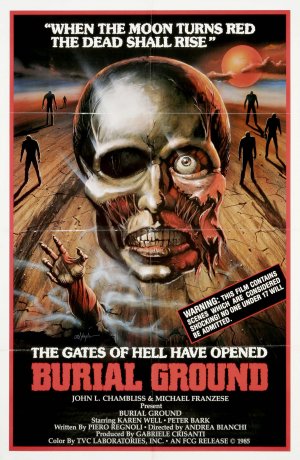
“For my final entry in October’s Daily Horror Grindhouse, I want to take a few minutes to tell you about an Italian zombie film from 1981. Burial Ground: The Nights of Terror is not very good but it certainly is memorable. I think it’s debatable whether or not any pleasure can truly be described as being guilty but if there ever was a movie that some people might feel guilty about enjoying, it would probably be Burial Ground.”
“Is that the movie with creepy kid in it?”
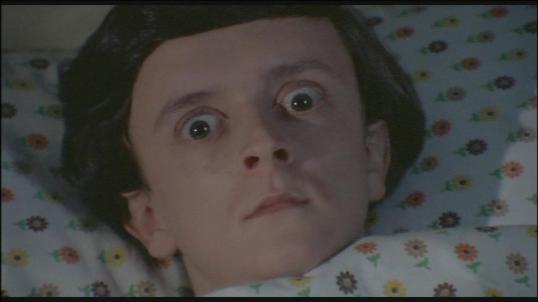
“Well, yes, one of the characters in this film is supposed to be a 12 year-old boy and yes, he’s kind of creepy. But you know what? Whenever anyone tries to talk about Burial Ground, everyone always wants to talk about the creepy kid. So, let’s hold off on the creepy kid…”
“That kid really is creepy…”
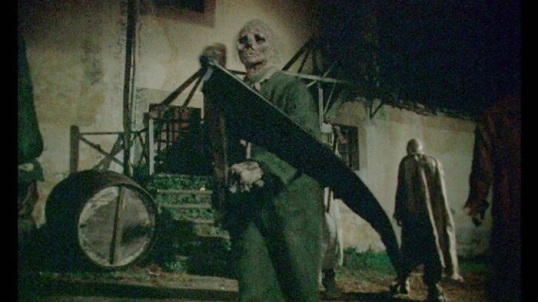
“Yes, I know the kid is creepy but there’s more to the film than just the kid! For instance, I wonder how many people realize that Burial Ground is perhaps the most blatantly political Italian zombie film ever made? I mean, let’s think about it. This is a film where a bunch of decadent rich people get trapped in a mansion — the same mansion that was used in Patrick Lives Again, by the way — and find themselves besieged by zombies. And who are the zombies? They’re the former workers. They’re the servants who used to toil in the fields and who died exploited and forgotten. And now, without any explanation, they’re suddenly back and they’re determined to kill everyone. And when it comes time to get inside the house, they actually use tools. They have scythes and hammers and all the former tools of their oppression. They are now using them to kill the rich. Well, not just the rich. There are two servants — a butler and a maid — who side with the rich and therefore, have to be killed as well because that’s the way things are in a revolution….”
“What was up with that kid?”
“We’ll get to him. No matter what else you say about Burial Ground, you can’t deny that the zombies were amazingly effective. I mean, they really looked like the living dead and, even if the ‘living’ actors were never quite convincing, the zombies were scary!”
“Not as scary as that creepyass kid…”
“You know, sometimes I think that y’all spend so much time going on about the weird little kid in Burial Ground that you tend to overlook some other fun parts of the film. For instance, there’s the scene Janet — played by Karen Well — gets her ankle stuck in a bear trap and, every time that her boyfriend Mark (Gianluigi Chirizzi) tries to pry it open, he accidentally ends up letting go and it snaps back shut on her ankle. On the one hand, I was having sympathy pains for poor Janet because, as a dancer, I know how much ankle pain sucks. On the other hand, I couldn’t help but laugh because the scene just goes on for so long that it actually starts to resemble a poorly-written SNL sketch. Plus, is it just me or does Mark look like a really young Jack Nicholson?”
“That creepy kid kind of looked like Dario Argento…”
“Yes, he did. But there’s more to this film than the kid! For instance, remember how it ends with this long quote from something called The Prophecy of The Black Spider but, on the title card, they misspelled prophecy…”
“Maybe the kid wrote that card…”
*Sigh* “Okay, I guess I should just admit the truth. The most memorable thing about Burial Groundis the creepy kid. The zombies may be effective. The film may be full of blood, nudity, bear traps, and misspelled words. But ultimately, it all comes down to the character of Michael. Michael is supposed to be 12 years old. He has a small body but he’s also got this weird adult face. According to the credits, he was played by an actor named Peter Bark and strangely enough, there seems to be next to no information available about him. This has led to rumors that Peter Bark was actually a little person or that all of his scenes used trick photography to make him look smaller than he actually was. According to Wikipedia, Peter Bark was actually 25 years old but he was cast because Italian law wouldn’t allow a child to appear in a film like Burial Ground. I don’t necessarily believe that, however. All I can say for sure is that Michael is a creepy little kid and the fact that he was obviously dubbed by an adult trying to sound like a child doesn’t help.”
“That’s not the only reason that Michael was creepy!”
“That’s true. He also has a few … icky scenes with his mother. She, by the way, was played by Mariangela Giordano. Like Giallo in Venice and Patrick Lives Again, Burial Ground was produced by her boyfriend, Gabriele Crisanti. For some reason, any film that he produced featured Mariangela dying in the most gruesome ways possible.”
“Plus, that little kid sure was creepy.”
“Yes, this is true. He certainly was. Happy Halloween.”
“Happy Halloween!”
“Before we leave, here’s two trailers for Burial Ground. The second one is the real trailer. The first one is all Michael.”




 Through the Shattered Lens