Cleaning Out The DVR, Again #6: Lemora (dir by Richard Blackburn)


Lemora_dvd_cover

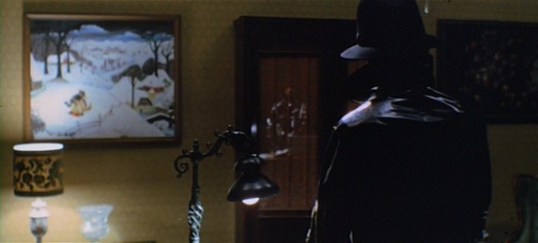
Continuing the process of cleaning out my DVR, I watched an odd little film from 1975 called Lemora.  I recorded Lemora on March 25th, when it aired as a part of TCM Underground.

Lemora opens with an odd scene that appears to be set in the 1920s.  A man dressed up like a stereotypical movie gangster (think Edward G. Robinson in Little Caesar) guns down another man with his tommy gun and then races off in his car.  After he crashes, he crawls into a dark forest where he is apparently captured by a mysterious, black-clad woman.

Suddenly, we cut to 13 year-old Lila Lee (Cheryl Smith), singing in church.  Lila is blonde, innocent, and has an almost heavenly singing voice.  Everyone listens to her with almost worshipful attention.  When the Reverend (played by the film’s director, Richard Blackburn) steps up to the pulpit, he announces that he knows what some people are saying about Lila and her father but that she is pure and innocent.

It turns out that the gangster is Lila’s father.  Lila hasn’t had much contact with her father.  Instead, she has been raised in the church by the Reverend.  However, Lila receives a letter from her father.  The letter claims that he’s dying and that he wants to see Lila and ask for forgiveness before he passes.  The letter also says that her father is in the town of Astaroth.

(You would think that, having been raised in the church, Lila would know that Astaroth is also the name of a legendary demon.)

Knowing that the Reverend would never allow her to go, Lila sneaks out of the house.  She stows away in the back of a couple’s car and listens as the couple gossips about her relationship with the Reverend, suggesting that the Reverend is just waiting for Lila to “turn legal.”  After she gets out of the car, she takes a bus the rest of the way to Astaroth.  Sitting on the dark bus, just her and the somewhat creepy driver, Lila listens as the driver tells her that the people of Astaroth have a certain look.

When she arrives at Astaroth, Lila finds herself being pursued by seemingly deformed vampires but she’s rescued by the mysterious Lemora (Lesley Gilb).  Or is she?  Lemora is the same woman who found Lila’s father in the forest and it soon becomes obvious that Lemora has plans for Lila as well…

Meanwhile, the Reverend discovers that Lila has run away and his reaction leads us to suspect that there may have been more than a little bit of truth to the conversation that Lila previously overheard in the car.  The Reverend sets out to track down and rescue Lila but, at this point, the viewer trusts him even less than they trust Lemora.

It’s a very strange movie and a difficult one to describe.  It’s a movie that creates its own unique and odd reality.  Lemora expects the viewer to conform to its style as opposed to conforming to the audience’s expectations.  Lemora‘s full name is Lemora: A Child’s Tale Of The Supernatural and it really does play out like a particularly nightmarish fairy tale.  Though the film was definitely low-budget, it’s full of strikingly surreal images.  The entire movie feels like a dream — everything from the almost campy, gangster-film opening to Lila’s strange journey on the dark bus to Lemora’s hypnotic stare to the sudden and shocking conclusion of the Reverend’s relationship with Lila.  The film has one of those endings that forces you to reconsider everything that you previously witnessed.

Much like Messiah of Evil, Lemora is one of those surrealistic and low-budget horror films that almost defies conventional criticism.  It’s a surreal dream of dark and disturbing things and one that everyone should see for themselves.  You may love it, as I did.  You may hate it.  But you will never forget it.

Cleaning Out The DVR, Again #5: We Are Still Here (dir by Ted Geoghegan)


1-we-are-still-here

The fifth film on my DVR was the 2015 haunted house film, We Are Still Here.  I recorded We Are Still Here off of the SyFy channel on March 20th.  Sad to say, I really can’t remember what I was doing or watching on March 20th while my DVR recorded one of the best horror movies of the previous year.  I was probably watching something pn Lifetime.  That usually seems to be the case.

But anyway, let’s talk about We Are Still Here.

As a self-professed lover of both horror and old grindhouse exploitation films, there is really no excuse for it to have taken me this long to see We Are Still Here.  We Are Still Here is one of those wonderfully low-budget indie films that mixes a traditional genre — in this case, the haunted house film — with a far less traditional view of humanity.  With its mix of bump-in-the-dark horror and cynicism about human nature, We Are Still Here feels like a mix of the Coen Brothers and H.P. Lovecraft.

Anne (Barbra Crampton, a veteran of horror films like Castle Freak and You’re Next) and Paul (Andrew Sensenig, who played the mysterious antagonist of Upstream Color) are a married couple who are struggling to deal with tragedy.  Their son, Bobby, was recently killed in a car wreck.  Anne is trapped in a prison of depression, while Paul just wants to move on with their lives.  Hoping that it will help them to forget their sadness, Paul and Anne buy a house in New England.

(New England, not coincidentally, was also the home of H.P. Lovecraft, as well as being the setting for some of his best-remembered stories.)

But, of course, the house proves to be anything but therapeutic.  From the minute they move in, Anne is convinced that they are not alone.  With every mysterious sound and strange happening within the house, Ann becomes more and more convinced that the spirit of Bobby is with them.

If you’re a horror fan, you will not be surprised to learn that they are not alone.  There is a presence in the house but is it Bobby or is it something far more sinister?  Shortly after moving in, Anne and Paul meet their new neighbors.  As friendly as they may be, there is definitely something off about Dave (Monte Markham) and his wife, Cat (Connie Neer).  Dave tells them that the house was originally a funeral home an about how it was owned by the mysterious Dagmar family.  The Dagmars were reportedly forced to leave town after it was learned that they were selling the bodies brought to them for burial and burying empty coffins.  Could this have anything to do with the strange vibe that Anne and Paul both get from the house?

Despite Paul’s skepticism, Anne invites her friends, May (Lisa Marie) and Jacob (Larry Fessenden), to come for a visit.  May and Jacob are both spiritualists and Anne hopes that they can contact Bobby’s spirit.  Again, it’s not a spoiler to reveal that they do contact something.  The surprise comes from what they contact and what happens as a result.

We Are Still Here is a chilly and dream-like film, one that wisely devotes as much time to creating and maintaining a properly creepy atmosphere as it does to all the expected scare scenes.  When the presence in the house is finally revealed, it’s a scary moment but for me, the most haunting scenes in the film are the shots of the snow-covered landscape surrounding the house.  The icy roads are as cold and unforgiving and as potentially dangerous as anything that might be living in the old Dagmar house.  And, just as the weather cannot be controlled, neither can the paranormal.

We Are Still Here is a deliberately paced film.  In fact, it’s probably a bit too deliberate to really be effective when viewed with commercial interruptions.  We Are Still Here works because it creates an atmosphere of foreboding and certain doom and it’s hard to maintain an atmosphere when, every 20 minutes or so, the action has to stop for a commercial about Tide pods.  To best appreciate this film and what it has to say about loss, faith, and delusion, it’s necessary to watch the story unfold without any pause to the narrative.

Fortunately, this intelligent and well-acted horror film is currently available on Netflix, where it can be viewed without commercial interruption!  If you’re a horror fan, you owe it to yourself to watch.

We-Are-Still-Here

Film Review: My Little Sister (dir by Roberto and Maurizio del Piccolo)


If there’s anything that I’ve learned, from my long history of watching horror films, it’s that only fools go camping.  Seriously, nothing good ever comes from wandering around in the woods or sleeping in a tent.  Inevitably, you’re either going to attacked by a zombie while you’re skinny dipping in the nearby pond or a man with a machete is going to show up while everyone’s busy having sex in a tent.  In short, nudity and the great outdoors equals death.

And really, it makes sense.  When you’re camping, you’re in an isolated place and you are totally at the mercy of the elements, the killers, and occasionally the zombies.  There’s a reason why so many horror films center around unlucky campers.  Because, seriously, camping is terrifying!

Just check out My Little Sister, for instance.

My Little Sister is the latest film from directors Roberto and Maurizio del Piccolo.  It opens in the wilderness, with shots of an old woman wandering through the woods.  The old woman looks happy but it’s a disturbing sort of happiness.  First off, she’s wearing a nightgown, which isn’t exactly the most practical wandering around in the woods outfit.  Secondly, her wrists are heavily bandaged.  And finally, she doesn’t really seem to have an easily identifiable reason for being out there in the woods.  She spends a while picking up leaves and smiling at them.  Occasionally, she crawls around in the dirty.  As we watch her, we occasionally cut to black-and-white photographs of an unhappy looking family and headlines about missing tourists.

While the old woman plays with leaves, something far more disturbing is happening in a nearby house.  In one room, a bound and terrified woman (Sofia Pauly) watches as her boyfriend is murdered and another woman is killed with a weed whacker.  Doing the killing is a hunched over, grunting man (Saverio Percudani) who appears to be horribly disfigured…

In another room of the house, an unmoving figure sits in front of a TV and watches grainy footage of a young girl holding an older man a bottle of what appears to be water.  The man pours the liquid on his face and suddenly starts to scream.  Hmmm…apparently, it wasn’t water…

Meanwhile, in the woods, campers Sheila (Holli Dillon) and Tom (Mattia Rossellini) watch as the old woman plays with the leaves and they laugh at her, which may seem mean but I think most of us would probably do the same thing.  Sheila and Tom are supposed to meet up with their friends but their friends are nowhere to be seen.  Instead, there’s just an empty campsite and an eccentric woodsman (David White) warning them to beware of someone that he calls the little sister…

Of course, all of these storylines converge but I’m not going to tell you how.  You may think that you’ve figured out some of it just by reading the review up to this point but My Little Sister has a few surprises up its sleeve.  There’s a little twist at the end that my horror-loving soul absolutely loved.  Let’s just say that, in this film, no one is every truly safe.

My Little Sister plays out like a mix of Friday the 13th, The Texas Chainsaw Massacre, and — believe it or not — Sinister.  At its best, My Little Sister achieves a dreamlike intensity.  The wilderness is filmed to look both beautiful and threatening at the same time and the scenes in the house, in particular, are pure nightmare fuel.  When it comes to a film like this, the effectiveness depends on how much you care about the potential victims and fortunately, both Holli Dillon and Sofia Pauly give totally believable, sympathetic, and relatable performances.  As I watched them try to survive, I kept wondering what I would do if I found myself in the same situation.  I doubt it would end well.

Finally, there’s no way I can finish this review without making a special mention of Lucia Castellano, who gives a really good and genuinely surprising performance as the crazy old woman in the wilderness.  She is both frightening and sympathetic at the same time.

My Little Sister is a brutally effective and entertaining horror film.  Keep an eye out for it!

The Things You Find On Netflix: Hush (dir by Mike Flanagan)


Hush_2016_poster

Let me start by stating the obvious.  I have seen a lot of horror movies.  I love horror as a genre and, in fact, it was my love of horror that first led to me becoming a film blogger in the first place.  I have seen a lot of scary and shocking images onscreen.  I know the experience of watching a movie and screaming.  I also know the experience of watching a horror movie and being bored out of my mind.

I have also seen a lot of home invasion movies.  The home invasion genre is not a complicated one.  A group of people are isolated and trapped in their home while, outside, some terrible menace tries to enter the house.  Night of the Living Dead is a home invasion film.  The final 20 minutes of Straw Dogs (both the remake and the original) are home invasion films.  Michael Haneke made two of the ultimate home invasion films with two separate versions of Funny Games.  And, of course, we can’t talk about the home invasion genre without mentioning the brilliant You’re Next.

The home invasion genre works so well because, at its center, is a very real fear: the fear that, even within our own home, we are not safe.  When I get home, I am practically obsessive about checking to make sure that I always close and lock the door behind me but really, what good would that really do if someone was determined to get in?  Like everyone, I chose to believe that things like a locked door or a closed window is going to keep me safe but, honestly, if someone wants to get in, they’re probably going to find a way.  Locks and alarms and calls to 911 can only do so much.  Perhaps for that reason, home invasion movies always frighten me.  I can watch a zombie graphically devour someone in an Italian horror film and it doesn’t bother me at all.  But a well-directed home invasion movie?

That’ll keep me up for a week!

(And I know what you’re saying: “Lisa, if home invasion movies scare you so much, why do watch them?”  It’s a legitimate question and it’s something that I’ve often wondered myself.  I think, ultimately, it comes down to this: the only way to conquer our fears is to face them.)

With all that in mind, allow me to now come to the point of this review.  Last night, I watched Hush, which was just recently released by Netflix.  Hush is a home invasion movie.  Kate Siegel (who also co-wrote the script) plays Maddie, a writer who has been deaf and mute since she was 13 years old.  Still dealing with the a bad break-up, Maddie lives in an isolate cabin in the wilderness.  By day, she works on her second novel and occasionally visits with her neighbor.  And by night — well, on this particular night, she finds herself being watched by a man.

The Man (who is played by John Gallagher, Jr.) wears a white mask that gives him a permanent smile.  He carries a crossbow with him, a crossbow that has 8 notches on it.  When we first meet the man, he’s stabbing Maddie’s neighbor, Sarah (Samantha Sloyan), to death.  And now, he’s turned his attention to Maddie…

I say this without hyperbole: Hush is one of the scariest home invasion movies that I’ve ever seen.  The plot may occasionally seem familiar but director Mike Flanagan keeps things moving at an almost unbearably intense pace and he creates an atmosphere of such dread that you never feel truly safe assuming that anyone is going to survive the movie.  John Gallagher, Jr, who speaks with a deceptively soft voice, is terrifying as the Man.  The fact that he has no motives beyond his own sadism makes him all the more frightening.

But, ultimately, the reason the film works so well is because of Kate Siegel.  Kate Siegel gets an introducing credit in this film.  According to the imdb, Hush is not her first film but that introducing credit still feels appropriate.  Siegel is wonderful in the role of Maddie, giving a performance of such ferocity and empathy that Hush announces that a major talent has arrived and that Kate Siegel is a force to be reckoned with.

Hush is not always an easy film to watch.  The violence is visceral, the often spurting blood looks real and, when bones were snapped, it sounded disturbingly authentic.  Throughout the entire film, I found myself wondering what I would do if I was Maddie.  I cheered whenever it appeared that she might be able to escape the Man and I screamed whenever it became clear that she would not.  This is an intense and frightening home invasion film and one that all horror fans should see.  Hush captures our most primal fears and makes us wonder if we have what it takes to conquer them.

Hush will undoubtedly give me nightmares but I’ll take them.

4 Shots From 4 Films: Macabre, Demons, Demons 2, Dinner With A Vampire


4 Shots From 4 Films is just what it says it is, 4 shots from 4 of our favorite films. As opposed to the reviews and recaps that we usually post, 4 Shots From 4 Films is all about letting the visuals do the talking.

Happy birthday, Lamberto Bava!

4 Shots From 4 Films

Macabre (1980, dir by Lamberto Bava)

Macabre (1980, dir by Lamberto Bava)

Demons (1985, dir by Lamberto Bava)

Demons (1985, dir by Lamberto Bava)

Demons 2 (1986, dir by Lamberto Bava)

Demons 2 (1986, dir by Lamberto Bava)

Dinner With A Vampire (1987, dir by Lamberto Bava)

Dinner With A Vampire (1987, dir by Lamberto Bava)

The TSL’s Grindhouse: April Fool’s Day (dir by Fred Walton)


(Because of the nature of the 1986 pseudo-slasher film, April Fool’s Day, it’s impossible to really talk about the film without talking about the film’s ending.  As a result, this review will have spoilers.  The ending will be revealed.  The entire plot will be spoiled.  Do not read on if that’s going to be an issue for you.)

(Did you read the warning above?)

If not for the way that the film ends, April Fool’s Day would probably be a forgotten film.  It’s a slasher film that doesn’t feature much blood, sex, or any particularly flamboyant kills (though there’s a good reason for that).  Compared to most low-budget slasher films from the mid-80s, April Fool’s Day does have a surprisingly charismatic and likable cast but it’s rare that anyone watches a holiday-themed slasher film for the acting.  Up until the final ten minutes or so, April Fool’s Day is professionally done but somewhat generic…

But then you hit that ending and it totally changes the whole film.  It’s not a perfect ending.  In many ways, it’s probably one the most imperfect endings that I’ve ever seen.  It requires a massive suspension of disbelief.  It makes no logical sense. But dammit, I love it.  Almost despite itself, it’s a great ending and it confirms that April Fool’s Day is meant to be a satire and not a straight horror film.

For the first 80 minutes or so, April Fool’s Day plays out like the 100th variation on And Then There Were None.  Heiress Muffy St. John (Deborah Foreman, giving a wonderfully odd performance) invites a group of college friends to her island mansion.  They arrives on April Fool’s Day and they spend the first night dealing with Muffy’s strange sense of humor.  (Actually, Muffy and I both find the same things funny but I’ve been told that I have a strange sense of humor so, therefore, I assume that Muffy must have one too.)  Harvey, who prefers to be called Hal (Jay Baker), smokes an exploding cigar and discovers his bedroom has been decorated with newspaper articles about a car accident that he was involved in.  Jock Arch Cummings (Thomas F. Wilson) finds steroids hidden away in a medicine cabinet.  Nikki (Deborah Goodrich) comes across handcuffs in a dresser.  Nan (Leah Pinset), a serious-minded drama student, hears a baby crying in the distance and is reminded of her abortion, something that she believes that only Muffy knows about.

The next day, Muffy is now wandering around in a daze and her brother, Skip (Griffin O’Neal), has vanished.  Kit (Amy Steel, playing a similar role to her character in Friday the 13th Part Two) and Rob (Ken Olandt) think that they see Skip’s decaying body floating under the boathouse.  As the day progresses, Arch and Nan vanish and later turn up at the bottom of a well.  Harvey is found hanging from a rope.  Chaz (Clayton Rohner) is castrated and, while we’re not quite sure what exactly happens to Nikki, we do see that it involves a large puddle of blood.  Kit and Rob discover Muffy’s head in the basement and realize that they are being stalked by Muffy’s crazy twin, Buffy.

(Deborah Foreman is great in both of the roles.  As Muffy, she delivers all of her lines with just a hint of sarcasm and constantly seems to be silently laughing at a private joke that only she understands.  And when she’s Buffy — well, she’s totally batshit crazy.)

Being pursued by a knife-wielding Buffy, Kit runs through the mansion and finds herself in the drawing room.  And who is waiting for her but all of Buffy’s victims?  No, they’re not dead!  Instead, they’re alive and they’re all in a very good mood.  And Buffy is not Buffy.  She’s Muffy and she’s been Muffy all along.

That’s right, it’s all a huge elaborate joke!  Muffy does spend a few minutes explaining how the whole weekend was a dry run for her plan to turn her estate into a resort, one that will offer a weekend of fake horror.  But, ultimately, it all comes down to the entire movie being an elaborate joke.  I know, just from perusing some of the comments at the imdb, that there are some horror fans who hate the ending of April’s Fool’s Day.   But, really, that’s the only “honest” way that a film like April Fool’s Day could end.  If the movie was called Thanksgiving, I could understand being upset.  But this is an April Fool’s Day movie!  It has to be a joke.

Of course, if you think about it too much, the ending makes no sense.  Muffy specifically states the no one was in on the joke until the last minute.  Whenever one of her friends would wander off on their own, Muffy would grab them, explain the joke, and get them to play along.  When you consider the size of the island and where, at various points, the victims are in relation to the other characters, Muffy must be a very fast explainer, as well as being very persuasive.  (As well, Harvey brings a gun with him to island.  Muffy jokes about nearly getting shot by him but imagine if he had been successful?)  Even if you accept that all of the friends — even Arch and Harvey, who are both kinda dumbasses — would be able to play along without screwing things up, you have to wonder why Muffy thought it would be a good idea to use dark secrets from everyone’s past.

If you search far enough online, you can find all sorts of rumors about the film that April Fool’s Day was originally meant to be.  In the finished film, Skip is a bit of a cipher but, in the original script, he was a much more complex character.  While Muffy was busy playing her elaborate prank, Skip was planning on killing Muffy and claiming their parent’s inheritance for himself.  The crying baby, the drugs, the incriminating newspaper articles; all of them were originally meant to be the work of Skip.  While Skip’s subplot was dropped, the dark secrets of the past were not.  As a result, Muffy comes across as being a lot more cruel than was originally intended.

Originally, the film was also meant to end with Skip killing Muffy but the ending was apparently changed at the last-minute.  (Reports differ on whether or not the original ending was ever filmed.)  Instead, the film now ends with Muffy stumbling into her bedroom, playing with a jack-in-the-box, and then getting a knife drawn across her throat by Nan.  It’s just another elaborate practical joke and, once Muffy realizes that she’s not dying, Nan gives her a quick kiss and smiles enigmatically.

(A lot of imdb commenters — mostly males — have read a lot into that kiss, obsessing on a subtext that really isn’t there.  As opposed to being the homage to Blue Is The Warmest Colour that many commenters appear to believe it to be, it’s really just a friendly kiss, a way of saying, “I got you.”  Sorry, guys, that’s all there is to it.)

It’s an ending that would never be done today.  Today, all horror films have to end with the promise of a sequel.  Muffy might still get away with pulling an elaborate prank but Nan would definitely have killed her at the end of the film.  Her little smile would have said, “Wait for the sequel.”  And the modern version of that ending definitely would not be as effective.  In fact, it would be so expected that it would be damn near infuriating.  Instead, the ending of April Fool’s Day is good-natured and likable, which is appropriate because April Fool’s Day is a surprisingly good-natured and likable film.

After Nan’s final joke, April Fool’s Day ends with a song.  And here it is!  Enjoy and I hope everyone had a great April Fool’s Day!


An Exorcist TV pilot? What Sweet Hell is This?


fanart_twisted_exorcism_tshirt

I don’t wear hats but if I did, I would give a tip of the hat to my friends over at Horrorpedia for the news that apparently, a pilot has been put into production for an Exorcist TV show.

And then I would sigh.  Actually, that’s what I’m doing right now.

Seriously, an Exorcist TV show?  Which dumbfug toadsucker thought this was a good idea?  What damnable dumbfuckery is this?

Oh!  And hey, the pilot is being written by the same guy who wrote the Fantastic Four movie!  It gets even better!

For what it’s worth, here’s the plot description:

Two very different men — Father Tomas Ortega (Alfonso Herrera) and Father Marcus Lang (Ben Daniels) — tackle one family’s case of horrifying demonic possession and confronting the face of true evil…

To be honest, I could probably get enthusiastic if the show was a prequel about the early life of Father Merrin.  But this sounds more like a remake of Deliver Us From Evil and that movie was pretty bad!  I mean, not even Joel McHale could save that movie…

And seriously — what type of priest is named Marcus Lang?

Here’s hoping that Pazuzu puts a stop to this before the legacy of a true horror classic is tarnished any further.

Pre Code Confidential #4: Boris Karloff in THE MASK OF FU MANCHU (MGM 1932)


gary loggins's avatarcracked rear viewer

“Rooted in medieval fears of Genghis Khan and the Mongolian invasions of Europe, the Yellow Peril combines racist terror of alien cultures, sexual anxieties, and the belief that the West will be overpowered and enveloped by the irresistible, dark, occult forces of the East”- Gina Marchetti, Romance and the Yellow Peril: Race, Sex, and Discursive Strategies in Hollywood Fiction (University of California Press, 1994)

fu1

First, a brief history lesson: The Yellow Peril was a particular brand of xenophobia that spread in the late 19th/early 20th century. Named by (of all people) Kaiser Wilhelm II of  Germany, and given credibility during the Boxer Rebellion of 1900, this “fear of the unknown” basically said those “inscrutable” Chinese were going to come over and slaughter all the good white Christians and rape their women. Popular culture of the times played on these fears by depicting villainous Oriental characters as barbaric, opium-smoking deviants who…

View original post 887 more words

Film Review: Pride and Prejudice and Zombies (dir by Burr Steers)


Pride_and_Prejudice_and_Zombies_poster

I had high hopes for Pride and Prejudice and Zombies, the just-released film which, like the novel upon which it is based, attempts to combine Jane Austen and The Walking Dead.  The source material was good.  The cast — with Lilly James as Elizabeth Bennet, Jack Huston as Wickham, and Matt Smith as Parson Collins — was impressive.  The trailers looked great, promising a combination of zombies, ornate costumes, and a very British sense of humor.  Sadly, however, the ultimate film is a bit of disappointment.

Actually, it’s more than just a bit of a disappointment.  It is a HUGE disappointment.  To have so much promise and then to turn out so bland — well, it’s enough to make you wonder if maybe zombies have become so common place in popular culture that they’re no longer as interesting as they once were.  Don’t get me wrong, as a symbol of the impossibility of escaping death, zombies are great nightmare fuel.  But, when you see them in a relatively bloodless PG-13 film like this, you realize that it takes more than just a few random zombies to make an effective horror film.

Plotwise, Pride and Prejudice and Zombies is exactly what it says it is.  It tells the same basic story as Pride and Prejudice, with the exception being that England is now under siege from zombies, the Bennet sisters have now been trained in how to kill zombies, Mr. Darcy (played by Sam Riley) is now Col. Darcy and he’s an expert at tracking down zombies and killing them, and Wickham is now more than just a cad, he’s a cad who wants to help the undead overthrow the living.  As I typed all that out, I realized I was probably making the film sound a lot more fun than it actually is.  And really, the movie should be fun but it’s not.

Director Burr Steers never manages to capture the proper tone for telling this story.  The satire is never as sharp as it needs to be.  The scenes that are meant to pay homage to Austen try a bit too hard to capture Austen’s style without contributing any of her insight and the romance between Elizabeth and Darcy is sabotaged by the fact that Sam Riley and Lilly James had absolutely no chemistry together.  The scenes with the zombies are bland, largely because this is a PG-13 rated film and bloodless zombies aren’t particularly scary.  A typical episode of The Walking Dead is more graphic than anything you’ll see in Pride and Prejudice and Zombies.

Which is not to say that there aren’t a few moments when Pride and Prejudice and Zombies kind of works.  It has moments but they’re isolated and they never really come together to build any sort of narrative momentum for the film as a whole.  Sam Riley is a bit of a dud as Darcy but Lilly James, Jack Huston, and especially Matt Smith all give good performance.  (Smith, in particular, is so good as Collins that I would like to see him play the role in an actual adaptation of Pride and Prejudice.)  Early on in the film, there’s a fun scene where the Bennet sisters destroy a horde of zombies and it actually strikes the right balance between comedy and horror.  Before that, we get the traditional scene that we get in all Austen adaptations, of the Bennet sisters preparing for a ball and, in between lacing up corsets and discussing whether they will all be able find husbands, they also carefully conceal the daggers and knives that they will be carrying just in case they happen to run into any of the undead.  It’s one of the few scenes that suggests what Pride and Prejudice and Zombies could have been if it had only found a consistent tone.

For that matter, I also liked the animated opening credits, which wittily explained how the zombies first appeared in England and, not surprisingly, suggested that it was all the fault of the French.  And the film also had a fairly effective scene that shows up in the middle of the end credits and suggested what would might happen if Pride and Prejudice and Zombies 2 is ever put into production.

But ultimately, even those moments that worked only left me frustrated that the rest of the film did not.  For all of its potential, Pride and Prejudice and Zombies disappoints.