Horror Film Review: Cape Fear (dir by J. Lee Thompson)


There are two versions of Cape Fear out there.

The one that most people seem to know and which regularly shows up on cable is the 1991 version.  This version was directed by Martin Scorsese and features Oscar-nominated performances from Robert De Niro and Juliette Lewis.  This is the version that has De Niro speaking in a broad Southern accent and attacking people while speaking in tongues.  If you’ve ever watched a rerun of an old sitcom and wondered why the laugh track was going wild at the sight of a tattooed prisoner lifting weights in a cell while portentous music boomed in the background, it’s because you were watching a parody of Scorsese’s Cape Fear.

That, however, is not the first version of Cape Fear.

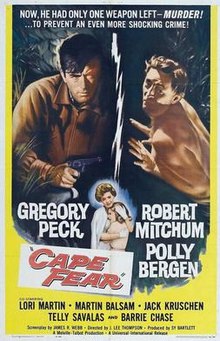
The first version of Cape Fear came out in 1962.  It was a black-and-white film that was directed by J. Lee Thompson.  In this version, the recently released rapist, Max Cady, is played by Robert Mitchum.  Sam Bowden, the attorney that Cady blames for his incarceration, is played by Gregory Peck.  Whereas the Scorsese version was highly stylized, the original Cape Fear is brutally straight forward.  (While Scorsese’s Cape Fear goes on for over two hours, the original Cape Fear tells its story in a brisk 100 minutes.)  While I think that Scorsese’s Cape Fear has its strong points, the original Cape Fear is superior in almost every way.

The original is certainly far more frightening than the remake.  What the original may lack in stylization, it makes up for in plausibility.  It’s scary because you can imagine everything in the film actually happening.  Robert Mitchum and Gregory Peck may both be iconic film stars but they’re also believable as human beings.

For modern audiences, it’s easy to smirk at Peck with his upright image and his sonorous voice but what made Peck a great actor was his ability to make it all seem natural.  Peck never seemed like he was acting like an honest man who always tried to do the right thing.  Instead, he simply was that man.  It’s perhaps significant that Peck played Sam Bowden the same year that he played another honest lawyer, Atticus Finch, in To Kill A Mockingbird.  The only real difference between them is that, whereas Atticus was always confident and sure of himself, Sam is frequently helpless.  He knows that Max is stalking him and his family and he’s just as aware that there’s nothing he can do about it.  When Max rapes a woman (Barrie Chase) that he meets at a bar, she refuses to testify against him.  When Sam’s dog turns up dead, everyone knows that Max killed him but there’s no way to prove it.  When Sam hires three men to intimidate Max, Max beats them up and promptly tries to get Sam disbarred.  When Sam finally resorts to plotting Max’s murder, we’re seeing Atticus Finch pushed beyond his limit.

As for Robert Mitchum, his animalistic performance is frightening precisely because it feels very real.  Everyone has known a Max Cady, even if they didn’t realize it at the time.  Max gives a fiercely physical performance, often appearing shirtless and strutting through his scenes with a sexual arrogance that’s both frightening and, at times, far more tempting than anyone would want to admit.  The scenes in which Max attacks Barrie Chase and Polly Bergen (who plays Peck’s wife) are absolutely terrifying but, for me, the most disturbing moments in Cape Fear are the moments when Max is silent.  Even when he’s not speaking, Mitchum allows you to see every depraved thought going through is head.

What’s the scariest moment for me?  When the camera catches Max watching Sam’s teenage daughter (Lori Martin).  It’s not just that I know what’s going on in Mitchum’s mind as he stares at her.  It’s because I know what it’s like to be watched.  It’s a scene that’s unsettling because it makes me consider just how many Max Cadys are out there right now.

The battle between Max and Sam is a fascinating one.  In prison, Max studied enough law to become as knowledgeable about how to manipulate it as Sam.  Under pressure, Sam grows more violent and more willing to circumvent his oath to uphold the same law that Max is now using against him.  It makes for a frightening  film, one that will stick with you long after you watch it.
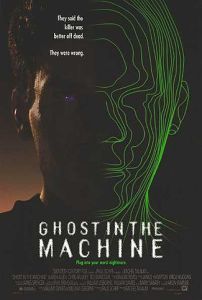
A Movie A Day #294: Ghost In the Machine (1993, directed by Rachel Talaly)


Karl (Ted Marcoux) is a serial killer who works in an electronics store and who steals address books and uses them to pick his victims.  His latest stolen address book belongs to Terry (Karen Allen).  Before Karl can start killing Terry’s family and friends, he is killed in a car accident.  Because there is a lightning storm going on at the same time, the dead Karl is able to transfer his evil soul into the electrical grid.  Traveling from appliance to appliance, Karl starts to kill all of Terry’s friends and co-workers.  A microwave oven.  A hand dryer.  A dishwasher.  If it is electrical, Karl can use it to kill.  Fortunately, Terry knows a legendary hacker (Chris Mulkey) who can help her fight back.

Like Prison, Destroyer, and The Horror Show, Ghost in the Machine is another dumb movie about a psycho who gets his soul transformed into electricity.  Ghost In The Machine was also obviously influenced by The Lawnmower Man and the entire movie is full of early 90s paranoia about the internet and computers in general.  Rachel Talaly, who got her start with the Nightmare on Elm Street franchise and who has recently directed some of the best received episodes of Doctor Who, does a good job with the deaths but cannot do anything with the lousy script and unlikable characters.  Nearly everyone who dies is killed because they know Terry but that never seems to bother her.

I think every 90s kid, or at least every 90s male, watched Ghost In The Machine on HBO and had a crush on Shevonne Durkin.

6 Trailers In Honor Of Val’s Search For The Evil Eye


Hi, everyone!

Welcome to another special edition of Lisa Marie’s favorite Grindhouse and Exploitation film trailers!

Today, for her music video of the day post, Val took a look at the video for Josh Ritter’s The Evil Eye.  I’m the one who suggested that video to her.  Little did I know that it would lead to her watching a handful of films, all of which were either titled Evil Eye or, at the very least, has a connection to eyes that might have been evil!

So, in honor of Val’s commitment to her craft, I decided that today’s six trailers would be for six movies that Val either watched or mentioned in her review of The Evil Eye!  Unfortunately, it turns out that not all of those movies have trailers on YouTube.   And I already shared the trailer for Mario Bava’s The Girl Who Knew Too Much (a.k.a. Evil Eye) last week.

Let’s see what I did find!

  1. Bruka, Queen of Evil (1973)

I could not find a trailer for Queen of Evil.  However, when I did a search for “Queen of Evil Trailer,” one of the trailers that came up was for Bruka, Queen of Evil.  I’ve never heard of this film before but it looks like something some of our readers would like.

2. Manhattan Baby (1982)

However, YouTube did have a trailer for Lucio Fulci’s Manhattan Baby, which was also known as Evil Eye.  Actually, Evil Eye was probably a better title for it.  I’m one of the few people willing to defend this film and even I’m unsure just what exactly Manhattan Baby is supposed to mean.

3. The Green Inferno (1988)

Val’s search for information about The Evil Eye led her to Bloody-Disgusting.com, which featured an infamous review of The Green Inferno.  Here’s the trailer for 1988’s Green Inferno, which should not be mistaken for Eli Roth’s Green Inferno.

4. The Green Inferno (2015)

Here’s the trailer for Eli Roth’s The Green Inferno, which I have long defended as being a political satire.

5. The Wicker Man (1973)

Among the films cited as an inspiration for The Evil Eye video was the original Wicker Man!  This is a classic, even without bees.

6. Evil Eye (2014)

Finally, though I couldn’t find a trailer for 1975’s Evil Eye, I did find a trailer for this 2014 Evil Eye!


Horror Film Review: From Hell (dir by The Hughes Brothers)


Who was Jack the Ripper?

That’s a question that people have been asking for 129 years.  Arguably the world’s first famous serial killer, Jack the Ripper killed at least five prostitutes in the Whitechapel section of London.  Some claim that he killed as many as twenty.  He may have also written several taunting letters to the police.  Again, some say that the letters are authentic and some say that they were hoaxes.  Hell, there’s even some people who say that Jack the Ripper himself is a myth and the five murders attributed to him were actually five unconnected crimes.  It was speculated that Jack the Ripper was a butcher, a surgeon, or maybe a midwife.  Just as suddenly as the murders began, they ended.  The London police claimed that he had committed suicide by jumping into the Thames.  Few people believed them then and even less now.

The reason that there is so much uncertainty is because Jack the Ripper was never caught.  He was never identified.  There were stories of confessions, though many of them came from the mentally infirm or they were heard by someone who was a friend of someone who claimed to be the Butcher of Whitechapel.  At one point, there was even a claim that Jack’s diary had been found.

As a horror fan, a true crime fanatic, and a lover of history, I’ve read quite a few theories about who Jack the Ripper was.  Nearly every prominent (or, at the very least, remembered) Victorian has been accused of having been Jack the Ripper.  Oscar Wilde has been accused of hiding a confession in The Picture of Dorian Gray.  Various members of the Royal Family have been fingered as the culprit.  Even Lewis Carroll could not escape accusation.  The true crime author Patricia Cornwell wrote an entire book where she (wrongly) accused the painter Walter Sickert.  Cornwell’s case could basically be summed up as follows: “Walter Sicket’s paintings were weird.  Walter Sickert must be Jack the Ripper.”  Apparently, she managed to destroy one of Sickert’s paintings while looking for clues.

The truth of the matter is that Jack the Ripper was probably some guy who no one has ever heard of, most probably one of the unknown men who lived and worked in the shadows of Whitechapel.  For all the talk of Jack being a doctor, it can be argued that the surgical precision of his murders has been overstated.  He didn’t get away with murder because he was particularly clever.  Instead, he got away with it because, in 1888, even fingerprinting was considered to be a radical science.

But, honestly, that’s not very intriguing.  For those of us who have researched the case, it’s far more interesting to speculate that Jack the Ripper was either a famous person or that the murders were all the result of a huge conspiracy.

That’s certainly the appeal of From Hell, the 2001 film from The Hughes Brothers.  Making the same basic case as Bob Clark’s Murder By Decree, From Hell argues that the Jack the Ripper murders were the result of a royal conspiracy.  In reality, that theory has been discredited but it certainly is the most cinematic of all the possibilities.

And, speaking of cinematic, it must be said that From Hell is very stylish movie.  Though the title comes from one of Jack the Ripper’s letters, From Hell also could just as easily be used to describe the film’s vision of Whitechapel.  Whitechapel is full of shadows and secrets and the blood flows freely.  If Mary Kelly (Heather Graham) isn’t killed by Jack the Ripper, it’s just as likely she’ll be killed by one of her clients.  Even as the murders are committed, life and business in Whitechapel goes on.  What other choice is there?  It’s either risk being killed or starve.

It falls to Frederick Abberline (Johnny Depp) to solve the murders.  The real-life Abberline was an almost legendary detective who lived for decades after the final Jack the Ripper murder.  The movie’s Abberline is an opium addict who always seems to be on the verge of a breakdown.  When he and Mary Kelly fall in love, you’re not really sure if it’s something to be happy about.  Abberline seems just as likely to go crazy as everyone else.

From Hell is an uneven and somewhat overlong movie but I like it.  Heather Graham and Johnny Depp give somewhat odd performances but the oddness fits right in with the Hughes Brothers’s vision of a world that’s been turned permanently upside down.  It’s a movie that’s full of atmosphere and the story is intriguing even if it’s never exactly convincing.  For obvious reasons, I can’t reveal who plays Jack the Ripper but I will say that he gives a very good performance.  When he says that, “One day, men will look back and say that I gave birth to the 20th century,” you believe him.

4 Shots From 4 Films: Special James Whale Edition


4 Shots From 4 Films is just what it says it is, 4 shots from 4 of our favorite films. As opposed to the reviews and recaps that we usually post, 4 Shots From 4 Films is all about letting the visuals do the talking.

This October, I am going to be using our 4 Shots From 4 Films feature to pay tribute to some of my favorite horror directors, in alphabetical order!  That’s right, we’re going from Argento to Zombie in one month!

Today’s director: James Whale!

4 Shots From 4 Films

Frankenstein (1931, dir by James Whale)

The Old Dark House (1932, dir by James Whale)

The Invisible Man (1933, dir by James Whale)

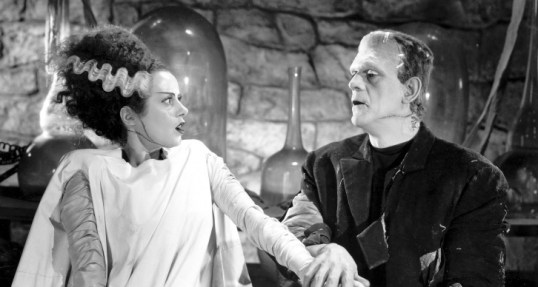
Bride of Frankenstein (1935, dir by James Whale)

Jedadiah Leland’s Horrific Adventures in The Internet Archive #23: Psycho (1988, Starsoft Development Laboratories)


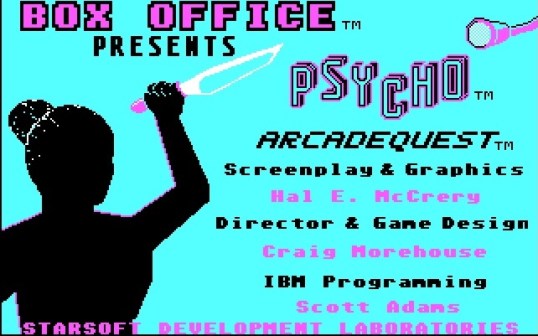
For my next horrific adventure in the Internet Archive, I played Psycho (1988, Starsoft Development Laboratories).

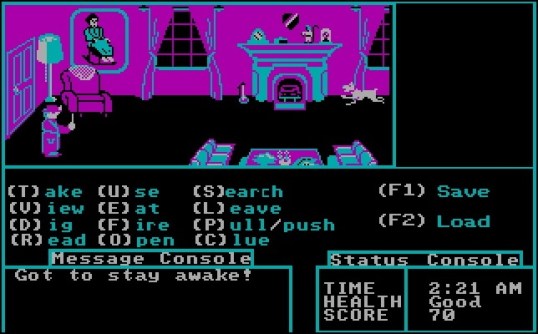
Psycho is an example of game that borrows a famous name but has next to nothing to do with its supposed inspiration.  Despite the picture above, you do not play Norman Bates in Psycho.  You are not Marion Crane, either.  You are not even Aborgast, Lila, or Sam.

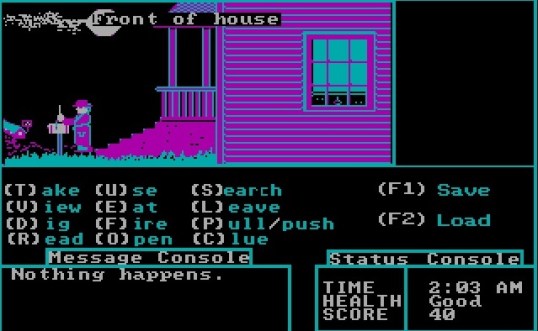
Instead, you are a nameless detective who is searching for some jewels that were stolen from a museum.  For some reason, you believe the jewels were stolen by Norman Bates and that Norman is holding a curator hostage at his motel.  (None of that sounds like Norman.)  You go to investigate.

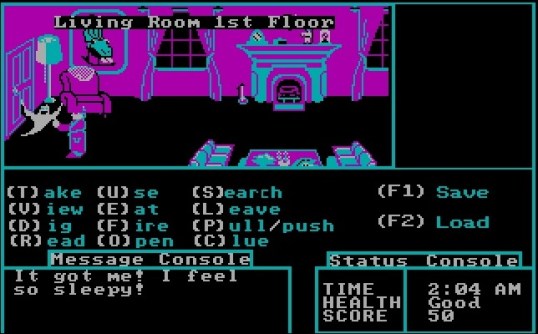
You have only four hours to find the jewels and rescue the curator.  Unfortunately, once you enter the house, you will be randomly besieged by ghosts, dogs, and other members of the Bates family.

If they touch you, you fall asleep for a period of time.  Somewhere in the game, there is a gun. If you find it, you can at least shoot at the ghosts.  Why wouldn’t a detective have his own gun?  I’m not sure.

Psycho the game has not aged well.  What was probably state of the art in 1988 now feels clunky and slow.

I do like the painting of Mother Bates, though.

Since first discovering it, I have tried to play Psycho on ten separate occasions.  Each time, I got frustrated with the slow gameplay and I quit.  Norman can have the jewels and the curator.  After all, he wouldn’t hurt a fly.

Horror on the Lens: The Little Shop of Horrors (dir by Roger Corman)


(It’s tradition here at the Lens that, every October, we watch the original Little Shop of Horrors.  And always, I start things off by telling this story…)

Enter singing.

Little Shop…Little Shop of Horrors…Little Shop…Little Shop of Terrors…

Hi!  Good morning and Happy October the 29th!  For today’s plunge into the world of public domain horror films, I’d like to present you with a true classic.  From 1960, it’s the original Little Shop of Horrors!

When I was 19 years old, I was in a community theater production of the musical Little Shop of Horrors.  Though I think I would have made the perfect Audrey, everybody always snickered whenever I sang so I ended up as a part of “the ensemble.”  Being in the ensemble basically meant that I spent a lot of time dancing and showing off lots of cleavage.  And you know what?  The girl who did play Audrey was screechy, off-key, and annoying and after every show, all the old people in the audience always came back stage and ignored her and went straight over to me.  So there.

Anyway, during rehearsals, our director thought it would be so funny if we all watched the original film.  Now, I’m sorry to say, much like just about everyone else in the cast, this was my first exposure to the original and I even had to be told that the masochistic dentist patient was being played by Jack Nicholson.  However, I’m also very proud to say that — out of that entire cast — I’m the only one who understood that the zero-budget film I was watching was actually better than the big spectacle we were attempting to perform on stage.  Certainly, I understood the film better than that screechy little thing that was playing Audrey.

The first Little Shop of Horrors certainly isn’t scary and there’s nobody singing about somewhere that’s green (I always tear up when I hear that song, by the way).  However, it is a very, very funny film with the just the right amount of a dark streak to make it perfect Halloween viewing.

So, if you have 72 minutes to kill, check out the original and the best Little Shop of Horrors