Welcome to Late Night Retro Television Reviews, a feature where we review some of our favorite and least favorite shows of the past! On Saturdays, I will be reviewing Saved By The Bell, which ran on NBC from 1989 to 1993. The entire show is currently streaming on Prime and Tubi!
This week, an important lesson is learned about credit cards.
Episode 1.2 “The Lisa Card”
(Dir by Don Barnhart, originally aired on August 28th, 1989)
Lisa’s father (Henry Brown) has given her his credit card and Lisa has charged way too much money on it! Now, she has to figure out how to raise the money to pay it off before he finds out.
I could relate to this episode. When I got my first credit card, I went crazy charging stuff to it. I’m still probably a little bit too quick to reach for it. To be honest, it wouldn’t be until I was 25 that I really came to understand that someone actually has to pay all that money back. I knew what Lisa was going through but I was still surprised at how all of her friends immediately came to her aid. What selfless friends! I can honestly say that, if a friend of mine needed that much money, I would probably not give it to them. Lisa got a job at the Max but Slater, Zach, Kelly, Jessie, and Screech ended up doing most of the work and they all did it for free. Maybe if they had all gotten a job at the Max (as opposed to just volunteering to help) they could have combined their paychecks and paid off that credit card. Zach also sells all of Lisa’s clothing, holding a sale in the middle of the school hallways. (“Closing them!” Zach shouts whenever Belding is nearby.) “Who wants this lingerie?” Zach asks. Screech pledges his life savings. Ummm, Lisa is like fourteen and Screech appears to be considerably younger. That’s kind of icky….
This episode was …. well, I was going to say it was dumb but every episode of Saved By The Bell is dumb. That said, it was dumb in a fun way. Lark Voorhees was always underused on Good Morning Miss Bliss but she really goes all out with this episode. Her nervous twitching when she learned all of her clothes had been given to charity (for free!) was something else to which I could relate.
In the end, Lisa’s father forgives her and Lisa gets upset because he’s not angrier. What? Lisa, you got away with it! Be happy!
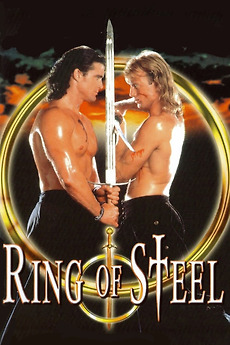
After Olympics-bound fencer Alex Freyer (Robert Chapin) accidentally kills his opponent, he is blacklisted from the sport. His career seems like it’s over until he’s saved from a mugging by the mysterious Man In Black (Joe Don Baker). The Man In Black says that he’s been watching Alex and he knows that Alex could be “the best.” The Man In Black isn’t talking about the Olympics, though. He’s talking about taking part in a series of underground sword fights, know as the Ring of Steel. Alex is all for it, until he learns how high the stakes actually are. The Man In Black is determined to keep Alex fighting so he abducts Alex’s girlfriend (Darlene Vogel).
This is one of the many “underground fighting films” that were made in the 90s. The plot is nothing special but the use of swords instead of fists does add an unexpected spark to the fight scenes. Robert Chapin, who also came up with the film’s story (and who wrote an original draft of the screenplay that was considerably darker than the film that was eventually made), was a stuntman and an accomplished swordfighter so the fights in RingofSteel feel authentic and are exciting even if the story is predictable. Joe Don Baker plays the villain, a character who actually is credited as being “The Man In Black,” and he does a good job tempting Alex to the dark side and then mocking his attempts to escape. Though I prefer Baker as a hero, he always really threw himself into his villainous roles.
RingofSteel used to show up on cable when I was a kid. I always made a point to watch it. It’s on YouTube now and it’s still an entertaining fight film.
Welcome to Late Night Retro Television Reviews, a feature where we review some of our favorite and least favorite shows of the past! On Tuesdays, I will be reviewing Baywatch Nights, a detective show that ran in Syndication from 1995 to 1997. The entire show is currently streaming on YouTube!
Some people stand in the darkness …. let’s get back to reviewing Baywatch Nights! I’ve missed talking about this silly show.
Episode 2.8 “Last Breath”
(Dir by Gregory J. Bonnan, originally aired on November 17th, 1996)
Lifeguards are disappearing!
After hearing the sounds of someone shouting for help in the distance, three lifeguards — including Donna — vanish while investigating. It’s assumed that they’ve drowned but Mitch has his doubts. And it turns out that Mitch is correct! This is an evil haunting the sea and yes, it’s stalking lifeguards.
What type of evil is it?
Is it a sea monster?
Is it a ghost?
Is it an alien creature?
How about a mutant octopus?
Maybe a dinosaur of some sort?
Could it be an unfrozen Viking or a vampire or a time traveler or a….
Well, you get the idea. And really, it should have been one of those things. The second season of Baywatch Nights was all about David Hasselhoff and Angie Harmon investigating supernatural ocean stuff. It was specifically designed to be X-Files on the beach. We’ve all heard the urban legend of the weeping woman who haunts lakes. As soon as the lifeguards heard those shouts, I assumed this episode would feature an ocean version of La Llorona.
Well, it turns out I was wrong. Instead, the lifeguard are being kidnapped by a man who blames them for the death of his family in a car accident. The madman (Brett Baxter Clark), who is not at all supernatural, is keeping the lifeguards trapped in a cage. (How do random madmen always manage to have a super-strong cage just lying around?) He wants to recreate the accident that led to the death of his family. Can Mitch track the cage down and rescue his lifeguards?
This episode was disappointing on many levels, with the main problem being that there was really nothing to distinguish it from a typical episode of Baywatch. All it needed was to open with that Some People Stand In The Darkness song for it to be an episode of Baywatch. When you watch the second season of Baywatch Nights, you’re watching because you want to see David Hasselhoff and Angie Harmon pretending to be Mulder and Scully. You watch it because you want to see a combination of swimsuits and supernatural phenomena. Once you take away the supernatural, you take away this show’s main appeal.
That said, if you were a fan of the original Baywatch, you may enjoy certain parts of this episode. Newmie shows up! At first, I was like, “Don’t you dare kidnap Newmie!” but, fortunately, Newmie was too clever to fall for any traps.
Next week, the supernatural will return to the beach!
Welcome to Late Night Retro Television Reviews, a feature where we review some of our favorite and least favorite shows of the past! On Wednesdays, I will be reviewing Monsters, which aired in syndication from 1988 to 1991. The entire series is streaming on YouTube.
This week, horror comes to the DMV! Seriously, there’s nothing scarier than renewing your license….
Episode 2.5 “Love Hurts”
(Dir by Manny Coto, originally aired on October 29th, 1989)
Smooth-talking Vance (Henry Brown) is a ne’er-do-well who has a job working at the DMV in New Orleans. He works with his disapproving father-in-law, Mr. Brownell (Fred Pinkard), who was responsible for getting Vance the job and who is always quick to make sure that Vance knows that he can cause Vance to lose his job as well. Oddly enough, it appears that Vance and Mr. Brownell are the only employees at the DMV and the DMV itself is housed in a rather small building. On the plus side, there’s never a line. Do people just not drive in New Orleans? I’ve been to the city and I saw a lot of cars while I was there.
Anyway, Mr. Brownell knows that Vance regularly cheats on his wife, Cora (Renn Woods). In fact, Vance is currently cheating with Jewel (Olivia Brown, who also played Trudy on Miami Vice). Mr. Brownell watches in silent disapproval whenever Jewel comes down to the DMV and hangs out at the front desk. Jewel wants Vance to herself so she turns to her friend, Angie (Valentina Quinn). Angie just happens to be a voodoo priestess.
The first spell that Jewel and Angie cast simply causes Cora and her father to fall ill with a terrible skin condition. While Cora and her father are at the doctor’s office, Jewel and Vance get to spend some alone time behind the desk at the DMV. When Mr. Brownell unexpectedly shows up at the office, he snaps at Vance not to have sex behind the desk at the DMV. Apparently, the DMV is a sacred space.
The next spell that Jewel and Angie cast causes Mr. Brownell to die. Without Mr. Bronwell constantly threatening to fire Vance for cheating on Cora, Jewel assumes that Vance will now leave his wife. Except …. Cora’s pregnant!
The next spell that Jewel casts is designed to join her soul to Vance’s. Unfortunately, this spell has some unintended consequences as the episode ends as a horribly mutilated and zombified Vance approaches Jewel. Agck!
The gore at the end was very much appreciated, at least by this viewer. Vance and Jewel were such unlikable characters that it was definitely a pleasure to see them get what was coming to them, the gorier the better. The ending was effectively macabre but the rest of the episode was far too mild for its own good. The script was weak, the actors were all a bit too theatrical in their performances, and the story itself played out at a surprisingly slow pace. Ending aside, this was one of the more forgettable episodes of Monsters.
Welcome to Late Night Retro Television Reviews, a feature where we review some of our favorite and least favorite shows of the past! On Tuesdays, I will be reviewing Baywatch Nights, a detective show that ran in Syndication from 1995 to 1997. The entire show is currently streaming on You tube!
Mitch has yet another old friend who needs help!
Episode 1.21 “A Closer Look”
(Dir by Bernard L. Kowalski, originally aired on May 11th, 1996)
Another old friend of Mitch’s had a problem.
Seriously, how many old friends does Mitch have and why are all of them always getting involved in something dangerous? And why is it always Mitch’s responsibility to help them out? I mean, doesn’t Mitch ever just want to tell them to take care of their own problems? Mitch isn’t Superman, after all. He’s a middle-aged guy who is already struggling to balance his day job with his night job. STAND UP FOR YOURSELF, MITCH!
Anyway, Dewey Morgan (Gary Collins, looking like Robert Redford in All Is Lost) is worried that his model wife, McKenna (Lisa Schad), has been replaced by an imposter. As he explains it, she’s been different ever since she returned from a health spa. She looks the same but there’s just all sorts of little differences. It’s the type of things that only an intimate acquaintance — like a husband, for instance — would notice.
Mitch is skeptical. He thinks that maybe Dewey is just upset because McKenna has recently left him and is now finding success as a model. Still, Mitch decides to investigate because Dewey is an old friend. It’s never really made clear how Mitch and Dewey became friends in the first place but Dewey does spend a lot of time in a wet suit and on a surf board. So, I guess having a shared love of having a mid-life crisis on a beach is the bond that holds Mitch and Dewey together.
Personally, I think it would have been interesting if Mitch and Ryan had discovered that McKenna actually was McKenna and Dewey really was some sort of unbalanced stalker. That would have been a nicely unexpected twist and it would also have forced Mitch to reconsider his loyalty to all of his old friends. It would have given the show a chance to say something about the dangers of a beach bum having a mid-life crisis. But that’s just not the Baywatch Nights way. It turns out that the real McKenna is dead and the woman claiming to be Dewey’s wife is an imposter.
Usually, I enjoy melodramatic nonsense like this but this episode featured both a murder and an attempted murder and all of that violence felt somewhat out-of-place. Baywatch Nights works best as goofy fun. Having people actually die kind of takes away from the goofiness and it makes me wonder how Mitch is holding up mentally. I mean, he just wanted to make some extra money as a private investigator. Instead, he’s being regularly exposed to the worst that humanity has to offer.
The first season is nearly over and that’s good because, as this rambling review might indicate to the careful reader, I’m getting kind of bored with it. The second season is a lot of fun because Mitch and Ryan spend 22 episodes dealing with aliens, vampires, and Vikings! But, before we can get to all that, there’s one more first season episode to go.
That’s the question at the heart of the 1975 film, The Man In The Glass Booth.
When we first meet Arthur Goldman (Maximilian Schell), he is a wealthy businessman who lives in a Manhattan high-rise and who appears to rarely leave the safety of his penthouse. He is waited on by two assistants, Jack (Henry Brown) and Charlie (Lawrence Pressman), both of whom he talks to and treats as if they are members of his own family. His most frequent visitor is his psychiatrist, Dr. Weissburger (Robert H. Harris), who frequently stops by and asks Arthur if he’s been taking his medication.
Arthur Goldman is a man who loves to talk. Indeed, the first hour of the film feels almost like a nonstop monologue on the part of Goldman, with just occasional interjections from the other characters. Goldman was born in Germany. He talks about how, when he was young, he and his family were sent to a concentration camp and it was there that he witnessed the murder of his father by the camp’s sadistic commandant, Dorff. Dorff is one of the many Nazis who disappeared to South America at the end of the war.
When Goldman spots a car that always seems to be parked across the street from his building, he becomes paranoid. He says that he’s being watched and even suggests that Dorff has come to capture him. Instead, it turns out that Mossad come for him. As the agents explain it to Charlie, dental records prove that Arthur Goldman is actually Commandant Dorff. Goldman/Dorff is taken back to Israel to stand trial for his crimes.
Are Arthur Goldman and Dorff the same man? Once in Israel, Goldman tells anyone who will listen that he is Dorff and that he feels no guilt for his actions. He insists on being allowed to wear his SS uniform during the trial. Because of threats to his safety, a booth made of bullet-proof glass has been placed in the courtroom. As the trial commences, The Man in the Glass Booth continues to rant and rave and declare his guilt. However, the prosecutor (Lois Nettleton) comes to doubt that the man is who he says he is.
The Man In The Glass Booth is based on a novel and play by Robert Shaw. (The same year that The Man In The Glass Booth was released, Shaw played Quint in Jaws.) The film was produced as a part of an experiment called American Film Theatre, in which well-known plays would be adapted to film and then would be shown at 500 participating movie theaters in America. Each production would only be shown four times at each theater and subscriptions were sold for an entire “season” of films. It sounds like an interesting experiment and the type of thing that I would have enjoyed if I had been around back then. Today, of course, these productions would have just premiered on a streaming service.
The Man In The Glass Booth is a film that very much feels like a filmed play. There are only three locations — Goldman’s penthouse, his cell, and the courtroom where he is put on trial. The three act structure is very easy to spot. Maximilian Schell’s performance is also very theatrical. In fact, it’s so theatrical that, for the first hour or so, I found myself wishing that he would just stop talking for a few second or two. He was so dramatic and so flamboyant and so intentionally over-the-top that he became somewhat exhausting. But, during the second hour, I came to see that all of that “overacting” was actually setting up the film’s final act. Schell talks so much that, when he finally does find himself unable to explain himself, it’s a shocking moment and one that perfectly captures not just the evil of the Nazis and the Holocaust but also how the legacy of that evil lives on after the fall of the Third Reich and the deaths of the majority of the Holocaust’s perpetrators. At that moment, I realized that The Man In The Glass Booth never stopped speaking because silence would force him to confront the horrors of the past and the trauma, guilt, and uncertainty lurking in his subconscious. Maximilian Schell was nominated for an Oscar for his performance here and, by the end of the film, I totally understood why.
The Man In The Glass Booth requires some patience. Actually, it requires a lot of patience. However, those who stick with it will discover an intelligent and thought-provoking film about not only the horror of the past but also how those in the present deal with and rationalize those horrors. Though the film is a bit too stagey for its own good, it’s also one that sticks with you even after the curtain falls and the end credits roll.
Welcome to Late Night Retro Television Reviews, a feature where we review some of our favorite and least favorite shows of the past! On Tuesdays, I will be reviewing Baywatch Nights, a detective show that ran in Syndication from 1995 to 1997. The entire show is currently streaming on Youtube!
This week …. eh, I don’t know. This is a messy episode. Geraldo Rivera is in it for some reason.
Episode 1.13 “Payback”
(Dir by Reza Badiyi, originally aired on February 17th, 1996)
This episode was a mess. It’s hard to know where to even start.
In a reminder that Baywatch Nights, during the second half of its first season, was trying to be more like the show it was spun off from, this episode begins with an extended sequence featuring a woman in a yellow bikini. She swims. She walks along the beach. She washes the sand out of her hair in one of those beach showers. And then an unseen person shoots her in the neck and the camera lingers on her body for an uncomfortable amount of time. The mix of sex and violence doesn’t feel particularly appropriate for a show that, at its best, is essentially just a goofy detective show.
After this opening, we are presented with Ryan and Mitch at some sort of party. Ryan has just come back from Catalina and, just as I would do, she took some Dramamine so she wouldn’t get car sick. Unfortunately, she has a little bit too much champagne at the party and is soon in a daze. Mitch takes her back to his place where Ryan demands to know why he’s never tried to “jump all over” her. Ryan then strips down to her underwear and ends up in Mitch’s bed.
Mitch, it should be said, is a total gentleman and sleeps on the couch. But, the next morning, he decides that it would be fun to keep Ryan in suspense as to whether or not they had sex the night before.
To any men reading: DO NOT DO THIS!
Seriously, this joke is totally out of character for Mitch. For that matter, it’s a bit out of character for Ryan as well. (Everything we’ve learned about Ryan would suggest that she would be smart enough to know better than to mix Dramamine and champagne.) David Hasselhoff and Angie Harmon did have a likable chemistry. It’s a shame that the show tried to rush things with stuff like this instead of letting it develop naturally.
As for the show’s plot, there are actually two cases. The lesser of the two features Garner helping out a young photographer named Griff Walker (Eddie Cibrian). Griff accidentally got a picture of a model’s murder and he’s worried that murderers are after him. Garner confronts the model’s ex and tells him to back off on trying to intimidate Griff. It’s a weird plotline that was obviously only included to introduce the character of Griff. (This is the third episode to feature Cibrian in the opening credits but the first to actually feature his character.)
Meanwhile, a reporter named Albert Romero (Geraldo Rivera …. yes, the one and only) comes to Mitch after some mobsters kidnap his wife, Bobbie (Meilani Paul). Bobbie was previously being used to smuggle drugs. Now, they want to use her to smuggle a bomb. Fortunately, the mobsters are pretty dumb and Mitch is easily able to thwart them. Unfortunately, this storyline features a lot of Geraldo. As anyone who has ever watched him do anything can tell you, Geraldo Rivera is a person who is incapable of sounding natural or sincere. Everything about him is calculated and over-rehearsed and that certainly comes through in his performance here. Only Geraldo Rivera could make overacting boring.
As I said, this was a messy and way too busy episode. It’s also one that nearly sabotaged the most appealing part of the show, Ryan and Mitch’s friendship. I can’t wait until the UFOs and the sea monsters and the Vikings show up during the second season.
Welcome to Late Night Retro Television Reviews, a feature where we review some of our favorite and least favorite shows of the past! On Tuesdays, I will be reviewing Baywatch Nights, an detective show that ran in Syndication from 1995 to 1997. The entire show is currently streaming on Youtube!
This week, Ryan goes undercover!
Episode 1.6 “976 Ways To Say I Love You”
(Dir by Charles Bail, originally aired on November 4th, 1995)
The sixth episode of Baywatch Nights opens with Mitch and Garner doing a surveillance job on someone. They are sitting out in their car and watching their target and talking about how much they hate having to work surveillance.
One thing that I’ve noticed about the first few episodes of Baywatch Nights is that Mitch and Garner both seem to spend a lot of time complaining about their job. It’s a bit odd because it’s not like there’s any reason why they have to work as private detectives. Garner could rejoin the police department if he wanted to. Mitch actually has another full-time job as one of the top lifeguards in California. There’s nothing that says they have to spend their nights doing surveillance. (In fact, I’m not even sure how Mitch is balancing being a lifeguard with being a private eye.) I mean, if it’s such a bother being a private eye, just don’t do it anymore!
The surveillance subplot doesn’t really have anything to do with the rest of the episode. (It’s mostly just there so the episode can feature a joke about Garner and Mitch getting dusted by a crop duster that happens to fly over their convertible.) Instead, the majority of this episode deals with Mitch, Garner, and Ryan helping Addy (Heather Campbell), a former phone sex operator who was scammed by her boss and who is now apparently being stalked by someone who is trying to murder everyone who was involved with Addy’s former career. This is one of those cases that doesn’t really add up to much but it does provide Garner with a chance to do some real detective work and abandon his idea to abandon crime fighting and open a chicken franchise.
(Seriously, that’s what Garner was planning on doing.)
The investigation also leads to Ryan putting on a blonde wig and going undercover as a phone sex operator. Watching this episode, I got the feeling that the entire pitch was, “Angie Harmon says sexy things on the phone,” and the plot was basically developed around that one idea. It should be said that Angie Harmon actually does a pretty good job playing up Ryan’s irritation with having to go undercover. The way she rolled her eyes whenever some mouth-breather started to talk to her told us everything we needed to know about the experience. Unlike her whiny partner, Ryan did what she had to do to solve the case and good for her! Really, this entire series should have just been Ryan kicking ass and solving crimes. Garner and Mitch are just taking up space.
Along with Angie Harmon’s work as Ryan, this episode was also distinguished by the performance of Robert Ginty as the owner of the phone sex company. Ginty was wonderfully sleazy as a businessman who made no apologies for how he made his money. As well, Police Academy fans will probably be happy to see Michael Winslow, as a surveillance technician who imitates static.
The episode was not bad, even if it wasn’t particularly memorable. Ryan did a good job and again proved herself to be the best private eye in California. Seriously, though, Mitch and Garner need to stop crying so much. If you don’t want to do detective stuff, don’t become a detective!
Welcome to Late Night Retro Television Reviews, a feature where we review some of our favorite and least favorite shows of the past! On Tuesdays, I will be reviewing Baywatch Nights, an detective show that ran in Syndication from 1995 to 1997. The entire show is currently streaming on Tubi!
The year was 1995 and Baywatch, a show about lifeguards, was the most popular in the world. Even though the critics never cared for the show, it got monster ratings. Having played head lifeguard Mitch Buchanan for 6 years, star David Hasselhoff was growing tired with Baywatch’s format. He wanted to try something new and that new thing was Baywatch Nights. During the two years that Baywatch Nights aired, Mitch would spend his days as a lifeguard and his nights as a private investigator!
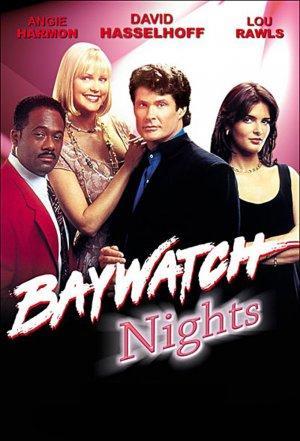
Baywatch Nights ran for two seasons. The second season is remembered for featuring Mitch battling aliens, ghosts, and vampires. The first season featured Mitch dealing with more traditional villains. For our latest Late Night Retro Television Review, we’ll be looking at both seasons of Baywatch Nights!
Episode 1.1 “Pursuit”
(Dir by Gus Trikonis, originally aired on September 30th, 1995)
The very first episode of Baywatch Nights opens with Mitch Buchanan (played, of course, by David Hasselhoff) speaking directly to the audience. He’s standing at his lifeguard stand, wearing his signature red Baywatch swim trunks.
“Some people,” Mitch says straight to the camera, “think that the beach closes when the sun goes down. Uh-uh. That’s when it really starts to heat up.” Mitch goes on to explain that he’s working a second job as a private investigator. His old friend, Garner Ellerbee (Gregory Alan Williams), is a partner in a detective agency with Ryan McBride (Angie Harmon), who was born in Texas, became a detective in New York, and recently moved to California. Mitch is working with them. Suddenly, Mitch says that he hopes those watching will enjoy this “new show.”
This brings up an interesting question. Are we listening to Mitch or are we listening to David Hasselhoff? If it’s David Hasselhoff talking directly to the audience, his monologue would seem to suggest that he thinks that Baywatch is real life, even though it’s a TV show. He talks about Garner and Ryan as if they’re real people. If we’re listening to Mitch Buchanan, that means that he has somehow become aware that he’s a character on a television show. Has Mitch become self-aware? Or has he realized that he’s living in some sort of Truman Show-style situation?
These are all questions that will probably never be answered.
As for the episode, it jumps right into things. Mitch, Garner, and Ryan have their private detective offices located right above a nightclub called — wait for it — “Nights.” Occasionally, they are helped by Destiny Desimone (Lisa Stahl), a perky blonde who spends her days doing Tarot card readings on the beach and her nights hanging out around the office. When Ryan can’t figure out how to use a computer, Destiny is there to help When Mitch and Garner can’t figure out how to have multiple landlines in one office, Destiny figures it all out! It’s all very 90s, with boxy computers and long telephone cords.
Mitch’s first case involves serving as a bodyguard for a model named Cassidy (Carol Alt). Cassidy says that someone is stalking her and she’s especially worried because another model has recently been murdered. (“Her name was Alexa,” Mitch muses as he looks at the murdered model’s body, “This was her last photo session.”) Mitch protects Cassidy and, of course, he falls for her but, in the end, he realizes that Cassidy has actually been stalking herself and was responsible for the other model’s death. Mitch is shaken by his discovery of Cassidy’s guilt, even though the exact same thing previously happened to him during the first season of Baywatch, when he fell in love with a woman who turned out to be a black widow murderer. Mitch muses that he knows how to be a lifeguard but he’s still learning how to be a private eye.
(Mitch, seriously, just watch reruns of Baywatch! I mean, you’re only one episode into Baywatch Nights and you’re already recycling old plots so I imagine you should just keep doing what you did the first time.)
This episode’s plot is pretty predictable but, for a pilot, it’s likable. Angie Harmon, Gregory Alan Williams, and David Hasselhoff all have a likable chemistry and, as a Texas girl, I appreciated the fact that Angie Harmon’s accent was authentic. Mitch narrates the episode in a hard-boiled, private eye manner and David Hasselhoff’s earnest delivery is so at odds with his words that it becomes rather charming. As a friend of mine once said when we watched him in Starcrash, “Every country should have a Hoff!”
As far as first episodes go, Pursuit does everything it needs to do. It introduces us to the characters and their personalities. Ryan is supercool and has really pretty hair. Destiny is quirky. Garner is determined. And Mitch …. well, Mitch is David Hasselhoff. Wisely, the first episode didn’t spend too much time trying to rationalize the idea of Mitch working all day as a lifeguard and then all night as a private eye. Realistically, it seems like he would end up too exhausted to be good at either job. Instead, the first episode simply tells the audience that Mitch is now a detective and that the audience better be willing to accept it.
(Unfortunately, most of the audience didn’t accept it, which is why the second episode featured Mitch dealing with sea monsters and resurrected Vikings. We’ll get to that in a while.)
Next week, Mitch battles a group of thieves on skates! Seriously, you know that’s going to be fun!


 Through the Shattered Lens