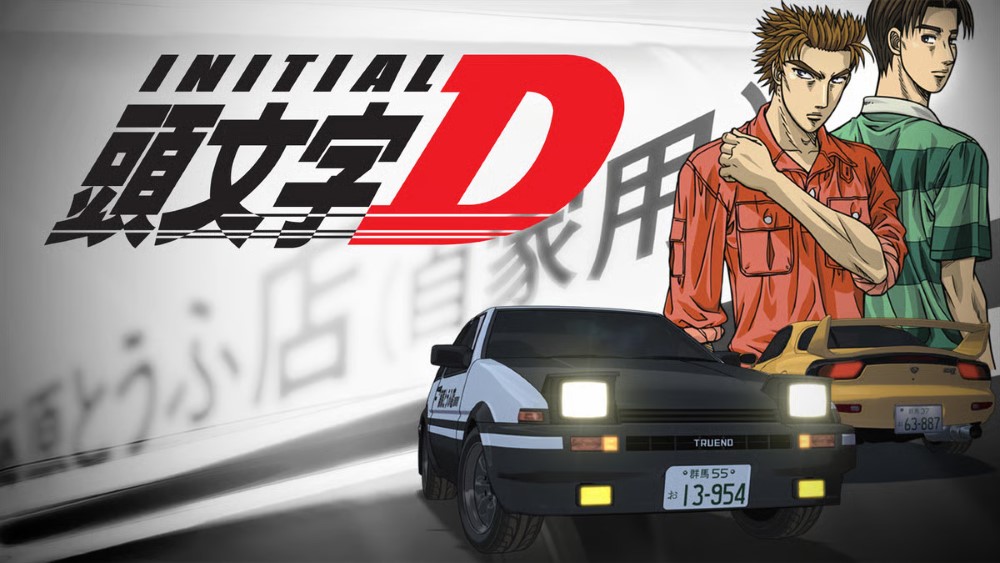
“I don’t care about winning or losing. I just want to see what’s beyond this…” — Takumi Fujiwara
If you’ve ever found yourself staring at a beat-up old Toyota AE86 and wondering why some people treat it like a holy relic, then you’ve already stumbled into the gravitational pull of Initial D. This late 90s anime, based on the manga by Shuichi Shigeno, is one of those classic series that any new fan of anime absolutely needs to have on their list. It’s raw, it’s ridiculous, and it’s somehow one of the most gripping sports anime ever made, despite half of its runtime being close-ups of a sweaty guy shifting gears. The premise is deceptively simple: Takumi Fujiwara, a high school kid who’s been delivering tofu in his dad’s panda-colored AE86 since before he could see over the steering wheel, accidentally discovers he’s the best downhill racer in the Gunma region. He’s not some hot-blooded hero—he’s tired, he works a gas station job, and he’d rather listen to Eurobeat than talk about his feelings. That’s the magic of Initial D. It takes a mundane, almost boring protagonist and turns him into a legend through sheer muscle memory and an encyclopedic knowledge of every gutter, hairpin, and blind corner on Mount Akina.
The anime originally ran from 1998 to 2000, and watching it now feels like cracking open a time capsule. The CGI cars have aged like milk left in the summer sun—clunky, blocky, and hilariously out of place against the beautifully painted 2D backgrounds. But you stop caring about ten minutes into the first episode because the soul is so undeniable. The soundtrack, a relentless barrage of Eurobeat tracks like “Deja Vu” and “Running in the 90s,” injects every race with a dose of pure, uncut adrenaline. You haven’t lived until you’ve watched a silent, unimpressed teenager drift through a tight corner while some Italian disco singer screams about gas gas gas. The manga, which ran from 1995 to 2013, is more detailed and technically sound, explaining the physics of weight transfer and braking points without losing that underdog charm. But the anime amplifies everything—the tension, the sheer speed, and the weird, lonely atmosphere of driving at 3 AM when nobody else is around.
What makes Initial D a classic that deserves a spot on any new fan’s watchlist isn’t just the racing. It’s the way it builds a world around mountain passes that might as well be battlefields. Every rival Takumi faces—Keisuke and Ryosuke Takahashi in their red RX-7, Mako Sato in her SilEighty, or the terrifyingly calm Kyoichi Sudo in his black Evo III—has their own backstory, their own obsession, and their own reason for pushing a car to the absolute limit. The show understands that street racing is about ego, youth, and that brief moment of perfection when you nail an impossible line. Takumi’s growth from a bored delivery boy to someone who genuinely loves driving is subtle but powerful. He doesn’t get a big speech about friendship; he just starts smiling a little more when he hits the apex.
Then there’s the film spinoff: Initial D Third Stage, released in 2001. It’s a movie, but calling it a movie feels generous since it’s only about 90 minutes and basically adapts the final arc of Takumi’s high school career. This is where things get serious. The animation improves—fewer PS1-looking cars—and the emotional stakes jump off a cliff. Takumi faces his toughest rival yet, a no-nonsense driver in an Evo IV named Kyoichi, but that’s not the real battle. The real battle is Takumi deciding whether he wants to drift forever or try to build a normal life. He also finally deals with his feelings for Natsuki Mogi, the girl who’s been his maybe-girlfriend for the whole series. I won’t spoil it, but the movie handles her subplot with a surprising amount of maturity, even if it’s heartbreaking to watch this stoic kid have his heart wrung out on the tarmac. The final race in Third Stage is arguably the most satisfying in the entire franchise, because it’s not just about winning—it’s about Takumi proving he’s ready to move on to the next level.
Now, here’s where Initial D’s legacy comes roaring into focus. You cannot talk about the first three Fast & Furious films without acknowledging the ghost of Mount Akina hovering behind every street race. Before Dom Toretto started grunting about family, the original The Fast and the Furious (2001) was basically a Hollywood translation of the Initial D formula: underground tuners, uphill/downhill respect, and a quiet hero who knows his machine better than he knows people. The sequels, 2 Fast 2 Furious and Tokyo Drift, leaned even harder into that DNA—Tokyo Drift especially, with its drift-obsessed plot, its foreign protagonist learning mountain passes from a local master, and its reverence for Japanese street racing culture. That movie’s entire vibe—the late-night touge battles, the Eurobeat-adjacent soundtrack, the focus on technique over raw horsepower—is Initial D with a Southern accent. Without Takumi Fujiwara’s sleepy-eyed drifts, there’s no Han Lue casually sliding an RX-7 through a parking garage.
Video game franchises owe an even louder debt. Gran Turismo literally included Mount Akina-inspired tracks in several entries, letting players reenact Takumi’s gutterslides with obsessive fidelity, and made the AE86 Sprinter Trueno a fan-favorite car despite its modest stats. Forza Horizon (the latest entry in the series happens to be set in Japan) took that influence and cranked it to eleven, with dedicated Initial D liveries, user-created touge events, and a community that still organizes “Akina downhill” time trials in every new installment. Need for Speed pivoted hard toward the Initial D template with Underground and Underground 2, ditching exotics for tuners and centering the plot on proving yourself against local kings, while Need for Speed: Carbon literally lifted the “crew vs. crew” mountain duel structure from Initial D’s Project D arc. The Crew series, with its massive open-world map and its obsession with car clubs and regional boss battles, practically begs you to recreate Takumi’s journey, even adding an official Initial D pack with the AE86 and an Akina-inspired track. Beyond direct references, Initial D normalized the idea that driving skill is a form of combat. Before its manga and anime, most racing media was about glamour or pure speed. After Initial D, you got Wangan Midnight, MF Ghost (its direct sequel), and a generation of car enthusiasts who argue about weight transfer the way sports fans argue about batting averages.
And here’s the observation that really separates Initial D from almost every other anime or manga out there: as popular as characters like Takumi, Keisuke, Ryosuke, and even side characters like Itsuki or Bunta have become, the series has never lost sight of the fact that it’s really about the cars. You won’t find long monologues about inner demons or tragic backstories resolved through the power of friendship. Instead, you get ten-minute sequences where two characters silently analyze the suspension geometry of a Nissan Skyline GT-R versus a Mazda RX-7, and somehow it’s riveting. The AE86 Trueno isn’t just Takumi’s car—it’s the co-protagonist. The same goes for Keisuke’s yellow FD3S, Nakazato’s R32 Godzilla, or Shingo’s absurdly loud Civic EG6. These machines have personalities, flaws, and growth arcs. An engine blow isn’t just a mechanical failure; it’s a dramatic turning point. A new carbon fiber hood or a swapped racing engine feels like a power-up in a shonen battle manga. That obsessive focus on the hardware—weight distribution, horsepower numbers, tire wear, the specific sound of a turbo spooling at 4 AM—is what makes Initial D feel less like a character drama with cars and more like a love letter written directly to the machinery itself.
That approach is exactly why Initial D single-handedly put Japanese street racing culture onto the global pop culture map. Before the manga launched in 1995 and the anime hit screens in ’98, the idea of “touge” (mountain pass racing) was a niche subculture known mostly to locals and hardcore gearheads in Japan. The rest of the world thought street racing was drag racing on empty American industrial strips. Initial D introduced millions of viewers to concepts like gutter drifting, the braking drift, the invisible line, and the terrifying art of a blind corner attack. It made the winding roads of Akina, Myogi, and Usui as famous as any racetrack in the world. Suddenly, teenagers in Europe, South America, Southeast Asia, and North America weren’t just dreaming of Ferraris and Lamborghinis—they wanted used Silvias, AE86s, and RX-7s. They started learning about Japanese domestic market (JDM) cars the way their parents learned about muscle cars. They argued over whether an Evo was better than an Impreza on a downhill section. They stayed up late watching pixelated fansubs of the anime just to hear the next Eurobeat track drop as a pair of headlights appeared in the rearview mirror.
Walk into any car meet today, and you’ll see AE86s with “Fujiwara Tofu Shop” decals on the doors. You’ll hear people unironically refer to the “Initial D tax” on vintage JDM parts. You’ll find YouTube channels dedicated entirely to recreating Initial D races in real life, with drivers narrating their line choices exactly like the characters in the show. The manga and anime didn’t just document Japanese street racing—they codified it, romanticized it, and exported it so effectively that the term “touge” is now understood by car enthusiasts on every continent.
Look, Initial D isn’t perfect. The dialogue can be wooden, the pacing drags during exposition about camshafts, and the less said about the weirdly horny gas station manager, the better. But none of that matters when the engine roars and the synth kicks in. For a new anime fan coming from modern shows with glossy animation and fast pacing, Initial D might feel like a relic. But that’s exactly why you need to watch it. It’ll teach you that passion can look like a sleepy teenager in a cheap track suit, that rivalries are built on mutual respect more than yelling, and that sometimes the best way to solve a problem is to take the inside line at 120 KPH with one hand on the wheel. Add the manga to your shelf too—it goes way deeper into Takumi’s professional career and is a masterclass in long-form storytelling. But start with the 90s anime. Let that clunky CG and those glorious Eurobeat hooks pull you in. Before you know it, you’ll be looking at every empty mountain road just a little differently, wondering if you’ve got what it takes to be the next ghost of Akina. Even the criticism that Initial D made the AE86 overpriced and overhyped is a testament to its power. A boring 1980s Corolla became a legend because a fictional teenager delivered tofu in it. That’s not just influence. That’s pop culture alchemy. So when you recommend Initial D to a new anime fan, tell them to pay attention to the characters, sure. But remind them to also listen for the roar of a four-cylinder engine bouncing off the limiter. Because that’s the real star of the show, and it always has been. And that, more than anything, is why Initial D will never be forgotten.
Anime You Should Be Watching
- Gakuen Utopia Manabi Straight
- Chōjin Densetsu Urotsukidōji
- School Days
- Higurashi no Naku Koro ni
- Toradora!
- Aria
- Azumanga Daioh
- Bible Black
- Puella Magi Madoka Magica
- Black Lagoon
- Ika Musume
- High School DxD
- Bakemonogatari
- Sailor Moon
- Princess Tutu
- Another
- Hellsing Ultimate
- Sword Art Online
- Wolf Children Ame and Yuki
- Toaru Kagaku no Railgun
- Nichijō
- Redline
- Gakkou Gurashi (School Live)
- Gate: Thus the Japanese Self-Defense Force Fought in Their Land
- Hinamatsuri
- Asobi Asobase
- Zombie Land Saga
- Monster
- Farming Life In Another World (Isekai Nonbiri Nouka)
- Perfect Blue
- Shiki
- Angel of Darkness (Injū Kyōshi)
- Blood: The Last Vampire
- Akira
- Space Battleship Yamato (Uchū Senkan Yamato)
- Macross Plus
- Ninja Scroll (Jūbē Ninpūchō)
- Tokyo Godfathers (Tōkyō Goddofāzāzu)
- Memories
- That Time I Got Reincarnated as a Slime (Tensei Shitara Suraimu Datta Ken)
- Spy x Family
- Record Of Lodoss War (Rōdosu-tō Senki)
- Berserk (Kenpū Denki Berserk)
- Jin-Roh
- Made In Abyss (Meido in Abisu)
- Legend of the Galactic Heroes (Ginga Eiyū Densetsu)
- Nausicaä of the Valley of the Wind
- May I Ask for One Final Thing? (Saigo ni Hitotsu dake Onegai Shitemo Yoroshī Deshō ka)

