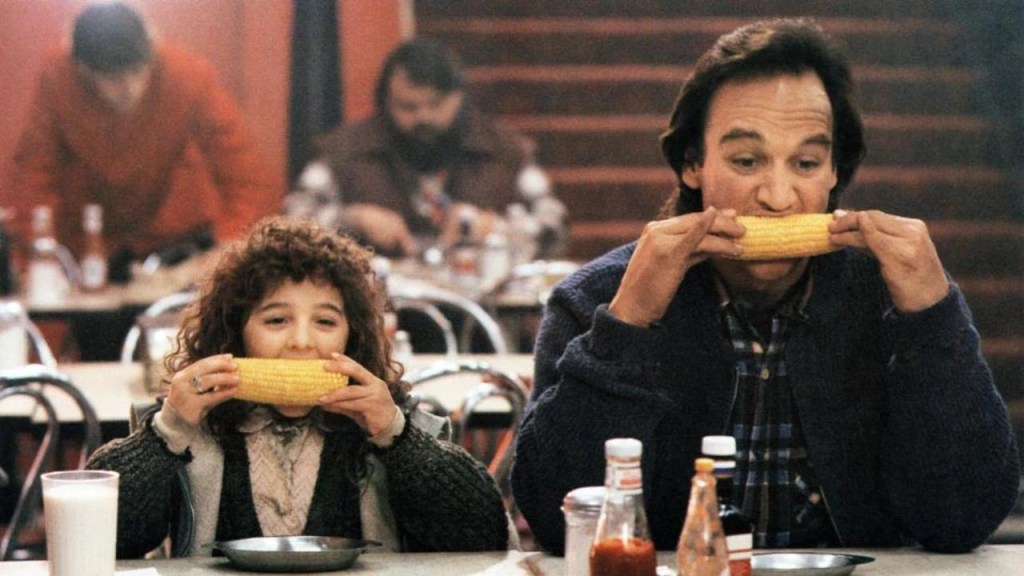
Brad reviews CURLY SUE (1991), starring James Belushi and Kelly Lynch!


Bill Dancer (James Belushi), a homeless drifter and small-time con artist, and his 9 year old companion Curly Sue (Alisan Porter), survive by running somewhat harmless scams against rich people. While traveling through Chicago they target Grey Ellison (Kelly Lynch), a rich, career-focused divorce attorney, tricking her into thinking that she ran over Bill with her Mercedes. Normally the pair are just after a free meal and maybe a little cash, but Bill doesn’t have the heart to take too much from Grey since she’s so darn pretty. Through a variety of circumstances, she actually does run over Bill the next day. This time she brings him and Curly Sue up to her fancy apartment so he can recover, despite the objections from her snobby boyfriend Walker (John Getz). As the three get to know each other, Grey forms an especially close connection with Curly Sue, and learns that Bill isn’t her actual dad, even though he’s raised her since she was a baby. Knowing that Grey can give Curly Sue a better life than he can, Bill thinks about leaving. But can he ever leave the girl he sees as a daughter? And can Grey discover a compassion for others and the maternal instinct that she’s been missing? 

As is often the case with movies I choose to write about, I had a sense of nostalgic warmth while watching CURLY SUE this morning for the first time in three decades. I saw CURLY SUE at the movie theater with my high school girlfriend in the fall of 1991. I remember enjoying the film and even buying it on VHS as a gift for my mom because I knew she would like it. In the years before she could record her Hallmark movies on her DVR, Mom watched that VHS tape many times. 

Quite different from his classic teen comedies, CURLY SUE, which is the final film directed by John Hughes, can only be described as unapologetically sentimental. Sure the movie is formulaic and pure syrup, but I still enjoy it anyway. This heartwarming fairy tale will make you believe that an unconventional, loving family can emerge from the most unexpected of circumstances. It will suggest that there are some things more important than any amount of money can buy. It will make you laugh out loud at times, and yes, it will even bring a tear to your eye as some of the more emotional scenes play out. CURLY SUE wants to manipulate its audience’s emotions, and it will happen if you just go with it. On the down side, if you catch this film in the wrong kind of mood, or if you’re feeling especially cynical, that magic will disappear and you probably won’t enjoy the movie at all. 

As for the performances, as a fan of James Belushi, I like him as the gruff but likable Bill. I also enjoy Kelly Lynch as the she evolves from a person married to her work to someone who starts to care deeply about the people around her. Probably the most important performance in the film comes from Alisan Porter as Curly Sue. If you don’t find her cute and adorable, then you’ll probably have a hard time watching the movie. I personally found her to be quite precious so that was not a problem for me. Once again, the movie version of early 90’s Chicago as our setting is something I enjoy as well. 

Overall, CURLY SUE is not in the same league as Hughes’ best work like PLANES, TRAINS AND AUTOMOBILES, and there will be many who downright dislike the schmaltzy nature of the film. However, if you’re in a nostalgic mood for an earnest, early ‘90s heart-tugger, this movie might just hit the spot.
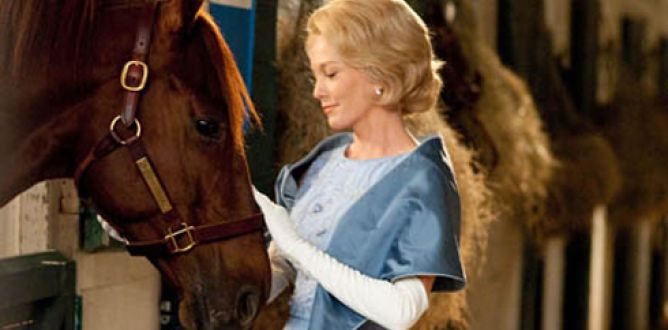
SECRETARIAT (2010) – The greatest racehorse of all time?


I’ll admit that I’m not a huge fan of horse racing, although I will periodically go to the Oaklawn Racetrack in Hot Springs, AR, and watch them run. I did enjoy the horse racing movie SEABISCUIT (2003) when I saw it a decade or so ago, and I always enjoy driving past the beautiful horse farms in Lexington, KY, when I’m on my way to see my wife’s family in West Virginia. This weekend was the Kentucky Derby, and I saw a stat that every horse running is a descendant of the 1973 triple-crown winner, Secretariat. I thought that was pretty cool stuff. I told my wife about it, so we decided to watch the movie SECRETARIAT (2010) this morning. 

The film centers on Penny Chenery Tweedy (Diane Lane), a Boulder, CO housewife who takes over the management of her dad’s horse stables in Virginia when his health gets so bad that he can no longer handle it himself. The business is facing a lot of financial problems, and her husband just wants her to sell everything and come on back home. But Penny doesn’t want to sell, especially when the stable acquires a young colt that just may have to the right combination of speed and stamina to become a great racehorse. Wanting to see her horse get a chance to run, she hires eccentric trainer Lucien Laurin (John Malkovich) and the aggressive jockey Ron Turcotte (Otto Thorwarth) in order to give “Secretariat” a chance to reach his potential. And boy does he ever, ultimately becoming the first “Triple Crown” winner in 25 years. 

I’ll go ahead and say that I pretty much got exactly what I was expecting with SECRETARIAT. It’s a “feel-good” movie that made me happy at the end. Outside of him being a triple crown winner, I didn’t know much about Secretariat’s story, so it was fun just seeing how dominant he truly was during his legendary run in 1973. And the performances from the leads are very good. Diane Lane is beautiful and convincing as the housewife determined to give every thing she has to make Secretariat a winner. John Malkovich’s eccentric horse trainer is the kind of role he excels in, and he’s both funny and emotionally engaging. I liked Otto Thorwarth and Nelson Ellis as Secretariat’s jockey and groomer, respectively. Each of them had their individual moments to shine. I also wanted to mention how impressive the camerawork is during the racing sequences. For a film like this to be exciting, the races have to be exciting and director Randall Wallace and cinematographer Dean Semler deliver in spades. If I had any complaint about the film, it would probably be the oversimplification of some of the supporting characters. For a film based on a true story, it was odd to see the owner of Secretariat’s primary competition reduced to almost a comic book villain in his behavior. That aside, I enjoyed the film and I’m glad I watched it. 

I’ve include the trailer for SECRETARIAT below:

Guilty Pleasure No. 73: Days of Thunder (dir by Tony Scott)


In 1990’s Days of Thunder, Tom Cruise plays Cole Trickle, a talented but headstrong racecar driver who is recruited by businessman Tim Daland (Randy Quaid) to become a NASCAR champion and to also provide some publicity for Daland’s Chevrolet dealership.  Tim convinces Harry Hogge (Robert Duvall) to come out of retirement and serve as Cole’s crew chief.  Harry builds cars in his barn and then he talks to them, whispering sweet nothings into their side mirrors.  (This happens quite a bit.)  Both Cole and Harry have something to prove.  Cole has to prove that he’s the best.  Harry has to prove, to himself, that an accident that killed one of his driver was not his fault.  Harry also has to prove that he’s not insane.  That’s not an easy thing to do when you’re always in the barn, talking to a car.

At first, Cole’s rival is Rowdy Burns (Michael Rooker) but, after Rowdy is seriously injured in a crash and told that he will never race again, Rowdy becomes Cole’s closest friend and supporter.  With Rowdy off the circuit, Russ Wheeler (Cary Elwes) becomes Cole’s main rival.  We know that Russ is a bad guy because he never has a hair out of place and he’s played by Cary Elwes, who for some reason was always cast as the smug bad guy in films like this despite having a rather charming screen presence.

Cole’s love interest is Dr. Claire Lewicki (Nicole Kidman), who is there to help Cole deal with his anger issues and who is surprisingly forgiving of all the times that Cole acts like a complete and total jerk.  That happens quite a bit.  Cole is a bit of brat but eventually, with the help of everyone around him, he learns how to be a great driver.

The first time I ever saw Days of Thunder, I was pretty dismissive of it.  The film was producer and directed by the same people who were behind Top Gun and it pretty much tells the same story, except the jets are replaced with cars and the stakes are a bit less than saving democracy.  Like Top Gun, it was a film where Tom Cruise played a character who wants to be the best but who has to learn how to set aside his own ego and take control of his impulsive nature.  The first time I saw the film, I shrugged and said that, while Nicole Kidman and Tom Cruise had a lot more chemistry than Cruise and Kelly McGillis, it was still nothing that I hadn’t seen before.

But I have to admit that, since then, I’ve rewatched the film a few times.  It’s one of those movies that I never specifically seek out but if I see it playing somewhere on cable, I’ll usually watch a bit of it.  Some of it is because the race scenes actually are exciting, even if they do get a bit repetitive after a while.  Tony Scott was a director who knew how to film action.  The other major reason why I often find myself watching Days of Thunder is for the totally over-the-top performances of Robert Duvall and Randy Quaid.

“We looked like a monkey fucking a football out there!” Quaid exclaims, not once but twice.  It’s a phrase that doesn’t make the least bit of sense and it’s one of those lines of dialogue that reminds us that Days of Thunder went into production with a script that was being written and rewritten on a daily basis.  But Randy Quaid’s delivery is so emphatic that line works despite being totally stupid.

As for Robert Duvall, his performance here is a perfect example of how much fun it can be to watch a legitimately great actor overact.  There’s nothing subtle about his performance and I doubt Days of Thunder will ever be a film that shows up when people are talking about the highlights of his legendary career.  But when Duvall talks to his car, you believe every minute of it.  It’s such a silly scene but Duvall pulls it off like the pro that he is.

Finally, if you’re going to watch a movie about two cocky race car drivers who are constantly taunting each other, wouldn’t you want them to look like Tom Cruise and Cary Elwes?  Good lookin’ guys in fast cars, drivin’ around Southern racetracks, what’s not to love?

Previous Guilty Pleasures

  1. Half-Baked
  2. Save The Last Dance
  3. Every Rose Has Its Thorns
  4. The Jeremy Kyle Show
  5. Invasion USA
  6. The Golden Child
  7. Final Destination 2
  8. Paparazzi
  9. The Principal
  10. The Substitute
  11. Terror In The Family
  12. Pandorum
  13. Lambada
  14. Fear
  15. Cocktail
  16. Keep Off The Grass
  17. Girls, Girls, Girls
  18. Class
  19. Tart
  20. King Kong vs. Godzilla
  21. Hawk the Slayer
  22. Battle Beyond the Stars
  23. Meridian
  24. Walk of Shame
  25. From Justin To Kelly
  26. Project Greenlight
  27. Sex Decoy: Love Stings
  28. Swimfan
  29. On the Line
  30. Wolfen
  31. Hail Caesar!
  32. It’s So Cold In The D
  33. In the Mix
  34. Healed By Grace
  35. Valley of the Dolls
  36. The Legend of Billie Jean
  37. Death Wish
  38. Shipping Wars
  39. Ghost Whisperer
  40. Parking Wars
  41. The Dead Are After Me
  42. Harper’s Island
  43. The Resurrection of Gavin Stone
  44. Paranormal State
  45. Utopia
  46. Bar Rescue
  47. The Powers of Matthew Star
  48. Spiker
  49. Heavenly Bodies
  50. Maid in Manhattan
  51. Rage and Honor
  52. Saved By The Bell 3. 21 “No Hope With Dope”
  53. Happy Gilmore
  54. Solarbabies
  55. The Dawn of Correction
  56. Once You Understand
  57. The Voyeurs 
  58. Robot Jox
  59. Teen Wolf
  60. The Running Man
  61. Double Dragon
  62. Backtrack
  63. Julie and Jack
  64. Karate Warrior
  65. Invaders From Mars
  66. Cloverfield
  67. Aerobicide 
  68. Blood Harvest
  69. Shocking Dark
  70. Face The Truth
  71. Submerged
  72. The Canyons

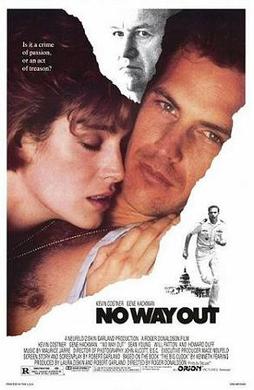
14 Days of Paranoia #7: No Way Out (dir by Roger Donaldson)


Trust no one in Washington would seem to be the message of this 1987 thriller.

Kevin Costner plays Lt. Commander Tom Farrell, a Naval Intelligence officer who is hailed as a hero after saving a shipmate who falls overboard.  In Washington, Tom is recruited by a friend from college, Scott Pritchard (Will Patton), to work for Secretary of Defense Brice (Gene Hackman).  Brice doesn’t trust the head of the CIA (played by future senator, Fred Dalton Thompson) and he wants Tom to serve as his mole within the service.  What Brice doesn’t know is that Tom is sleeping with Brice’s mistress, Susan Atwell (Sean Young).

Still, Brice does suspect that the woman with whom he is cheating is also cheating on him.  When he confronts her about it, their argument leads to him accidentally pushing Susan over an upstairs railing.  Pritchard, who is implied to be in love with Brice, takes charge of the cover-up and decides to push the story that Susan was killed by a possibly mythical Russian agent who is known only by the name “Yuri.”

Tom assists with the investigation of her death, both because he wants to know who killed Susan and also because he knows that there’s evidence in Susan’s apartment that could be manipulated to make him look guilty of the crime.  For instance, Susan took a picture of Tom shortly before her death.  The picture failed to develop but, through the use of what was undoubtedly cutting edge technology in 1987, Naval Intelligence is slowly unscrambling the picture.  For Tom, it’s a race against time to find the actual killer before the picture develops and he’s accused of both killing Susan and being Yuri.

Everyone has an agenda in No Way Out, from the ambitious Brice to the fanatical Scott Pritchard to the head of the CIA, who wants Brice to approve funding for a costly submarine.  Even the film’s nominal hero has an agenda, which has less to do with finding justice for Susan and everything to do with protecting himself and his future.  In fact, as is revealed in the film’s enjoyable if slightly implausible twist ending, some people in Washington have multiple agendas.  The film portrays Washington as being a place where, behind the stately facade, everyone is a liar and everyone is ultimately a pawn in someone else’s game.  If you have the right connections, you can even get away with murder.  Loyalty is rewarded until you’re no longer needed.

It’s an enjoyably twisty thriller, one that makes good use of the contrast between Kevin Costner’s All-American good looks and his somewhat shady screen presence.  The film introduces Costner as being a character who, at first glance, seems almost too good to be true and then spend the majority of its running time suggesting that is indeed the case.  Gene Hackman is well-cast as the weaselly cabinet secretary, as is Sean Young as the woman who links them all together.  In the end, though, the film is stolen by Will Patton, who plays Scott Pritchard as being someone who has unknowingly given his loyalty to a man who is incapable of returning it.  As played by Patton, Scott is an outsider who desperately wants to be an insider and who is willing to do just about anything to accomplish that goal.  He’s a version of Iago who never turned against Othello but instead devoted all of his devious tricks to trying to cover up the murder of Desdemona.

Even with an over-the-top final twist, No Way Out holds up well as a portrait of how the lust for power both drives and corrupts our political system.

14 Days of Paranoia:

  1. Fast Money (1996)
  2. Deep Throat II (1974)
  3. The Passover Plot (1976)
  4. The Believers (1987)
  5. Payback (1999)
  6. Lockdown 2025 (2021)

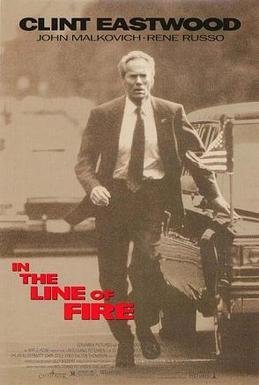
Film Review: In The Line of Fire (dir by Wolfgang Petersen)


Earlier today, it was announced that director Wolfgang Petersen had passed away.  He was 81 years old and had been suffering from pancreatic cancer.  Though Petersen started his career making films in his native Germany (and his 1981 film, Das Boot, remains the most Oscar-nominated German film of all time), Petersen eventually relocated to Los Angeles and established himself as a very successful director of thrillers and star-filled action films.

Last month, I watched one of Petersen’s films.  First released in 1993, In The Line of Fire stars Clint Eastwood as Frank Horrigan.  Frank is a veteran member of the Secret Service, still serving at a time when almost all of his colleagues have either retired or died.  When we first meet Frank, he and his new partner, Al (Dylan McDermott), are arresting a gang of counterfeiters and Frank (and the then 63 year-old Eastwood) is proving that he can still take down the bad guys.

But is Frank still up to protecting the President?  Of the agents that were with President Kennedy when he was assassinated in 1963, Frank Horrigan is the last one standing.  He’s the only active secret service agent to have lost a president and he’s haunted by what he sees as being his failure to do his job and the feeling that America has never recovered from Kennedy’s death.  Also obsessed with Frank’s history is a mysterious man who calls himself Booth.  Booth (played by John Malkovich, who received an Oscar nomination for his performance) starts to call Frank.  He informs Frank that he’s planning on assassinating the president, who is currently traveling the country as a part of his reelection bid.  Booth views Frank as being a worthy adversary and Frank, looking for redemption, requests to be returned to the Presidential Protective Division.

While Frank struggles to keep up with both the President and the younger agents, Booth slowly and methodically puts his plan in motion.  He builds his own wooden gun and tries it out on two hunters who are unfortunate enough to stumble across him.  Making a heart-breaking impression in a small role, Patrika Darbo plays the bank teller who, unfortunately, comes a bit too close to uncovering Booth’s secret identity.  Booth is friendly and sometimes apologetic and he quickly shows that he’s willing to kill anyone.  It’s a testament to both the skill of Malkovich’s performance and Petersen’s direction that the audience comes to believe that there’s a better than average chance that Booth will succeed.  He just seems to have such a strong belief in himself that the audience knows that he’s either going to kill the President or that he’s going to willingly die trying.

Meanwhile, no one believes in Frank.  The White House Chief of Staff (Fred Dalton Thompson, later to serve in the Senate and run for President himself) views Frank as being a nuisance.  The head of the detail (Gary Cole) thinks that Frank should be put out to pasture.  Only Lilly Raines (Rene Russo), another agent, seems to have much faith in Frank.  While Frank is hunting Booth, he falls in love with Lilly and she with him.  (Fortunately, even at the age of 63, Eastwood still had enough of his old Dirty Harry charisma that the film’s love story is credible, despite the age difference between him and Russo.)  The hunt for Booth reawakens something in Frank.  Just as Booth has a psychological need to be pursued and challenged, Frank needs an enemy to which he can re-direct all of his guilt and self-loathing.  Frank becomes a stand-in for everyone who fears that, because of one particular incident or tragedy, America will never regain the strength and promise that it once had.  (In Frank’s case, that strength is symbolized by his idealized memories of JFK.)  Defeating Booth is about more than just saving America.  It’s about redeeming history.

It all makes for an very exciting thriller, one in which Eastwood’s taciturn style of acting is perfectly matched with Malkovich’s more cerebral approach.  Just as the two characters are challenging each other, Eastwood and Malkovich also seem to challenge each other as actors and it leads to both men giving wonderful performances.  Wolfgang Petersen not only does a good job with the action scenes but also with generating some very real suspense.  The scene in which Malkovich attempts to assemble his gun under a table is a masterclass in directing and evidence that Petersen had not only watched Hitchcock’s films but learned from them as well.

As directed by Petersen and performed by Malkovich and Eastwood, In The Line of Fire emerges as a film that was more than just an exciting thriller.  It was also a mediation on aging, guilt, love, redemption, and the national traumas of the past.  It’s a film that stands up to multiple rewatches and as a testament to the talent of the man who directed it.

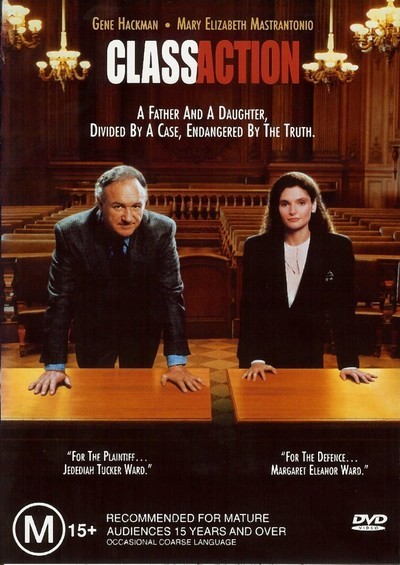
Cleaning Out The DVR: Class Action (dir by Michael Apted)


Sometimes, it takes a really good actor to give a really bad performance.

That’s what I found myself considering tonight as I watched the 1991 film, Class Action. I recorded this film off of Starz a few months ago, mostly due to the fact that I usually enjoy legal dramas. Class Action is about a father and a daughter, both of whom are attorneys, who find themselves facing each other in court. Gene Hackman plays Jedediah Ward Tucker while Mary Elizabeth Mastrantonio played Maggie, his daughter.

From the very first scenes, Jed Tucker is portrayed as being a firebrand, a crusader who stands up for the little guy against big corporate interests. (“Jed Ward is a great man!” one his clients exclaims while the other lawyers nod along in agreement.) Tucker is flamboyant, loud, perpetually outraged, in love with attention, and determined to make the world a better place. This is the type of role that would probably encourage any actor to overact just a bit. However, when you cast someone like Gene Hackman in the role, the performance becomes a masterclass in overacting. Gene Hackman was never a particularly subtle actor to begin with and casting him as Jed Tucker guarantees about two hours of Hackman bellowing, smirking, occasionally flirting, and basically coming across less like Gene Hackman and more like someone doing a particularly antic impersonation of Gene Hackman. Hackman goes so over overboard in the role that it becomes rather fascinating to watch. You watch and you ask yourself, “How much louder can he get? He much more obviously can he telegraph his intentions? Just how Gene Hackmanish is Gene Hackman going to get in this film?” Don’t get me wrong, Gene Hackman was a great actor. (He famously retired in 2004, after the indignity of appearing in Welcome to Mooseport.) One need only watch Bonnie and Clyde, The French Connection, Unforgiven, and The Royal Tennenbaums to see that Gene Hackman was a great actor. But sometimes, it takes a great actor to give a memorably bad performance.

Gene Hackman’s performance, as overbaked as it may be, is actually the only interesting thing about Class Action. It’s a well-made but ultimately rather silly mix legal maneuvering and family drama. Jed was a terrible father so Maggie becomes a corporate attorney in order to spite him. Class Action so embraces the idea that all professional women are motivated by daddy issues that even Aaron Sorkin would probably look at it and say, “Whoa, that’s really demeaning.” At one point, Maggie says to her father, “Have you ever considered that I might be a good attorney?,” just to have her father smirk and say that’s only because he’s her father. Jed’s response is to be expected, as he’s kind of an arrogant windbag. The problem is that the movie itself doesn’t seem to be willing to consider that Maggie could be a good attorney.

The other problem, of course, is that Class Action makes its good guys and its bad guys so painfully obvious that it’s hard to take any of the conflicts seriously. Of course, the big corporate law firm is going to be evil and of course, Jed Ward’s associates are going to be saints even if Jed isn’t. Laurence Fishburne plays Jed’s protégée and he gets stuck with all of the worst lines. Far more entertaining is future U.S. Senator and presidential contender Fred Dalton Thompson, playing a doctor who explains why it actually costs less for a car company to settle a lawsuit than to fix a design flaw.

Class Action is a forgettable film, not so much terrible as just bland. That said, if you want to hear some vintage Gene Hackman-style yelling, this might be the film for you.