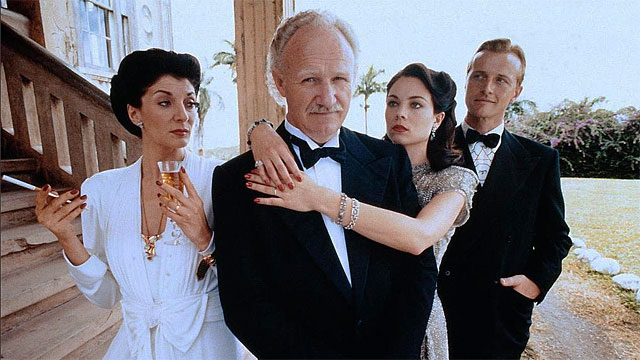
EUREKA (1983) – Gene Hackman strikes gold and tries to strike Rutger Hauer with a meat cleaver in the same move!


I’ve been thinking a lot about Gene Hackman as he recently celebrated his 95th birthday. He’s an incredible actor who has been a part of my life since I first really discovered my love of movies beginning in the mid-80’s. I’ve also been writing about Rutger Hauer every Sunday here on the Shattered Lens. Hackman and Hauer made a movie together back in 1983 called EUREKA, and to be honest, I almost forgot about it. It’s a movie I watched a long time ago and hadn’t watched again until today. It seemed like the perfect time for a revisit.

EUREKA opens with a stunning aerial shot that descends upon obsessed gold prospector Jack McCann (Gene Hackman) who’s fighting with a man on a snow-covered mountain in the Yukon territory. The man has asked Jack to partner with him in their search for gold, and Jack makes it clear that he will never “make a nickel on another man’s sweat.” Next, we see Jack as he’s walking through a nearly deserted town. In another unforgettable shot, Jack watches a man, who’s clearly gone mad, commit suicide just outside of the local “Claims office.” Before watching again today, that was the only scene that I could remember from my initial viewings of the film so many years ago. Next, we see Jack lying down below a tree at night, in windy, frigid temperatures, just about to freeze to death. Three hungry wolves have even approached ready for dinner. And this is where things get strange. Out of the blue, this clairvoyant madam (Helena Kallianiotes) from a local brothel sees him in her crystal ball, as a mysterious stone falls right next to him, starting a fire that warms him and drives away the wolves. He goes to see the madam at the brothel where she tells him that he will strike gold, but he “will be alone now.” Jack leaves the next morning and finds gold, rivers of gold. It’s another stunning sequence showing the obsessed man, who’s been searching for gold for 15 long and hard years, finally finding the object of his obsession. 

Cut to 20 years in the future, where Jack is now the richest man on earth, living on his own Caribbean island. It also appears he may also be the unhappiest man on earth. He has all the money in the world, but there is no peace in his heart or soul. His wife Helen (Jane Lapotaire), who he was once deeply in love with, is now detached and addicted to alcohol. His daughter Tracy (Theresa Russell) has fallen in love and married Claude Maillot Van Horn (Rutger Hauer). Jack cannot stand Claude as he suspects that he seduced and married Tracy so he could get to his money. His best friend Charles (Ed Lauter) has somehow gotten mixed in with Miami mobsters, led by a guy named Mayakofsky (Joe Pesci) and his lawyer Aurelio D’Amato (Mickey Rourke), who want to force Jack to sell them land on his island so they can build a casino. Jack feels like everybody just wants a piece of him and his money. He has lost the joy in his life. The rest of the film plays out against this backdrop as Jack tries to separate Tracy from Claude, and as the mobsters try to force Jack to sell to them by any means necessary.
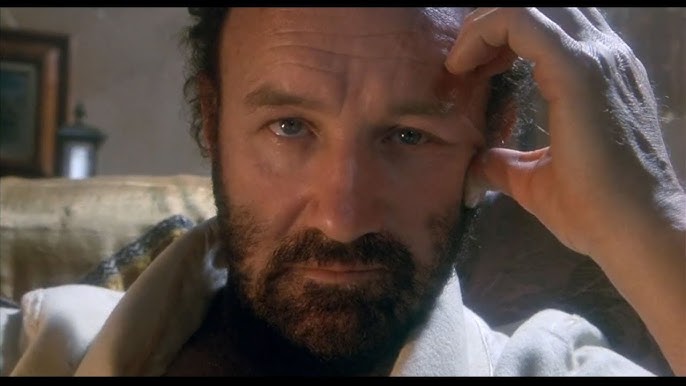
EUREKA is not a film that everyone will love, but I enjoyed watching it again after so many years. Director Nicolas Roeg, who also directed PERFORMANCE (1970), DON’T LOOK NOW (1973) and FULL BODY MASSAGE (1995), creates some truly amazing and brutal images that once seen are not easily forgotten. The scene where Jack McCann finds his huge vein of gold is so beautiful, but there are alternatively horrific scenes of brutal violence that play out almost to the point of overkill. The movie also takes some surprising twists and turns in the third act that you may not see coming. I always like it when a movie surprises me. It’s a melodramatic film that doesn’t have a lot of likable characters, but with a cast this good, I’m willing to go along with the filmmakers. In addition to the excellent work of Gene Hackman and Rutger Hauer, Theresa Russell has the important role as the daughter stuck between the man she loves and the dad who adores her. Her acting style exemplifies the melodrama of Roeg’s vision, so it works well in the context of this film. Jane Lapotaire has a couple of strong moments as Hackman’s alcoholic wife who yearns for days long gone when they were so in love. We were quite spoiled in the early 80’s when a movie could round out its already impressive cast with actors like Joe Pesci, Mickey Rourke, Ed Lauter, Corin Redgrave and Joe Spinell.

Nicolas Roeg appears to be trying to make deep statements about the meaning of life in EUREKA. I’m not a person who generally consumes films for deep meaning, but I thought it might be fun to at least take a surface-level view of some of the items I noticed while watching the movie. Jack spouts a lot of profound things throughout the movie, things that he feels describe him as a person. I mentioned one earlier when Jack tells the competing prospector prior to finding gold that, “I’ll never make a nickel off of another man’s sweat.” He will continue to use this saying throughout the film, even after he’s a rich, jaded, older man. The truth is that he would not have found the gold without the help of the clairvoyant madam, with her even passing away right after he hits the jackpot. In another scene at an extremely awkward dinner party, Jack tells his guests that the only rule that matters is the Golden Rule, “Do unto others as you would have them do unto you.” While I agree with the importance of this rule, Jack does not seem to follow the Golden Rule in any way that helps others or gives him any sense of peace or connection. Jack does not seem to understand the contradictions in his use of these phrases as played out in his own life, but I also think that his lack of understanding helps to illustrate a truth that plays out at times in many of our own lives. So often we’ll claim certain beliefs and values, but our lives as lived will be much more complex and often hypocritical. We can see them in Jack, but can we always see them in ourselves?

EUREKA also seems to be a movie that’s open to different interpretations based on who’s viewing the movie and where they are in life at that specific time. In a moment of clarity with his wife, Jack seems to recognize the hypocrisy in his life when he tells her “I once had it all… now I just have everything.” Jack is finally reflecting on the important things in his life, rather than dwelling on his current distrust of everyone around him. This final quote got me to thinking about my own life and just how different I am as a man in my early 50’s compared that naïve 20-year-old who first watched this film. I didn’t know what it was like to chase my dreams, catch them, and then try to figure out how to keep striving with a purpose. I didn’t know what it was like to be married with the responsibility of loving my wife and genuinely caring about her needs, through both the good times and the bad times. I didn’t know what it was like to be a dad who wanted nothing but true happiness for his children. Jack has lived through these specific opportunities in life, and we can see how he’s dealt with them. Each of these things have now played out in my own life. There have been times that I’ve failed, and there have been times that I’ve succeeded. I just keep reminding myself to try to focus on the things that matter and not get distracted by the things that don’t. Even now, it’s not always easy to do.    

I’ve included the trailer for EUREKA below:

Beverly Hills Cop (1984, directed by Martin Best)


Two years after teaming with Nick Nolte in 48 Hrs., Eddie Murphy returned to the action genre in what remains he best-known action comedy, Beverly Hills Cop.

We all know the story.  Eddie Murphy is Axel Foley, a streetsmart detective in Detroit whose childhood friend, Mickey (James Russo), is murdered because of something that he saw while working as a security guard in Beverly Hills.  Axel plays by his own rules and gets results even as he gives his boss, Inspector Todd (Gil Hill), heartburn.  Todd refuses to allow Foley to investigate Mickey’s death so Axel puts in for some vacation time and catches the first plane to Beverly Hills.

In Beverly Hills, he meets up with another childhood friend, Jenny (Lisa Eilbacher).  Axel thinks that Mickey’s murder was ordered by a shady businessman named Victor Maitland (Steven Berkoff).  The Beverly Hills Police Department orders Axel to leave Maitland alone and to return to Detroit.  Axel won’t go until he gets justice for Mickey.  Lt. Bogomil (Ronny Cox) assigns Taggart (John Ashton) and Rosewood (Judge Reinhold) to follow Axel in Beverly Hills.

Like 48 Hrs., the story is serious but the comedy comes from how the well-drawn characters interact with each other and from seeing how Axel reacts to the strange and wealthy world of Beverly Hills.  Axel has the same reactions that we would have but, because he’s played by Eddie Murphy, he always has the perfect response to everything that he sees, whether it’s dealing with a snooty hotel clerk or with someone like Serge (Bronson Pichot), Jenny’s co-worker who speaks with an unidentifiable accent.  Even more so than in 48 Hrs or Trading Places, Murphy reveals himself to be a natural star here.  One reason why we like Axel is because he’s not just funny but he’s also the type of confident hero that we all wish we could be.  He’s not intimidated by Beverly Hills for a second.

It’s now impossible to picture anyone else in the role of Axel Foley but, when the film’s script was first being shopped around, it was originally offered to Sylvester Stallone, who said the story had potential but was missing something.  He rewrote the script and took out all of the humor, turning it into a grim and serious action film.  (It is rumored that Stallone later turned his version of the script into Cobra.)  Fortunately, Stallone eventually dropped out of Beverly Hills Cop so that he could co-star with Dolly Parton in Rhinestone.  Producers Don Simpson and Jerry Bruckheimer, then at the start of their producing careers, then offered the role to Eddie Murphy, who took Stallone’s script and added back all of the humor.  Murphy also ended up ad-libbing several of the film’s best one-liners, improvising the hotel lobby scene and the meeting with Serge on the spot.

Beverly Hills Cop was a huge success, cementing Murphy’s status as a star and proving that Murphy could carry a movie on his own.  The film still holds up, certainly better than any of the sequels that followed.  Even though Murphy was clearly the main attraction, the movie also gave actors like John Ashton, Judge Reinhold, Ronny Cox, Bronson Pinchot, and even Paul Reiser a chance to shine.  The villainous performances of Steven Berkoff and Jonathan Banks would serve as a model for countless bad guys through the 80s and 90s.  Beverly Hills Cop is a movie that makes you happy that Sylvester Stallone didn’t have a better sense of humor.

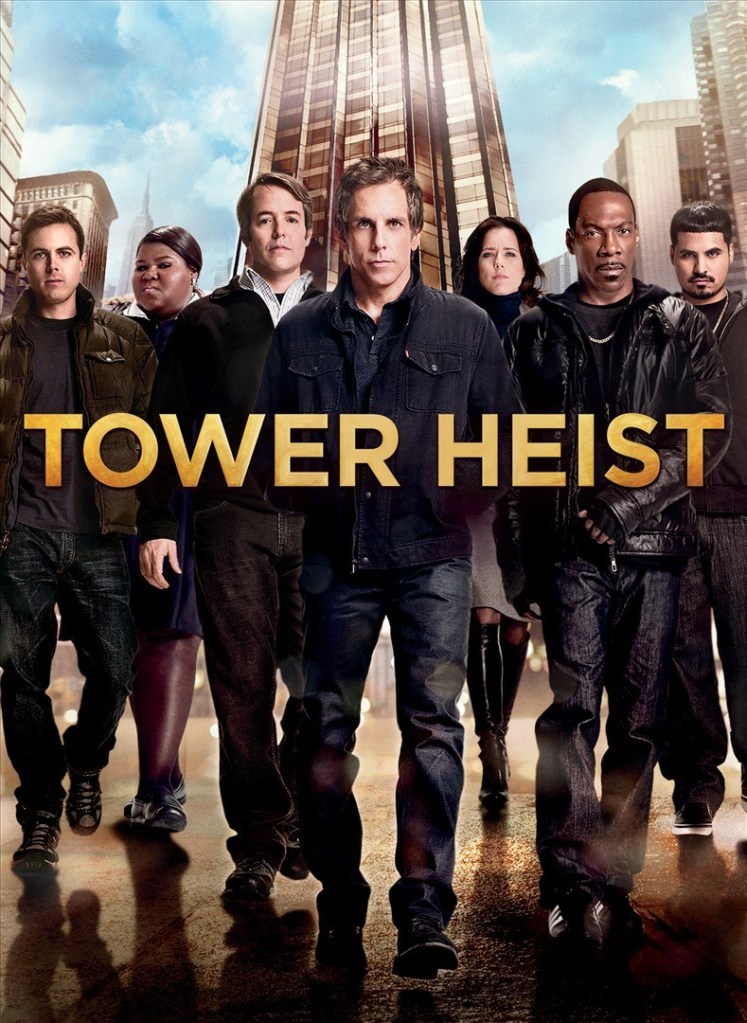
#MondayMuggers – Why TOWER HEIST?


Every Monday night at 9:00 Central Time, my wife Sierra and I host a “Live Movie Tweet” event on X using the hashtag #MondayMuggers. We rotate movie picks each week, and our tastes are quite different. Tonight, Monday November 25th, we’re watching TOWER HEIST starring Ben Stiller, Eddie Murphy, Casey Affleck, Alan Alda, and Matthew Broderick.

So why did Sierra pick TOWER HEIST, you might ask? It’s simple. It’s a Thanksgiving movie. The Macy’s Thanksgiving Day Parade is even used as a key part of the heist strategy! Sierra and I love the holidays and we’re getting in the spirit. We hope watching this movie will enhance your Thanksgiving week!

It’s on Amazon Prime, and we’ll be following along the theatrical edition (NOT the Extended Edition). Join us if you’d like!

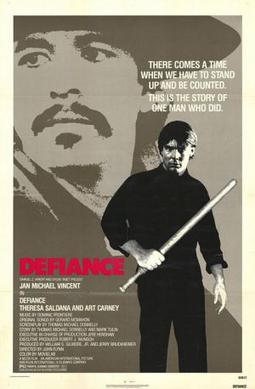
Defiance (1980, directed by John Flynn)


Serving out a six-month suspension, Merchant Seaman Tommy Campbell (Jan-Michael Vincent) rents an apartment on New York’s Lower East Side and passes the time painting and trying to learn Spanish in hope of getting assigned to a ship that is heading to Panama.

Tommy just wants to be left alone but he finds himself being drawn into the close-knit neighborhood.  He becomes friends with Carmine (Danny Aiello) and more than friends with his upstairs neighbor (Theresa Saldana).  He becomes a mentor to a street kid (Fernando Lopez) who lives with a punch-drunk boxer named called Whacko (Lenny Montana).  Abe (Art Carney), who owns the local bodega, agrees to let Tommy use his phone.

Tommy also finds himself drawing the attention of Angel Cruz (Rudy Ramos), head of the local street gang.  Tommy doesn’t want to get involved in any trouble.  He just wants to serve his suspension and sail to Panama.  But with Angel and his gang terrorizing the neighborhood and even robbing a church bingo game, Tommy and his friends finally stand up to the gang.

Defiance is more intelligent and realistic than many of the other urban vigilante movies that came out in the 70s and 80s.  Tommy never becomes a cold-blooded killer, like Charles Bronson did in the Death Wish films.  Instead, he spends most of the film trying to stay out of trouble and, when he does stand up for himself and the neighborhood, he does so realistically.  He fights the gang members but he doesn’t set out to the kill them.  About as deliberately destructive as he and Carmine get is that they destroy Angel’s car.  Rather than being a typical vigilante movie, Defiance is a portrait of a neighborhood where everyone takes care of everyone else.  Angel and his gang mistake the neighborhood’s kindness for weakness.  The neighborhood proves them wrong.

Defiance stars two actors who never quite got their due.  Theresa Saldana’s promising career was derailed when she was attacked and nearly killed by a deranged stalker in 1982.  Though she recovered and went on to do a lot of television, she never became the star that she should have.  Jan-Michael Vincent did become a star in the 70s and 80s but he later became better-known for his struggles with drugs and alcohol.  Both of them are very good in Defiance and leave you thinking about the careers that they could have had if things had just gone differently.

Retro Television Reviews: Miami Vice 1.19 “The Home Invaders”


Welcome to Retro Television Reviews, a feature where we review some of our favorite and least favorite shows of the past!  On Mondays, I will be reviewing Miami Vice, which ran on NBC from 1984 to 1989.  The entire show is currently streaming on Tubi!

This week, Crockett and Castillo take down some home invaders.  Yes, Crockett and Castillo.  Not Crockett and Tubbs.  Read on to find out why.

Episode 1.19 “The Home Invaders”

(Dir by Abel Ferrara, originally produced by March 15th, 1985)

Always do your research.

Philip Michael Thomas does not appear in this episode of Miami Vice.  At the start of the episode, it’s mentioned that he’s in New York, visiting Valerie Gordon.  It’s a line that sounds like it was written at the spur of the moment and, when I heard it, I assumed that there had been some sort of behind-the-scenes drama between Thomas and the producers.  Fortunately, before I went with that and said something snarky, I actually looked up the reason for Thomas’s absence and I discovered that he was injured performing a stunt in the previous episode.  Thomas missed this episode because he was recovering.  As well, this was the only episode that he missed during the entire run of Miami Vice.

Thomas may be absent but that doesn’t mean that crime is going to take a break in Miami.  A series of violent home invasions lead to Crockett and Castillo getting temporarily assigned to the robbery division.  Crockett is excited to be working under his former boss and mentor, Lt. John Malone (Jack Kehoe).  Castillo quickly realizes that Malone has gotten rusty and that his investigation into the robberies has been sloppy.

This is a moody episode, with the emphasis as much on Crockett’s disillusionment with his old boss as with the efforts to catch the home invaders.  That said, the home invaders are a scary bunch.  Led by Esai Morales and David Patrick Kelly, they are totally ruthless and willing to kill anyone who fails to move quickly enough.  The scenes in which they break into various mansions and threaten the inhabitants are difficult to watch and it definitely captures the trauma of having your personal space invaded and your sense of safety destroyed.

(When I was 17, our house was broken into and, for months, I couldn’t sleep through the night.  Almost every night, I was woken up by what I thought was the sound of someone breaking into my house and I would end up walking through the house in my nightclothes, carrying a golf club for protection.  One night, I nearly hit my sister when she came out of the kitchen with a midnight snack.  It may sound funny now but, at the time, it was terrifying.)

It ends with a shootout that’s violent even by the standards of Miami Vice.  Castillo and Crockett gun down the bad guys and it’s hard not to notice that, while Crockett seems to be clearly upset by the fact that he had to kill a few men, Castillo barely shows any emotion at all.  Castillo is effective because he holds back his feelings about everything.  That’s also why Castillo, and not Crockett, is capable of seeing that Lt. Malone is past his prime.  With the home invaders neutralized, Malone tells Crockett that he’s quitting the force.  His days of being an effective detective are over.  The job and all of the terrible stuff that he deals with on a daily basis has left him burned out and it’s hard not to notice that he and Crockett are the same age.  Fighting crime in Miami takes a toll.

This episode was directed by Abel Ferrara, who keeps the action moving quickly and who fills the screen with ennui-drenched images of people who are not sure whether they’re making any difference at all.  This is an effective episode, even without the presence of Ricardo Tubbs.

Maniac Cop III: Badge of Silence (1992, directed by William Lustig)


Despite finally getting his burial with honors at the end of Maniac Cop 2, Matt Cordell (Robert Z’Dar) returns for one last outing.  Raised from the dead by a voodoo houngan (Julius Harris), Cordell invades a hospital to seek vengeance for a comatose policewoman named Katie Sullivan (Gretchen Baker).  In a coma due to the wounds she received while thwarting a convenience store robbery, Katie is being framed by unscrupulous reporters and attorneys who claim that Katie was a bad cop who killed a clerk in cold blood.  Cordell sees Katie as being a fellow victim of anti-cop bias and he is not going to let anyone treat her with disrespect, which is something that two doctors (Robert Forster and Doug Savant) are unfortunate enough to discover.  Sean McKinney (Robert Davi) and Dr. Susan Lowery (Caitlin Dulany) try to figure out how to bring peace to the souls of both Cordell and Katie.

As opposed to the first two films, Maniac Cop III had a troubled production.  Lustig and screenwriter Larry Cohen wanted to set the film in a Harlem hospital and bring in an African-American detective to investigate Cordell’s activities.  The film’s Japanese producers insisted that Robert Davi return as the lead, even though the script’s lead character had little in common with the way Sean McKinney was portrayed in Maniac Cop 2.  Larry Cohen then refused to do any rewrites on the script unless he was paid more.  William Lustig filmed what he could and ended up with a 51-minute movie.  Extra scenes were directed by one of the film’s producers and the film was also padded out with outtakes from Maniac Cop 2.

The film is disjointed and there’s too much time devoted to Jackie Earle Haley playing a character who has much in common Leo Rossi’s serial killer from the second film.  (Haley’s performance is fine but the character feels superfluous).  But the movie’s hospital setting leads to some interesting kill scenes and Z’Dar and Davi both give good performances as two different types of maniac cops.  The supporting cast is full of good character actors like Haley, Forster, Savant, Julius Harris, Bobby Di Cicco, and Paul Gleason.  Despite the film’s flaws, Maniac Cop III is a solid ending for the trilogy.

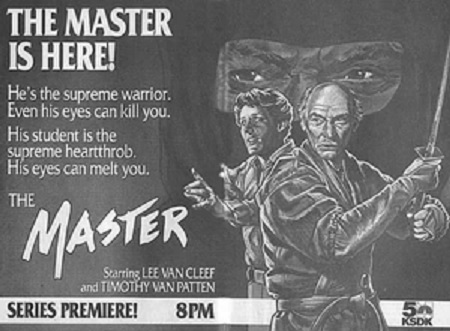
Retro Television Reviews: The Master 1.12 “Rogues”


Welcome to Retro Television Reviews, a new feature where we review some of our favorite and least favorite shows of the past! On Fridays, I will be reviewing The Master, which ran on NBC from January to August of 1984.  The show can be found on Tubi!

Max and McAllister continue their trip through California!

Episode 1.12 “Rogues”

(Dir by Gordon Hessler, originally aired on August 10th, 1984)

This week’s episode finds Max and McAllister on Los Angeles’s famed Rodeo Drive.  We know that this episode takes place on Rodeo Drive because every single establishing shot opens with a close-up of the street sign.  It’s as if someone in production said, “Do not let them forget that this episode is not only set on Rodeo Drive but we filmed it there as well!”

Wow, a television program filmed in Los Angeles!  The Master was all about spoiling their audience.

Here’s my thing with Rodeo Drive — the word is pronounced Ro-Dee-O.  Get out of here with all that Roe-Day-O nonsense, you yankees.

Anyway, this episode continues last week’s theme of McAllister and Max dropping in on people from Max’s past.  Apparently, the hunt for John Peter McAllister’s long lost daughter has been abandoned so that Max can drop in on his old high school buddies.  Seeing as how it hasn’t even been ten years since Max graduated from high school whereas McAllister has never even met his daughter and it’s totally possible that McAllister’s ninja rivals may be trying to kill her, it seems a bit odd that this is what Max and McAllister are concentrating on but whatever.  We’re nearly done with this show anyway.

Max visits his ex-girlfriend, Talia (Cindy Harrell), at the health club where she works.  Talia is an aerobics instructor, which means that there’s a lot of spandex in this episode.  While McAllister deals with a trainer who takes one look at him and declares him to be in terrible shape (and she has a point because, unlike his stunt double, Lee Van Cleef was noticeably overweight and often seemed to be winded on The Master), Max talks to Talia and discovers that Talia’s brother, Jerry (Paul Tulley), became a cop and is now missing!  Max promises to help her find Jerry.

However, it turns out that Jerry is just hiding outside the health club.  When he sees Max’s van, he tosses a note inside of it, asking Max and McAllister to meet him.  (How exactly did Jerry know that Max and McAllister would be able to help him?)  It turns out that, while investigating a series of Rodeo Drive robberies, Jerry discovered that the culprits were rogue cops who had been hired by a local gallery owner.  Now, the crooked policemen are after Jerry!  Needless to say, it’s time for McAllister to put on his black ninja outfit so that Lee Van Cleef’s stunt double can beat up some corrupt law enforcers!

This was not a particularly memorable episode.  The corrupt cops were generic villains and even the fight scenes, which were usually The Master‘s saving grace, felt sloppy and rushed.  While it was always obvious that this show was dependent on stunt doubles, it was especially obvious in this episode as the stand-ins for both Van Cleef and Van Patten didn’t even resemble their respective actors.  There was a brief moment of hope when the action moved to one of those police academy shooting ranges, full of fake buildings and cardboard targets but the show never really took advantage of the location’s potential.  This was one of those episodes where it felt like the basic plot could have been used for a dozen other shows without having to make anything more than a few cosmetic changes.  It could have just as easily been an episode of Half Nelson.

(L.A. — you belong to me!  No, no, we’ve moved on….)

Next week …. The Master ends!  Will McAllister even mention his missing daughter during the show’s final episode?  We’ll find out!