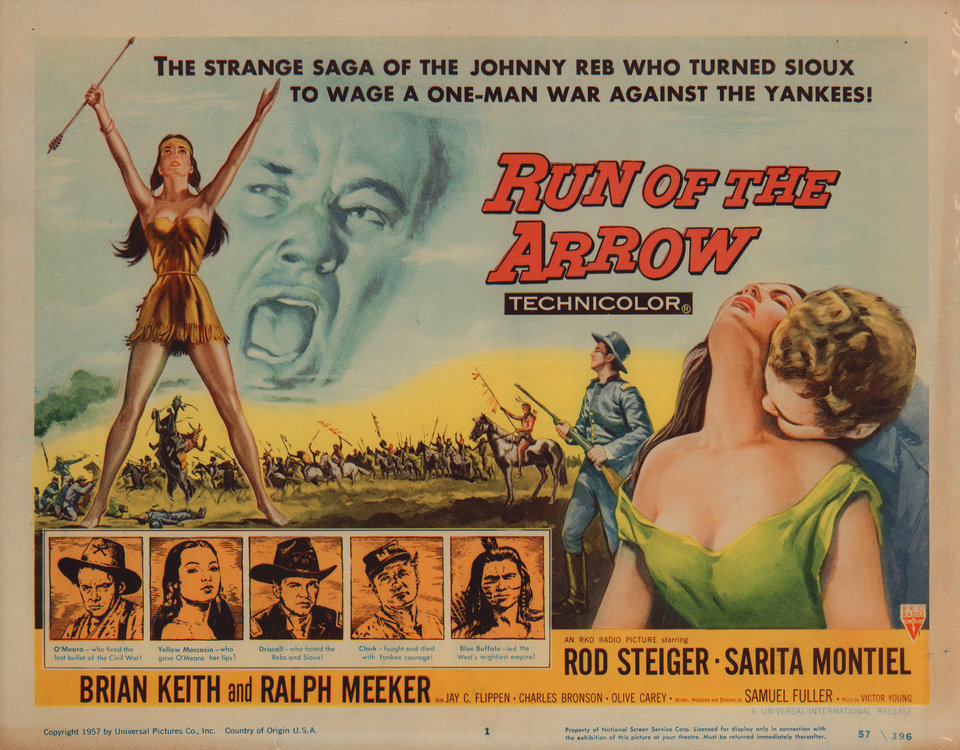
Brad reviews Samuel Fuller’s RUN OF THE ARROW (1957), starring Rod Steiger and Charles Bronson! 


RUN OF THE ARROW opens up on April 9th, 1963, with confederate sharpshooter O’Meara (Rod Steiger) shooting a Union lieutenant named Driscoll (Ralph Meeker). This turns out to be the final shot fired in the Civil War as General Lee is in the process of surrendering to General Grant. It also turns out to be Driscoll’s lucky day, as a slight warping of the bullet causes O’Meara’s aim to be off just enough for him to survive. With no more war to fight and with a heart full of hate for the Yankees, O’Meara declares himself to be a man without a country and decides to head out west towards the land of the Indians. As part of his travels he happens across Walking Coyote (Jay C. Flippen), an aging, renegade Sioux scout who’s headed back home to die. Walking Coyote takes O’Meara under his wing and teaches him the Sioux language, as well as many of their customs. When they’re captured by a band of Sioux warriors led by Crazy Wolf (H.M. Wynant), and are being prepared to be killed, Walking Coyote invokes the “run of the arrow”, a ritualistic game that could save their lives. Unfortunately, no one has ever survived the run of the arrow. But today, it seems there’s a first time for everything, as O’Meara survives just long enough to be found, hidden, and saved by the beautiful Indian squaw Yellow Moccasin (Sarita Montiel). Yellow Moccasin nurses him back to health and presents him to her tribal chief, Blue Buffalo (Charles Bronson), who spares his life since he survived the run. Blue Buffalo also welcomes O’Meara into their tribe and allows O’Meara and Yellow Moccasin, who have fallen in love, to get married and adopt the mute orphan boy, Silent Tongue, as their own son. Things seem to be going well until Sioux Leader Red Cloud (Frank DeKova) and Army General Allen (Tim McCoy) reach an agreement that allows for an Army Fort to be built in a narrowly defined area. While the construction of the fort is entrusted to an honest man of integrity named Captain Clark (Brian Keith), the agreement is ultimately sabotaged by the murderous Crazy Wolf, and then further by the Indian hating Captain Driscoll… yes, that same Union soldier that O’Meara shot on the last day of the war! When the fighting starts again, will O’Meara prove himself to truly be a Sioux warrior willing to kill American army soldiers, or is a part of his heart still with his country?

Director Samuel Fuller’s RUN OF THE ARROW is a movie about the damage that occurs when human beings allow their hearts to be so filled with bitterness and hate that they quit caring about other people. It’s also about what happens when those same people run into rational people of good will, and we find out if they’re still capable of even considering the possibility that their own hate has blinded them from the truth. In other words, it’s a film that’s possibly more relevant today than it was when it was made in 1957. Bitterness and hate is represented by the characters of O’Meara (Steiger), Crazy Wolf (Wynant), and Lieutenant Driscoll (Meeker). O’Meara hates Yankees, Crazy Wolf hates the white man, and Driscoll hates the Indians. The rational people of good will are the characters of Yellow Moccasin (Montiel), Blue Buffalo (Bronson), and Captain Clark (Keith). Yellow Moccasin saves O’Meara, when everyone else would have just let him die. Blue Buffalo engages in honest conversation with O’Meara and even welcomes him into their tribe. Captain Clark shows O’Meara an empathetic ear and kindness when so many others have told him to just get over himself. The actions and fates of the characters play out against this dynamic of hatred versus humanity, with the results underscoring just how tragic it is when people focus on the things that separate us rather than the things that unite us. It’s all so unnecessary, but it’s also a realistic vision of the world we live in. The film also struck me as particularly violent for a 50’s western, which also underscores that reality.

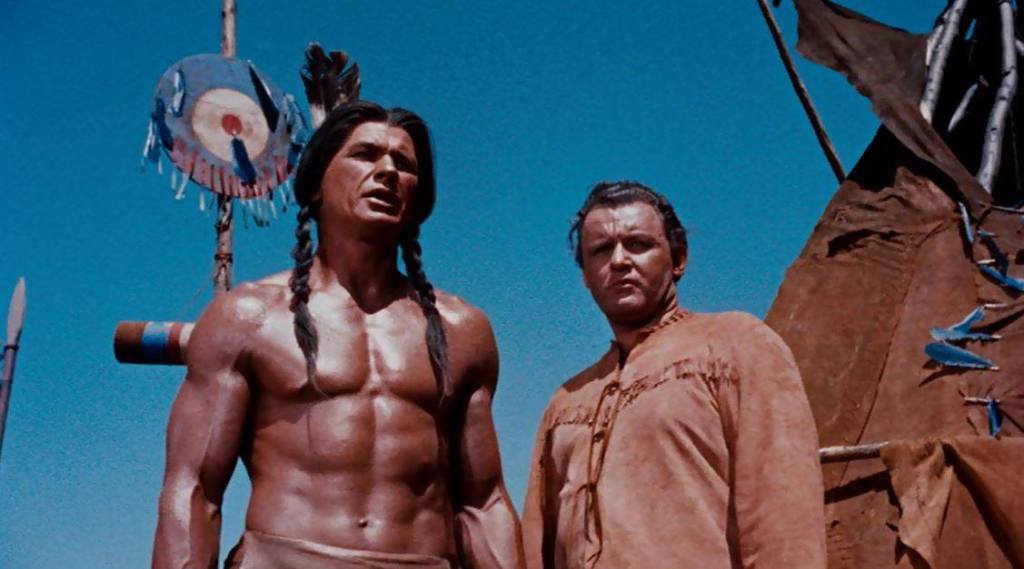
Some of the performances are very effective in the film. Rod Steiger’s Irish, confederate Sioux is an interesting character and the actor gives it his all as you’d expect. I’m a big fan of Steiger and his performance here only solidifies my respect for him. Brian Keith’s Captain Clark arrives fairly late in the proceedings and comes across as a tough, but honest man of integrity at a point when the movie really needs him. He has an excellent scene with Steiger where he debates the old confederate’s reasons for renouncing his citizenship with both sound logic, empathy, kindness and a hint of likable sarcasm all at the same time. It’s one of the best scenes in the film. And likewise, Charles Bronson, the most buff Hollywood Indian to ever strip down to a loincloth, comes across as a reasonable and kind tribal chief in his dealings. Bronson had played Indians before, but he was usually more of the renegade, warpath variety, so it was nice seeing him as a good guy here. H.M. Wynant took the renegade Indian role here which you might have expected for Bronson at the time. He’s suitably fierce but one-dimensional. The same can be said for Ralph Meeker as Lieutenant Driscoll. He’s pretty much just a stereotypical jerk. He’s good at being a jerk though! And Sarita Montiel, voiced by Angie Dickinson, is quite the beauty as Yellow Moccasin. We discussed H.M. Wynant and RUN OF THE ARROW with author Steven Peros on the “This Week in Charles Bronson Podcast.” Check out that interview below:

I’ve recently heard RUN OF THE ARROW compared to Kevin Costner’s DANCES WITH WOLVES, and there are definitely many similarities. I won’t go into all of those here, but one of the things I appreciated the most about RUN OF THE ARROW is the fact that the movie makes its feelings known about politics. In a movie filled with characters who have had their lives upended by the various decisions of political leaders, director Samuel Fuller has crafted a story that focuses most sharply on defining the quality of men based on what’s in their “hearts.” When it’s all said and done, oftentimes the only control we have is the way we respond to the events in our lives, and that’s not politics, it’s personal. To drive this home, in one of their conversations, Walking Coyote tells O’Meara that he could have been a chief if he had wanted to be. When O’Meara pushes the old scout on why he didn’t want the position, Walking Coyote responds with, “Because I hate politics!” On that point, I couldn’t agree more. 
Horror On The Lens: Teenage Caveman (dir by Roger Corman)


Future serious actor Robert Vaughn made his film debut in 1958’s Teenage Caveman.  Directed by Roger Corman, Teenage Caveman tells the story of a rebellious young man (that’s Robert Vaughn) who chooses to defy his father’s warnings and venture beyond the caves and into “the forbidden zone.”  He’s told that monsters roam in the forbidden zone and indeed, at least one of them does.  However, neither the Teenage Caveman nor his father are prepared for what lies at the heart of the forbidden zone.

(What will he find out there, Dr. Zaius?)

Robert Vaughn later said that, out of all the bad films that he made, this was the worst.  Personally, I think he was being a bit too hard on the film.  It’s not good but it is definitely fun.  Along with watching all of the dinosaur stock footage, you get to wonder how a caveman — especially a teenage caveman! — could possibly have such perfect hair.  Even more importantly, if you stick with it, this film has a twist ending that has to be seen to be believed.

Here is Teenage Caveman:


Film Review: The Don Is Dead (dir by Richard Fleischer)


“The Don is Dead!” shouts the title of this 1973 film and it’s not lying.

After the powerful and respect leader of the Regalbuto crime family dies, the Mafia’s governing body meets in Las Vegas to debate who should be allowed to take over the family’s operations.  Frank Regalbuto (a smoldering Robert Forster) wants to take over the family but it’s agreed that he’s still too young and hot-headed.  Instead, control of the family is given Don Angelo DiMorra (Anthony Quinn), an old school Mafia chieftain who everyone agrees is a man of respect.  Don DiMorra will serve as a mentor to Frank while Frank’s main enforcers, The Fargo Brothers, will be allowed to operate independently with the understanding that they will still respond if the mob needs them to do a job.  Tony Fargo (Forrest) wants to get out of the rackets all together while his older brother, Vince (Al Lettieri), remains loyal to the old ways of doing things.

Frank is not happy with the arrangement but he has other things to worry about.  He knows that there’s a traitor in his family.  While he and the Fargo brothers work to uncover the man’s identity so that they can take their revenge, Don Angelo falls in love with a Vegas showgirl named Ruby Dunne (Angel Tompkins).  However, Ruby is engaged to marry Frank and, when Frank returns from taking care of the traitor, he is tipped off as to what has been happening in his absence.  Frank goes crazy, nearly beating Ruby to death.  Don Angelo declares war on Frank and the Fargo brothers are forced to decide which side they’ll serve.

In the 1970s, almost every crime film was either a rip-off of The French Connection or The Godfather.  The Don Is Dead is unique in that it attempts to rip off both of them at the same time.  The film opens French Connection-style with a couple of hoods trying to double-cross Frank during a drug deal, leading to shoot-out.  (Keep an eye out for Sid Haig as one of Frank’s men.)   The film is full of scenes that are meant to duplicate the gritty feel of The French Connection though, needless to say, none of them are directed with the cinema verité intensity that William Friedkin brought to that classic film.  Meanwhile, Anthony Quinn plays a character who is very much reminiscent of Don Vito Corleone, even pausing at one point to tell Frank that “drugs are a dirty business.”  The Godfather‘s Abe Vigoda and Al Lettieri show up in supporting roles and Robert Forster gives a performance that owes more than a little to James Caan’s Oscar-nominated turn as Sonny Corleone.  (Interestingly enough, both Quinn and Forster were among the many actors considered for roles in The Godfather.)

Unfortunately, the film itself is slowly-paced and never really draws us into the plot.  Director Richard Fleischer, who directed a lot of films without ever developing a signature style, brings none of the intensity that William Friedkin brough to The French Connection nor can he duplicate Francis Ford Coppola’s operatic grandeur.  The Don is Dead plays out like a particularly violent made-for-TV movie.  There’s a lot of talented people in the cast but they’re defeated by thinly drawn characters.  Robert Evans often said that Coppola was hired to direct The Godfather because, as an Italian-American, he would bring an authenticity to the material that a non-Italian director would not be able to do.  The Don Is Dead would seem to indicate that Evans knew what he was talking about.

THE MECHANIC (1972) – Celebrate the New Year with one of Charles Bronson’s most iconic roles!


THE MECHANIC features an iconic performance by Charles Bronson, a performance that would represent a blueprint for the type of character he would play in many films…the strong, silent, unstoppable, man of action.  Bronson plays Arthur Bishop, a hit man with a gift for planning and executing his hits in a way that make the deaths look like natural deaths rather than murders.  Facing health issues and loneliness, he takes on a young protégé named Steve McKenna, played by Jan-Michael Vincent.  This upsets his bosses in the underworld because he takes on the apprentice without asking them.  Will they allow him to train up this new protégé and complete tag team hits going forward, or will they decide that Bishop is no longer worth the risk?          

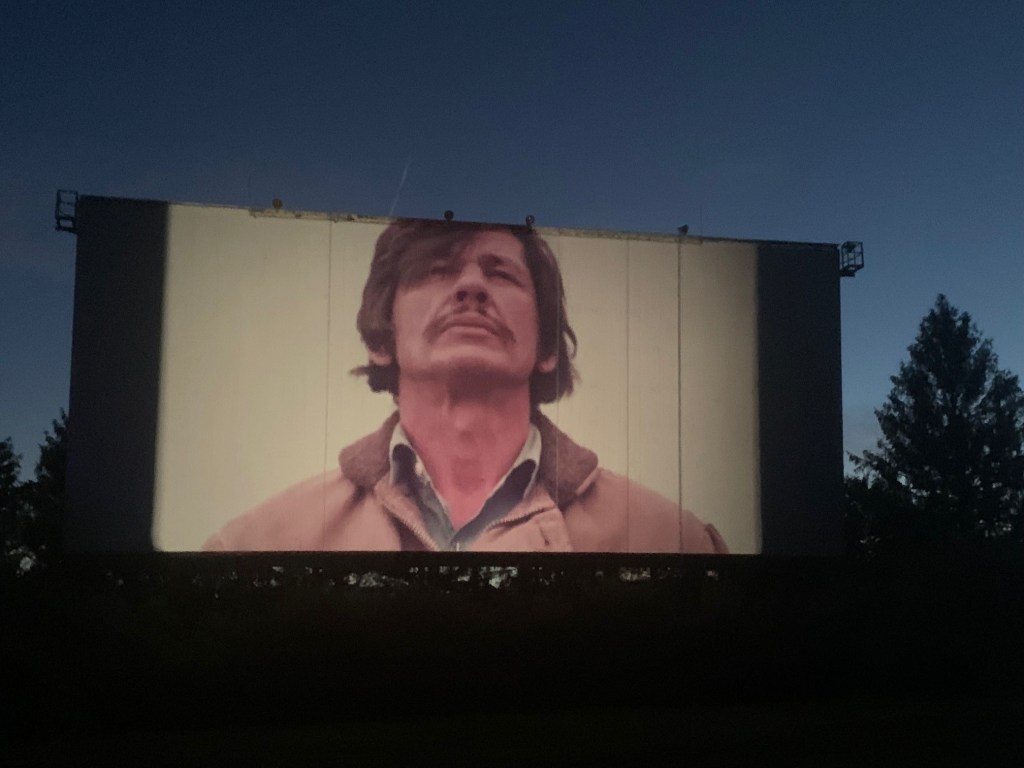
I’ll start off by stating up front that I love THE MECHANIC.  The first Charles Bronson movie I ever owned on VHS was a nearly unwatchable, 2nd hand version of the film, but I still tried to watch it.  The first Charles Bronson movie I ever saw on the big screen was a beautiful 35mm print of the film at the Mahoning Drive-in theater in Lehighton, PA.  I also believe that this film has the best ending of any Charles Bronson film.  Needless to say, the following review will be full of praise, so if you’re looking for a real critical take on the piece, this is probably not the place to look!

To start off, THE MECHANIC has a uniquely amazing opening sequence.  The first 16 minutes of the film features hitman Bishop going through the mundane tasks of setting up a hit.  We watch him set up shop across the street from the mark, we watch him break into the mark’s apartment to rig the things needed to accomplish the hit, we watch him squeeze a wax ball, etc.  Bishop speaks no dialogue during these 16 minutes, and the only things we hear are the sounds of the soundtrack and the street.  Bronson’s unique screen presence makes it mesmerizing.  Could you imagine an action film trying this strategy in this day and age?   

Once Bishop has successfully completed the first hit, we’re introduced to Bishop’s world outside of what we’d observed during the opening sequence.  We meet Harry McKenna (Keenan Wynn), the “uncle-like” figure who has gotten himself in trouble with the organization.  We’re not surprised who’s given the job to eliminate this problem.  We meet Harry’s son Steve (Jan-Michael Vincent) who hits it off with Bishop at the funeral where their relationship really begins.  On a side note, the film’s script featured these two characters as gay men, and the sexuality element was going to be a major way that Steve would get close enough to Bishop to gain his trust.  That part of the script was changed to get Bronson and secure financing for the film.  Since that element is not part of the movie I’ll move on.  We meet a prostitute (Jill Ireland) who’s visited by Bishop.  This is a very interesting scene that gives us a strong insight into just how lonely Bishop is and also helps us understand why he’s open to the idea of bringing on an apprentice.  I think Jill Ireland is quite effective in her one scene.

Once the various characters are introduced, the film settles nicely into a mentoring relationship between Bishop & Steve.  The experienced hitman shares his knowledge, and we follow along with them as they complete various assignments.  The movie seems most interested in the relationship between the men, but this is an action movie, so we have a couple of very solid action sequences in the middle portion of the film, as well as the end.  Director Michael Winner, who directed Charles Bronson in six different films, stages these sequences extremely well, especially the sequence that ends the film in Naples, Italy.  We see necks snapped.  We see faces knuckle punched.  We see a motorcycle chase ending with a motorcycle flying off a cliff and exploding into a ball of flames upon impact.  We see boats exploding.  We see Bronson using my favorite weapon, the pump shotgun, with expert precision.  We see cars chasing each other along the Italian coast.  We see bombs being dropped out of moving cars with precision timing to blow up the cars behind them.  We even see a bulldozer pushing a moving car off the side of a cliff.  It’s some amazing stuff, with Bronson & Vincent appearing quite badass at times.  And then the ending, the ending that proves just how awesome Bishop truly is!  I won’t say anymore about that.  Just watch and enjoy! 

**BONUS CONTENT** – We dedicated an episode of the “This Week in Charles Bronson” podcast to THE MECHANIC. It was one of the most enjoyable episodes for me to record. If you’re interested in learning more about the film from a group of guys who love Charles Bronson, give it a listen!

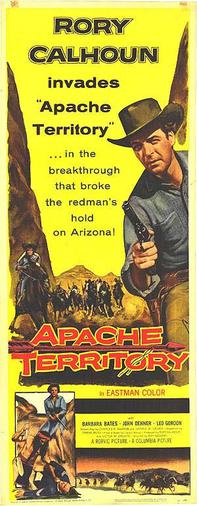
Apache Territory (1958, directed by Ray Nazarro)


In this B-western, Rory Calhoun plays Logan Cates, an old west drifter, while traveling through the desert, comes across a young woman named Junie Hatchett (Carolyn Craig).  Junie’s parents were settlers who were captured and killed by a group of Apaches.  Knowing that the Apaches will still be looking Junie, Logan takes her to a nearby canyon where there’s water and shelter.  Soon, other victims of the Apaches start to show up at the canyon.  With their supplies dwindling and the Apaches surrounding them, Logan has to keep everyone alive and lead them to safety.

Complicating matters is that one of the people who shows up at the canyon is Logan’s ex-girlfriend, Jennifer (Barbara Bates).  Jennifer is traveling with her new husband, the wealthy (and therefore cowardly) Grant Kimbrough (John Dehner).  Also seeking shelter at the canyon are a group of Calvary officers, a Pima Indian named Lugo (Frank DeKova), and a naive teenage cowboy named Lonnie (Tom Pittman).

Based on a novel by Louis L’Amour, Apache Territory is a pretty standard western.  Some of the battle scenes are surprisingly brutal — particularly when one of the Calvary officers gets hit by a flaming arrow — but otherwise, this is a typical B-western, the type of movie that would have been the second part of a double bill at a Saturday matinee.  Logan Cates is able to survive because, unlike Grant Kimbrough, he knows and respects the land and, unlike the Calvary officers, he respects his enemy.  He’s a typical western hero, though well-played by Rory Calhoun.

The main problem with the film is that, for a film about a group of people trapped in one location, it never achieves any sense of claustrophobia.  The size of the canyon seems to change from shot to shot.  The film’s finale involves a well-realized dust storm but it still never reaches the type of action-packed conclusion that most western fans will be hoping for.  It ends with a whimper instead of a bang.  It feels more like an extended episode of Gunsmoke or The Virginian than a feature film.

This one will be best appreciated by undemanding fans of the genre.

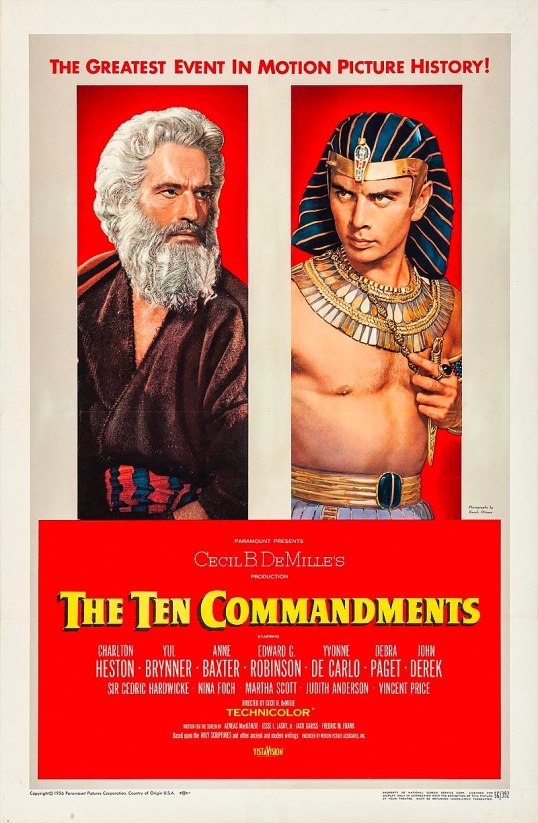
Film Review: The Ten Commandments (dir by Cecil B. DeMille)


Though you may not know it if you’ve only seen the film during one of its annual showings on television, the 1956 religious epic, The Ten Commandments, originally opened with director Cecil B. DeMille standing on a stage.  Speaking directly to the audience, DeMille explains that, though the film they’re about to see me take some dramatic license with the story of Moses, it still based on not just the Bible but also the accounts of Philo, Josephus and Eusebius.  He also tells us that The Ten Commandments is more than just an adaptation of the Book of Exodus.  Instead, it’s a film about every man’s desire to be free.

Demille concludes with: “The story will take 3 hours and 29 minutes to unfold.  There will be an intermission. Thank you for your attention.”

To be honest, it’s kind of a sweet moment.  Cecil B. DeMille is a name that is so associated with (occasionally overblown) epic filmmaking that it’s easy to forget that DeMille was one of the most important names in the artistic development of American cinema.  He was there from the beginning and, unlike a lot of other filmmakers, he was equally successful in both the silent and the sound era.  Say what you will about his films, DeMille was a showman and he handles the introduction like a pro.  At the same time, there’s a real sincerity to DeMille’s tone.  After you listen to him, you’d almost feel guilty if you didn’t sit through all 3 hours and 29 minutes of his film.

That sincerity extends throughout the entire film.  Yes, The Ten Commandments is a big, long epic and some members of its all-star cast are more convincing in their roles than others.  And yes, the film can seem a bit campy to modern viewers.  (In fact, it wouldn’t surprise me if it seemed a bit campy to viewers in 1956 as well.)  Yes, The Ten Commandments does feature Anne Baxter saying, “Oh Moses!  You sweet adorable fool!”  But it doesn’t matter.  Even the most ludicrous of dialogue just seem right.  The film is just so sincere that it’s difficult not to enjoy it.

In the Book of Exodus, Moses is described as having a speech impediment and even tries to use it as an excuse to get out of going to Egypt.  That’s actually one of the reasons why Moses brought Aaron with him to Egypt, so that Aaron could speak for him.  In the movie, Moses is played by Charlton Heston, who comes across as if he’s never felt a moment of insecurity over the course of his entire life.  But no matter.  Heston may not by the Moses of Exodus but he’s the perfect Moses for the DeMille version.  When Heston says that Egypt will be visited by plagues until his adopted brother Ramses (Yul Brynner) agrees to allow the Jews to leave Egypt, you believe every word.  (Aaron, incidentally, is played by the legendary John Carradine.  He doesn’t get too much other than respectfully stand a few feet behind Charlton Heston but still: John Carradine!)

And really, anyone who dismisses The Ten Commandments out-of-hand should go back and, at the very least, watch the scene where the Angel of Death descends upon Egypt.  The scene where Moses and his family shelter in place while the screams of distraught mothers echo throughout the city is chilling.  Ramses may spend most of the film as a petulant villain but you almost feel sorry for him when you see him mourning over his dead son.  When he sets off after Moses, it’s not just because he’s doing what villains do.  He’s seeking vengeance for the loss of his first born.  For that brief moment, Ramses goes form being a melodramatic bad guy to being someone with whom the viewer can empathize.  Brynner, with his burning intensity, gives a great performance as Ramses.

As I said before, this film has what, in 1956, would have been considered an all-star cast.  Watching the names as they show up during the opening credits — Cedrick Hardwicke!  Yvonne DeCarlo!  Woody Strode!  Debra Paget! — is like stepping into a TCM fever dream.  Some of the performers give better performance than others.  And yet, even the worst performer feels as if they just naturally belong in the world that DeMille has created.  John Derek may seem rather smarmy as Joshua but his callowness provides a good contrast to the upright sincerity of Heston’s performance as Moses.  Edward G. Robinson’s cries of, “Where is your God now!?” may have provided endless fodder for impersonators but just try to imagine the film without him.  Even Vincent Price is in this thing!  He doesn’t have his famous mustache but, as soon as you hear his voice and see that famous glare, you know that it’s him.

Of course, when you’re growing up and The Ten Commandments is on TV every year, you mostly just want to see the scene where Moses parts the Red Sea.  The Ten Commandments was nominated for seven Oscars but it only won one, for its special effects.  (The prize for Best Picture went to another epic, Around The World In 80 Days.)  Today, the film’s special effects may no longer amaze viewers but there’s still something rather charming about the Red Sea parting and then crashing in on the Egyptian army.  The scene where the Earth opens up and swallows those who worshiped the Golden Calf remains impressive, if just because all of the extras really look terrified that they might die.  And while the Pillar of Fire may look a bit cartoonish to modern eyes, that’s a huge part of the film’s appeal.

The Ten Commandments is a big, long, sometimes silly, sometimes effective, and always entertaining epic.  It’s a grand spectacle and one that I usually watch every year when it shows up on television.  I missed this year’s showing but, fortunately, I own it on DVD.  It’s a sincere epic and a difficult one not to like.


Horror on TV: Thriller 2.17 “La Strega” (dir by Ida Lupino)


For tonight’s excursion into televised horror, we have an episode of Thriller!

This episode is called T and it deals with an artist (Alejandro Rey) who saves a young woman (Ursula Andress) from drowning.  It turns out that the local villagers believe that the woman is a witch.  The artist has no time for superstition and takes the woman back to his home.  She starts as his model and then becomes his lover.  She may not be a witch but her mother (Jeanette Nolan) definitely is…

And, of course, this episode is introduced by the one and only Boris Karloff!

The episode premiered on January 15th, 1962.

Film Review: The Rise and Fall of Legs Diamond (1960, directed by Budd Boetticher)


TheRiseFallofLegsDiamondIt’s the 1920s.  Prohibition is the law of the land and gangsters control the streets of New York City.  Jack Diamond (Ray Danton) and his tubercular brother, Eddie (Warren Oates), arrives in town.  Jack and Eddie are small-time jewel thieves but Jack has ambitions to be something more.  He works with his girlfriend, Alice (Karen Steele), as a dance instructor but he dreams of being the most powerful mobster in the world.  His first step is to get a job working as a bodyguard for New York crime lord (and fixer of the 1919 World Series), Arnold Rothstein (Robert Lowery).  Though Rothstein never trusts him, Jack works his way into his inner circle and even gets a nickname.  Because he is a dancer, he is renamed “Legs” Diamond.
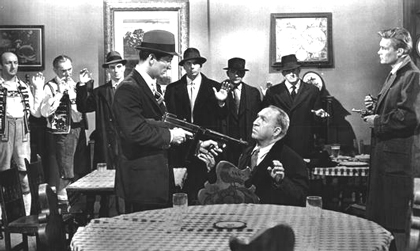
From the minute that he starts working with Rothstein, Legs Diamond’s cocky personality and ruthless ambition make him enemies.  When he is shot three times, Legs shocks everyone by surviving and announces that he is invulnerable and cannot be killed.  After Rothstein is mysteriously gunned down, Diamond goes to war against Leo “Butcher” Bremer (Jesse White, better known as the original Maytag repairman) for control of the New York underworld.

The Rise and Fall of Legs Diamond was directed by the legendary Budd Boetticher, a bullfighter-turned-director who is best known for directing a series of low-budget westerns in the 1950s.  The violent and hard-boiled The Rise and Fall of Legs Diamond was Boetticher’s only gangster film and it’s a good one.  The Rise and Fall of Legs Diamond is tightly-written, fast-paced, and Lucien Ballard’s black-and-white cinematography ranks with the best of film noir.

The role of Legs Diamond was originally offered to future producer Robert Evans (of The Kid Stays In The Picture fame) but when Evans turned it down, the role was given to Ray Danton.  Though he is occasionally a little stiff, Danton still gives a good and tough performance as Diamond but it is still hard not to wonder what Evans would have been like in the role.  The rest of the cast is full of recognizable B-movie actors, all of whom do a good job.  Actress Dyan Cannon made her film debut in Legs Diamond, playing one of Diamond’s girlfriends.  Meanwhile, in only his third film role, Warren Oates is memorable and sympathetic as the sickly Eddie.  Though Oates does not get to do much in the film, his performance still shows why he went on to become one of the most popular and well-respected character actors of all time.

Though hardly historically accurate (in real life, Arnold Rothstein never knew Jack Diamond and Diamond received his nickname not because he was a dancer but because of the speed with which he ran away from the police), The Rise and Fall of Legs Diamond is an exciting and entertaining Depression-era gangster film.

LegsDiamond

Film Review: American Pop (1981, directed by Ralph Bakshi)


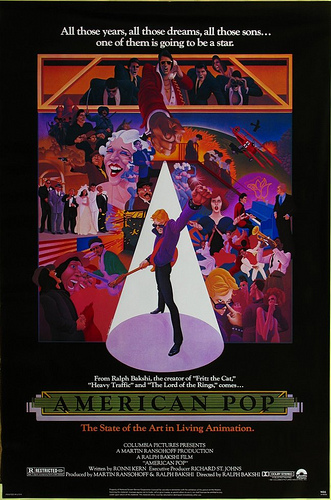
American PopLong before South Park, The Simpsons, and Pixar, there was Ralph Bakshi.  At a time when animation was considered to only be good for children, Bakshi shocked audiences and critics with animated films that dealt with mature themes and were definitely meant for adults.  His first two films, Fritz the Cat (1972) and Heavy Traffic (1973), was the also the first two animated films to receive an X-rating.  Bakshi satirized racism in the controversial Coonskin (1975) and Bakshi’s adaptation of The Lord Of Rings (1978) beat Peter Jackson’s by 23 years.  It was after the critical and commercial disappointment of the heavily flawed but interesting Lord of the Rings that Bakshi decided it was time to make a film that would be more personal to him.  The end result was American Pop.
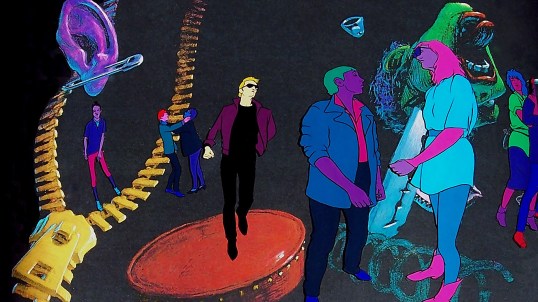
American Pop tells the story of four generations of a family of Jewish immigrants and how music affects their lives.  In typical Bakshi fasion, this animated film deals with issues of violence, sexuality, drug abuse, and poverty.  American Pop may be animated but it is definitely a film meant for adults.

In the 1890s, Zalmie (Jeffrey Lippa) and his mother escape from Russia after Zalmie’s father, a rabbi, is killed by the Cossacks.  Zalmie grows up in New York and after his mother is killed in the Triangle Shirtwaist Factory fire, he is raised by a vaudeville comedian named Louie (Jerry Holland).  Zalmie wants to be a singer but is shot in the throat during World War I.  His voice ruined, Zalmie marries a stripper named Bella (Lisa Jane Persky) and manages her career.  His partnership with the mobster Nicky Palumbo (Ben Frommer) leads to Bella dying and Zalmie going to prison.

Zalmie’s son, Benny (Richard Singer), is a jazz pianist who, as a favor to his father, marries Nicky’s daughter.  Benny has a son named Tony and tries to pursue his career without using his father’s influence.  Then World War II breaks out.

Benny enlists in the army, seeking redemption from the crimes of his father and father-in-law.  Serving in Europe, he misses his piano and, when he finds one in a bombed-out house in Nazi Germany, he plays a few bars of As Time Goes By.  When a Nazi walks in on Benny, Benny plays Lili Marleen.  For a few seconds, Benny and the Nazi share the common bond of music.  “Danke,” the Nazi says before shooting Benny dead.

Growing up without his father, Tony (Ron Thompson) becomes a beatnik and eventually runs away from home.  He ends up in Kansas, where he has a one-night stand with a waitress and becomes a songwriter for Frankie Hart (Marya Small), a stand in for Janis Joplin.  Both Tony and Frankie start using heroin and Frankie dies of an overdose right before she is supposed to open for Jimi Hendrix.  Abandoned by Frankie’s band, Tony ends up as an addict and dealer in New York.  Accompanying him is his son, Pete, the result of his hookup with the waitress.

After being abandoned by his father, Pete (also played by Ron Thompson), follows in his footsteps and becomes a successful drug dealer.  He is dealing cocaine to all of the big rock bands but, after discovering punk rock, he realizes that he wants something more out of his life.

After announcing that he will no longer sell anyone cocaine unless he is given a chance to record a demo, Pete is given a band and a recording studio.  With the drug-craving record company execs watching, this tough and cocky punk grabs the microphone and sings…

…BOB SEGER’S NIGHT MOVES!?

The use of Night Moves, which is one of the least punk songs ever written, is one of the few false notes in American Pop.  Otherwise, this is one of Ralph Bakshi’s best films.  The majority of the film’s animation was done through rotoscoping, a technique in which animation is traced over live action footage.  (For the gang war scenes, scenes from The Public Enemy were rotoscoped, as was footage of the Nicholas Brothers used in the Sing Sing Sing With A Swing montage.)  Seen today, the technique is crude but effective at showing the contrast between the fantasy of music and the grim reality of life.  Though it has its flaws (*cough* Night Moves *cough*), American Pop is an engaging look at the history and development of American music.

American_Pop

What could have been: The Godfather


I don’t know about you but I love to play the game of “What if.”  You know how it works.  What if so-and-so had directed such-and-such movie?  Would we still love that movie as much?  Would so-and-so be a star today?  Or would the movie have failed because the director was right to reject so-and-so during preproduction?

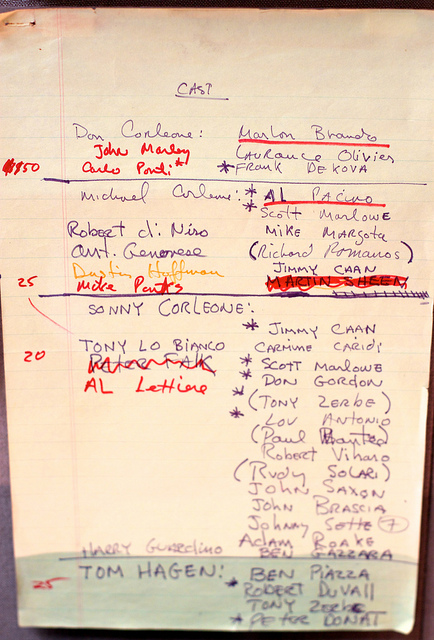
I guess that’s why I love the picture below.  Taken from one of Francis Ford Coppola’s notebooks, it’s a page where he jotted down a few possibilities to play the roles of Don Vito, Michael, Sonny, and Tom Hagen in The Godfather.  It’s a fascinating collection of names, some of which are very familiar and some of which most definitely are not.  As I look at this list, it’s hard not wonder what if someone like Scott Marlowe had played Michael Corleone?  Would he had then become known as one of the great actors of his generation and would Al Pacino then be fated to just be an unknown name sitting on a famous list?

(This page, just in case you happen to be in the neighborhood , is displayed at the Coppola Winery in California.)

The production of the Godfather — from the casting to the final edit — is something of an obsession of mine.  It’s amazing the amount of names — obscure, famous, and infamous — that were mentioned in connection with this film.  Below is a list of everyone that I’ve seen mentioned as either a potential director or a potential cast member of The Godfather.  Consider this my contribution to the game of What If….?

Director: Aram Avankian, Peter Bogdonavich, Richard Brooks, Costa-Gravas, Sidney J. Furie, Norman Jewison, Elia Kazan, Steve Kestin, Sergio Leone, Arthur Penn, Otto Preminger, Franklin J. Schaffner, Peter Yates, Fred Zinnemann

Don Vito Corleone (played by Marlon Brando): Melvin Belli, Ernest Borgnine, Joseph Callelia, Lee. J. Cobb, Richard Conte, Frank De Kova, Burt Lancaster, John Marley, Laurence Olivier, Carlo Ponti, Anthony Quinn, Edward G. Robinson, George C. Scott, Frank Sinatra, Rod Steiger, Danny Thomas, Raf Vallone,  Orson Welles

Michael Corleone (played by Al Pacino): John Aprea, Warren Beatty, Robert Blake, Charles Bronson*, James Caan, David Carradine, Robert De Niro, Alain Delon, Peter Fonda, Art Genovese, Dustin Hoffman, Christopher Jones, Tommy Lee Jones, Tony Lo Bianco, Michael Margotta, Scott Marlowe, Sal Mineo, Jack Nicholson, Ryan O’Neal, Michael Parks, Robert Redford, Burt Reynolds, Richard Romanus, Gianni Russo, Martin Sheen, Rod Steiger**, Dean Stockwell

Sonny Corleone (played by James Caan): Lou Antonio, Paul Banteo, Robert Blake, John Brascia, Carmine Caridi, Robert De Niro, Peter Falk, Harry Guardino, Ben Gazzara, Don Gordon, Al Letteiri, Tony LoBianco, Scott Marlowe, Tony Musante, Anthony Perkins, Burt Reynolds***, Adam Roarke, Gianni Russo, John Saxon, Johnny Sette, Rudy Solari, Robert Viharo, Anthony Zerbe

Tom Hagen (played by Robert Duvall): James Caan, John Cassavettes, Bruce Dern, Peter Donat, Keir Dullea, Peter Falk, Steve McQueen, Richard Mulligan, Paul Newman, Jack Nicholson, Ben Piazza, Barry Primus, Martin Sheen, Dean Stockwell, Roy Thinnes, Rudy Vallee****, Robert Vaughn, Jerry Van Dyke, Anthony Zerbe

Kay Adams (played by Diane Keaton): Anne Archer, Karen Black, Susan Blakeley, Genevieve Bujold, Jill Clayburgh, Blythe Danner, Mia Farrow, Veronica Hamel, Ali MacGraw, Jennifer O’Neill, Michelle Phillips, Jennifer Salt, Cybill Shepherd, Trish Van Devere

Fredo Corleone (played by John Cazale): Robert Blake, Richard Dreyfuss, Sal Mineo, Austin Pendleton

Connie Corleone (played by Talia Shire): Julie Gregg, Penny Marshall, Maria Tucci, Brenda Vaccaro, Kathleen Widdoes

Johnny Fontane (played by Al Martino): Frankie Avalon, Vic Damone*****, Eddie Fisher, Buddy Greco, Bobby Vinton, Frank Sinatra, Jr.

Carlo Rizzi (played by Gianni Russo): Robert De Niro, Alex Karras, John Ryan******, Sylvester Stallone

Virgil “The Turk” Sollozzo (played by Al Letteiri): Franco Nero

Lucas Brasi (played by Lenny Montana): Timothy Carey, Richard Castellano

Moe Greene (played by Alex Rocco): William Devane

Mama Corleone (played by Morgana King): Anne Bancroft, Alida Valli

Appollonia (played by Simonetta Steffanelli): Olivia Hussey

Paulie Gatto (played by John Martino): Robert De Niro*******, Sylvester Stallone

—-

* Charles Bronson, who was in his mid-40s, was suggested for the role of Michael by the then-chairman of Paramount Pictures, Charlie Bluhdorn.

** By all accounts, Rod Steiger – who was then close to 50 – lobbied very hard to be given the role of Michael Corleone.

*** Some sources claim that Burt Reynolds was cast as Sonny but Brando refused to work with him.  However, for a lot of reasons, I think this is just an cinematic urban legend.

**** Despite being in his 60s at the time, singer Rudy Vallee lobbied for the role of the 35 year-old Tom Hagen.  Supposedly, another singer — Elvis Presley — lobbied for the role as well but that just seems so out there that I couldn’t bring myself to include it with the “official” list.

***** Vic Damone was originally cast as Johnny Fontane but dropped out once shooting began and announced that the project was bad for Italian Americans.  He was replaced by Al Martino.

****** John P. Ryan was originally cast as Carlo Rizzi but was fired and replaced with Gianni Russo.  Ryan went on to play the distraught father in Larry Cohen’s It’s Alive.  Russo went on to co-star in Laserblast.

******* Robert De Niro was originally cast in this role but dropped out to replace Al Pacino in The Gang That Couldn’t Shoot Straight.  Pacino, incidentally, had to drop out of that film because he was given the role of Michael in The Godfather.