Horror Film Review: They Look Like People (dir by Perry Blackshear)


they_look_like_people_poster

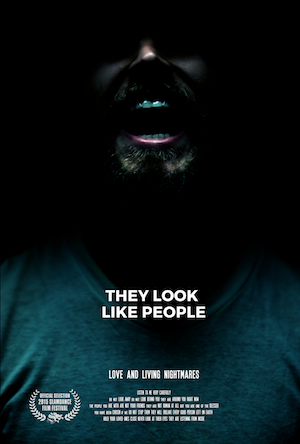
I am sure that there are some people would probably be willing to debate me on whether or not They Look Like People should be considered a horror film.  That’s fair enough.  They Look Like People is a film that, in many ways, defies easy characterization.  It’s a drama that is occasionally very comedic.  It’s a love story that isn’t necessarily romantic.  It’s an undeniably eerie film, one that keeps you guessing.  It’s a film that left me feeling very uneasy.  It made me jump and it made me doubt the shadows in the house and, for that reason, I feel comfortable calling it a horror film.

I can’t tell you too much about They Look Like People, not without spoiling it.  This is a film where unanswered questions hang over every scene.  The film eventually answers those questions but it would not be right for a reviewer to do the same thing.  Usually, I hate it when people go crazy over spoilers but They Look Like People is not a film that I would ever dream of spoiling.

It’s an indie film, about two old friends.  Christian (Evan Dumouchel) is still dealing with the insecurities of his youth.  He obsessively listens to self-help tapes.  He goes out of his way to present an image of hypermasculinity.  The thing is, as hard as he tries to come across as being an alpha male, he’s not very good at it.  The weakness and the insecurity is always right underneath the surface.  He has a crush on his boss (Margaret Ying Drake) and, despite his issues, she seems to like him as well.

One day, Christian happens to run into his childhood friend, Wyatt (MacLeod Andrews).  Wyatt, who used to have everything, now appears to be nearly homeless.  Christian invites Wyatt to stay with him at his apartment.  Wyatt claims that he has friends to stay with but soon, he is crashing on Christian’s couch.

Christian and Wyatt spend a lot of time talking about old times and there’s something undeniably charming about watching these two embrace the geekiness of their youth.  However, what Christian does not know is that Wyatt rarely sleeps through the night.  Instead, he’s regularly woken by intense nightmares.  Once awake, Wyatt wanders around the apartment, hiding weapons under chairs.  Occasionally, Wyatt gets a phone call from a mysterious voice that informs him that the demons will be invading soon.  The demons look like people.  The only way to expose them is to pour sulphuric acid on their face…

Is Wyatt crazy?  Or are the demons truly coming?  You’ll have to watch the movie to find out!  (Look for it on Netflix.  It’s there.)

They Look Like People is an amazingly creepy little film, one that repeatedly catch you off guard.  (At the same time, the film does eventually provide a definitive answer to its questions.  Admirably, this is not a film that tries to have it both ways.)  Deliberately paced and well-acted, They Look Like People is an excellent film that will keep you guessing.

4 Shots From Horror History: The Texas Chainsaw Massacre, Jaws, Carrie, The Omen


This October, I’m going to be doing something a little bit different with my contribution to 4 Shots From 4 Films.  I’m going to be taking a little chronological tour of the history of horror cinema, moving from decade to decade.

Today, we continue with the 70s!

4 Shots From 4 Films

The Texas Chainsaw Massacre (1974, dir by Tobe Hooper)

The Texas Chainsaw Massacre (1974, dir by Tobe Hooper)

Jaws (1975, dir by Steven Spielberg)

Jaws (1975, dir by Steven Spielberg)

Carrie (1976, dir by Brian DePalma)

Carrie (1976, dir by Brian DePalma)

The Omen (1976, dir by Richard Donner)

The Omen (1976, dir by Richard Donner)

Horror on the Lens: The Phantom of the Opera (dir by Rupert Julian)


The_Phantom_of_the_Opera_(1925_film)

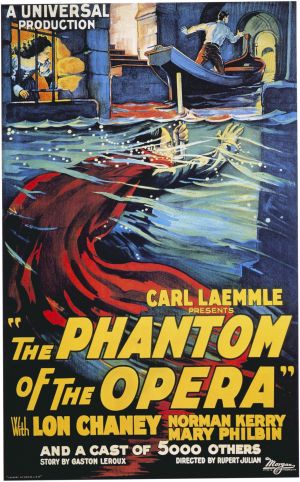
Today’s horror movie on the Shattered Lens is both a classic of silent era and one of the most influential horror films ever made.  It’s one that I previously shared in 2013 and 2o15 but it’s such a classic that I feel that it is worth sharing a second time.  Add to that, the original video that I embedded has been taken off of YouTube.

First released in 1925, The Phantom of the Opera is today best known for both Lon Chaney’s theatrical but empathetic performance as the Phantom and the iconic scene where Mary Philbin unmasks him. However, the film is also a perfect example of early screen spectacle. The Phantom of the Opera was released during that period of time, between Birth of the Nation and the introduction of sound, when audiences expected films to provide a visual feast and Phantom of the Opera certainly accomplishes that. Indeed, after watching this film and reading Gaston Leroux’s original novel, it’s obvious that the musical was inspired more by the opulence of this film than by the book.

This film is also historically significant in that it was one of the first films to be massively reworked as the result of a poor test screening. The film’s ending was originally faithful to the end of the novel. However, audiences demanded something a little more dramatic and that’s what they got.

The TSL’s Daily Horror Grindhouse: 976-Evil (dir by Robert Englund)


976-evil_cover

Ewwwwww!  The movie reeks of stale cigarettes and Axe body spray!

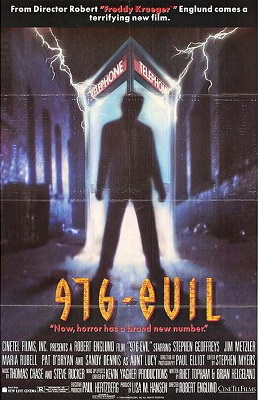
976-Evil tells the story of two teenagers named Spike (Patrick O’Bryan) and Hoax (Stephen Geoffreys).  You know what?  Whether your parents decide to name you Spike or to name your Hoax, your life is pretty much fucked up from the minute either name is entered on your birth certificate.  Anyway, Spike and Hoax are cousins.  Spike is the dangerous bad boy who rides a motorcycle and wears a leather jacket.  Hoax is the really nerdy kid who worships Spike and who lives with his ultra-religious mother (Sandy Dennis).  Hoax can’t wait until the day he and Spike ride across the country on their motorcycles.  Spike is just busy trying to get laid and looking forward to heading out on his own.

Anyway, Hoax eventually gets tired of being picked on all the time so he decides to call the phone number mentioned in the film’s title.  Hoax discovers that he has a direct line to Hell and the voice on the other end has some definite ideas for what Hoax could do to even the score.  For instance, Hoax could cause spiders to attack a Spike’s girlfriend.  And, after that, Hoax could transform into a monster and attack the local bullies at their poker game.

“That’s a dead man’s hand!” Hoax announces, while literally holding up a dead man’s hand.

(That’s right!  Turning evil means becoming a master of puns!)

Uh-oh!  It looks like Hoax has been possessed by evil!  Even worse, the phone bill is HUGE!  Those calls to the Devil aren’t cheap, you know!  Can Spike defeat his cousin or will evil rule the day?

Now, I will say this for 976-Evil: as annoying as Stephen Geoffreys is when he’s playing nerdy Hoax, he actually is a bit frightening as evil Hoax.  For that matter, Patrick O’Bryan is probably does about as good a job as you can do while playing a character named Spike.

But otherwise, 976-Evil is nearly unwatchable.  I mean that literally.  The entire film appears to be covered by a layer of grime.  Between the unappealing visuals, the poor dialogue, and the lack of appealing characters, there’s really not much in 976-Evil to hold our attention.  It might help if we felt bad for Hoax but, even before he calls the phone number, he’s such a weirdo perv that you just kind of want him to go away.  Hoax is basically the type of loser who thinks that an Axe body spray commercial is a documentary.  You can imagine him desperately spraying himself before he goes to school every day and announcing, “I smell like Axe!  I’m losing my virginity next period!  And then me and Spike are going to ride our motor scooters to Toronto!”

Released in 1989, 976-Evil was also the directorial debut of Robert Englund.  I kinda hate to be so negative about the film because Robert Englund is such a good actor and he always comes across as being such a nice guy.  If you haven’t already, be sure to get a copy of Englund’s autobiography, Hollywood Monster.  Englund tells a lot of good stories and is admirably positive about being a horror icon.  But, though Robert Englund’s a great guy, 976-Evil just doesn’t work.

Horror Film Review: The House On Sorority Row (dir by Mark Rosman)


the_house_on_sorority_row_poster

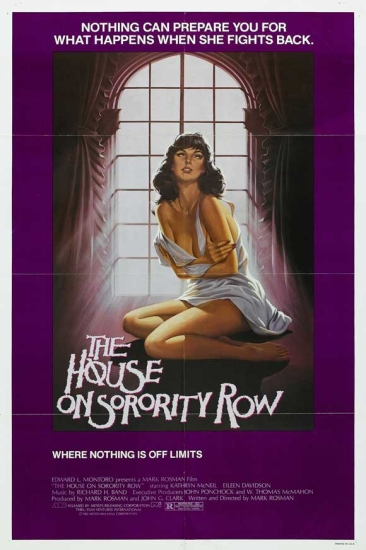
The 1983 film, The House on Sorority Row, is one of the best (and sadly, one of the more underrated) slasher films to be released during the slasher boom of the early 1980s.  Yes, I know that the poster above probably makes it look a little generic.  And “Where Nothing Is Off Limits” sounds more like a tagline for a film about snowboarders than a rather engaging and occasionally even witty suspense film.

But no matter!

The House on Sorority Row is a masterpiece of the genre.  (Avoid the remake, Sorority Row.  ALWAYS AVOID THE REMAKE … except for The Maltese Falcon, the Hammer Dracula films, The Departed … you know what?  Use your own damn judgement. )

Seven sorority sisters are excited about graduating and want to throw a big party.  However, their strict and slightly insane house mother, Mrs. Slater (Lois Kelso Hunt), has a strict no party policy.  She also has a strict “everyone out of the house once the semester ends” policy and she’s not very happy when she discovers that the seven girls are planning on staying for the weekend!  She demands that they all leave.  She then proceeds to use her cane to destroy a waterbed while one girl is on it with her boyfriend.  As the hallway floods, the girls wonder what’s wrong with Mrs. Slater.

Of course, what they don’t know is that Mrs. Slater has a tragic past.  Well, actually, they kind of do know it.  At the very least, they suspect it.  They know that Slater does have a reason for always closing the house on the weekend immediately following the end of the semester.  They know but they don’t care.  Instead, they plan an elaborate hoax.  That’s right!  V for Vengeance!

How does the hoax work out?  Well, like most college hoaxes, it ends up with two laughing girls, five angry and/or worried girls, and one dead house mother floating in the pool.  OH NO!  They’ve got to both throw a party and hide a dead body!  See, this is why I never joined a sorority.  I can throw a party.  And I can hide a dead body.  But not both in one night!

At first, things go okay.  Nobody discovers the body.  The party goes off as planned.  Everyone’s having as good a time as you can while trying to cover up a future-ruining felony.  But then suddenly, the body disappears.  And then the girls start to disappear, one-by-one…

So, let’s just be honest here.  Plotwise, The House on Sorority Row is not going to win points for originality.  Though the film does include a few clever twists, it’s pretty much your standard slasher film and it has its share of scenes where the girls stupidly split up, drop knives that they really shouldn’t drop, and hide in silly places.  I always feel bad for the girl killed in the bathroom stall because seriously, that’s the last place I would want to die.  (Add to that, her head later turns up in a toilet.  BLEH!)

While the plot may be familiar, The House on Sorority Row is a triumph of style.  Director Mark Rosman may have told a familiar story but he told it well, putting more emphasis on suspense than gore.  Regardless of how silly the story may be, you still get caught up in it.  Rosman is at his best towards the end of the film when the final survivor has to fight off the murderer while under the influence of a hallucinogenic drug.

Finally, the film is far better acted than your typical slasher film.  Though the majority of the characters are definitely familiar types (there’s the bitchy girl, the slightly less bitchy girl, the best friend, the mousy girl, the smart girl, the dumb girl, etc), the actresses who play them are all sympathetic and likable.  You actually care about them.  Yes, you even care about self-centered, immature Vicki, even though she’s the one who came up with the hoax in the first place.  Vicki is played by Eileen Davidson and she gives one of the best performances in slasher film history.  It’s hard not to relate to her exasperation as it turns out to be harder to cover up a murder than she originally assumed.

That said, having watched the film, I’m glad that I never joined a sorority.  Between the waterbed and the murders, I don’t know how I ever would have ever graduated.

4 Shots From Horror History: The Shiver of the Vampires, The Abominable Dr. Phibes, Last House On The Left, The Exorcist


This October, I’m going to be doing something a little bit different with my contribution to 4 Shots From 4 Films.  I’m going to be taking a little chronological tour of the history of horror cinema, moving from decade to decade.

Today, we start the savage 70s!

4 Shots From 4 Films

The Shiver of the Vampires (1970, dir by Jean Rollin)

The Shiver of the Vampires (1970, dir by Jean Rollin)

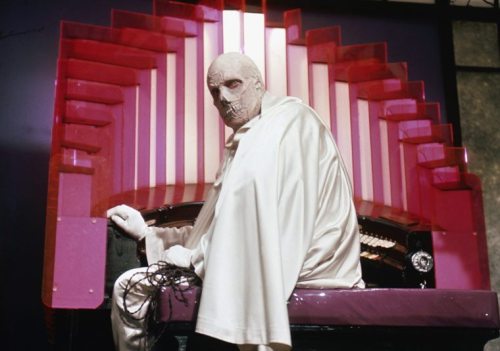
The Abominable Dr. Phibes (1971, dir by Robert Fuest)

The Abominable Dr. Phibes (1971, dir by Robert Fuest)

The Last House On The Left (1972, dir by Wes Craven)

The Last House On The Left (1972, dir by Wes Craven)

The Exorcist (1973, dir by William Friedkin)

The Exorcist (1973, dir by William Friedkin)

Horror on the Lens: The Lodger (dir by John Brahm)


Today’s horror on the lens is 1944’s The Lodger, a remake of Hitchcock’s silent classic.

This creepy little story of paranoia and murder in the London fog features an excellent performance from Laird Cregar and is definitely one of the best films ever made about Jack the Ripper!

Enjoy!

The TSL’s Daily Horror Grindhouse: Mountaintop Motel Massacre (dir by Jim McCullough)


mountaintop-motel-massacre

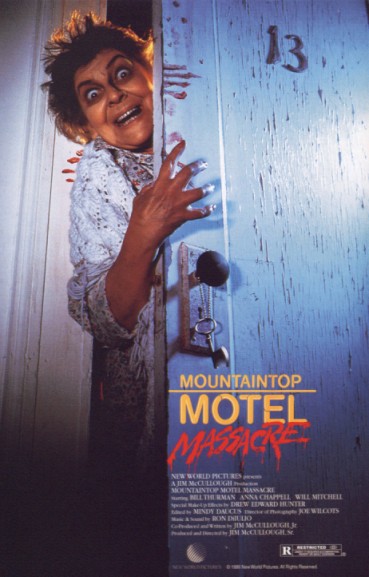
AGCK!  What a scary woman!  Seriously, the poster for the 1986 slasher film Mountain Top Motel Massacre is pure nightmare fuel!  Unfortunately, the poster above does not feature the film’s tag line, which I happen to love.

You want to know what it was?

“Please do not disturb Evelyn.  She already is!”

BRILLIANT!  Of course, I have to admit that one reason why I love that tagline is because my best friend is named Evelyn and you better believe that, as soon as I came across this film, I called her up and I said, “Please don’t disturb Evelyn.  She already is.”

Evelyn, of course, had no idea what I was talking about because not many people have heard of Mountaintop Motel Massacre.  It’s one of the many low-budget slasher films to be released in the late 80s.  (That said, the film was actually made in 1983 and sat on the shelf for three years before getting a release.)  With a few notable exceptions, these films are pretty much forgotten, except for when they occasionally turn up on TV or when you come across them in the bargain bin.  I found my copy of Mountaintop Motel Massacre at the Movie Trading Company.  It was being sold for $1.99, which is another way of saying, “Nobody in the world cares about this damn movie.”  But I bought it, because I thought the old woman was scary and I love horror movies.

Mountaintop Motel Massacre was filmed in Louisiana and it perfectly captures that whole you’re-going-to-die-as-soon-as-you-turn-off-the-lights atmosphere of the Deep South.  Personally, I was hoping that all the guests at the motel would be obnoxious tourists from up north, the type who would bitch about not being able to get a good philly cheesesteak in Louisiana before being killed and dumped in the bayous.  (Either that or they’d go up to the desk clerk and say, “We refuse to shop at a low class establishment like Walmart.  Where is the closest Wawa?”)

Unfortunately (or perhaps fortunately, depending on how you look at it), there were no Northerners in this film.  Instead, all the guests at the motel were locals.  For instance, there was the alcoholic preacher.  And then there was the newlywed couple, determined to have a wonderful wedding night despite not being able to afford the Holiday Inn.  (Why would you marry a man who couldn’t even afford the Holiday Inn?  Why, God, why!?)  And then there was Al, the traveling salesman.  Al checked into the motel with two hitchhikers, both of whom were under the impression that Al worked for a record company.  Al’s kinda sleazy but he was also the film’s designated hero.

Needless to say, not many guests survived the night.  Some were killed by snakes.  Some were killed by sickles to the face.  All were killed by a crazy old woman named Evelyn.  Evelyn owned the motel but she had previously spent three years in a mental hospital.  Before she killed all of her guests, she apparently murdered her daughter as well.  Except, for the fact, that her daughter was later seen walking through the woods.  Was her daughter a zombie or was this just a set-up for a sequel that would never be made?  Your guess is as good as mine.

Anyway, Mountaintop Motel Massacre doesn’t make a lot of sense.  Like many slasher films, the film’s plot is pretty much dependent on everyone acting like a total moron.  Usually, I defend the slasher genre by pointing out that, realistically speaking, most people do act like morons in the face of danger.  But, compared to some of the people in Mountaintop Motel Massacre, the counselors at Camp Crystal Lake look like freaking geniuses.

However, with all that in mind, Mountaintop Motel Massacre is still an effectively creepy movie.  It’s drenched in atmosphere and, as played by Ann Chappell, Evelyn is more frightening than your average anonymous 80s slasher.  She spends most of the film running through a series of underground tunnels that are underneath the hotel and the sight of that murderous old woman burrowing from room to room will stick with you long after the movie ends.

So, if you happen to come across it this October, feel free to give Mountaintop Motel Massacre a shot.  If you’re a fan of the slasher genre, you might enjoy it.

And … please.

Don’t disturb Evelyn.

SHE ALREADY IS!

Horror Film Review: The Possession of Joel Delaney (dir by Waris Hussein)


joeldelaneyposter

The Possession of Joel Delaney is a film that I watched a few years ago and it totally freaked me out.  It’s a film about possession that has never gotten as much attention as The Exorcist but seriously, this is one frightening movie.

This 1972 film takes place in New York City.  Norah Benson (Shirley MacClaine) is a rich and spoiled socialite, a snob who might brag about how nice she is to her maid but who would never dream of being caught dead visiting the neighborhood where she lives.  On the other hand, her younger brother — Joel Delaney (Perry King) — is a self-styled bohemian.  He’s just as rich as his sister and, in many ways, he’s just as much of a snob.  However, he disguises that fact by living in the “bad” part of town and hanging out with (and both idealizing and condescending to) the poor.  (When people talk about the “bad” part of the town in this film, they’re euphemistically referring to any part of the city where the majority of the residents are not white.)  If The Possession of Joel Delaney were made today, Norah would be Sasha Stone and Joel would be Devin Faraci.

Norah is extremely protective of Joel.  In fact, the film suggests that there might be something more to their relationship than just a sibling bond.  Norah worries about Joel living in a bad neighborhood.  She worries about his friends.  She reacts jealously when she meets his girlfriend, Sherry (Barbara Trentham).

So, you can imagine that Norah is rather upset when Joel is suddenly arrested for trying to kill his landlord.  Judged to be insane, Joel is sent to Bellevue.  Joel claims that he has no memory of attacking anyone.  In order to get out of the mental hospital, Joel lies and says that he was on drugs.

Moving in with Norah and her two kids, Joel starts to act strangely.  He starts to quiz Norah about her sex life.  He plays too rough with the children.  He tries to set Sherry’s hair on fire.  And he starts to speak in Spanish!

Could it be that Joel has been possessed by the spirit of his friend, Tonio?  Tonio, it turns out, was the landlord’s son.  It also appears that Tonio was the main suspect in a series of decapitation murders.  Could Tonio have moved his spirit into Joel’s body?  That’s what Norah’s Puerto Rican maid, Veronica (Miriam Colon), thinks!  Veronica quits her job, rather than have to deal with possessed Joel.

Norah decides to go to Veronica’s home and ask what’s happening with Joel.  What follows is a mix of horror and social satire.  Despite being a total stranger in Veronica’s neighborhood, Norah seems to be shocked when Veronica doesn’t exactly act overjoyed to see Norah standing in front of her small apartment.  As Norah demands to know what’s happening with her brother and Veronica explains that Joel may be possessed, you can’t help but get the feeling that Norah is more upset by the fact that Joel has been possessed by someone poor than by anything else.  In these scenes, Norah becomes the ultimate symbol of wealthy white privilege.

Meanwhile, Joel is going more and more crazy.  It all leads to one of the most horrifying sequences that I’ve ever seen, in which a possessed Joel torments Norah’s two children.  It’s an amazingly disturbing scene, one that is all the more upsetting because, in the title role, Perry King had previously done such a good job portraying Joel as being irresponsible but likable.  I don’t want to give too much away, beyond saying that the scene gave me nightmares and if you’re triggered by scenes of child abuse, you should not watch The Possession of Joel Delaney.

As I said, The Possession of Joel Delaney has never really gotten the credit that it deserves.  It’s always overshadowed by The Exorcist.  But if you want to see a truly scary film and if you like a little social satire mixed in with your horror, The Possession of Joel Delaney is one to track down.

4 Shots From Horror History: Even The Wind Is Scared, Witchfinder General, Rosemary’s Baby, The Nude Vampire


This October, I’m going to be doing something a little bit different with my contribution to 4 Shots From 4 Films.  I’m going to be taking a little chronological tour of the history of horror cinema, moving from decade to decade.

Today, we finish off the 1960s!

4 Shots From 4 Films

Even The Wind is Scared (1967, dir by Carlos Enrique Taboada)

Even The Wind is Scared (1967, dir by Carlos Enrique Taboada)

The Witchfinder General (1968, dir by Michael Reeves)

Witchfinder General (1968, dir by Michael Reeves)

Rosemary's Baby (1968, dir by Roman Polanski)

Rosemary’s Baby (1968, dir by Roman Polanski)

The Nude Vampire (1969, dir by Jean Rollin)

The Nude Vampire (1969, dir by Jean Rollin)4