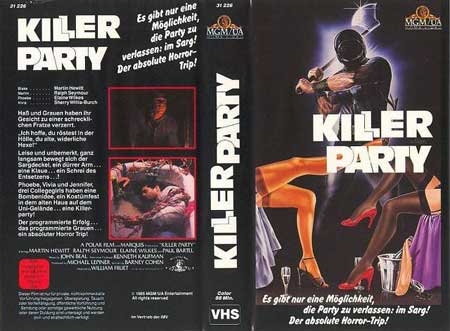
The TSL’s Horror Grindhouse: Killer Party (dir by William Fruet)


The 1986 film Killer Party is one of those late 80s slasher films that somehow has developed a cult following.  Up until recently, there was a fairly active fansite devoted to the history of Killer Party and Killer Party still regularly shows up on TCM Underground.

So, apparently, Killer Party has fans.

I’m just not sure why.

Some of it, I suppose, could have to do with the first ten minutes of the film, which are genuinely clever.  It starts out with a young woman being menaced at a drive-in theater and, just when you’ve gotten invested in her story and have started to wonder whether or not she’ll survive the entire movie, it is suddenly revealed that we’ve actually been watching a movie-within-a-movie.  And that movie-within-a-movie then turns out to be part of an incredibly silly music video, featuring a band that is so 80s that you find yourself expecting them to stop performing so they can do a line of coke and play the stock market.  At one point, the band even performs while standing on the drive-in’s concession stand.

It’s all marvelously silly and kind of clever.  The problem is that the rest of the film never lives up to those ten minutes.  In fact, you spend the rest of the movie wishing you were still watching that movie about the girl trapped at the drive-in.

I also suppose that some of the film’s cult reputation has to do with the fact that Paul Bartel has a small supporting role.  Bartel plays the same basic role that he played in almost every horror film in which he appeared.  He’s a pompous professor who says a few dismissive lines and is then promptly killed off.  Maybe it’s the Bartel factor that has led to this film developing a cult following.

Who knows?

Killer Party is essentially four movies in one.  The first movie is that part that I’ve already talked about.  The opening is clever but it only lasts for ten minutes.

After the opening, the film turns into a rather standard college comedy.  Three girls want to join the wildest sorority on campus but it won’t be easy!  Everyone on this campus is obsessed with playing pranks.  And by pranks, I mean stuff like locking a bunch of people outside while they’re naked in a hot tub and then dumping a bunch of bees on them.  Of course, that prank gets filmed and the footage is later shown at a meeting of stuffy old people.  That’ll teach those uptight members of the World War II generation!  You may have made the world safe for democracy but that was like a really, really long time ago!  So there!  It’s time for a new generation, one that will make the world safe for pranks!

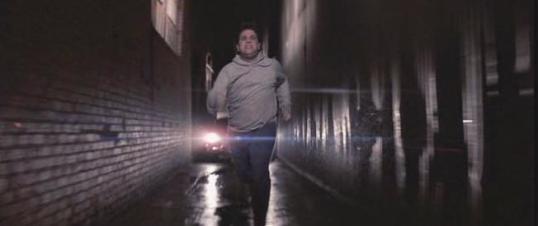
During this part of the film, there are only a few hints that we’re watching a horror movie.  For instance, the sorority wants to have a party in an abandoned frat house.  Their housemother goes by the frat house and kneels in front of a grave.  She speaks to someone named Alan and tells him that it’s time to move on.  Then she promptly gets killed and no one ever seems to notice.

The comedy part of the movie segues into a remarkably bloodless slasher movie.  The cast assembles at the forbidden house.  They have a party.  Someone in a diving mask shows up and kills off the majority of the cast in 20 minutes.  Almost everyone dies off-screen so there’s really not even any suspense as far as that goes.

Then, during the last few minutes of the film, the slasher film suddenly turns into a demonic possession film and that seems like that should be brilliant turn of events but it just doesn’t work in Killer Party.  Usually, I love movies that are kind of messy but Killer Party is a rather bland and listless affair.  If you’re going to combine a campus comedy with a slasher film and a demonic possession film, you owe it to your audience to really go totally over the top and embrace the ludicrousness of it all.  Instead, Killer Party rolls out at a languid and rather dull pace.

I would not accept an invitation to Killer Party.
 

Horror Scenes That I Love: The Monster Lives in Frankenstein


Today’s horror scene that I love comes from the 1931 Universal classic, Frankenstein!

Though it’s been parodied to death and often used out of context (for example, a few years ago, it was used in a freaking car commercial), the “It’s Alive!” scene from Frankenstein is still a classic piece of horror history.  Colin Clive is often unfairly criticized for going overboard in this scene but let’s be honest here: if you ever reanimated a corpse, you’d probably get pretty damn excited about it.

(After watching the scene, be sure to check out my review of this classic film by clicking here!)

(And if you want to see an alternative take on the creation of Frankenstein’s Monster, check out the 1910 silent version by clicking here!)

Horror Film Review: Village of the Damned (dir by John Carpenter)


At the risk of getting in trouble with at least a few people around the TSL offices, I am going to say something right now.  It may be controversial.  It may be shocking.  It may even make you question your belief in whatever it is that you believe in.

Ready?

Here we go:

I do not think that the 1995 version of Village of the Damned is that bad.

Now, please notice that I didn’t say that I thought it was that great, either.  However, when you listen to some people talk about this movie (which, admittedly, doesn’t seem to happen a lot), they make it sound as if Village of the Damned is one of the worst films ever made.  It is usually cited as being a waste of director John Carpenter’s abilities and Carpenter himself has said that he’s indifferent to the film.  Carpenter has gone as far as to call the film a “contractual assignment.”

Of course, one reason why people dislike the 1995 Village of the Damned is because it’s a remake of an acknowledged classic.  Even worse, it’s an unnecessary remake.  I would not disagree with that opinion.  The 1960 Village of the Damned holds up remarkably well, featuring George Sanders at his best and a lot of creepy little children.  (If anything, the fact that the original is in black-and-white makes the children look even creepier in the original.)  Having recently watched both versions of Village of the Damned, I can say that the remake doesn’t really improve on the original.

And yet, I would still argue that John Carpenter’s Village of the Damned is an underrated and crudely effective little movie.

The film tells the story of the town of Midwich, California.  (The original film took place in the UK and Midwich doesn’t really sound like the name of a town you’d find in California.  Incidentally, my favorite town in California is a place named Drytown, specifically because the town bar advertises itself as being “the only wet place in Drytown.”)  Midwich is a nice, little town.  Everyone is friendly.  Everyone knows everyone else.  Carpenter spends a while establishing Midwich as being the idealized coastal town.  But then, one day, the skies turn dark and everyone in Midwich loses consciousness.  Unfortunately, that doesn’t work out well for some people.  Frank McGowan (Michael Pare), for instance, is driving when the blackout occurs and he ends up dying when his truck goes off the road.  Another unfortunate fellow was manning the grill at the church picnic and, when he passed out, he ended up burning to death.

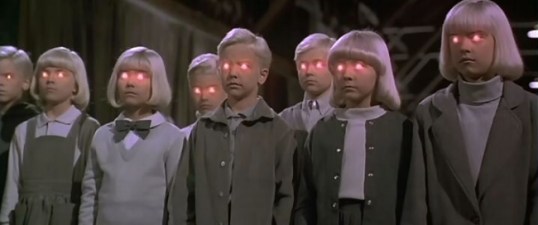
When everyone does wake up, it’s discovered that ten women are now pregnant.  One of them, Kate (Linda Kozlowski), is the widow of Frank.  Another, a teenage girl named Melanie (Meredith Salenger), is a virgin.  Nine months later, all of the babies are born on the same night, though Melanie’s is stillborn.  The 9 babies eventually become 9 very creepy children.  They have pale skin, white hair, glowing eyes, and no emotions.  Soon the government, led by Dr. Verner (Kristie Alley), invades the town so that they can investigate and experiment on the children.  You know that once the government shows up and takes over, everyone’s screwed.

And, while all of this is going on, the once friendly and vibrant town of Midwich becomes a far different place.  We watch as the citizens of the town die, one after another.  Melanie finds herself ostracized and abandoned.  The local reverend (Mark Hamill) goes insane and ends up perched on a hill with a rifle.  The town doctor (Christopher Reeve) loses his wife when she walks into the ocean.

And the children continue to coldly and unemotionally kill anyone who displeases them.  One man is forced to shoot himself.  In perhaps the film’s most disturbing scene, a scientist is forced to dissect herself.

Admittedly, some of the actors do a better than others.  Meredith Salenger gives the best performance while Mark Hamill definitely gives the worst.  At first, Kirstie Alley seems miscast but she actually gives one of the better performances in the film.  As the nominal hero, Christopher Reeve is boring but then again, many small town doctors are.  Of course, nearly everyone in the movie is dead by the time the end credits roll.

It’s a seriously dark movie and, when taken on its own terms, it’s definitely effective.  Carpenter does such a good job of establishing Midwich as a place where anyone would want to live that it does carry an impact to see the town suddenly isolate from the world and the once happy citizens resorting to suicide just to escape the town’s children.  In the end, John Carpenter’s Village of the Damned does capture the anguish of feeling as if there’s no escape from the present nor hope for the future.

Village of the Damned is crudely effective but effective nonetheless.


4 Shots From 4 Films: Special John Carpenter Edition


4 Shots From 4 Films is just what it says it is, 4 shots from 4 of our favorite films. As opposed to the reviews and recaps that we usually post, 4 Shots From 4 Films is all about letting the visuals do the talking.

This October, I am going to be using our 4 Shots From 4 Films feature to pay tribute to some of my favorite horror directors, in alphabetical order!  That’s right, we’re going from Argento to Zombie in one month!

Today’s director is the man who put Halloween on the map and a personal favorite of TSL editor-in-cheif Arleigh Sandoc’s, John Carpenter!

4 Shots From 4 Films

Halloween (1977, dir by John Carpenter)

The Fog (1980, dir by John Carpenter)

The Thing (1982, dir by John Carpenter)

Christine (1983, dir by John Carpenter)

Horror on the Lens: Gargoyles (dir by Bill Norton)


For today’s horror on the lens, we have a made-for-TV monster movie from 1972, Gargoyles!

What happens when a somewhat condescending anthropologist (Cornel Wilde) and his daughter (Jennifer Salt) head out to the desert?  Well, they stop by a crazy old man’s shack so that they can look at his genuine monster skeleton.  Before Wilde can thoroughly debunk the old man’s claims, the shack is attacked by real monsters!

That’s right!  Gargoyles exist and they apparently live in Arizona!

This film was introduced to me by TSL contributor and Late Night Movie Gang founder Patrick Smith and we had an absolute blast watching it.  There’s nothing particularly surprising about the plot but the gargoyles are memorable creations and Bernie Casey gives a good performance as their leader.  The gargoyle makeup was designed by none other than Stan Winston, who won an Emmy for his work here and who went on to win Oscars for his work on Aliens, Terminator 2, and Jurassic Park.

As well, a very young Scott Glenn shows up in the cast.  I like to think that he’s playing the same character in both Gargoyles and Sucker Punch.

Enjoy!

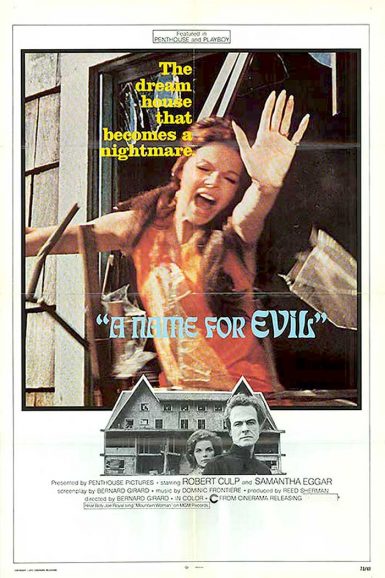
The TSL’s Horror Grindhouse: A Name For Evil (dir by Bernard Girard)


So, this is an odd one.

First released in 1973 but reportedly filmed several years before, A Name For Evil tells the story of John Blake (Robert Culp) and his wife, Joanna (Samantha Eggar).  John is a successful architect who lives in the big city.  He used to be a passionate rebel but now he’s just a boring corporate man.  Even his wife is bored with him.  John knows that he has to make some changes.  Since this movie was made in 1973, those changes start with throwing a TV out of a window.

(Trust me.  If you watch enough films from the early 70s, you will see so many TVs get tossed through so many windows that it will no longer surprise you.  Apparently, being a rebel in 1973 meant destroying a TV.  According to Wikipedia, the top five TV shows in 1973 were, in order, All In The Family, Sanford and Son, Hawaii 5-0, Maude, and the NBC Sunday Night Mystery Movie.  I choose to believe that the NBC Saturday Night Mystery Movie is what drove everyone over the edge.  Anyway…)

Anyway, John decides to quit his high-paying job and instead move up to New England and live in his grandfather’s mansion.  (His grandfather, by the way, was known as The Major.)  Joanna is reluctant to accompany him and she’s even more upset when it turns out that 1) the house is a total wreck and 2) the last tenant died under mysterious circumstances.

John, however, grows somewhat obsessed with the house.  This is despite the fact that John doesn’t seem to really like the house or the inhabitants of the nearby town that much.  For instance, there’s a scene — which might be a dream — in which John crashes the funeral of a local boy who died in Vietnam and he starts to laugh uncontrollably when the minister praises the boy for sacrificing himself for his country.  I think we’re supposed to like John during this scene but John laughs so long and so hard and he just keeps going and going that, by the end of it, I think even the most dedicated peace activist would look at him and say, “What an asshole.”

At the house, John keeps seeing strange shadows and hearing weird noises.  Occasionally, he sees someone who looks like the long-dead Major riding a white horse.  He hears voices coming from the walls and he accuses Joanna of being behind it.  Joanna tells him that he’s being paranoid.  Of course, Joanna herself is slowly coming to appreciate the house, especially after a ghost kisses her hand…

Suffering from ennui, John does what anyone in 1973 would do.  He tracks down the local hippies and he takes part in a down-with-the-establishment orgy.  Are the hippies real or are they figments of his imagination?  Is the house real or is it a figment of John’s imagination?  Is John real or is he just a figment of his imagination?  A Name For Evil does not seem to really know but you can be sure that we’ll get another shot of that TV falling out of that window before the movie ends.

On the one hand, A Name For Evil is a standard haunted house/spiritual possession type of film.  But, on the other hand, it’s obvious that A Name For Evil was trying to make some sort of grand statement about life in America in 1973.  How else do you explain the hippies, the funeral scene, and that TV flying out the window?  Robert Culp spends the entire movie so pissed off that there’s no way he wasn’t meant to be some sort of generational spokesman.  It makes for a very strange, only-in-the-70s hybrid type of film.

Now, I should mention that I actually did a little research before writing this review.  I discovered that A Name for Evil was originally produced by MGM but it spent years on the shelf until Penthouse (the magazine) bought the film and re-cut it for theatrical release.  Apparently, the first version was clear about being an attempt at social satire with a little horror and nudity thrown in.  The version that was actually released was edited to emphasize the horror and the nudity.  That probably explains why the film feels like such a strange mishmash of genres and attitudes.

If you ever get the chance, I’d recommend watching A Name For Evil.  It’s not that good but it’s just too strange not to watch.


Horror Scenes That I Love: Mary Philbin unmasks Lon Chaney in The Phantom of the Opera!


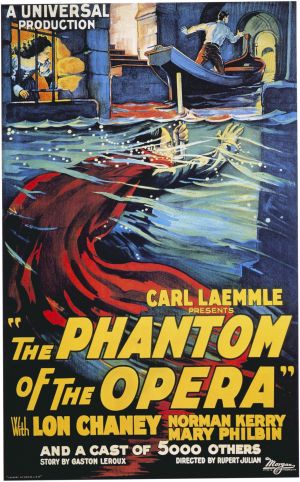
Today’s horror scene that I love comes from the 1925 version of The Phantom of the Opera.

In this famous scene, which was directed by Rupert Julian, Mary Philbin unmasks the Phantom (played, of course, by Lon Chaney).  Both of their reactions are justifiably famous.

I have read that Philbin was apparently not told what Chaney would look like when she removed the mask, which contributed to her state of shock.  I don’t know if that’s true but I hope it is.  It’s certainly a good story.

Was this horror cinema’s first “jump scare?”

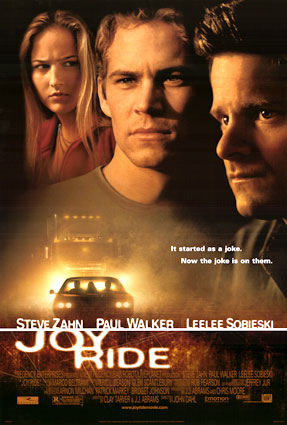
Horror Film Review: Joy Ride (dir by John Dahl)


The 2001 film Joy Ride is an example of a subgenre of horror that I like to call the Don’t Fuck With Truckers genre.  It all started with Duel back in the early 70s and since then, there’s been a large number movies about ordinary people who end up getting on the wrong side of a trucker.

Myself, I would never piss off a trucker.  First off, I have a few cousins who are proud members of the Teamsters and I can tell you, from personal experience, that you don’t want to get on their bad side.  Secondly, those trucks are really, really big and it takes a certain amount of skill to drive them, certainly more skill than it takes me to drive my little convertible.  (Truckers can make turns in those gigantic trucks and somehow do it without crashing into a stop light.  I can barely parallel park.)  Trucks block out the road, making it impossible to see anything beyond them, which makes the prospect of trying to pass them all the more frightening.  Essentially, if you get into a vehicle fight with a trucker, you’re going to die.  There’s just no way your little car is going to be able to beat that giant truck.

Now, I have to admit that I really like Joyride but sometimes, I feel like maybe I shouldn’t.  It basically comes down to two things:

Number one, I have always defended horror movies against the charge that they always feature people making the stupidest possible decisions.  My defense is usually that people in real life are actually far more stupid than they realize and that whenever anyone says, “I would never be stupid enough to wander around a deserted camp ground in the middle of the night!,” they are essentially lying.  Seriously, everyone would do that just so they could later joke about how it was just like being in a horror movie.

That said, the majority of the characters in Joy Ride are really, really dumb.  Basically, two brothers (Steven Zahn and Paul Walker) are driving from California to Colorado so that they can pick up Walker’s best friend (Leelee Sobieski).  Along the way, Zahn and Walker decide to have some fun by getting on the CB radio and telling a trucker who calls himself Rusty Nail (voiced by Ted Levine, who was also the killer in The Silence of the Lambs) that there is a prostitute named Candy Cane waiting for him in a motel room.  The joke, of course, is that Zahn and Walker know that an obnoxious businessman is actually staying in the room.

The next morning, after playing their little joke and then listening to Rusty Nail and the businessman have a huge fight, the brothers are informed that the businessman has been found on the side of the road.  He’s still alive but his jaw was ripped off.  The brothers’ reaction is to get the Hell out of town.

Okay, so far, so good.  The joke was mean but people are mean.  Leaving town instead of helping with the police investigation was selfish but people are selfish.  What drives me crazy is that, once they’re on the road, the brothers get back on the CB radio and inform Rusty Nail that there was no Candy Cane and that they were just playing a joke on him.

IDIOTS!  Seriously, you’ve just been told that the guy ripped off another man’s jaw and now you’re going to piss him off more?

My other problem is that Leelee Sobieski’s character is so underdeveloped.  The film’s nearly halfway over before Zahn and Walker reach Colorado and pick her up.  Just a few scenes later, Sobieski is kidnapped by Rusty Nail.  Characterwise, she pretty much only exists to be kidnapped and held hostage.  It seems like a waste of Sobieski’s talents and the flatness of her character is especially disappointing when you consider how well-developed the characters played by Walker and Zahn are.

And yet, despite all of that, I really like Joy Ride.  It’s just a well-made film, a relentless thrill ride that succeeds largely because director John Dahl never gives the audience any time to relax and think about whether or not the film makes any sense.  As a largely unseen threat, Rusty Nail is both plausible and seemingly supernatural at the same time.  I mean, that truck literally pops up out of nowhere sometimes.  Zahn and Walker are very well-cast as brothers, with Zahn’s natural goofiness nicely paired up with Walker’s natural earnestness.  You like them, even if they are selfish idiots.

Almost despite itself, Joy Ride is a good movie and it features an important message: Don’t fuck with truckers.

4 Shots From 4 Films: Special Tod Browning Edition


4 Shots From 4 Films is just what it says it is, 4 shots from 4 of our favorite films. As opposed to the reviews and recaps that we usually post, 4 Shots From 4 Films is all about letting the visuals do the talking.

This October, I am going to be using our 4 Shots From 4 Films feature to pay tribute to some of my favorite horror directors, in alphabetical order!  That’s right, we’re going from Argento to Zombie in one month!

Today’s director is Tod Browning, who started his career during the silent era, ended it in the sound era, and was responsible for some of the most important horror and suspense films of both!

4 Shots From 4 Films

West of Zanzibar (1928, dir by Tod Browning)

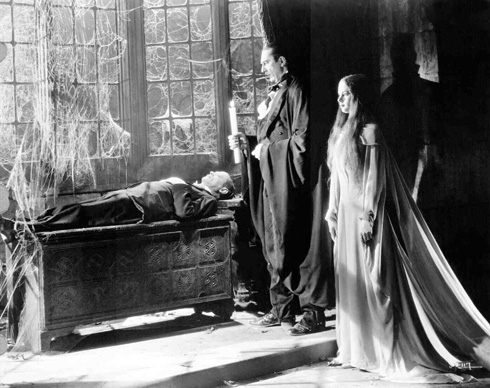
Dracula (1931, dir by Tod Browning)

Freaks (1932, dir by Tod Browning)

Mark of the Vampire (1935, dir by Tod Browning)


Horror on the Lens: The Cabinet of Dr. Caligari (dir by Robert Wiene)


The Cabinet of Dr. Caligari is a film that I’ve shared four times previously on the Shattered Lens.  The first time was in 2011 and then I shared it again in 2014, 2015 and 2016.  Well, you know what?  I’m sharing it again because it’s a classic, it’s Halloween, and everyone should see it!  (And let’s face it — it’s entirely possible that some of the people reading this post right now didn’t even know this site existed in 2016.  Why should they be deprived of Caligari just because they only now arrived?)

Released in 1920, the German film The Cabinet of Dr. Caligari is one of those films that we’ve all heard about but far too few of us have actually seen.  Like most silent films, it requires some patience and a willingess to adapt to the narrative convictions of an earlier time.  However, for those of us who love horror cinema, The Cabinet of Dr. Caligari remains required viewing.  Not only did it introduce the concept of the twist ending (M. Night Shyamalan owes his career to this film) but it also helped to introduce German expressionism to the cinematic world.

My initial reaction to The Cabinet of Dr. Caligari was that it simply wasn’t that scary.  It was certainly interesting to watch and I was happy that I was finally experiencing this film that I had previously only read about.  However, the film itself was obviously primitive and it was difficult for my mind (which takes CGI for granted) to adjust to watching a silent film.  I didn’t regret watching the film but I’d be lying (much like a first-year film student) if I said that I truly appreciated it after my first viewing.

But you know what?  Despite my dismissive initial reaction, the film stayed with me.  Whereas most modern films fade from the memory about 30 minutes after the end credits,The Cabinet of Dr. Caligari has stuck with me and the night after I watched it, I even had a nightmare in which Dr. Caligari was trying to break into my apartment.  Yes, Dr. Caligari looked a little bit silly staring through my bedroom window but it still caused me to wake up with my heart about to explode out of my chest.

In short, The Cabinet of Dr. Caligari passes the most important test that a horror film can pass.  It sticks with you even after it’s over.

For the curious who have 74 minutes to spare and an open mind to watch with, here is Robert Wiene’s The Cabinet of Dr. Caligari…