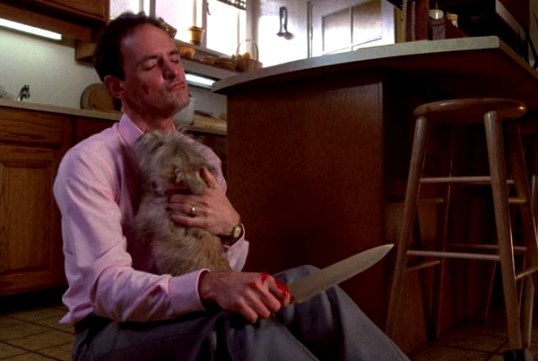
Horror Film Review: Butcher, Baker, Nightmare Maker (by William Asher)


This is an unexpectedly odd psychological thriller from 1981.

Okay, well, actually, I guess the technical term for this film would be “slasher” because it does feature a dark secret from the past and a series of gruesome murders and some 20-something teenagers getting naked.  That said, calling this movie a slasher brings to mind thoughts of Friday the 13th and Halloween and, as much as I’ve defended those films in the past, it’s hard to compare them to a film like Butcher, Baker, Nightmare Maker.  Nor is the film comparable to more giallo-influenced slashers that came out in the late 70s and the early 80s.  The identity of the murderer is revealed too early for that.

The murderer is Cheryl Roberts (Susan Tyrrell), who may seem like a perfectly normal suburban widow but who has some bad habits.  For instance, when she’s sexually rejected by television repairman Phil Brody (Caskey Swaim), she reacts by grabbing a knife and stabbing him to death in the kitchen.  When the police arrive, she says that he attempted to rape her.  When it’s later revealed to her that Phil was gay and in a committed relationship with the local high school basketball coach, she snaps that “Homosexuals are very sick people!”  Cheryl goes on to murder several more people, all because she views them as a threat to her relationship with her nephew, Billy (Jimmy McNichol).

Billy is a senior in high school.  His parents died in a mysterious car crash when he was an infant and he’s been raised by his aunt Cheryl.  Billy has an opportunity to go away to college on a basketball scholarship but Cheryl isn’t happy about that.  Cheryl never wants Billy to leave and she’s not above drugging his milk to make sure that he has a bad game while the college scouts are watching.  Cheryl is also not happy that Billy has a girlfriend, Julia (Julia Duffy).  When she finds out that Billy and Julie are sexually active, Cheryl’s response is to trap Julia in the basement.

Aunt Cheryl is not Billy’s only problem.  There’s also Detective Joe Carlson (Bo Svenson).  Carlson has been assigned to investigate the murder of Phil and he quickly becomes fixated on the fact that Phil was gay and that he was in a relationship with Billy’s coach, Tom Landers (Steve Eastin).  Despite all of the evidence that Cheryl’s killing people left and right, Carlson becomes obsessed with proving that Billy’s gay and that he murdered Phil as the result of a love triangle.  It quickly becomes clear that Carlson, who brags about his own military service, is incapable of going for more than five minutes without accusing someone of being gay.  (Of course, Carlson never says “gay.” Instead, he uses a slur that begins with the letter F and he uses it a lot.)

What sets this film apart from other horror films of the era is that the rampant homophobia is not played for laughs or for shock value.  Traditionally, being gay in a 1980s horror film meant that the character was either going to be held up as an object of ridicule or, in many cases, turn out to be the murderer.  Instead, in Butcher, Baker, Nightmare Maker, the gay characters are literally the only fully sympathetic people in the entire film.  Instead, the film’s villains are homophobes like Carlson, Cheryl, and Eddie (Bill Paxton!), a bully who gives Billy a hard time over his friendship with the coach.  As many people as Cheryl kills over the course of the film, the bigger monster is Carlson, who is so determined to indulge his prejudices that he’s blind to everything that’s happening in front of him.

It makes for an unexpectedly thoughtful slasher film.  Butcher, Baker, Nightmare Maker has its flaws, to be sure.  I wish, for instance, that Julia and Billy weren’t such bland characters.  (They’re well-acted but neither is written with much depth.)  There’s some pacing issues as well.  But overall, this is an unexpectedly good thriller which features two horrifyingly plausible performances from Susan Tyrrell and Bo Svenson.

 

Horror on the Lens: The Screaming Woman (dir by Jack Smight)


Today’s horror on the lens is The Screaming Woman, a 1972 made-for-TV movie that’s based on a Ray Bradbury short story.

Olivia de Havilland plays Laura Wynant, who has just returned home from a stay at a mental institution.  Soon after her arrival, Laura starts to hear a woman crying for help.  Laura becomes convinced that the woman has been buried alive on her property but, because of her debilitating arthritis, she can’t dig the woman up on her own.  And, because of her own mental history, no one believes her when she tries to tell them about what she’s hearing!

The Screaming Woman features screen legend Olivia De Havilland giving a sympathetic performance as Laura.  It also features two other luminaries of the golden age of Hollywood — Joseph Cotten and Walter Pidgeon — in supporting roles.  It’s a good little thriller so watch and enjoy!

(And of course, I should mention that the great Olivia De Havilland is still with us, 103 years old and living in France.)

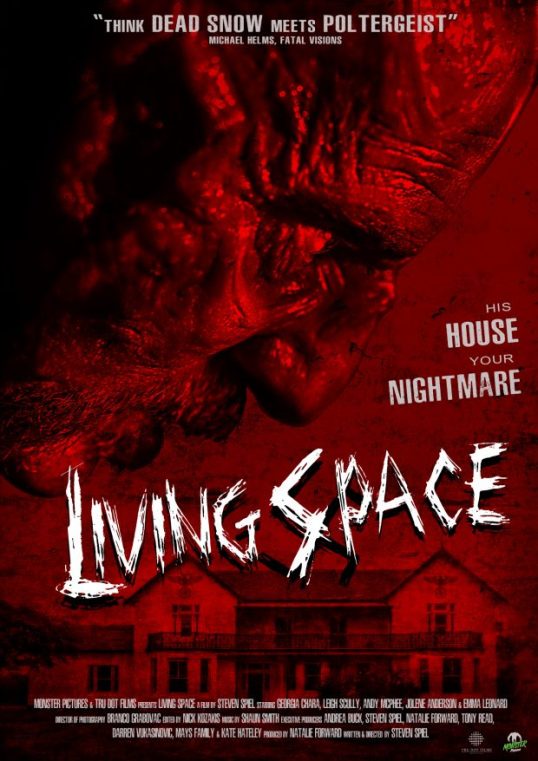
The TSL’s Horror Grindhouse: Living Space (dir by Steven Spiel)


So, before I talk about this movie, I want to talk about the title.  This is an independent Australian film from 2018 and, when it was originally released, its title was Living Space.  That’s not a particularly exciting title but it’s a title that goes along with the plot of the film and, in context of the story, it makes sense.

The film has since been retitled Nazi Undead.  That’s the title that’s used on the imdb.  That’s the title that’s used when it airs on Showtime and Starz.  When I recorded the film, I specifically set the DVR to record Nazi Undead.  I’m going to assume that it was felt that Nazi Undead was a more “commercial” title and I suppose it is.  For me, I saw the title and I immediately thought of the great 70s zombie flick, Shock Waves.  That said, it’s not a title that I plan on using in this review.  Living Space may not carry the punch of Nazi Undead but it’s still a far more appropriate title for this film, which involves a very evil spirit but no actual zombies.

As for the film itself, it opens with two Americans tourists driving through Germany.  Ashley (Georgia Chara) and Brad (Leigh Scully) should be having the time of their lives but they just can’t stop arguing.  At one point, Brad even calls Ashley a “whore” and it’s shortly afterwards that a house appears in the distance.  They’re having car trouble.  Brad wants to go in the house and get help.  Ashley is haunted by a horrific sense of deja vu and doesn’t want to.  Brad orders her to enter the house.

It turns out that Ashley was right.  The house is not a place you want to enter.  The house was once owned by a Nazi officer (Andy McPhee) who, one night, murdered his entire family.  His spirit is there and it’s still filled with the hatred and the sadism that fueled the Third Reich.  Brad is killed.  Ashley is next….

Suddenly, Ashley and Brad are sitting in the car again.  The house is sitting in front of them.  Ashley again has a horrific feeling of deja vu.  Brad again orders her to go into the house.  It’s a time loop, always starting with them at the car and always ending with a night of torture and death inside the house.  Each time, Ashley’s sense of deja vu grows stronger.  And each time, Brad is insistent that she enter the house….

It’s an interesting idea, really.  The evil of the Nazis, the film seems to be saying, cannot just be forgotten and, due to stubbornness  or willful blindness, we’re destined to suffer through their evil again and again unless people are willing to listen to and heed the warning signs.  The film opens with a title card that explains the idea behind Hitler’s concept of a “living space,” that room had to be made for the Aryan people and, in order to make that room, all undesirables would have to be moved somewhere else.  The house is a living space, one that is dominated not just by the evil ideology of its former inhabitant but also by the officer’s overwhelming hatred of women.  (Both the ghost and Brad use the word “whore,” which suggests that the whole reason the house appeared was because of Brad’s uttering of that word.  Brad and the ghost are in league, whether Brad realizes it or not.)  Every time, it’s Ashley who know what waits inside the house and Brad who insists that she enter it….

If only the execution was as assured as the idea behind it!  Georgia Chara does a good job in the role of Ashley but the rest of the cast is less impressive and, once they enter the house, the film sometimes seems to get so caught up in trying to duplicate other recent “torture” films that it runs the risk of trivializing exactly what it’s meant to condemn.  The film has a lot of ambition and, flaws and all, I do look forward to seeing what Steven Spiel does next.  Hopefully, whatever it is, it won’t get saddled with a name like Nazi Undead.

Scenes I Love: Robert Forster in El Camino


Today, I’m taking a break from sharing horror movie scenes that I can pay tribute to the great actor, Robert Forster.

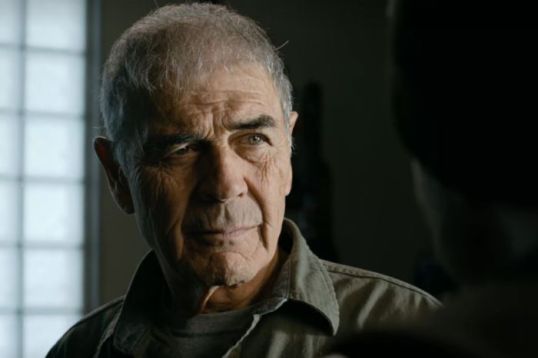
Forster passed away on Friday, shortly after his final film — El Camino — dropped on Netflix.  Forster had a small but pivotal role in the film, reprising the Breaking Bad character of Ed.  Ed may look like a vacuum cleaner repairman but he’s actually the guy you want to see if you need to start a new life far away from New Mexico.

Admittedly, Forster doesn’t say a lot in the scene below.  Aaron Paul’s the one who does most of the talking but then again, Forster wasn’t an actor who needed a lot of lines to make an impression.  Forster excelled at playing down-to-Earth men who may not have said much but who still meant every word that they said.  Forster does so much with just his eyes and his taciturn expression here.  And when he does speak, the lines are killer.

Obviously, this scene is going to count as a spoiler if you haven’t seen El Camino yet.

Robert Forster, R.I.P.  He was one of the greats.


International Horror Film Review: Nosferatu, the Vampyre (dir by Werner Herzog)


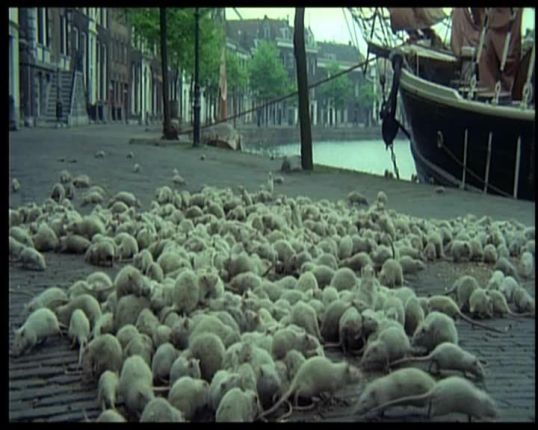
Agck!  The rats!

Nosferatu, Werner Herzog’s 1979 remake of the F.W. Murnau’s classic silent vampire film, may be best known for Klaus Kinski’s feral performance of Count Dracula but, for me, I’ll always remember the rats.

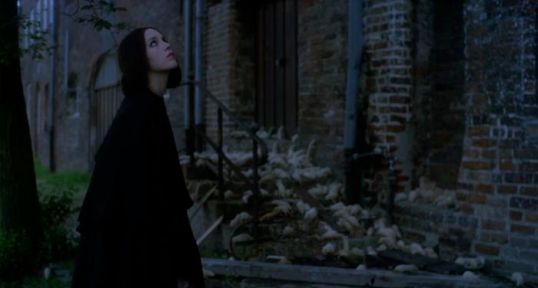
When Dracula first comes to the city of Wismar, he travels via a boat.  Spending the day in his coffin, he arises at night to kill the crew of the ship.  (Eventually, the captain’s dead body ends up tied to the wheel to ensure that the boat’s course is not altered.)  In order to keep the people of Wismar from realizing that they have a vampire in their midst, Dracula travels with thousands of rats and forges the ship’s log to make it seem as if the crew has fallen victim to the plague.  When the boat docks at Wismar, thousands of rats flood into the streets.  When Lucy (Isabelle Adjani) later walks through the streets of the Wismar, it becomes obvious that the rats have conquered the city.  The remaining people are too busy burying their dead and preparing for the end to do much about the rats.  One group cheerfully eats a lavish meal while thousands of rats wait behind them.  Later, the rodents have taken over the table.  The people are gone but the rats remain.

Werner Herzog has often cited the original Nosferatu as one of the films that most inspired him as a young filmmaker.  His remake is both a respectful homage to the original film and also a uniquely Herozgian work.  Much as the Spanish expedition at the center of Aguirre, The Wrath of God ended with the raft being conquered by monkeys, the city of Wismar is conquered by both rats and mythology.  Even towards the end of the film, when it becomes obvious that a vampire has come to town, the people refuse to believe it.  Some wait for God to save them.  Some just decide to celebrate the end.  But only Lucy, who we are told is pure of heart, is willing to sacrifice herself for the people of Wismar.  And yet, the film leaves us wondering if that sacrifice would really be worth it.  Are the people of Wismar worth saving?  This version of Nosferatu suggests that perhaps they’re not.


Lucy is the wife of estate agent Jonathan Harker (Bruno Ganz).  As with almost every version of Dracula, Nosferatu opens with Harker traveling to Dracula’s castle, dismissing the claims of local villagers are being mere superstition, and then eventually meeting the count himself.  Klaus Kinski may be made up to look like Max Schreck from the original film but he still turns Dracula into a uniquely Kinski-like creation.  Kinski’s Dracula has little of the old world charm of Bela Lugosi or even Christopher Lee.  Instead, he’s like a feral animal, hissing out his dialogue and almost always hiding in the shadows.  It’s been such a long time since this Dracula was human that he no longer knows how interact with them.  Instead, like an abused animal, he cringes when Harker attempts to speak to him.  There’s a loneliness to this Dracula and an unexpected sadness in his eyes.  Asking him to control his thirst for blood would be like asking a wild animal not to obey its natural instinct to kill.  The only time that this Dracula doesn’t seem to be full of self-loathing is when he’s actually hunting blood.  Then he moves like a calculating predator.

As one might expect from a Herzog film, Nosferatu moves at its somewhat odd but deliberate pace.  (Harker’s lengthy journey to reach Dracula’s remote castle will remind you of Klaus Kinski trying to conquer the Amazon in Aguirre and Fitzcarraldo.)  The imagery is surreal and dream-like.  I already mentioned the rats and the scene of Kinski stalking the captain of the boat feels like it was taken from a filmed nightmare.  It’s also impossible to forget the images of black-clad men, marching down the streets of Wismar and carrying coffins on their shoulders, all ignoring Lucy as she begs them to understand that there is something even deadlier than the plague at work in Wismar.

Both the original and the remake of Nosferatu are classic vampire films.  I suggest watching both.  Herzog shot two version of Nosferatu, one in German and one in English.  Though both versions are essentially the same, I recommend the German version just because, in the English version, it’s obvious the actors are occasionally having trouble performing in a foreign language.  The German version feels more authentic.  Since the film is basically a visual poem, it’s effective even if you’re watching it without subtitles.


4 Shots From 4 Films: Child’s Play, Faceless, The Lair of the White Worm, Night of the Demons


4 Shots From 4 Films is just what it says it is, 4 shots from 4 of our favorite films. As opposed to the reviews and recaps that we usually post, 4 Shots From 4 Films lets the visuals do the talking!

This October, we’re using 4 Shots From 4 Films to look at some of the best years that horror has to offer!

4 Shots From 4 1988 Horror Films

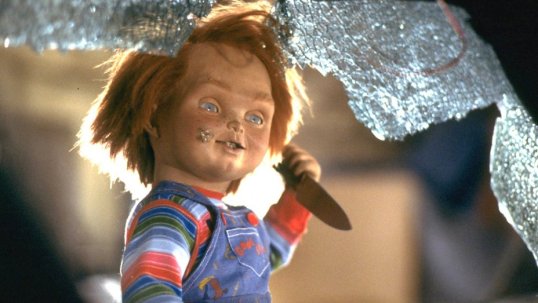
Child’s Play (1988, dir by Tom Holland)

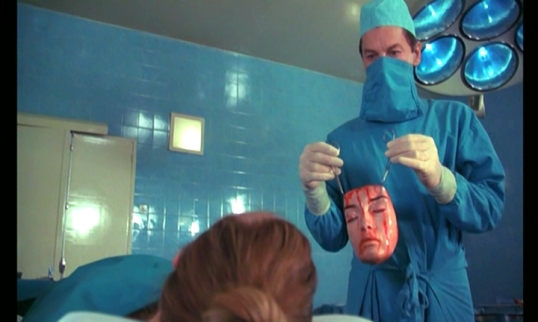
Faceless (1988, dir by Jess Franco)

The Lair Of The White Worm (1988, dir by Ken Russell)

Night of the Demons (1988, dir by Kevin Tenney)

Horror Film Review: One Hour Photo (dir by Mark Romanek)


I guess some people might argue that the 2002 film, One Hour Photo, isn’t really a horror film.

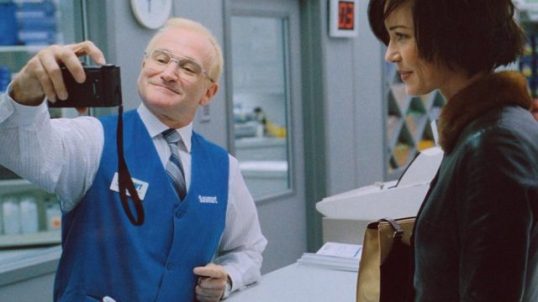
It’s an argument that I can understand.  The film does have its scary moments, like the scene where Sy Parrish (Robin Williams) dreams that his eyes are exploding.  But there aren’t any ghosts or vampires or hockey mask-wearing slashers to be found in One Hour Photo.  Even the film’s most disturbing moment — in which we see that Sy’s apartment is nearly empty except for a giant collage of pictures that cover his living room wall — is more depressing than scary.

It’s really a very sad movie.  In fact, it’s probably even more sad today than when it was originally released.  Now, when you see Robin Williams’s sad eyes and you hear him talking about how reality can never live up to a photograph, it’s impossible not to think about the actor’s 2014 suicide.  I remember that, when One Hour Photo and Insomnia came out in the same year, there was a lot of talk about how unexpected it was to see Robin Williams playing such dark characters.  Now, of course, that darkness is a key part of Robin Williams’s persona.

In hindsight, it’s also sad because one watches the film with the knowledge that, even if Sy hadn’t lost it at the end of One Hour Photo, he still probably be a lost soul in 2019.  When we first meet Sy, he’s working at the one-hour photo lab in SavMart.  He talks about how much he loves developing pictures.  When someone mentions that they’ve been thinking about getting a digital camera, Sy nervously chuckles and says, “Don’t do that, you’ll put us out of business.”  Of course, in 2019, people take pictures with their phones and even digital cameras are viewed as being something of a relic.  If Sy were around and free today, I doubt he’d have a job.  If he did have a job, it’s doubtful it would be one that would allow him to cover his wall with someone else’s photos.  Instead, in 2019, I imagine Sy would be one of those people following strangers on social media and printing out all their pictures and probably sending them unsolicited DMs and private messages.

Sy is obsessed with the Yorkin family, Will (Michael Vartan), Nina (Connie Nielsen), and their son, Jake (Dylan Smith).  Even though the family barely knows who Sy is, he knows them because Sy has spent years developing (and stealing) their photos.  Sy views them as being the perfect family.  They’re the family that he wants to be a part of.  “Sometimes I think of myself as being Uncle Sy,” he says at one point.  But then Maya Burson (Erin Daniels) brings in her photos to be developed and Sy learns that the reality of the Yorkins is not as perfect as the photographs.  And Sy loses it.

Actually, there’s quite a few reasons why Sy loses it and the film suggests that, if the Yorkins had never stepped into SavMart, Sy would have found another family on which to obsess.  Something is missing inside of Sy.  Incapable of dealing with reality, Sy instead deals with posed pictures of happy times.  Towards the end of the film, there’s a throw-away line that attempts to offer some sort of insight into why Sy is such a lost soul.  Personally, I think the film works better without an explanation.  Why is less important than the fact that Sy exists.

In the end, One Hour Photo qualifies as a horror film not because of any paranormal danger but because it’s a film about the horror of everyday life.  You never know who might be watching you.  That friendly clerk who waits on you at the grocery store might be following you home and imagining that he’s a part of your life.  You never know.  One Hour Photo is the film that suggests that, lurking behind every friendly smile, there’s a blank Sy Parrish.  It’s a scary thought.

Horror on the Lens: Plan 9 From Outer Space (dir by Edward D. Wood, Jr.)


Watching Ed Wood’s infamous Plan 9 From Outer Space is something of an October tradition here at the Shattered Lens!  And you know how much I love tradition!

Some people say that this film has a reputation for being the worst film ever made.  Personally, I don’t think that it deserves that reputation.  Is it bad?  By traditional standards of quality, I guess it can be argued that Plan 9 From Outer Space is a bad movie.  But it’s also a lot of fun and how can you not smile when you hear Criswell’s opening and closing statements?

Enjoy and be sure to read Gary’s review!

(And also be sure to read Jedadiah Leland’s tribute to Criswell!)

(On another note: Watch this as quickly as you can because, over the least year or so, it seems like all the films of Ed Wood get yanked off YouTube as soon as they are posted.  Copyright violations, they say.  Personally, I think that’s shameful.  First off, Ed Wood is no longer alive.  Wood had no children and his widow died in 2006, having never remarried.  Whatever money is being made off of his films is not going to support his family.  Wherever he is, I think Ed would be more concerned that people see his films than some faceless corporation make money off of them.)

(It seems like, every year, someone threatens to either remake Plan 9 or produce a sequel.  Again, the original is all that is needed.)

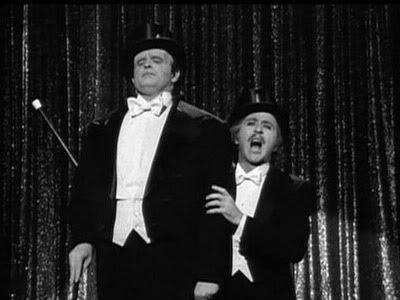
Horror Scenes That I Love: Frankenstein and his Creation Put On The Ritz From Young Frankenstein


This scene from 1974’s Young Frankenstein is not only funny but kinda poignant and sad.  I mean, you can tell that the Monster (Peter Boyle) is trying so hard to do a good job and what does it get him?  Not only does the audience turn on him but even his creator (Gene Wilder) starts yelling at him.

I mean, considering that the Monster had only been alive for a few days, I think he deserves a lot of credit for handling the performance as well as could be expected!  To me, the true monsters in this scene are the theater patrons who apparently brought cabbages and other vegetables with them to the theater.  I mean, you don’t pack a salad unless you’re planning on using it.

The performers didn’t have a chance.

Enjoy!


4 Shots From 4 Films: Evil Dead II, Near Dark, Stage Fright, The Stepfather


4 Shots From 4 Films is just what it says it is, 4 shots from 4 of our favorite films. As opposed to the reviews and recaps that we usually post, 4 Shots From 4 Films lets the visuals do the talking!

This October, we’re using 4 Shots From 4 Films to look at some of the best years that horror has to offer!

4 Shots From 4 1987 Horror Films

Evil Dead II (1987, dir by Sam Raimi)

Near Dark (1987, dir by Kathryn Bigelow)

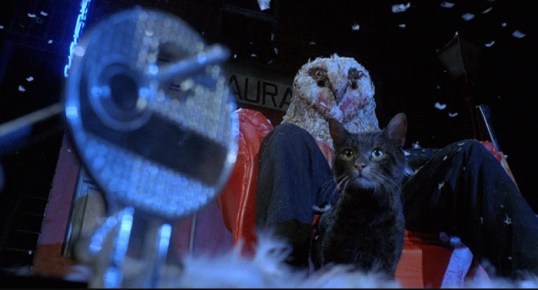
Stage Fright (1987, dir by Michele Soavi)

The Stepfather (1987, dir by Joseph Ruben)