To be honest, of all the trailers that were released yesterday, this the only one that I really cared about.
Here is the 2nd trailer for Wonder Woman 1984! Looks pretty good, doesn’t it?
To be honest, of all the trailers that were released yesterday, this the only one that I really cared about.
Here is the 2nd trailer for Wonder Woman 1984! Looks pretty good, doesn’t it?
I have no idea who Black Adam is or what to make of this trailer but here it is!
I guess the main theme of this trailer is “Dwayne Johnnson’s back and DC’s got him.”
“Hmmmm …. I don’t know. Suicide Squad wasn’t that good. I don’t know if I want to see a sequel….”
“But this isn’t Suicide Squad 2! This is …. THE Suicide Squad!”
“Oh. Well, that’s different. Take my money.”
Actually, another reason to see this film is because it was directed by James Gunn. I’ll watch anything that James Gunn directs.
Here’s the trailer:
Another trailer that premiered this weekend was the trailer for Zack Snyder’s cut of Justice League.
Since hardly anyone wants to be associated with Joss Whedon anymore, I assume that this will be the new, official version of Justice League. I never saw the original release version so I can’t really tell you if this trailer looks like an improvement or not. (Seriously, I was so annoyed with Batman v Superman that I pretty much just looked at Justice League and said, “No way.” Not even the presence of Gal Gadot could change my mind)
That said, a lot of people online are really excited about the Snyder cut so here’s the trailer:
This weekend, several trailers were dropped for the upcoming installments in the DC Extended universe. People on twitter certainly were excited, though I have to admit that, with the exception of Wonder Woman, I’ve never cared much about the DC films.
Then again, that could change. To be honest, I haven’t been that enthusiastic for the new MCU films. I’m even kind of dreading Black Widow because the way the character was killed off in Infinity War still bothers me. Speaking of which, with the exception of killing off Natasha, I loved Infinity War but I have to admit that it kind of felt almost like to perfect an ending for the entire MCU. All the films that follow will be in its shadow. Meanwhile, the DC films are still finding themselves and that could potentially be interesting to watch. Or not. We all remember Man of Steel.
Then again — and yes, I know, I’m indecisive — it’s hard for me to get excited for yet another Batman film. “This Batman is dark and serious!” Oh, you mean as opposed to all the other recent Batman films? Y’know why people loved LEGO Batman? Because it was willing to poke fun at itself and the character.
Anyway, here’s the trailer for The Batman, with Robert Pattinson in the lead role. I think Robert Pattinson is an excellent actor who has more than proven that he deserves to be known for more than just playing Edward Cullen. For the record, though this is a DC film, it’s apparently not considered to be a part of the DCEU. So, I guess maybe it’s taking place in the same cinematic universe as Joker.
(Seriously, it’s kind of hard to keep all these universes straight….)
“This is Lawrence. This is Lawrence, Kansas. Is anybody there? Anybody at all?”
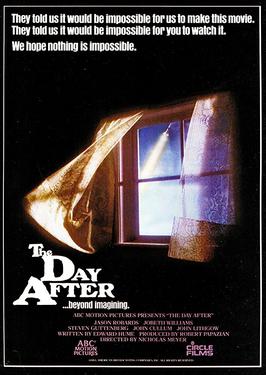
The words of Joe Huxley (John Lithgow) hang over the ending of The Day After, a 1983 film that imagines what the aftermath of a nuclear war would be like not on the East or the West Coasts but instead in the rural heartland of America. Huxley is a professor at the University of Kansas and, as he explains early on in the film, Kansas would be an automatic target in any nuclear war because it houses a number of missile silos. When he explains that, it’s in an almost joking tone, largely because the missiles haven’t been launched yet. Instead, the only thing we’ve heard are a few barely noticed news stories about growing tensions between America and Russia. About halfway through The Day After, the bombs go off and there are suddenly no more jokes to be made.
When the bombs drop over Kansas, we watch as cities and field and people burst into flames. In a matter of minutes, several thousands are killed. I’m almost ashamed to admit that I was probably more upset by the image of a horse being vaporized than I was by the death of poor Bruce Gallatin (Jeff East), the college student who was planning on marrying Denise Dahlberg (Lori Lethin). I guess it’s because horses — really, all animals — have nothing to do with the conflicts between nations. Humans are the ones who take the time to build bigger and better weapons and The Day After is one of the few films about war that’s willing to acknowledge that, when humans fight, it’s not just humans that die.
The bombing sequence is lengthy and I have to admit that I was a bit distracted by the fact that I recognized some of the footage from other movies. A scene of panicked people running through a building was taken from Two-Minute Warning. A scene of a building exploding and a construction worker being consumed by flames was lifted from Meteor. As well, there’s some stock footage which should be familiar to anyone who has ever seen a documentary about the early days of the Cold War. Still, despite that, it’s an effective sequence simply because it’s so relentless. Some of the film’s most likable characters are vaporized before our eyes. Steve Guttenberg, of all people, is seen ducking into a store.
Guttenberg plays Stephen Klein, a pre-med student who manages to survive the initial attack and takes shelter with the Dahlberg family at their ranch. At first, it’s a bit distracting to see Steve Guttenberg in a very serious and very grim film about the nuclear apocalypse but he does a good job. The sight of him losing both his teeth and his hair carries a punch precisely because he is reliably goofy Steve Guttenberg.
If the film has a star, it’s probably Jason Robards, the doctor who witnesses the initial blast from the safety of his car and then treats the dying in Lawrence, Kansas. He does so, despite the fact that he doesn’t know if his wife, son, and daughter are even still alive. He continues to do so until he also falls ill with radiation poisoning. Knowing that he’s dying, he heads home just to discover that there is no home to return to.
Home is reccuring theme throughout The Day After. Everyone wants to return to their home but everyone’s home has been wiped out. “This is my home,” Jim Dahlberg (John Cullum) tries to explain before he’s attacked by a group of feral nomads. Home no longer exists and trying to pretend like life can go back to the way it once was is an often fatal mistake.
Real happy film, right? Yeah, this isn’t exactly a film that you watch for fun. I have to admit that I made a joke about how I wouldn’t want to die while wearing the unfortunate blue jumpsuit that Jason Robards’s daughter chooses to wear on the day of the nuclear attack and I felt guilty immediately. (Well, not that guilty. Seriously, it was a terrible fashion choice.) The Day After is a film that gives audiences zero hope by design. It was made at a time when it was generally assumed that nuclear was inevitable and it was designed to scare the Hell out of everyone watching. And while I can’t attest to how audience may have reacted in 1983, I can say that, in 2020, it’s still a powerful and disturbing film.
“Is anybody there? Anybody at all?” Joe Huxley asks and by the end of the film, the answer doesn’t matter. The damage has already been done.
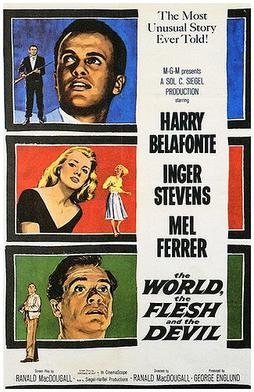
The 1959 film, The World, the Flesh, and the Devil, opens with a mine cave-in in Pennsylvania. Trapped in the cave-in is a mine inspector named Ralph Burton (Harry Belafonte). Despite being trapped underground, Ralph remains in surprisingly good spirits. (In fact, as the movie progresses, Ralph’s tendency to joke when faced with bleak reality will become a recurring theme.) Ralph sings to himself. Ralph tells jokes. Ralph listens to the sound of the men who are digging a tunnel to rescue him. Except, one day, Ralph can no longer hear anyone digging. Realizing that he’s going to have to save himself, Ralph manages to dig his way out of the cave. Once again above ground, Ralph discovers that he’s alone.
The world has changed. Cars and buildings sit deserted. Everything that was made by mankind is still there but it’s all now empty. Confused but understanding that something huge has happened, Ralph makes his way from Pennsylvania to New York. During his journey, he comes across old newspapers and a recording in a radio station and he’s able to piece together what’s happened. Some country — no one was ever sure which one — released a radioactive isotope into the atmosphere. For five days, the air was poisoned. Everyone who didn’t get to shelter died. The only reason Ralph survived was because he was trapped underground.
At first, New York appears to be as deserted as Pennsylvania. (The film was shot on location in Manhattan, reportedly in the early morning hours before rush hour, when there was no one on the streets. The visuals of the empty city are often hauntingly bleak.) Struggling to maintain his own sanity, Ralph steals two mannequins and spends his days talking to them. He comes up with projects to pass the time. He’s able to get the power flowing in Times Square. And he even meets another survivor!
Sarah Crandall (Inger Stevens) was one of three friends who hid in a bunker when the world started to end. Sarah’s two friends left the bunker after two days and were killed by the radioactive cloud. Sarah waited the entire five days and survived. Though we don’t learn much about her background, it’s heavily suggested that Sarah was rich and didn’t have a care in the world before society collapsed. Now, she and Ralph are just happy to have found each other.
Sarah and Ralph quickly become friends. Sarah has obvious romantic feelings towards Ralph but, to her frustration, he keeps his distance. When Sarah asks why they don’t just live together instead of maintaining separate apartments, Ralph nervously jokes that if they got a place together, people would talk. Sarah is white and Ralph is black. When Sarah says that doesn’t matter anymore, Ralph tells her that it does matter and that she has no idea what his life was like before the world ended. When a frustrated Sarah says that she can move in with Ralph because she’s “free, white, and 21 and I can do whatever I want,” Ralph looks like she’s just slapped him. Later, Ralph tells her that, because she’s white, she will never be able to understand the pain that her words caused him. I can only imagine how audiences in 1959 reacted to this scene.
Eventually, Ralph discovers that there are scattered survivors across the world. One of them, Benson Thacker (Mel Ferrer), even comes to New York and joins Ralph and Sarah. With the arrival of the white Thacker, Ralph suddenly finds himself being treated like a servant. Thacker not only attempts to take over the group but he also tells Ralph that Sarah belongs to him. When Thacker, a self-described “former idealist,” tells Ralph, “I have nothing against Negroes,” Ralph coldly replies, “That’s mighty white of you,” and again, the modern viewer cannot help but wonder how audiences in 1959 reacted to hearing those words uttered on a movie screen.
The World, the Flesh, and the Devil is a frequently fascinating film. Belafonte brings a lot of charm and wit to the role of Ralph but he also doesn’t shy away from portraying Ralph’s anger at still being limited by the conventions of a society that, for all intents and purposes, has destroyed itself. Ralph brings New York back to life, just to watch as Thacker moves in and claims it for himself. Significantly, Thacker doesn’t view himself as being a racist. Instead, in his mind, he’s simply living the way that he’s always lived. By treating Ralph like a second class citizen, he’s keeping society alive. Sarah, meanwhile, is torn between her desire to create a new world and the temptation to return to her spoiled and privileged upbringing. While the film is dominated by Belafonte’s performance, both Inger Stevens and Mel Ferrer bring some shadings to characters that, in lesser hands, could have been extremely flat and predictable.
The film falls apart a bit during the third act. The World, the Flesh, and the Devil spends a good deal of time building up to a rather downbeat climax just to suddenly reverse itself. The film ends on a hopeful note that just doesn’t feel realistic after everything that we’ve just seen. The film’s conclusion brings a promise of renewal that feels like it was tacked on at the last moment. Still, up until that moment, it’s a compelling and intelligent film and one that’s feels ever more relevant today than it probably did in 1959.
There’s been a murder on the Orient Express!
In the middle of the night, a shady American businessman (Richard Widmark) was stabbed to death. Now, with the train momentarily stalled due to a blizzard, its up to the world’s greatest detective, Hercule Poirot (Albert Finney), to solve the crime. With only hours to go before the snow is cleared off the tracks and the case is handed over to the local authorities, Hercule must work with Bianchi (Martin Balsam) and Dr. Constantine (George Coulouris) to figure out who among the all-star cast is a murderer.
Is it the neurotic missionary played by Ingrid Bergman? Is it the diplomat played by Michael York or his wife, played by Jacqueline Bisset? Is it the military man played by Sean Connery? How about Anthony Perkins or John Gielgud? Maybe it’s Lauren Bacall or could it be Wendy Hiller or Rachel Roberts or even Vanessa Redgrave? Who could it be and how are they linked to a previous kidnapping, one that led to the murder of an infant and the subsequent death of everyone else in the household?
Well, the obvious answer, of course, is that it had to be Sean Connery, right? I mean, we’ve all seen From Russia With Love. We know what that man is capable of doing on a train. Or what about Dr. No? Connery shot a man in cold blood in that one and then he smirked about it. Now, obviously, Connery was playing James Bond in those films but still, from the minute we see him in Murder on the Orient Express, we know that he’s a potential killer. At the height of his career, Connery had the look of a killer. A sexy killer, but a killer nonetheless….
Actually, the solution to the mystery is a bit more complicated but you already knew that. One of the more challenging things about watching the 1974 version of Murder on the Orient Express is that, in all probability, the viewer will already know how the victim came to be dead. As convoluted as the plot may be, the solution is also famous enough that even those who haven’t seen the 1974 film, the remake, or read Agatha Christie’s original novel will probably already know what Poirot is going to discover.
That was something that director Sidney Lumet obviously understood. Hence, instead of focusing on the mystery, he focuses on the performers. His version of Murder on the Orient Express is full of character actors who, along with being talented, were also theatrical in the best possible way. The film is essentially a series of monologues, with each actor getting a few minutes to show off before Poirot stepped up to explain what had happened. None of the performances are exactly subtle but it doesn’t matter because everyone appears to be having a good time. (Finney, in particular, seems to fall in love with his occasionally indecipherable accent.) Any film that has Anthony Perkins, John Gielgud, Lauren Bacall, Sean Connery, Ingrid Bergman, and Albert Finney all acting up a storm is going to be entertaining to watch.
Though it’s been a bit overshadowed by the Kenneth Branagh version, the original Murder on the Orient Express holds up well. I have to admit that Sidney Lumet always seems like he would have been a bit of an odd choice to direct this film. I mean, just consider that he made this film in-between directing Serpico and Dog Day Afternoon. However, Lumet pulls it off, largely by staying out of the way of his amazing cast and letting them act up a storm. It looks like it was a fun movie to shoot. It’s certainly a fun movie to watch, even if we do already know the solution.

The 1983 film, Testament, is about death. It’s about the death of a family, the death of a town, the death of a way of life, and the death of hope.
And you may be saying, “Well, gee, Lisa — that sounds like a really happy movie.”
Well, it’s not meant to be a happy movie. Testament is a painfully grim movie about the end of the world.
The movie takes place in the town of Hamelin, California, which we’re told is 90 minutes away from San Francisco. It’s a nice town, the type of place where everyone knows each other. Mike (Mako) runs the local gas station and cares for his disabled son, Hiroshi (Gerry Murillo). Elderly Henry Abhart (Leon Ames) spends his time on his radio, talking to strangers across the world. Fania (Lilia Skala) offers up piano lessons. Father Hollis (Philip Anglim) looks over the spiritual needs of the parish. It’s a normal town.
The town is home to the Weatherlys. Carol (Jane Alexander) is a stay-at-home mom who does volunteer work and who is directing the school play. Tom (William Devane) is a common sight riding his bicycle through town every morning before heading off to work in San Francisco. They have three children. Mary Liz (Roxanna Zal) is a teenager who is taking piano lessons. Brad (Ross Harris) is always trying to impress his father and is looking forward to his 14th birthday. Scottie (Lukas Haas, in his first film) is the youngest and never goes anywhere without his teddy bear. They’re a normal family living a normal life in a normal town.
And then, one day, everything changes. Scottie is watching Sesame Street when the program is suddenly interrupted by a clearly terrified anchorman who announces that New York has been bombed. The president is about to speak but, before he can, there’s a bright flash of light, an distant explosion, and the entire town loses power.
At first, the people of Hamelin try to remain hopeful. Though Tom works in San Francisco and San Francisco is among the many cities that have apparently been bombed (by who, we never learn), he also left a message on the family’s answer machine, telling them that he was on his way home. Even with Tom missing, Carol continues to insist the he’ll be coming home at any minute.
Tom doesn’t come home.
The rest of the film follows the slow death of the town. Even though the town was not damaged by the blast, the fallout soon hits. Cathy (Rebecca De Mornay) and Phil (Kevin Costner) bury their newborn baby after it falls ill from radiation poisoning. Mike, Henry, and Fania all start to grow physically ill and, in some cases, dementia sets in. Father Hollis goes from being hopeful to being tired and withdrawn as he tries to attend to each and every death. Larry (Mico Olmos), a young boy whose parents have disappeared, briefly moves in with the Wetherly family. He disappears about halfway through the movie and we never learn if he left or if he died. All we know is that no one mentions him or seems to notice that he’s gone.
Over the course of the film, Carol buries two of her children. By the end of the film, her remaining child is starting to show signs of being sick, as is she. Testament, which opened with bright scenes of a happy town, ends in darkness, with only a handful of people left among the living. Even those who are alive are clearly dying and can only speak of the importance of remembering all of it, what they had and what they lost.
Sounds like a really happy film, right? Well, it’s meant to be depressing. It was made at a time when nuclear war was viewed as being not just probable but also inevitable. Testament is a film that portrayed what a lot of people at the time were expecting to see in the future and, as a result, it’s not meant to be a particularly hopeful movie. It’s a film that accomplishes what it set out to do, thanks to a great (and Oscar-nominated) performance from Jane Alexander and Lynne Littman’s low-key direction. Unlike a lot of atomic war films, Testament does not feature any scenes of burning buildings or excessive gore. That actually what makes it even more disturbing. Even after the war, Hamelin still looks like it did beforehand, with the exception that many of the houses are now empty and that all of the residents are slowly dying.
(Would I have reacted as strongly to the film if I hadn’t watched it at a time when many people are afraid to go outside? Perhaps not. But this pandemic has brought extra power to a lot of films that may not have had as much of an impact in 2018.)
Testament is a powerful film, though not necessarily one that I ever want to watch again.


This is a trailer for a film called Dead. I haven’t heard much about this film but death is a universal theme. Is he a zombie or is he a ghost? I’m hoping for a ghost. I’m a little bit tired of zombies.
Well, regardless of whether he’s a ghost or a zombie, this dead cop has a job to do. He needs to capture the man responsible for his death!
Here’s the trailer!
 Through the Shattered Lens