Horror Film Review: Wake In Fright (dir by Ted Kotcheff)


To be honest, it’s probably open for debate whether or not Wake In Fright is actually a horror film.

This 1971 Australian film, which tells the story of a school teacher who becomes stranded in a small town in the outback, doesn’t feature any ghosts or werewolves or vampires or zombies or anything else of a supernatural nature.  The school teacher meets a large number of people in town, the majority of whom are technically quite friendly.  They teach him how to gamble.  They take him on a hunt.  They give him shelter when he doesn’t have anywhere else to stay.  The word “mate” is tossed around so frequently that it soon becomes clear that every man — significantly, there’s only two women in the film and one of them only appears in the teacher’s memories — in the outback is considered to be one.
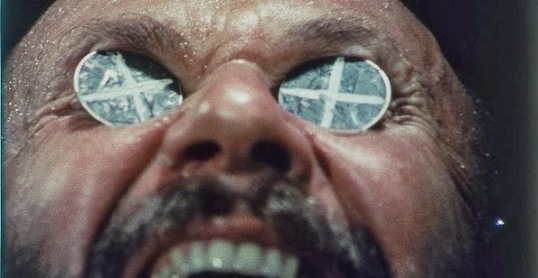
The people of town of Bundanyabba — or “The Yabba,” as they call it — are also very generous with their beer.  If they meet you for the first time, they expect you to have a beer with them.  If they see you for the first, second, or third time during the day, they expect you to have a beer with them.  They wake up in the morning drinking and they go to bed drunk.  When John Grant (Gary Bond) first shows up in the Yabba, he can barely handle two beers.  By the end of his stay, he’s drinking nonstop.

However, John also discovers that it dangerous to turn down those offers of beer.  Turn down a beer and you might get a strange look, if you’re lucky.  More likely, you’ll get yelled at.  Turn down a beer from the wrong person and you might even get attacked.  Everyone in the Yabba is friendly but everyone is also always on the verge of throwing the first punch.  Refuse a beer and you might be in trouble.  Refuse to enthusiastically take part in a savage and sadistic kangaroo hunt and your mates might starts to talk.  When John first arrives, he’s a bit amused by the town and what he sees as being its backwards ways.  It’s obvious that he looks down on the people around him and one can sense that they realize that.  Perhaps that’s why everyone around him seems to take such joy in watching John slowly lose his identity.

That’s horror at the heart of Wake in Fright.  It’s not the horror of the paranormal.  Instead, it’s the horror of the isolation.  There’s no way to fight the isolation and the madness it brings.  Your only choice is to either surrender to it or be destroyed by it.  The longer John spends in the Yabba, the more the bleakness of the outback gets to him.  It’s a world dominated by brutal men, none of whom are particularly impressed when they find out that John’s teacher and that he has a suitcase full of books.  They view John as being soft and, in order to prove that he’s not, John starts to sacrifice his identity.  He starts to become just as much of a brute as Dick (Jack Thompson) and Joe (Peter Whittle).

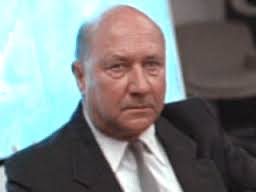
Having lost all of his money, John eventually ends up staying with Doc Tydon (Donald Pleasence).  Doc really is a doctor.  He’s also, as he cheerfully explains, an alcoholic.  When John says that he’s going to find some place else to stay, Doc makes it clear that John isn’t leaving.  The film makes good use of Pleasence’s eccentric screen presence.  Is Doc simply being friendly or does Doc have more sinister motives fueling his insistence that John stay with him?  When Doc gives John advice, is it to help him or is it to further degrade John?  Like John, Doc is an educated man and obviously smarter than those around him.  And yet, Doc seems very happy in the mad world of the Yabba, drinking, hunting, and gambling.  Is John destined to become Doc or can he escape?
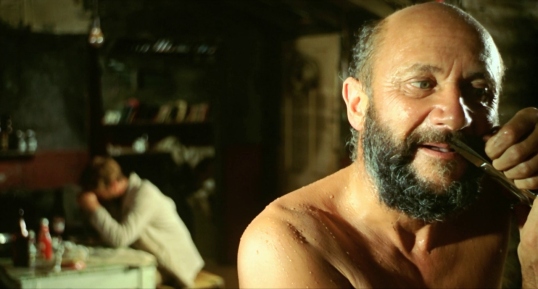
John discovers that leaving the Yabba isn’t easy.  Every time he tries, he ends up back in town.  All roads seems to lead back to the Yabba.  In retrospect, perhaps the most frightening thing about Wake In Fright is that no one seems to be surprised by the sight of the increasingly disheveled and unstable John.  Even when he stumbles through town while carrying a rifle, no one gives him a second look.  He’s just another part of the scenery.

No, Wake In Fright is not a traditional horror film but it’s a horror film, nonetheless.  It’s about the horror of not only losing your identity but perhaps not being quite sure what your identity was in the first place.  As played by Gary Bond, John is an often frustrating character but you never stop caring about him.  It’s frightening to watch him lose himself, even while you wonder if he ever knew who he truly was in the first place.  Bond was a stage actor who only appeared in three films.  Wake in Fright was his final film and one of the huge reasons why it’s so effective is because Gary Bond is not an actor who we recognize from other films.  We don’t seen an actor when we look at him.  Instead, we see a person who, for the first time, is discovering just how unsettling life on the fringes can be.

It’s a powerful film and a controversial one.  When John is taken on a kangaroo hunt, footage from an actual hunt was included in the film and it’s a horrific sequence, one that’s made all the more disturbing by the fact that the hunters refuse to acknowledge just how horrific and unjust it all is.  Reportedly, when Wake In Fright was first released, someone in a Sydney theater stood up and shouted at the screen, “This is not us!”  Actor Jack Thompson, who made his film debut in Wake In Fright, was in the audience and shouted back, “It is us, mate!  Sit down!”

For a long time, it was impossible to see Wake In Fright.  Only one known print was known to exist and it was a badly damaged one.  Fortunately, in 2002, another print was found in Pittsburgh and Wake In Fright was rereleased and rediscovered.  When it was first released in 1971, the film’s violence and downbeat atmosphere were both controversial and it struggled at the Australian box office.  (Many Australians, like that theatergoer in Sydney, initially viewed the film as being a bit of a personal attack.)  Rereleased in 2003 and championed by Martin Scorsese, Wake In Fright was embraced by a new generation of critics, many of whom declared it to be one of the greatest and most important Australian films ever made.

Wake In Fright is a powerful and unsettling film, a portrait of a place that seems to be fueled by toxic masculinity and self-destruction.  It’s a disturbing film and not easy to watch.  But if you do watch it, it will stick with you and leave you thinking long after the final credits roll.

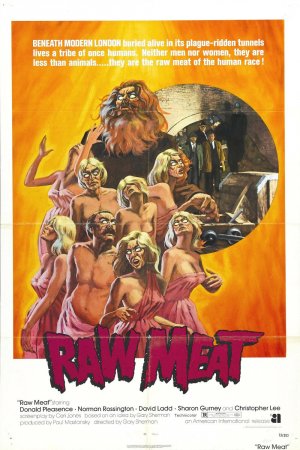
Horror Scenes That I Love: Donald Pleasence Meets Christopher Lee in Death Line


In the 1972 British horror film Death Line (released in the U.S. as Raw Meat), Donald Pleasence gives one of his best performances as Inspector Calhoun, an alcoholic, somewhat fascistic detective who discovers evidence of cannibals in the London Underground.  Since the British government would rather this information not be revealed, a mysterious man played by Christopher Lee is sent to discuss things with Calhoun.

This scene features a meeting between two icons of horror so, of course, I love it.  Pleasence is wonderfully obsessive and Lee is wonderfully menacing.  Since the film is as much about the class struggle as it is about cannibalism, it’s interesting to see the automatic conflict between the working class Calhoun and the definitely upper class character played by Christopher Lee.

4 Shots From 4 Donald Pleasence Films: Wake In Fright, The Mutations, Halloween, Phenomena


4 Shots From 4 Films is just what it says it is, 4 shots from 4 of our favorite films. As opposed to the reviews and recaps that we usually post, 4 Shots From 4 Films lets the visuals do the talking!

Today, we celebrate the life and career Donald Pleasence!  One of the greatest of all the horror icons, Pleasence was born 101 years ago today and that means that it’s time for….

4 Shots From 4 Films

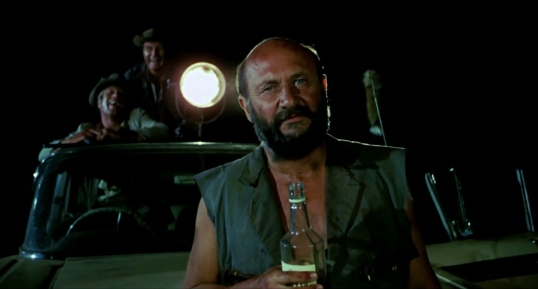
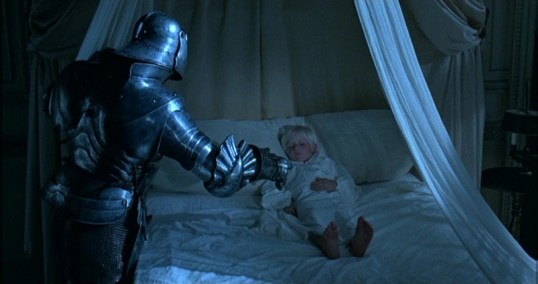
Wake in Fright (1971, dir by Ted Kotcheff)

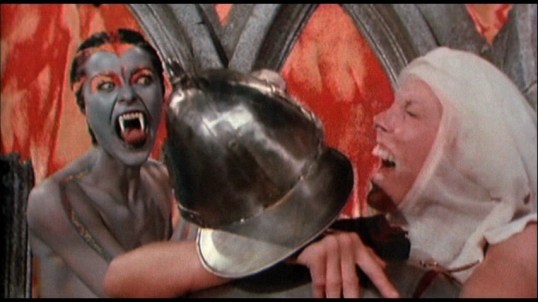
The Mutations (1974, dir by Jack Cardiff)

Halloween (1978, dir by John Carpenter)

Phenomena (1985, dir by Dario Argento)

Horror on the Lens: Robot Monster (dir by Phil Tucker)


Today’s horror film is a true classic of its kind, the 1953 science fiction epic Robot Monster.

Now, I should admit that this is not the first time that I’ve shared Robot Monster in October.  I share it every year and, every year, YouTube seems to pull the video down in November.  That sucks because Robot Monster is one of those weird films that everyone should see.  So, I’m going to share it again.  And, hopefully, YouTube will let the video stay up for a while.

As for what Robot Monster is about…

What happens with the Earth is attacked by aliens?  Well, first off, dinosaurs come back to life.  All of humanity is killed, except for one annoying family.  Finally, the fearsome Ro-Man is sent down to the planet to make sure that it’s ready for colonization.  (Or something like that.  To be honest, Ro-Man’s exact goal remains a bit vague.)

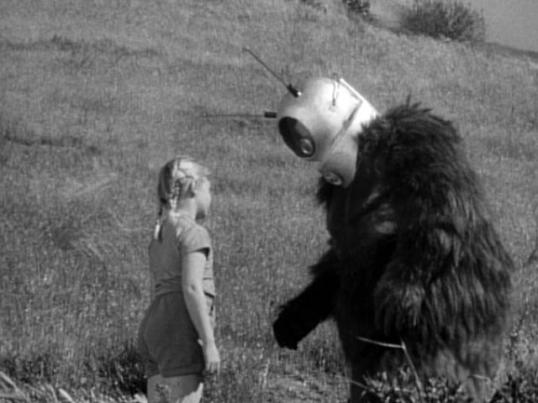
Why is Ro-Man so fearsome?  Well, he lives in a cave for one thing.  He also owns a bubble machine.  And finally, perhaps most horrifically, he’s a gorilla wearing a diver’s helmet.  However, Ro-Man is not just a one-dimensional bad guy.  No, he actually gets to have a monologue about halfway through the film in which he considers the existential issues inherent in being a gorilla wearing a diver’s helmet.

Can humanity defeat Ro-Man?  Will Ro-Man ever get his intergalactic supervisor to appreciate him?  And finally, why are the dinosaurs there?

All of those questions, and more, are cheerfully left unanswered but that’s a large part of this odd, zero-budget film’s considerable charm.  If you’ve never seen it before, you owe it to yourself to set aside an hour and two minutes in order to watch it.

You’ve never see anything like it before.

Enjoy!

(On another note, this movie was a favorite of TSL Contributor Gary Loggins.  Gary passed away a year ago today so this showing is dedicated to his memory.  We miss you, Gary!)

The TSL’s Horror Grindhouse: The Giant Spider Invasion (dir by Bill Rebane)


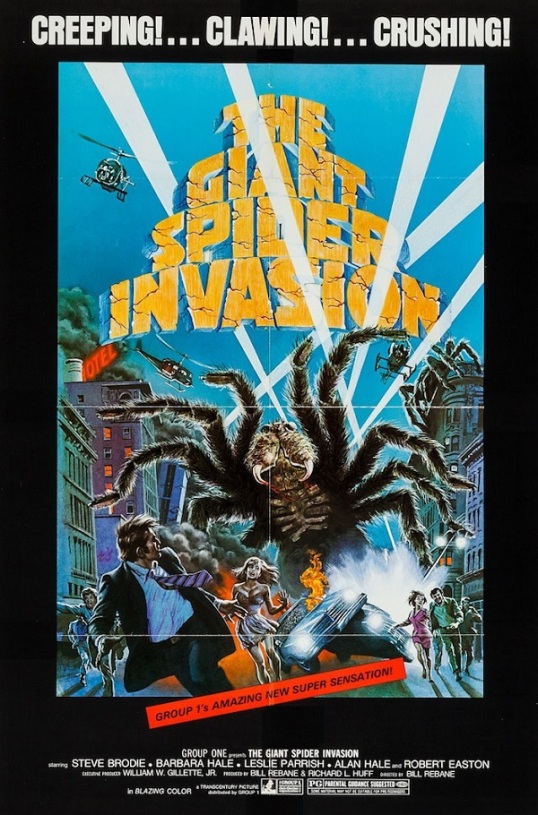
Welcome to rural Wisconsin, where everyone’s running around in their underwear and getting attacked by giant spiders!

That’s not meant to be a dig at the 1975 film, The Giant Spider Invasion, either.  I mean, let’s be honest.  If you’re going to be running around the trailer park in your underwear, the last thing that you want to do is walk straight into a giant spider web.  That happens a few times in The Giant Spider Invasion and I cringed every time because …. AGCK!  I mean, it’s a scary thought and The Giant Spider Invasion understands that.  Years ago, I was riding a horse and I rode head first into a spider web and oh my God!  I lost track of how many hours I spent washing my hair afterwards.  Of course, fortunately, I wasn’t in my underwear when I rode into that spider web.  So, it wasn’t as bad as it could have been.

Anyway, The Giant Spider Invasion opens with a meteorite crashing down to Earth.  As I previously mentioned, it lands in Wisconsin.  I can’t help but think that the alien spiders were a bit disappointed when they emerged out of their meteorite and discovered that they were in Wisconsin.  One would imagine that they were probably aiming for Washington D.C. and maybe they got off track.  Still, it works to the spiders’ advantage in that they’ve managed to land in a place so filthy and messy that no one is going to notice a few extra tarantulas crawling around.  Or, at least, they don’t notice until the tarantulas are gigantic and wandering through the fields.

(Go ask Alice …. when she’s ten feet tall…..)

We follow as various people deal with the giant spider invasion.  What we quickly discover is that, in 1975, America just wasn’t ready to make contact with alien spiders.  While Dr. Langer (Barbara Hale) and Dr. Vance (Steven Brodie) investigate the meteorite crash, the rest of the town is too busy with their own personal dramas to be of much help.  The Sheriff (Alan Hale, Jr.) is a buffoon who tries to coordinate a response from the safety of his office.  Dan (Robert Easton) and Ev (Leslie Parrish) obsess on whether or not the meteorites contain diamonds as well as spiders.  Dan has an affair with barmaid Helga (Christine Schmidtmer) while Ev’s younger sister, Terry (Dianne Lee Hart) dates Dave (Kevin Brodie), the son of the local newspaper editor.  Every 15 minutes or so, a crazed-looking preacher pops up and starts ranting about how the world’s going to end because of the sins of people like Dan, Eve, and Helga and, to be honest, the preacher seems to be the only person in town who understands just how much trouble they’re all in.

It’s all kind of silly but, because this is a Bill Rebane film, it all plays out with a certain unbridled enthusiasm that’s impossible to resist.  Rebane was never one to let a low-budget get in the way of his ambitions and the special effects in The Giant Spider Invasion may be cheap but they still have a charm all their own.  I mean, let’s face it.  Spiders are scary and any scene that features a giant one sneaking up on someone is going to be at least somewhat effective.  (I’ll even go on to say that a shot of a “giant” spider super-imposed over a field was actually rather effective and creepy.)  Add to that, The Giant Spider Invasion has only an 84-mintue running time so it doesn’t waste any time getting to the spiders.  This is a fun movie and a perfect one to watch in October.

Horror Scenes That I Love: The Interview With The Chief From Night of the Living Dead


“Yeah, they’re dead …. they’re all messed up.”

There’s a lot of disturbing scenes in the original Night of the Living Dead but I’ve always loved this live, televised interview with the chief of police.  First, there’s the delivery of that classic line.  “….they’re all messed up.”  Yes, they are.  Then there’s the fact that the chief doesn’t seem to be particularly perturbed by the fact that the dead are coming back to life.  Instead, his attitude is very straight-forward.  It’s happening, we need to take care of it, let’s arm some civilians.

Of course, this interview sets up the film’s ending, in which we learn that those helpful civilians with guns are a bit trigger happy and sometimes, the living get in the way.  When you first see this interview, it’s easy to laugh at the sight of the chief’s posse and everyone’s odd confidence that the dead will somehow just go away.  (Death, after all, is the one thing that is guaranteed to happen to everyone eventually.)  Once you know how the story’s going to end, though, this scene becomes much more ominous.

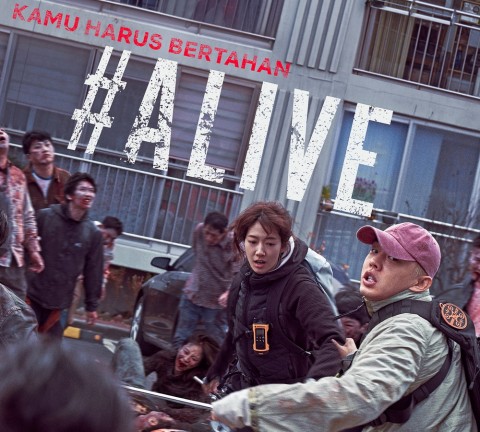
International Horror Film Review: #Alive (dir by Cho Il-hyung)


My feelings on the zombie genre are so mixed.

On the one hand, zombies are scary and zombie movies, when done well, can be genuinely disturbing.  Zombie movies deal with the inevitably of death.  Whenever someone dies, we always say that they’re at peace.  “At least, they’re not suffering anymore,” we say.  Zombie movies suggest that there is no peace after death.  Instead, the suffering of life is just replaced with nonstop hunger and savagery of death.  Meanwhile, the living don’t even get a chance to mourn their dead before they’re forced to kill them again.  Zombies are relentless and they used to be our friends and family.  That’s one reason why zombies haunt us in a way that certain other monsters never will.

At the same time, when it comes to zombie movies, there’s just so many of them!  Seriously, it seems like there must be at least a hundred zombie movies released every year.  We’ve seen so many scenes of the dead running through empty city streets that it’s hard not to get cynical.  The first time you see a reanimated corpse eat its parents, it’s disturbing.  But, by the hundredth time you’ve seen it, it’s just expected.  We now live in an age where every disaster is compared to a “zombie apocalypse.”  Even non-horror fans know about zombies.  The days of zombies being obscure are over.  They’re now firmly a part of pop culture and, as a result, they’ve become a bit annoying.

I say all this because, in many ways, #Alive is a standard zombie film.  This South Korean film opens with Joon-woo
(Yoo Ah-in) in his apartment, playing video games.  When reports come in of something strange happening in the streets of Seoul, Joon-woo goes out to his balcony to see what’s happening.  What he sees is a world gone mad, one in which hordes of growling people run through the streets, biting down and feeding on anyone who gets to close to them.  Yes, the zombie apocalypse has begun and Seoul is apparently right in the middle of it.

And don’t get me wrong.  The zombies are indeed frightening and there’s an exciting sequence where Joon-woo has to force one out of his apartment.  It’s all very well-directed and well-acted by Yoo Ah-in but it’s not anything that we haven’t seen before.  At this point, audiences have seen so many zombie rampages that if a real one ever breaks out, the uninfected will probably start bitching about how different it is from what the movies led them to expect.

What sets #Alive apart is the way it captures the feeling of being totally isolated and alone.  Trapped in his apartment with only a limited amount of food and with no way of knowing whether or not his family is still alive, Joon-woo tries to maintain his sanity.  Joon-woo is isolated from the outside world.  He’s quarantied himself.  Occasionally, he steps out on the balcony and sees if the zombies are still outside.  (They are.)  Occasionally, he checks the news to see if there’s an end in sight.  (There’s not.)  As the days pass, Joon-woo finds himself tempted to surrender to his despair.

But what if Joon-woo isn’t the only person left alive in his apartment complex?  What if, on the other side of the complex, there’s a woman named Kim Yoo-bin (Park Shin-hye) who is trying to catch Joon-woo’s attention so that he’ll know that he’s not alone and that she’s willing to help?  And just how much of a risk is Joon-woo willing to take to end his isolation?

That’s a question that feels especially relevant today, at a time when so many people are isolated, either voluntarily or by doctor’s orders.  When a newscaster describes the zombies as being infected, it’s impossible not to think about what’s currently going on in the world.  When Joon-woo discovers how truly difficult it is to be alone and unable to leave your home …. well, that’s the way many people have felt this entire year.  Though #Alive was filmed before the pandemic lock-downs, it feels like a movie about our current times.  As such, it has a power to it that it might not have had if it had been released at a different time.  Like everyone, Joon-woo struggles with fear and despair.  But, at the same time, he never allows himself to forget that he’s not dead yet.  He’s still alive and there’s still hope.

#Alive is a film about how difficult it can be to live while everyone around you is obsessing on death but it’s also a film that encourages its viewers to embrace life, no matter how difficult or frightening the situation.  It’s a film about the dead that ultimately has a lot to say about what it means to be alive.

4 Shots From 4 Ken Russell Films: The Devils, Crimes of Passion, Gothic, The Lair of the White Worm


4 Shots From 4 Films is just what it says it is, 4 shots from 4 of our favorite films. As opposed to the reviews and recaps that we usually post, 4 Shots From 4 Films lets the visuals do the talking!

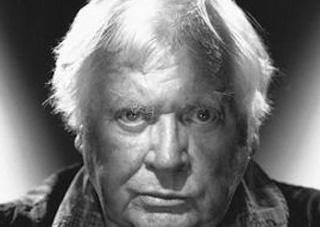
This October, we’re using this feature to recognize and honor some of our favorite horror directors!  Today, we honor the legendary Ken Russell!

4 Shots from 4 Films

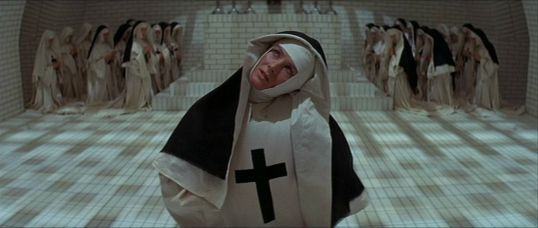
The Devils (1971, dir by Ken Russell)

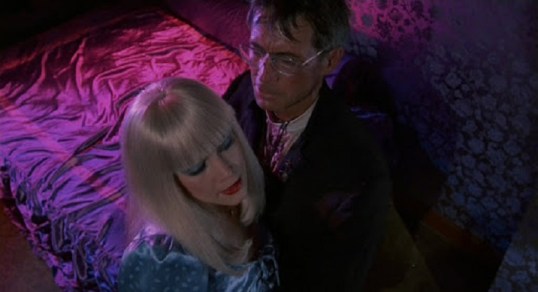
Crimes of Passion (1984, dir by Ken Russell)

Gothic (1986, dir by Ken Russell)

The Lair of the White Worm (1988, dir by Ken Russell)


Horror Film Review: Host (dir by Rob Savage)


Host tells the story of the Zoom meeting from Hell.

Actually, that description is a case of me being a bit too glib.  Though this hour-long film, which can currently be viewed on Shudder, has received a lot of attention for its Zoom call format, there’s a good deal more going on in Host.  It’s the first film of the COVID-19 era and, when this era finally ends, it’s a film that will remind viewers of what it was like to be locked down and afraid that, even behind closed door and with a mask ready to go, there was truly no escape from the virus.

Host is a British film about six friends, one psychic medium, and one very destructive spirit.  Locked down due to COVID, the friends have weekly Zoom meetings.  Some of them drink wine during the meetings.  One of them smokes a good deal of weed.  The important thing that they’re staying in contact and not allowing the separation to drive them apart.  As so many others have done over the course of 2020, they’ve tried to find some sort of normalcy in a situation that is anything but.  Even though the viewer only spends an hour with these characters, it’s impossible not to relate to what they’re going through.

For this week’s meeting, a medium named Seylan (Seylan Baxter) had been hired to lead the friends in an online séance.  Everyone has a different reaction to Seylan, which I liked.  Jemma (Jemma Moore) seems to be struggling not to laugh as Seylan tells everyone to light their candles.  (I related to Jemma, as I probably would have had the same reaction.)  Emma (Emma Louise Webb) and Caroline (Caroline Ward) are both obviously taking the séance a bit more seriously and are concerned about what will happen when they contact the other side.  Haley (Haley Bishop) tries to keep the group focused while Radina (Radina Drandova) and Teddy (Edward Linard) deal with interruptions from their significant others.

Well, needless to say, the séance doesn’t exactly lead to the best of results.  That doesn’t count as a spoiler because first off, this film is on Shudder and secondly, since when has it ever been a good idea to try to contact the dead?  If there’s anything that I’ve learned from the movies, it’s that the dead are extremely touchy and prone to violence.

Host makes great use of its format.  Every time someone drops out of the meeting, we’re left to wonder if they’ve just temporarily lost their connection or if they’ve been attacked by something from beyond.  When we watch the interaction between the six friends — who feel like a group of real friends, though I don’t know how well everyone knew each other before production began — we find ourselves constantly looking over everyone’s shoulder, searching for any sign of an unexpected presence.  Sometimes, we think we see something just to then discover that it was just our overactive imagination.  Sometimes, we think we something and …. well, we actually do.

Host works because it’s a horror film to which everyone can relate.  It gets to a truth that gets beyond the usual horror movie mechanics.  There’s an interesting scene where one of the zoom participants is forced to flee from her flat.  Even with an evil presence chasing her, she still makes sure to mask up before leaving.  If it’s not the demons waiting to get you while you’re in quarantine, it’s the COVID waiting to get you as soon as you exit.  The greatest fear that many people have had over the past few months is that, even if you isolate and wear your mask and stay inside, the disease is still going to somehow get you.  Much like a demon from the other side, the coronavirus can’t be seen but it could be anywhere.  The evil spirit in Host is not named COVID but it might as well be.

Horror on the Lens: Bloodlust! (dir by Ralph Booker)


In this 1961 version of The Most Dangerous Game, two vacationing couples find themselves trapped on a tropical island and hunted by the insane Dr. Albert Balleau (Wilton Graf).  Dr. Balleau loves to hunt people.  Why, you could even say that Dr. Balleau has a …. BLOODLUST!

Anyway, this is an undeniably low-budget film and it’s kind of silly but that’s actually what makes it watchable.  There’s a thousand different versions of The Most Dangerous Game out there but this is the only one to feature Robert Reed, the dad from The Brady Bunch, being hunted through the jungle.  If you’re like me and you think that Mike Brady was an authoritarian fascist, this film is for you.

Enjoy!