6 Shots From 6 Horror Films: 1994 — 1996


4 Or More Shots From 4 Or More Films is just what it says it is, 4 shots from 4 of our favorite films. As opposed to the reviews and recaps that we usually post, 4 Shots From 4 Films lets the visuals do the talking!

This October, I’m going to be doing something a little bit different with my contribution to 4 (or more) Shots From 4 (or more) Films.  I’m going to be taking a little chronological tour of the history of horror cinema, moving from decade to decade.

Today, we take a look at 1994, 1995, and 1996!

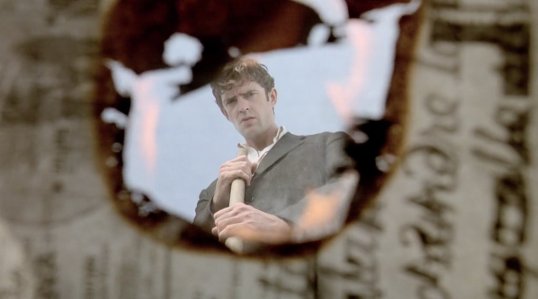
6 Shots From 6 Horror Films: 1994 — 1996

Dellamorte Dellamore (1994, dir by Michele Soavi, DP: Mauro Marchetti)

In The Mouth of Madness (1994, dir by John Carpenter, DP: Gary B. Kibbe)

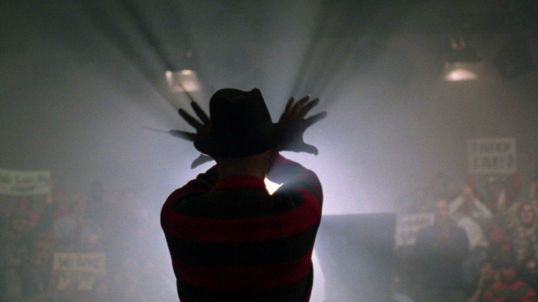
New Nightmare (1994, dir by Wes Craven, DP: Mark Irwin)

Lord of Illusions (1995, dir by Clive Barker, DP: Ronn Schmidt)

The Stendhal Syndrome (1996, dir by Dario Argento, DP: Giuseppe Rotunno)

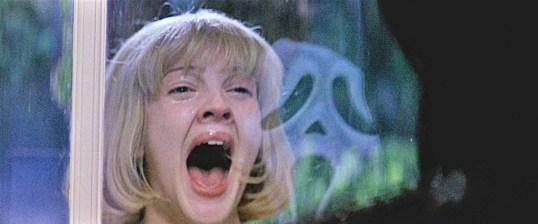
Scream (1996, dir by Wes Craven, DP: Mark Irwin)

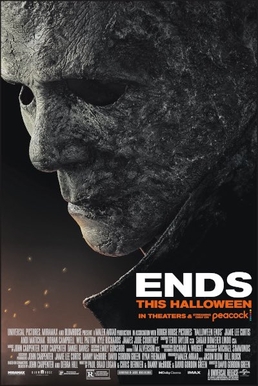
Horror Film Review: Halloween Ends (dir by David Gordon Green)


Halloween Ends?  Not likely.

It is true that, with this movie, David Gordon Green does close out his version of the Halloween trilogy and, for that, we should all be thankful.  For all the critical acclaim that the film received, none of Green’s Halloween films seem destined to stand the test of time.  I like almost all of David Gordon Green’s work except for his Halloween films and, unfortunately, I find his version of Halloween to be so self-important and annoying that it overshadows what I previously liked about his other movies.  (Don’t even get me started on the news that he will next be rebooting The Exorcist.)  Watching the Green Halloween trilogy, you find yourself wondering why Green made the films at all since he seems to consider the whole slasher genre to be beneath him.  Say what you will about Rob Zombie’s Halloween films, Zombie at least loves the horror genre.  Green, like so many Blumhouse filmmakers, only seems to make horror films so that he can remind us that he’s better than them.

But I doubt that this will be the final Halloween film.  It will be the last Halloween film produced under Blumhouse, as the rights to the story and the characters now revert back to Malek Akkad.  And, as long as there is money to be made off of the franchise, there will be new Halloween films.  Someone else will come along and reboot the franchise and hopefully wipe out the Green continuity just as ruthlessly as Green wiped out the previous franchise’s continuity.  In an age of franchises and prequels and cinematic universes, the Halloween franchise is proud to say, “Ha!  You mean you actually kept track of what happened in all the other movies!?  Sucks to be you, dumbass.”

But let’s talk about Halloween Ends.

As you may remember, Halloween Kills ended with Michael killing Laurie Strode’s daughter and Laurie (Jamie Lee Curtis) grabbing a shotgun and heading out to get  revenge.  Well …. ha ha, joke’s on you.  Laurie never got her revenge.  Michael vanished.  Four years later, Laurie has gone from being a badass survivalist to being a cheerful, cookie-baking grandma because she had to let go of the anger.  Laurie spent forty years preparing for Michael to return and then, when Michael does return and brutally murders her daughter, Laurie decides that she has to let go of her anger.  Laurie’s main concern is that the town of Haddonfield is now a traumatized and angry place.  Maybe she can spread positivity by writing a memoir about her life.  Sadly, this means that we also have to listen to passages from Laurie’s memoirs.  Laurie Strode is good at fighting psychotic killers but she sucks as a writer.

Unfortunately, whenever Laurie leaves the house that she shares with her granddaughter, Allyson (Andi Matichak), she runs the risk of being accosted by all of the angry people who all lost a relative or a friend to Michael Myers.  All of them view Laurie as being a reminder of the pain caused by Michael.  They actually do have a point and you have to wonder about Laurie’s claim that she’s staying in Haddonfield to help the town heal.  First off, I don’t know why Laurie would have so much loyalty to what appears to be a fairly generic suburb.  Secondly, the townspeople are so traumatized that is actually seems a bit a selfish for Laurie to remain in Haddonfield and to continually remind everyone of the worst night of their lives.  I mean, Laurie could move.  You know who can’t leave?  The wheelchair-bound woman who was paralyzed while Michael was killing everyone in town because he wanted to find Laurie.

Michael disappeared after killing Laurie’s daughter.  No one knows where Michael is.  Michael is a big and fearsome serial killer who nearly wiped out an entire town and he’s out there somewhere and apparently, no one is looking for him.  That’s what one has to assume because, according to the film, he’s spent the last four years living underneath a bridge.  He’s still wearing his mask.  He looks and acts exactly the same way as he did previously.  He’s still killing people.  He’s just doing it under a bridge.  How, in four yeas time, has it not occurred to anyone in law enforcement to not check under the bridge?  It’s the most obvious hiding spot in town but no one looked under the bridge.  And why, if Michael is obsessed with killing Laurie, has he spent four years under a bridge as opposed to going to Laurie’s house?

Michael is pretty much treated as a supporting character in Halloween Ends.  For that matter, so is Laurie.  The majority of the film centers around a new character named Corey (Rohan Campbell).  Corey was a college student with a bright future until a terrible babysitting accident led to the death of a boy named Jeremy.  Corey was blamed for the death, even though it really wasn’t his fault.  (The scenes with Corey and Jeremy open the film and are so well-handled that it leaves little doubt that Green was far more emotionally invested in Corey’s storyline than he was in any of the Michael/Laurie nonsense.)  Even though Corey was acquitted of manslaughter, he is now the town pariah.  Corey meets and falls in love with Allyson but, unfortunately, the town’s constant taunting and suspicion causes him to snap.  He becomes a disciple and then a rival of Michael’s.

Corey is the type of damaged character who has been at the center of many of David Gordon Green’s non-Halloween films.  One gets the feeling that Green wanted to make a movie about Corey but, since he’s abandoned indie films in order to spend his time screwing up venerable horror franchises, Green and co-writer Danny McBride instead jammed Corey’s story into a Halloween film.  While Corey has the potential to be an interesting character, he doesn’t belong here.  Making Corey into a killer means reducing Michael’s powers.  Michael goes from being a fearsome symbol of pure evil to being some guy in the sewers who gets beaten up and mugged by a nerdy guy who previously couldn’t even stand up to the members of the school band.  It not only goes against the spirit of the original Halloween films but also against everything that was previously established in the Green Halloween films.  I mean, Corey beats up Michael after Corey gets beaten up by a bunch of band kids.  Maybe if the posse in Halloween Kills had been made up of the high school marching band, Laurie’s daughter would still be alive.

It all gets to be a bit annoying.  There are so many little things that don’t make any sense.  My favorite is that the family of that hired Corey to babysit moves out of their house after the death of their son.  Corey continues to break into the now abandoned house, which has sat empty for four years.  And yet, the abandoned house is remarkably well taken care of.  For some reason, the family took all of their furniture but left behind a grand piano.  Why wouldn’t they take the piano with them?  In the drawing room, there’s a book shelf that is empty except for three books.  Why would the family leave those three books behind?  When Green rebooted the Halloween franchise, he ignored all of the sequels because, according to him, the sequels weren’t any good and didn’t make sense.  But Halloween Ends feels as rushed and nonsensical as any of the films that featured Danielle Harris as Laurie’s daughter.

The film ends with the community of Haddonfield coming together once again.  It’s a scene that I wish I could describe but to do so would mean spoiling the end of the movie.  Let’s just say that it’s incredibly dumb and it almost feels like a parody of the previous Green films.  One of the worst thing about the Green films is the insistence of presenting Haddonfield as being some sort of iconic location as opposed to just being a generic anytown USA.  The whole reason why the original Halloween films were so effective was because Haddonfield could have been anywhere.  Green tries to turn Haddonfield into another Twin Peaks and it’s another sign that he never really understood what made John Carpenter’s original film work in the first place.  Ironically, a lot of what happens during the final moments of Halloween Ends would make more sense if Michael was Laurie’s brother but, again, the Green films did away with all that.

Halloween Ends is not necessarily the worst film of 2022.  As a director, Green is still capable of coming up with an effective shot or two.  But, considering the hype that accompanied it, it is one of the most disappointing.  And it also has the most unintentionally funny ending of any film you’re likely to see in 2022.  Whenever I feel down, I just think about that solemn procession to the auto yard and it cheers me right up.

As I said at the start of this review, Halloween will never end as long as there is money to be made.  So, in another few years, we’ll get another reboot and, once again, we’ll discover with Laurie, Tommy Doyle, Linsdey, and Sheriff Brackett have been doing since the night Michael came home.  My idea for a reboot is that they should make Michael and Laurie into siblings.  That would be interesting.
Horror on the Lens: Dr. Jekyll and Mr. Hyde (dir by John S. Robertson)


394px-Dr_Jekyll_and_Mr_Hyde_1920_poster

Ever since the birth of film, Robert Louis Stevenson’s Dr. Jekyll and Mr. Hyde has been a popular subject for adaptation.  Not only does the classic story of a good doctor who unleashes his evil instinct via potion serve as a potent metaphor for everything from sexual repression to drug addiction, but the dual role of Dr. Jekyll and Mr. Hyde has provides an excellent opportunity for an actor to show off.

The first film adaptation of Dr. Jekyll and Mr. Hyde is believed to have been made in 1908.  Two more version followed in 1912 and 1913 and then, suddenly, 1920 saw three different film versions.

The best known of the 1920 version is our film for today.  This version is best remembered for John Barrymore’s powerful performance in the title role but it also holds up remarkably well as a work of cinematic horror.

October Positivity: Power of the Air (dir by Dave Christiano)


The 2018 film, Power of the Air, tells the story of David Williams (Nicholas X. Parsons).  David thinks that he can be a committed Christian despite the fact that he spends every weekend at the movies.  In fact, he and his friends have a streak going.  For over 40 weekends, they have gone to the movies and David has never once worried about all of the violence, nudity, and adult language that he sees.

Some might say that this is because David is an adult who has found a way to relax after work.  However, a Nigerian missionary named Emeka Odum (played — quite well, it must be said — by Veryl Jones) says that it’s because David is using the movie theater as a substitute for church.  As Odum explains it, the movie theater has become America’s new house of worship and, as a result, America is now a second-rate nation that has lost its way.  Why, in three years, America might even have a president who obviously doesn’t know where he is half the time.  And it’s all Hollywood’s fault!  Well, actually, the movie suggests that it’s really your fault for going to the movies.

If that sounds like an old-fashioned message, that’s because Power of the Air is a very old-fashioned movie.  That is perhaps not surprising, as this is a Dave Christiano production, but it still feels strange to hear David — the character and not the director, though one gets the feeling that it’s not a coincidence that they share the same name — announce that he can no longer watch any movies that feature people cursing.  I mean, avoiding a movie because of violence makes sense to me.  Avoiding a movie because of nudity or political messaging is also understandable.  Everyone has different things that they’re looking for.  But avoiding a movie because of cursing is basically just another way of announcing that you’re never going to watch another movie.  I mean, I’ve known plenty of Christians who do curse.  At the same time, I do have to admit that I hardly ever curse but that’s just because I don’t want to sound like everyone else.  I gave up cursing for Lent and my sisters all accused me of cheating because, according to them, it’s not really a sacrifice if you give up something that you don’t actually do.

Anyway, David wants to use mass media to spread a good Christian message so he comes up with the idea of broadcasting a commercial on all fifteen of his city’s radio stations at the exact same time.  As he sees it, this will mean that everyone will hear the commercial whether they try to change the station or not.  (Or, you know, they might just turn off their radio.  Or they might turn down the volume.  Or they might resent having David’s message forced upon them and respond by going to a Marvel film.)  Unfortunately, Charlie (Patty Duke), the manager of the biggest station in town, doesn’t want to run a religious commercial.  Can David change her mind?

Of course, I think the real problem with David’s plan is that the days of people spending all day listening to the local radio stations are pretty much over.  That’s true today and it was true when this film was made in 2018.  There are now so many options out there and so many other ways to keep oneself entertained during the day that the idea of everyone in the city listening to local AM radio seems a bit naïve.  David really should have started a podcast or something.

Anyway, Power of the Air is a fairly slow-moving film and it’s one of those films that will mostly appeal to people who already agree with its message.  The film is probably most interesting as Dave Christiano’s feature-length justification for making the type of movies that he does.  The main message seems to be that if only more people watched Christiano’s films, then David wouldn’t have had to spend all that money on those radio ads.

The TSL’s Horror Grindhouse: The First Power (dir by Robert Reskinoff)


In this 1990 horror film, Lou Diamond Phillips plays Russell Logan, a Los Angeles police detective who specializes in capturing and sometimes killing serial killers.  (“So far,” a news reporter breathlessly tells us, “Detective Logan has captured or killed three serial killers!”)  His latest triumph is the capture of Patrick Channing (Jeff Kober), also known as the Pentagram Killer because he carves a pentagram on his victims.

Logan captures Channing thanks to a tip from a psychic named Tess (Tracy Griffith).  Tess specifically made Logan promise her that he wouldn’t push for Channing to get the death penalty.  However, after Logan captures him, he goes back on his word and Channing is sentenced to die in the gas chamber.  To be honest, I wasn’t aware that detectives had the power to decide whether or not to go for the death penalty when it comes to prosecuting murder cases.  As far as I’ve known, that’s always been the job of the district attorney’s office.  Maybe they do things differently out in California….

Anyway, Channing smiles when he’s sentenced to death and then he smiles again when he’s executed.  Logan shrugs all of that off but suddenly, the pentagram murders start up again.  The murderer is killing people in the exact same way that Channing did and he also appears to be targeting the people who were involved in Channing’s capture.  Meanwhile, Tess is running around angry because she specifically told Logan not to allow Channing to be executed.

Hmmmm …. have you figured out what’s going on, yet?

Of course you have!  That’s because you’ve seen a horror movie before.  From the minute that Channing was sentenced to die, you probably knew that Channing would eventually come back from the dead and start murdering people all over again.  It turns out that, by executing Channing, the state of California has granted him the first power, i.e. resurrection.  By committing more murders, Channing is hoping to unlock all of the other powers.  Those powers include the power to appear and disappear at will, possess other people, jump off of roof tops, and mockingly laugh at anyone who tries to stop him.

Apparently, Detective Logan is not a fan of horror movies because it takes him a while to figure all of this out.  (We should keep in mind that he’s a cop so his job is to be skeptical of claims of people returning from the dead.)  But once he starts hearing Channing’s disembodied voice and getting attacked by possessed priests and homeless women, he really has no other option but to accept the truth and work with Tess to try to end Channing’s reign of terror.

The First Power is one of those horror films that’s extremely predictable but effective nonetheless.  Lou Diamond Phillips manages to maintain a straight face, regardless of how outlandish this film gets and Jeff Kober seems to be having a blast as the flamboyantly evil Patrick Channing.  Channing jumps off of rooftops and through windows with a graceful aplomb and the film actually has some fun with the idea of Channing skipping from body to body.  The First Power is often dumb but always entertaining.

Horror Scenes that I Love: Pennywise Visits The Library In It


Admittedly, this scene from the 1990 version of It is a bit more goofy than scary but still, I love Tim Curry’s performance as Pennywise the Clown.  When the first part of the latest version of It came out, it was kind of fashionable to dismiss the 1990 version.  But then the second movie came out and everyone was like, “We waited a year for this!?  Give us back our Tim Curry!”

Anyway, in this scene, Pennywise shows at the Derry Public Library and offers Richie (Harry Anderson) some balloons.

International Horror Film Review: En el Pozo (dir by Bernardo and Rafael Antonaccio)


In this 2019 film from Uruguay, four people spend the day at a quarry.  Needless to say, things don’t go well.

Alicia (Paula Silva) grew up in the small town of Suarez but she has since moved to the big city.  When she returns to her home to visit her parents, she brings along her new boyfriend.  Bruno (Augusto Gordillo) is well-educated and apparently wealthy.  He’s not a fan of hunting.  He finds fishing to be barbaric.  He doesn’t think much of Alicia’s small town and it’s obvious, from the first minute that we see him, that he is eager to get back to the city.  However, Alicia wants to spend the day at the water-filled quarry (“It’s as close to the beach as we get,” someone explains) with two of her old friends, Tincho (Rafael Beltran) and Tola (Luis Pazos).  Tincho is Alicia’s ex-boyfriend and is obviously still in love with her.  He gets the day off to an awkward start by telling her that he’s ready to abandon Suarez and join her in the city.  Tola, meanwhile, is a cheerful joker.  While Bruno and Tincho spend their timed trying to one-up each other, Tola is content to just smoke weed and drink beer.  While Alicia tries to keep the peace, the tension between Tincho and Bruno continues to grow.

From the start, it’s obvious that at least one member of the group is going to eventually end up trying to kill the others.  It’s just a question of who is going to snap first.  The film tells its story with a deliberate pace, capturing each moment of growing tension.  When Bruno kicks away Tincho’s soccer ball, we wonder, “Is this the moment that’s going drive Tincho to murder?”  When Tincho taunts Bruno into risking serious injury by diving into the quarry, we again wonder if this is the moment that Bruno is going to finally lose it.  Even Tola occasionally seems somewhat suspicious.  I mean, no one can be that laid back!  As women have done since the beginning of time, Alicia tries to keep the men from killing each other in their attempts to impress her with their displays of machismo.  It takes a while but the inevitable violence does arrive and I have to say that I was actually a little surprised to see who instigated it.

En El Pozo (the name translates to In The Quarry) is a well-acted and tense film.  One thing that works to the film’s advantage is that no one in the film is one-dimensional.  None of them are perfect but none of them are totally evil.  Bruno is correct when he says that Tincho is trying to bait him but, at the same time, Bruno is also a bit condescending to both Tincho and Alicia.  Tincho may be an immature jerk but his feelings for Alicia are real.  And while I sympathized and related to Alicia, I did have to wonder why she thought it would be a good idea to have her new boyfriend hang out with her ex-boyfriend in an isolated quarry.  The violence erupts suddenly and the events that happen afterwards are as much a result of panic as they are of maliciousness.  En El Pozo is well-acted and well-directed, with the atmosphere becoming progressively more claustrophobic as the tensions continue to rise.  It all leads to appropriately dark and downbeat ending.  Así es la vida.

8 Shots From 8 Horror Films: 1990 — 1993


4 Or More Shots From 4 Or More Films is just what it says it is, 4 shots from 4 of our favorite films. As opposed to the reviews and recaps that we usually post, 4 Shots From 4 Films lets the visuals do the talking!

This October, I’m going to be doing something a little bit different with my contribution to 4 (or more) Shots From 4 (or more) Films.  I’m going to be taking a little chronological tour of the history of horror cinema, moving from decade to decade.

Today, we take a look at 1990, 1991, 1992, and 1993!

8 Shots From 8 Horror Films: 1990 — 1993

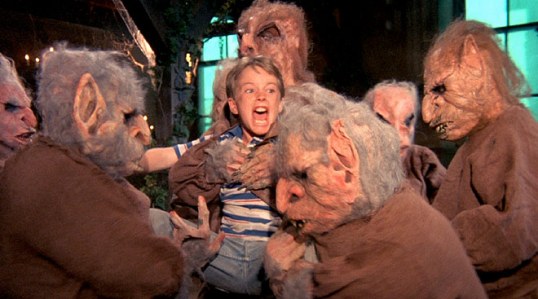
Troll 2 (1990, dir by Claudio Fragasso, DP: Giancarlo Ferrando)

It (1990, dir by Tommy Lee Wallace, DP: Richard Lieterman)

Frankenstein Unbound (1990, dir by Roger Corman, DP: Armando Nannuzzi)

The People Under The Stairs (1991, dir by Wes Craven, DP: Sandi Sissel)

Twin Peaks: Fire Walk With Me (1992, dir by David Lynch, DP: Ron Garcia)

Bram Stoker’s Dracula (1992, dir by Francis Ford Coppola, DP: Michael Ballhaus)

Witchboard 2: The Devil’s Doorway (1993, dir by Kevin S. Tenney, DP: David Lewis)

Cronos (1993, dir by Guillermo Del Toro, DP: Guillermo Navarro)

Horror Film Review: The Watcher (dir by Joe Charbanic)


Released in 2000, The Watcher is one of those movies where a burned out FBI Agent finds himself locked in a game of cat-and-mouse with an overly verbose serial killer. The FBI agent doesn’t want to get involved and is struggling with a drug addiction. (It’s always either drugs or a wife who doesn’t feel like she knows him anymore.) The serial killer is surprisingly intelligent and well-spoken, despite the fact that most real-life serial killers are only a step or two away from blowing themselves up in a meth lab. Movies love the idea of a witty sociopath but it rarely happens in real life.

Anyway, you get the point. Probably just from reading the previous paragraph, you already know everything that happens in The Watcher. There’s not a single moment in this movie that will take you by surprise. In fact, this movie is so full of clichés that, when I watched it, I actually got mad at the film’s characters for not being able to figure out that they were all just characters in a predictable serial killer film. Seriously, if I woke up and discovered that I was only a character in a movie, I imagine that I would devote at least a few minutes to having an existential crisis. There is also a lot of random slow motion in this movie. The slow motion doesn’t create suspense or generate thrills or anything like that. It’s just kind of there.

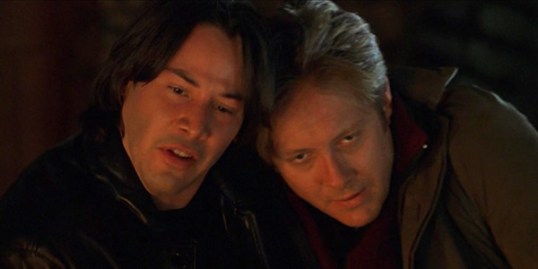
Really, the only interesting thing about The Watcher is the cast. For a movie like this, it has a surprisingly good cast. James Spader plays the FBI agent. Marisa Tomei plays the agent’s therapist. (She’s also the only female character to have more than 10 lines in the entire movie. To be honest, it’s a role that anyone could have played but Tomei does her best with what she’s been given.) The serial killer, who is named David Allen Griffen because all serial killers have three names, is played by Keanu Reeves.

Keanu as a serial killer is strange casting. For the most part, Keanu’s appeal has always been that he comes across like someone who, to quote Mother Bates, wouldn’t hurt a fly. Keanu flashes his charming smile and speaks politely with his future victims and, at no point, does he make much of an effort to be a believable killer. Some of that may be because Keanu apparently didn’t want to do the film. Keanu has always said that one of his assistants forged his name on a contract, legally obligating Keanu to appear in this movie. That’s a strange story. When you hear it, you think to yourself, “This the type of thing that could only happen to Keanu Reeves.”

For more than Keanu, James Spader is convincing in his role. Spader spends the entire movie looking like 1) he’s going through massive drug withdrawal and 2) like he’s on the verge of losing his mind. So much of acting is expressed through the eyes and, throughout this movie, Spader’s eyes are bloodshot and exhausted. It’s a superior piece of acting and it’s hard not to feel that it’s probably more than this movie deserved.

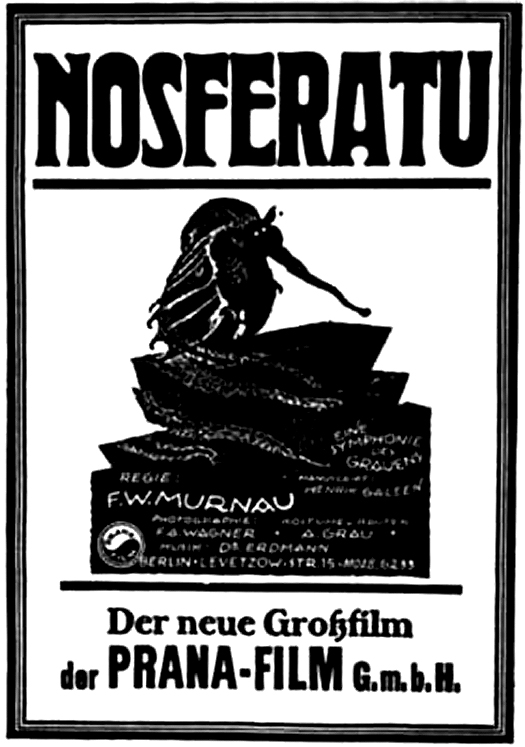
Horror on the Lens: Nosferatu (dir by F.W. Murnau)


Today’s Horror on the Lens is a classic film that really needs no introduction!  Released in 1922, the German silent film Nosferatu remains one of the greatest vampire films ever made.  It’s a film that we share every October and I’m happy to do so again this year!

Enjoy!