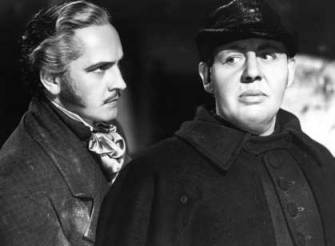
Film Review: Les Miserables (dir. by Richard Boleslawski)


Every year, I set a few goals for myself.  In 2012, for instance, my goal was to stop worrying so much about achieving unrealistic goals.  For 2013, my goal is to post a film review a day, alternating between reviews of films that have been nominated for Academy Awards and films that most assuredly were not.

With that in mind, I’d like to get things started by taking a look at Les Miserables.  Now, I’m not talking about the Tom Hooper-directed musical extravaganza that’s currently playing at a theater near you.  Instead, I’m talking about the Les Miserables that was directed by Richard Boleslawski and which was nominated for best picture of 1935.  (It lost to another literary adaptation that featured Charles Laughton as a classic villain, Mutiny On The Bounty.)  As opposed to Hooper’s film, this version of Les Miserables is not based on a Broadway musical.  Instead, it’s a condensed version of Victor Hugo’s original novel.

As opposed to the novel, Les Miserables takes a straight-forward chronological approach to telling the story of Jean Valjean.  We start with Valjean (played here by Fredric March) being sentenced to prison and then follow him through his experiences in prison.  We watch as the embittered Valjean first meets the kindly bishop (played here by Cedric Hardwicke) who turns his life around.  Valjean becomes both a mayor and the protector of the young Cosette, who eventually ends up falling in love with the young revolutionary Marius.  Thoughout all of this, Valjean is pursued by the obsessive Inspector Javert (Charles Laughton).

As a film, Les Miserables is more faithful to the spirit of Hugo’s original novel than to the exact details.  For instance, in this film, Javert first encounters Valjean while the latter is in prison.  While this is clearly different from the novel, it works perfectly from a cinematic point of view.  As well, the film jettisons many of the book’s longer digressions and instead, it focuses on the characters of Valjean and Javert.  As such, characters like Cosette and Marius are only important (and considered) in how they relate to the two main characters.  Fortunately, Valjean and Javert are played by two of the best actors to ever appear on screen.

While Charles Laughton, in the role of Javert, gets to the give the showier performance, the film is rightfully dominated by Fredric March’s quietly determined performance as Jean Valjean.  Valjean is a truly complex character who, over the course of the film, goes from being bitter and angry to kindly and strong and March perfectly captures each side of Valjean’s personality.  As an actor, Fredric March is not as well-remembered as some of his contemporaries (like Charles Laughton, for instance).  However, in this film, Fredric March proves himself to be the perfect Jean Valjean.  He is the Jean Valjean that all other Valjeans must be judged against.

While director Richard Boleslaswki is hardly a household name (I have to admit that I had never heard of him before I saw this film), his work on Les Miserables is impressive.  Interestingly, he directs the film almost as if it was a combination of a Warner Bros. gangster film and a Universal monster film.  (It’s easy to imagine some alternative universe where his version of Les Miserables starred Edward G. Robinson as Valjean and Boris Karloff as Javert.)  He’s at his strongest is the dream-like sequence where Valjean carries the wounded Marius through the sewers of Paris.

While Les Miserables may not be a perfect film, it is the perfect introduction to Hugo’s novel. Incidentally, the most faithful cinematic adaptation of Les Miserables actually came out a year before the Boleslawski version.  It was a French film that had a running time of five hours.  It occasionally turns up on TCM and, like the 1935 version, it’s well-worth watching.

Lisa Marie’s Favorite Film of 2012: Anna Karenina (dir by Joe Wright)


For the most part, 2012 was a bland year as far as cinema is concerned.  The most acclaimed films of the year (Argo and Lincoln being two obvious examples) were well-made and often entertaining but they were hardly revolutionary.  2012 was the year that the establishment told us what we should enjoy and, for the most part, film critics slavishly hopped on the bandwagon.  As you can probably guess, 2012 was not my favorite year as far as the movies are concerned.  That said, there were a few films that gave me hope.  As the year ends, despite being underwhelmed by most of the films that were released, there are a few that I truly did love.

My favorite film of 2011 was a criminally underappreciated film from director Joe Wright.  That name of that film was Hanna.  My favorite film of 2012 is another criminally underappreciated film from director Joe Wright.  The name of this film?  Anna Karenina.*

History has a way of repeating itself.

Anna Karenina is, of course, based on the classic novel by Leo Tolstoy.  Anna Karenina (played, quite brilliantly, by Kiera Knightley) is the wife of the noble (but somewhat boring and judgmental) Russian statesman Alex Karenin (Jude Law, who is also quite brilliant and rather tragic in a role that, in lesser hands, could have become a stock villain).  When Anna’s good-for-nothing brother (played in a wonderfully comedic performance by Matthew MacFayden) is caught cheating on his wife, Anna leaves her safe home in St. Petersburg and travels to Moscow where she helps to save her brother’s marriage and meets Count Vronsky (Aaron Taylor-Johnson).

Among the members of the Russian high society, it is well-known that Vronsky is pursuing the hand of the young and beautiful Kitty (Alicia Vikander, who generates a lot of sympathy for a character who, at the start of the film, could easily have been portrayed as just a spoiled brat).  However, at the ball where it is widely expected that Vronsky will ask Kitty to marry him, Vronsky creates a scandal by dancing with Anna instead.

Vronsky loses interest in Kitty and instead, he now obsessively pursues the married Anna.  Though Anna is resistant at first, she finally gives in and embarks on an adulterous affair with Vronsky, resulting in scandal and tragedy.

Again, history repeats itself.  The story of Anna Karenina is a familiar one that has been told repeatedly over the ages.  That’s one reason why Tolstoy’s novel has remained one of the greatest novels ever written and why it has been adapted into so many other mediums.  Director Joe Wright begins Anna Karenina with the assumption that the majority of the people in his audience already know the story of Anna’s ill-fated love affair with Vronsky.  As such, he puts less emphasis on the story itself and more on how the story is told.

Anna Karenina is a masterpiece of style.  When the film opens, Wright has his actors literally performing on a stage.  When Anna travels to Moscow, a miniature train is seen rolling across the stage.  When the scene changes from a factory to a high society ball, the factory workers walk backstage, change costumes, and then step back onstage, suddenly transformed into noblemen.  At one point, we even see a janitor nonchalantly cleaning up the now-empty theater while the story continues to play out on the stage in front of him.  When Anna and Vronsky dance for the first time, the other actors freeze in place and a spotlight shines down on the dancing couple.  It’s an amazingly romantic moment, one to which anyone who has ever been infatuated will be able to relate.  Finally, a door opens onstage and the characters (and the viewing audience) are able to step out into the “real” world but, throughout the film, we occasionally return to that stage.  While several critics have criticized this aspect of the film, I thought it was brilliant.  By literally putting his actors on stage, Wright both acknowledges that this is a story that may be familiar but can be interpreted in many different ways and he also drives home the point that, ultimately, we are all just actors on a stage, being observed and judged by a society that is often hostile to any sign of individual desire or unpredictable  emotion.

Needless to say, the film’s extreme stylization is not for everyone.  That’s actually one of the reasons that I love this version of Anna Karenina so much.  In a year that was almost excessively safe, Joe Wright took a risk and, as a result, encouraged us to look at a familiar story in a different way.  For that reason, Anna Karenina is my favorite film of 2012.

—-

* For the record, my second favorite film of 2012 was The Cabin In The Woods.

A Blast From The Past: Dating (1970)


As I may have mentioned a few times in the past, I am secretly a huge history nerd.  I am fascinated by the past and I’ve discovered that one of the best ways to learn about the past is to watch movies that were specifically made to be shown to the children and teenagers of the past.  I’m talking, of course, about educational films.

Take, for instance, this oddly dark little gem from 1970: Dating.

Dating may, on the surface, appear to just be an educational film about teen dating but I think it’s actually a portrait of generational ennui, envy, and repression.  It also features some vintage 70s fashion, dancing, and perhaps the most dreary party in the history of dreary parties.  If nothing else, this film shows that while the customs may change, the drama remains the same.  

Before there was Degrassi, there was Dating!

I Saw The Hobbit


The_Hobbit-_An_Unexpected_Journey_74

Full disclosure (this paragraph is something of an insane rant and has nothing to do with the Hobbit, so feel free to skip it): I am in the incredibly tiny minority who was not overly impressed with the Lord of the Rings films. While I thought that they did an exemplary job of capturing the setting, sights and sounds of Middle Earth, and even the grand scope of Tolkien’s masterwork, I found some of the inexplicable changes to the core story that started appearing in The Two Towers (why is Faramir a dick? The whole point of his character is that he is unlike Boromir in aspect. He is something greater. Like Aragorn. He’s a reason to hope. Why does Faramir take Frodo and Sam to Osgiliath? So we can see it under siege? Probably. Sam then somehow fends off a Nazgul on winged steed by tackling Frodo and crying out. Hmmmmm…swiss cheese. If Aragorn’s army of ghosts can simply sweep across the field and massacre Sauron’s entire army without apparent effort or effect… and Aragorn knows Sauron has another, bigger army… why doesn’t he just go ahead and spend the ten minutes to kill that army too? I’m sure the spirits of the dead would be willing to stay off their eternal rest for ten minutes. Especially because they’re under you control, Aragorn. King of the Dummies.) In addition, Return of the King in particular is much too long. Since the Hobbit has now been split into a stunning three films (!) … in retrospect it seems like Return of the King could definitely have occupied two. Particularly since some of the action elements from The Two Towers were woven into it and… okay.

Moving on.

I saw The Hobbit! Against my wishes, and against my better judgment, I went on a double date sort of affair in the bitter cold to take in this pre-coronated motion picture just days after its release. Fearing the worst, I brought along a large flask filled to the brim with Kraken spiced rum and decided I wouldn’t be shy about pulling off of it. I didn’t really end up needing to, much to my surprise… because here’s the thing about The Hobbit: I liked it. Sort of. Mostly. Oh, more full disclosure: I saw the film in two dimensions at the standard twenty-four frames per second. We didn’t feel like driving to a fancy theater.

As I’d come to expect from Jackson’s Lord of the Rings films, the production here is outstanding. From the very instant The Hobbit begins, we’re drawn back into the realm of Middle Earth. Dwarves, Elves, and now… a dragon. Of course, one of the major reveals that Jackson is keeping for his second film is Smaug, so we don’t see more than the ophoid slit of his eye in what really amounts to an extended intro that describes the history of Erebor, its fall, and the escape of a few dwarves, including Thorin Oakenshield (Richard Armitage). Once we’re all caught up, we return to Hobbiton, and meet Bilbo Baggins (Martin Freeman). Freeman is excellent as the earnest, earthy Bilbo, who is friendly and considerate, but really doesn’t feel like he wants to be involved in an adventure at all … at first. It’s in this first section at Bilbo’s hobbit hole that, in my estimation, the film shines most. The dwarves of Thorin’s company arrive in a steady stream, along with the wizard Gandalf (Ian McKellen), and treat Bilbo to a night of drinking and feasting… and reminiscing about their lost home, the twilight of the dwarven people, and their enmity with the goblins of the mountains. The music, the mood, the performances, are superb, and by morning… I was as ready as Bilbo was to follow Thorin on his damn fool idealistic crusdade.

The film’s tone throughout mostly remains what I feel to be appropriate to the story being told. The Hobbit is a much more lighthearted affair than the ponderous material of The Lord of the Rings. Instead of twisted Uruks made by the unholy marriage of man and goblin, we have goblins that do a lot of singing and arguing among themselves, and who ultimately don’t seem particularly organized or threatening. Perhaps without the all-possessing will of Sauron behind them, goblins are an essentially pathetic people. There are stupid trolls, dumb goblins, and running axe and sword fights to spare, including some invented and extended action sequences which are a necessity in any three hour long fantasy film epic. The problems that the Hobbit suffers, and they are relatively few but fairly damning, universally occur when it drifts away from this lighthearted tone and fast pacing.

Without going into too much detail, let me just say that Jackson crams the final meeting of the White Council (if you don’t know what that is, believe me, there is not time for a lengthy explanation, but check the footnote at the bottom for the cliff notes version) as a scene in the middle of the film that, frankly, goes on forever. Christopher Lee and Cate Blanchette reprise their roles (Saruman and Lady Galadriel, respectively) from the Lord of the Rings films and join Elrond (Hugo Weaving) and Gandalf in some lengthy pontificating about the threat posed by The Necromancer, the evil force which is corrupting Mirkwood from within. Because this film doesn’t ever reach Mirkwood, we haven’t seen enough of Mirkwood yet to really understand its corruption, and while the White Council’s final meeting does happen concurrently with the events of the Hobbit, it has essentially nothing to do with that story, this scene is dead weight. It absolutely kills the momentum of the film. Worse yet? It’s book-ended by two long sequences where Bilbo Baggins has, essentially, no lines at all and spends huge periods of time off the screen. Now, I may not be a famous movie director, but I have watched a lot of movies in my life… and I can tell you that there’s a problem if your character driven fantasy story about a single unlikely hero and his friends excludes that unlikely hero from a third of its run time. It’s triply aggravating because Freeman is so magnetic as Bilbo when he’s on-screen.

Because of this real problem in the mid-point of the film, the Hobbit very much loses its way for a while, even if you happen to have read the novel and already know how the story is going to play out. This was a real disappointment for me, as I actually thought one of the few genuinely great bits of the script and directing in the Lords of the Rings trilogies was editing action and plot points smartly to keep the films moving. That doesn’t happen here. The setting and music eventually drug me back in (also, the riddle-telling sequence with Gollum (a returning Andy Serkis) is delightful. It has a lot to do with Martin Freeman. I might have a little man crush.) and I was with the movie again by the finale, but I really did feel disappointed when I walked out of the theater, and that sucked after such a promising start.

Anyway, if you’re looking for a recommendation, see The Hobbit! I can’t speak as to the technology additives I’m afraid, but the film itself is enjoyable enough. Just don’t expect a masterpiece, because this film, while good… falls well short of great.

Tolkien Nerd Footnote: The White Council – This is a group comprised of the wizards (Saruman, Gandalf, Radagast the Brown, and two Blue Wizards who are MIA) and the leaders of the Elves (Elrond, Galadriel, and Ciridan), though as Gandalf bears Ciridan’s ring and he spends all his time building escape ships, he doesn’t show up for this dance. Basically, the White Council was the body of good powers in the world that kept things peaceful and friendly during Sauron’s long slumber. They’re mentioned only in passing except during The Fellowship of the Ring when Gandalf tells the story that is recounted for us live in this film. Their last act was to put the Necromancer out of Mirkwood, after Gandalf discovered that the Necromancer was, in all likelihood, Sauron garbed in a lesser form to pull the proverbial wool over the council’s eyes.

Film Review: Hitchcock (dir by Sacha Gervasi)


Alfred Hitchcock is one of those iconic cultural figures who will never go out of style.  Though he’s been dead longer than I’ve been alive, he’s still one of my favorite directors.  If I see a Hitchcock film listed in the TV schedule, I can guarantee that I will find the time to watch it.  Whether its The 39 Steps, Rebecca, Strangers On A Train, Topaz, or Frenzy, if it’s Hitchcock, I’m there. And I’m not alone as far as this is concerned.  If Hitchcock hadn’t made The Birds, James Nguyen would never have made Birdemic.  If Hitchcock hadn’t made Psycho, hundreds of low-budget horror films would never have had a chance to be distributed on DVD by Anchor Bay.

While it may have been Vertigo that was recently named the best film of all time by the Sight and Sound Poll, Psycho remains Hitchcock’s best known and most popular film.  Psycho is certainly my favorite Hitchcock film, which is why I was certainly curious when I first heard about Hitchcock, a new movie that claims to tell the true story behind the making of Psycho.

Hitchcock opens with 60 year-old Alfred Hitchcock (Anthony Hopkins) trying to figure out how to follow up the success of North By Northwest.  Hitchcock settles on adapting a little-regarded pulp novel that’s based on the true life crimes of serial killer Ed Gein.  Over the objections of the censors, the studio, and all of his associates, Hitchcock makes Psycho his next film.  At the same time, his wife Alma (Helen Mirren) deals with living in the shadow of her famous husband.  While Hitchcock devotes all of his time to his film and obsessing over his leading actresses, Alma find herself tempted by a slick screenwriter named Whitfield Cook (Danny Huston).

(Has anyone good ever been named Whitfield Cook?)

As a film, Hitchcock is likable but shallow.  Anthony Hopkins and Helen Mirren have great chemistry and they’re a lot of fun to watch but you never truly believe that you’re watching the true story of the making of a movie that changed cinematic history.  Whenever Hitchcock threatens to become truly insightful about the artistic process, the story abruptly cuts away to another scene of Alma writing on the beach with Whitfield Cook.  It doesn’t help that Danny Huston plays Cook as such an obvious cad that it actually diminishes Alma as character when she doesn’t immediately see through him.

Similarly, in the role of Alfred Hitchcock, Anthony Hopkins gives a performance that is very likable and quite watchable but, in the end, still feels rather shallow.  His performance feels like a good and entertaining impersonation but it never quite feels real.  The closest that the film (and Hopkins) comes to suggesting any of Hitchcock’s inner demons is when he imagines having a conversation with Ed Gein (played by Michael Wincott).  These scenes feel terribly out-of-place when compared to the rest of the film.

The actresses playing the women in Hitchcock’s life fare a little bit better.  Jessica Biel and Scarlett Johansson are well-cast as Vera Miles and Janet Leigh, respectively.  Helen Mirren is widely expected to earn an Academy Award nomination for her performance as Alma and she does have several strong scenes in Hitchcock.  As I watched the film, I certainly could relate to Alma’s desire to be taken seriously as an individual and her frustration with being defined solely by the vows of marriage.  It’s a feeling that Mirren captures perfectly.

In the end, Mirren aside, Hitchcock is entertaining but forgettable.

Scenes That I Love: Birdemic


There’s been a lot of talk about the end of the world recently.  In fact, a lot of people seem to be convinced that the world is going to end sometime later today. In the face of such negativity, it seems to me that we need to celebrate movies that remind us why we even bother to wake up in the morning and leave our homes.

One such movie is the 2008 epic Birdemic: Shock and Terror.  While the film itself deals with what happens when a bunch of birds go on a rampage, it still finds the time to highlight some of the good things about life.

Today, I want to highlight two scenes that I love from Birdemic.

In this first one, we’re reminded that, even in bad economic times, the corporate life can be a rewarding one.

This second scene celebrates the mystery of love and the excitement of flirtation.

And, just because I love you, here’s a bonus scene from a totally unrelated movie!

(That movie, by the way, was The Room.)

This Holiday Season, Giovanni Lombardo Radice Needs Your Help!


If you’re a fan of Italian horror, then you know who Giovanni Lombardo Radice is.  He danced for you in The House On The Edge of the Park.  He came back from the dead and helped to destroy the town of Dunwich in City of the Living Dead.  He went on an eating binge at a movie theater in Cannibal Apocalypse.  He’s appeared in three films directed by Michele Soavi, he recorded one of the greatest DVD commentaries ever for Cannibal Ferox, and he was a contributor to one of the most important books about Italian horror cinema, Eaten Alive.

However, there’s more to Giovanni Lombardo Radice than just a resume of showy roles in bloody movies.  He’s also a director, a writer, and an animal lover.  As anyone who follows him on Facebook knows, he can discuss the intricacies of William Shakespeare with the best of them.  He has appeared in films directed by people like Martin Scorsese and he is one of Quentin Tarantino’s favorite actors.

Most importantly, while he has always claimed to be somewhat bewildered by the popularity of some of his films, Giovanni Lombardo Radice is an actor who has always been kind and gracious to his fans.   I’ve met several Italian horror fans who have told me about how excited they were to get a reply to a question from Giovanni or how touched they were to get a gracious message from him.  Myself, I can still remember how excited I was when Giovanni responded to a rather odd dream that I had posted in my online dream journal.  (The dream and his response can be read here and here.)

Recently, Giovanni posted the following on his Facebook page:

MY dog Tommy has hernia and most probably must have surgery. Just what I needed….if you read that someone robbed a bank to cure his dog it will be me.

Anybody who is lucky enough to be friends with Giovanni on Facebook knows how much he loves animals and how much he loves Tommy.  Speaking as someone who spends 8 hours a day looking at cute cat pictures, my heart went out to him.

Earlier today, Giovanni announced (again on Facebook) that Tommy’s operation had been a success!  However, Giovanni is also flat broke.  People tend to assume that a cult film star like Giovanni Lombardo Radice must be rich but that’s rarely the case.  It’s been over 30 years since Giovanni made (and was paid for) the films that most people know him from and films like The House On The Edge of the Park and Cannibal Apocalypse didn’t become cult films until several years after they were first released.  When someone buys a DVD or a Blu-ray of a film like The House On The Edge of the Park, the money goes to the film’s distributor, not to the actors who appeared in the film.  Though Giovanni Lombardo Radice is definitely a star to many of us, he’s also just a working actor who struggles to make ends meet just like everyone else.

So, Giovanni Lombardo Radice is currently asking for help.  He has set up a paypal account connected to his e-mail address, info@giovannilombardoradice.com and he is accepting donations of any amount to help pay for Tommy’s surgery.

As an actor, Giovanni has always been there for his fans.  Hopefully, some of them will now be there for him.

Thank you for reading this and for your consideration.  And, to Tommy and Johnny, I wish both of you all the best this holiday season.  Buona fortuna!

Tommy

Tommy

Film Review: Killing Them Softly (dir. by Andrew Dominik)


Killing Them Softly is perhaps the most unpleasant film of 2012.

Taking place in 2008, Killing Them Softly tells the story of how a poker game got robbed in New Orleans and how that robbery led to a lot of people getting killed.  The poker game is run by Markie (Ray Liotta), a likable and well-meaning gangster who made a big mistake in the past.  A few years  previously, Markie arranged for one of his poker games to get robbed.  Though everyone knew that Markie was guilty, nobody could prove it and Markie continued to claim his innocence even while being tortured by a legendary hitman named Dillon (Sam Shepard).  So, years later, three small-time crooks figure that if they rob another one of Markie’s games, the Mafia will automatically blame Markie and hold him responsible.

Unfortunately, one of the crooks (played by Ben Mendelsohn, who was so good in Animal Kingdom) is also a heroin addict and something of an idiot.  He talks to the wrong people and soon the Mafia knows who was actually responsible.  Since Dillon is in the hospital, his protegé Jackie (Brad Pitt) is sent down to New Orleans to take care of the situation.  As Jackie explains to the mob’s representative (played by Richard Jenkins who gives a very Richard Jenkinsy performance here), not only do the three criminals have to die but Markie has to die as well.  It’s all strictly business.

Speaking of business, this entire story plays out against the backdrop of the 2008 elections.  For some reason, all of these sleazy criminals seem to be obsessed with watching CNN.  As a result, nearly every scene features either George W. Bush or Barack Obama speaking in the background.  At one point, Jackie says, “This is America,” just in case you couldn’t figure out that the film’s plot is supposed to be allegorical.

Killing Them Softly is an odd film, a well-made film that never quite convinces us that its story needs to be told.  Brad Pitt is miscast as Jackie and James Gandolfini has a truly annoying cameo as an alcoholic killer but otherwise, the film is perfectly cast.  Mendelsohn and Scoot McNairy are believable as two of the stupidest criminals to ever appear on-screen and Ray Liotta is likable and sympathetic as the tragic Markie.  Director Andrew Dominik makes good use of the New Orleans locations and the film has a few genuinely suspenseful moments.  That said, the film’s graphic and brutal violence quickly goes from being shocking to just being tedious.

If for no other reason, I did appreciate the fact that Killing Them Softly was brave enough to lump Barack Obama in with every other politician whose words are used to punctuate the film’s action.  Here in America, filmmakers tend to be very hypocritical when it comes to criticizing the government, going to almost ridiculous lengths to excuse Obama for following the same policies that they previously spent eight years attacking George W. Bush for instituting.  Instead of attempting to promote any partisan position, Killing Them Softly argues that the business of America will remains the same regardless of who is in charge.  Normally, that would seem to be a pretty obvious point but, in today’s cult-like political climate, it’s practically revolutionary.

Critics have been mixed on Killing Them Softly but, judging on both the film’s anemic box office and a lot of the comments that have been left online, audiences seem to absolutely loathe this film.  This isn’t particularly surprising because Killing Them Softly, with its constant emphasis on everything that’s ugly and dirty about life, seems to be a film that was specifically made to annoy audiences.  Even the film’s strengths ultimately serve to alienate the viewer.  I suspect that was Andrew Dominik’s ultimate goal and, on that count, he definitely succeeded.

Ultimately, I guess that’s why I ended up developing a strange sort of respect for Killing Them Softly, even though I found it impossible to enjoy the film itself and I would rather visit my gynecologist than ever have to sit through it again.  This is a film that stays true to itself, even at the risk of becoming unwatchable as a result.

What Lisa Watched Last Night #59: Dead Season (dir by Adam Deyoe)


Okay, I know what you’re going to say.  “Hey, Bowman, Dead Season was just on the SyFy network a few hours ago.  What’s up with this last night crap?”  Well, it’s true that I did watch Dead Season from 8 to 10 on Saturday night.  It’s also true that,  as I sit here starting this review, it is a few minutes passed midnight.  In other words, it is now Sunday and therefore, I can truthfully say that I watched Dead Season last night.

Seriously, people, work with me here.

Why Was I Watching It?

Tonight, as far as watching a movie on television was concerned, I had two options.  I could have either watched Elf on ABC or I could have watched Dead Season on SyFy.  I ended up going with Dead Season because I’ve already seen Elf a few thousand times and I know that I’ll probably end up watching it again on Christmas Eve with my sisters.  Plus, watching a bad movie on SyFy (and writing about it on twitter while doing so) has become something of a Saturday night tradition for me.

What Was It About?

(Minor Spoilers Below)

Your guess is as good as mine.

Seriously, Dead Season generated a near record number of tweets last night and the majority of those tweets were some variation of “WTF!?”  I somehow managed to pay attention to the entire film and I’m still not 100% sure what I saw.  However, here’s my interpretation of the film’s plot:

The zombie apocalypse has hit.  All across the world, the dead are wandering around and eating people.  The few remaining living humans spend their time listening to vinyl records and talking to each other via short wave radio.  If I sound a little bit confused, that’s because the first few minutes of the film is narrated by a guy who is using one of those radios and appears to be exclusively broadcasting on the static channel.

Elvis (Scott Peat) is a doctor who meets a woman named Tweeter (Marissa Merrill).  Tweeter has a kid with her who might be her son but then again, he might not be.  Actually, it’s probably best just to pretend like the kid isn’t in the film.  That’s what we did on twitter.

Eventually, Elvis and Tweeter set sail on a boat and they end up on some jungle island off of South America.  The jungle is full of zombies but luckily, they come across a compound that’s run by Kurt Conrad (James C. Burns).  Kurt has a collection of soldiers, a small harem of concubines, and a daughter (Corsica Williams) who hasn’t left her room in 10 months.

Kurt welcomes Elvis and Tweeter into the compound.  Tweeter starts to bond with Kurt’s daughter while Elvis discovers that his new job is to be both the camp’s doctor and the camp’s cook.  Apparently, Kurt’s a cannibal and eats other survivors.  Elvis is reluctant to take part but Kurt tells him, “I’ve seen you walk in the darkness.”

Meanwhile, Tweeter comes across a bunch of home movies, which she watches while Elvis and Kurt debate the morality of the zombie apocalypse.

And then some other stuff happens.

Again, your opinion of what happened in the film might differ.

What Worked?

While we were talking about the movie on twitter, my friends and I agreed that absolutely nothing worked.  Seriously.  At one point, #deadseason actually became a trending topic and I felt the need to issue an apology to anyone who might end up watching the film as a result.

That said, with the hindsight the comes from three hours of contemplation, I can now say that — despite the fact that their characters were kinda annoying — both Scott Peat and Marissa Merril did about as well as they could with the material that they were given to work with.

What Did Not Work?

Good Lord, where to begin?

Storywise, the film felt like a total rip-off of The Walking Dead.  However, after doing a little research on the imdb, it appears that this film was actually in production before The Walking Dead even premiered.  That said, it was still impossible to watch the film and not unfavorably compare it to The Walking Dead.  The zombies are even called “walkers” at several points.

Technically, the film is a mess.  This is one of those films where various members of the camera crew make cameo appearances.  Most noticeably, the film has one of the most out-of-control, garbled sound tracks that I’ve ever heard.  One conversation between Kurt and Elvis was literally unintelligible because of the overpowering sound of chirping crickets.

Finally, this is one of those zombie films where people are constantly getting blood splashed all over their clothes but yet they never seem to consider changing outfits.  Seriously, I would hate it if I got blood all over the only shirt I had bothered to bring to the zombie apocalypse.  Tweeter spends the first third of the film in a blood drenched shirt and, despite the fact that she’s on a boat and surrounded by water, it never seems to occur to her to try to wash the blood off.  Honestly, after spending a week in a blood-covered shirt, I’m just going to take it off.  I don’t care who sees my boobs.

Admittedly, I am a bit of a clean freak but surely, I’m not alone in this.

“Oh my God!  Just like me!” Moments

If there’s one rule that I learned from zombie films and that I live by, it’s that you should always be sure to pack an extra lacy black bra in case of a zombie apocalypse.  Tweeter, as is revealed several times during the film, agrees with me.

Lessons Learned:

I didn’t learn a damn thing.  So there.

What Lisa Marie Watched Last Night #58: The 12 Disasters of Christmas (dir by Steven R. Monroe)


Last night, I got into the holiday spirit by watching a SyFy original movie called The 12 Disasters of Christmas.

Why Was I Watching It?

Because it was on SyFy, it was called 12 Disasters of Christmas, and it looked like it would be a fun film to live tweet on twitter.

What Was It About?

The Mayans were right!  That’s right, it’s December 21st and the world is about to end.  Coincidentally, it’s also the birthday of this girl named Jacey.  She lives in the Canadian town of Calvary.  Her father is named Joseph, her mother is named Mary, and her younger brother is named Peter.  According to her crazy neighbor, Grant (who I’m sure we all remember from the Gospel of St. Grant), Jacey is also the chosen one.

What does being the chosen one mean?  It means that whenever you’re near one of the five rings that can save the world, you start to have the worst cramps ever!  Seriously, being the chosen one sucks.

Anyway, Grant explains that the 12 Days of Christmas is actually an adaptation of a Mayan song that tells about the 12 world-ending disasters that’ll occur on Jacey’s birthday.  So, it’s up to Jacey and Joseph to find those five rings before the 12th disaster.  Unfortunately, there’s a villainous businessman named Kane who is convinced that if he sacrifices Jacey, the world will be saved.

So, once again, the fate of the world is in the hands of a bunch of Canadians.

What Worked?

First off, 12 Disasters of Christmas has got to be one of the best titles in the history of cinema.  SyFy films generate a lot of tweets but I think that 12 Disasters of Christmas set a record.  Everyone wanted to see what this movie was about.

This was a fun movie to live tweet.  The plot was ludicrous, there was rarely a dull moment, and the actors played their roles with just the right blend of melodrama and humor.  This is one of those films that was made to be watched as part of a communal experience.

On twitter, we had a lot of fun picking up all the references to Lord of the Rings, Harry Potter, previous SyFy films, and the Bible.  Especially the Bible.  For once, I was able to put all of those old catechism class lessons to good use.

What Did Not Work?

On Twitter, we were all a bit confused as to what this movie defined as being a “disaster” and what was just something sucky that happened.  For instance, was it one of the disasters when the Christmas tree lights went crazy and caused one of the characters to explode?  Or was it just something sucky that happened?  While the film certainly had every right to remain ambiguous on this point, it still didn’t change the fact that we all tuned in to see 12 (and exactly 12) disasters of Christmas.  By my count, the film only featured 10 disasters of Christmas but again, it all depends on how you define disaster.

While I appreciated all of the biblical names, I think the filmmakers missed a big opportunity by not featuring any characters named Gabriel, Pilate, Salome, Martha,  Luke, Barnabas, Timothy, or James.

While this certainly cannot be blamed on the film or the filmmakers, there was a lot of hashtag confusion on Twitter with as many as three different hashtags being used during the viewing of the film.  Some people used the #12DisastersofChristmas hashtag.  Some went with the simpler #12Disasters.  Others used #SyFyMovies.  And some people — like me — used all three!

Eventually, #12DisastersofChristmas became a trending topic and was hijacked by people looking for an excuse to discuss terrible things that had happened them on Christmas.  That got kinda old kinda fast.

“OMG!  JUST LIKE ME!” Moments

Whenever Jacey was about to have to do something unpleasant, she got the most dramatic cramps imaginable and got out of doing it.  I used to do the same thing to get out of gym class.

Lessons Learned

The Mayans had a twisted sense of humor.  Seriously, way to ruin 2012 for everyone!