For today’s Horror on the Lens offering, we present you with The Night Flier, a 1997 adaptation of a Stephen King short story. Miguel Ferrer plays a sleazy tabloid reporter, named Richard Dees, who is pursuing a serial killer who could very well be a vampire.
I have to admit that I’m not quite as big a Stephen King fan as some of my fellow writers here at the Shattered Lens. In fact, I’ve been meaning to write a “10 Reasons Stephen King Is Overrated” article for a while. Far too often, it seems like Stephen King adaptations manage to capture all of King’s weaknesses without making use of any of his strengths. However, The Night Flier is one of the more effective King adaptations. It’s no Shining but it’s still better than The Shawshank Redemption. Plus, it features a great lead performance from Miguel Ferrer.
In many ways, 2014 was the year of Hercules. Or, at the very least, it could have been the year of Hercules. Neither one of the two Hercules film released this year exactly managed to set the American box office on fire. Of the two, The Legend of Hercules was memorable largely for being forgettable while the Dwayne Johnson-starring Herculeswas far better than any film directed by Brett Ratner has any right to be.
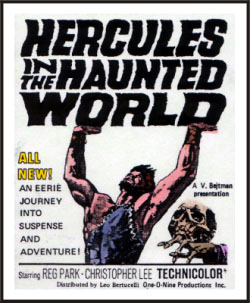
Neither one of them, however, can really hold a candle to the 1961 film, Hercules In The Haunted World. In this Italian film, Hercules (Reg Park) discovers that his lover Princess Deianira has gone insane so he goes to Hades in order to get the Stone of Forgetfulness, so he can use it to cure her. The story’s really not that important. What is important is that this visually stunning film was the first color film to be directed by Mario Bava and that the film’s villain is played by Christopher Lee.
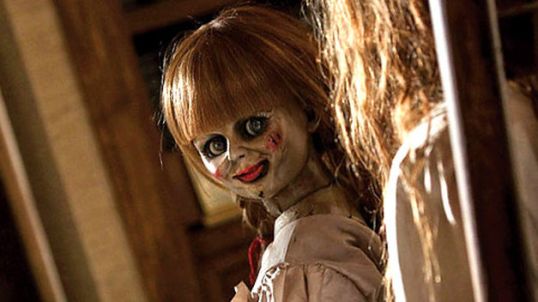
Remember Annabelle, the tres creepy doll from The Conjuring?
Well, she’s back and she’s starring in a film of her very own! Annabelle is the first horror film to be given a wide release this October and, judging from the commercials, New Line Cinema and Warner Bros. are really hoping that you’ll remember just how scary and effective The Conjuring was when it comes time to decide whether you want to see Annabelle or Gone Girl this weekend.
Of course, Annabelle actually have very little do with The Conjuring. Though Father Perez, the token concerned priest played by Tony Amendola, mentions Ed and Lorraine Warren, neither one of them actually appears in the film. Neither do any of the other characters or ghosts from The Conjuring. The only link between the two films is that doll.
Taking place in 1969, Annabelle is an origin story of sorts. Doctor John Gordon (Ward Horton) buys a doll for his pregnant wife, Mia (Annabelle Wallis). The doll looks evil from the minute that Mia unwraps it but, according to the film, it was actually harmless until a psychotic hippie girl (Tree O’Toole) bled on it. That blood seeped into the doll’s eye and the next thing you know…
No, I’m not going to spoil it for you. In fact, it’s really not necessary for me to spoil it for you because I imagine you can probably guess everything that’s going to happen. If you’ve ever seen a haunted house film, you know exactly what’s going to happen when John goes to work and Mia gets left in the house alone. If you’ve ever seen a demonic possession film, you can guess what’s going to happen when Mia happens to stumble across the occult book store next door. And, if you’ve ever seen any film, you can guess that the book store is managed by a sassy mystic played by Alfre Woodard.
That’s right! There’s nothing surprising about Annabelle!
But that’s not necessarily a bad thing. Horror films are unique in that they often times actually benefit from being so predictable. You watch in dread because you know that something terrible is going to happen even though the characters in the film do not. You know enough to yell, “Don’t open that door!” but the characters in the film don’t. That’s exactly what makes a film like Annabelle scary.
The Conjuring, I thought, was not only a great horror film but it was also one of the best films of 2013. That’s because, along with being a scary movie, The Conjuring also dealt quite intelligently with very real issues of faith and family. The Conjuring was fun to watch because it was scary but it stayed with you because it was full of subtext. Annabelle, on the other hand, is a film without subtext. Everything important about Annabelle can be found right on the surface.
Annabelle is a film that exists solely to scare you and how much you enjoy it will probably depend on how much you enjoy horror films to begin with. The shock scenes are handled well, with an emphasis on sudden noise on the soundtrack and intimidating shadows appearing in the background. Everything that distinguished The Conjuring — the attention to detail, the lively performances, and the imaginative plotting — has been pushed to the side to make room for the next scare.
As a result, Annabelle is one of those films that makes you jump while you’re watching it but doesn’t stick around in your head afterwards. If you’re a fan of the horror genre and like a good scare, you’ll probably find something to enjoy in Annabelle. (It’s no Devil’s Due but it’s still better than the latest Paranormal Activity film.) If you’re not a horror fan — well, then you probably weren’t planning on seeing Annabelle in the first place.
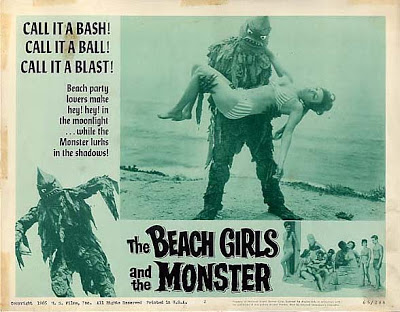
For today’s horror on the lens, we offer up 1965’s The Beach Girls and the Monster. In this one, a monster that might be a mutated barracuda is hiding out on the beach and killing teenagers. Can Dr. Otto Lindsay (played by the film’s director, Jon Hall) figure out how to defeat the monster? Will Otto’s son Richard (Arnold Lessing) ever stop surfing long enough to get back to studying science? Will Otto’s much younger wife Vicky (Sue Casey) seduce the troubled and crippled sculptor Mark (Walker Edmiston)? And will it ever occur to anyone to just go to a different beach?
Complete with a ludicrous monster, a great soundtrack, tons of dancing, melodramatic acting, and a twist ending that will surprise no one, The Beach Girls and the Monster is low-budget favorite of mine. It’s also, I think, a perfect movie to watch on the 3rd of October.
Today’s horror film is a true classic of its kind, the 1953 science fiction epic Robot Monster.
What happens with the Earth is attacked by aliens? Well, first off, dinosaurs come back to life. All of humanity is killed, except for one annoying family. Finally, the fearsome Ro-Man is sent down to the planet to make sure that it’s ready for colonization. (Or something like that. To be honest, Ro-Man’s exact goal remains a bit vague.)
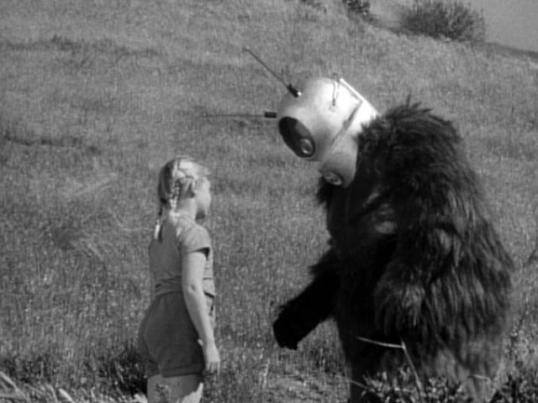
Why is Ro-Man so fearsome? Well, he lives in a cave for one thing. He also owns a bubble machine. And finally, perhaps most horrifically, he’s a gorilla wearing a diver’s helmet. However, Ro-Man is not just a one-dimensional bad guy. No, he actually gets to have a monologue about halfway through the film in which he considers the existential issues inherent in being a gorilla wearing a diver’s helmet.
Can humanity defeat Ro-Man? Will Ro-Man ever get his intergalactic supervisor to appreciate him? And finally, why are the dinosaurs there?
All of those questions, and more, are cheerfully left unanswered but that’s a large part of this odd, zero-budget film’s considerable charm. If you’ve never seen it before, you owe it to yourself to set aside an hour and two minutes in order to watch it.
Hi there and welcome to October! This is our favorite time of the year here at the Shattered Lens because October is horror month. For the past three years, we have celebrated every October by reviewing and showing some of our favorite horror movies, shows, books, and music. That’s a tradition that I’m looking forward to helping to continue this year.
So, let’s start things off with the 1959 cult classic The Hideous Sun Demon. In The Hideous Sun Demon, a scientist named Gil (played by Robert Clarke, who also wrote and directed) is exposed to radiation. Perhaps not surprisingly, this does not turn out well for Gil. Now, whenever Gil is exposed to direct sunlight, he turns into a scaly and murderous monster. Struggling to control his new monstrous side and slowly losing his grip on his own sanity, Gil retreats to a seaside town where he spends most of his time sitting in the dark. He only emerges from his house at night and then only so he can go down to a bar and listen to the sultry Trudy sing a song. However, the sun always rises…
The Hideous Sun Demon may not be a great film but it’s perfect for a little Halloween fun. Robert Clarke is sympathetic in the lead role and, while the Sun Demon might just be a man in a rubber suit, that’s all just a part of the film’s charm.
So, let’s start October by pulling down the shades, blocking out the sun, and enjoying The Hideous Sun Demon!
Hi there and greetings from beautiful Lake Texoma. Having recently completed both 3 months of covering Big Brother for the Big Brother Blog and my series of Back to School reviews for this site, I am currently on a much-needed vacation with my wonderful boyfriend. However, you all know that I would never let a little thing like being on vacation keep me from watching and then reviewing whatever is currently playing down at the closest available theater.
For instance, last night, we saw The Maze Runner at the Cinemark 14 in Denton, Texas. The Cinemark is a really nice theater. The seats are comfortable. The people working there were nice and polite. The movie sounded great. Even the audience was surprisingly polite. Only a few people came in late and, for the most part, everyone refrained from talking during the film. Good for them and good for you, Cinemark 14!
As for the movie itself…
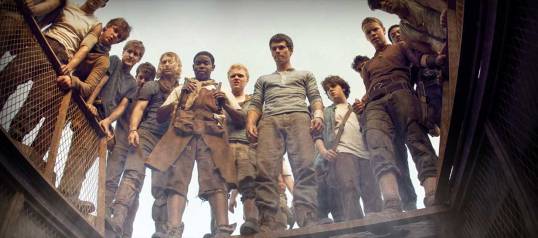
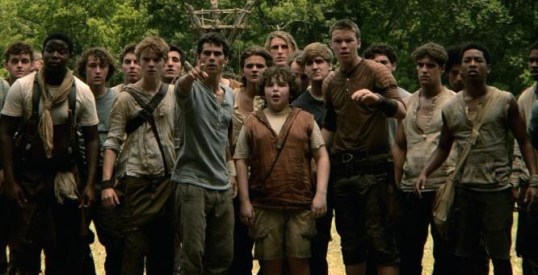
The Maze Runner tells the story of Thomas (Dylan O’Brien), a teenager who wakes up one day in a grassy clearing that is encircled by gigantic, gray walls. Thomas finds himself surrounded by several other teenage boys. Unable to remember anything about his past (but haunted by chaotic dreams that suggest that he is the part of some sort of lab experiment), Thomas initially reacts by trying to run. However, he is quickly tackled and introduced to his new home.
The grassy area is known as the Glade and the boys who live there are known as Gladers. Their leader is Alby (Aml Ameen) and, as he quickly explains to Thomas, he has created a tediously collectivist society where everyone has his assigned place and his assigned duty. (And yes, that is the correct pronoun. There are no girls among the Gladers.) Alby explains that, behind the walls, there lies a maze that is patrolled by terrifying creatures known as Grievers. The most athletic and intelligent of the Gladers are allowed to become Runners. Everyday, the Runners run through the maze and memorize every twist and turn.
Thomas, needless to say, wants to be a runner. And it’s good that he does because otherwise, the film would be kind of boring.
Anyway, along the way to becoming a runner, Thomas has more visions of an autocratic woman (Patricia Clarkson) and he also manages to make an enemy out of Gally (Will Poulter), a Glader who never wants to leave Glade. Eventually, a girl named Teresa (Kaya Scodelario) shows up, along with a note saying that she’s the last one and no one else will be showing up in the Glade.
Now, at this point, you may be tempted to ask, “What’s going on?”
Well, you’ll have to wait a few years to find out because The Maze Runner is just part one of a trilogy. Much like The Hobbit, Divergent, and The Hunger Games, it answers just enough questions to keep the audience satisfied while still ending with a cliffhanger. So, if you do see The Maze Runner, be sure to pay attention because you don’t want to forget everything that happened before the sequel comes out sometime next year.
There’s a lot of good things that can be said about The Maze Runner. For the most part, the actors did a good job. The grievers were scary. The maze looked impressive, though it’s hard not to feel that the film did not take full narrative advantage of it.
However, to be honest, I have seen so many recent adaptations of dystopian YA books that, with the exception of The Hunger Games and Catching Fire, they’re all starting to blend together. The Maze Runner was well made but there really wasn’t anything about it that distinguished it from the pack. Without the presence of a star like Jennifer Lawrence or the satirical subtext that distinguished The Hunger Games, The Maze Runner ultimately just felt like your typical franchise starter, not so much a story but instead just an extended prologue.
Again, it’s not necessarily a bad film. It’s based on a book and, undoubtedly, a lot of details did not make it from the page to the screen but there’s still enough there that even people who haven’t read the book will probably be able to follow the story. Me, I’m a Texas girl and, therefore, it’s a part of my heritage to appreciate any film that features an individual taking on an elitist dystopia. But, in the end, the film is never quite as memorable as you want it to be.
Perhaps we’ve all just been spoiled by The Hunger Games…
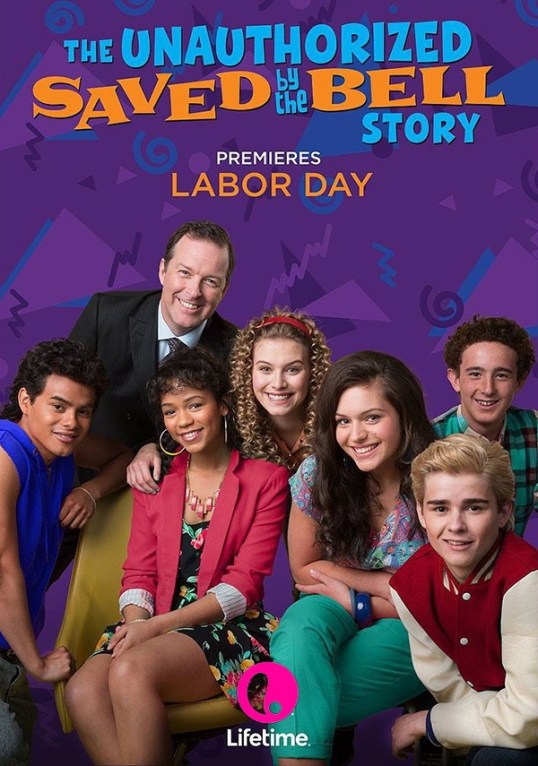
Well, it’s here! This is my 80th and final Back to School review! As I’ve mentioned before, I originally thought I’d be able to do all of these reviews in just one week. Instead, it’s taken me five weeks but you know what? I’ve had fun doing these reviews and I hope that you’ve enjoyed reading them. It’s been interesting to see how teen films have progressed and changed over the decades. We started this series with 1946’s I Accuse My Parentsand now, we end it with a film from 2014 that might as well be called I Accuse Screech.
Technically, it’s called The Unauthorized Saved By The Bell Story but that’s kind of an unwieldy name, isn’t it? I can’t really see myself typing that title over and over again. So, for the purposes of this review, this movie is called I Accuse Screech.
First off, some background. When I was a kid, I used to watch Saved By The Bell: The New Class. What’s weird is that, when I look back at it, I think even then I knew that the show wasn’t very good. I knew that the jokes were frequently not funny. I knew that the story lines were predictable. I think I was even aware that it was strange how frequently actors were either dropped from or added to the cast. Don’t get me wrong. The show was (and still is) oddly watchable but it was never any good and I am pretty sure I knew that. Then again, maybe that’s just way I want to remember it. Being a fan of Saved By The Bell: The New Class isn’t exactly something that you brag about. However, one thing that I can be sure of is that, even when I was young, I knew that Screech Powers sucked.
As played by Dustin Diamond, Screech was the principal’s assistant at Bayside High. He was also probably the most annoying character ever to be unleashed onto the psyches of impressionable children and tweens. Screech spoke in a high, squeaky voice and could usually be relied upon to do something incredibly stupid. Whenever he fucked things up (and he managed to do this several times in each episode), he would say something like, “Zoinks!” Everybody hated Screech.
Now, I have to admit that I never actually saw an episode of the classic original Saved By The Bell until after the New Class was already off the air. And that’s when I discovered the adventures of Zack Morris, A.C. Slater, Kelly Kapowski, Jessie Spano, and … Screech. That’s right, you can’t escape Screech!
And here’s the thing — the original Saved By The Bell is one of those shows that really is kind of terrible and yet you can’t stop watching. It’s addictively bad, the type of show that you watch with a combination of shock, horror, and amusement. The original Saved By The Bell is the television equivalent of The Room or Troll 2. It’s terrible but it’s fun.
So, you would think that a made-for-tv movie about what went on behind-the-scenes of Saved By The Bell would also be terrible yet fun. That’s certainly the way that it was advertised by Lifetime. Lifetime appeared to be hoping that their version of the story behind Saved By The Bell would give them a Sharknado of their very own.
And hey, it should have been great. There’s an interesting story there. How would a bunch of teens handle suddenly becoming famous? How would they handle the pressure of being famous while also appearing on a show so bad that it would essentially run the risk of ruining their lives, not to mention their careers? How would they handle having to grow up both on TV and in real life?
Those are the questions that we expected to have answered by this movie but instead…
Well, let’s just say that I Accuse Screech!
In 2009, Dustin Diamond published a “memoir” called Behind The Bell and oh my God, it is literally the worst fucking book ever written. Words escape me to describe just how terrible this book is. Essentially, the book is full of Diamond either complaining that his co-stars didn’t like him or bragging about the fact that he used to have sex with 12 year-olds at Disneyland. Diamond accuses his castmates of smoking weed. (Wow, teenagers smoking weed. MY GOD, THE SCANDAL!) Diamoned accuses his castmates of having sex. (OH MY GOD, TEENAGERS HAVING SEX!) In other words, the book is pretty much Dustin Diamond complaining about the fact that everyone but him was having fun on the set of Saved By The Bell.
So, of course, if you’re going to make a movie about Saved By The Bell, where would you go for your source material? Well, you can’t go to any of the stars because, with the exception of Dustin Diamond, they all have successful careers outside of Saved By The Bell. And you can’t go to Dennis Haskins because, seriously, who cares what Mr. Belding thought?
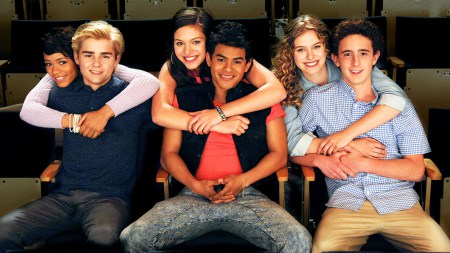
Lifetime decided to use Behind the Bell as their source material. Unfortunately, Diamond himself has admitted that the book was a pack of lies. As a result, most of the more salacious (and therefore entertaining) material could not actually be used in the movie. The Lifetime film is full of hints of bad behavior but no direct evidence. At one point, we see the actor playing Mario Lopez flirting with an extra in a deserted classroom. In another scene, the girls get snarky with each other because they all like Mark-Paul Gosselaar. But, beyond those hints, we don’t get to see any of the book’s more sordid accusations. Instead, all we get are a lot of scenes of the actor playing Dustin Diamond looking annoyed with his castmates.
(Because, literally, the only verifiable, non-slanderous thing to be found in the book is that apparently Dustin Diamond was whiny, bitter, and jealous…)
As a result, the film seems to be suggesting that Saved By The Bell was put together and performed by the most boring people on Earth. The end result is not only the worst film to have appeared on Lifetime but perhaps one of the worst films of all time.
Why is it so bad?
I accuse Screech!
(Incidentally, if you want to learn more about Saved By The Bell, I suggest checking out the best Saved By The Bell review site around, The Summer of Morris!)
And, on that note of failure, we conclude this series of 80 Back to School reviews! Thank you, everyone, for your indulgence and your patience! I hope everyone enjoyed reading them as much as I enjoyed writing them.
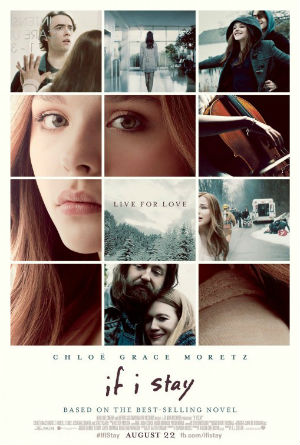
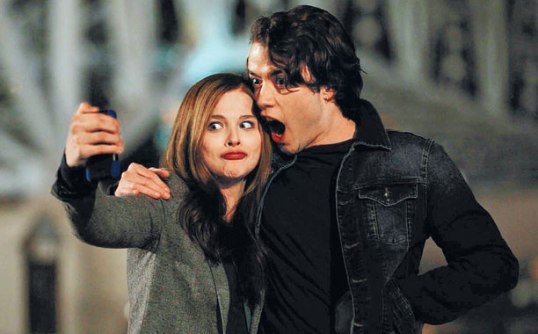
17 year-old Mia Hall (Chloe Grace Moretz) appears to have everything that a girl could want. She has a wonderful, if somewhat goofy, father in former musician-turned-teacher Denny (Joshua Leonard). She has a loving mother, a travel agent named Kat (Mirelle Enos). She has an adorable little brother (Jakob Davies), a loyal best friend (Liana Liberato), and — best of all — she has an older boyfriend named Adam (Jamie Blackley), who is on the verge of rock stardom. Even better, Mia has a wonderful future ahead of her. A musical prodigy, Mia is cello player who is waiting to hear whether or not she’s been accepted to Julliard.
And then, one day on a snowy road, it all changes. There’s a car accident. Both Denny and Kat are killed. Mia’s brother is several injured. And Mia in a coma. While her friends and what remains of her family watch over her at the hospital, Mia has an out-of-body experience. She walks through the hallways of the hospital, she listens to her loved ones as they struggle to accept what has happened, and she remembers all of the days that came before the accident. She remembers first meeting Adam. She remembers falling in love with him. She remembers their fights and then she remembers her family and she realizes that she’s facing a future without any of them. Ultimately, Mia has to decide whether to wake up and stay or to die and perhaps be at peace.
Based on an excellent novel by Gayle Forman, If I Stay is a tear jerker in the best sense of the word. Yes, the film has been clearly designed to make you cry but what’s wrong with that? Sometimes, crying is the best thing that one can do and, much like The Fault In Our Stars, the film’s tears are earned. As directed by R.J. Cutler, the film strikes a deliberate and telling contrast between Mia’s lively memories and the stark coldness of the hospital through which she now finds herself wandering. Joshua Leonard and Mirelle Enos bring a lot of life to the roles of the doomed parents and Stacy Keach is great as Mia’s grandfather. (Try not to cry when he tells the comatose Mia that it’s okay to move on. I dare you!)
Finally, Chloe Grace Mortez gives a wonderful and soulful performance of Mia. Moretz is one of those young actresses who always seems to be both wise beyond her years and painfully fragile as well. If I Stay contains yet another strong performance from her, one that elevates the entire film. That said, I hope she gets to do a nice romantic comedy at some point in the future because, after all the trauma she’s acted out in everything from Kick-Ass to Texas Killing Fields to Carrie to If I Stay, she’s earned it!
As for If I Stay, it’s still playing at theaters even as I write this review. If you haven’t already, go see it.
I hate to admit it but it actually took me a day or two to really warm up to Boyhood.
When I first saw it, I knew that I was watching a great film and it was a movie that I had a good deal of respect for. By now, we’ve all heard the story of how the film was made and how director Richard Linklater first started the film in 2002 when star Ellar Coltrane was only 6 years old. Over the next 12 years, Linklater would spend a few weeks out of each year filming. The script was written on a year-by-year basis, allowing the story to develop organically and often taking into account whatever was happening in Coltrane’s life at the time. The end result is that Coltrane grows up on screen in much the same way that Mason, the character he’s playing, does. As I watched Boyhood, I knew that Linklater had somehow managed to turn what could have been a mess into an undeniably effective movie.
But yet, in the hours immediately following the showing, I had a nagging feeling. I realized that, as much I respected the film and as much as I wanted to love the film, there was a part of me that was slightly disappointed. In some ways, it made sense. Richard Linklater is a director whom I absolutely revere and, as a result, I am always going to watch his movies with extremely high (and occasionally unrealistic) expectations. As for the film itself, Boyhood is the most acclaimed film of the year so far. For the longest time, it had a perfect 100% rating over at Rotten Tomatoes.
And, when you’re continually told that a film is the greatest movie ever made, it’s going to be a challenge to then judge the film on its actual merits.
And so, I was content to think of Boyhood as being one of those undeniably important films that I respected more than I enjoyed.
But then something happened.
Boyhood stuck with me. Boyhood is a film that has stuck with me more than almost any other film this year. (Interestingly enough, perhaps the only 2014 film that I’ve seen so far that has stuck with me more was Guardians of Galaxy, which in many ways is the exact opposite of Boyhood.) There are scenes in Boyhood that are still as fresh in my mind as they were when I first saw them. Interestingly enough, they’re not big, dramatic scenes. (Indeed, Boyhood is memorable for just how determined it is to avoid the big, dramatic scenes that usually appear in coming-of-age films.) Instead, what stuck with me were the little details.
I remembered how, when Mason was 6 and his family was moving down to Houston, his best friend rode by on a bicycle and waved goodbye, never to be seen again in the film but definitely destined to be remembered by both Mason and the audience.
I remembered how, from the minute that Mason’s mom (Patricia Arquette), met and married the seemingly friendly Bill (Marco Perella), I knew that the marriage wasn’t going to work. I remembered the scenes of Mason and his sister (Lorelei Linklater) trying not upset Bill and failing every time. Years later, when Arquette marries yet again, I knew that it wasn’t going to work out any better. By that point, Mason knew it too but what can you do when you’re only 16?
I remembered how Mason, after having been moved to San Marcos, had an awkward conversation with a girl from his school. The girl obviously liked Mason and Mason obviously liked the girl but neither one had a clue how to say it.
I remembered feeling stunned when, over the course of just one scene break, Mason went from being an innocent-looking 14 year-old to a skinny and angrily sullen 15 year-old. It’s hard for me not to feel that, in that regard, Boyhood serves as a warning of what’s probably in store for me once I actually have kids.
I also remember being surprised when Mason’s Dad (Ethan Hawke) went from being the guy who ranted about George W. Bush in 2004 to a 2011 newlywed who asks his children to come to church with him. But then again, in retrospect, was it that much of a shock or, like Mason, did I unfairly expect his Dad to remain a rebel for the rest of his life?
(One of the most interesting things about the film is that, since it was literally filmed while the story was occurring, Boyhood serves as a time capsule of life and culture throughout the beginning on this century. While the scenes set in 2004 and 2008 are dominated by Mason’s father enthusiastically talking about politics, he never mentions anything about the presidential election in 2012. And it actually makes sense because was anyone enthusiastic about 2012?)
That’s the thing that sets Boyhood apart from other coming-of-age films. Many of the events that would be major scenes in other teen films — like losing one’s virginity or learning to drive — happen off-screen in Boyhood. Instead, Boyhood is just about watching life unfold. Many questions are not answered. Characters come and go, playing their part in Mason’s life and then disappearing as Mason moves on.
Some of them, like Mason’s stepbrother and step sister who are both left behind when his mother leaves Bill, we wonder about, just as surely as Mason wonders about them too. But life is rarely neat enough to provide all the answers and Boyhood, if nothing else, is about life.
And that, ultimately, it why Boyhood sticks with you. Looking back on the film, you can see how Mason the 6 year-old who had to be forced to leave behind his best friend eventually grew up to be Mason the 18 year-old who is almost insensitive in his eagerness to leave behind his mother and drive himself to college. But, and this is the key, you have to be willing to look back on the film to truly understand at. Trying to figure out how the pieces of puzzle fit together while watching the film will only leave you frustrated, as life often does while you’re living it. It’s only after the film that you can truly understand what it all means. It’s only when you look back that you realize just how much Richard Linklater has accomplished with Boyhood.