Pixar Does It Again With Inside Out


Inside_Out_(2015_film)_posterInside Out is the latest brilliant film from Pixar’s Pete Docter and it will remind you why you fell in love with Pixar in the first place.

There are no talking cars or lovable monsters in Inside Out.  Instead, it’s the story of a very normal 12 year-old girl named Riley (voiced by Kaitlyn Dias).  Or rather, it’s the story of what goes on in her head.  For most of the movie, Riley deals with experiences to which we can all relate: she moves to a new city, she struggles to relate to her well-meaning parents (voiced by Kyle MacLachlan and Diane Lane), and she tries to fit in at a new school.  Inside Out is a film about the small moments of life and how they all add up to create a bigger picture.

What sets Inside Out apart is the way that it tells its deceptively simple story.  Inside Out takes place almost entirely inside of Riley’s brain.  And it turns out that her mind is gigantic wonderland, one that is so big and complex that not even the characters who live there quite understand how it all works.  Bing Bong (Richard Kind), a pink half-elephant, half-cat, half-dolphin creature, spends his time wandering through the halls of memory and mournfully thinking back to when he was Riley’s imaginary friend.  Whenever Riley goes to sleep, the actors and directors at Dream Productions film a different nightly movie.  Meanwhile, Imagination Land is a fun place to visit but not a good place in which to live and past childhood traumass — like a gigantic stalk of broccoli and a terrifying birthday clown — are locked away deep in Riley’s subconscious, where they are guarded by officious policemen.   Zigzagging through this mental landscape is the literal Train of Thought.

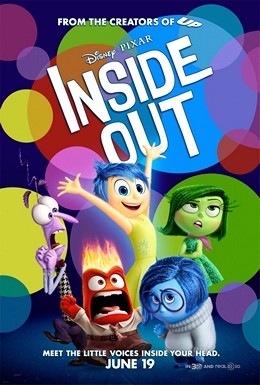
And then, above it all, there’s Headquarters.  This is where five different emotions take turns “steering” Riley through life.  Fear (Bill Hader) is always nervous but, at the same time, keeps Riley safe.  Disgust (Mindy Kaling) prevents Riley from eating broccoli and hanging out with the wrong crowd.  Sadness, meanwhile, hasn’t had much to do over the past 12 years and, as a result, she spends most of her time standing in a corner and feeling … well, sad.  Sadness is voiced by Phyllis Smith, best known for playing Meredith on The Office.  Smith proves herself here to be a strong and empathetic voice artist.

Their unquestioned leader is Joy (Amy Poehler).  As befits her name and job, Joy is always positive, always upbeat, and always optimistic.  For 12 years, Joy has been in charge of steering Riley’s life but that all changes when Riley and her family move to San Francisco.  Suddenly, Joy finds it more difficult to keep Riley permanently happy.  Memories that were formerly color-coded yellow for happy start to turn blue.

When both Joy and Sadness are accidentally expelled from the Headquarters, it’s up to the three remaining emotions to try to keep Riley well-balanced until they can return.  However, the journey back up to the Headquarters is a long and dangerous one, full of some of the most imaginative (and metaphorical) imagery in Pixar’s history.  Joy and Sadness will have to work together to make it.

And really, that’s what makes Inside Out so special.  It’s the rare family film that acknowledges that allowing ourselves to feel sad is often as important as being happy.

Inside Out is a brilliant coming-of-age story and one of the best films of the year.  It’s a film that will make you laugh and cry and will remind you of why you fell in love with Pixar in the first place.  Kids will love the humor and adults … well, adults will probably be trying to hold back the tears.

What a great film!

Thank you, Pixar.

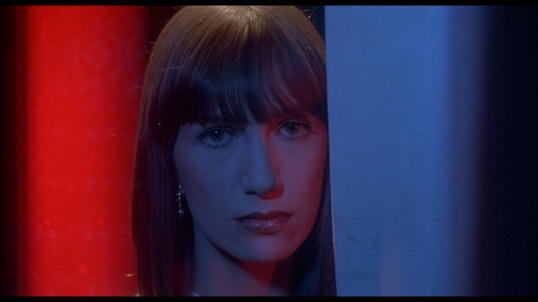
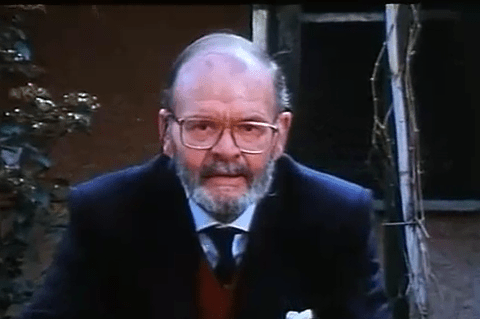
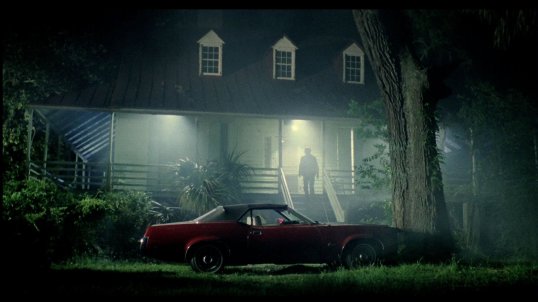
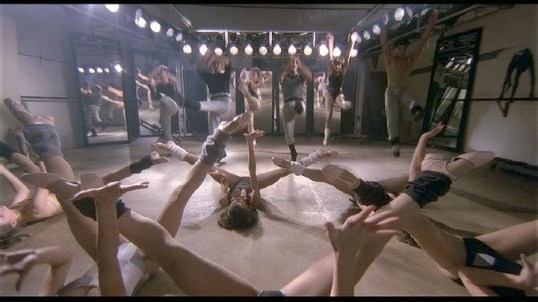
4 Shots From 4 Films: Special Daria Nicolodi Edition!


Daria Nicolodi in Tenebra (1982, dir by Dario Argento)

Daria Nicolodi in Tenebrae (1982, dir by Dario Argento)

4 Shots From 4 Films is just what it says it is, 4 shots from 4 of our favorite films.  As opposed to the reviews and recaps that we usually post, 4 Shots From 4 Films is all about letting the visuals do the talking.

I have to admit that I’m breaking the rules here.  When Arleigh first suggested 4 Shots From 4 Films as a feature here on Through the Shattered Lens, I promised myself that I would pace myself and, at most, only contribute once on a weekly basis.

But then, after Arleigh posted the first entry in 4 Shots From 4 Films, I realized that it was Lucio Fulci’s birthday and, being the lover of Italian horror that I am, there was no way that I could pass up the chance to post a Fulci-themed 4 Shots From 4 Films.  And now, less than 24 hours later, I find myself posting yet another 4 Shots From 4 Films.

But can you blame me?  It’s Daria Nicolodi’s birthday and, if you love Italian horror, then you know just how important an actress Nicolodi is.  Not only did Daria Nicolodi serve as the inspiration for what is arguably Dario Argento’s best film, Suspiria, but she also appeared in Mario Bava’s classic Shock.  The combination of her undeniable talent and her outspoken and eccentric style — there is no such thing as a boring Daria Nicolodi interview — has made Daria Nicolodi into an icon of horror cinema.

And, on top of all that, she’s Asia Argento’s mother!

So, indulge me because, as a lover of Italian horror, there is no way that I could pass up a chance to present our readers with 4 Shots From 4 Films: The Special Daria Nicolodi Edition!

Deep Red (1975, dir by Dario Argento)

Deep Red (1975, dir by Dario Argento)

Shock (1977, dir by Mario Bava)

Shock (1977, dir by Mario Bava)

Inferno (1980, dir by Dario Argento)

Inferno (1980, dir by Dario Argento)

Delirium (1987, directed by Lamberto Bava)

Delirium (1987, directed by Lamberto Bava)


Here’s the Trailer for Boulevard, Robin Williams’s Final Film


I made out my latest Oscar predictions before I saw the trailer for Boulevard.  Filmed shortly before Robin Williams’s suicide, Boulevard features his final dramatic performance.  Could Robin Williams receive a posthumous nomination for his role here?  We’ll find out later this year.

Lisa Marie’s Too Early Oscar Predictions For June


oscar trailer kitties

It’s time for our monthly edition of Lisa’s Too Early Oscar predictions!

This is our first entry since the Cannes Film Festival.  As a result of Cannes, former contenders like The Sea of Trees have been dropped from the predictions.  Meanwhile, new contenders like Michael Caine and Sicario have emerged.  I have also added Pixar’s Inside Out to my list of predictions because a 98% rating on Rotten Tomatoes demands the consideration.

(Unfortunately, adding Inside Out meant dropping The Good Dinosaur.  Though it could happen, I find it hard to imagine two animated films receiving best picture nominations.)

If you want to see how my feelings on the race have developed, be sure to check out my predictions for January, February, March, April, and May!

And without further ado, here are Lisa’s Too Early Oscar Predictions for June!

Best Picture

Black Mass

Brooklyn

Carol

The Danish Girl

In the Heart of the Sea

Inside Out

MacBeth

Sicario

Suffragette

The Walk

Best Actor

Johnny Depp in Black Mass

Michael Caine in Youth

Michael Fassebender in Steve Jobs

Eddie Redmanye in The Danish Girl

Jason Segel in The End of the Tour

Best Actress

Cate Blanchett in Carol

Marion Cotillard in MacBeth

Jennifer Lawrence in Joy

Saoirse Ronan in Brooklyn

Lily Tomlin in Grandma

Best Supporting Actor

Albert Brooks in Concussion

Benicio Del Toro in Sicario

Joel Edgerton in Black Mass

Idris Elba in Beasts of No Nation

Kurt Russell in The Hateful Eight

Best Supporting Actress

Joan Allen in Room

Jennifer Jason Leigh in The Hateful Eight

Rooney Mara in Carol

Meryl Streep in Suffragette

Julie Walters in Brooklyn

Best Director

John Crowley for Brooklyn

Todd Haynes for Carol

Ron Howard for In The Heart of the Sea

Denis Villeneuve for Sicario

Robert Zemeckis for The Walk

4 Shots From 4 Films: Lucio Fulci Edition


CATINTHEBRAIN-Lucio

Lucio Fulci (1927 — 1996)

Yesterday, I was excited to see Arleigh launch a new feature here at the site.  With 4 Shots From 4 Films, the TSL contributors will be sharing favorite shorts from some of their favorite scenes.  As opposed to doing our usual review or recap, this feature will let the image do the talking.  Hopefully, some readers will be inspired to track down and watch, if they haven’t already, some of the films that we end up featuring.

At the very least, it’s a great way for us all to express our love for the cinematic art form.

Yesterday was also the birthday of the late, great Lucio Fulci.  My first entry in 4 Shots From 4 Films highlights some of the maestro‘s finest work.

The City of the Living Dead (1980)

The City of the Living Dead (1980)

The Beyond (1981)

The Beyond (1981)

The House By The Cemetery (1981)

The House By The Cemetery (1981)

Murder Rock (1984)

Murder Rock (1984)


The Daily Grindhouse: The Lashman (dir by Cameron McCasland)


339542_242684609106121_126435694064347_676919_7608822_o

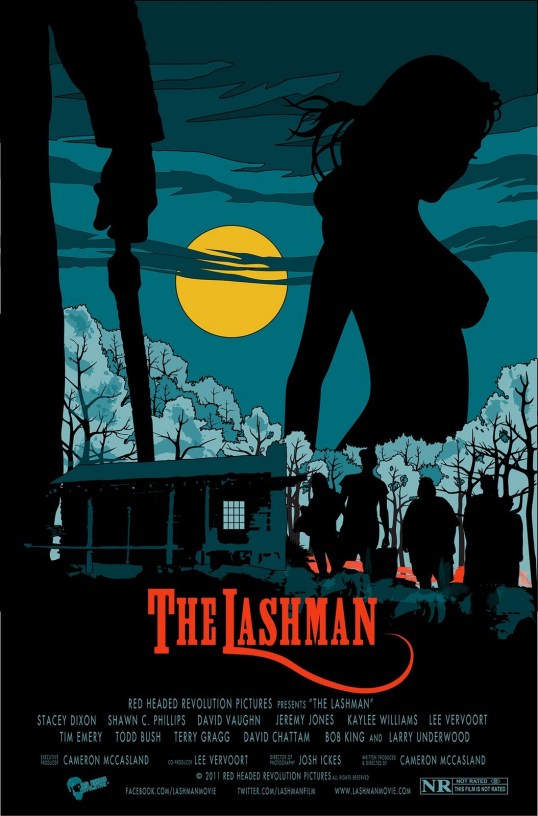
It’s been a while since I’ve down a Daily Grindhouse review here on the Shattered Lens and shame on me for that!  Fortunately, I recently saw a film called The Lashman, a film that may have been released in 2014 but which serves as a tribute to the low-budget, wilderness slasher spectaculars that played at so many grindhouse and drive-in theaters in the 70s and 80s.  After watching the film, I knew that I had seen the perfect film with which to relaunch this feature.

The Lashman was directed by Cameron McCasland and filmed in Kentucky.  As I’ve said many times in the past, I love local horror films.  These are films that are made on location, outside of Hollywood and which often utilize local talent, both behind and in front of the camera.  Along with reminding us that no one location has a monopoly on American filmmaking talent, these locally made horror films also feel a lot more authentic than the slick, “mainstream” films coming out of Hollywood.  This is horror taking place in the real world, as opposed to on a sound stage.  “Authenticity,” that belief that what you’re watching could happen just as easily to you as it could to the people onscreen, is one of the keys of effective horror cinema.  If you can’t relate to the fear of the characters or believe that the film’s threat — no matter how outlandish — might just happen to be waiting for you in the shadows, then the film is not going to work.  Grindhouse horror films, with their rough edges and their cast of often unfamiliar faces, worked precisely because they felt authentic.

I think this especially true for slasher films.  As unfairly critically reviled as they may be, the slasher film is based on a horror that we can all relate to.  We all know that there are disturbed people out there.  We all secretly suspect that we’re more vulnerable, both mentally and physically, than we like to pretend we are.  And, as much as we like to shout back at the screen and complain about how slasher movie victims are always doing something stupid, we all know that we have no idea how we would react if we ever found ourselves in the same situation.  Most of us secretly know that we’d never survive a slasher film.  I know I wouldn’t.  I’d be the girl wandering around outside in her underwear, saying, “This isn’t funny!,” and then spraining my ankle as soon as I tried to run away.

The Lashman is a throwback to those old grindhouse slasher films, a loving homage to films that may have never been critically embraced but which remain undeniably effective.  The film’s story is simple.  Five students spend the weekend at a cabin in the woods.  Lashman, who is rumored to be the malevolent spirit of a man killed over 100 years before, shows up.  People die.

Our five students are all traditional slasher movie victims.  In fact, they share the same basic relationships as the five victims from the original Texas Chainsaw Massacre.  There’s two couples, Stacy (Stacy Dixon) and Billy (David Vaughn) and Daniel (Jeremy Jones) and Jan (Kaylee Williams) and then there’s Stacy’s awkward misfit of a brother, Bobby (Shawn C. Phillips).  (Much like poor wheelchair-bound Franklin from Texas Chainsaw, Bobby spends a lot of time complaining.)

Out of the cast, Shawn Phillips is the one who I immediately recognized because he’s appeared in several low-budget and undeniably fun horror films, with Ghost Shark being a personal favorite.  However, all five of the main cast members do a good job.  I’m jealous of the screaming abilities of Stacy Dixon and Kaylee Williams and David Vaughn made for a good “nice guy” hero.  However, special mention has to be made of Jeremy Jones.  One of the unwritten rules of the slasher genre is that one of your main victims has to be a totally obnoxious jerk and Jeremy Jones deserves a lot of credit for the total commitment that he shows to that role.

The Lashman is a film that will best be appreciated by those who know their horror movies and who can appreciate that McCasland has essentially crafted this film to be a valentine to the entire genre.  Everything about the film — from the beautifully shot opening where two anonymous teens fall victim while the moon beautifully glows down on a lake to the final chase through the woods between the Lashman and his suddenly partially undressed final prey — feels like a tribute to the classic grindhouse horror films of the past.

Finally, as I wrap up this review, allow me to share just a few more thoughts:

This film was produced by Red Headed Revolution Pictures.  As a redhead, I appreciated that.  It was also co-produced by Lee Vervoort, who was one of the directors on Volumes of Blood.

The token crazy old man character (every slasher film has one and nobody ever listens to him when he attempts to warn them) is played by an actor named Larry Underwood, who is a horror host (under the name Dr. Gangrene) and a Rondo-winning horror blogger.  (That said, I should admit that the main reason that I initially smiled when I saw his name in the credits is because I just started reading Stephen King’s The Stand.)

Director Cameron McCasland has a cameo appearance in the film and is credited as playing Handsome Bartender.

The end credits declare, “A good cast is worth repeating!”  If you’ve seen any the great Universal films from the 30s and 40s, you will immediately recognize the phrase.  When I was a kid and I would watch any of the old monster movies, I always loved seeing that “a good cast is worth repeating!”  In a weird way, it always made me feel happy for the cast.


Embracing the Melodrama Part II #126: Veronika Decides To Die (dir by Emily Young)


VeronikaDecidesToDie_USPosterWell, here we are!

It’s been 9 weeks since we originally embarked on this journey that I called Embracing The Melodrama Part II.  At that time, my plan was to do 126 reviews in just three weeks.  It didn’t quite work out that way, did it?  But still, I had fun doing this series of reviews and I hope that you’ve had at least a little fun reading them.  If I’ve inspired you take a chance on any of the films that I’ve reviewed — whether it be Sunrise or An American Hippie In Israel or Cocaine: One Man’s Seduction or Calvary — then this has all been worth it!

So, for my final review in this series, I want to take a quick look at one of the most melodramatic films to be released this year so far, Veronika Decides To Die.

Veronika Decides To Die finally got an American release in 2015, six years after it initially premiered on the festival circuit.  Years before it was available here in the States, Veronika played in Europe.  Not surprisingly, the American release felt much like an afterthought, one final attempt to make a little money off the film before moving on.  It’s spent about a week in theaters and two months later, it is now showing up on cable and Netflix.  And while Veronika didn’t get many reviews, the few that it did get were rather dismissive.

But you know what?

I like Veronika Decides To Die.

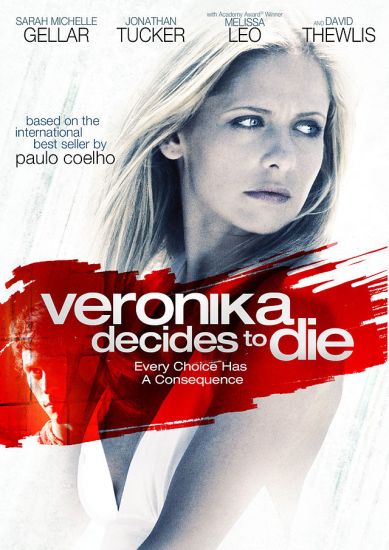
Don’t get me wrong.  It’s not a great film.  In many ways, it’s a very silly film.  The entire plot hinges on a character doing something that makes no sense.  Frustrated with her life as an anonymous and lonely office worker, Veronika (Sarah Michelle Gellar) attempts to commit suicide.  She survives the suicide attempt and, upon waking in a mental hospital, she’s told by a mysterious psychologist (David Thewlis) that, as a result of her attempt, she now has a heart condition that will kill her in a matter of weeks.  And what does Veronika decide to do after learning that she’s going to die?  She voluntarily remains in the mental hospital and goes to sessions of group therapy!

And you never really believe that Veronika would do that.  But, if you can bring yourself to accept that one implausibility — well, you’ll soon be confronted by a lot of other implausibilities.  You’ll meet Veronika’s glassy-eyed roommate (Erika Christensen) and a mysterious older patient (Melissa Leo).  You’ll also meet Edward (Jonathan Tuker), who is mute but has such a sexy stare that he really doesn’t need to speak.  And as Veronika gets to know her fellow patients, she starts to come to terms with her own issues of anger and regret and she realize that importance of embracing life and doing what you love.

Of course, that’s a little hard to do when you’re in a mental hospital.  Luckily, there’s a piano that Veronika can play while Edward silently watches her.  If you’re guessing that this eventually leads to Veronika sitting naked at the piano and masturbating in front of Edward, well, you’re right…

Listen, Veronika Decides To Die is one of those films that takes itself way too seriously and it ends with a plot twist that you’ll see coming from a thousand miles away.  I can understand why the film’s release was delayed because the film’s tone is all over the place.

But, dammit, I liked Veronika Decides To Die!

When taken on its own defiantly melodramatic terms, it works.  That’s largely because Sarah Michelle Gellar really commits herself to the role.  You forget that you’re watching Buffy.  Instead, Gellar truly becomes Veronika, this tragically sad and lonely young woman who finds inner peace by masturbating at a piano.  Veronika Decides To Die is a movie that really shouldn’t work but Sarah Michelle Gellar saves it.  When the film starts, she beautifully captures Veronika’s lonely desperation, her feelings of isolation and worthlessness.  (I don’t care who you are, we’ve all felt like Veronika at some point in our life.)   As the film progresses, she portrays both Veronika’s anger and her growing appreciation of life.  She has a nice chemistry with Jonathan Tucker and, in the end, Sarah Michelle Gellar probably gives a better performance than the material really deserves.

Of course, another reason that Veronika Decides To Die works is because it is so silly and melodramatic.  This is one of those films that goes so far over-the-top that it creates an almost heightened sense of reality.  It becomes, almost despite itself, compulsively watchable.

It’s also the perfect film with which to complete Embracing the Melodrama Part II.  I hope y’all have enjoyed reading these 126 reviews because I’ve certainly enjoyed writing them!  To everyone who has read these reviews and clicked on the “like” button and occasionally left a comment or two, thank you so much!  Love you!   However much effort or work it may take, all of you make it worth it.

And now I’m going to go pass out for a little while…

Embracing the Melodrama Part II #125: Spring (dir by Justin Benson and Aaron Moorehead)


Spring_(2014_film)_POSTERWhen was the last time that a film truly took your be surprise?

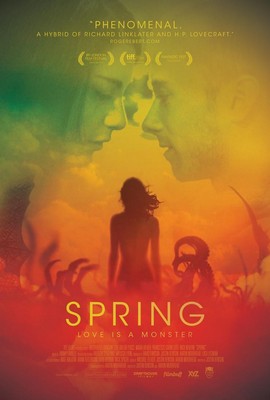
Well, regardless of what you may think of the film overall, Spring will take you by surprise.  The film takes two different genres — talky romance and body horror — and mashes them together.  It’s the sort of thing that shouldn’t work and, yet, it somehow does.  If Richard Linklater and David Cronenberg spliced their DNA, the result would be Spring.

Spring opens in Los Angeles, with Evan (Lou Taylor Pucci) sitting at the bedside of his cancer-stricken mother and watching her die.  After the funeral, Evan is drinking at a bar when a drunk and obnoxious toadsucker picks a fight with him.  Though Evan, at first, tries to avoid the confrontation, he eventually ends up punching the man.  (Evan spends the majority of the film trying to avoid confrontation.  He’s actually a genuinely likable character and when was the last time you saw that in a film?)  With the man now looking to kill him and the police possibly interested in pressing assault charges, the distraught Evan impulsively decides to take a trip to Italy.

He spends a while wandering around Italy.  He hangs out with obnoxious and continually drunk tourists, the type who will be familiar to anyone who has ever spent the summer after high school graduation in Europe.  And, eventually, he ends up in a beautiful Italian village, where he meets the mysterious Louise (Nadia Hilker).

Louise is a researcher and, at first, it would seem like she and Evan have little in common.  (She’s an intellectual.  Evan, cute as he is, most definitely is not.)  But, over the course of a week, they get to know each other and Evan starts to fall in love with Louise.  These scenes are full of nonstop conversation, covering topics of culture, history, and philosophy.  It’s an obvious homage to Richard Linklater’s films with Ethan Hawke and Julie Delpy and it works perfectly.  Both Pucci and Hilker are likable performers and they have a lot of chemistry.

However, there’s another story unfolding.  At night, a strange creature roams the city, eating stray animals and eventually killing one of the most obnoxious American tourists to ever appear in a film.  How do these two stories connect?

Well, I’m not going to tell you.  You need to see the movie for yourself.

To be honest, when I started this review, I thought I was going to be a lot more critical of Spring.  As often happens with ambitious but low-budget indie films, there are a few scenes where the pacing is off and, once the solution to the film’s big mystery has been revealed, the explanation goes on for a bit too long.  I appreciate the filmmakers attempt to make everything plausible but, sometimes, it’s better to just gloss over the exact details.

But you know what?

As I sit here writing this review, I realize that those criticisms may be valid but, in the big picture, they don’t really matter.  So what if the film has flaws?  All films have flaws!  Spring tells a unique and interesting story and it will take you by surprise.  Plus, it captures the romance of Italy!  So, instead of getting all nitpicky, I’m just going to recommend that you see the film.