Insomnia File #69: Candy (dir by Christian Marquand)


What’s an Insomnia File? You know how some times you just can’t get any sleep and, at about three in the morning, you’ll find yourself watching whatever you can find on cable or streaming? This feature is all about those insomnia-inspired discoveries!

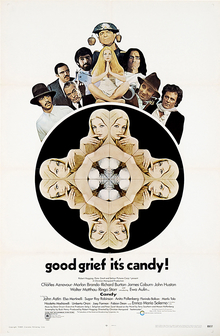
If you find yourself having trouble getting to sleep tonight, you can always pass the time by watching the 1968 film, Candy.  It’s currently on Tubi.

Based on a satirical novel by Terry Southern and Mason Hoffenberg, Candy follows Candy Christian (Ewa Aulin), a naive teenager from middle America as she has a number of increasingly surreal adventures, the majority of which end with her getting sexually assaulted by one of the film’s special guest stars.  It’s very much a film of the 60s, in that it’s anti-establishment without actually seeming to know who the establishment is.  It opens with a lengthy sequence that appears to be taking place in outer space.  It ends with an extended sequence of Candy walking amongst the film’s cast and a bunch of random hippies.  Director Christian Marquand appears as himself, directing the film.  Yep, this is one of those films where the director and the film crew show up and you’re supposed to be say, “Far out, I didn’t realize I was watching a movie, man.”

The whole thing is a bit of a misfire.  The novel was meant to be smut that satirized smut.  The film isn’t really clever enough to work on any sort of real satirical level.  As was the case with a lot of studio-made “psychedelic” films in the 60s, everything is a bit too obvious and overdone.  Casting the Swedish Ewa Aulin as a character who was meant to represent middle America was just one of the film’s missteps.  Based on The Graduate, Mike Nichols probably could have made a clever film out of Candy.  The French Christian Marquand, a protegee of Roger Vadim’s, can not because he refuses to get out of the film’s way.  It’s all jump cuts, flashy cinematography, and attempts to poke fun at American culture by someone who obviously knew nothing about America beyond the jokes told in Paris.

That said, the main reason that anyone would watch this film would be for the collection of guest stars who all show up and try to take advantage of Candy.  Richard Burton plays an alcoholic poet named MacPhisto and his appearance goes on for far too long.  (Burton, not surprisingly, appears to actually be drunk for the majority of his scenes.)  Ringo Star — yes, Ringo Starr — plays a Mexican gardener who assaults Candy after getting turned on by the sight of MacPhisto humping a mannequin.  When Emmanuel’s sisters try to attack Candy, she and her parents escape on a military plane that is commanded by Walter Matthau.  Landing in New York, Candy’s brain-damaged father (John Astin) is operated on by a brilliant doctor (James Coburn) who later seduces Candy after she faints at a cocktail party.  Candy’s uncle (John Astin, again) also tries to seduce Candy, leading to Candy getting lost in New York, meeting a hunchback (Charles Aznavour), and then eventually ending up with a guru (Marlon Brando).  Candy’s adventures climax with a particularly sick joke that requires a bit more skill to pull off than this film can afford.

If you’re wondering how all of these famous people ended up in this movie, you have Brando to thank (or blame).  Christian Marquand was Brando’s best friend and Marlon even named his son after him.  After Brando agreed to appear in the film, the rest of the actors followed.  Brando, Burton, and Coburn received a share of the film’s profits and Coburn later said that his entire post-1968 lifestyle was pretty much paid for by Candy.  That seems appropriate as, out of all the guest stars, Coburn i the only one who actually gives an interesting performance.  Burton is too drunk, Matthau is too embarrassed, Starr is too amateurish, and Brando is too self-amused to really be interesting in the film.  Coburn, however, seems to be having a blast, playing his doctor as being a medical cult leader.

Candy is very much a film of 1968.  It has some value as a cultural relic.  Ultimately, it’s main interest is as an example of how the studios tried (and failed) to latch onto the counterculture zeitgeist.
Previous Insomnia Files:

  1. Story of Mankind
  2. Stag
  3. Love Is A Gun
  4. Nina Takes A Lover
  5. Black Ice
  6. Frogs For Snakes
  7. Fair Game
  8. From The Hip
  9. Born Killers
  10. Eye For An Eye
  11. Summer Catch
  12. Beyond the Law
  13. Spring Broke
  14. Promise
  15. George Wallace
  16. Kill The Messenger
  17. The Suburbans
  18. Only The Strong
  19. Great Expectations
  20. Casual Sex?
  21. Truth
  22. Insomina
  23. Death Do Us Part
  24. A Star is Born
  25. The Winning Season
  26. Rabbit Run
  27. Remember My Name
  28. The Arrangement
  29. Day of the Animals
  30. Still of The Night
  31. Arsenal
  32. Smooth Talk
  33. The Comedian
  34. The Minus Man
  35. Donnie Brasco
  36. Punchline
  37. Evita
  38. Six: The Mark Unleashed
  39. Disclosure
  40. The Spanish Prisoner
  41. Elektra
  42. Revenge
  43. Legend
  44. Cat Run
  45. The Pyramid
  46. Enter the Ninja
  47. Downhill
  48. Malice
  49. Mystery Date
  50. Zola
  51. Ira & Abby
  52. The Next Karate Kid
  53. A Nightmare on Drug Street
  54. Jud
  55. FTA
  56. Exterminators of the Year 3000
  57. Boris Karloff: The Man Behind The Monster
  58. The Haunting of Helen Walker
  59. True Spirit
  60. Project Kill
  61. Replica
  62. Rollergator
  63. Hillbillys In A Haunted House
  64. Once Upon A Midnight Scary
  65. Girl Lost
  66. Ghosts Can’t Do It
  67. Heist
  68. Mind, Body & Soul

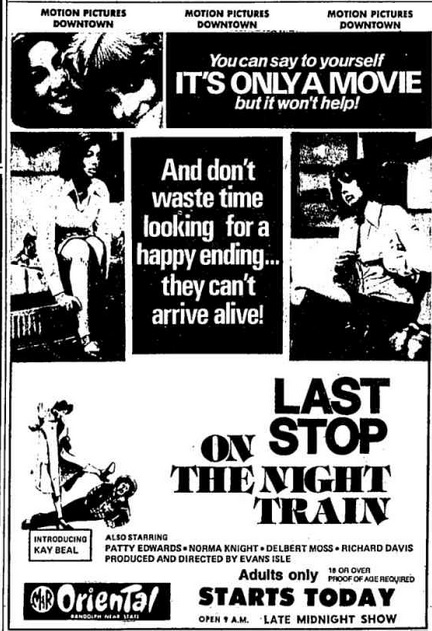
International Horror Film Review: Last Stop on the Night Train (dir by Aldo Lado)


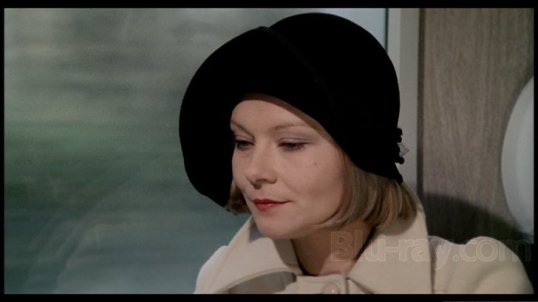
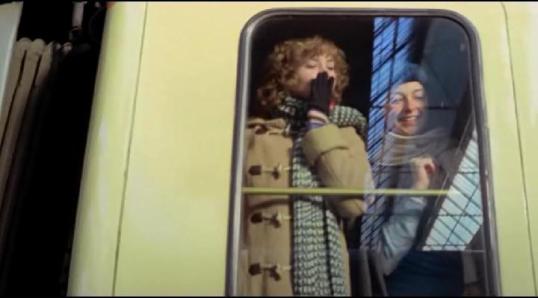
This Italian film from 1975 opens with two German teenagers — Lisa Stradl (Laura D’Angelo) and Margaret Hoffenbach (Irene Miracle) — happily looking forward to the future in general and spending Christmas with Lisa’s parents in specific.  (Of course, the Stradls live in Verona so Lisa and Margaret are going to have to take a train to visit them.)  Their happiness is reflected by the song that plays over the opening credits.  A Flower’s All You Need is perhaps the most obnoxiously happy song to ever show up in an Italian horror film.  Imagine my shock when I discovered that it was apparently co-written by Ennio Morricone.

Like many Italian exploitation films, Last Stop on the Night Train has been released under many different titles.  Here’s just a few: Night Train Murders, Xmas Massacre, Don’t Ride on Late Night Trains, Torture Train, New House on the Left and Second House on the Left.  As those last two titles indicate, this film was directly inspired by the financial success of Wes Craven’s Last House on the Left (which, for what it’s worth, was sold as being a remake of Ingmar Bergman’s The Virgin Spring).  According to an interview with director Aldo Lado, which was included with the film’s Code Red DVD release, the film’s producers approached him and told him that they wanted him to remake Last House On The Left.  Since Lado hadn’t seen Last House on the Left, the producers hastily filmed him on what happened in Craven’s film.  Based on what the producers told him, Lado proceeded to write the script for what would become Last Stop On The Night Train.

As a result, Last Stop on the Night Train follows the general plot of Last House on the Left but with some key differences.  Lado was a protegee of director Bernardo Bertolucci so, not surprisingly, he added a Marxist political subtext to the story, one that makes Last Stop On The Night Train a bit more interesting than the usual exploitation rip-off.  (Wes Craven, it should be said, always said that Last House On The Left was meant to be political, too.  Whether that’s true or not is open to debate.)  Like Craven’s film, Last Stop On The Night Train is about two innocent travelers who are abused and murdered by a group of thugs (played, in this case, by Flavio Bucci and Gianfranco de Grassi).  By an amazing coincidence, the murderers then find themselves staying at the home of one of the girl’s parents (Enrico Maria Salerno and Marina Berti).  When the parents discover the identity of their guests, they get revenge and prove themselves to be just as capable of violence and sadism as the murderers.

The main difference between Craven and Lado’s take on the story is that Lado adds a mysterious character who is identified as being only The Lady on the Train (played by Macha Meril, who also played the unlucky psychic in Argento’s Deep Red).  The Lady on the Train is apparently very privileged.  When we first see her, she is coolly and calmly talking to a group of other wealthy passengers.  The only hint that she’s anything other than an upper class passenger on a train comes when she reveals that she’s carrying a collection of BDSM-themed postcards with her.  Before meeting the Lady on the Train, the two criminals played by Bucci and de Grassi were portrayed as just being obnoxious and larcenous but not necessarily homicidal.  It’s the Lady on the Train who goads the two men into attacking and ultimately murdering Lisa and Margaret, largely for her own amusement.  (Disturbingly, the train’s other upper class passengers are portrayed as being aware of what’s happening but either not caring or being amused by the whole thing.  One passenger — who is later revealed to be an acquaintance of the Stradls — briefly joins in.)  Even at the end of the film, while the parents are savagely attacking the two men, the Lady on the Train watches with the confident certainty that her wealth and position will protect her from any form of retribution.

It’s a disturbing film and definitely not one for everyone.  Even if you appreciate the technical skill with which it was made, this is a film that you won’t necessarily want to rewatch.  (I rewatched it only so I could write this review.  For me, it certainly didn’t help that one of the victims was named Lisa.)  If Wes Craven’s film was ultimately about gore and the idea that violence only leads to more violence, Lado is less concerned with both of those and instead focuses on the idea that, when the privileged and the marginalized both commit the same crime, only the marginalized are punished.  Lado’s film is also far better acted (and, if we’re going to be honest, directed) than Craven’s film, which makes Last Stop On The Night Train the rare rip-off that’s better than its source material.

The Films of Dario Argento: The Bird With The Crystal Plumage


the-bird-with-the-crystal-plumage-2

Dario Argento.

The name inspires a lot of reactions.  Some people will tell you that Dario Argento is one of the greatest directors of all time.  Some people regularly cite him as being a prime example of an artist who hit his peak too early and who has spent the latter part of his career imitating his previous successes.  Some people will tell you that his films are dangerous.  He’s one of those directors whose films always seem to end up getting banned in certain communities.  Other cineastes will always praise him as a superior stylist whose influence is still felt to this very day.  Argento’s films have inspired thousands of horror filmmakers.  His films have also inspired a countless number of viewers to fall in love with horror.  Without the influence of Argento the horror genre would be not only less interesting but less profitable as well.

Myself, I’m a huge Argento fan.  Yes, I do love Suspiria but then again, everyone love Suspiria.  I have also made it a point to track down and watch the forgotten and/or critically reviled Argento films, like Trauma and The Phantom of the Opera.  My love of Argento is so strong that I usually even find myself enjoying his less acclaimed work as much as his acknowledged triumphs.  He is one of the masters of horror, a true maestro of Italian art.  For the longest time, I’ve been meaning to watch and review all 21 of Argento’s cinematic thrillers.  (Sadly, his one non-thriller, The Four Days, is notoriously difficult to see.)  With this being October, I figured why not now?

Dario Argento made his directorial debut in 1970 with The Bird With The Crystal Plumage.  Before directing his first movie, Argento had been a film critic and a screenwriter.  (Among other credits, he is listed as being one of the writers of Sergio Leone’s Once Upon A Time In The West.  Interestingly enough, his co-writer was another future director, Bernardo Bertolucci.)  With his very first film as a director, Argento established himself as a master of both suspense and horror.

I have seen some reviews that have identified The Bird With The Crystal Plumage as being the first giallo film.  That’s not at all true.  If anything, the credit for directing the first giallo should probably go to Mario Bava (who directed The Girl Who Knew Too Much in 1964) and some students of Italian cinema would even disagree with that.  However, The Bird With The Crystal Plumage undoubtedly did a lot to popularize the genre outside of Italy.

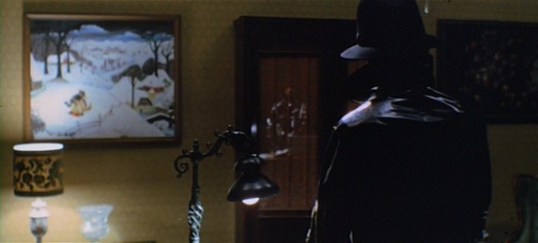
The film tells the story of Sam (Tony Musante) and his girlfriend, Julia (Suzy Kendall).  Sam is a writer and he’s living in Rome.  Argento is not traditionally known as an actor’s director but Musante and Kendall are both remarkably sympathetic in their roles and they seem to have a very real chemistry when they’re both on-screen together.  You actually do care about them as a couple and you find yourself hoping that nothing bad happens to them.  One thing that I liked was that their tiny apartment looked like it was someplace where a couple actually would live, love, and try to solve a murder.  Looking at Sam and Julia in that apartment (which is decorated with a picture of Albert Einstein and a poster reading “Black Power!”), you get the feeling that they have an existence outside of what you’re seeing during the film’s 94 minute running time.  They feel real.

Reportedly, Tony Musante and Argento did not have a great working relationship.  (Mustante was a character actor who wanted to talk about motivation.  Argento was more concerned with the technical aspects of shooting the film.)  Mustante may have been miserable but that actually works for his character.  When we first meet Sam, he’s frustrated because he’s suffering from writer’s block.  He’s so frustrated that he’s on the verge of moving back to the United States.  Sam’s frustration feels real and if that’s because Musante happened to be frustrated while shooting the film, so be it.  Whatever works.

One night, Sam goes for a walk and witnesses a stabbing in an art gallery.  Monica Ranieri (Eva Renzi) survives but it appears that her assailant has managed to escape.  The police suspect that Sam might be more than just a witness so they confiscate his passport.  Until the attacker is caught, Sam is stuck in Rome.

There’s a serial killer terrorizing Rome and both Sam and the police suspect that Monica nearly became the killer’s latest victim.  Some of the film’s most unnerving sequences are shot from the point-of-view of the killer, a technique that both leaves the killer’s identity a secret and also makes the audience complicit in the murders.  It’s as if Argento the film critic is daring the audience to consider why they’re watching what Argento the director is doing.

(And the murders in The Bird With The Crystal Plumage are brutal, even by the standards of Italian cinema.  The first murder that we actually witness — which is usually referred to as being “the panty murder,” for reasons that I’m not going to freak myself out by describing — is pure and total nightmare fuel.)

Everything that you might expect to find in a giallo is present in The Bird With The Crystal Plumage.  It may not have been the first but it’s definitely one of the prototypes for what the genre is usually considered to be.  Graphic violence, sexual perversion, point-of-view shots, a constantly roaming camera, a dramatic musical score, a killer who wears black gloves and carries a razor, a witness who has to prove his innocence, and a solution that’s revealed only when Sam reexamines what he thinks he saw; it’s all here.

What distinguishes The Bird With The Crystal Plumage is the style with which Argento tells his story.  Dario was 30 years old when he directed The Bird With The Crystal Plumage and there’s an infectious enthusiasm to the way he frames the mayhem.  Like many film critics directing their first film, Argento fills his debut with homages to earlier films.  You can tell he’s having a lot of fun while discovering just how far he can go without losing his audience.

46 years after it was first released, The Bird With The Crystal Plumage holds up surprisingly well.  It’s a nightmarish but compulsively watchable thrill ride and it remains one of Argento’s best.