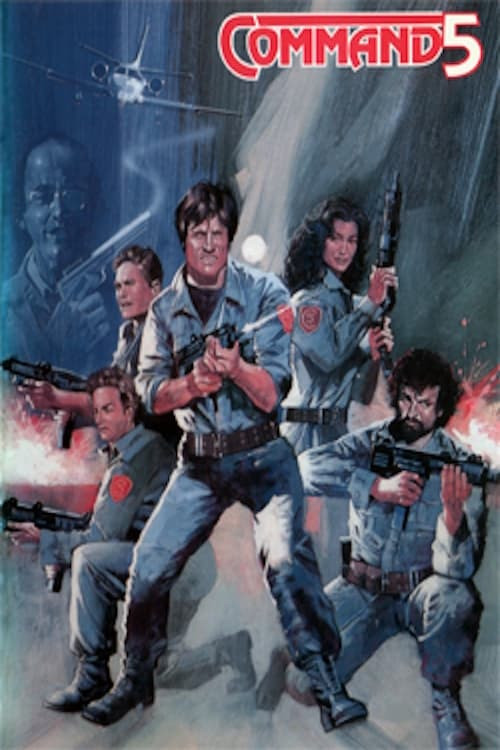
Command 5 (1985, directed by E.W. Swackhamer)


Morgan (Stephen Parr) is a mysterious government operative who puts together a special paramilitary force to take on extreme threats.  He says that only misfits are allowed to join his group because they have the edge he needs.  Smith (William Russ) is a wild Texan who drives like a maniac.  Psychiatrist Winslow (Sonja Smits) can fire an Uzi better than any man.  Kowalski (John Matuszak) is a demolitions expert who listens to Beethoven.  Jack Coburn (Wings Hauser) is a rebellious detective who is good with a throwing knife.

After a montage of their extensive training and a scene where our heroes take a look at the bullet-proof RV that they’ll be traveling the country in, the movie finally gets down to business.  A motorcycle-riding terror cult led by Delgado (Gregory Sierra) has taken an entire town hostage and is threatening to kill everyone unless they’re given a flight out of the country.  Our heroes drive their bulletproof van into town and try to defeat the bad guys.  There’s one good scene where the RV is driving down the town’s main street and getting hit nonstop with bullets.  The scene was obviously ripped off from the end of Clint Eastwood’s The Gauntlet but it’s still exciting to watch.  Otherwise, the action in this one is pretty rudimentary.

I guess Command 5 was supposed to be a pilot for television show that never went into production.  It is very much a television production.  There’s a lot of shooting but no blood.  Wings Hauser is less dangerous than usual.  The whole thing ends with Command 5 looking forward to adventures that were never to come.  Watching the pilot, you can see why it never became a show.  The characters were all thinly-written and never seemed to have much of a connection with each other and Hauser and Russ both seemed to be competing to be the loose cannon of the group.  This one is for Wings Hauser completists only.

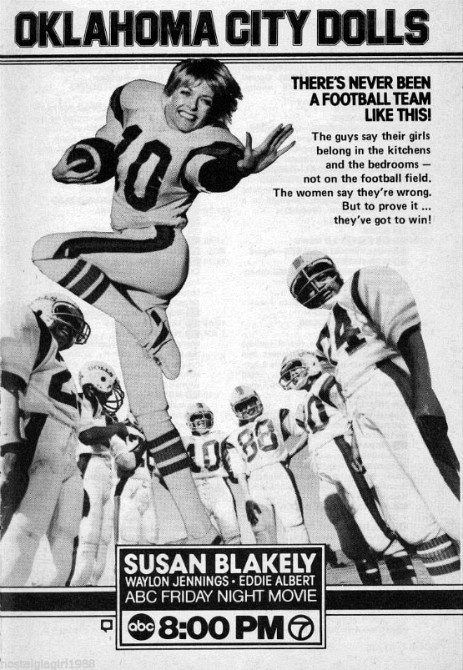
The Oklahoma City Dolls (1981, directed by E.W. Swackhamer)


At an Oklahoma manufacturing plant, the women are always expected to put in extra hours while their male co-workers practice as a part of the company’s football team.  Shop steward Sally Jo (Susan Blakely) files a complaint with the EEOC.  John Miller (Robert Hooks) pays a visit to the plant and says that the women have to be given the same opportunities and benefits as the man, including recreation time.  The plant’s foreman, J.D. Hines (David Huddleston), agrees.  The woman can have recreation time as long as they’re doing what the men are doing and that’s playing football.  Determined to show up Hines and all of her sexist co-workers (and her boyfriend, played by Waylon Jennings), Sally Jo puts together a football team and even gets a broken-down former NFL coach (Eddie Albert) to serve as their trainer.

There actually was a woman’s football team called The Oklahoma City Dolls.  They played in the National Women’s Football League and they won the league’s championship three times.  However, they don’t appear to have anything to do with this movie, which is as much about Sally Jo trying to get a fair treatment for the workers as it is about hitting the field and running it in for a touchdown.  There are some parts of the movie that work.  I liked Eddie Albert’s performance as the alcoholic coach and the scene where he discovered that his community service would include coaching a group of women who had never played football before.  Folk singer Ronee Blakley was good as the team’s emotionally fragile wide receiver.  I even liked that the women didn’t all automatically become the world’s best football players.  The movie’s main weakness was that Susan Blakely just wasn’t believable as someone who lived in a trailer park, used “ain’t” in every sentence, and spent her time organizing a union.  She was too glamorous for the role and her scenes with Waylon Jennings all felt overwritten and overacted.  The story couldn’t decide if it wanted to be a drama about working in a factory or a football comedy and it was pretty uneven as a result.  The good thing is that the movie’s heart was in the right place, even if it didn’t always score a touchdown.

As for the real life Oklahoma City Dolls, they were active from 1976 to 1979.  An attempt to revive the team in 1982 failed when their financial backers pulled out at the last seconds.  The National Women’s Football League folded in 1988.

Retro Television Reviews: Lookwell 1.1 “The Pilot”


Welcome to Retro Television Reviews, a feature where we review some of our favorite and least favorite shows of the past!  On Thursdays, I will be reviewing Lookwell, which aired on NBC in 1991.  The entire show is currently streaming on YouTube!
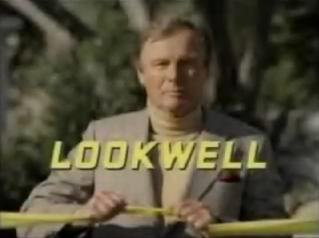
Adam West is an actor who solves crimes …. kind of.

Episode 1.1 “Lookwell”

(Dir by E.W. Swackhamer, originally aired on July 28th, 1991)

Ty Lookwell (Adam West) was once the biggest star in Hollywood.

Well, maybe not the biggest star.  But, in the 70s, he did have his own cop show.  It was called …. BanacekMannix?  No, that’s not it.  Oh …. BRANNIGAN!  Ty Lookwell starred on a show called Brannigan and he was even given his own honorary police badge in 1972.  It was presented to him at a ceremony in Television City.

However, nearly 20 years later, things have changed.  Brannigan is no longer on the air and Ty Lookwell has been reduced to wearing a wig and a leather jacket in an attempt to get a role in a revival of Happy Days.  (He not only doesn’t get the role but he doesn’t even get to audition.)  When he returns to his home, he is informed that his favorite hairspray has been discontinued (“Those fools!”) and that all the messages on his machine are for his nephew.  Kevin Costner calls looking for Lookwell’s nephew.  Francis Ford Coppola calls for Lookwell’s nephew and leaves a message in which he promises to call back.  No one calls for Ty Lookwell.

Lookwell, however, still has a steady gig teaching an acting class and his students not only look up to him  but also help him out whenever he decides that there’s a crime he has to solve.  This apparently happens frequently as Lookwell takes his honorary badge very seriously.

“Remember how we talked about how you don’t have to come around here?” Detective Kennery (Ron Frazier) asks Lookwell at one point.

The pilot follows Lookwell as he investigates a series of car thefts.  Helping him out is his favorite student, Jason (played by future director Todd Field).  Lookwell’s investigative techniques are not particularly complicated.  He puts on a disguise and attempts to go undercover.  It never quite works, largely because everyone that Lookwell meets is smarter than Lookwell.  Lookwell’s attempt to disguise himself as a Grand Prix racer fails because the security guard takes one look at him and sees that he’s obviously not a Grand Prix racer.  His attempt to conduct a stakeout on a fancy diner is nearly thwarted by his bizarre decision to disguise himself as a hobo.  His attempt to go undercover at a garage is thwarted by the other mechanics misunderstanding his leading questions.

(“Who beat you up, Mr. Lookwell?” his students ask at the start of class.)

As the investigation continues, Jason wonders if they’re just wasting time.

“You do not waste time,” Lookwell corrects him, “Time wastes you.”

Lookwell was written by Conan O’Brian and Robert Smigel, long before either one of them became famous, and the humor is definitely the humor of a generation who grew up watching network television, especially the cop shows of the 70s and the 80s.  While the dialogue is clever and definitely funny, it’s really Adam West who makes the pilot work.  West delivers all of his line with such conviction and confidence that it doesn’t matter that he only plays a peripheral role in solving the case and, in fact, usually makes things worse for everyone involved.  As played by West, Lookwell is so confident in his abilities and so blithely unaware of his limitations that it’s hard not to admire his spirit.

Unfortunately, the spirit was not admired by NBC and Lookwell only aired once.  But it has since developed a cult following.  Adam West described it as being his favorite of the various shows that he did.  I enjoyed the pilot, though I do think the premise was perhaps a bit too thin to support an actual series.  (It would have made a great recurring SNL bit, though.)  Thanks to YouTube, everyone can now watch what NBC passed up.
Retro Television Reviews: Death Sentence (dir by E.W. Swackhamer)


Welcome to Retro Television Reviews, a feature where we review some of our favorite and least favorite shows of the past!  On Sundays, I will be reviewing the made-for-television movies that used to be a primetime mainstay.  Today’s film is 1974’s Death Sentence!  It  can be viewed on YouTube!

There’s been a murder!

A young woman has been strangled in her own home.  The nosy neighbor (Hope Summers) testifies that the woman often argued with her woman and that she heard the woman yelling on the night of the murder.  The husband, John Healy (Nick Nolte), is found in a neighborhood bar and, when he’s brought back to his house, his drunken reaction to seeing his dead wife doesn’t do much to keep him from looking totally guilty.

However, the viewer knows that John is innocent because the viewer has already seen that the woman was murdered by Don Davies (Laurence Luckinbill), the man with whom she was having an affair.  She demanded that he leave his wife for her and Don, realizing that his cheating was about to revealed, responded by strangling her.

Don’s wife is Susan Davies (Cloris Leachman), who knows that she and Don have been going through a rough patch but who certainly had no idea that Don was cheating on her.  Shortly after the murder, Susan is called up for jury duty.  She’s placed on the jury and told that she will be an important part of a major trial.  As a result, she and the other jurors will be sequestered in a hotel….

And who is the defendant in this trial?  John, of course!

As opposed to the other members of the jury, who are ready to convict John even before the first bit of testimony is heard, Susan pays attention to what is said in the courtroom.  She listens to Lubell (Alan Oppenheimer), the prosecutor.  She listens to Tanner (William Schallert), the defense attorney.  She comes to believe that John is innocent but will she be able to hold her own against the rest of the jury?  And will she ever figure out that the murder was actually committed by her husband?

It’s an intriguing premise, even if it is a bit far-fetched.  I mean, it really is an amazing coincidence that Susan just happened to end up on the jury for a case involving a murder that was actually committed by her husband.  However, this is a made-for-television movie and, as soon as “Produced by Aaron Spelling” appears on the screen, most viewers should be savvy enough to know what they’re getting into.  Instead, the main problem with the film is that it opens by showing us who the murderer is.  Therefore, there’s really zero suspense as to who actually committed the crime.  Instead, the viewer spends the entire movie waiting for Susan to catch up.  Since the majority of the film takes place in court, it’s a very talky film but there’s no joy to be found in paying close attention to every word said and picking up on the details that will allow you to solve the crime for yourself.  This is a case where the film spoils its biggest twist and, despite good performances from Leachman and Luckinbill, it’s a bit dull.

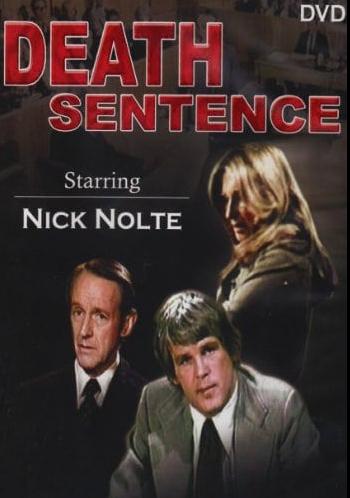
(Nick Nolte, for his part, spends most of the movie silently sitting in the courtroom.  He’s not bad and his look of anguish is believable but it’s hardly a starring role, regardless of what the film’s video packaging might otherwise claim.)

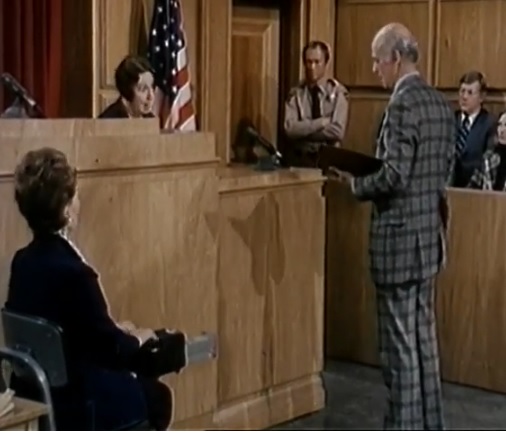
In the end, what I’ll mostly remember about Death Sentence were the atrocious fashion choices made by the prosecutor.  Seriously, would you trust a man wearing this suit?

Horror Film Review: Terror at London Bridge (dir by E.W. Swackhamer)


On a foggy London night in 1888, the shadowy killer known as Jack the Ripper is pursued by a combination of police and citizens.  Cornered and facing certain execution if captured, Jack jumps off of London Bridge and disappears into the murky waters of the Thames.

Jump forward to the late 80s.  London Bridge has been transported, brick-by-brick, to a town in Arizona and it now serves as a somewhat tacky tourist attraction.  Unfortunately, it turns out that Jack the Ripper’s spirt is inside in the bricks and transporting the bridge has also transported Jack.  Considering that Jack died in the Thames, I’m not really sure why his spirit will still be trapped in the bricks of the bridge.  It seems like his spirit should still be in the river but whatever.  Let’s just go with it.  One tourist accidentally cuts her finger while walking across the bridge.  Her blood hits the wrong brick and suddenly, Jack the Ripper is alive and killing in Arizona!  Can the murders be stopped before they interfere with the tourist season!?

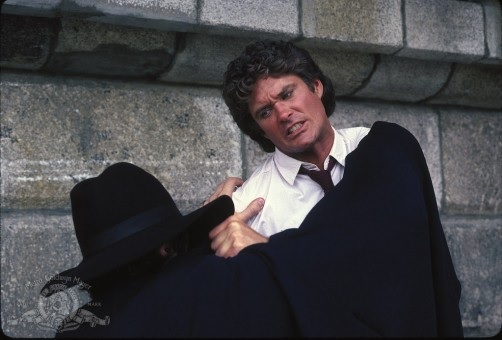
Only Detective Don Gregory (David “The Hoff” Hasselhoff) thinks that Jack the Ripper has returned to life.  His captain (Clu Gulager) doesn’t believe him.  The sleazy city councilamn (Lane Smith) doesn’t believe him.  His potential girlfriend, Angie (Stepfanie Kramer), has doubts about Don’s theory.  His own partner (Randolph Mantooth) doesn’t buy it.  Even Angie’s best friend, a librarian named Lynn (Adrienne Barbeau), doesn’t think that there’s any connection between Jack the Ripper and the handsome Englishman (Paul Rossilli) who has recently been stopping by the library and flirting with her.

And really, why would anyone believe Don?  His theory makes no sense, even if it does turn out to be true.  Indeed, Don is remarkably quick to accept the idea of Jack the Ripper traveling through time.  Of course, what also doesn’t make sense is the city council’s refusal to shut down the bridge until the killer’s been caught.  It’s the tourist season but seriously, it seems like a serial killer — whether he’s Jack the Ripper or not — would be bad for business!

This 1985 movie was made for television.  The premise is intriguing but the execution is a real let-down.  It’s a 90 minute film and the Hoff doesn’t really seem to get serious about trying to hunt down Jack the Ripper until 60 minutes in.  This is the odd Jack the Ripper film in which the Ripper is often treated as an afterthought.  Instead, the majority of the film is taken up with Don flirting with Angie and trying to come to terms with an accidental shooting that occurred when Don was a cop in Chicago.  The whole Jack the Ripper subplot is almost treated like a red herring, which is an odd way to treat a 19 century villain who can travel through time.  I mean, sometimes, romance has to wait until the time-traveling serial killer has been taken care of.  It’s all about priorities.

In the end, this one is for hardcore Hasselhoff fans only.  Those who want to watch a Jack the Ripper time traveling movie would be better served by watching Time After Time, featuring David Warner as the Ripper and Malcolm McDowell as H.G. Wells.

Horror On The Lens: Night Terror (dir by E.W. Swackhamer)


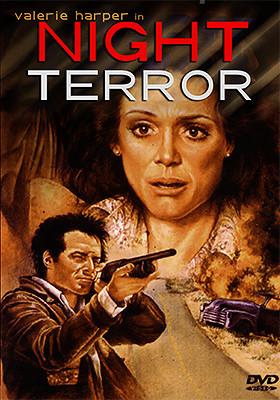
Today’s horror on the lens is a surprisingly violent and grim made-for-TV movie from 1977, Night Terror! 

In Night Terror, Valerie Harper plays a woman trying to drive to Denver, overnight.  Unfortunately, she catches the attention of The Killer (played by Richard Romanus), a mute psychopath who spends his time driving up and down the highway, killing random people.  This is a pretty well-done and suspenseful made-for-television movie, featuring good performances from both Harper and Romanus.  I wrote a more in-depth review of the film back in May so give it a read after you watch the movie.

(Or before you watch the movie.  I’m not going to tell you how to do things.)

Drive carefully!

https://www.youtube.com/watch?v=hahgGBOHLSg


Film Review: Night Terror (dir by E.W. Swackhamer)


“There’s a killer on the road.

His brain is squirming like a toad.”

So sang Jim Morrison in the song Riders on the Storm. Now, whatever you may think of Jim Morrison and the Doors (personally, I think the music was good, Jim was pretentious as Hell, and I look cute in my Doors t-shirt), this is a perfect description of the character who is at the center of the 1977 film, Night Terror. He’s played by Richard Romanus and, in the credits, he’s simply called The Killer. The Killer spends his times driving up and down the highway, killing people seemingly at random. We never learn why exactly the Killer does what he does, though the film does offer up a few hints. For one thing, he has no voice. He carries an electrolarynx with him and holds it up to his throat whenever he wants to speak. Of course, he only does this two times in the film and, both times, it’s to basically howl with rage. In another scene, he can clearly be seen to be wearing military-style dog tags. Given when this film was made and the unfortunate popularity of the “deranged Vietnam vet” trope in the 70s and 80s, it’s easy to pick up on what exactly the film is implying.

Night Terror follows one night in the life of both The Killer and Carol Turner (Valerie Harper). Carol is just trying to get to Denver, where her son is in the hospital. When she sees a police officer pulling over a sports car for speeding, Carol decides to ask the cop for directions. Unfortunately, the sports car belong to The Killer and, as soon as the cop turns his back on him, out comes the shotgun. Carol slams down on the accelerator and speeds off, with the Killer pursuing her in own his vehicle. Unfortunately, Carol’s station wagon (which comes with wood paneling because, again, this is a movie from 1977) is nearly out of gas. What follows is a fairly tense game of cat-and-mouse, as Carol tries to hide from the Killer while the Killer stalks the highway, relentlessly searching for her. Along the way, a few familiar character actors pop up. John Quade is a homeless man living in a gas station. The great Nicholas Pryor is another motorist, one who proves to be not much help. Making things all the more dangerous for Carol is that the Killer knows what she looks like but she has no idea what the Killer looks like.

Night Terror owes an obvious debt to Steven Spielberg’s Duel and a host of other 70s car chase films. While Night Terror really can’t compare to the Duel, it does do a good job of creating and maintaining suspense. Fortunately, the film never makes the mistake of tying to turn Carol into some sort of badass action girl. She’s just an average person who has found herself in a terrifying situation and, as played by Valerie Harper, she’s never less than relatable. Richard Romanus, meanwhile, makes for a terrifying killer. The fact that he occasionally flashes a rather child-like smile only serves to make his single-minded pursuit of Carol all the more frightening. We never learn much about what’s led The Killer to becoming what he is but Romanus gives such an intense performance that we don’t need to understand him in order to be scared of him. He’s a nightmare come to life.

Night Terror ends on a somewhat awkward note, as if the filmmakers suddenly remembered that they were making a made-for-TV movie as opposed to a feature film. But, that said, Night Terror is an effectively scary and suspenseful road film. It can currently be viewed on YouTube.

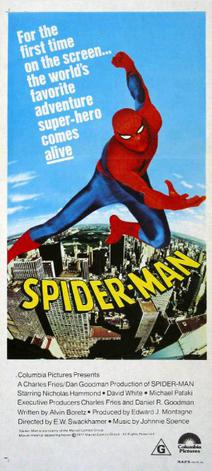
Spider-Man (1977, directed by E.W. Swackhemer)


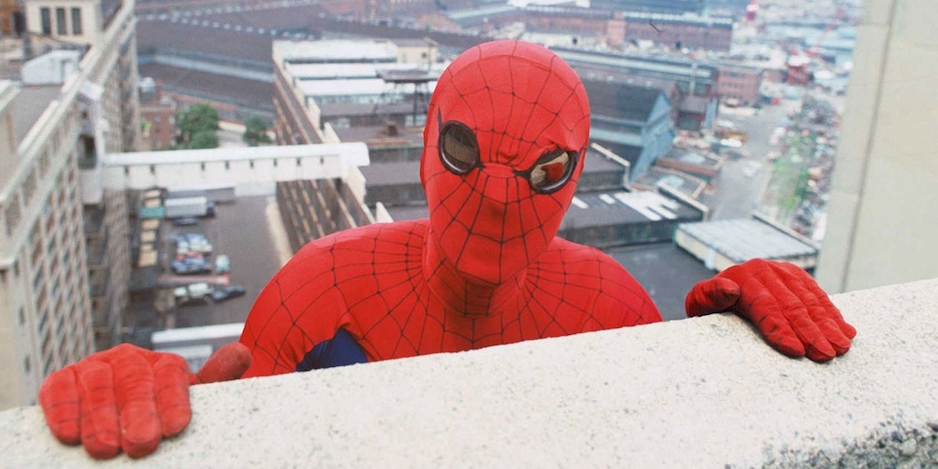
When a college student named Peter Parker (Nicholas Hammond) is bitten by a radioactive spider, he’s stunned to discover that he can now do everything that a spider can.  He can climb walls.  He has super strength.  He has super senses.  And, once he invents a sticky web serum, he can shoot webs and swing around the city!  All he has to now is sew himself a red and blue costume and he’ll be ready to fight crime in New York City!

It’s not a minute too soon because New York is dealing with a crime wave that only Spider-Man can deal with.  Seemingly ordinary people are suddenly going into hypnotic trances, stealing money and committing suicide.  An extortionist sends words that, unless he’s paid a lot of money, he’s going to unleash a wave hypnotic chaos on the city.  Could it have anything to do with a sinister New Age guru and hypnotist named Edward Byron (Thayer David)?

Though it was released theatrically in Europe, Spider-Man was produced for television and it served as the pilot for a short-lived CBS television series.  Along with The Incredible Hulk, this was one of the first attempts to build a television series around one of Marvel’s characters.  Unfortunately, the series only last 14 episodes before being canceled.  Though it can be hard to believe nowadays with the nonstop hype around every single comic book movie, there was a time when television and film executives were actually weary about trying to bring super heroes like Spider-Man and Captain America to life.  According to Stan Lee (who served as a consultant on Spider-Man), CBS wanted to distance their version of Spider-Man from its comic book origins.  While both the pilot and the series features Peter Parker crawling up walls and shooting webs, there’s no Uncle Ben.  There’s no talk about how with great power comes great responsibility.  Worst of all, there are no members of Spider-Man’s famed rogue’s gallery.  No Electro, no Sandman, no Green Goblin, and certainly no Dr. Octopus.  CBS wanted the show to feature down-to-Earth villains, which is an interesting strategy for a show about a grad student who can climb walls.

The television version of Peter Parker isn’t as insecure and angsty as either the comic book version or even the movie versions.  Hammond is likable and sincere in the role but he is also almost too self-assured as Parker, proof that CBS didn’t understand that a huge part of Spider-Man’s appeal was that he was never as confident as Superman or Captain America.  Instead, much like many of the people who read his comic, Peter was frequently worried and consumed with self-doubt.  The comic book version of Spider-Man was always wracked with guilt for not stopping the thief who eventually killed Ben.  The television version was more worried about selling enough selfies to The Daily Bugle to be able to go on a date with his professor’s daughter.

At least the pilot film featured a villain who wouldn’t have felt out of place in an issue of The Amazing Spider-Man, though he probably would have had a cool villain name, like the Mesmerizer, if he had appeared in the comic.  Thayer David played a lot of smug villains in the 70s, not to mention the fight promoter in Rocky.  In Spider-Man, David goes all in as the villain and he’s got the perfect posh accent for delivering threats and sarcastic put-downs.  Unfortunately, this version of Peter Parker is not the wise-cracking machine that he was in the comic books and he never really gets a chance to verbally put Byron in his place.

If you can overlook its deviations from the comic book, the pilot isn’t a bad made-for-TV adventure.  Though miscast and playing a far different version of Peter Parker than we’re used to, Nicholas Hammond does his best to make Peter and his transformation credible.  Thayer David, as always, is a good villain and the story, with ordinary people suddenly turning into ruthless criminals, isn’t bad.  Though there are a few convincing shots of Spider-Man web-slinging, most of the special effects are lousy but they’re really not any worse than what you would expect to see in a 70s made-for-TV movie.  Though the series ultimately didn’t work, the pilot is still an enjoyable precursor to what, decades later, would become the Marvel Cinematic Universe.

Film Review: Cocaine and Blue Eyes (1983, directed by E.W. Swackhamer)


When San Francisco-based private investigator Michael Brennen (O.J. Simpson) gives a ride to Joey Crawford (John Spencer) on Christmas Eve, he doesn’t know that it’s going to lead to the biggest case of his career.  When Joey asks Michael to help him track down his ex-girlfriend, Michael assumes that Joey would never be able to pay for his investigative services.  But one week later, Michael gets something in the mail from Joey.  Inside the envelope, there’s a picture of both Joey’s ex and a thousand dollar bill.  Ever after he discovers that Joey was mysteriously killed the night before, Michael decides to take on the case.  His investigation will take him not only to Joey’s ex but it will also lead to him uncovering a drug ring that involves one of San Francisco’s most prominent families.

Simpson not only starred in this made-for-TV movie but he also served as executive producer.  Watching the movie, it’s obvious that it was meant to serve as a pilot for a Michael Brennen TV series and it’s also just as obvious why that series never happened.  O.J. Simpson was not a terrible actor but, ironically for someone who set records as an NFL player, there was nothing tough about him.  Simpson may be playing a two-fisted, cash-strapped P.I. but, in every scene, he comes across like he can’t wait to hit the golf course.  Simpson’s pleasant demeanor may have served him well in other areas of his life but it didn’t help him with this role.  Whenever Simpson has to share a scene with John Spencer, Candy Clark, Cliff Gorman, or any of the other members of this film’s surprisingly talented supporting cast, Simpson’s bland screen presence and lack of gravitas becomes all the more apparent.

Of course, when seen today, the main problem with Cocaine and Blue Eyes is that it’s impossible to watch without thinking, “Hey, didn’t the star of this movie get away with killing his wife and an innocent bystander?”  Even the most innocuous  of lines take on a double meaning when they’re uttered by O.J. Simpson.  It doesn’t help that the movie opens with Michael visiting his estranged wife and their children on Christmas Eve and getting chased around the neighborhood by a guard dog.  When the movie was made, this scene was probably included so that O.J. could show off some of the moves that made him a star at UCLA and with the Bills.  Seen today, the scene takes on a whole different meaning.

Without O.J. Simpson, Cocaine and Blue Eyes could easily pass for being an extended episode of Magnum P.I., Simon and Simon, or any other detective show from the 80s.  With Simpson, it becomes a pop cultural relic.  I don’t think it’s ever been released on DVD but it is available on YouTube, where it can be viewed by O.J. Simpson completists everywhere.