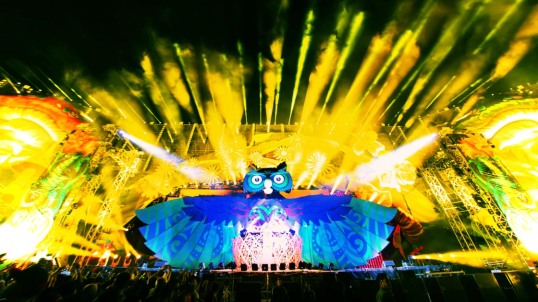
There’s a moment in the documentary Under the Electric Sky that moved me beyond belief.
For the first 90 minutes of the film, we’ve followed different people as they experience the 2013 Electric Daisy Carnival. Some of them are sweet, some of them are oafish, some of them are people that I would want to hang out with, and some of them I definitely would go out of my way to avoid. The one thing that they have in common is that they love EDM and that love has brought them to Las Vegas.
One of the more likable of them is a young, wheelchair bound man named Jose. Up until this point, we’ve seen Jose wheeling his way through the crowd, having a good time but still frustrated by the fact that he can’t see the stage from his wheelchair. And then, while Hardwell is performing on stage, a group of strangers lift up Jose’s wheelchair, literally holding him on their shoulders so that he can see the stage.
And you know what? I fully realize that this could have been arranged beforehand. I understand that someone involved in production could have asked those people to lift up Jose because he or she knew it would make a perfect film moment. But I don’t care. It’s such a wonderful moment and it perfectly encapsulated everything that I love about the EDM scene. It’s a moment that brought tears to my eyes when I saw it and it’s still bringing tears to my eyes as I write about it.
As far as the rest of Under the Electric Sky is concerned, if you’re into EDM, you’ll enjoy it. And if you’re one of those people who doesn’t get EDM — well, sucks to be you, doesn’t it?
Admittedly, the film was produced by the same people who put on the EDC and, at its weakest, it felt like a mix between an infomercial and an A&E reality show. But at its frequent best — like in the moment described above and in the brief moments where artists like Avicii, Armin Van Buuren, and Above & Beyond open up to the camera — it’s a wonderful and heartfelt tribute to one of the most loving and misunderstood subcultures in the world. At it’s best, Under the Electric Sky is a blast of pure musical joy and, with the world the way it is right now, we could all use a little joy.
Under the Electric Sky is currently available on Netflix and yes, I recommend it.
All of the meat and cheese of BlizzCon’s content is traditionally crammed into Friday. They open with a bang, throw all of the big news at you all at once, and then spend Saturday giving you some time to soak it in. Lots of Q&A panels are the norm, along with a growing collection of e-sports grand finals and a big rock concert to send you off in style. 2014 was no different, and there is certainly no major news to bring to the table, but it was nevertheless a day full of entertaining events, and I would like to share with you my two favorites.
The first is a documentary called “Looking for Group”. In celebration of the ten year anniversary of World of Warcraft, Blizzard created a one hour documentary about how the game came to be. The film leaves a lot to be desired from the players’ perspective. Blizzard took up a great deal of the time archiving fan experiences in the game–a married couple talks about first meeting in Stormwind, a teen reflects on growing up playing the game with his father, a handicapped woman remembers playing WoW to help mentally recover from her accident. It is probably incredible for a game developer to think that they made that much of an impact on peoples’ lives, but anyone who has played the game long enough has run into situations like this before. It’s nothing particularly novel or exciting for the fans. But the film also incorporates plenty of behind-the-scenes looks into how the company has operated over the years and the personalities leading the charge. I found the details on the early developmental years of the game especially interesting. If you have ever enjoyed World of Warcraft, it’s worth taking an hour to watch this:
The second video I want to share with you might take some persuasion. When your two favorite professional sports are golf and Starcraft, it is really hard to make friends. But such is my fate. Despite all of the columns I was pumping out Friday, I actually did manage to watch live all 30 matches of the Starcraft II World Championship Series Global Finals that took place at BlizzCon. MMA knocking off Bomber 3-1 might have been the biggest upset, but Classic’s rocky 3-2 finish over herO made MMA’s path to the final round feel easy. Life ultimately outclassed him 4-1 in a way that was certainly impressive but not exceptionally fun to watch. The real excitement came in the bottom bracket semi-finals. Life and TaeJa breezed their ways past San and INnoVation 3-0 and 3-1 respectively, and both players looked to be at the peak of their game rolling into the semi-finals. Life ultimately progressed to the finals 3-2 in what was surely the most intense series of the event. The video below was my favorite match of that series. It starts off with both players taking extremely aggressive and risky stances–in Life’s case one you would almost never see at this level. I’m not going to spoil who wins, but the 24 minute length of the video should tell you that both players move beyond the opening chaos. Neither player is willing to put on the breaks all game, forcing some really unconventional gameplay. With practically perfect micro on both fronts, we get to see what a top tier SC2 match ought to look like–two masterminds who can’t hope to surpass the other’s technical precision and have to bluff, gamble, and predict moves ahead of time to pull off a win.
I suppose that a lot of e-sports boil down to mind games as a sort of maximum skill level is reached. The glory of Starcraft II is that reaching that threshold is so difficult even many of the pros in the global finals succumb to error in basic techniques and strategy. That was not the case this weekend with TaeJa and Life, and that is what made this series my favorite at BlizzCon 2014.
And lastly, for those of you who were actually watching yesterday, what did you think of Metallica? I had a lot of fun on IRC during the closing ceremonies trash talking Lars, predicting what song would come next, and blabbering about metal in general. How did this band selection rank for you in the annals of BlizzCon closing ceremonies? Blizzard have offered a lot of variety in their selections over the years. From the somewhat genre-appropriate (Metallica), to the big ticket, high-budget rock sensation (Foo Fighters), to the bottom-barrel (Blind-182), to the in-house absurd (Lvl 80 Tauren Chieftain), we’ve seen a lot. Is it enough? Blizzard is all about nerd aggro. It is the heart and soul of their ethos. I’ve long thought a fantasy-oriented power metal band would be the best choice to reflect that. Even if most of the spectators had never heard of Blind Guardian before, you know they would bring the house down. Amon Amarth, Dethklok, Iced Earth, Iron Maiden, and Rhapsody of Fire were some of the other names that got dropped. Of course the most popular choice for a future BlizzCon was GWAR.
This will be my last post on BlizzCon 2014. Thanks for reading! Here are links to my previous entries:
I have to admit that I’m always a little bit cynical whenever I hear various film fans bemoaning films that were never made. These are the films that were nearly made but ended up being abandoned because the production company ran out of money or maybe a lead actor died or maybe the studio refused to release it or else they released it in a heavily edited form. There’s a certain tendency among hipsters to decide that any movie that they will never be able to see would automatically have been the greatest film ever. It’s rare that anyone ever suggests that maybe it’s for the best that Stanley Kubrick never made his version of Napoleon or that maybe Ridley Scott’s version of I Am Legend would have been just as bad as the version that starred Will Smith or even that the footage that we have of Orson Welles’s unfinished The Other Side of The Wind doesn’t look that impressive.
In fact, some day, I want to see a documentary about an abandoned film where everyone says, “Oh my God, I’m glad that movie never got made. It would have sucked!”
However, that documentary is never going to be made. The great thing about praising a film that was never made was that you don’t have to worry about anyone watching the film and then going, “You have no idea what you’re talking about!”
For instance, I recently watched an excellent documentary called Jodorowsky’s Dune. This film tells the story of how the iconoclastic director Alejandro Jodorowsky attempted to make a film out of the science fiction novel Dune in the mid-70s. During the documentary, Jodorowsky explains that his version of the story would, in many ways, be different from the book. Since I’ve never read the book nor have I seen any of the various adaptations that actually were eventually produced, I can’t say whether Jodorowsky’s changes would have been an improvement. For that matter, I can’t say whether or not Jodorowsky’s film would have been great or if it would have been a legendary misfire. I’ve seen El Topo and The Holy Mountain so I’m pretty sure that his version of Dune would have been uniquely his own. But there’s no way for me — or anyone else for that matter — to say whether or not the film would have been any good because, after assembling an intriguing cast (Orson Welles, Mick Jagger, Salvador Dali, and David Carradine) and recruiting several talented artists and technicians (H.R. Giger, Dan O’Bannon, Chris Foss, and Moebius), Jodorowsky was never able to make his film. The Hollywood studios took one look at Jodorowsky’s vision and said, “There’s no way were paying for that.”
However, the documentary goes on to make a very intriguing argument that Jodorowsky’s Dune may be the most influential film never made. Many of the people who collaborated with Jodorowsky would go on to work on other science fiction films and, when they did, they brought with them many of the ideas and concepts that were originally developed for Dune. The documentary not only suggests that this might be true but also offers up some pretty compelling evidence, showing us how everything from Raiders of the Lost Ark to Prometheus has featured scenes that originally appeared in Jodorowsky’s Dune storyboards.
I may not be totally convinced that Jodorowsky’s Dune would have been the greatest film ever made but I love this documentary. The majority of it is spent just listening as Jodorowsky, alternating between English and Spanish, tells us the story of what he hoped to do with Dune and how, ultimately, he could not do it. Jordorowsky’s love of film and art is obvious with each word that he says. Whether he’s talking about meeting Salvador Dali or passionately advocating for creativity and imagination, Alejandro Jodorowsky is never less than charming and inspiring.
If you love movies, you’ll love Jodorowsky’s Dune. If you don’t love movies, Jodorowsky’s Dune will change your mind.
“We all are born with a certain package. We are who we are: where we were born, who we were born as, how we were raised. We’re kind of stuck inside that person, and the purpose of civilization and growth is to be able to reach out and empathize a little bit with other people. And for me, the movies are like a machine that generates empathy. It lets you understand a little bit more about different hopes, aspirations, dreams and fears. It helps us to identify with the people who are sharing this journey with us.” – Roger Ebert
I’ve enjoyed film for pretty much all my life, but I didn’t truly come to appreciate and love it as an art form – as something more than simply entertainment – until my first year of college (I know, how cliché). I didn’t just come to love watching film, but (as you can obviously see as I write this) I came to love reviewing and discussing the medium with others as well. The first critic who introduced me to film criticism was Roger Ebert. His reviews were the first to really click with me. It wasn’t because I always agreed with him (because I definitely didn’t); but it was because I truly, truly admired his love of film. It was a contagious sort of love, a passion I never knew could be had for motion pictures. Following his example I too began writing about films and discussing them on forums and blogs. These discussions opened up the door really, and I charged head first, exploring the medium more deeply than I ever imagined I could.
It became a journey that I can honestly say made me the person I am today. Film was, and always will be, what I turn too when I am happy, bored and most importantly when I am sad. The best example I have of this was when my grandfather passed away years ago. It was a special sort of hurt, and no discussions with family or friends could do much to quell that pain. I remember sitting down the night it happened, alone in my dark room, and deciding to watch ‘Amelie’. It is a film I adored, one of the few films that truly moved me with every viewing. When it ended, as it had done many times before, I had a huge smile on my face. It did it again. Film did it again; it was once again one of the few things in my life that could heal, or overshadow, any hurt I happened to be feeling. I don’t think I would have known about or adored ‘Amelie’ if not for the journey my love for film had created – a love that wouldn’t have blossomed without the analysis and discussions I had about them – discussions I would never have started if I hadn’t read Roger’s reviews religiously and decided to start writing some myself.
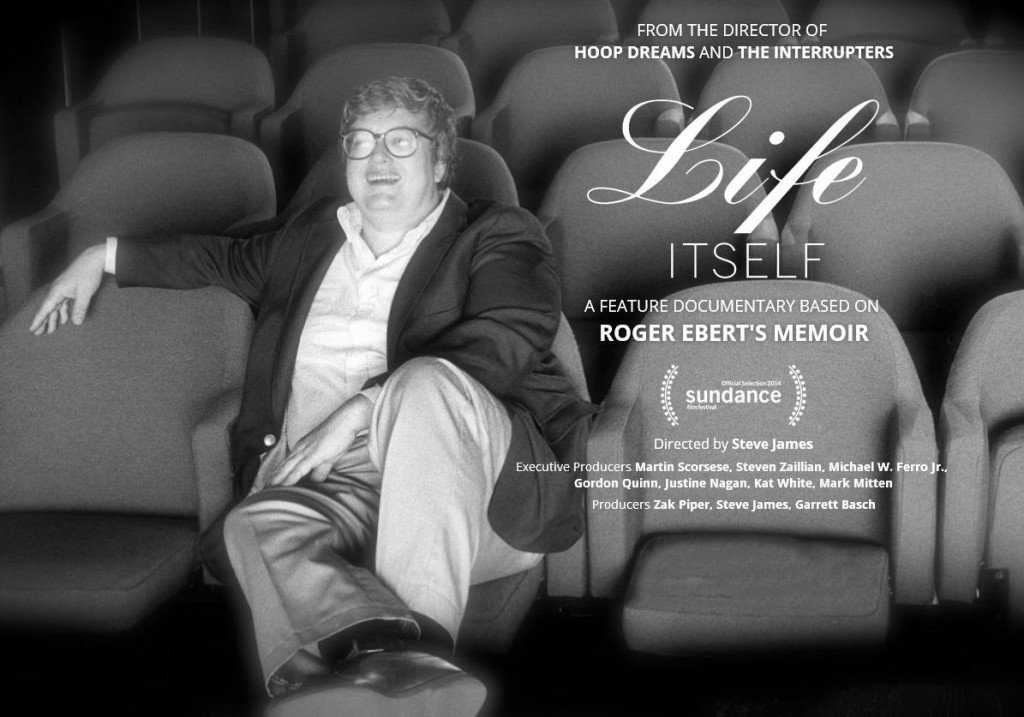
That is why I was deeply saddened when Roger Ebert passed away. He is one of those rare people for me who although I never actually met or spoke with him, he still managed to have a profound effect on my life. An effect that still moves me, as I learned today as I finally watched ‘Life Itself’. I shamefully had put it off for far too long, partly because I think I knew the sort of emotional response I would have towards it. But as the quote I began this posts says, film helps us “identify with the people who are sharing this journey with us”, and it was about time I took a look at the journey that was the life of Roger Ebert.
And boy, was it rough. It did bring me to the verge of tears, as I expected, but I loved every minute of it. ‘Life Itself’ is an honest and in depth portrait of a man who wasn’t without his faults. But no matter what battles he encountered – either with alcohol, his colleagues, or cancer – he still faced everyday ready for what came next. He had a passion for life that was reflected in his passion for film – or maybe the other way around. This for me is what shined through the documentary, handled with such care and attention by Steve James. It is an affectionate tribute to a man who moved so many, generating the very same empathy that Ebert himself loved about film, and for that I think it deserves two big thumbs up.
(Above is an exclusive poster found on Collider.com)
I am having a hard time remembering the last time I made a post like this that wasn’t a review, so I think you can use this article as a measure of just how excited I am for ‘Dawn of the Planet of the Apes’. I, like a lot of people, was completely surprised by how good ‘Rise of the Planet of the Apes’ was. It rejuvenated a franchise (one I really enjoy) that was most recently tarnished by a really, really bad remake. It was so good that a sequel was not only inevitable, but desired.
Luckily Fox is fulfilling that desire next week with the release of the sequel, which has received universal praise from the few reviews that have already been released. The out-pour of this praise definitely has me more excited than I was beforehand…but it is not the true source of the hype that has me ready to buy a ticket for a Thursday night showing for the first time since ‘The Dark Knight Rises’. No, the source of that hype is a series of short films that act as a bridge between ‘Rise’ and ‘Dawn’, examining (quite artistically, surprisingly) the events that occurred after the outbreak of the Simian Flu at the end of ‘Rise’. These shorts are a collaboration of 20th Century Fox and Motherboard and can be viewed below:
‘Spread of Simian Flu: Before The Dawn of the Apes (Year 1)’ (dir. Isaiah Seret)
‘Struggling to Survive: Before The Dawn of the Apes (Year 5)’ (dir. Daniel Thron)
‘Story of the Gun: Before The Dawn of the Apes (Year 10)’ (dir. “thirtytwo”)
What I love most about these is how they are so unlike most “viral” shorts. These aren’t straight forward stories like you see with the Marvel One-Shots. These are actually artistic, emotional and thought provoking films, to the point in which I saw people commenting on them being pretentious…music to my ears to be honest with you. Each explore themes of their own while also wonderfully adding to the atmosphere and mythos of the new ‘Apes’ series. Furthermore, the very fact that the studio clearly gave the writers and directors of each liberty to not “play it safe” with a piece of marketing revolving around a multi-million dollar franchise just gives me a ton of confidence in the franchise on the whole. It is this, more than the reviews, that has me excited to see ‘Dawn of the Planet of the Apes’ next week, and maybe they will do the same for you.
———————————————————————————————————————-
Along with the prequel shorts, which are directly related to the events of the film, they also released a documentary which can be seen below. It too is incredibly well made, and is a surprisingly poignant true story of apes and human interactions during and after the events of medical testing and human warfare.
While some have called 2009 as not being so great in terms of quality films, there have been others who think the year was a very good year for films from start to finish. Not all the best films of 2009 came out during the so-called “awards season” from October thru December. Some of the worst films, in my opinion, were released very late in the year and clearly done so to try and force its way into award contention. While the year of 2009 saw some very good films come out early in the year and, to my surprise, even during the popcorn and brainless season of the summer blockbusters.
My list consists of the 10 films I saw in 2009 which I believe to be the best of all them. Some people will probably agree with me on and some won’t. Some of my picks may have been little seen outside of independent arthouse theaters or film festivals but it doesn’t diminish just how much I think it deserves inclusion in a “best of” list. In the end, I thought these films doesn’t just celebrate what’s great about films but also celebrating those filmmakers who show that when given room to breathe and do things their way magic can still happen.
10. Bad Lieutenant: Port of Call – New Orleans (dir. Werner Herzog)