Charlie Smith (Jack Nicholson) gets a job with the Texas border patrol and goes from scrounging in a California trailer park to living the high life in a duplex in El Paso. His wife (Valerie Perrine) is looking forward to spending all the money that he’ll be making as a border agent. But then Charlie discovers that his bigoted superior (Warren Oates!) and his partner (Harvey Keitel) are running a human smuggling ring. When the baby of a young Mexican woman (Elpidia Carrillo) is kidnapped and sold to an illegal adoption ring, Charlie is finally forced to take a stand.
The Border seems to be one of Jack Nicholson’s forgotten films and it really can’t compete with some of the other movies that Nicholson was making around the same time. Compared to films like The Shining, Terms of Endearment, and The Postman Always Rings Twice,The Border really does feel and look like a poorly paced made-for-TV movie. British director Tony Richardson doesn’t really seem to know what type of movie he wanted The Border to be or what he wanted to say about immigration. This is the type neo-Western that Sam Peckinpah could have worked wonders with but Tony Richardson just doesn’t seem to have any feel for the material.
Still, Jack Nicholson is pretty good here, playing the type of weary character that he specialized in during the pre-Batman portion of his career. I especially liked the scenes that he shared with Valerie Perrine, who gave a good performance as someone who viewed buying a waterbed as being the height of luxury. Harvey Keitel’s performance sometimes felt too familiar. He’s played a lot of similar villains but he and Nicholson act well together.
And finally, Warren Oates in this movie, bringing his rough-hewn authenticity to his role. This was the last of Oates’s films to be released before his premature death. Blue Thunder and Tough Enough were both released posthumously. Warren Oates is an actor who was only 52 when he died. Whenever I see him onscreen, I think of all the great performances he would have given if he had only made it through the 90s.
Opening with a swarm of helicopters spaying for medflies and ending with an earthquake, 1993’s Short Cuts is a film about life in Los Angeles.
An ensemble piece, it follows several different characters as they go through their own personal dramas. Some of them are married and some of them are destined to be forever single but they’re all living in varying states of desperation. Occasionally, the actions of one character will effect the actions of another character in a different story but, for the most part, Short Cuts is a portrait of people who are connected only by the fact that they all live in the same city. There are 22 principal characters in Short Cuts and each one thinks that they are the star of the story.
Jerry Kaiser (Chris Penn) cleans the pools of rich people while, at home, his wife, Lois (Jennifer Jason Leigh), takes care of their baby and works as a phone sex operator. Jerry’s best friend is a makeup artist named Bill (Robert Downey, Jr.) who enjoys making his wife, Honey (Lili Taylor), looks like a corpse so that he can take her picture. One of her photographs is seen by a fisherman (Buck Henry) who has already discovered one actual corpse that weekend. He and his buddies, Vern (Huey Lewis) and Stuart (Fred Ward), discovered a dead girl floating in a river and didn’t report it until after they were finished fishing. (The sight of Vern unknowingly pissing on the dead body is one of the strongest in director Robert Altman’s filmography.)
Stuart’s wife, Claire (Anne Archer), is haunted by Stuart’s delay in reporting the dead body. A chance meeting Dr. Ralph Wyman (Matthew Modine) and his wife, artist Marian (Julianne Moore), leads to an awkward dinner between the two couples. Claire works as a professional clown and Ralph ends up wearing her clown makeup while his marriage falls apart.
Earlier, Claire was stopped and hit on by a smarmy policeman named Gene Shepard (Tim Robbins), who just happens to be married to Marian’s sister, Sherri (Madeleine Stowe). Gene is already having an affair with Betty Weathers (Frances McDormand), the wife of a helicopter pilot named Stormy (Peter Gallagher). When Stormy discovers that Betty has been cheating, he takes a creative revenge on her house.
Doreen Pigott (Lily Tomlin) lives in a trailer park with her alcoholic husband, Earl (Tom Waits). Driving home from her waitressing job, Doreen hits a young boy. The boy says he’s okay but when he gets home, he passes out. His parents, news anchorman Howard Finnegan (Bruce Davison) and his wife, Anne (Andie MacDowell), rush him to the hospital, where his doctor is Ralph Wyman. As Howard waits for his son to wake up, he has a revealing conversation with his long-estranged father (Jack Lemmon, showing up for one scene and delivering an amazing monologue). Meanwhile, a baker named Andy (Lyle Lovett) repeatedly calls the Finnegan household, wanting to know when they’re going to pick up their son’s birthday cake.
Based on the short stories of Raymond Carver and directed by Robert Altman, Short Cuts can sometimes feel like a spiritual descendent of Altman’s Nashville. The difference between this film and Nashville is that Short Cuts doesn’t have the previous film’s satiric bite. As good as Nashville is, it’s a film that can be rather snarky towards it character and the town in which it is set. Nashville is used as a metaphor for America coming apart at the seams. Short Cuts, on the other hand, is a far more humanistic film, featuring characters who are flawed but, with a few very notable exceptions, well-intentioned. If Nashville seem to be a portrait of a society on the verge of collapse, Short Cuts is a film about how that society ended up surviving.
It’s not a perfect film. There’s an entire storyline featuring Annie Ross and Lori Singer that I didn’t talk about because I just found it to be annoying to waste much time with. (The Ross/Singer storyline was the only one not to be based on a Carver short story.) The conclusion of Chris Penn’s storyline wasn’t quite as shocking as it was obviously meant to be. But, flaws and all, Altman and Carver’s portrait of humanity does hold our attention and it leaves us thinking about connections made and sometimes lost. Seen today, Short Cuts is a portrait of life before social media and iPhones and before humanity started living online. It’s a time capsule of a world that once was.
John Carpenter has directed 18 features film, from 1974’s Dark Starto 2010’s The Ward. Some of his films have been huge box office successes. Some of his films, like The Thing, were box office flops that were later retroactive recognized as being classics. Carpenter has made mainstream films and he’s made cult favorites and, as he’s always the first to admit, he’s made a few films that just didn’t work. When it comes to evaluating his own work, Carpenter has always been one of the most honest directors around.
Amazingly, Carpenter has only directed one film that received an Oscar nomination.
That film was 1984’s Starman and the nomination was for Jeff Bridges, who was one of the five contenders for Best Actor. (The Oscar went to F. Murray Abraham for Amadeus.) Bridges played the title character, an alien who is sent to Earth to investigate the population and who takes on the form of the late husband of Jenny Hayden (Karen Allen). The Starman takes Jenny hostage, though its debatable whether or not he really understands what it means when he picks up her husband’s gun and points it at her. He and Jenny drive across the country, heading to Arizona so that he can return to his ship. Pursued by the government (represented by the sympathetic Charles Martin Smith and the far less sympathetic Richard Jaeckel), the Starman learns about emotions, eating, love, and more from Jenny. Jenny goes from being fearful of the Starman to loving him. Carpenter described the film as beingIt Happened One Night with an alien and it’s not a bad description.
After Jenny and the alien visitor make love in a boxcar, the Starman says, “I gave you a baby tonight,” and that would be an incredibly creepy line coming from a human but it’s oddly charming when uttered by an alien who looks like a youngish Jeff Bridges. Bridges definitely deserved his Oscar nomination for his role here. Speaking with an odd accent and moving like a bird who is searching for food, Bridges convincingly plays a being who is quickly learning how to be human. The Starman is constantly asking Jenny why she says, does, and feels certain things and it’s the sort of thing that would be annoying if not for the way that Bridges captures the Starman’s total innocence. He doesn’t mean to be a pest. He’s simply curious about everything.
Bridges deserved his nomination and I would say that Karen Allen deserved a nomination as well. In fact, it could be argued that Allen deserved a nomination even more than Bridges. It’s through Allen’s eyes that we see and eventually come to trust and then to love the Starman. Almost her entire performance is reactive but she makes those reactions compelling. I would say that Bridges and Allen deserved an Oscar for the “Yellow light …. go much faster” scene alone.
Carpenter agreed to make Starman because, believe it or not, The Thing had been such a critical and commercial flop that it had actually damaged his career. (If ever you need proof that its best to revisit even the films that don’t seem to work on first viewing, just consider Carpenter’s history of making films that were initially dismissed but later positively reevaluated. Today, The Thing, They Live, Prince of Darkness, and In The Mouth of Madness are all recognized as being brilliant films. When they were first released, they all got mixed reviews.) Carpenter did Starman because he wanted to show that he could do something other than grisly horror. Starman is one of Carpenter’s most heartfelt and heartwarming films. That said, it also features Carpenter’s trademark independent streak. Starman not only learns how to be human but, as a result of the government’s heavy-handed response to his arrival, one can only assume that he learns to be an anti-authoritarian as well.
Starman is one of Carpenter’s best films and also a wonderful showcase for both Karen Allen and Jeff Bridges.
Welcome to Late Night Retro Television Reviews, a feature where we review some of our favorite and least favorite shows of the past! On Mondays, I will be reviewing CHiPs, which ran on NBC from 1977 to 1983. The entire show is currently streaming on Freevee!
This week, Ponch and Baker face their greatest enemy …. frat boys with a grudge!
Episode 2.8 “The Grudge”
(DIr by John Florea, originally aired on November 11th, 1978)
When Baker and Ponch attempt the warn the driver of an RV about the fact that his vehicle won’t be able fit through a tunnel, the driver reacts by trying to speed away. That’s because the driver is a frat boy and the RV is full of marijuana (or “Cannabis Rex!” as another frat boy puts it). This leads to the RV not only crashing in the tunnel but also Baker and Ponch busting all of the frat boys for possession.
A few months later, the frat boys are horrified when, despite only getting probation, they are still suspended from college and their fraternity is kicked off campus. The frat boys decide to get revenge on Baker and Ponch by playing a series of practical jokes. They send Baker and Ponch mysterious letters. They toss a bunch of fake money on the highway, causing a slow motion wreck. They try to disrupt the CHiPs open house, over which Baker and Ponch have been put in charge.
This was a bit of a silly episode. The frat boys somehow had the ability to always know exactly where Ponch and John were. For some reason, Ponch and John didn’t do the obvious and bust the frat boys for violating their probation. Sgt. Getraer, meanwhile, spends almost the entire episode being a jerk. He puts Ponch and Baker in charge of the open house and then gets mad at them for working on it while on the clock. Well, when are they supposed to work on it?
The episode did feature one good car crash. In fact, not only were multiple vehicles destroyed but it all happened in slow motion. That made up for a lot. Still, in the end, The Grudge was just a bit too silly to really work.
Welcome to Late Night Retro Television Reviews, a feature where we review some of our favorite and least favorite shows of the past! On Tuesdays, I will be reviewing Gun, an anthology series that ran on ABC for six week in 1997. The entire show is currently streaming on Tubi!
This week, Robert Altman! This will be good …. right?
Episode 1.4 “All The President’s Women”
(Dir by Robert Altman, originally aired on May 10th, 1997)
When it comes to the fourth episode of Gun, I have to admit that my expectation were high because this episode was the only one in the series to be directed by Gun’s producer, Robert Altman. The story, about the womanizing president of a golf club, sound like it would be right up Altman’s alley and allow him to engage in the social satire for which he was best-known.
Unfortunately, the episode itself just isn’t that good. In fact, it’s the worst episode of Gun that I’ve seen so far. Watching the show, it’s easy to see that Altman directed it. There’s several very Altman-like moments. The show’s plot and its characters all tend to mirror Altman’s trademark obsessions. That said, for all of Altman’s strengths as a filmmaker and a satirist, he was also a bit self-indulgent and this episode is basically 50 minutes of Altman patting himself on the back and bragging about how clever he is.
The film takes place at a golf club in Texas. After the club’s president is bitten by a rattlesnake and then accidentally shoots himself in the foot while trying to kill the snake, Bill Johnson (Randy Quaid) is elected as his replacement. Bill is friendly but shallow, a businessman who is all about prestige and showing off his wealth. While his wife (Daryl Hannah) spends her time researching real-life presidents, Bill is having an affair with the former’s president’s widow (Jennifer Tilly) while also flirting with his new secretary (Dina Spybey). Meanwhile, another former lover (Sean Young) is now his attorney while Sally Kellerman plays Jennifer Tilly’s mother and continually warns Bill to stay away from her daughter.
Bill is shocked to discover that someone is sending packages to the women in his life. Jennifer Tilly receives the gun that was used to shoot the rattlesnake. Darryl Hannah receives the magazine. Sean Young receives the bullets. If you can’t already guess that this is going to end up with Bill in his underwear on the 18th hole, being menaced by a woman carrying a gun, I don’t know what to tell you.
This episode just falls flat and it’s largely the fault of the cast. Randy Quaid, at the very least, has a Texas accent but he’s not a convincing lothario. The women all butcher their accents, with the majority of them sounding more like they’re from Georgia than Texas. Most the cast goes overboard with their quirkiness while Altman directs in a meandering fashion that robs the episode of whatever satirical impact that it might have had. It’s just a boring episode, regardless on the nails-on-a-chalkboard accents and all the overacting. Watching this episode, I was reminded of why I usually can’t stand anthology shows. They just seem to bring out the worst in everyone.
Next week, Kirsten Dunst guest stars. Did Gun bring out the worst in her? We’ll find out!
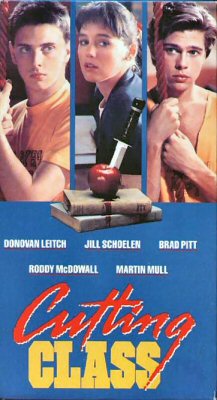
Someone is murdering the students and the teachers at the local high school and it’s up to Paula Carson (Jill Schoelen), the studious daughter of the local DA (Martin Mull), to figure out who is responsible!
Though the principal (Roddy McDowall, who seemed to be cast as a lot of bizarre school employees during the latter half of his career) is a perv and the janitor (Robert Glaudini) fancies himself as being some sort of bizarre ninja with a mop, it soon becomes apparent that there’s really only two viable suspects. One of them is Brian Woods (Donavon Leitch), who has just returned home after spending several months in a mental hospital where he was regularly given electroshock therapy. The other is Dwight Ingalls (Brad Pitt), the alcoholic jock who is under tremendous pressure to win a basketball scholarship and who also happens to be Paula’s boyfriend! Brian and Dwight were friends when they were younger. Now, Dwight spends all of his time bullying Brian and Brian spends all of his time staring at Paula. Who could the murderer be!?
Actually, you won’t be surprised at all when the identity of the murderer is revealed. You’ve probably already guessed who the killer is. A campy slasher film from 1989, Cutting Class doesn’t exactly win any points for originality. If Cutting Class is remembered for anything, it’s for providing Brad Pitt with an early leading role. Pitt, it should be said, is totally convincing as Dwight. On the one hand, he’s such a jerk that it’s difficult to really like him but, on the other hand, he looks like Brad Pitt so you totally can’t blame Paula for putting up with him. For that matter, both Leitch and Schoelen give convincing performances as well. When you’ve got a trio as talented as these three, it’s kind of a shame that Cutting Class wasn’t a better film.
Cutting Class tries to mix horror and comedy but the comedy is too broad (Roddy McDowall leers like a cartoon wolf) while the horror is not quite horrific enough and, as such, the film never really settles on a consistent or an interesting tone. Whenever the film starts to get into a horror grove, Martin Mull shows up like a character in an overplayed Saturday Night Live skit. Whenever the film starts to find itself as a comedy, someone is horribly murdered and you’re totally taken out of the mood. This is also another one of those films where the characters randomly switch from being ludicrously stupid to unnaturally intelligent from scene-to-scene. The killer, for instance, is diabolically clever until the film’s final moments, at which point the murderer suddenly gets very talky and very easily fooled.
Cutting Class is occasionally interesting as a time capsule. It’s from 1989, after all. And it’s interesting to see Brad Pitt playing the type of character one would more likely expect to see on a very special episode of Saved By The Bell. Otherwise, this one is fairly forgettable.
“Say goodbye to classical reality, because our logic collapses on the subatomic level… into ghosts and shadows.”
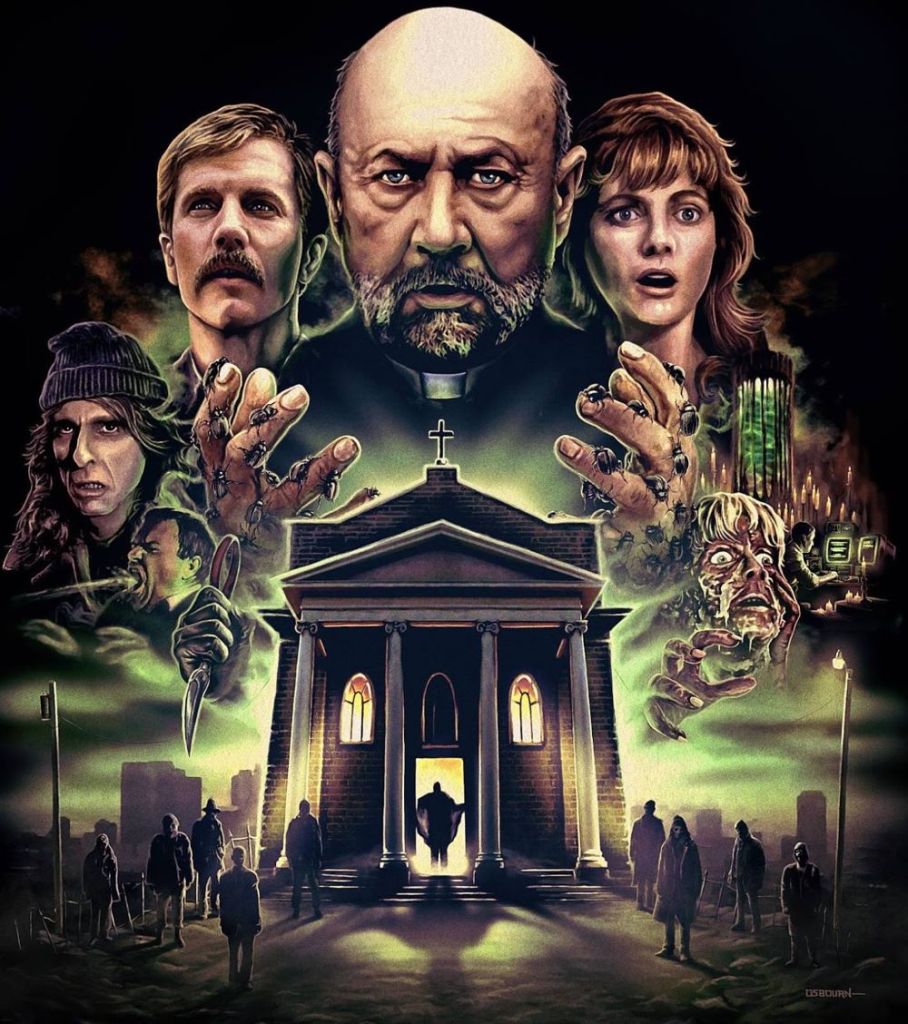
John Carpenter’s Prince of Darkness is a criminally underrated entry in his canon—a blend of philosophical, apocalyptic horror and supernatural mystery that’s as unsettling as it is deliberately strange. Released in 1987, the film often gets eclipsed by Carpenter classics like The Thing and In the Mouth of Madness. Even so, it stands out as a unique organic link between science-driven paranoia and cosmic horror—the sort of film that grows on you as you unravel its layers.
The setup is simple but immediately offbeat: In a derelict Los Angeles church, Father Loomis (Donald Pleasence, always at his nervous best) stumbles on a swirling green cylinder hidden away in the basement. Loneliness and age hang over Loomis as he realizes this is no mere relic but possibly the essence of absolute evil—the literal embodiment of Satan. Sensing he’s in over his head, the priest reaches out to Professor Birack (Victor Wong), a physicist whose rational mindset is quickly tested by the uncanny. Birack arrives with a diverse team of grad students and lab techs, each bringing curiosity, skepticism, and just enough personality to keep things lively.
What starts as an academic investigation quickly goes off the rails. Strange, shared dreams trouble the researchers—fragmented transmissions from the future, warning of disaster in unsettling, VHS-glitch style. Meanwhile, the area outside the church transforms into a kind of urban wasteland: homeless people, gripped by an unseen force, stumble with zombie-like intent, trapping the group inside. Inside, members fall prey to unsettling phenomena, from unexplained possession to increasingly grotesque violence. There’s a sense that the evil in the cylinder isn’t content to simply stay put—and the combination of supernatural implication and scientific uncertainty gives everything a persistent, gnawing tension.
Carpenter directs the film with measured, stifling precision. His color palette—rotting yellows, bruised greens, washed-out sunlight—creates a perpetually uneasy mood. He uses slow tracking shots and carefully composed frames to ratchet up suspense, and the score (co-composed with Alan Howarth) pulses with ominous synths that buzz beneath all the dialogue, making even the film’s quieter moments feel restless and charged with threat. Compared to the gooey spectacle of The Thing, the terror in Prince of Darkness is more metaphysical—less visible monsters, more eroding reality.
Sound and image work together to keep the audience on edge: moments of unsettling silence are punctuated by visual oddities, like swarms of bugs or the warped geometry of the church’s shadows. The group’s scientific attempts to decode the evil—a jumble of quantum theory, apocalyptic Christian lore, and unsettling mathematics—do more to ramp up anxiety than offer answers. Carpenter seems to delight in ambiguity; the revelations never clarify so much as deepen the void, giving shape to a primordial kind of fear.
The film’s most iconic device is its recurring nightmare sequence, where the group—cut off from the world—witnesses a cryptic, shadowy figure emerging from the church, broadcast as a tachyon transmission from the future. It’s classic Carpenter: deeply unsettling, oddly hypnotic, and open to any number of interpretations. The blending of science fiction and theological horror feels fresh and ambitious, and it’s fair to say these sequences alone have ironically kept the film alive in horror culture discussions and remixes.
The cast, featuring Pleasence and Wong, manages the film’s shifts in tone—moving from banter about theoretical physics to genuine terror with surprising ease. The grad students are likable enough for you to root for, especially Lisa Blount and Jameson Parker, who carry the emotional brunt as things collapse. Alice Cooper’s cameo as a silent, menacing street dweller further anchors the film’s reputation for “unexpected creepy” in the best way possible.
While there are flashes of gore—possessions, injuries, even some memorable stabbings—Carpenter resists making violence the centerpiece. The real horror here is psychological: paranoia, loss of agency, and the collapse of foundational beliefs. Where The Thing was about trusting (or not trusting) your friends, Prince of Darkness is about grappling with a world where even faith and science seem powerless and interchangeable in the face of the unknown.
Thematically, this is Carpenter at his most cerebral and bleak. The notion that neither faith nor science can adequately tackle the unfathomable echoes Lovecraft, yet Carpenter grounds it all in urban decay and deadpan dialogue rather than Gothic flourish. The questions get bigger—what good is faith if truth is poisonous, and what does science matter against a force older than logic? Dialogue about quantum uncertainty and theological paradoxes isn’t there to solve anything, but to make everything less secure.
If the film has a flaw, it’s that its pacing feels deliberately patient—some might say slow. Tension accumulates gradually, and you’re invited to sit in the discomfort as the group loses sleep, loses one another, and loses touch with reality. As the stakes escalate, the line between dream and waking life shreds, leading to an ending that’s haunting, ambiguous, and deeply open-ended. There’s no neat wrap-up or cathartic victory—only trauma, unsolved terror, and a lingering sense that evil never really left, just waited.
It’s this refusal to explain or comfort that gives Prince of Darkness its lasting cult appeal. Carpenter puts cosmic pessimism front and center: knowledge itself stands as a kind of curse, and both faith and reason bend beneath the weight of mystery. Rather than offer solutions, the movie warns about the dangers of peeling back reality’s surface—a theme that’s only grown more unsettling in the years since it was made.
Watching Prince of Darkness now, the film may not fit everyone’s idea of a fun Friday-night scarefest. But if you want horror that’s slow, dense, and sticks with you, this is essential viewing. Carpenter delivers a bleak, hypnotic nightmare about what happens when explanations fail—when the universe itself seems ready to swallow us whole. Whether you’re a die-hard genre fan or someone looking for something different, Prince of Darkness is cult horror at its most unshakable—proof that the scariest stories are often those that leave their deepest secrets unexplained.
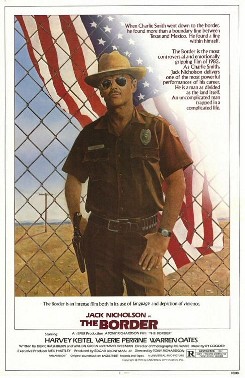 Charlie Smith (Jack Nicholson) gets a job with the Texas border patrol and goes from scrounging in a California trailer park to living the high life in a duplex in El Paso. His wife (Valerie Perrine) is looking forward to spending all the money that he’ll be making as a border agent. But then Charlie discovers that his bigoted superior (Warren Oates!) and his partner (Harvey Keitel) are running a human smuggling ring. When the baby of a young Mexican woman (Elpidia Carrillo) is kidnapped and sold to an illegal adoption ring, Charlie is finally forced to take a stand.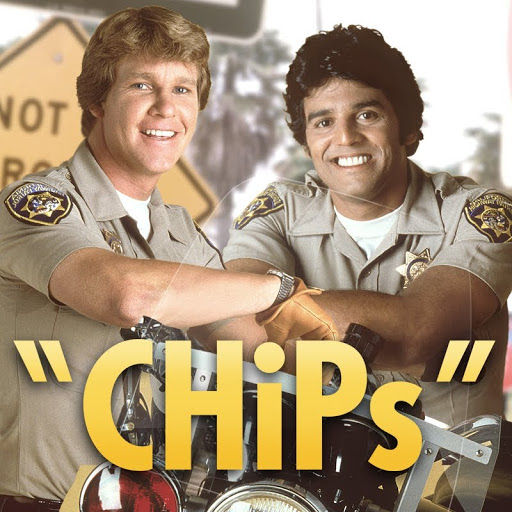

 Through the Shattered Lens