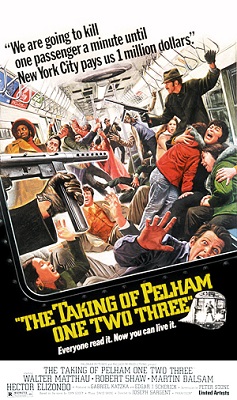
100 years ago, on this date, Joseph Sargent was born in New Jersey. Sargent would go on to become one of the busiest directors of the 70s, 80s, and 90s, working in both film and television. Though he would never receive the type of critical attention as some of his contemporaries, Sargent was a skilled director who specialized in making entertaining, no-nonsense films. Though his reputation was tarnished a bit by the fourth Jaws film, it should be remembered that Sargent was also responsible for films like Colossus: The Forbin Project,Tribes, Nightmares, and The Taking of Pelham One Two Three.
1974’s The Taking of Pelham One Two Three has come to be recognized as a genre classic. It’s certainly one of my favorite films about how New Yorkers will be rude to anyone in any circumstances. You can see an example of this in today’s scene that I love. Having hijacked a train, Robert Shaw calls in his last of demands and gets a very New York response.
Welcome to Retro Television Reviews, a feature where we review some of our favorite and least favorite shows of the past! On Fridays, I will be reviewing St. Elsewhere, a medical show which ran on NBC from 1982 to 1988. The show can be found on Hulu and, for purchase, on Prime!
It’s another day at the hospital.
Episode 1.14 “Remission”
(Dir by Mark Tinker, originally aired on February 22nd, 1983)
A young Michael Madsen pops up in this episode, playing a hoodlum named Mike O’Connor who brings his severely beaten friend to the hospital. This was Madsen’s first role on television and, in his very first scene and while delivering his very first televised monologue, he drops the N-word as he accuses a group of black men of beating up his friend. Dr. Morrison is worried about whether or not Madsen’s friend is going to lose a kidney. Meanwhile, race relations in Boston are not doing well. What else is new?
(I remember, after the shooting of Michael Brown in Ferguson, there was a commentator who thought he was being clever when he said, “I don’t understand why blacks stay in the South when they could just move to Boston.” The response to his comments served as a reminder that Boston’s history of racism makes some Southern cities seem almost progressive by comparison.)
It’s interesting that Michael Madsen is the second well-known actor to appear on St. Elsewhere as a gang member. Just a few episodes ago, Howie Mandel was chasing Ray Liotta out of the hospital. This particular episode ended with a fight breaking out in the ER between a white gang and a black gang. I assume this will be continued next week so I guess we still have time to see Howie Mandel pull a gun on Michael Madsen. Seriously, it better happen. I’m plotting the upcoming week around it.
Speaking of Dr. Fiscus, he got evicted from his apartment. He was shocked, even though he hadn’t paid his rent in forever. No one wants Fiscus to stay with them but, after Fiscus saved Dr. Ehrlich from getting beaten up in the ER (and no, this was not a part of the gang fight, instead it was a different fight — goldang, Boston’s dangerous! And yes, I gave up cursing for Lent), Ehrlich agrees to let Fiscus stay with him until he gets a new place. I imagine Ehrlich will come to regret that, especially after Fiscus showed up with Dr. Kochar and a homeless guy who had earlier helped them steer a truck out of a traffic jam. What? Don’t ask, it didn’t make much sense on the show either.
Dr. Cavenero has been nominated for a prestigious fellowship by Dr. Auschlander but she’s not sure if she should accept it because the fellowship would be for research and she’s not sure that’s what she wants to focus on. Auschlander has bigger issues to deal with, as he ends up collapsing in the hospital hallway, a result of his liver cancer. The irony that Auschlander, a liver specialist, is dying of liver cancer is not lost on Auschlander and Norman Lloyd did a wonderful job in this episode, portraying not only Auschlander’s frustration but also his gentle humor.
Also, a woman was walking around the hospital and flashing people. She said it was because she wanted to show off that, even in middle age, she still had a good body. That makes sense to me. Played by Janis Page, she was somehow who was fine for a one episode storyline but I’m going to scream if this becomes a multi-episode thing, like it did with Ralph the Birdman.
This was a good episode, even if I get the feeling the whole gang thing is going to be cringey in the way that most 80s television shows tended to be whenever they tried to take on race relations. Norman Lloyd’s heartfelt performance carried the hour. I’m hoping the best for Dr. Auschlander. He’s a character that I would hate to lose.
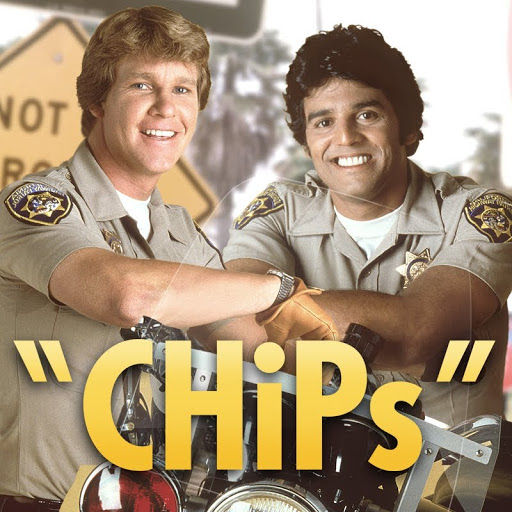
Welcome to Late Night Retro Television Reviews, a feature where we review some of our favorite and least favorite shows of the past! On Mondays, I will be reviewing CHiPs, which ran on NBC from 1977 to 1983. The entire show is currently streaming on Prime!
This week, it’s a special two-hour episode of CHiPs!
Episodes 3.9 and 3.10 “Drive, Lady, Drive”
(Dir by Don Weis, originally aired on November 10, 1979)
The police at nearby Palma Vista are on strike and the state of California has agreed to allow some members of the Highway Patrol to patrol the town until the strike is over. Getraer assigns Baker, Ponch, Bear, and some new guy named Lenny (Leon Isaac Kennedy) to head over to the town, Baker is named the OIC, which I eventually figured out stood for “Officer in Charge.” Getraer knows better than to give the job to Ponch.
Ponch, by the way, is back! After being absent for two episodes due to Erik Estrada actually injuring himself in a motorcycle crash, Ponch returns in this episode and he goes through the entire episode with this huge grin on his face as if he’s saying, “You know you missed me.” Ponch’s return means that Baker is once again relegated to being the strong, silent partner who doesn’t really get to do anything. In fact, Baker crashes his motorcycle early on in this episode, as if the show was trying to tell us, “See? It could happen to anyone!”
The striking cops accuse Baker, Ponch, Bear, and Lenny of being scabs and strike breakers. I’m not really a fan of public sector unions. (When it comes to the police striking, my hero is Calvin Coolidge, who came to fame when he broke up a policeman’s strike in Massachusetts.) Still, it felt strange to watch the show’s heroes cross that picket line. That would definitely not happen on television today.
There’s a lot going on in Palma Vista. There’s some rich kids who keep joyriding in a dune buggy and who think they can escape prosecution by crossing the city limits. (Joke’s on them! The Highway Patrol has jurisdiction everywhere!) There’s some truck hijackers who are setting up a headquarters in town. There’s an angry city councilman (Michael Conrad) who doesn’t feel his children should be held accountable for their actions.
That said, the majority of this two-hour episode centered on a stock car race and one of the racers, Candi Wright (Kelly Harmon). Will Candi win the big race or will she lose to her friendly rival (and possible future romantic partner) Don Croyden (Jordan Clarke)? Will Ponch be able to both date her and do his job? And most importantly, will she be able to adopt a traumatized little girl (played by Tracey Gold) who Candi discovered outside of a burning house? That’s a lot of storylines for someone who wasn’t even a regular cast member and a part of me wonders if maybe this episode was meant to be a secret pilot for a Candi Wright television series. It would explain a lot.
This really was a basic episode of CHiPs, with the only real difference being that it was two-hours long for some reason. A lot of what happened in the episode, especially the racing footage, felt like filler. There was really no need for this to be a double-sized episode. It also doesn’t help that, as opposed to the lovely Los Angeles scenery that we usually see, this episode took place in a rather ugly town. There was some appropriately spectacular crashes but, in the end, this episode ran too long and felt a bit pointless. Get the Highway Patrol back on the highways!
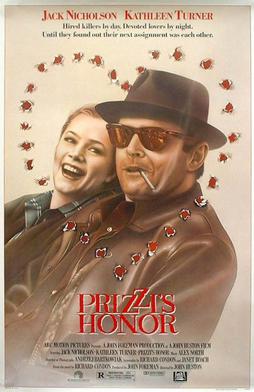
First released in 1985, Prizzi’s Honor tells the story of Charley Partanna (Jack Nicholson), a blue collar guy who lives in Brooklyn and who is a hard-working hit man for the Prizzi crime family. Charley is the son of Angelo (John Randolph), who is the right-hand man to the family’s elderly but still ruthless Don (William Hickey). In the past, Charley came close to marrying the Don’s daughter, Maerose Prizzi (Anjelica Huston), and he is almost as much a member of the family as the Don’s two sons, Eduardo (Robert Loggia) and Dominic (Lee Richardson).
While attending a family wedding, Charley meets and is immediately infatuated with a woman named Irene Walker (Kathleen Turner). Later, when Charley is sent to California to kill a man who robbed one of the family’s Vegas casinos, he is shocked to discover that the man is Irene’s husband. Irene swears that she didn’t have anything to do with the casino theft and, after a whirlwind courtship, Charley and Irene get married in Mexico. What Charley doesn’t know (but eventually discovers) is that Irene is herself a professional killer. While Charley and Irene try to balance work and love, Maerose conspires to turn the family against Irene and win Charley back.
Directed by the legendary John Huston, Prizzi’s Honor is pitch black comedy about two hard-working people who kill for a living. (The film’s big set piece is an extended sequence in which Charley and Irene’s attempt to pull a job together goes wrong in every way and they end up arguing about their relationship while dragging dead bodies from one room to another.) Though Prizzi’s Honor was released long before the series premiered on HBO, the film feels almost like a companion piece to The Sopranos, full of mobsters who are not as clever as they think they are and who struggle to uphold the old ways in an increasingly complicated world. Particularly when compared to the gangster who populate a film like TheGodfather, the Prizzis are defined by their pettiness. If Don Corleone epitomized wisdom and honor, Don Prizzi epitomizes someone who holds onto power solely for power’s sake.
Prizzi’s Honor is one of those films that probably seemed a bit more revolutionary when it was first released than it does today. At this point, we’ve seen so many films about hired killers who have quirky conversations while carrying out their work that the mix of violence and dark humor can feel almost like a cliché. As well, there are certain parts of the film, like the opening wedding sequence, that feel as if they go on for just a few minutes too long, as if John Huston himself was not always comfortable with the balance between the dark drama and the comedy of mob manners. That said, Jack Nicholson, Kathleen Turner (who gives a performance worthy of the great femme fatales of film noir), Anjelica Huston, John Randolph, and especially William Hickey all give strong enough performances to hold the audience’s attention and the film’s finale cuts to the point in such a way that it leaves you reconsidering everything that you’ve previously seen. Prizzi’s Honor has its flaws but Nicholson and Turner have such chemistry that the film’s ending sticks with you.
Prizzi’s Honor was nominated for 8 Oscars, including Best Picture, Best Director, Best Actor, and Best Supporting Actor for William Hickey. (Oddly, Kathleen Turner was not nominated for playing Irene.) In the end, it only won one Oscar that year, for supporting actress Anjelica Huston. The Oscars that year were dominated by a far more convention love story, Out of Africa.
The 1989 film, She’s Out of Control, tells the story of Doug Simpson (Tony Danza, showing why he never became a movie star), a radio manager and the single father of two daughters. When Doug goes out of town, his girlfriend, Janet (Catherine Hicks), gives 16 year-old Katie Simpson (Ami Dolenz) a make-over. When Doug leaves, Katie is awkward and wears braces and thick glasses. When he returns, she’s lost the braces, she’s switched to contacts, and every boy in the neighborhood wants a date with her. Doug freaks out.
And listen, I get it. I know that the point of the film is that parents are protective and I know that when I first started to develop and get noticed by boys, certain members of my family freaked out as well. (Of course, I was a little bit younger than Katie, who is portrayed as being the most absurdly sheltered 16 year-old of all time.) And I also understand that this film is not only a comedy but also an 80s comedy and, on top of that, an 80s comedy starring Tony Danza. So, I’m willing to accept that Doug’s reaction had to be exaggerated a bit for the joke, as it is, to qualify as being a joke.
But seriously, Doug freaks out so much that it’s just really creepy, not to mention a little bit insulting to teenage girls in general. Katie loses her glasses and her braces and suddenly, Doug is incapable of seeing her as being anything other than some sort of hypersexualized vixen. Doug goes from being protective to being rather obsessive and, since the film is told from his point of view, that means that, whenever the camera ogles Katie, it comes across as if Doug is ogling his own daughter and …. I mean, yeah, it’s pretty icky. The film’s title may be She’s Out Of Control but that’s never an accurate description of anything that Katie does over the course of the film. Instead, the only person who is truly out of control is Doug but he’s out of control to such an extent that it’s hard to watch him without hearing the voice of Dr. Phil in background, saying, “I’m a mandated reporter so I’m going to be makin’ a call as soon as the show is over….”
Speaking of everyone’s favorite unlicensed TV doctor, Doug starts to see a psychologist who is an even bigger jackass than Dr. Phil and that’s probably a good thing. Not only does Doug clearly need some mental help but it also allows the film to introduce Wallace Shawn as Dr. Fishbinder, the pompous author of a book that deals with how to raise an unruly teenager. Shawn is one of the film’s few good points. He plays Fishbinder as being such a self-important little weasel that he’s always entertaining to watch. Fishbinder encourages Doug to be strict and warns him that, if he isn’t, Katie will be pregnant in no time. Definitely, don’t let her to go to prom. “That’s where 87% of teenage girls lose their virginity!” Fishbinder exclaims, news to which Tony Danza responds by mugging for the camera like an extra in a Roger Corman monster film.
Katie has many suitors over the course of the film, some of whom are more memorable than others. Dana Ashbrook (who played drug dealer-turned-deputy Bobby Briggs on Twin Peaks) is the rebel with a heart of gold. A very young Matthew Perry is the spoiled rich kid who is only interested in one thing. An even younger Dustin Diamond (you might know him better as Screech Powers on Saved By The Bell) pops up as a kid who gawks at Katie on the beach. And while Doug comes across as being a jerk for most of the film, one can understand why anyone would be upset at the thought of Dustin Diamond coming any parent would be upset by the thought of Dustin Diamond coming anywhere near their daughter.
In the end, the main problem with the movie is that it asks you to sympathize with Doug Simpson but he’s so obviously overreacting to every little thing that you quickly grow tired of him and his worries. Of course, it doesn’t help that he’s played by Tony Danza, whose eyes often seem as if they’re on the verge of popping out of his head. Danza wanders through the movie with a perpetually shocked expression on his face and it gets old after a while. By the time he’s forcing his daughter’s friends to listen to songs from his old vinyl collection, most viewers will be done with him. It doesn’t help that Doug is described as being some sort of former hippie protester type. It’s hard to think of any other boomer actor who would be less convincing as a former hippie than Tony Danza.
She’s Out Of Control is a forgettable and, quit frankly, rather annoying little film. However, it has achieved a certain bit of fame because it was one of the film’s that Roger Ebert consistently cited as being one of the worst that he had ever reviewed. You have to keep in mind that Ebert was a film reviewer for over 40 years and during that time, he reviewed a lot of movies that he disliked. He even published at least three books devoted to negative reviews that he had written. Considering the amount of bad films that Ebert watched, the fact that he specifically cited She’s Out Of Control as one of the absolute worst films that he had ever sat through …. well, it was enough to encourage me to actually watch the film when I came across it on Starz. And, in this case, Ebert was right. It was pretty bad.
She’s Out Of Control is a dumb movie about dumb people doing dumb things. The key word is dumb.
The year is 1962 and Douglas MacArthur (Gregory Peck), the legendary general, visits West Point for one last time. While he meets the graduates and gives his final speech, flashbacks show highlights from MacArthur’s long military career. He leaves and then returns to Philippines. He accepts the Japanese surrender and then helps Japan rebuild and recover from the devastation of the war. He half-heartedly pursues the Presidency and, during the Korean War, gets fired by Harry Truman (Ed Flanders).
MacArthur is a stolid biopic about one America’s most famous and controversial generals. It was produced by Frank McCarthy, a former general who knew MacArthur and who previously won an Oscar for producing Patton. McCarthy was obviously hoping that MacArthur was do its subject what Patton did for George Patton and both films follow the same basic pattern. a warts-and-all portrait of a World War II general with all of the action centered around the performance of a bigger-than-life actor in the title role. Though obviously made for a low budget, MacArthur is a well-made and well-acted movie but it suffers because Douglas MacArthur was just not as interesting a figure as George Patton. Gregory Peck does a good job subtly suggesting MacArthur’s vanity along with capturing his commitment to his duty but he never gets a scene that’s comparable to George C. Scott’s opening speech in Patton. The main problem with MacArthur, especially when compared to Patton, is that George Patton was a born warrior while Douglas MacArthur was a born administrator and it is always going to be more exciting to watch a general lead his men into battle then to watch him sign executive orders.
Raymond St. Ives (Charles Bronson) is a former cop-turned-writer who desperately needs money. Abner Procane (John Houseman) is a wealthy and cultured burglar who needs someone to serve as a go-between. Five of Procane’s ledgers have been stolen. The thieves are demanding a ransom and Procane believes that St. Ives is just the man to deliver the money. But every time that St. Ives tries to deliver the money, another person ends up getting murdered and St. Ives ends up looking more and more like a suspect. Who is the murderer? Is it Janet (Jacqueline Bisset), the seductive woman who lives in Procane’s mansion? Is it Procane’s eccentric psychiatrist (Maximillian Schell)? Could it be the two cops (Harry Guardino and Harris Yulin) who somehow show up at every murder scene? Only Ray St. Ives can solve the case!
Charles Bronson is best remembered for playing men of few words, the type who never hesitated to pull the trigger and do what they had to do. St. Ives was one of the few films in which Bronson got to play a cerebral character. Ray St. Ives may get into his share of fights but he spends most of the film examining clues and trying to solve a mystery. The mystery itself is not as important as the quirky people who St. Ives meets while solving it. St. Ives has a great, only in the 70s type of cast. Along with those already mentioned, keep an eye out for Robert Englund, Jeff Goldblum, Dana Elcar, Dick O’Neill, Daniel J. Travanti, Micheal Lerner, and Elisha Cook, Jr. It’s definitely different from the stereotypical Charles Bronson film, which is why it is also one of my favorites of his films. As this film shows, Bronson was an underrated actor. In St. Ives, Bronson proves that, not only could he have played Mike Hammer, he could have played Philip Marlowe a well.
St. Ives is historically significant because it was the first Bronson film to be directed by J. Lee Thompson. Thompson would go on to direct the majority of the films Bronson made for Cannon in 1980s, eventually even taking over the Death Wish franchise from Michael Winner.
The great character actor Warren Oates appeared in a lot of fairly obscure movies but none are as obscure as Prime Time.
With a running time of barely 70 minutes, Prime Time is a comedic sketch film that was meant to capitalize on the then-recent success of The Groove Tube, Tunnelvision, The Kentucky Friend Movie, and the first season of Saturday Night Live. According to the Unknown Movies Page, Prime Time was financed independently and was picked up for distribution by Warner Bros. After the Warner execs saw the finished film, they decided it was unreleasable so the film’s production team sold the film to Cannon Pictures, who were famous for being willing to release anything. The movie played in a few cities under the terrible title American Raspberry and then went straight to VHS obscurity.
Sketch comedies are usually hit-and-miss and Prime Time is definitely more miss than hit. The majority of the film is made up of commercial parodies but, since most of the commercials being parodied are no longer on the air, the humor has aged terribly. There is also a wrap-around story. The President (George Furth) and a general (Dick O’Neill) try to figure out where the commercial parodies are coming from and stop them before the broadcast leads to a riot. There are a few funny bits (including Harry Shearer as a stranded trucker looking for a ride and Kinky Friedman singing a song about “Ol’ Ben Lucas who has a lot of mucus”) but, for the most part, the film is epitomized by a skit where people literally get shit dumped on their head. The film’s opens with an incredibly racist commercial for Trans Puerto Rican Airlines and it’s all downhill from there.
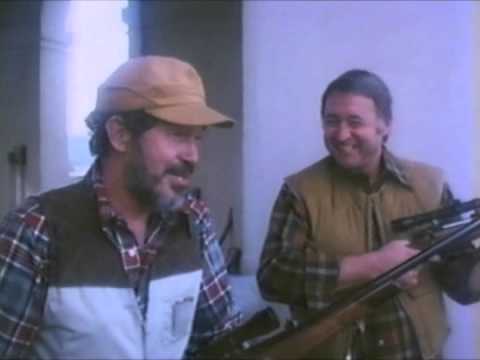
As for Warren Oates, he appears in an early skit. He and Robert Ridgely (best known for playing Col. James in Boogie Nights) play hunters who take part in the Charles Whitman Celebrity Invitational, climbing to the top of the Tower on the University of Texas campus and shooting at the people below. It’s even less funny now than it probably was in 1977.
How did Warren Oates end up in a movie like Prime Time? Even great actors have bills to pay. As for Prime Time, it is the one Warren Oates film that even the most dedicated Warren Oates fan won’t regret missing.
I have to admit that I had ulterior motives for reviewing the film Hustle as a part of Embracing the Melodrama. I was already planning on reviewing another 1975 film about prostitutes, one that I had recently watched on Netflix. That name of that film was Hustling and, for whatever reason, it amused me to imagine being alive in 1975 and going to see Hustle at a movie theater and then coming home, turning on TV, and finding myself watching a film called Hustling.
So really, if I was going to review one of those films, I had to review the other, right? It made perfect sense at the time!
Anyway, as for Hustling, it’s a film about prostitutes in New York and the wealthy magazine writer who decides to interview them for an article. Watching the film, what I immediately noticed was that, even though the film had a properly gritty feel to it, none of the characters ever cursed and, for a film about sex workers, there was no nudity. Though the characters continually talked about getting beaten up by their pimps, all of the violence occurred off-screen. Even more importantly, whenever something dramatic happened, the scene would fade to black. It was almost as if the movie was pausing for an unseen commercial.
Which, of course, it was. Hustling was made for television and, as I watched it, it was easy for me to imagine that I was actually watching the latest Lifetime original film. It certainly followed a pattern that should be familiar to anyone who has ever watched a movie on Lifetime. Wanda (Jill Clayburgh, giving an excellent performance) is a veteran prostitute who, after being arrested for the hundredth time, is told that the charges against her will be dropped if she allows herself to be interviewed by magazine writer, Fran Morrison (Lee Remick). At first Wanda refuses but, after her pimp refuses to pay her fine and suggests that she should just accept spending a few months in jail, Wanda reconsiders and accepts Fran’s offer.
The rest of the film charts Fran and Wanda’s unlikely friendship. Wanda tells Fran what it’s like to be prostitute. Fran encourages Wanda and the other prostitutes to stand up for their legal rights. Wanda deals with a society that looks down on her. Fran deals with a boyfriend (Monte Markham) who can’t understand why she’s so concerned about a bunch of prostitutes. Wanda considers going back to her pimp. Fran considers exposing all of the “respectable” men who use prostitutes.
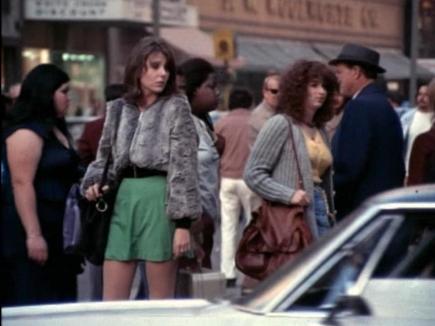
So, Hustling is pretty predictable and, not surprisingly, rather dated but it’s also a fairly effective portrait of life on the margins of society. Lee Remick is stuck playing a one-note character but Jill Clayburgh is great in the role of Wanda. If nothing else, Hustling was filmed on location in some of the sleaziest parts of 1970s New York City and therefore, the film serves as a bit of a historical document.
For those wishing to check it out, the film’s currently available on Netflix.
“I don’t care if critics like it; I hated it. I can’t like or be objective about films I had a terrible time doing.”
— Tuesday Weld on Pretty Poison (1968)
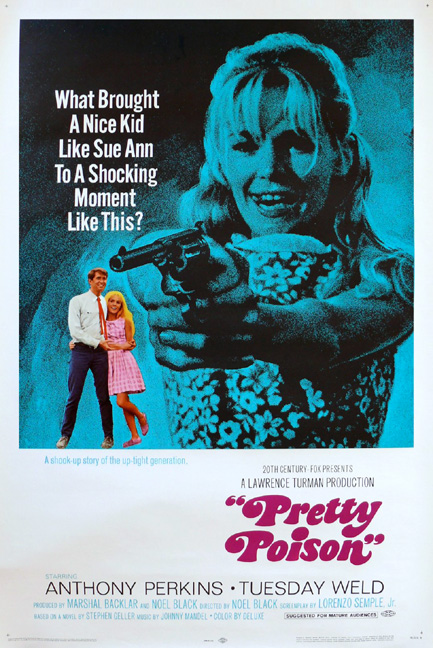
It’s actually rather depressing to read that Tuesday Weld hates Pretty Poison because it really is an underrated gem, a nifty little thriller that acts as sly satire on youth, conformity, and small town life. The main reason that the film works is because of the performances delivered by both Weld and her co-star, Anthony Perkins.
But then again, when we the viewers think back on a movie, we remember what we saw as a member of the audience and sometimes, we forget that just because a film is fun to watch, that doesn’t necessarily mean that it was enjoyable to make. When actors and other technicians think back on a film they were involved with, they remember the experience of actually making it. Reportedly, Weld did not get along with the director of Pretty Poison and couldn’t wait to get away from him.
Interestingly enough, in Pretty Poison, Tuesday Weld plays a teenage girl who doesn’t get along with her mother and who can’t wait to get away from her. Perhaps being miserable while making Pretty Poison helped Weld to bring a miserable character to life.
Pretty Poison opens with a nervous-looking man named Dennis Pitt (Anthony Perkins) watching a group of high school cheerleaders practicing on a field. His attention is focused on one cheerleader in particular, the blonde Sue Ann Stepanek (Tuesday Weld). Even before the opening credits have ended, the film has established a familiar dynamic. Sue Ann is the fresh-faced example of small town American innocence. Dennis is the type of creepy older guy that every girl has had to deal with at some point in her life. (When I was in high school, there were always guys like Dennis hanging out around the mall. When I was in college, the Dennis Pitts of the world were the guy who still hung out around the dorms even though they hadn’t been a student in a decade.)
Having established this dynamic early on, Pretty Poison spends the rest of its running time turning that dynamic upside down.
Dennis has recently been released from a mental hospital. Under the watchful eye of his parole officer (John Randolph), Dennis gets a mind-numbingly dull job at a local mill and tries to live a normal life. When Dennis finally does get a chance to talk to Sue Anne, he lies to her and tells her that he’s a secret agent and that he’s in town on a mission. Sue Anne responds to Dennis’s awkward flirting and soon, she’s accompanying him on his “missions.” During one such mission near the mill, they’re spotted by a security guard. Sue Anne responds by enthusiastically murdering him.
Yes, the cheerleader’s a sociopath.
Sue Anne’s tyrannical mother (Beverly Garland) does not approve of her relationship with Dennis. Sue Anne wants her mother out of the way and she expects her secret agent boyfriend to help her out…
Pretty Poison is a sharp mix of dark comedy and heightened drama, one that gets progressively darker as it progresses. From the minute the film first shows Sue Anne intensely practicing on that field while Dennis watches her, it’s pretty obvious that the film was meant to be an allegory for American society in 1968. Sue Anne is the perfect, all-American cheerleader who kills people because she can. Dennis is the neurotic outsider who knows that he’ll never be able to get anyone to believe the truth.
And it all works, largely because both Anthony Perkins and Tuesday Weld are so well-cast. It is, of course, impossible to watch Perkins without first thinking about Psycho but he actually manages to make Dennis into a very different character from Norman Bates. If Norman was a psycho who, at first sight, looked like an innocent, Dennis is an innocent who, at first sight, looks like a psycho. Tuesday Weld, meanwhile, turns Sue Anne into a disturbingly plausible killer, the type who, within minutes, can alternate between moodiness and giddiness, all the while squealing with orgasmic joy while bashing in someone’s head.
Tuesday Weld may hate Pretty Poison but it’s still a pretty good movie.

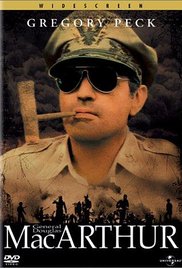 The year is 1962 and Douglas MacArthur (Gregory Peck), the legendary general, visits West Point for one last time. While he meets the graduates and gives his final speech, flashbacks show highlights from MacArthur’s long military career. He leaves and then returns to Philippines. He accepts the Japanese surrender and then helps Japan rebuild and recover from the devastation of the war. He half-heartedly pursues the Presidency and, during the Korean War, gets fired by Harry Truman (Ed Flanders).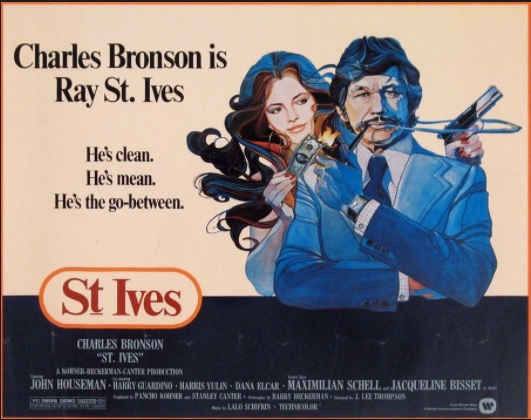

 Through the Shattered Lens