Icarus File No. 22: Revolution (dir by Hugh Hudson)


1985’s Revolution opens on July 4th, 1776.  The Declaration of Independence has just been published.  The streets are full of people celebrating.  A statue of King George is pulled down.  In her carriage, the wealthy Mrs. McConnahay (Joan Plowright) turns up her nose to the enthusiastic rebels, including the fanatical Liberty Woman (Annie Lennox).  Mrs. McConnahay’s daughter, Daisy (Nastassja Kinski) is intrigued by this idea of freedom and equality.

Fur trader Tom Dobbs sails his boat into Hudson Harbor.  Tom is Scottish, illiterate, and very much a man of the 18th Century.  However, he’s played by Al Pacino, who was none of those things.  After Revolution was released to desultory reviews, Pacino took four years off from the movies and watching this film, one can see why.  Pacino is miscast as Dobbs and, as a result, he gives the type of truly bad performance that can only be given by a great actor.  Unable to disguise the fact that he had the accent of a modern-day New Yorker, Pacino resorts to mumbling the majority of his lines.  Tasked with playing a character who has no idea how to deal with the history-making events in which he finds himself, Pacino alternates between a blank look and with bulging his eyes like a madman, proving that it’s far more difficult to play an uneducated character than an educated one.  Why cast Pacino, who can be one of our most exciting actors, as a character who can barely speak and who has neither the intensity of Michael Corleone or the subversive wit of Tony Montana?  Due to Pacino and Kinski having zero chemistry, the scenes where Tom falls in love with Daisy are almost painful to watch.

The film follows Tom as he and his son, Ned (Simon Owen when the film begins, Dexter Fletcher by the time the action moves to Valley Forge), as they find themselves conscripted into the Revolutionary Army.  Eventually, Ned is abducted into the British army and serves as a drummer boy under the sadistic watch of Sgt. Major Peasy (Donald Sutherland).  The idea behind the film isn’t a bad one.  It attempts to portray the American Revolution through the eyes of the average citizen.  Instead of focusing on the Founding Fathers, Revolution tries to tell the story of the everyday people who found themselves in the middle of the war.  Tom loses his boat and (temporarily) he loses his son.  Fortunately, this is one of those films where people are constantly running into each other by chance, regardless of whether it makes any sense or not.  Daisy goes from seeing Tom in New York to randomly coming across him in a field to eventually finding him in Valley Forge.  It’s not because she’s specifically looking for him.  Instead, he just happens to be there.

Why does Revolution fail?  A lot of it comes down to Pacino’s performance, though Pacino certainly isn’t the only talented actor to give a not-quite good performance in Revolution.  (Donald Sutherland has never been more wasted in a film.)  The script is full of dialogue like, “My mouth belongs where I place it.”  (Pacino gets stuck with that one.)  Hugh Hudson directs in a leaden manner.  Towards the end of the film, there is one brilliant sequence where Tom wanders through the streets of New York and, for a few minutes, the film comes to like with a spontaneity that was previously lacking.  Unfortunately, it’s just one sequence in a very long movie,

To be honest, we could use some good films about the American Revolution and I’m not talking about elitist nonsense like Hamilton.  No taxation without representation.  It’s still a good message for us all.

Previous Icarus Files:

  1. Cloud Atlas
  2. Maximum Overdrive
  3. Glass
  4. Captive State
  5. Mother!
  6. The Man Who Killed Don Quixote
  7. Last Days
  8. Plan 9 From Outer Space
  9. The Last Movie
  10. 88
  11. The Bonfire of the Vanities
  12. Birdemic
  13. Birdemic 2: The Resurrection 
  14. Last Exit To Brooklyn
  15. Glen or Glenda
  16. The Assassination of Trotsky
  17. Che!
  18. Brewster McCloud
  19. American Traitor: The Trial of Axis Sally
  20. Tough Guys Don’t Dance
  21. Reach Me

Lisa Marie Reviews An Oscar Nominee: The Elephant Man (dir by David Lynch)


The Elephant Man (1980, dir by David Lynch, DP: Freddie Francis)

David Lynch never won a competitive Oscar.

He received an honorary award from the Academy in 2019.  He generated some minor but hopeful buzz as a possible nominee for Best Supporting Actor for his role in Steven Spielberg’s The Fabelmans.  He was nominated for Best Director three times and once for Best Adapted Screenplay.  But he never won an Oscar and indeed, even his nominations felt like they were given almost begrudgingly on the part of the Academy.  In an industry that celebrated conformity and put the box office before all other concerns, David Lynch was an iconoclastic contrarian and the Academy often didn’t do know what to make of him.  Of the many worthy films that he directed, only one David Lynch film was nominated for Best Picture and, in my opinion, it should have won.

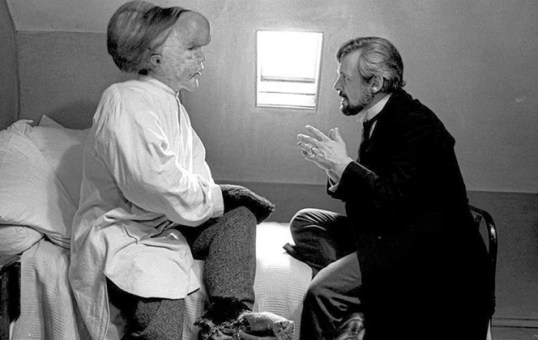
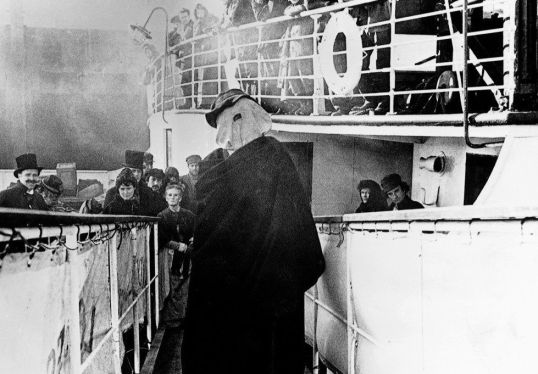
1980’s The Elephant Man is based on the true story of Joseph Merrick (renamed John for the film), a man who was horribly deformed and terribly abused until he was saved from a freak show by a surgeon named Dr. Frederick Treves.  The sensitive and intelligent Merrick went on to become a celebrity in Victorian London, visited by members of high society and allowed to live at London Hospital.  (Even members of the royal family dropped in to visit the man who had once been forced to live in a cage.)  Merrick lived to be 27 years old, ultimately dying of asphyxiation when he attempted to lie down and, in Treves’s opinion, sleep like a “normal person” despite his oversized and heavy head.  In the film, Merrick is played by John Hurt (who gives a wonderful performance that, despite Hurt acting under a ton on makeup, still perfectly communicates Merrick’s humanity) while Treves is played by Anthony Hopkins, who is equally as good as Hurt.  (Hurt was nominated for Best Actor but Hopkins was not.  Personally, I prefer Hopkins’s performance as the genuinely kind Dr. Treves to any of his more-rewarded work as Dr. Lecter.)  The rest of the cast is made up of veteran British stars, including John Gielgud, Wendy Hiller, Freddie Jones, and Kenny Baker.

Lynch’s version of The Elephant Man is only loosely based on the facts of Merrick’s life.  It opens with a disturbing fantasy sequence (one which I assume is meant to be from Merrick’s point of view) in which a herd of elephants strike down Merrick’s mother and then appear to assault her.  Shot in stark black-and-white and often featuring the sounds of droning machinery in the background (in many ways, The Elephant Man feels like it takes place in the same world as Eraserhead), the first half of The Elephant Man feels like a particularly surreal Hammer film.  (Veteran Hammer director Freddie Francis served as The Elephant Man‘s cinematographer.)  Merrick is kept off-camera and, when we finally do see his face, it’s in a split-second scene in which Merrick is as terrified as the person who sees him.  Before we really meet Merrick, we’ve already heard Treves and the hospital administrator (John Gielgud) discuss all of the clinical details of his condition.  We know why he’s deformed.  After we see him, we know how he’s deformed.  After all of that, the audience is finally ready to know Merrick the human being.  Without engaging in too much obvious sentimentality, Lynch shows us that Merrick is a kind soul, one who has been tragically mistreated by the world.  Just as with the real Merrick, almost everyone who meets the film’s John Merrick is ultimately charmed by him.  In the film, Merrick is kidnapped by his former owner, the alcoholic Bytes (Freddie Jones), who wants again puts Merrick on display in a cage.  In the end, it’s Merrick’s fellow so-called “freaks” who set him free and allow him to return to the hospital, where he has one final vision of his mother.  This vision is a much less disturbing than the one that opened the film.  The film celebrates the humanity of John Merrick but is also reveals the genius of David Lynch.  There’s so many moments when the film could have gone off the rails or become too obvious for its own good.  But Lynch’s unique style so draws you into the film’s world that even the mysterious visions of his mother somehow feel completely necessary and natural.  The Elephant Man is the David Lynch film that makes me cry.  Lynch was a surrealist with a heart.

The Elephant Man was only David Lynch’s second film.  He was hired to direct by none other than Mel Brooks, who produced the film but went uncredited to prevent people from thinking it would be a comedy.  (Lynch, however, did cast Brooks’s wife, Anne Bancroft, as an actress who visits Merrick.)  Brooks hired Lynch after seeing Eraserhead and recognizing a talent that many in Hollywood would never have had the guts to take a chance on.  (Despite the success of Eraserhead on the midnight circuit, David Lynch was working as a roofer when he was offered The Elephant Man and had nearly given up on the idea of ever making another film.)  Reportedly, Brooks stayed out of Lynch’s way and protected him from other executives who fears Lynch’s version of the story would be too strange to be a success.  Lynch and Brooks proved those doubters wrong.  Acclaimed by critics and popular with audiences, The Elephant Man was nominated for Best Picture and David Lynch was nominated for Best Director.  I like Ordinary People.  I like Raging Bull.  But The Elephant Man was the film that should have won in 1980.

The Elephant Man remains a powerful movie and an example of how an independent artist can make a mainstream movie without compromising his vision.  (Of course, I imagine it helps to have a producer who has the intelligence and faith necessary to stay out of your way.)  David Lynch may be gone but his art will live forever.  The Elephant Man will continue to make me cry for the rest of my life and for that, I’m thankful.

The Elephant Man (1980, dir by David Lynch, DP: Freddie Francis)

Lisa Reviews An Oscar Winner: Bohemian Rhapsody (dir by Bryan Singer and Dexter Fletcher)


Can a film be a box office hit and win the most Oscars of the year while also ending the career of the man who was credited as directing it?

If it’s Bohemian Rhapsody, it can.

The story is well-known but it is worth repeating.  From the moment that the film went into production in 2017 until it was finally released in November of 2018, the buzz was that Bohemian Rhapsody was going to be a disaster.  Despite the fact that he sometimes claimed that directing a biopic about Queen lead singer Freddy Mercury was a bit of a passion project for him, reports from the set indicated that director Bryan Singer was behaving just a little bit erratically.  He argued with lead actor Rami Malek.  He frequently disappeared from the set.  Shooting was delayed for days because no one knew where Singer was.  At the same time, with the #MeToo movement at the height of its cultural power, Singer was being accused of being one of Hollywood’s worst abusers.  Eventually, 20th Century Fox suspended the production, fired Bryan Singer, and brought in Dexter Fletcher to finish shooting the film.  By most accounts, Fletcher did a professional and exemplary job of getting the production back on track but, due to the DGA bylaws, he wasn’t credited with directing the film.  Instead, he had to settle for an executive producer credit and the opportunity to direct the Elton John biopic, Rocketman.

As such, no one was expecting much from Bohemian Rhapsody.  There were, of course, reports that Rami Malek did an unusually good job as Freddy Mercury.  If somehow the film could be saved in editing, Malek might even pick up an Oscar nomination.  But everyone knew that Bohemian Rhapsody was going to have to overcome a lot to be a successful film.  While everyone appreciated that Dexter Fletcher had finished the film after Singer flaked out, there was a lot of doubt as to whether or not Fletcher’s work would mesh with Singer’s vision.

And indeed, the initial reviews were not positive.  Malek was praised by most (but certainly not all) critics but the film itself was described as being disjointed and full of clichés.  The film’s historical accuracy was criticized, as was its reticence in seriously exploring Mercury’s sexuality.  Bohemian Rhapsody‘s editing was also heavily criticized, with the film’s sloppiness felt to be a result of the editor trying to put a coherent story together out of scenes that were filmed by two very different directors.  

Here’s the thing, though. 

The critics may have dismissed the film but what about the audiences?  What about the people who pay money to see a film in a theater on the weekend that it comes out?  What about the people who are motivated not by the opinions of film critics but instead by the recommendations of their friends and family?  Those people, they didn’t care.  They flocked to see Bohemian Rhapsody and, judging by the film’s box office, quite a few people saw it more than once.  After all the drama and bad publicity, Bohemian Rhapsody became a huge hit.

It also became an Oscar contender.  The film received five Oscar nominations, including for Best Picture of the Year.  (Among the films that were not nominated for Best Picture were Eighth Grade, First Reformed, First Man, The Ballad of Buster Scruggs, and If Beale Street Could Talk.)  Though the award for Best Picture went to Green Book (another film that was more popular with audiences than with critics), Bohemian Rhapsody won the other four awards for which it was nominated.  In fact, Bohemian Rhapsody won the most Oscars that year.  It won more Oscars than BlackKklansman, Black Panther, A Star is Born, The Favourite, and RomaBohemian Rhapsody even won the Oscar for Best Editing.

Even at the time that Bohemian Rhapsody was winning all of those Oscars, people seemed to be rather embarrassed by the film’s success.  (Not one winner mentioned Bryan Singer in their speech, though most did take the time to thank Dexter Fletcher.)  In the years since, Bohemian Rhapsody has developed a reputation for being one of the worst films to ever be nominated for Best Picture.

So, when I rewatched the film on Hulu, the main question on my mind was, “Is Bohemian Rhapsody as bad as everyone remembers?”

Well …. it’s not great.  At the same time, it’s not terrible.  It’s one of those films that’s very much in the middle.  All those complaints about Bohemian Rhapsody being disjointed were and are valid.  The script indulges in just about every rock star biopic cliché and the other members of Queen are portrayed as being ciphers.  Perhaps most surprisingly, Rami Malek’s acclaimed, Oscar-winning performance doesn’t hold up particularly well.  Malek has the charisma necessary to be a believable rock star but his performance is all on the surface and you never really get any ideas as to what exactly was going on inside of Mercury’s head.  This is a biopic that doesn’t seem to be sure what it wants to say about its main subject, other than “Thanks for the music.”  And really, there’s nothing wrong with saying “Thanks for the music.”  But that could have just as easily been said by re-releasing a Queen concert film.  That said, the story moves quickly, the 70s and 80s fashion is enjoyably over the top, and the concert scenes are nicely put together.  I’m not really a Queen fan but I know that I’m in the minority and there’s enough Queen music in the film to keep the majority happy.  The film, after all, was made for the fans.

So, I guess my opinion is that Bohemian Rhapsody isn’t good enough to justify all of those Oscars but it’s not quite bad enough to justify all of the hate either.  The film would probably have a better reputation if it hadn’t won all those Oscars.  Without all of those Oscars, it would be remembered as an uneven biopic with some good musical scenes and a lot of enjoyably tacky fashion choices.  Instead, it’s destined to forever be remembered as the film that won Best Editing over The Favourite.  Sometimes, it’s better to not be nominated.

It will also be remembered as the film that, along with a series of serious sexual misconduct allegations, ended Bryan Singer’s career as a major filmmaker.  Singer was briefly attached to direct a new version of Red Sonja but, after the resulting outcry, that project was canceled.  As far as I know, he hasn’t been attached to any major films since then.  With the X-Men now a part of the MCU, it’s doubtful he’ll be invited to have anything else to do with that franchise.  Much as happened with Sam Peckinpah and Convoy, Bohemian Rhapsody was a box office success that made its credited director a pariah in the industry.  Dexter Fletcher, meanwhile, was acclaimed for his work as director of Rocketman and he recently directed two of the better episodes of The Offer.  


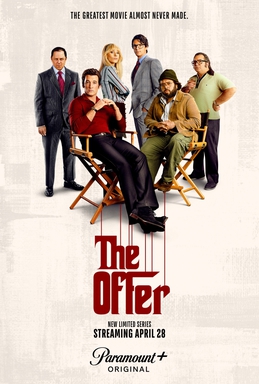
Miniseries Review: The Offer (dir by Dexter Fletcher, Adam Arkin, Colin Bucksey, and Gwyneth Horder-Payton)


Almost despite myself, I enjoyed The Offer.

That may come as a surprise to some.  The Offer is a 10-hour miniseries about the making of The Godfather and how Hollywood politics aren’t really that much different from Mafia politics.  As anyone who has regularly read this site over the past few years should know, I absolutely love The Godfather.  It’s my favorite movie.  It’s a movie about which I’ve done a lot of personal research.  There’s very little about the making of The Godfather that I don’t know.  If we’re going to be honest, I’m probably a little bit of a snob about it.

So, like many people, I was a bit skeptical when I first heard about The Offer.  It didn’t seem like something that was particularly necessary and it was hard for me to imagine how the miniseries would ever be able to convincingly cast anyone as Marlon Brando or Al Pacino or, for that matter, Francis Ford Coppola.  My skepticism only increased when I learned that the story was going to be told from the perspective of the film’s producer, Al Ruddy.  Everyone agrees that Ruddy was an important part of The Godfather team but he’s never been quite as compelling a figure as the brilliant but often self-destructive Brando or the neurotic but playful Pacino.  When people talk about what makes The Godfather such a brilliant film, they talk about the quotable dialogue.  They talk about the masterful performances.  They talk about Coppola’s skill as a storyteller.  They talk about the way that Gordon Willis lit the scenes so that the characters often seemed to be on the verge of being swallowed by their shadows.  They even talk about how Robert Evans insisted that the film could only be directed by an Italian and how Evans defied Paramount when the studio originally demanded that Coppola cut the film down to two hours.  When Al Ruddy is praised, it’s usually for staying out of the way.

I knew that I would have to watch The Offer eventually but I avoided it while it was actually airing and I made sure not to read anyone else’s opinion to it.  Despite my own obvious biases, I did want to try to maintain as open a mind as I possibly could.  That said, I wasn’t expecting much when I finally watched The Offer this weekend.

But, as I said at the start of this review, I enjoyed it.

Don’t get me wrong.  It’s a bit of a silly show.  If The Offer was a sitcom, it would be called Everybody Loves Ruddy because the main theme of the show seems to be that Al Ruddy (played by a miscast Miles Teller) was literally the most important man in the entire history of Hollywood.  There’s not a problem that Ruddy can’t solve, whether it’s convincing CBS to air a tasteless sitcom called Hogan’s Heroes or convincing Paramount to take a huge risk on a mercurial director named Coppola and an unknown actor named Pacino.  When gangster Joe Colombo (Giovanni Ribisi) tries to interfere with production, Ruddy befriends him and is soon a popular guy with the crew.  When Al Pacino (Anthony Ippolito) signs a contract with MGM, Ruddy puts the pressure on Paramount to find a way to get Pacino out of it.  When Coppola (Dan Fogler) has a fight with Gordon Willis (T.J. Thyne), Ruddy convinces them to make up.  When Robert Evans (Matthew Goode) goes on a coke binge, Ruddy snaps him out of it.  When …. well, you get the idea.  There’s nothing Al Ruddy can’t do!  When Evans mentioned that Henry Kissinger was coming to the Godfather premiere, I half expected Al Ruddy to negotiate a ceasefire in Vietnam.

From the start, The Offer is full of visual cues and dialogue that pay homage to not only The Godfather but the other films of the period.  The first line of the miniseries is Joe Colombo telling someone to, “Leave the cannoli.”  At first, I groaned but, slowly but surely, the show won me over.  By the end of the first episode, it was obvious that The Offer was not necessarily meant to be taken literally.  The Offer doesn’t tell the story of what Hollywood was really like in the late 60s and early 70s.  Instead, it tells the story of how people like me, who were born a few decades too late, imagine it was.  It’s less about the decade itself and more about how that decade continues to fascinate us and spark our imagination.  In our imagination, Robert Evans is snorting coke in his office, Ali MacGraw is lounging by the pool, Frank Sinatra is making angry phone calls to Joe Colombo, Al Pacino is so nervous that he can’t look anyone in the eye, and Marlon Brando is wandering around his mansion in a kimono and talking about how he can’t get anyone to see his latest, politically-charged film.  In our fantasies, it only makes sense that Evans and his assistant Peter Bart (Josh Zuckerman) would spend all of their time dropping titles of well-regarded, still-remembered films because why would anyone fantasize about them discussing a film that was forgotten?  And, of course, no one is going to fantasize about people discussing some actor who was briefly big in 1972 and then spent the rest of their career on television.  Instead, in the fantasy, it’s all about Robert Redford, Jack Nicholson, Liz Taylor, and Marlon Brando.  It also makes sense that only classic 70s music would be heard in the background of every scene because, seriously, who ever fantasizes about a bad song playing at a party?

Once it is accepted that it is all meant to be a fantasy, it becomes much easier to appreciate The Offer for what it is, a gossipy, Hollywood story with a Mafia subplot and an overabundance period detail.  Once the viewer accepts The Offer is a fantasy, the viewer is freed up to appreciate the 70s-chic wardrobe.  Once the viewer gets past the fact that the cast is playing characters based on actual people, it becomes much easier to appreciate the performances of character actors like Colin Hanks (who plays an uptight executive) and Burn Gorman (who plays the notoriously eccentric businessman, Charles Bluhdorn).  Patrick Gallo is slyly funny as Mario Puzo while Dan Fogler does a credible enough job as Coppola, even if he never quite captures Coppola’s larger-than-life persona.  Even Lou Ferrigno gets a nice bit, playing a mob enforcer turned unwilling actor.  At the center of it all is the absolutely brilliant Matthew Goode, giving a charismatic performance as the brilliant but sometimes unstable Robert Evans.

As a history, The Offer won’t win any points for accuracy.  But, as a fantasy, it’s undeniably entertaining.  It’s not so much the story of how The Godfather was made but the story of how we wish it was made.

An Offer You Can’t Refuse #15: Bugsy Malone (dir by Alan Parker)


Remember how, a few weeks ago, I said I was going to spend the month of June reviewing 30 gangster movies?  Well, I was doing pretty well but then I got distracted with some things and I ended up falling behind and now, it’s the last day of June and I’ve only reviewed 14 of the 30 films that I was planning on taking a look at.  It’s frustrating but, as any movie blogger can tell you, it happens.  Still, I’m not one to give up so easily!  I promised to review 30 gangster movies and I’m going to keep my word.  Or, at the very least, I’m going to try to…. like, definitely maybe try to….

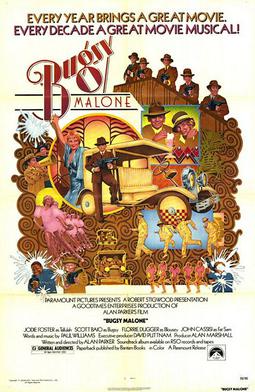
Anyway, let’s get back to it with 1976’s Bugsy Malone!

Bugsy Malone is an homage to the old gangster movies of the 1920s and 30s.  It’s also a musical, featuring a lot of songs about wanting to make a lot of money, fall in love, and go away to Hollywood.  On top of all that, it’s also a children’s film.  Though they may be playing gangsters and going to war over who will control the rackets, the cast is entirely made up of children.  Though the film does feature a lot of guns, none of the guns fire bullets.  Instead, they shoot custard pies.  Once you get cornered by a rival gangster and you get “splurged,” your career in the rackets is over.  You’re humiliated.  You’re nothing.  You’re just another two-bit hood who couldn’t make it in the big leagues.  You’re just….

Well, you get the idea.

Basically, the plot of the film is that Dandy Dan (Martin Lev) and Fat Sam (John Cassissi) are two rival gangsters who want to take over the Lower East Side.  Fat Sam owns a speakeasy, which means that there’s always a lot of dancing and singing going on in the background.  Bugsy Malone (Scott Baio) is a tough boxer who wants Fat Sam to give a job to Blousey Brown (Florrie Dugger), who dreams of going to Hollywood and becoming a big star.  Tallulah (Jodie Foster) is Fat Sam’s gun moll but she used to go out with Bugsy and she still wants him back.  Bugsy get caught up in the middle of the war between Dandy Dan and Fat Sam and it all eventually leads to a big pie fight and a lot of children covered in custard.  “You give a little love,” the children sing as they realize that their lives don’t have to be defined by gang wars, “and it all comes back to you….”

So, I have to admit that I was absolutely dreading watching Bugsy Malone.  I mean, singing children and custard pie guns?  It all sound just unbearably cutesy.  But, to my surprise, Bugsy Malone actually turned out to be a fun and clever little movie, one that was full of smart dialogue, catchy songs, excellent dancing, and wonderfully non-cutesy performances from its cast.  Even though the film may be about a bunch of children dressing up as gangsters, all of the child actors take their characters seriously and director Alan Parker directs the film as if it were an actual gangster film as opposed to just a children’s musical.  The end result is a film that’s cute but never cutesy.  Believe me, there is a huge difference between the two.

To my shock, Bugsy Malone turned out to be an offer that you can’t refuse.

Previous Offers You Can’t (or Can) Refuse:

  1. The Public Enemy
  2. Scarface
  3. The Purple Gang
  4. The Gang That Could’t Shoot Straight
  5. The Happening
  6. King of the Roaring Twenties: The Story of Arnold Rothstein 
  7. The Roaring Twenties
  8. Force of Evil
  9. Rob the Mob
  10. Gambling House
  11. Race Street
  12. Racket Girls
  13. Hoffa
  14. Contraband

Film Review: The Bounty (dir by Roger Donaldson)


Oh, poor Captain Bligh.

For those who recognize the name, it’s probably because they’ve either read a book or seen a film that portrayed him as being the tyrannical captain of the HMS Bounty.  In 1787, William Bligh and the Bounty set off on a mission to Tahiti.  When, after ten months at sea, the Bounty arrived in Tahiti, the crew immediately fell in love with the relaxed pleasures of island life.  When Bligh ordered them to leave Tahiti and continue with their mission, his own second-in-command led a mutiny.  Bligh and the few men who remained loyal to him were set adrift in a lifeboat while Christian and the mutineers eventually ended up settling on Pitcairn Island.  Against impossible odds, Bligh managed to make it back to civilization, where he faced both a court-martial and a future of being portrayed as a villain.

Though most historians agree that Bligh was a knowledgeable and talented (if strict) captain and that the mutiny had more to do with Christian’s desire to remain in Tahiti than Bligh’s treatment of the crew, most adaptations of what happened on the Bounty have laid the blame for the mutiny squarely at Bligh’s feet.  Personally, I think it has to do with the names of the people involved.  William Bligh just sounds evil, in much the same way that the name Fletcher Christian immediately brings to mind images of heroism.  In 1935’s Mutiny On The Bounty, Charles Laughton portrayed Bligh as being a viscous sadist.  In 1962’s Mutiny in the Bounty, Trevor Howard portrayed Bligh as being an overly ambitious martinet, though ultimately Howard was overshadowed by Marlon Brando, who gave a bizarrely mannered performance in the role Christian.

In fact, it would seem that there’s only one film that’s willing to give William Bligh the benefit of the doubt.  That film is 1984’s The Bounty.

The Bounty opens with Bligh (played by Anthony Hopkins) facing a court-martial for losing the Bounty.  That the admiral presiding over Bligh’s court-martial is played by Laurence Olivier is significant for two reasons.  Olivier’s stately and distinguished presence lets us know that the mutiny was viewed as being an affront to British society but it also reminds us that Hopkins began his career as Olivier’s protegé.  Much as how William Bligh was a star of the British navy, Hopkins was (and is) a star of British stage and screen.  One gets the feeling the scene isn’t just about the admiral judging Bligh.  It was also about Olivier judging Hopkins as the latter played a role that had already been made famous by two other great British thespians, Charles Laughton and Trevor Howard.

By opening with Bligh on trial, The Bounty allows itself to be told largely through Bligh’s point of view.  We watch familiar events play out from a new perspective.  Once again, it takes longer than expected for Bligh and the Bounty to reach Tahiti and, once again, Bligh’s by-the-book leadership style alienates a good deal of the crew.  However, this time, Bligh is not portrayed as being a villain.  Instead, he’s just a rather neurotic man who is trying to do his duty under the most difficult of circumstances.  Bligh knows that the crew blames him for everything that goes wrong during the voyage but he also knows that the only way their going to survive the journey is through maintaining order.

In fact, the film suggests that Bligh’s biggest mistake was promoting Fletcher Christian (Mel Gibson) to second-in-command.  Christian is portrayed as being good friends with Bligh and one gets the feeling that Bligh promoted him largely so he would have someone to talk to.

The film does a good job contrasting the dank claustrophobia of the Bounty with the vibrant beauty of Tahiti.  When the crew first lands, Bligh proves his diplomatic skills upon meeting with the native king.  However, it quickly becomes apparent that, while Bligh views the stop in Tahiti as just being a part of the mission, the majority of the crew view it as being an escape from the dreariness of their lives in Britain.  For the first time in nearly a year, the crew is allowed to enjoy life.  When Bligh eventually orders the crew to leave Tahti, many of the men — including Christian — are forced to abandon their native wives.

Unfortunately for Bligh, he doesn’t understand that his crew has no desire to return to the dreariness of their old life, either on the Bounty or in the United Kingdom.  Bligh’s solution to the crew’s disgruntlement is to become an even harsher disciplinarian.  (Bligh is the type of captain who will order the crew to clean the ship, just to keep them busy.)  However, Bligh no longer has Christian backing him.  When the inevitable mutiny does occur, Bligh seems to be the only one caught by surprise.

Anthony Hopkins gives a performance that turns Bligh into a character who is, in equal amounts, both sympathetic and frustrating.  Bligh means well but he’s so rigid and obsessed with his duty that he can’t even being to comprehend why his crew is so annoyed about having to leave Tahiti.  Since Bligh can’t imagine ever loving anything more than sailing, it’s beyond his abilities to understand why his men are so obsessed with returning to Tahiti.  Hopkins portrays Bligh as being not evil but instead, rather isolated.  He knows everything about sailing but little about emotion or desire.  Ironically, the same personality traits that led to him losing the Bounty are also key to his survival afterward.  By enforcing discipline and emphasizing self-sacrifice, Bligh keeps both himself and the men who stayed loyal to him alive until their eventual rescue.

Interestingly, Mel Gibson portrayed Christian as being just as neurotic as Bligh.  In fact, if Bligh and Christian have anything in common, it would appear to be they’re both obsessed with what the crew thinks of them.  Whereas Bligh is obsessed with being respected, Christian wants to be viewed as their savior.  When the mutiny finally occurs, Christian gets an almost messianic gleam in his eyes.  While Christian is not portrayed as being a villain (and, indeed, The Bounty is unique in not having any cut-and-dried villains and heroes), Gibson’s portrayal is certainly far different from the heroic interpretation offered up by Clark Gable.

(The rest of the cast is full of familiar British character actors, along with a few future stars making early appearances.  Both Daniel Day-Lewis and Liam Neeson appear as members of the Bounty’s crew.  One remains loyal to Bligh while the other goes with Christian.  Watch the movie to find out who does what!)

The Bounty is best viewed as being a character study of two men trying to survive under the most trying of conditions.  Just as Bligh’s personality made both the mutiny and his survival inevitable, the film suggests that everything that made Christian a successful mutineer will also make it impossible for him to survive for long afterward.  Whereas Bligh may have been a poor leader but a good diplomat, Christian proves to be just the opposite and the king of Tahiti makes clear that he has no room on his island for a bunch of mutineers who will soon have the entire British navy looking for them.  Whereas Bligh makes it back to Britain, Christian and the mutineers are forced to leave Tahiti a second time and end up settling on the previously uncharted Pitcairn Island.  (Of course, no one knows for sure what happened to Christian after the mutineers reached Pitcairn Island.  The last surviving mutineer claimed that Christian was murdered by the natives who were already living on the island.)

The Bounty has its flaws.  There are some pacing issues that keep the film from working as an adventure film and a few of the actors playing the crew aren’t quite as convincing as you might hope.  (If you only saw him in this film, you would never believe that Daniel Day-Lewis is a three-time Oscar winner.)  But it’s still an interesting retelling of a familiar story and it’s worth watching for the chance to see one of Anthony Hopkins’s best performances.


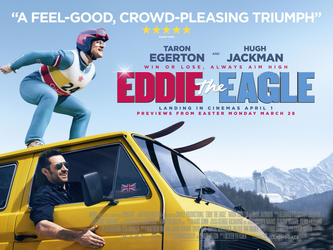
Film Review: Eddie the Eagle (dir by Dexter Fletcher)


eddie_the_eagle_poster

Hi, everyone!

So. I’m guessing, after what happened last night, some of our readers might need something to cheer them up.  If you’re a regular reader of this site, I’m going to imagine that you love movies.  And, in your moment of uncertainty or whatever, you might want to watch a movie.  And, of course, you’re asking yourself, “What does Lisa think I should watch?”

Well, I’ll be honest.  My cinematic tastes tend to be rather dark.  I like horror movies.  I like movies with sad endings.  I love brutal satire.  I love movies that attack their audience and that dare you to look away.  So, I might not be the best person to ask…

But you know what?

There actually is a movie that I can recommend to anyone who needs to be cheered up this week.  Eddie the Eagle, which came out way back in February, is exactly the type of movie that you would expect an arthouse snob like me to dismiss.  It’s a feel-good sports movie, one that is based on a true story but which also features a lot of composite characters and manufactured drama.  No, Eddie the Eagle is perhaps not the type of film that you would expect me to enjoy but, when I finally got around to watching it a few days ago, I absolutely loved it!

Eddie the Eagle tells the story of Eddie Edwards (Taron Egerton), a somewhat eccentric Englishman who dreams of competing in the Winter Olympics, despite the fact that he’s not all that athletically inclined.  When he’s turned down for a spot on the Olympic skiing team, Eddie decides to try to go to the Olympics as a ski jumper.  Working to Eddie’s advantage is the fact that there are no other English ski jumpers.  (We’re told that it’s been over 60 years since the UK even sent a ski jumper to the Olympics.)  In theory, Eddie should be able to qualify for the Olympic team just by showing up.  Working to Eddie’s disadvantage is the fact that the snooty British Olympic officials don’t want him to represent the UK in the Olympics.

Of course, there’s also the fact that Eddie has no experience as a ski jumper and only a few months to learn how to do it.  And, if Eddie makes any mistakes during one of his jumps, he could easily be severely injured or perhaps even die.

Most people would probably just give up and find something practical to do with their life but not Eddie!  Eddie has a dream and he’s going to achieve it, no matter what.  Fortunately, Eddie finds a coach.  Alcoholic Bronson Peary (Hugh Jackman) used to be a champion ski jumper but he’s spent the last few years drinking and being bitter.  At first, Bronson doesn’t want anything to do with Eddie but eventually, Eddie wins him over with his sincerity and his refusal to give up.  As Eddie explains to Bronson, he doesn’t care whether or not he wins a medal.  He just wants to compete…

And really, it shouldn’t work.  I should be complaining about how shamelessly manipulative this movie is.  I should be making fun of the fact that it features almost every sports film cliché imaginable.  But dammit, it’s such a sweet movie!  Director Dexter Fletcher does a great job filming Eddie’s jumps (often times from his point of view) and Taron Egerton is so charmingly odd in the role that you can’t help but cheer whenever Eddie manages to land without crippling himself.  Meanwhile, Hugh Jackman does a good job of grounding the movie in reality (which makes it all the more ironic that, unlike Egerton, Jackman is playing a fictional character).  Add to that, this film features a somewhat random Christopher Walken cameo!  Seriously, you’re sitting there and you’re thinking, “This is a good movie but I just wish Christopher Walken was here…” and then suddenly …. THERE’S CHRISTOPHER WALKEN!

Eddie the Eagle is a sweet and sincere burst of positivity.  It’s the perfect antidote to 2016!

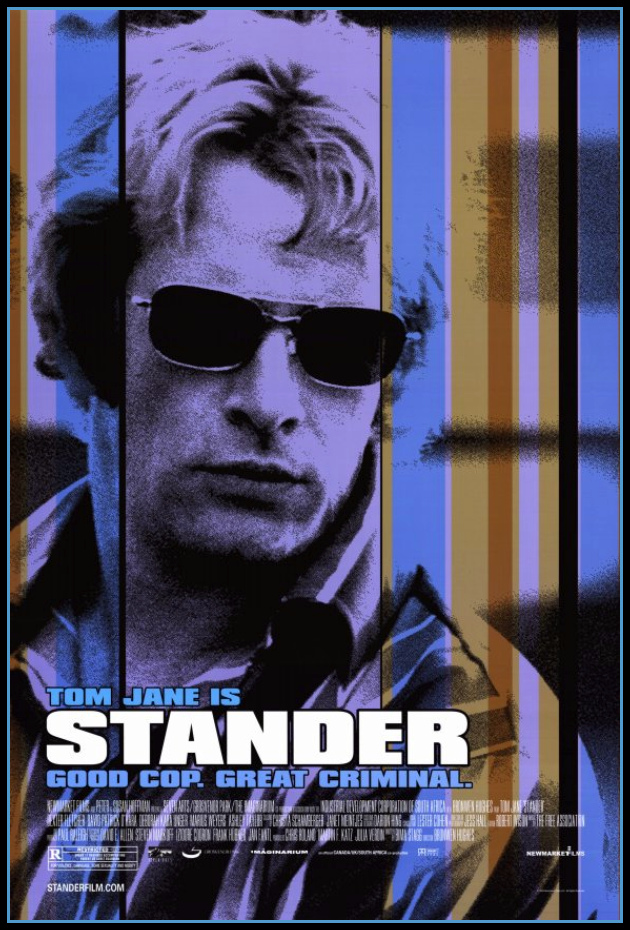
Quickie Review: Stander (dir. by Bronwen Hughes)


Stander was a very good film about the real-life exploits of Andre Stander, Lee McCall and Allan Heyl who were known collectively as The Stander Gang. The Stander Gang was well-known for their daring and reckless bank robberies in their homeland of South Africa. The film stars Thomas Jane (The Punisher, The Mist) as the title character with Dexter Fletcher (Band of Brothers and Lock, Stock and Two Smoking Barrels) and David Patrick O’Hara (Braveheart, Doomsday) rounding out the rest of the Stander Gang.

The film starts off introducing Andre Stander as a highly decorated member of the South African Police Force in the late 1970’s and the beginning of the anti-apartheid movement. It shows Andre Stander’s growing disgust and disenchantment in his government’s racist apartheid policies and his own role in enforcing it. After a violent and brutal break-up of an anti-apartheid protest gathering where Stander kills a protestor, the film begins to move into meat of the story. Stander’s disenchantment with the government causes him to commit bank robberis in audacious fashion as a way to rebel and defy the very state he has sworn to protect and serve.

The scenes where Stander commits these bank robberies were shot well and showed just how daring Andre Stander really was in his exploits. There’s even a sequence where he returns to the scene of his most recent crime to investigate the robbery. A robbery he just committed just hours before during his lunchtime. These scenes and the later ones when he’s joined by two other bank robbers shows Tom Jane at his finest. I think many would be hard-pressed not to think Jane’s performance as a South African, accent and all, wasn’t authentic. His charisma ruled throughout the film and was mostly evident through the many bank robbing sequences. He truly gave Andre Stander the air of a Robin Hood character who, despite his criminal acts, became a sort of folk antihero.

The second half of the film details the exploits of Stander after his incarceration for his bank robberies while a captain of the South African Police Force. It’s here that we meet the rest of Stander’s Gang as he recruits fellow inmate and outlaws Lee McCall and Allan Heyl. Even the way Stander engineers his escape from the work-prison he has been sent to shows his daring in thumbing his nose at the state and the police he used to be a part of. Dexter Fletcher was very good as the twitchy and less stable Lee McCall whose nerves begin to fray the bolder and bolder the gangs bank robberies become. David Patrick O’Hara was also good as the very professional bank robber Allan Heyl. Heyl didn’t have the charisma that Stander had, but he was the rock which kept the robberies from spiraling out of their control. It was great to see O’Hara in another strong role. Some might recognize him as the scene-stealing Stephen, the Irish rebel who joins William Wallace’s fight against the English during Mel Gibson’s Braveheart.

The rest of the film was pretty much one bank robbery after the other with the Stander Gang always one step ahead of the police task force put together to capture them. In a twist of fate, the task force was headed by Stander’s former friend in the police force Cor Van Deverter whose intimate knowledge of Stander’s tactics and thought-processes helps in slowly closing the noose around the gang. There’s abit of a repetition in the robberies and the getaways, but they serve an important purpose of slowly building up the Stander Gang’s folk hero status amongst the population. It also showed the effect it had on some of the members of the gang. As popular and infamous the gang had become they were still outlaws who knew that sooner or later their luck would run out and they’d either be put back into prison or killed outright. For some it was the latter and for others the former.

Throughout the film, one could sense that some of the motivations behind Andre Stander’s actions as a bank robber was to assuage his guilt over the sanctioned acts of brutality he had to perform to protect the apartheid government of his nation. The film and the story being told was almost a full-length film of Stander’s attempt to make up for his past transgressions. And what better way to do this than use the system of the state against itself. He himself points out that a white man could get away with anything when most of the policemen in the city were called away to deal with an emergency regarding the black majority population. Stander realizes this to be true and his second career as a bank robber was born. The film only hints at him being a very good policeman, but the majority of the film shows just how much better he was as a criminal.

The film was expertly directed by Bronwen Hughes and as said earlier had strong performances from all the main leads in the film. The story rarely slowed down to the point that the story lost its direction. Every scene always led to the next part of the story being told until the very bitter end. Stander was a very good film anchored by a fine performance from Thomas Jane. The film showed a brief glimpse into South Africa’s apartheid past and how one individual’s decision to defy the state led to a brief, but daring life of a modern-day Robin Hood.