The Unnominated #15: Touch of Evil (dir by Orson Welles)


Though the Academy of Motion Picture Arts and Sciences claim that the Oscars honor the best of the year, we all know that there are always worthy films and performances that end up getting overlooked.  Sometimes, it’s because the competition too fierce.  Sometimes, it’s because the film itself was too controversial.  Often, it’s just a case of a film’s quality not being fully recognized until years after its initial released.  This series of reviews takes a look at the films and performances that should have been nominated but were, for whatever reason, overlooked.  These are the Unnominated.

I come here to defend Charlton Heston.

1994’s Ed Wood is a great film that has one unfortunate line.  Towards the end of the film, director Ed Wood (Johnny Depp) meets his hero, Orson Welles (Vincent D’Onoforio), in a bar.  They talk about the difficulties of directing a film.  Wood talks about the trouble that he’s having with Plan 9 From Outer Space.  Welles says that he can understand what Wood is going through because the studio is forcing him to cast Charlton Heston as a Mexican in his next movie.

And look, I get it.  It is true that Charlton Heston does play a Mexican prosecutor named Mike Vargas in Welles’s 1958 film, Touch of Evil.  And it is true that Heston is not the most convincing Mexican to ever appear in a film.  And I understand that there are people who enjoy taking cheap shots at Charlton Heston because he did have a tendency to come across as being a bit full of himself and he was a conservative in a industry dominated by Leftists. There are people who actually think Michael Moore doesn’t come across like a self-righteous prick when he confronts Heaton in Bowling for Columbine.  I get the joke.
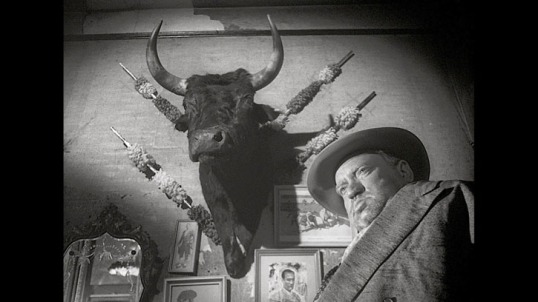
But it’s not true and it’s not fair.  When Touch of Evil was first put into production by Universal, Welles was not hired to direct.  He was hired to play Hank Quinlan, the formerly honest cop with a habit of planting evidence on those who he believed to be guilty.  When Charlton Heston was offered the role of Vargas, he asked who had been hired to direct.  When he was told that a director hadn’t been selected, Heston was the one who suggested Welles be given the job.  When, as often happened with Welles’s film, the studio decided to take the film out of Welles’s hands, Heston argued for Welles’s vision while Welles was off trying to set up his long-dreamed of film of Don Quixote.  Say what you will about Charlton Heston’s career, he fought for Orson Welles, just as he later fought for Sam Peckinpah during the making of Major Dundee.  Heston may not have agreed with either Welles or Peckinpah politically but he fought for them when few people were willing to do so.
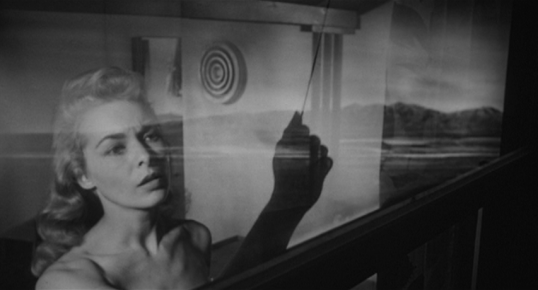
That Touch of Evil is a brilliant film is pretty much entirely due to Welles’s directorial vision.  The story is pure pulp.  While investigating the murder of an American businessman in Mexico, Vargas comes to believe that Quinlan is attempting to frame a young Mexican for the crime.  While Vargas watches Quinlan, his wife Susie (Janet Leigh) is menaced by the crime lord Joe Grandi (Akim Tamiroff), who has his own issues with both Vargas and Quinlan.  The plot may be the stuff of a B-programmer but, as directed by Welles, Touch of Evil plays out like a surreal nightmare, a journey into the heart of darkness that is full of eccentric characters, shadowy images, memorably askew camera angles, and lively dialogue.  Welles and cinematographer Russell Metty create a world that feels alien despite being familiar.  Just as he did with Gregg Toland in Citizen Kane, Welles shapes a film that shows us what’s happening in the shadows that most people try to ignore.

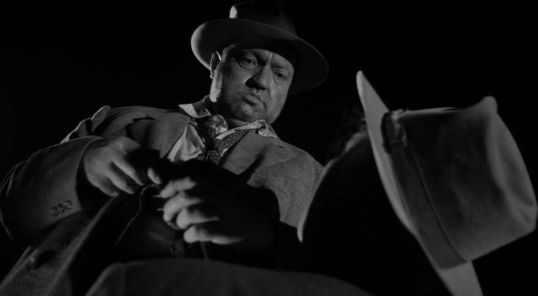
There’s really not a boring character to be found in Touch of Evil and the cast is full of old colleagues and friends of Welles.  Marlene Dietrich shows up as Quinlan’s former lover.  Mercedes McCambridge plays a leather-clad gang leader.  Dennis Weaver is the creepy owner of a remote motel.  (Two years before Psycho, Touch of Evil featured Janet Leigh being menaced in a motel.  Mort Mills, who played Psycho’s frightening highway patrolman, plays a member of law enforcement here as well.)  Zsa Zsa Gabor shows up for a few brief seconds and it makes a strange sort of sense.  Why shouldn’t she be here?  Everyone else is.  Joseph Cotten plays a coroner.  Ray Collins plays a local official.   In the film’s skewered world, Charlton Heston as Mike Vargas works.  His upright performance grounds this film and keeps it from getting buried in its own idiosyncrasies.   Big personalites are everywhere and yet the film is stolen by Joseph Calleia, playing Quinlan’s quiet but observant partner.  Calleia’s performance is the heart of the film.

Touch of Evil was not nominated for a single Oscar and that’s not surprising.  It’s not really the type of film that was noticed by the Academy in the 50s.  It was too pulpy and surreal and, with its story of a crooked cop framing someone who might very well be guilty anyway, it was probably too subversive for the Academy of the 1950s.  It would take a while for Touch of Evil to be recognized for being the noir masterpiece that it is.  In a perfect world, Welles would have been nominated for directing and for his larger-than-life performance as Quinlan.  Joseph Calleia would have been nominated for Supporting Actor and perhaps both Janet Leigh and Marlene Dietrtich would have been mentioned for Supporting Actress.  That didn’t happen but it would have been nice if it had.
Previous entries in The Unnominated:
  1. Auto Focus 
  2. Star 80
  3. Monty Python and The Holy Grail
  4. Johnny Got His Gun
  5. Saint Jack
  6. Office Space
  7. Play Misty For Me
  8. The Long Riders
  9. Mean Streets
  10. The Long Goodbye
  11. The General
  12. Tombstone
  13. Heat
  14. Kansas City Bomber

An Offer You Can’t Refuse: Dragnet (dir by Jack Webb)


1954’s Dragnet opens with a gangland slaying.  We watch as a man is brutally gunned down in a field in Los Angeles.  The rest of the film deals with the efforts of the LAPD to track down and arrest the killers.

Based on the televisions show that gave birth to the whole “cop show” format, Dragnet features Jack Webb as Sgt. Joe Friday, calmly and efficiently investigating the slaying.  Working with Friday is Officer Frank Smith (Ben Alexander) but the film (just like the show) is ultimately about how the whole criminal justice system works together as a machine designed to protect the citizenry and to punish crime.

Or, at least, that’s the way it’s supposed to work.  Especially if you’re only familiar with Dragnet from its late 60s incarnation and the countless parodies that followed, the 1954 Dragnet can seem surprisingly cynical and rough-edged.  The killings are violent, the criminals are ruthless, and the cops are often frustrated in their attempts to solve crimes.  In this film, at least, justice is not guaranteed.

The shooting victim is identified as a low-level gangster named Miller Starkie and Friday and Smith immediately suspect that he was killed on the orders of West Coast mob boss Max Troy (Stacy Harris).  Friday and Smith know that Troy is guilty and they even figure out who worked with Troy to kill Starkie.  But, throughout the film, they struggle to get any sort of concrete evidence tying Max to the crime.  Dragnet is a police procedural that follows every bit of the investigation, including the attempts to convince a grand jury to indict Max.  One of the more interesting moments in the film is when Friday gives his grand jury testimony and it becomes obvious that the district attorney was right to be skeptical about trying to bring charges.  Friday really doesn’t have enough evidence to justify arresting Max for the crime that everyone knows he committed.  To the film’s credit, it doesn’t attack the grand jury system or suggest that the system is unfairly rigged for the criminals.  Friday may be frustrated but he understands that the system has to protect the rights accused first.  One has to be presumed innocent until proven guilty even when everyone knows that person is guilty.

That said, Friday and Smith and the entire LAPD end up harassing Max Troy in a way that would probably not fly if the film were made today.  At one point, a line of police cars park in front of Max’s house and then all shine their lights into his windows.  Friday and Smith end up following Max everywhere that they he goes, stopping him and randomly frisking him before ordering him to empty his pockets.  Today, I imagine this would lead to lawsuit.  Even in the film, it doesn’t exactly pay off.

What does pay off is sending a police woman (played by Ann Robinson) into Max’s nightclub undercover, with a recording device.  This whole sequence is interesting because it’s apparent that the idea of a tiny recording devices — something that we take for granted nowadays — was apparently a new and exciting concept in 1954.  (Indeed, the one used in this film actually looks a bit bulky.)  For a few minutes, the action stops so Dragnet can show off the LAPD’s latest toy.

I liked Dragnet.  It’s an nicely-paced time capsule and, despite its docudrama style and television origins, director Jack Webb manages to come up with a few memorable visuals.  As someone who has binged the late 60s version of Dragnet, it was interesting to see a tougher and much more cynical version of the series.  While Webb was hardly an expressive actor, his dour demeanor serves him well as Joe Friday and Stacy Harris is appropriately sleazy as the crime boss.  Despite all of Friday’s frustrations, the case eventually comes to a conclusion in the 1954 film, even if it’s not the one that Friday and his bosses wanted.  Max may be able to escape the police but he can’t escape his own health.  Friday and Smith move on to investigate the next case.  As always, the names will be changed to protect the innocent.

I Watched A Winner Never Quits (1986, dir. by Mel Damski)


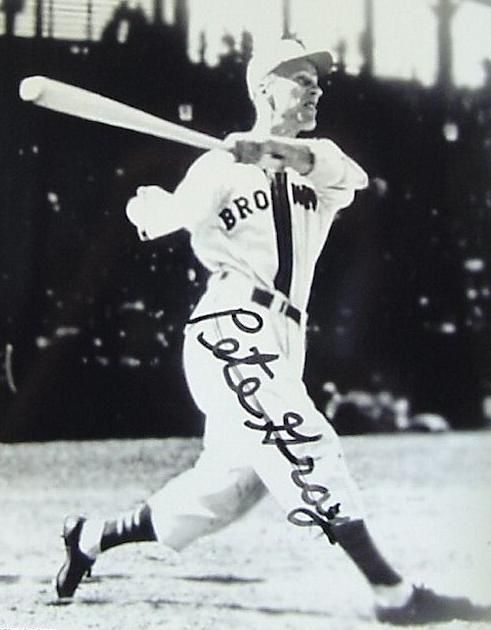
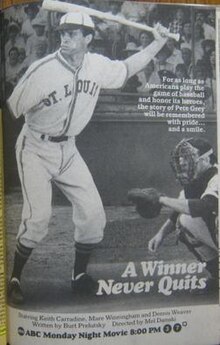
In 1945, Peter Gray made history when he became the first one-armed major league baseball player.  Gray grew up in poverty in Pennsylvania.  His father was a miner and Peter was one of five children.  He was only seven years old when he lost his right arm in a wagon accident but he loved baseball and he wasn’t going to let his disability keep him from playing.  He learned how to bat and catch and throw with his left hand.  He quit school when he was thirteen and worked for a while as waterboy while playing baseball in the local leagues.  Eventually, he made his way up to the minor leagues and, in 1945, he was called up to the majors.  He played one season for the St. Louis Browns.

The media loved the story of the one-armed baseball player but Peter always said that he resented feeling like he was being put on display whenever he took the field.  He was a competitive outfielder who could catch a ball, remove his glove, and then throw the ball to the infield just as quickly as anyone with two hands.  As a hitter, he struggled because pitchers figured out early on that he couldn’t hit the breaking ball.  After the 1945 season, Peter was sent to back to the minors, where he spent the rest of his career.  Though Peter was known for being an angry player who resented anyone pointing out his disability, he still made time to visit amputees in military hospitals to show them that they could still find success and to encourage them to chase after their dreams.

Peter’s story was the basis of A Winner Never Quits, which I watched on YouTube this weekend.  It was a good baseball movie, starring Keith Carradine as Peter.  What I liked is that the movie didn’t make him into a saint.  Carradine played Peter as being angry and with a definite chip on his shoulder.  Peter had every right to be angry and I’m glad the movie acknowledged that.  In both the movie and in real life, Peter was worried that he was just being treated as a sideshow.  In the movie, his attitude improves when he meets a young boy who recently lost his arm and who looks up to Peter.  Peter remained a friend to the boy and his family for the rest of his life.  A Winner Never Quits is about pursuing what you love and never giving up.  That’s what baseball is all about.  A Winner Never Quits is a good and inspiring baseball movie that’s not just for the fans.

Guilty Pleasure No. 71: Submerged (dir by Fred Olen Ray)


THUNDERSTRIKE!

Listen, if you’re going to watch the 2000 film Submerged, you better be a  big fan of the term “Thunderstrike,” because it’s repeated so many times that one gets the feeling that the actors just loved saying it.

Thunderstrike is a satellite that was built by western businessman Buck Stevens (Dennis Weaver).  He and his daughter (Nicole Eggert) and her sort-of boyfriend (Hannes Jaenicke) are all flying to Hawaii so that they can conduct more tests on the Thunderstrike.  However, arms dealer Owen Cantrell (Tim Thomerson) wants the Thunderstrike for himself so he sends a mercenary named Jeff Cort (Coolio.  Yes, Coolio.) to steal the plans from the airplane.  The plan is to kill the pilot, substitute a new pilot, and then crash the plane into the ocean …. which is pretty much what happens, despite the best efforts of heroic CIA agent, Rex Manning (Maxwell Caulfield).

Actually, wait a minute.  Maxwell Caulfield’s character is named Jim Carpenter.  Well, I don’t care.  He’ll always be Rex Manning to me!

While Special Agent Mack Taylor (Brent Huff) tries to stop Cantrell from stealing the Thunderstrike, Captain Masters (Fred Williamson) tries to figure out a way to bring the plane to the surface.

If this sound familiar, it’s because Submerged has the same plot as Airport ’77.

If it looks familiar, it’s because Submerged lifts a lot of footage from Airport ’77, including the scene where the plane crashes, the scene where the plane settles on the ocean floor, and the scene where the plane is lifted off the ocean floor.  Even a scene of water pouring into plane is lifted from Airport ’77, which means that the plane in Submerged suddenly has a staircase that no one apparently noticed before.

Submerged was directed by the wonderful Fred Olen Ray and seriously, how can you not love it?  Between the cast and the fact that it features all of the best parts of Airport ’77, this is a film for which the term guilty Ppeasure was invented!  It helps that the cast, for whatever reason, appears to be taking the film rather seriously.  This film was Dennis Weaver’s final screen appearance and he seems to be having a ball playing a cheerful good old boy who can’t wait to put a dangerous satellite in the sky.

Plus, the film features Rex Manning!

Plus, Jack Deth!

Plus, Black Caesar!

Plus …. THUNDERSTRIKE!

Previous Guilty Pleasures

  1. Half-Baked
  2. Save The Last Dance
  3. Every Rose Has Its Thorns
  4. The Jeremy Kyle Show
  5. Invasion USA
  6. The Golden Child
  7. Final Destination 2
  8. Paparazzi
  9. The Principal
  10. The Substitute
  11. Terror In The Family
  12. Pandorum
  13. Lambada
  14. Fear
  15. Cocktail
  16. Keep Off The Grass
  17. Girls, Girls, Girls
  18. Class
  19. Tart
  20. King Kong vs. Godzilla
  21. Hawk the Slayer
  22. Battle Beyond the Stars
  23. Meridian
  24. Walk of Shame
  25. From Justin To Kelly
  26. Project Greenlight
  27. Sex Decoy: Love Stings
  28. Swimfan
  29. On the Line
  30. Wolfen
  31. Hail Caesar!
  32. It’s So Cold In The D
  33. In the Mix
  34. Healed By Grace
  35. Valley of the Dolls
  36. The Legend of Billie Jean
  37. Death Wish
  38. Shipping Wars
  39. Ghost Whisperer
  40. Parking Wars
  41. The Dead Are After Me
  42. Harper’s Island
  43. The Resurrection of Gavin Stone
  44. Paranormal State
  45. Utopia
  46. Bar Rescue
  47. The Powers of Matthew Star
  48. Spiker
  49. Heavenly Bodies
  50. Maid in Manhattan
  51. Rage and Honor
  52. Saved By The Bell 3. 21 “No Hope With Dope”
  53. Happy Gilmore
  54. Solarbabies
  55. The Dawn of Correction
  56. Once You Understand
  57. The Voyeurs 
  58. Robot Jox
  59. Teen Wolf
  60. The Running Man
  61. Double Dragon
  62. Backtrack
  63. Julie and Jack
  64. Karate Warrior
  65. Invaders From Mars
  66. Cloverfield
  67. Aerobicide 
  68. Blood Harvest
  69. Shocking Dark
  70. Face The Truth

Grand Dame Guignol: WHAT’S THE MATTER WITH HELEN? (United Artists 1971)


gary loggins's avatarcracked rear viewer

The recent FX mini-series FEUD has sparked a renewed interest in the “Older Actresses Doing Horror” genre, also known by the more obnoxious sobriquettes “Hagsploitaion” or “Psycho-Biddy” movies. This peculiar film category lasted from 1962’s WHATEVER HAPPENED TO BABY JANE? until winding down around the early Seventies. 1971’s WHAT’S THE MATTER WITH HELEN? came towards the end of the cycle, a creepy little chiller with Debbie Reynolds and Shelley Winters   getting caught up in murder and madness in 1930’s Hollywood.

I wouldn’t exactly call Debbie Reynolds a “hag”; she was only 39 when this was filmed, and still quite a hottie, especially when glammed-up in a Jean Harlow “Platinum Blond” wig. Deb gets to show off her tap-dancing and tangoing in a few scenes, showing off her still amazing legs for good measure. She and Shelley play a pair of Iowa mothers who (as the opening newsreel footage tells us) have spawned two killer sons that…

View original post 649 more words

Cleaning Out The DVR Yet Again #24: Duel (dir by Steven Spielberg)


(Lisa recently discovered that she only has about 8 hours of space left on her DVR!  It turns out that she’s been recording movies from July and she just hasn’t gotten around to watching and reviewing them yet.  So, once again, Lisa is cleaning out her DVR!  She is going to try to watch and review 52 movies by the end of Tuesday, December 6th!  Will she make it?  Keep checking the site to find out!)

duel

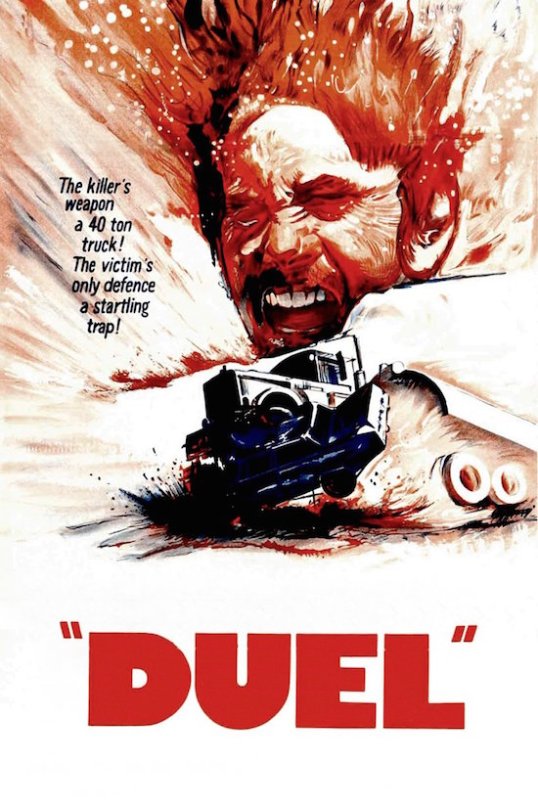
On November 5th, I recorded the 1971 film Duel off of MeTV!

Duel tells the story of David Mann (played by Dennis Weaver).  The name is probably not a coincidence.  David is an “everyman,” if your idea of an everyman is a workaholic who is incapable of expressing his emotions.  David is driving through the California desert.  When he calls his wife (apparently, he left home in the morning without ever bothering to wake her), he tells her that he’s on a strict schedule and that he might lose an important sale if he’s delayed in any way.  You get the feeling, however, that David’s trip is less about business and more about a desire to get away from his life.  His conversation with his wife is strained and, when we watch him interact with a gas station attendant, we’re struck by how awkward David is.

Indeed, the only time that David seems to be really comfortable and relaxed is when he’s safely inside of his car.  When we first see him, he’s listening to a radio talk show and occasionally commenting on what he’s hearing.  David Mann has a better rapport with an unseen talk show host than he does with his own family.

Later, in the film, David is flagged down by a school bus that has stalled on the side of the road.  The bus driver asks David to give him a push.  For his part, David reacts with visible panic at the sight of several hyperactive children rushing towards his car. When they hop on his hood, David starts to frantically order them off.  It makes sense really.  The car is what he loves.

Of course, it’s not just bratty children that David has to deal with.  There’s also a gigantic truck traveling up and down the highway.  When David gets stuck behind the truck, he honks his horn.  He yells at the unseen driver.  He passes the truck at one point, just to have the truck promptly pass him so that it can continue to block him.  When the driver finally does motion for David to pass him, David changes lanes just to discover another car coming straight at him.

The truck’s driver, it turns out, wants to kill David.  Why does he want to kill David?  We’re never quite sure.  For that matter, we’re never quite sure what the truck is transporting, beyond the fact that it’s apparently flammable.  But the brilliance of Duel is that it doesn’t matter why the truck’s driver is trying to kill David. All that matters is that he’s determined to do so.

And David — the man who can’t even figure out how to have a conversation with his wife — must now try to figure out how to defeat a seemingly unstoppable predator…

Today, Duel is probably best known for being Steven Spielberg’s first film.  (It was a made-for-television production that got a theatrical release in Europe.)  Watching Duel (and Jaws, for that matter) it’s easy to imagine an alternative universe where, instead of becoming America’s best known creator of mainstream entertainment, Spielberg instead became one of America’s best horror director.  Duel is a suspense-filled thrill ride, one that’s scary because it remains rooted in reality.  Seriously, who hasn’t gotten nervous when they’ve found themselves sharing the road with a gigantic truck?

(If anything, I’d argue that Duel is scarier than Jaws.  I mean, I live in Dallas so it’s not like I have to worry about getting attacked by a shark.  On the other hand, I drive my car nearly every day.)

Dennis Weaver plays the archetype of what would become the typical Steven Spielberg protagonist and he does an excellent job in the role.  Weaver is on screen throughout the entire movie.  We see the entire story unfold through his eyes and Weaver gives a harrowing performance as a man who is slowly but steadily pushed to the verge of a breakdown by an enemy that he cannot even begin to comprehend.

If you haven’t seen Duel, you need to.

Horror on The Lens: Don’t Go To Sleep (dir by Richard Lang)


For today’s horror on the lens, we present Don’t Go To Sleep!

In this TV movie from 1982, a little girl is killed in a horrific car crash.  Her family blames themselves for her death and they really should.  The father (Dennis Weaver) was drunk.  The mother (Valerie Harper) didn’t keep her drunk husband from driving.  Finally, the girl’s brother (Oliver Robins) and sister (Robin Ignico) were playing a prank on her when the car crashed.  By tying her shoe laces together, they made it impossible for her to get out of the car.

However, they’re not the only ones who blame themselves.  The dead girl blames them as well.  When the family moves out to the country and attempts to heal, the girl’s ghost goes with them.  And soon, she is encouraging her sister to kill the other members of the family.

And that’s just what happens.

Seriously, this movie took me by surprise.  For a movie that made for network television in 1982, it’s a surprisingly dark film that doesn’t shy away from graphically killing off most of the cast.  It’s a surprisingly effective little film and you can watch it below!

(Thank you to my wonderful cousin, Toni Posados, for recommending this film!)

Embracing the Melodrama Part II #71: Cocaine: One Man’s Seduction (dir by Paul Wendkos)


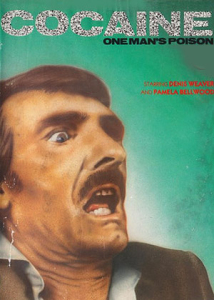
CocaineNow, I originally saw the 1983 made-for-TV movie Cocaine: One Man’s Seduction on Netflix so I have absolutely no first hand knowledge of how this film was advertised.  However, I have it on very good authority (i.e., I read it on another blog) that the image above is from the film’s VHS packaging.

Just looking at this image, you would be justified in thinking that Cocaine: One Man’s Seduction was an early David Cronenberg film.  Seriously, it looks like a deleted scene from Scanners and Dennis Weaver’s head is about to explode.

But no!  There are no scanners in Cocaine: One Man’s Seduction.  David Cronenberg did not direct this film.  As far as I can tell, it wasn’t even filmed in Canada.  Instead, Cocaine: One Man’s Seduction is about one man who gets seduced cocaine.

You may have noticed that I enjoy reminding you that this film is called Cocaine: One Man’s Seduction.  That’s because that’s a great title.  If the film had just been called Cocaine, you might watch the film expecting it to be set on a 1970s film set.  And if the film had just been called One Man’s Seduction, viewers may have watched the film expecting a Double Indemnitystyle film noir.  But Cocaine: One Man’s Seduction leaves no doubt about what we’re about to see.

Add to that, it’s a very melodramatic title and the name of this series of reviews is, after all, Embracing the Melodrama Part 2!

Anyway, Cocaine: One Man’s Seduction is about a real estate agent named Eddie Grant (Dennis Weaver).  He’s the type of semi-successful white-collar suburban guy who you just know is going to have a really over-the-top midlife crisis.  He has a wife (Karen Grassle) who loves him.  He has a son (James Spader — yes, that James Spader!) who wants to put off going to college for a year.  Eddie also has a job where he’s viewed as being an over-the-hill relic.  People looking to buy a new home simply are not impressed with Eddie’s cheap suits, mild manner, and old-fashioned scotch-after-work style.

What Eddie needs is a new wardrobe and aviator sunglasses.  And, as we all know from watching movies set in the 70s and 80s, nothing gets you into aviator sunglasses faster than snorting a line of coke.

Soon, Eddie is driving a fast car, he’s wearing nicer suits, and he’s keeping a lot of secrets.  Then, one day, his son — JAMES SPADER! — happens to look inside Eddie’s shave kit and discovers where dad has been hiding his cocaine.

Now, this is where I was expecting Jeff VanVondern to show up and say, ” I see a bunch of people that love you like crazy and they feel like they are losing you. And they wanna fight to get you back.”  But apparently, people in the 80s did not need an intervention to get them to go to rehab.  Instead, they just needed to have a dramatic nose bleed at work and nearly overdose on someone else’s kitchen floor.  They also needed to be called out by James Spader.

Of course, it also helps that Eddie is friends with a recovering cocaine addict who is played by a very thin-but-already-bald Jeffrey Tambor.  Jeffrey Tambor is already something of a hyperactive actor (and that’s why we love him!) so when you combine that natural tendency with a character who is supposed to be coked up, it’s something that simply has to be seen.

Anyway, Cocaine: One Man’s Seduction is a fairly good example of the-worst-that-can-happen-will-happen cinema.  If nothing else, it has some worth as a time capsule and it’s undeniably interesting to see James Spader play a role that one would normally never associate with James Spader.

Cocaine: One Man’s Seduction is currently seducing viewers on Netflix.

Horror on TV: Twilight Zone 2.26 “Shadow Play”


TheTwilightZoneLogo

This is one of my favorite episodes of The Twilight Zone! In Shadow Play, a man (Dennis Weaver) is curiously unconcerned about being on death row. According to him, it’s all just a recurring dream and everyone around him — the other prisoners, the District Attorney, the judge, the jury, and everyone else — is just a part of his dream. As the other characters start to realize that Weaver could be telling the truth, they’re forced to consider what will happen when he either wakes up or starts the dream over…

I love this one. It’s just a lot of fun and not quite as heavy-handed as some of The Twilight Zone‘s other attempts at social commentary.

This was originally broadcast on May 5th, 1961. It was directed by John Brahm and written by Charles Beaumont.