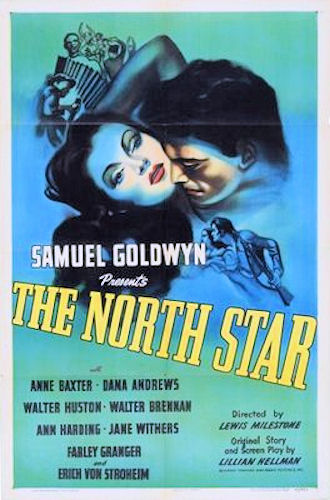
The Fabulous Forties #41: The North Star (dir by Lewis Milestone)


The North Star

The 40th film — wait a minute, I’m finally up to number 40!?  That means that there’s only ten more movies left to review!  And then I’ll be able to move on!  It’s always exiting for me whenever I’m doing a review series and I realize that I’m nearly done.

Anyway, where was I?

Oh yeah — the 40th film in Mill Creek’s Fabulous Forties box set was the 1943 war epic, The North Star.  This is one of the many war films to be included in the Fabulous Forties box set and I have to admit that they all kind of blend together for me.  Since these films were actually made at a time when America was at war, there really wasn’t much room for nuance.  Instead, every film follows pretty much the same formula: the Nazis invade, a combination of soldiers and villagers set aside their individual concerns and/or differences and team up to defeat the Nazis, there’s a big battle, a few good people sacrifice their lives, the Nazis are defeated, and the allies promise to keep fighting.

It’s a pretty predictable formula but that’s okay because it was all in the service of fighting the Nazis.  Could I legitimately point out that the villains in these movies are always kind of two-dimensional?  Sure, I could.  But you know what?  IT DOESN’T MATTER BECAUSE THEY’RE NAZIS!  Could I point out that the heroes are often idealized?  Sure, but again it doesn’t matter.  Why doesn’t it matter?  BECAUSE THEY’RE FIGHTING NAZIS!

That’s one reason why, even as our attitude towards war changes, World War II films will always be popular.  World War II was literally good vs evil.

Anyway, The North Star was a big studio tribute to America’s then ally, the Soviet Union.  When a farm in the Ukraine is occupied by the Nazis, the peasants and the farmers refuse to surrender.  They disappear into the surrounding hills and conduct guerilla warfare against the invading army.  It’s all pretty predictable but it’s also executed fairly well.  It doesn’t shy away from showing the brutality of war.  There’s a haunting scene in which we see the bodies of all of the villagers — including several children — who have been killed in a battle.

The Nazis are represented by Erich Von Stroheim.  Von Stroheim plays a German doctor who continually claims that he personally does not believe in the Nazi ideology and that he’s just following orders.  When wounded Nazi soldiers need blood transfusions, he takes the blood from the children of the village.  His rival, a Russian doctor, is played by all-American Walter Huston and indeed, all the Russians are played by American stars, the better to create a “we’re all in this together” type of spirit.  When Huston tells Von Stroheim that he is even worse than the committed Nazis because he recognized evil and chose to do nothing, he’s speaking for all of us.

Unfortunately, before the Nazis invade, The North Star devotes a lot of time to showing how idyllic life is in the communist collective and these scenes are so idealized that they totally ring false.  Everyone is so busy singing folk songs and talking about how happy they are being a part of a collective (as opposed to being an individual with concerns that are not shared by the other members of the collective) that it’s kind of unbearable.  Not surprisingly, The North Star was written by Lillian Hellman, who wrote some great melodramas (like The Little Foxes) but who was always at her most tedious when she was at her most overly political.

(Watching the opening of The North Star, I was reminded that I would be totally useless in a collectivist society.)

So, I have to admit, that I was rather annoyed with the villagers at first.  But then the Nazis invaded and I realized that we’re all in it together!  As I said earlier, you can forgive your heroes almost anything when they’re fighting Nazis.

The North Star is an above average war film and a below average piece of political propaganda.  See it as a double feature with The Last Chance.
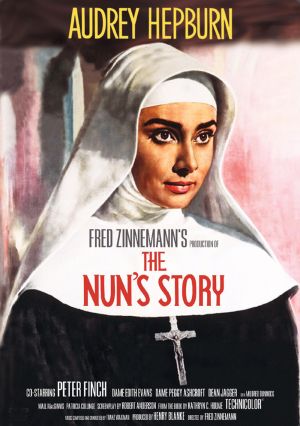
Lisa Watches An Oscar Nominee: The Nun’s Story (dir by Fred Zinnemann)


Nun_story

Happy Ash Wednesday!

So, earlier today, I got off work early so I could go to Noon Mass with my sister and we both got our ashes.  And I’m sure that will take some people by surprise because I’m not exactly the most faithful or devout of Catholics.  But what can I say?  I love the ornate ritual of it all.

And, as a part of my own personal ritual, I washed my forehead before I left the church.  Erin and I had a great vegetarian lunch at Cafe Brazil and then we came home and I turned on the TV and what should be finishing up on TCM but the 1959 best picture nominee, The Nun’s Story.  Fortunately, I had already set the DVR to record The Nun’s Story and so, on this most Catholic of days, I was able to watch this most Catholic of best picture nominees.

The Nun’s Story tells the story of Gaby (Audrey Hepburn), the daughter of a famous Belgian doctor (Dean Jagger).  At the start of the film, Gaby has entered a convent because she wants to become a missionary nursing sister in the Belgian Congo.  However, before Gaby can go to the Congo, she has to learn to give up her own rebellious streak and individual independence.  Taking the name Sister Luke, she excels at her medical training but, because it is felt that she is still too independently minded, she is not sent to the Congo but instead assigned to work in a mental hospital.  It’s there that her independent streak nearly gets her killed when she is fooled by a dangerous patient who claims to be the Archangel Gabriel.  It is only after she takes her final vows that Sister Luke is finally sent to the Congo and it is there that she’s forced to work with the abrasive agnostic Dr. Fortunati (Peter Finch).  Of course, as Sister Luke goes through her own spiritual struggles, the world inches closer and closer to the start of a second world war.  When war does break out, Sister Luke finds herself torn between her vow of obedience (which includes remaining political neutral) and the realities of living in a country that’s been occupied by the Nazis.

1959 was apparently a good year for religious films.  Not only did Ben-Hur win best picture, but The Nun’s Story also received 8 nominations.  Reportedly, The Nun’s Story was the most financially successful film to be released by Warner Bros, up to that point.  If Wikipedia is to be believed, it was also Audrey Hepburn’s personal favorite of the many movies that she made.

When seen today, probably the first thing that people notice about The Nun’s Story is that it’s extremely long and occasionally rather slow.  The film follows Gaby from the minute she enters the convent to the moment that she makes her final choice about whether to be obedient to herself or to her vows and, during that time, it examines every single detail of her life in glorious Technicolor.  A lot of emphasis is put on the rituals that Sister Luke goes through on her way to taking her final vows.  Now, if you’re like me, all of the rituals are fascinating to watch and produce a whole host of conflicting emotions.  Even as I found myself admiring Sister Luke’s dedication and her sacrifice, I still kept wondering — much as she did —  if it was all really worth giving up her independence.  But, I also have to admit that I found myself wondering if someone from a Protestant background would feel the same way.

To a certain extent, I really hate to say that you probably have to come from a Catholic background to truly enjoy any film.  But I certainly think that’s the case with The Nun’s Story.  But, even Protestants and skeptics will appreciate Audrey Hepburn’s wonderful lead performance.  She keeps this film grounded and makes her mostly internal conflict of faith compelling.  In a career that was full of great performance, this is one of Audrey’s best.