Days of Paranoia: Glengarry Glen Ross (dir by James Foley)


“Always be closing!” Alec Baldwin shouts at a group of seedy salesman in 1992’s Glengarry Glen Ross and, as tempting as it can be to be snarky about Alec Baldwin, I have to admit that he delivered that line so well that even I briefly worried about my job and I was just watching the movie!

Baldwin plays Blake, the top salesman at a company that sells worthless real estate to people who are dumb enough or trusting enough to believe what its salesmen tell them about always pursuing their dreams.  Murray and Mitch, the never-seen but often-mentioned owners of the company, send Blake to the New York office to try to inspire its salesmen to stop whining about their terrible leads and to actually start selling.  Blake inspires through bullying.  Coffee isn’t for losers, he hisses.  The salesman who makes the most money will win a car.  The salesman who makes the second-most money will get a set of steak knives.  (Blake even brings the knives with him.)  Everyone else will get fired.  Blake’s speech and Baldwin’s cameo are justifiably famous.  Baldwin is only in the film briefly but he’s unforgettable, whether he’s bragging about how much his watch costs or if he’s holding up a pair of brass balls to tell the salesmen (and they are all men) what they’re lacking.  He not only attacks them for not being good at their jobs.  He also attacks their masculinity.  It’s a totally ludicrous speech but it works because the film is taking place in a ludicrous world, one where desperate men try to appear confident as they sell worthless land.

The only salesman who misses Blake’s speech is Ricky Roma (Al Pacino), who is busy conning a friendly but nervous fellow named James Lingk (Jonathan Pryce) out of his money.  Roma is probably the only salesman who could have stood up to Blake and that’s because Roma is the only one who has any confidence.  Roma’s on a streak.  Roma’s winning that car!

Dave Moss (Ed Harris) isn’t going to win that car.  Moss is steak knife bound.  Moss is bitter and angry and won’t stop talking about how he’s not being treated with enough respect by Murray and Mitch.  When the hated office manager, John Williamson (Kevin Spacey), hands out a bunch of leads, Moss is quick to point out that the leads are worthless.  When Williamson refuses to hand out the leads identifying prospective customers for the “Glengarry Heights Development,” Moss tells another salesman, the neurotic and weak-willed George Aaronow (Alan Arkin), that they should break into the office, steal them, and sell them to a competitor.  Aaronow isn’t a thief but Moss insists that, just because he listened to Moss talk about it, Aaronow is now legally considered to be an accomplice.

And then there’s Shelley Levene (Jack Lemmon), who used to be the top salseman but who is now a desperate mess, begging people to listen to his pitch and insisting that he’s only hit a temporary dry spell.  He has a sick daughter.  He needs the job and he needs the money and he needs the good leads.  Williamson offers to sell them to Levene but the two men then get caught up in arguing about the specifics.

Welcome to Mamet World.  Glengarry Glen Ross is a film adaptation of a David Mamet play so it’s not surprising that the film is about a group of men who can argue about anything.  The characters in this film talk a lot and the dialogue is so profane, angry, and desperate that it can be easy to overlook that it’s often very funny as well.  Roma is having fun.  He loves his job, even when he’s yelling at Williamson for ruining a possible sale.  Even when the salesmen come to the office and discover that someone has robbed the place and that they’re now all suspects, they continue to try to outhustle everyone around them.  Roma tries to sell Lingk on some worthless land.  Aaronow, Levene, and Moss try to sell the cops on their innocence.  Williamson tries to sell the salesmen on the idea that he’s a boss who is worthy of respect.  They’re all born salesmen, even if some of them aren’t very good at it.

Glengarry Glen Ross is very much a filmed play, dialogue-heavy and largely confined to that office and the restaurant nearby.  (Levene does visit one prospective investor at home but it doesn’t reduce the film’s staginess.)  Fortunately, the combination of Mamet’s dialogue and the performances of the amazing cast holds our interest.  Pacino was nominated for an Oscar for his performance.  Jack Lemmon should have been as well.  (Lemmon’s tendency to overact works well with Levene’s character.)  Alec Baldwin and Kevin Spacey, problematic as they may be for modern audiences, both give outstanding supporting performances.  You’ll want to hug Alan Arkin.  You’ll want someone to punch Ed Harris.  Glengarry Glen Ross holds up as a darkly humorous examination of desperate men.
Days of Paranoia: Edmond (dir by Stuart Gordon)


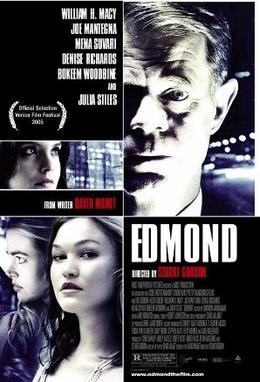
Based on a one-act play by David Mamet, 2005’s Edmond tells the story of Edmond Burke (William H. Macy).

Edmond shares his name (if not the actual spelling) with the philosopher Edmund Burke.  Edmund Burke was a strong believer that society had to put value in good manners to survive and that religious and moral institutions played an important role in promoting the idea of people treating each other with respect and decency.  Edmund Burke knew what he believes and his writings continue to influence thinks to this day.  Edmond Burke, on the other hand, doesn’t know what he believes.  He doesn’t know who he wants to be.  All he knows is that he doesn’t feel like he’s accomplished anything with his life.  “I don’t feel like a man,” he says at one point to a racist bar patron (played by Joe Mantegna) who replies that Edmond needs to get laid.

On a whim, Edmond steps into the shop of a fortune teller (Frances Bay), who flips a few Tarot cards and then tells Edmond that “You’re not where you’re supposed to be.”  Edmond takes her words to heart.  He starts the night by telling his wife (played by Mamet’s wife, Rebecca Pidgeon) that he’s leaving their apartment and he won’t be coming back.  He goes to the bar, where he discusses his marriage with Mantegna.  He goes to a strip club where he’s kicked out after he refuses to pay $100 for a drink.  He goes to a peep show where he’s frustrated by the glass between him and the stripper and the stripper’s constant demand that he expose himself.  He gets beaten in an alley by three men who were running a three-card monte scam.  Edmond’s problem is that he left home without much cash and each encounter leads to him having less and less money.  If he can’t pay, no one wants to help him, regardless of how much Edmond argues for a little kindness.  He pawns his wedding ring for $120 but apparently, he just turns around and uses that money to buy a knife.  An alley-way fight with a pimp leads to Edmond committing his first murder.  A one-night stand with a waitress (a heart-breaking Julia Stiles) leads to a second murder after a conversation about whether or not the waitress is actually an actress leads to a sudden burst of violence.  Edmond ends up eventually in prison, getting raped by his cellmate (Bookem Woodbine) and being told, “It happens.”  Unable to accept that his actions have, in one night, led him from being a businessman to a prisoner, Edmond says, “I’m ready to go home now.”  By the end of the film, Edmond realizes that perhaps he is now where he was meant to be.

It’s a disturbing film, all the more so because Edmond is played by the likable William H. Macy and watching Macy go from being a somewhat frustrated but mild-mannered businessman to becoming a blood-drenched, racial slur-shouting murderer is not a pleasant experience.  Both the play and the film have generated a lot of controversy due to just how far Edmond goes.  I don’t see either production as being an endorsement of Edmond or his actions.  Instead, I see Edmond as a portrait of someone who, after a lifetime of being willfully blind to the world around him, ends up embracing all of the ugliness that he suddenly discovers around him.  He’s driven mad by discovering, over the course of one night, that the world that is not as kind and well-mannered as he assumed that it was and it all hits him so suddenly that he can’t handle it.  He discovers that he’s not special and that the world is largely indifferent to his feelings.  He gets overwhelmed and, until he gets his hands on that knife, he feels powerless and emasculated.  (The knife is an obvious phallic symbol.)  It’s not until the film’s final scene that Edmond truly understands what he’s done and who he has become.

Edmond is not always an easy film to watch.  The second murder scene is truly nightmarish, all the more so because the camera remains on Edmond as he’s drenched in blood.  This is one of William H. Macy’s best performances and also one of his most disturbing characters.  That said, it’s a play and a film that continues to be relevant today.  There’s undoubtedly a lot of Edmonds out there.

THE UNTOUCHABLES (1987) – Happy 70th Birthday, Kevin Costner!


There was a time in my life, before I could drive, when I would beg my parents to stop at the video store every time we went to the neighboring town of Conway, Arkansas. The town I grew up in was too small to have more than just a gas station, so this movie buff had to take advantage of every trip to town. One night when we were headed home, my parents relented to my repeated requests, so we stopped off at Budget Video. I wanted to choose all the movies, but unfortunately mom and dad would also let my brother and sister choose movies from time to time as well. On this particular night, my brother wanted to rent THE UNTOUCHABLES (1987). I don’t remember what I was wanting, but I do remember that it was not THE UNTOUCHABLES. I probably pouted a little bit, but we ended up taking THE UNTOUCHABLES home with us. We turned it on that night, and I’ll gladly admit that I was 100% wrong. THE UNTOUCHABLES immediately became one of my favorite films. Great job, bro!

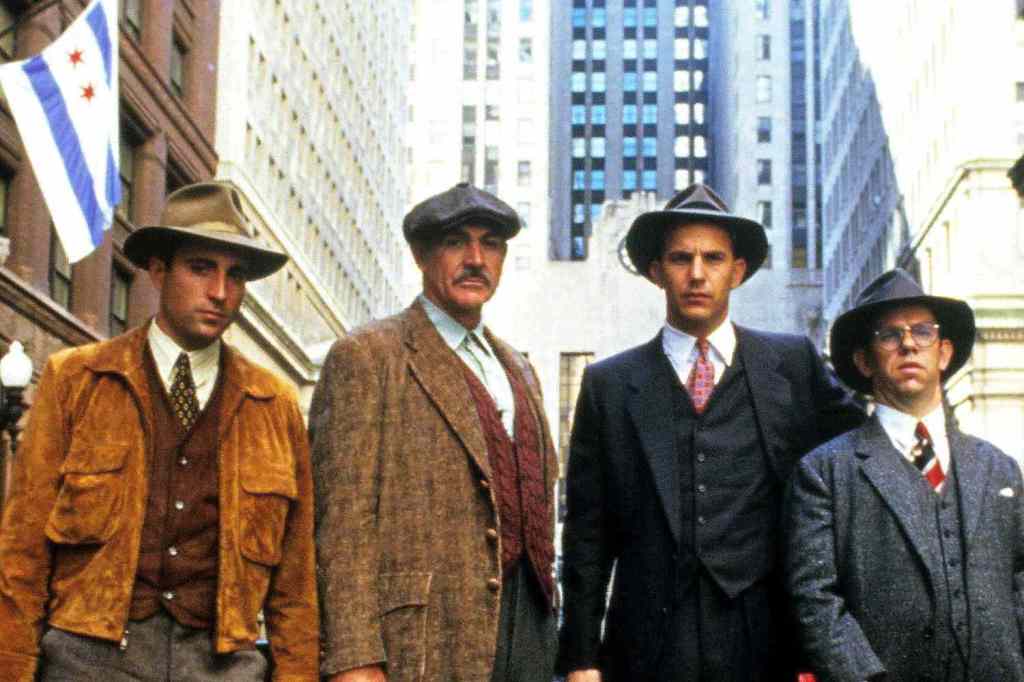
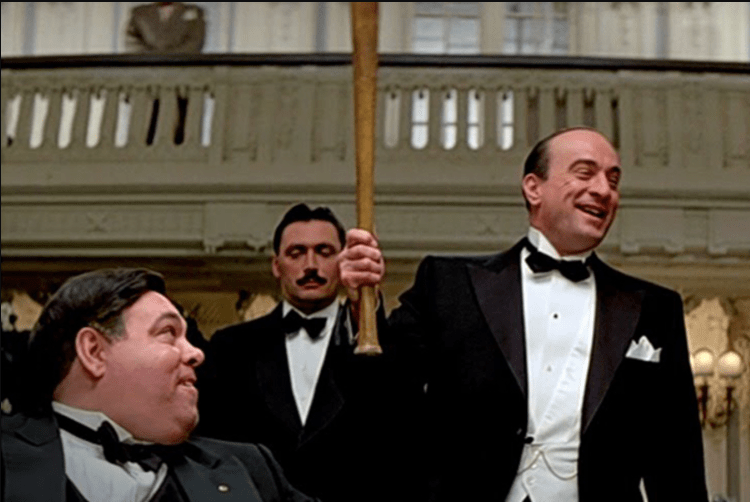
It’s 1930 and Prohibition is the law of the land in the United States of America. Treasury agent Eliot Ness (Kevin Costner) has been given the seemingly impossible task of bringing down notorious gangster Al Capone (Robert De Niro), who supplies booze to nearly all of Chicago. Capone doesn’t just supply the booze, he rules Chicago with an iron fist; and if you’re a local business who doesn’t want to buy his product, he just may blow your ass up! Ness’ job is made especially difficult due to the rampant corruption in Chicago, where everyone from the Mayor, to the judges, lawyers, and law enforcement officers are all on Capone’s payroll, making it pretty much impossible to trust anyone. In a complete stroke of luck, Ness encounters the honest Irish American policeman James Malone (Sean Connery) and asks him to join him in bringing down Capone. With Malone, Ness has found that honest and badass cop who’s not afraid to go up against Capone and his goons. Knowing that most of the police force is already compromised, the two men head to the police academy to try to find another honest cop. This turns out to be another great move as they come upon an Italian American trainee named George Stone (Andy Garcia), who’s a prodigy with a gun. Their last, and greatest move in this humble CPA’s opinion, comes when they accept accountant Oscar Wallace (Charles Martin Smith) to their team. Wallace is convinced that the key to bringing down Capone is trying to build a tax evasion case against him. He’s initially laughed at, but it’s soon apparent that this accountant knows his debits and credits, and his expertise may be just what’s needed to end Capone’s reign of terror once and for all.

I’ve always considered THE UNTOUCHABLES to be a near perfect film. One of the main reasons I find the film so perfect is the direction of Brian De Palma. I’ve been a fan of his “style” for so long, with films like DRESSED TO KILL (1980) and BLOW OUT (1981), but I think he just nails the material here. There are so many great scenes, but the “Union Station” sequence has to be one of the most perfectly choreographed sequences of all time. The building of the tension, the slow-motion shootout when the bad guys arrive, and finally the badass resolution all prove what an absolute master De Palma could be with the right material. De Palma claims that he made up the series of shots as he was filming the scenes at the train station, making the final product that much more impressive. And this all plays out against the background of a “lullaby theme” composed by the legendary Ennio Morricone (THE GOOD, THE BAD, AND THE UGLY). This is what “cinema” is all about.

THE UNTOUCHABLES has an amazing cast of actors to bring its “based on real events” story to life. Kevin Costner was just beginning to emerge as a movie star when this movie was made back in 1987. Especially as a younger actor, Costner was good at projecting both a certain innocence, tempered with the willingness to do what it takes to get the job done once his family and friends are put in danger. And what can you say about actors like Sean Connery and Robert De Niro?!! Connery is so charismatic, wise, and tough as the beat cop who shows Eliot Ness how to beat Capone… ”he sends one of yours to the hospital, you send one of his to the morgue!” He’s a beat cop because he’s incorruptible, and Connery projects that stubborn honesty perfectly. I’m so glad that Connery won an Oscar for this performance, as it would be the only time he would ever be nominated for an Academy Award. He’s amazing in this role, even if his accent is Scottish rather than Irish (a notable controversy at the time). Connery may have won the Oscar, but Robert De Niro matches him scene for scene. His ability to make Capone both charismatic and evil in equal measure is an example of what makes De Niro special as an actor. So many actors phone in these types of broad performances, but not De Niro. I also just think it’s cool that De Niro admitted that his performance was heavily influenced by Rod Steiger’s in 1959’s AL CAPONE. I love Steiger and consider this a wonderful tribute. Throw in a young Andy Garcia, the always underrated Charles Martin Smith, and a creepy Billy Drago as Frank Nitti, and you have one of the better casts ever assembled. I especially became a fan of Garcia based on his performance in THE UNTOUCHABLES.

The last person I want to mention is the screenwriter, David Mamet. His screenplay is another perfect element of THE UNTOUCHABLES. The same man who has directed his own films like HOUSE OF GAMES (1987), HOMICIDE (1991), THE SPANISH PRISONER (1997), and SPARTAN (2004) knows how to write a great screenplay. There are so many amazing moments, from the “baseball bat” sequence to the “Stone recruitment” scene, and even Ness’ “he’s in the car” line about Frank Nitti, it’s a muscular screenplay full of big-time moments of audience satisfaction.

At the end of the day, THE UNTOUCHABLES is just a great movie. I still periodically thank my brother for picking it out that fateful day in the late 80’s, and it will always be one of my very favorites. It’s one of those movies that I recommend with zero reservations!

Check out the trailer below, and if you’re smart, you’ll watch one of the great movies of the 1980’s, Brian De Palma’s THE UNTOUCHABLES.

An Offer You Can Take or Leave #13: Hoffa (dir by Danny DeVito)


The 1992 film, Hoffa, opens in 1975, with two men sitting in the backseat of a station wagon.  One of the men is the controversial labor leader, Jimmy Hoffa (Jack Nicholson).  The other is his longtime best friend and second-in-command, Bobby Ciaro (Danny DeVito).  The two men are parked outside of a roadside diner.  They’re waiting for someone who is late.  Jimmy complains about being treated with such disrespect and comments that this would have never happened earlier.  Jimmy asks Bobby if he has his gun.  Bobby reveals that he does.  Jimmy asks him if he’s sure that there’s a loaded gun in the diner, as well.  Bobby goes to check.

Jimmy Hoffa, of course, was a real person.  (Al Pacino just received an Oscar nomination for playing him in The Irishman.)  He was a trucker who became a labor leader and who was eventually elected president of the Teamsters Union.  He was a prominent opponent of the Kennedys and that infamous footage of him being interrogated by Bobby Kennedy at a Senate hearing seems to sneak its way into almost every documentary ever made about organized crime in the 50s.  Hoffa was linked to the Mafia and was eventually sent to prison.  He was freed by the Nixon administration, under the condition that he not have anything to do with Teamster business.  When he disappeared in 1975, he was 62 years old and it was rumored that he was planning on trying to take over his old union.  Everyone from the mob to the CIA has been accused of having had Hoffa killed.

Bobby Ciaro, however, was not a real person.  Apparently, he was a composite character who was created by Hoffa’s screenwriter, David Mamet, as a way for the audience to get to know the enigmatic Jimmy Hoffa.  Bobby is presented as being Hoffa’s best friend and, for the most part, we experience Jimmy Hoffa through his eyes.  We get to know Jimmy as Bobby gets to know him but we still never really feel as if we know the film’s version of Jimmy Hoffa.  He yells a lot and he tells Bobby Kennedy (a snarling Kevin Anderson) to go to Hell and he talks a lot about how everything he’s doing is for the working man but we’re never really sure whether he’s being sincere or if he’s just a demagogue who is mostly interested in increasing his own power.  Bobby Ciaro is certainly loyal to him and since Bobby is played by the film’s director, it’s hard not to feel that the film expects us to share Bobby’s admiration.  But, as a character, Hoffa never really seems to earn anyone’s loyalty.  We’re never sure what’s going on inside of Hoffa’s head.  Jack Nicholson is always entertaining to watch and it’s interesting to see him play a real person as opposed to just another version of his own persona but his performance in Hoffa is almost totally on the surface.  With the exception of a few scenes early in the film, there’s doesn’t seem to be anything going on underneath all of the shouting.

The majority of Hoffa is told via flashback.  Scenes of Hoffa and Bobby in the film’s present are mixed with scenes of Hoffa and Bobby first meeting and taking over the Teamsters.  Sometimes, the structure of the film is a bit cumbersome but there are a few scenes — especially during the film’s first thirty minutes — that achieve a certain visual poetry.  There’s a scene where Hoffa helps to change a man’s flat tire while selling him on the union and the combination of falling snow, the dark city street, and Hoffa talking about the working man makes the scene undeniably effective.  The scenes where Hoffa spars with Bobby Kennedy are also effective, with Nicholson projecting an intriguing blue collar arrogance as he belittles the abrasively ivy league Bobby.  Unfortunately, the rest of the movie doesn’t live up to those scenes.  By the time Hoffa becomes a rich and influential man, you realize that the film isn’t really sure what it wants to say about Jimmy Hoffa.  Does it want to condemn Hoffa for getting seduced by power or does it want to excuse Hoffa’s shady dealings as just being what he had to do to protect the men in his union?  The film truly doesn’t seem to know.

Hoffa is definitely not an offer that you shouldn’t refuse but, at the same time, it’s occasionally effective.  A few of the scenes are visually appealing and the cast is full of character actors like John C. Reilly, J.T. Walsh, Frank Whaley, and Nicholas Pryor.  It’s not a disaster like The Gang Who Couldn’t Shoot Straight.  Hoffa is an offer that you can take or leave.

Previous Offers You Can’t (or Can) Refuse:

  1. The Public Enemy
  2. Scarface
  3. The Purple Gang
  4. The Gang That Could’t Shoot Straight
  5. The Happening
  6. King of the Roaring Twenties: The Story of Arnold Rothstein 
  7. The Roaring Twenties
  8. Force of Evil
  9. Rob the Mob
  10. Gambling House
  11. Race Street
  12. Racket Girls

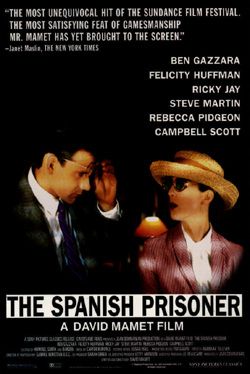
Insomnia File #40: The Spanish Prisoner (dir by David Mamet)


What’s an Insomnia File? You know how some times you just can’t get any sleep and, at about three in the morning, you’ll find yourself watching whatever you can find on cable? This feature is all about those insomnia-inspired discoveries!

If, at 3 in the morning on Wednesday, you were struggling to get to sleep, you could have flipped over to Flix and watched the 1998 film, The Spanish Prisoner.

Joe Ross (Campbell Scott) is an engineer.  He’s a quiet, polite, and always considerate man.  At one point, he’s told that he’s “too nice” and, watching him, you can’t help but agree.  Joe works in an otherwise bland office where the walls are covered with menacing posters that, in an accusatory manner, announce, “SOMEONE TALKED!”  Paranoia is in the air but Joe, for whatever reason, seems to be incapable of sensing it.

Joe has just invented something called The Process.  It’s deliberately left obscure just what exactly The Process is but we do know that it stands to make Joe’s boss, Mr. Klein (Ben Gazzara), a lot of money.  When Mr. Klein invites Joe and the company lawyer, George (Ricky Jay), to an island retreat, Joe assumes that it’s so Mr. Klein can offer him a lucrative cash bonus as a reward for creating the process.  Instead, it turns out that Mr. Klein has no interest in giving George any extra reward.  Instead, Klein feels that Joe should just be happy to be a part of the company.

On the island, Joe takes a picture of a mysterious man named Jimmy Dell (Steve Martin).  Jimmy offers to give Joe a thousand dollars for the camera.  Joe, instead, hands over the camera for free.  Later, Jimmy tracks down Joe and apologizes for his behavior.  He and Joe strike up an unlikely friendship on the island.  Upon learning that Joe will soon by flying back to New York, Jimmy gives Joe a package to deliver to his sister.  Joe agrees.

It’s not until Joe is on the plane and in the air that he starts to wonder about what’s inside the package.  It doesn’t help that his secretary, Susan (Rebecca Pidgeon), won’t stop talking about you never really know anyone and how easy it is to trick an innocent person into becoming a drug mule.  Finally, Joe steps into the plane’s lavatory, unwraps the package, and….

And that’s all I can tell you without spoiling the film.  The Spanish Prisoner is a film about a dizzying confidence game, one that is full of nonstop twists and turns.  No one in the film turns out to be who you thought they were when you first saw them.  At times, it can be a bit hard to keep up with the plot but that’s actually a part of the fun.  The Spanish Prisoner keeps you guessing and, fortunately, Campbell Scott gives a likable enough performance that you’re willing to explore the maze at the heart of this film with him.  Steve Martin is also wonderfully sinister as Jimmy, using his own “nice guy” image to keep us off-balance.

As you might expect from a film written and directed by David Mamet, the dialogue is heavily stylized.  The characters all move and speak at their own odd rhythm.  Lines that should be innocuous take on a dangerous edge and it becomes impossible not try to read between the lines of even the simplest of exchanges.  It creates a rather dream-like atmosphere, one in which you’re never quite sure what’s real and what’s just another part of the game.

The Spanish Prisoner is an intriguing mystery and one that seems like it will definitely reward repeat viewings.

Previous Insomnia Files:

  1. Story of Mankind
  2. Stag
  3. Love Is A Gun
  4. Nina Takes A Lover
  5. Black Ice
  6. Frogs For Snakes
  7. Fair Game
  8. From The Hip
  9. Born Killers
  10. Eye For An Eye
  11. Summer Catch
  12. Beyond the Law
  13. Spring Broke
  14. Promise
  15. George Wallace
  16. Kill The Messenger
  17. The Suburbans
  18. Only The Strong
  19. Great Expectations
  20. Casual Sex?
  21. Truth
  22. Insomina
  23. Death Do Us Part
  24. A Star is Born
  25. The Winning Season
  26. Rabbit Run
  27. Remember My Name
  28. The Arrangement
  29. Day of the Animals
  30. Still of The Night
  31. Arsenal
  32. Smooth Talk
  33. The Comedian
  34. The Minus Man
  35. Donnie Brasco
  36. Punchline
  37. Evita
  38. Six: The Mark Unleashed
  39. Disclosure