Today, we continue our look at the Dirty Harry film franchise by taking a look at the second film in the series, 1973’s Magnum Force.
Despite the fact that Dirty Harry famously ended with Harry Callahan throwing away his badge in disgust, Magnum Force reveals that Callahan (played again by Clint Eastwood) is still a member of the San Francisco Police Department. He’s got a new partner (Felton Perry, a likable actor in a thankless role) but he’s still butting heads with his superiors at the department. He’s also still got a way with the one-liners. When Lt. Briggs (Hal Holbrook) brags that he never once had to draw his gun while he was in uniform, Callahan replies, “A man’s got to know his limitations.”
While Callahan is busying himself with doing things like gunning down robbers and preventing an attempt to hijack a plane, a group of motorcycle cops are gunning down the town’s criminals. They begin by killing a mobster who has just beaten a murder charge on a technicality but soon, they’re gunning down anyone who has ever so much as been suspected of committing a crime. Alone among the detectives investigating the murders, Callahan believes that the killers are cops and, even worse, he suspects that his old friend Charlie McCoy (played by Mitchell Ryan) might be a member of the group…
Though it suffers when compared to Dirty Harry, Magnum Force is still an exciting and effective action film that is clearly a product of the same period of time that gave us such classics of paranoid cinema as The Parallax View and Three Days of the Condor. Whereas Dirty Harry took an almost documentary approach to capturing life and death in San Francisco, Magnum Force is a film that is full of dark shadows and expressionistic angles.
In Dirty Harry, the Scorpio Killer was both an obvious outsider and an obvious force of destruction. The film’s dramatic tension came from the fact that he was so clearly guilty and yet nothing could be done to stop him. The villains in Magnum Force are the exact opposite of Scorpio. As chillingly played by David Soul, Robert Urich, Tim Matheson, and Kip Niven, the killer cops are distinguished not by their otherness but by their total lack of individuality.
In the film’s best scene, they confront Harry in a parking garage and basically tell him that he’s either with them or against him. Sitting on their motorcycles, wearing their leather jackets, and with their grim faces hidden behind their aviator sunglasses, these cops are the ultimate representation of faceless fascism. After listening to their excuses, Harry asks if they consider themselves to be heroes.
“All of our heroes are dead,” one of them replies, delivering the film’s best line.
Obviously, Magnum Force was made to be an answer to those critics who claimed that Dirty Harry was a fascist film and it is a bit jarring, at first, to see Harry “defending” the system. (“I hate the goddamn system but until something better comes along…”) When Harry tells the killer cops, “I’m afraid you’ve misjudged me,” it’s not hard to see that this is the same message that Eastwood meant to give his critics.
However, what makes the killer cops in Magnum Force such interesting villains is that they are, ultimately, tools of the system that they’re attempting to destroy. By killing off criminals as opposed to arresting them and putting them on trial, the killer cops are minimizing the risk of the flaws inherent in the system being exposed. Hence, by defending the system, Harry is helping to expose and destroy it.
When I told Jeff that I was planning on watching and reviewing all of the Dirty Harry films, he suggested that I watch them in reverse-order. His logic was that, since the films tended to get worse as the series progressed, watching them backwards would allow me to end my project on a happy note as opposed to a note of bitter disappointment. I took his advice and I’m glad I did. While I disagree with him about whether or not The Dead Pool is a better film than Sudden Impact, I do have to agree that the first two Dirty Harry films are dramatically better (and quite different in tone) from the ones that subsequently followed.
Tomorrow, we’ll look at the third film in the series, 1976’s The Enforcer.
“Dirty Harry is obviously just a genre film but this action genre has always had fascist potential and it has finally surfaced…Dirty Harry is a deeply immoral movie.” — Pauline Kael
“It’s not about a man who stands for violence. It’s about a man who can’t understand society tolerating violence.” — Clint Eastwood
I decided that I wanted to review the Dirty Harry film franchise about two seconds after Clint Eastwood finished giving his speech at the Republican National Convention last month.
It had nothing to do with the politics of Eastwood’s speech because, quite frankly, I think a good film is a work of art and art is always more important than politics. Instead, as I watched Eastwood give his speech, I was reminded that Clint Eastwood is about as close to a living icon as we have in America. There aren’t many actors who could get away with giving a speech to an empty chair and, despite the predictable outraged tweets from Roger Ebert, Eastwood is one of them. And, if Eastwood is an icon, Harry Callahan is perhaps the most iconic role of his career.
Now, I have to admit that, as I started this project, I knew more about Harry Callahan as a character than I did about the films he had actually appeared in. I had seen both Dirty Harry and The Dead Pool because, for whatever reason, they both seem to turn up on AMC every other week. I knew that Harry Callahan was a police inspector who was based in San Francisco. I knew that he was willing to go to extremes when it came to fighting criminals. I knew that, in his first film appearance, Harry had a really impressive head of hair that had pretty much vanished by the time that he reached his final appearance in The Dead Pool. And, finally, I knew that, at some point in the film series, Harry growled the line, “Go ahead, make my day.”
So, for me, reviewing every film in the Dirty Harry franchise gave me a chance to discover why Harry has become such an iconic character and why people still ask Eastwood to repeat that “make my day” line. When I started watching the films, Jeff warned me that the Dirty Harry films got worse as you went along and I discovered that, in many ways, he was right. But I still enjoyed the experience and I hope that you enjoy reading my reviews over the next few days.
But, first things first. Let’s take a look at the film that started the entire series, 1971’s Dirty Harry.
I have to admit that it’s a bit intimidating to try to review Dirty Harry because, quite frankly, what’s left to be said about this film? It’s one of the most influential movies of all time. Any time you see a cop in a TV show or a movie getting yelled at by his superiors for not going “by the book,” it means that you’re watching a movie or an episode that is directly descended from Dirty Harry. And yet, despite all the imitations, it’s a movie that remains as exciting and visceral today as when it was first released.
Dirty Harry tells the story of two outsiders, two men who seem to exist solely to reveal the dark impulses of conventional society. Both of these men are killers and both of these men are motivated by a rage against what they perceive society as being.
One of these men calls himself Scorpio. As played by Andy Robinson (who gives one of the definitive cinematic psycho performances here), Scorpio is a jittery mass of nerves, an unkempt man who wears a peace sign as a belt buckle but who also writes letters to the Mayor of San Francisco (played by John Vernon) in which he threatens to kill one innocent person a day unless he’s paid off. When he first appears, he’s on a rooftop, aiming a rifle at an unaware woman in a swimming pool. At one point, the phallic barrel of rifle seems to be pointed directly at the camera (and by extension, at us in the audience). When he fires the rifle, we see the mortally wounded woman silently sink under the water. It’s a scene that still disturbs me every time I see it, one that establishes early on that we’re all potentially vulnerable to the Scorpios of the world.
In the next scene, we see San Francisco Police Inspector Harry Callahan (Clint Eastwood, of course) investigating the crime scene. The difference between Harry and Scorpio is striking. Whereas Scorpio is only calm while killing, Callahan inspects the crime scene (and goes through almost the entire film) without showing a hint of emotion. While Scorpio looks like a madman, Callahan looks like a professional. And yet, when Callahan foils a bank robbery (and delivers his famous “Do you feel lucky?” monologue to wounded bank robber played by Albert Popwell), it becomes obvious that he does have something in common with Scorpio. They’re both willing to shoot to kill. The only difference is that, as a police officer, Callahan is ostracized for his willingness to kill while Scorpio, as an American citizen, is protected by the U.S. Constitution.
It would be foolish to pretend that Dirty Harry isn’t a political film. One need only watch the scene where a law professor explains to Harry why his pursuit and arrest of Scorpio violated Scorpio’s constitutional rights. (The way that Eastwood snarls during this scene is priceless.) As one can tell from the quote from Pauline Kael at the beginning of this review, Dirty Harry was a film that upset a lot of liberals when it was first released (much as Clint Eastwood’s empty chair speech managed to upset Roger Ebert). However, as the years have passed, Dirty Harry has come to be acknowledged as a classic by critics on both sides of the political divide.
The success of Dirty Harry goes beyond politics. I think any film students who aspires to direct an action film should be required to watch Dirty Harry a few dozen times before he graduates. What makes the film work is not just what director Don Siegel does but what he doesn’t do. As opposed to some of the later films in the franchise, Dirty Harry is a fast-paced film that tells its story with a minimum amount of padding. It’s hard to think of a single scene that isn’t necessary to tell the story that the film wants to tell. Even the oft-criticized scene where Harry, on a stake out, spies on some naked lesbians, works as a parallel to Scorpio’s own voyeurism at the start of the film.
Much as in a classic western, Harry and Scorpio are presented as two sides of the same coin. Both of them are outsiders who refuse to follow the rules of society and the film’s violent and mournful climax is powerful precisely because, by this point, the audience understands that the Scorpios of the world can not exist without the Harrys and vice versa.
Along with generated a lot of controversy, Dirty Harry was a huge box office success. Not surprisingly, a sequel would follow.
(This is not a political post but if it was, it would solely reflect my opinion and not necessarily the opinion of anyone else who writes for this site.)
The big news tonight seems to be that former President Bill Clinton is giving a speech at the Democratic National Convention. After being told by several people on twitter that Clinton is “one of the greatest speakers of all time,” I listened to a few minutes of “America’s greatest politician” and you know what?
I still prefer Clint Eastwood.
That’s not meant to be an endorsement of any political position that has or has not been advocated by Clint Eastwood over the past few weeks. This is not a political statement as much as it’s just an acknowledgement of the fact that Presidents give speeches but Clint Eastwood gets results.
And that leads me to tonight’s scene that I love. From the classic 1971 crime film Dirty Harry, here’s the famous scene that explains why so many people love Clint Eastwood in the first place.
Anyone who complains that all Hollywood does nowadays are sequels and remakes should think before they start to rant. Sequels and remakes are not exclusive to Hollywood (Bollywood anyone) and it’s been a tried-and-true practice both inside and outside the glitzy confines of Hollywood. Sergio Leone took classic Kurosawa samurai films and remade them into the classic spaghetti Westerns which made Clint Eastwood a household name (pre-RNC chair).
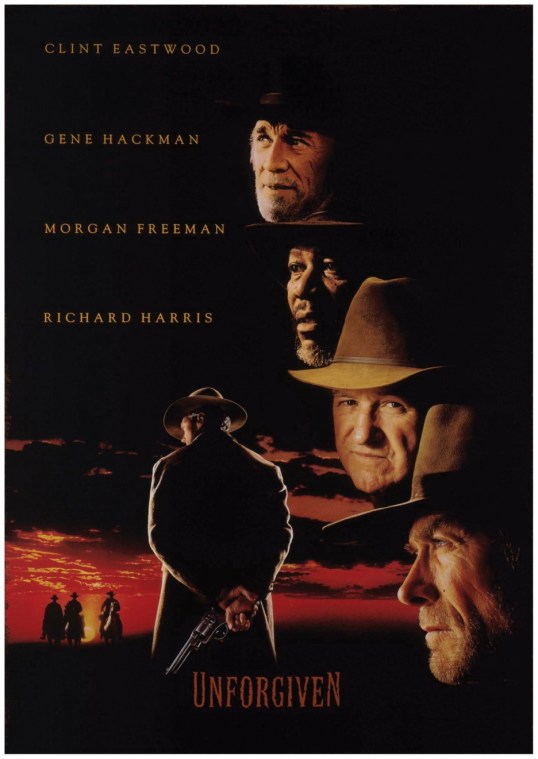
Now Japan is looking to take one of the best Westerns of the past quarter-century in Eastwood’s own critically-acclaimed and award-winning Unforgivenand remake it as a samurai film set in 188’s Japan. The film will star Ken Watanabe in the same role Eastwood had in his film with fellow actors Akira Emoto and Koichi Sato rounding out the cast. The remake will have the title of Yurusarezaru-mono and will closely follow the same story of Eastwood’s film with just changes in location and other cultural changes.
The film will be directed by award-winning Korean filmmaker See Sang-il and should see a release date sometime around 2013.
I, for one, am looking forward to see how this remake will turn out. Jidaigeki (samurai period films) have seen a resurgence in Japanese cinema these past couple years and it’s going to be interesting to see how one of Eastwood’s Western masterpieces will turn out as a samurai drama. Fans of both genres have a mutual understanding that the Western and the samurai films share similar themes and character traits so it shouldn’t have been a surprise that Unforgivenwill be remade into a samurai. What is a surprise is that Japan took twenty years to decide to do it.
Politics constitute an indomitable itch for those of us inclined to discuss them. This is not a post about politics. This is a post about Clint Eastwood’s chair.
Clint Eastwood’s chair was first made known to me at about 3:30 this afternoon. I know, I’m behind the times. At my ripe old age of 27 it’s hard to keep up with the world. But I made that perilous journey to youtube, and with, I am proud to say, no great difficulty, I procured a mouse cursor in a blank textbox, from whence my journey began.
Arriving at my destination, and bearing witness the public oration there displayed, I found myself not at all befuddled or amused by an old man’s rant. Quite the contrary, I thought it a reasonably clever comedy sketch in consideration of his age, chuckled at his tongue-in-cheek endorsement (which amounted to little more than a ‘lesser of two evils’ vote), and felt inclined to comment on his behalf. Then my troubles set in.
I was caught off guard. The text below the video bombarded me like an artillery barrage, every 10 seconds a new string of demented rambling surpassing all of my direst expectations for the video at hand:
“LOL do you just make shit up? California well off? LOL just keep making shit up your boy will gone in November.” (kEMCO2)
“YOU’RE PROBABLY A LOSER SITTING IN YOUR MOTHER’S BASEMENT WATCHING FADING POSTERS OF OBAMA WAITING FOR YOUR NEXT WELFARE CHECK.” (Chloe Smith)
“You’re an idiot. You’re going to get old to you moron. Old age has nothing to do with dementia. People become deranged at 35, look at your hero Obama, he is as stupid as they get.” (DonDraperism)
“Ask the ones that OUR military freed and saved! Your a pansy and have no clue! Your part of the reason we’re in the shape we are!” (bessedchevy20)
“LOL. congratz u have been brainwashed” (bobilo95)
I didn’t believe it at first. I panicked, frantically hammering out search terms into Google, but no relief was in sight. I turned to Gogloom, dear old friend, but its springs too had run dry; IRC, my last vestige of hope, failed me.
And I thought maybe, just maybe, this tragic loss and the verbal assault upon Clint Eastwood’s chair were somehow related.
I was born and raised on the internet. I remember when we first got dial-up in 1996. I passed the tender age of 11 sharing insightful comments much akin to those I experienced today, only geared to my youthful interests. “LOL u dont even know ff3 is rly ff6 and u wasted $200 on a PSX even tho ff7s gonna suck NINTENDO FOR LIFE” Ah, such fond memories. A prodigy no doubt, I learned quickly to curb my intellectual idioms to placate the masses, adapting to the drudgery of coherent English in my teenage years and beyond. Was it some cruel twist of fate that now finds me linguistically isolated from the very internet users for whom I learned to converse? All I wanted to do was talk about Clint Eastwood’s chair.
The fact of the matter is the internet no longer functions as an outlet for sharing free thought. Oh, I am “sharing” my thoughts here, with the four or five of you who happen to read this, but should you choose to respond you will do so in the form of a comment, in reply to my post which I moderate. I am in charge here, and that means I am not really intimately engaging with anyone. These WordPress blogs completely lack an equal playing field for discussion, but they’re ideal for sharing one’s opinion with the wind. We’re all special. We all have a voice. Here’s mine.
That’s the state of WordPress. That’s the state of Facebook. That’s the state of Twitter, I suppose. I don’t use the latter two, frankly because the notion of making an isolated personal statement bores me save on rare occasions such as these. I post here because all of my previous outlets have slowly withered away. Are new outlets out there? I suppose there’s 4chan. The launch of /r9k/ encompasses some of my fondest memories of the internet, specifically due to the brief period of intellectual discussion it spawned. Coincidentally coinciding with the launch of Project Chanology, it generated countless debates on the political and social impacts of anonymity and collective thought, perhaps culminating in a collective realization of and expansion upon the notion of Stand Alone Complex (Ghost in the Shell). We were each participants, debating and trolling in turn, in the very social experiment we were conducting. It was a grand culmination of everything I loved about the internet in the 1990s and 2000s, but it was indeed a culmination–an end–because complacency and the totality of its form of anonymity rendered it non-sustainable. I remember acknowledging that at the time, and feeling as though my online world was passing away even as it stood resplendent in its most accomplished form.
And so it did. It took me four years to admit it, but the internet is dead. The pathways and connections through which such experiments as /r9k/ emerged as hubs for collective contemplation (a great majority of us, myself included, were not active 4chan members, and that fact was pivotal to elements of the discussion) dried up into defunct forums and dead irc channels. Our mutual file-sharing ties, the final tether, were severed by delayed but decisive corporate rationality headed by the likes of Apple and Netflix. The generation-spanning cultivation of anonymity was wiped clean and even culturally discredited by Facebook, with present-day internet users lavishly emblazoning their identity upon all electronic activity. The collective internet mind dispersed into relegated pockets. I am now an individual, and I despise that fact.
I wanted to talk about Clint Eastwood’s chair, but I couldn’t. I could tell a few people about it. I’m not really doing so at the moment, but I could. I could also scream at the wall, as so many youtube users of voting age are doing right now. And indeed, they’re relatively anonymous. Chloe Smith and blessedchevy20 will certainly never know that I read their banter, and, though I could probably trace down their thorough identities with easy today, apathy preserves them. But they aren’t engaging anything. Their ‘thoughts’, if what they wrote even amounts to thinking, involved not but petty rebuttals to the most recent of 12,000 comments, by now surely buried behind thousands more. The /r9k/ ideal, of thoughtful engagement under the shroud of total anonymity, was short-lived. Perhaps it carries on in some diminished form. But the long-sustained anonymous community is what we’ve truly lost. The modestly sized forum; the casual irc channel; the self-contained communities where one could engage under independent but locally consistent identities: it’s their loss that we now suffer.
Would so many adults scream at the wall if they had any alternative? In an age where everyone has access to the internet, would we be so simultaneously excitable and yet devoid of well-formed opinions if we had any means of discussion? I can talk here and hope you hear me. I can shout on youtube knowing you won’t. In neither medium am I well positioned to receive an intelligible response by an identity in equal social standing. You’re either on my turf or in the combat zone with barely time to breathe before taking aim. And even if the spirit of youtube calmed down a bit, what can you meaningfully say in 500 characters?
I don’t want to talk about Clint Eastwood’s chair anymore. I was going to say some silly crap about a metaphor for lack of political leadership that would sound corny as hell but would spark up some discussion. But I can’t do that here, because as an editor I’m in charge and that means I have to maintain boundaries. And there’s no point in doing it anywhere else. I guess I’ll just go back to playing Warcraft, maybe discuss the new expertise cap or auction house inflation. In the absence of loosely-moderated discussion boards and public chats those seem to be the approachable topics we have left on the internet.
On Friday, as I was watching the new Oscar contender from Clint Eastwood, J. Edgar, something rather odd happened.
Without giving out in spoilers, here’s what was happening on screen: Leonardo DiCaprio (playing J. Edgar Hoover, the first director of the F.B.I.) had just offered a job to Clyde (played by Armie Hammer). Clyde — who we’ve been told has “no interest in women” — accepts on the condition that he and Edgar have lunch and dinner together everyday. As soon as Clyde gave his condition, I heard it.
“UGGGGGGH!”
“EWWWWWW!”
“DAMN, UGGGGGGGGGGGGGGGGH!”
It was coming from several rows behind us so I glanced over my shoulder and, brushing a strand of my naturally red hair out of my eyes, I saw the source of all this commentary. Two men, sitting on the top row. Judging from their bull necks and the globby roundness of their bodies, they were former athletes-turned-movie-critics. They both wore baseball caps and there was an empty seat between them which, as I know from years of observing the odd social rituals of the male species, probably meant that they had come to the film together but they were too scared of accidentally touching arms to actually sit next to each other. (Seriously, what’s up with that?) Anyway, I held my perfectly manicured middle finger to my lips, gave them a nice, long “shhhhhhhhhh!,” and then turned back to the movie.
A bit later into the film, Leonardo DiCaprio and Armie Hammer had a violent wrestling match which ended up with DiCaprio kissing Hammer.
And oh my God, you would have thought that the world was ending.
“EWWWWWWWWWW!” it started.
“GAWD, MAN! GAWD!” it continued.
“UGGGGGGGGGGGHHHHHHHHHHHHHHHHH!”
“THAT’S SICK, MAN, SICK! UGGGGHHHHHHHHHH!”
And it just kept going. “EWWWWWWWWW! GAWD, DISGUSTING! EWWWWW!”
All of this from the same two idiots. I again looked over my shoulder at them, gave them my little “shhhhh!” command but I doubt they noticed because one of them was staring at the ceiling while punching the chair in front of him while the other was staring at the floor, shaking his head and going, “DAMN, MAN! DAMN!”
And, I do not kid, this went on for like the next 15 minutes.
(Incidentally, this is only point in the film in which DiCaprio is seen to actually kiss anyone.)
Here’s a few random thoughts inspired by these two “gentlemen:”
1) Did the two gentleman not know which film they had bought tickets for?
2) Did they not know that J. Edgar is a biopic about J. Edgar Hoover, a man who most historians seem to agree was probably gay?
3) Were the two men illiterate or had they just not bothered to read any of the literally hundreds of reviews of J. Edgar, the majority of which mentioned that J. Edgar Hoover is assumed by many to have been gay?
4) Were these two guys — both of whom appeared to be a lot older than me — unaware that J. Edgar Hoover was gay? Because, seriously, I knew he was gay before seeing the film and I’m a part of the notoriously ignorant Wikipedia generation that knows nothing and is proud of it.
5) Did not the fact that J. Edgar has been advertised as being “the latest film from the writer of Milk,” not clue them into the possibility that this film might feature at least one gay character?
6) Finally — is this not 2011? I mean, did these two guys just wake up one day in pre-Project Runway America, found themselves a time machine, and then decided to transport themselves to 2011 just so they could see a movie?
Seriously, guys, some people are gay. Deal with it.
As for the movie itself, it’s definitely an improvement over Eastwood’s last film, the absolutely awful Hereafter. It’s a long movie but it doesn’t drag and, even though it’s a bit too self-conscious in its attempts to be a “great film,” it still has its entertaining moments. DiCaprio, Hammer, Judi Dench, Jeffrey Donovan and Naomi Watts all give excellent performances and DiCaprio’s “old age” makeup is actually a bit more effective than you’d guess from the trailer.
That said, J. Edgar shares one major flaw with Hereafter and it’s a big one. Both films attempt to use several different stories to paint one big picture and, in both cases, all of the different stories simply fail to come together. The sequences in which J. Edgar is a young man searching for the Lindbergh Baby and railing against gangsters are exciting and consistently interesting. However, the scenes in which Hoover — now an old, paranoid man — struggles to write his memoirs and attempts to blackmail Martin Luther King, are heavy-handed, predictable, and ultimately rather cartoonish.
The end result is a film that is always watchable and frequently fascinating but also one that is also fatally uneven and ultimately frustrating. It’s nowhere close to being the best film of the year but it is one of the more interesting.
Every year since he retired from acting we seem to get one film from Clint Eastwood and this year it’s going to be one major prestige picture due this November. The film is J. Edgar and it’s a biopic detailing the life of the FBI’s founder and first director, J. Edgar Hoover.
This film will be the first time Leonardo DiCaprio and Eastwood will be working together. From the look of the cast assembled Eastwood has surrounded DiCaprio with some talented performers from Dame Judi Dench, Naomi Watts right up to Jeffrey Donovan, Geoff Pierson and Stephen Root.
The trailer shows just how much the film just screens “Awards Picture” from beginning to end. It’s not a suprise that J. Edgar has become one of the films this coming fall/winter to be a major frontrunner for the many film circles awards and, most likely, for the next Academy Awards. Here’s to hoping that this film will be a major bounce back for Eastwood after 2010’s very uneven and dull Hereafter.
J. Edgar is set for a limited release this November 9, 2011 before going worldwide a couple days later on November 11.
In just another few days, the summer movie season will end and we’ll enter the fall. The fall movie season is when all of the prestigious, massively hyped “quality” films are released. These are the films that everyone is expecting to see remembered at Oscar time. We expect more out of films released in the Fall and therefore, when a film fails to live up to the expectation of perfection, we are far more quicker to simply damn the whole enterprise by exclaiming, “That sucked!”
Below are 15 upcoming fall films which I think are going to “suck.” Quite a few of them are “prestige” films though a few of them most definitely are not. However, they are all films that I fully expect to be disappointed with.
Quick disclaimer: This list is based on only two things, my gut instinct and the advice of my Parker Brothers Ouija Board. These are my opinions and solely my opinions and they should not be taken as a reflection of the opinions of anyone else involved with this web site. Got it? Good, let’s move on to the fun part:
Anonymous (10/28) — Roland Emmerich takes on the burning issue of whether or not Shakespeare actually wrote his plays. Who cares? I’m sure this will spark a lot of discussion among people who found The Da Vinci Code to be mind-blowing.
The Girl With The Dragon Tattoo (12/21) — Deal with it, fanboys.
The Ides of March (10/7) — It’s a political film directed by and starring George Clooney! Watch out for the smug storm that will surely follow.
Immortals (11/11) — Yes, it will suck but it will still probably be better than Clash of the Titans.
The Iron Lady (12/16) — Bleh. This is one of those movies that they make solely because Meryl Streep needs another Oscar nomination. Nobody will see the film but everyone will talk about how brilliant Meryl was in it.
J. Edgar (TBA) — So, when was the last time that Clint Eastwood actually directed a movie that you didn’t have to make excuses for?
Mission Impossible — Ghost Protocol (12/21) — Honestly, has there ever been a Mission Impossible film that didn’t suck in one way or another?
Real Steel (10/7) — How do I know this film is going to suck? Go look up the trailer on YouTube and you can see that little kid go, “You know everything about this fight game!” for yourself.
Red State (9/23) — A satirical horror film with a political subtext? Well, let’s just hope they’ve got a great director…
Sherlock Holmes: A Game of Shadows (12/16) — It’s the law of diminished returns. The better the original, the worse the sequel. That said, I really hope I’m wrong on this one. I loved Sherlock Holmes.
Straw Dogs (9/16) — It’s a remake of the old Peckinpah classic except now, it’s a Yankee Blue Stater getting attacked by a bunch of Redneck Red Staters. Yankee paranoia is so freaking tedious. Add to that, Straw Dogs has been remade a few million times and never as well as the original. At least those remakes had the decency to come up with their own name instead of just trying to coast on the credibility of a better film. This travesty was written, directed, and produced by Rod Lurie. Shame on you, Rod Lurie. (Of course, the toadsuckers over at AwardsDaily.com are madly enthused about this film.)
The Three Musketeers (10/21) — Is anybody expecting otherwise?
Tower Heist (11/4) — Brett Ratner continues to encourage us to lower our standards with this action-comedy. The film’s villain is played by Alan Alda and is supposed to be a Bernie Madoff-type so expect a lot of tedious pontificating from rich actors playing poor people.
War Horse (12/28) — This might actually be a good film but, as a result of all of the hype, it’s going to have to be perfect or else it’s going to suck.
W.E. (12/9) — Madonna makes her directorial debut with … well, do I really need to go on?
So, guess what I did earlier today? That’s right — I put on a blindfold, a stumbled over to my ever-growing DVD, Blu-ray. and even VHS collection and I randomly selected 12 films!
Why did I do this?
I did it so you, the beloved readers of Through the Shattered Lens, could once again have a chance to tell me what to do. At the end of this post, you’ll find a poll. Hopefully, between now and next Sunday (that’s August 21st), a few of you will take the time to vote for which of these 12 films I should watch and review. I will then watch the winner on Sunday and post my review on Monday night. In short, I’m putting the power to dominate in your hands. Just remember: with great power comes great … well, you know how it goes.
Here are the 12 films that I randomly selected this afternoon:
Abduction — From 1975, this soft-core grindhouse film is based on the real-life abduction of Patty Hearst and was made while Hearst was still missing. Supposedly, the FBI ended up investigating director Joseph Zito to make sure he wasn’t involved in the actual kidnapping.
Aguirre, The Wrath of God — From director Werner Herzog and star Klaus Kinski comes this story about a Spanish conquistador who fights a losing battle against the Amazon.
Black Caesar — In one of the most succesful of the 70s blaxploitation films, Fred Williamson takes over the Harlem drug trade and battles the mafia.
Don’t Look Now — Donald Sutherland and Julie Christie are a married couple who attempt to deal with the death of their daughter by going to Venice, Italy. Christie quickly falls in with two blind psychics while Sutherland pursues a ghostly figure in a red raincoat through Venice. Directed by Nicolas Roeg.
The Lion In Winter — From 1968, this best picture nominee stars Peter O’Toole and Katharine Hepburn as King Henry II and his wife, Eleanor of Aquitaine. Taking place on Christmas Eve, Henry and Eleanor debate which one of their useless sons will take over a king of England. This film is also the feature debut of both Anthony Hopkins and Timothy Dalton.
Logan’s Run— From 1976, this sci-fi film features Michael York and Jenny Agutter as two future hedonists seeking Sanctuary and instead finding Peter Ustinov and a bunch of cats. Filmed in my hometown of Dallas.
Lost Highway — From director David Lynch comes this 1997 film about … well, who knows for sure what it’s about? Bill Pullman may or may not have killed Patricia Arquette and he may or may not end up changing into Balthazar Getty.
Mystic River— From director Clint Eastwood comes this film about murder, guilt, redemption, and suspicion in working-class Boston. Starring Sean Penn, Kevin Bacon, and Tim Robbins.
Naked Massacre — From 1976, this stark film is something a grindhouse art film. It takes the true life story of Chicago mass murderer Richard Speck and transfers the action to Belfast. Also known as Born for Hell.
Night of the Creeps— From 1986, this film features alien slugs that turn an entire college campus into a breeding ground for frat boy zombies. Tom Atkins gets to deliver the classic line: “Well don’t go out there…”
Petulia — Considered by many to be one of the best American films ever made and one of the definitive films of the 60s, Petulia tells the story of a divorced doctor (George C. Scott) who enters into an odd relationship with Julie Christie. Directed by Richard Lester, this film also stars Joseph Cotten, Richard Chamberlain, and the Grateful Dead.
What Have You Done To Solange? — From 1975, What Have You Done To Solange is a classic giallo that features dream-like murders, disturbing subtext, and one of the best musical scores of all time.
So, there’s your 12 films. Vote once, vote often, have fun, and I await your decision.
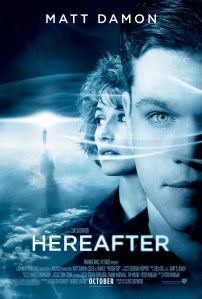
Hereafter is a very serious film about a very serious topic, death. Following three separate but ultimately connected stories, the film attempts to explore death and the question of what happens after death from three different angles — intellectually, emotionally, and spiritually. I really wanted Hereafter to be a great film. So did the film’s makers, which is precisely why Hereafter fails.
The intellectual consideration of death is represented by the character of Marie (Cecile De France), a French journalist who, at the start of the film, drowns in a tsunami and is, for a few minutes, clinically dead. Before she is eventually revived, she has a classic near-death experience: the bright light, the people waiting to greet her, the whole deal. After this experience, Marie is compelled to investigate whether or not there truly is such a thing as an afterlife. As she does so, Marie finds herself shunned by her resolutely secular friends and grows increasingly distant from her skeptical (and rather condescending) boyfriend.
The emotional response to death is represented in the story of twin brothers, Marcus and Jason (played by Frankie and George McLaren). The two boys live in London with their drug-addicted mother and share a strong (and, to be honest, kinda creepy) bond. Jason, while simply trying to return home with some drugs for his detoxing mother, is roughed up by some bullies and ends up running out into the middle of the street. Naturally, since this is a movie, Jason is hit by a truck as soon as he steps off the curb. Jason is killed and Marcus is taken away by social services and put into a foster home. Marcus continues to carry Jason’s cap with him and soon starts tracking down local English psychics in an attempt to talk to his brother again.
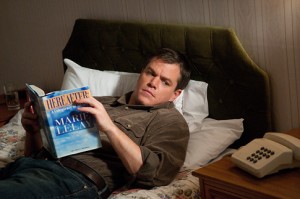
Finally, the spiritual aspect is detailed in the film’s most interesting story. This story features Matt Damon as George Lonegan, a psychic who can speak with the dead. After years of being a minor celebrity, George burned out and went into a self-imposed exile. He now works at a factory while his brother (Jay Mohr, who looks incredibly puffy in this movie) keeps trying to find ways to convince George to get back into the business of talking to dead for fun and profit. After George reluctantly gives a reading to Richard Kind, he finds himself being dragged back into his old life.
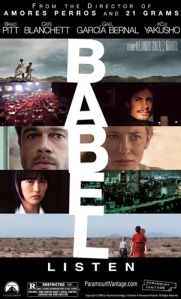
A lot of viewers and critics have compared Hereafter to Alejandro González Iñárritu’s 2006 masterpiece, Babel. Both films follow three separate but connecting stories and both films are concerned with the theme of death and how it connects us all. As well, Babel featured Brad Pitt in a serious role and Hereafter features Matt Damon. The main difference, however, is that Babel was a great film but Hereafter is basically an uneven mess.
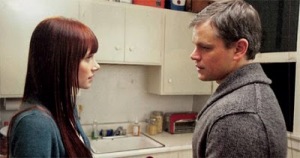
Whereas Babel featured three strong stories, Hereafter features 1 compelling story (that would be Damon’s) which is compelling solely because Matt Damon is a talented enough actor that he can apparently perform miracles. He’s probably about as likable as he’s ever been in the role of George but he also wisely plays the role as being just a little bit off. Even though the film makes the mistake of never really going into the details of just what exactly caused George to give up being a psychic, Damon is so good in the role that you’re willing to take him at his word that he had a good reason. Probably the highlight of the film (and one of the few sections to really inspire any sort of real emotional response) is an extended sequence where Damon befriends and the manages to alienate an insecure, single woman played by Bryce Dallas Howard. Damon and Howard have a scene that involves eating while blind-folded that manages to be both powerfully erotic and wonderfully romantic at the same time. If the entire film had been about them, Hereafter would have been a much better movie.
Unfortunately, we’ve got to slog through two other stories.
Cecile La France gives an excellent performance as Marie and the opening tsunami scene is truly terrifying. For someone like me, who cannot swim and risks having a panic attack if she even stands near the deep end of a swimming pool, the tsunami scene was almost impossible to watch. I had to put my hands in front of my eyes and watch the scene through my fingers. However, once she drowns, Marie sees a vision of the afterlife that — as a harbinger of things to come — is rather dull. I mean, with everything that can supposedly be done in movies today, the best that Hereafter can give us is a bland white light. Once Marie returns to Paris and starts her investigation, La France remains a sympathetic presence and the film actually does a pretty good job of showing just how condescending most supposedly “liberal” men are whenever a woman starts to stray from the established orthodoxy. But, unfortunately, her story is just never that interesting. Marie decides to write a book about the afterlife. As a writer myself, I have to say that there is nothing more boring than watching someone else write.
As for Marcus, I was shocked just how little I cared about him or his attempts to contact his brother. I come from a very close family and I have a very strong bond with all three of my sisters and, among them, I am notorious for crying at any movie that deals with that sort of sibling bonding. Yet I sat through the saga of Marcus and Jason without shedding a tear and I felt terrible about it. I really wanted to cry. I really wanted to have some sort of emotional response to the story but I just never believed it. I hate to say this but honestly, a lot of this was due to the fact that the McLaren twins are such bad actors. Director Clint Eastwood has said that he specifically cast them because they weren’t professional actors and therefore, they wouldn’t introduce any false “sentimentality” into the mix. But dammit, it was a sentimental story. Sentiment is not necessarily a bad thing and just because something is sentimental, that doesn’t make it false.
So, what exactly went wrong with Hereafter? The film opens strongly with a terrifying tsunami and the final 30 minutes are also undeniably touching (if also a bit contrived). It’s everything that happens in between those two points that ruins Hereafter. Director Eastwood, obviously looking to avoid that dreaded curse of being sentimental, keeps the whole film very low-key and realistic. Other than the opening tsunami, there are no big wow moments but to be honest, isn’t that what movies are for? If you’re going to make a movie that specifically shuns the wow moment, you better have something compelling (a perfect script or an entire cast giving a compelling performance as opposed to just a handful of them) to take its place. Hereafter doesn’t and, as a result, the movie drags. This, honestly, has got to be one of the slowest, most boring movies I’ve ever seen. If director Eastwood’s westerns and actions films can all be seen as homages to Sergio Leone and Don Siegel, I think Hereafter must be an homage to some of Andy Warhol’s intentionally dull films. Whereas Warhol, at the very least, gave us Joe Dallesandro to look at, Eastwood gives us Jay Mohr. It’s not a fair trade.
I don’t know how much of Hereafter should be blamed on Eastwood and how much should be blamed on the script written by Peter Morgan. Here’s a quote from Morgan that appeared in The Hollywood Reporter:
“It’s quite spiritual material, and quite romantic, too. It’s the sort of piece that’s not easy to describe and in the hands of different filmmakers could end up as wildly different films. Quite unlike some of my other material, which I think there were only certain ways that you could shoot it. It’s really not just another boring Hollywood movie with the same old boring Hollywood actors, although I see the point that the public and sick of paying $10.00 to see a movie with same old faces and the same gramma of story telling.”
And to that, all I can say is “Shut up, Peter Morgan!”
This is not spiritual material as much as it’s just a bunch of vaguely New Age platitudes being delivered by a mainstream screenwriter who apparently doesn’t have the guts to come down either firmly for or against an afterlife. This is the type of feel-good BS that leads to thousands of people every year giving up their life savings to some fraud who claims he can deliver messages from beyond. Morgan’s script goes out of its way not to actually define the afterlife. Is it heaven or is it Hell? Is there a God? Do the worthy go to Heaven? Are souls saved? Or are they just ghosts who are waiting for us to be willing to let them go? These are all questions that would have been considered by a good film but Hereafter doesn’t consider them. Oh, don’t get me wrong. It pretends to bring them up but only so the movie can shrug and go, “I guess nobody knows.” And to that I say, either take a position or don’t expect everyone else to pay money just to listen to you duck the question because you’re too scared of alienating mainstream critics or audiences.
(Myself, I do believe that those who love us are always with us in some way even if I don’t believe in a literal afterlife. And while I know that answer might seem vague, you should also consider that I’m not the one spending millions of dollars to make a movie celebrating that vagueness.)
Morgan’s script also make its a point to incorporate real-life events into his contrived narrative. As a result, the London Subway bombings and the Thailand Tsunami are both used as convenient plot points in much the same way that The Curious Case of Benjamin Button used Hurricane Katrina. I felt it was ghoulish when Button did it and, the more I think about it, it’s equally ghoulish in Hereafter. It’s hard not to feel that the film’s saying, “Too bad all those real people died but what’s important is how these events impacted the lives of a bunch of fictional characters.”
Hereafter’s main problem is that it simply tries too hard to be great. You get the feeling that every scene and line has been calculated to make you go, “Wow, what genius!” As a result, even the scenes that work still somehow feel very dishonest. The end result is a very insincere film about some very sincere concerns.


 Through the Shattered Lens