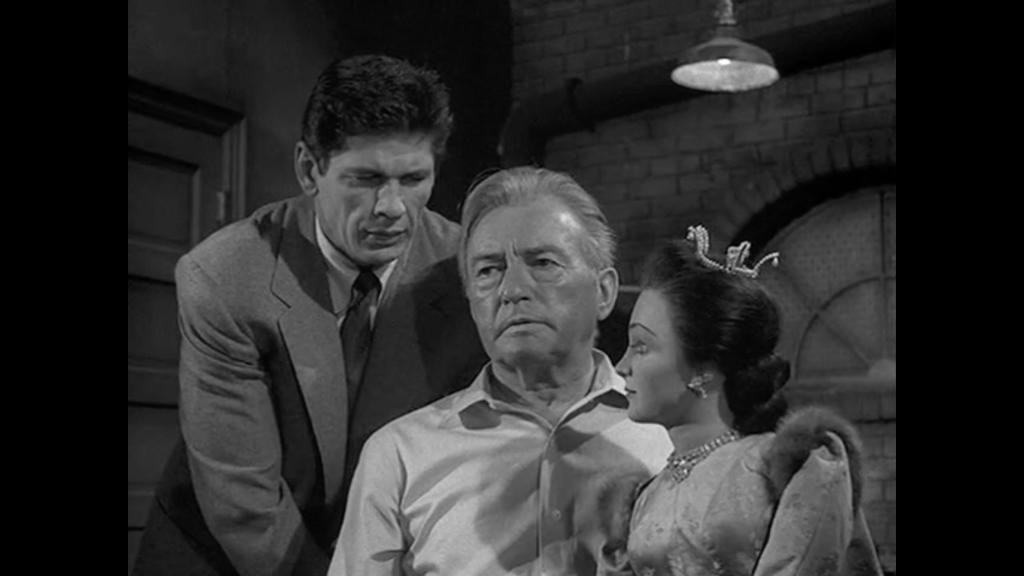
I’ve never been a rabid consumer of horror films, but I do love Alfred Hitchcock. And when you consider that Charles Bronson was featured three times in his TV series, ALFRED HITCHCOCK PRESENTS, you know I’m all in. Bronson first appeared in the season 1 episode, “And So Died Riabouchinska” which starred the Invisible Man himself, Claude Rains! I thought it would be fun to revisit this early episode from the classic TV series.
When a juggler named Ockman is found dead in the basement of a vaudeville theater, Detective Krovitch (Charles Bronson), a no-nonsense police investigator, is on the case. The prime suspect quickly emerges to be John Fabian (Claude Rains), a ventriloquist whose act revolves around his beautiful female dummy, Riabouchinska, who we find out is modeled after a long, lost love. As Krovitch interrogates Fabian and all of those around him, including his embittered wife Alyce (Wynne Miller), and her lover, the shady manager Douglas, it becomes clear that the ventriloquist has a dark and dangerous past. We discover a Fabian who is lost in a world of obsession, self delusion and even perversion, a world that the now deceased Ockman was threatening to expose. Without giving too much away, this episode blends psychological horror with police procedural and spits out an episode that still resonates loudly on the freaky-meter!
Adapted by Mel Dinelli from Ray Bradbury’s short story, “And So Died Riabouchinska” is an exceptional entry in Season 1 of the ALFRED HITCHCOCK PRESENTS TV series. Claude Rains is incredible as Fabian. It’s a thespian tour-de-force, with Rains creating a role that’s creepy, pathetic, and oddly relatable all at the same time. I haven’t seen many of Rains’ most notable works, but based on his performance here, I do know that he’s amazing. Charles Bronson, whose strong screen presence was as obvious as the nose on his face, even this early in his career, goes toe to toe with Rains (and Riabouchinska) and helps ground the episode in something resembling the real world. It’s not a showy role for the legendary tough guy, but he conveys the toughness and authority that would go on to define his career. Performances aside, the episode is truly set apart with an emotional storyline that plumbs the depths of the human psyche in a way that seems daring for 1956 television. There are parts of this episode that will definitely make you squirm in your seat!
Overall, in my opinion, “And So Died Riabouchinska” is an essential episode of the ALFRED HITCHCOCK PRESENTS series. It’s a lot of fun seeing Hitchcock introduce the show at the beginning and wrap it up at the end, but the best part is the fact that the story that takes place in-between is creepy, clever, and compulsively re-watchable.
Today is the 121st birthday of one of the great actors of Hollywood’s Golden Age, the one and only Cary Grant. For those of us who love to watch older films, Grant is usually the epitome of old-fashioned movie star charisma. He was an actor who could do it all, from screwball comedy to tear-jerking melodrama to exciting thrillers. What one usually hears about Cary Grant is that he was an actor who was taken for granted because he made everything seem so effortless.
And yet, there was a darkness to Grant’s best performances. Like Jimmy Stewart, he was an actor whose affable screen presence often hinted at inner turmoil. And, much as in the case of Stewart, Alfred Hitchcock was a director who immediately understood that. He cast Grant in some of his best films, usually playing a character with a secret or two to hide. One of my favorite “darker” Grant performances and films is 1946’s Notorious.
Directed by Alfred Hitchcock, Notorious opens with T.R. Devlin (Cary Grant) meeting and, it is implied, seducing Alicia Huberman (Ingrid Bergman). Alicia, at the time, was attempting to drink away her sorrow over her father being convicted of treason for his pro-Nazi activities during World War II. As the daughter of an American Nazi with a reputation for drinking too much and being promiscuous, Alicia is indeed notorious. That’s something that Devlin uses to his advantage the next morning when he informs that hangover Alicia that he is an American intelligence agent and that he is investigating the activities of a group of Nazi sympathizers who fled to South America at the end of the war. He wants Alicia, as the daughter of a known sympathizer, to infiltrate their operations.
Reluctantly, Alicia agrees and, while they wait for to learn the exact details of her assignment, they fall in love. Devlin is not happy when his superiors inform him that they want Alicia to approach and seduce Alex Sebastian (Claude Rains), a friend of her father’s who now lives in Brazil with his domineering mother (Leopoldine Konstantin). Alicia is even less happy when Devlin tells her of the assignment, especially as she knows that the weak-willed Sebastian has always been in love with her. She assumes that Devlin only pretended to love her.
After Devlin arranges for Alicia to be at the local riding club at the same time as Alex, Alex meets her and immediately brings her to the mansion that he shares with his mother. Alex is an interesting character. When we first meet him, he hardly seems like a Nazi sympathizer. His happiness when he sees Alicia and the apparent sincerity of his love for her stands in contrast to the often cold, manipulative, and harsh Devlin. Sebastian invites Alicia to move into his mansion and soon, Alicia tells Devlin that he can add Sebastian to “my list of playmates.” When Sebastian asks Alicia to marry him, Devlin tells Alicia to do what she wants. Alicia married Sebastian though she loves Devlin but she soon discovers just how for Sebastian and his mother will go to protect themselves and their Nazi conspirators.
Notorious is famous for its 2 and a half kissing scene between Devlin and Alicia, filmed at a time when the production code specifically stated that kisses could only last for three seconds. Hitchcock handled this by interrupting the kiss every three seconds and then having his two stars get back to it. Both Cary Grant and Ingrid Bergman said the scene was awkward to shoot, specifically because they had to keep finding reasons to split apart without splitting too far apart but the effect onscreen is amazingly romantic and probably about as erotic as 1940s studio production could be. In that scene, you have no doubt that Devlin and Alicia share a passion that Alex, even though he is in love with Alicia, could never understand. Grant and Bergman have an amazing chemistry in this scene and really the entire film.
As played by Cary Grant, Devlin is not always likable in Notorious. He can be cold and manipulative and judgmental but, in the end, we never doubt his love for Alicia. Alex also loves Alicia but he ultimately puts himself (and his mother) first. As for Alicia, she is someone who has been unfairly branded by both the activities of her father and her past reputation and anyone who has ever come to work or gone to school on a Monday morning and heard the snickering that goes along with the rumors about what she did during the weekend will immediately relate to Alicia. Alicia is told that the mission is a way to redeem herself but the film suggests that no redemption is necessary. If anything, it’s Devlin who needs to redeem himself for the way he previously manipulated and judged her. Devlin and his superiors are trying to stop a group of Nazi sympathizers from graining power in South America and their mission is an important one. (That sentiment would be even more true from audience watching in 1946, just a year after the end of World War II). But the important of their mission doesn’t change the fact that the people involved are human beings with very real and very fragile emotions.
Notorious features some of Hitchcock’s best set pieces, from the famous kissing scene to another scene involving the key to a wine cellar. Grant, Bergman, and Rains give three of their best performances in this intelligent thriller. (Watching, one can see why Ian Fleming suggested Cary Grant as a possible James Bond.) I first saw Notorious in a film class in college. At first, the class was a bit hesitant about a black-and-white movie from 1946 but, by the end, there were cheers as Devlin rushed to save Alicia. Notorious is a timeless classic.
Notorious (1946, dir by Alfred Hitchcock, DP: Ted Tetzlaff)
1941’s Here Comes Mr. Jordan tells the story of Joe Pendelton (Robert Montgomery).
Joe’s a boxer, an honest and kind-hearted guy who is in training for the big title fight. Despite the concerns of his trainer, Max (James Gleason), Joe decides to take his own private airplane out for a flight. A freak accident causes the plane to go into a nosedive and Joe suddenly finds himself standing amongst the clouds with a bunch of other people who are waiting for their chance to enter Heaven.
7013 (Edward Everett Horton), an angel, explains that he took Joe’s soul up to heaven when he saw that the plane was about to crash. Joe is not happy about this. He wants his title fight! 7013’s superior, Mr. Jordan (Claude Rains), checks his records and discovers that a mistake has been made. Joe was supposed to live until 1991 and he was also supposed to win the boxing championship. Unfortunately, Max has had Joe’s body cremated. Mr. Jordan decides to put Joe’s soul into the body of someone else who is scheduled to die. Joe asks to be put in the body of an athlete so that he can pursue his boxing career.
Instead, Joe ends up in the body of a middle-aged banker named Bruce Farnsworth. Farnsworth has been poisoned by his wife (Rita Johnson) and her lover (John Emery). At first, Joe refuses to become Farnsworth but when he sees his murderers taunting Bette (Evelyn Keyes), whose father was defrauded by Farnsworth, Joe changes his mind. His murderers are shocked when Farnsworth turns out to be alive. Bette is shocked when the previously cold Farnsworth helps her get back the money that her father lost. And Max is shocked when Farnsworth calls him to the mansion and explains that he’s really Joe Pendleton. Only with Joe/Farnsworth plays the saxophone badly does Max believe what Joe says. Joe asks Max to train him for the boxing match that he was scheduled to fight while alive. Max agrees but Mr. Jordan warns Joe that, if he’s going to fulfill his destiny and become champ, it’s not going to be as Bruce Farnsworth, regardless of the fact that Joe/Farnsworth and Bette have now fallen in love.
A romantic comedy that is blessed with two likable performances from Robert Montgomery and Evelyn Keyes and a great one from Claude Rains, Here Comes Mr. Jordan was nominated for Best Picture of 1941. It lost to How Green Was My Valley. While Here Comes Mr. Jordan really can’t compare to some of the other films that lost (amongst the other nominees were Citizen Kane and The Maltese Falcon), it’s still a wonderfully charming film that holds up well today. Everyone should be as lucky as to have a guardian who is as charming and urbane as Claude Rains is as Mr. Jordan.
In 1978, Here Comes Mr. Jordan was remade by Warren Beatty, who named his version of the story Heaven Can Wait. That version of the story was also nominated for Best Picture, though it lost to The Deer Hunter.
Welcome to Late Night Retro Television Reviews, a new feature where we review some of our favorite and least favorite shows of the past! On Fridays, I will be reviewing Friday the 13th: The Series, a show which ran in syndication from 1987 to 1990. The show can be found on YouTube!
This week, a nerdy film students takes his love of a 1940s horror film too far!
Episode 2.16 “Scarlet Cinema”
(Dir by David Winning, originally aired on February 20th, 1989)
Darius Pogue (Jonathan Wise) is a nerdy film student who is obsessed with The Wolf Man. When Darius steals an old antique movie camera, he discovers that, by looking through the camera’s view finder, he can bring The Wolf Man to life and send him to kill anyone who annoys him. Darius kills a snooty antique store manager. He kills a bully. He kills his professor. He even sends the wolf after Ryan and a girl that Darius likes.
However, as much as Darius enjoys sending the Wolf Man after people, he wants to be the Wolf Man himself. After allowing the Wolf Man to scratch him, Darius shoots him with silver bullets. Transforming into a werewolf himself, Darius goes after Ryan, Micki, and Jack. Unfortunately, Darius didn’t consider that film stock is full of silver nitrate. Live by the film, die by the film….
This episode was a case where the premise was pretty interesting but the execution didn’t quite work. The episode mixes in archival footage from The Wolf Man with scenes of Darius’s victims meeting their fate. So, for example, one sees Lon Chaney Jr. turning into the Wolf Man and then the viewer sees The Wolf Man killing one of Darius’s classmates. The problem is that the Friday the 13th werewolf makeup doesn’t really look much like the Wolf Man makeup. Regardless of how darkly lit each scene is, it’s pretty obvious that the Wolf Man from the film is not the same Wolf Man that is doing Darius’s bidding. It not only negates the whole idea behind the cursed antique but it’s also pretty distracting for those of us just trying to watch the show. And, again, it’s a shame because the idea behind this episode was actually pretty clever.
Myself, I’ve always liked the original Wolf Man. Eventually, Larry Talbot got a bit too whiny for his own good and it’s pretty much impossible to buy the idea of the hulking, very American Lon Chaney, Jr. as the son of the sophisticated and very British Claude Rains. But, even with all that in mind, The Wolf Man holds up as a classic American horror film, full of atmosphere and featuring a pretty impressive monster. Friday the 13th deserves some credit for making Darius a Wolf Man fan because The Wolf Man, with its portrait of a man being driven mad by a curse that he cannot control, fits in perfectly with the main idea behind Friday the 13th. Darius, like most of the villains on this show, isn’t really evil until he starts using the camera. Each times he picks up the camera, his actions become progressively worse. Just as Larry Talbott was cursed by the werewolf, Darius is cursed by the camera. Much like a drug addict, Darius falls in love with the camera and he just can’t stop using it. His addiction changes his personality as it becomes all-consuming,. Eventually, it drives him to become the Wolf Man himself.
The episode ends with another cursed antique safely hidden away and Darius joining Larry Talbot in the cold embrace of death. There was a lot of potential to this episode so it’s a shame that it didn’t quite work.
As some of our regular readers undoubtedly know, I am involved in a few weekly live tweets on twitter. I host #FridayNightFlix every Friday, I co-host #ScarySocial on Saturday, and I am one of the five hosts of #MondayActionMovie! Every week, we get together. We watch a movie. We tweet our way through it.
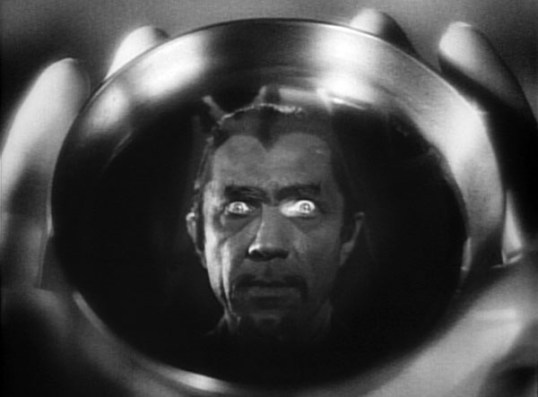
Tonight, we’ve got a special Halloween double feature! First up, we’ve got 1932’s White Zombie, starring Bela Lugosi!
After White Zombie, we will watch 1940’s The Wolf Man, starring Claude Rains, Lon Chaney Jr, and …. Belua Lugosi!
Halloween is always fun at #ScarySocial!
If you want to join us on Saturday night, just hop onto twitter, start White Zombie at 9 pm et, and use the #ScarySocial hashtag! The films are available on Prime! I’ll be there co-hosting and I imagine some other members of the TSL Crew will be there as well. It’s a friendly group and welcoming of newcomers so don’t be shy.
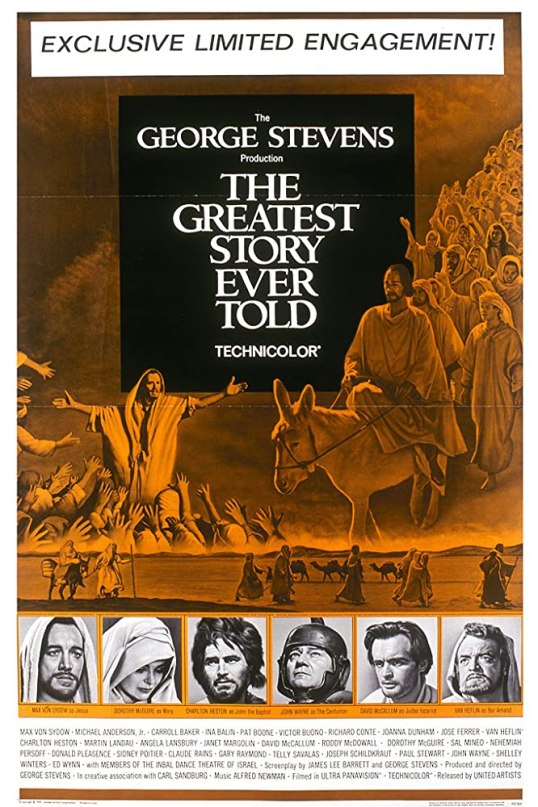
The 1965 biblical epic, The Greatest Story Ever Told, tells the story of the life of Jesus, from the Nativity to the Ascension. It’s probably the most complete telling of the story that you’ll ever find. It’s hard to think of a single details that’s left out and, as a result, the film has a four hour running time. Whether you’re a believer or not, that’s a really long time to watch a reverent film that doesn’t even feature the campy excesses of something like The Ten Commandments.
(There’s actually several different version of The Greatest Story Ever Told floating around. There’s a version that’s a little over two hours. There’s a version that’s close to four hours. Reportedly, the uncut version of the film ran for four hour and 20 minutes.)
Max von Sydow plays Jesus. On the one hand, that seems like that should work because Max von Sydow was a great actor who gave off an otherworldly air. On the other hand, it totally doesn’t work because von Sydow gives an oddly detached performance. The Greatest Story Ever Told was von Sydow’s first American film and, at no point, does he seem particularly happy about being involved with it. von Sydow is a very cerebral and rather reserved Jesus, one who makes his points without a hint of passion or charisma. When he’s being friendly, he offers up a half-smile. When he has to rebuke his disciples for their doubt, he sounds more annoyed than anything else. He’s Jesus if Jesus was a community college philosophy professor.
The rest of the huge cast is populated with familiar faces. The Greatest Story Ever Told takes the all-star approach to heart and, as a result, even the minor roles are played by actors who will be familiar to anyone who has spent more than a few hours watching TCM. Many of them are on screen for only a few seconds, which makes their presence all the more distracting. Sidney Poitier shows up as Simon of Cyrene. Pat Boone is an angel. Roddy McDowall is Matthew and Sal Mineo is Uriah and John Wayne shows up as a centurion and delivers his one line in his trademark drawl.
A few of the actors do manage to stand out and make a good impression. Telly Savalas is a credible Pilate, playing him as being neither smug nor overly sympathetic but instead as a bureaucrat who can’t understand why he’s being forced to deal with all of this. Charlton Heston has just the right intensity for the role of John the Baptist while Jose Ferrer is properly sleazy as Herod. In the role Judas, David McCallum looks at the world through suspicious eyes and does little to disguise his irritation with the rest of the world. The Greatest Story Ever Told does not sentimentalize Judas or his role in Jesus’s arrest. For the most part, he’s just a jerk. Finally, it’s not exactly surprising when Donald Pleasence shows up as Satan but Pleasence still gives a properly evil performance, giving all of his lines a mocking and often sarcastic bite.
The Greatest Story Ever Told was directed by George Stevens, a legitimately great director who struggles to maintain any sort of narrative momentum in this film. Watching The Greatest Story Ever Told, it occurred to me that the best biblical films are the ones like Ben-Hur and The Robe, which both largely keep Jesus off-screen and instead focus on how his life and teachings and the reports of his resurrection effected other people. Stevens approaches the film’s subject with such reverence that the film becomes boring and that’s something that should never happen when you’re making a film set in Judea during the Roman era.
I do have to admit that, despite all of my criticism of the film, I do actually kind of like The Greatest Story Ever Told. It’s just such a big production that it’s hard not to be a little awed by it all. That huge cast may be distracting but it’s still a little bit fun to sit there and go, “There’s Shelley Winters! There’s John Wayne! There’s Robert Blake and Martin Landau!” That said, as far as biblical films are concerned, you’re still better off sticking with Jesus Christ Superstar.
It’s Oscar night in Hollywood! We all may have our gripes with the Academy over things like the nominating process (see my posts on THE OTHER SIDE OF THE WIND , STAN & OLLIE and THEY SHALL NOT GROW OLD ), but in the end, we’ll all still be watching – I know I will!
One of my gripes over the years has always been how the horror genre has gotten little to no attention from Oscar over the years. Sure, Fredric March won for DR. JEKYLL & MR. HYDE , but there were plenty of other horror performances who’ve been snubbed. The following ten actors should have (at least in my opinion) received consideration for their dignified work in that most neglected of genres, the horror film:
(and I’ll do this alphabetically in the interest of fairness)
As a classic film blogger, I’m contractually obligated to cover film noir during the month of “Noirvember”, so every Tuesday this month I’ll be shining the spotlight on movies of this dark genre!
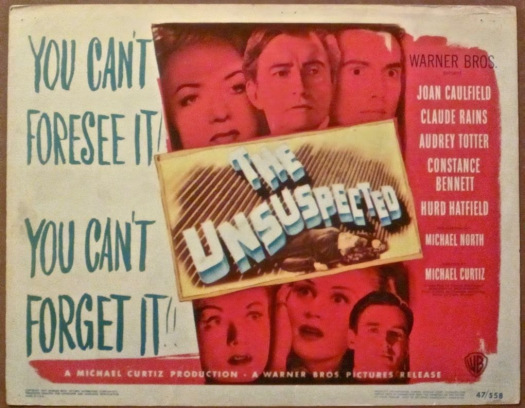
Claude Rains received second billing in 1947’s THE UNSUSPECTED, but there’s no doubt who’s the star of this show. Nobody could steal a picture like Rains, as I’ve stated several times before – his sheer talent commands your attention! Here, he gives a chilling portrayal of a cold, calculating murderer in a Michael Curtiz noir based on a novel by Edgar Award-winning mystery writer Charlotte Armstrong, and runs away with the film. Joan Caulfield gets top billing, but let’s be honest – it’s Claude’s movie all the way!
The film begins with a frightening scene played mostly in shadow, as a figure creeps into the office of Victor Grandison (Rains) and murders his secretary Robyn Wright while…
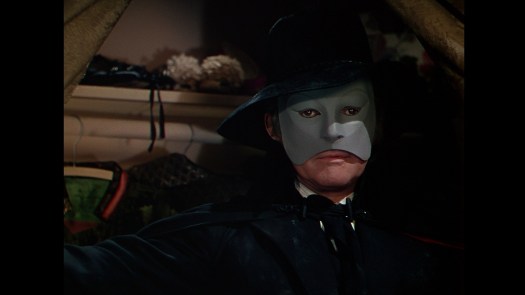
Universal’s 1943 remake of the 1925 Lon Chaney Sr. classic THE PHANTOM OF THE OPERA is definitely an ‘A’ movie in every way. A lavish Technicolor production with an ‘A’ list cast (Claude Rains, Nelson Eddy, Susanna Foster) and opulent sets (including the Opera House interiors built for the ’25 silent), it’s the only Universal Horror to win an Oscar – actually two, for Art Direction and Cinematography. Yet I didn’t really like it the first time I saw it. It’s only through repeated viewings I’ve softened my stance and learned to appreciate the film.
Claude Rains’s performance in particular has made me a convert. As Erique Claudin, he’s a sympathetic figure, and one can’t help but feel sorry for him. When he’s let go from the orchestra by the maestro, after twenty long years as a violinist, his arthritis causing his playing to become subpar, I felt pity for…
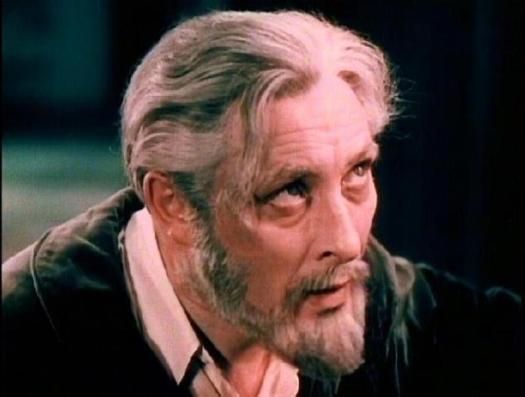
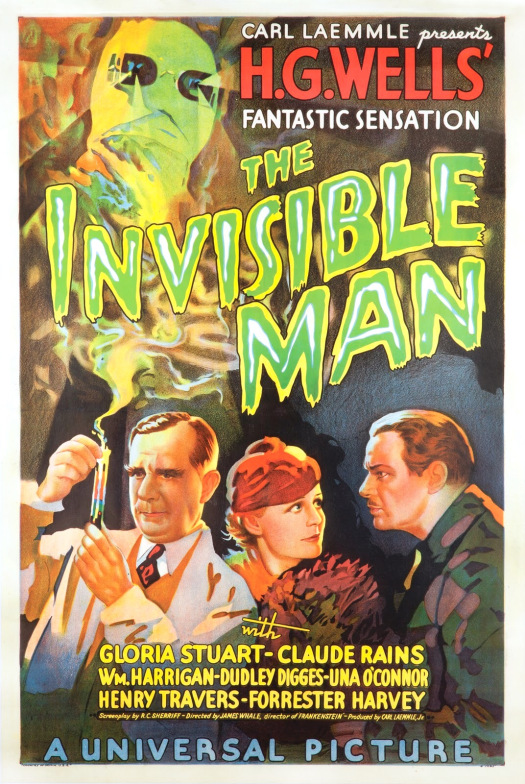
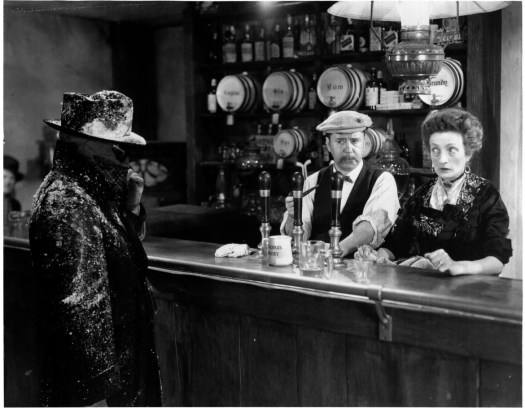
James Whale’s FRANKENSTEIN set the bar high for horror, and his follow-up THE OLD DARK HOUSE is one of the blackest comedies ever made. But with THE INVISIBLE MAN, Whale raises that bar by combining gruesome terror with his macabre sense of humor. THE INVISIBLE MAN doesn’t get the respect of other icons in the First Horror Cycle (Frankenstein’s monster, Dracula, Imhotep), but Claude Rains’s outstanding performance as the mad scientist Jack Griffin, driven to insanity by the chemicals he’s pumped into his veins, is as sick and deranged as any you’ll find in the genre… and the fact Rains does much of his acting using only his voice is an amazing feat, and a testament to the man’s acting genius.
Whale’s opening shot sets the eerie tone, as a solitary figure, his face swaddled in bandages, trudges through a snowstorm and enters the Lion’s Head Inn seeking solitude. The…







 Through the Shattered Lens