What’s an Insomnia File? You know how some times you just can’t get any sleep and, at about three in the morning, you’ll find yourself watching whatever you can find on cable? This feature is all about those insomnia-inspired discoveries!
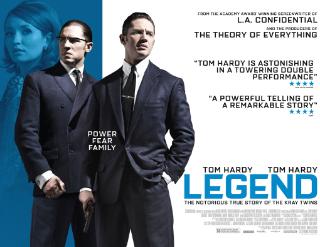
If, last night, you were having trouble getting to sleep around two in the morning, you could have turned over to HBO and watched the 2015 British gangster film, Legend.
Tom Hardy is Reggie Kray. Arrogant, handsome, charming, and dangerous to know, Reggie is a club owner who is also an up-and-coming gangster in 1960s London. Scotland Yard has him under surveillance. The East End both fears and respects him. American gangsters want to do business with him.
Tom Hardy is also Ronny Kray! Ronny is the ugly twin, the one who lives in a trailer and has just been released from a psychiatric institution. Ronny is openly gay at a time when that was still illegal in the UK. Driven by jealousy of Reggie and a desire to prove himself superior to everyone who has ever judged or looked down on him, Ronny is determined to make sure that he and his brother become the top gangsters in London.
Together …. they solve crimes!
No, actually, they do the exact opposite. They commit a lot of crimes. Ronny is willing to shoot anyone in the head. Reggie tries to be a bit more respectable. He even attempts to run a legitimate nightclub. Reggie understand that sometimes, the threat of violence is more effective than violence itself. Reggie and Ronny are about as close as siblings can be, even if they do spend a lot of time beating each other up.
Frances Shea (Emily Browning) is the sister of Reggie’s driver, Frankie (Colin Morgan). She’s sixteen when she meets and falls in love with Reggie Kray. Reggie loves her too and he even marries her. (Of course, he has to do a stint in prison first.) Reggie swears to Frances that he’s going to go straight and that they’re going to have a normal life. Deep down, Frances know that will never happen so, while her husband and brother-in-law conquer London, she copes with pills. Lots and lots of pills.
For an American viewer like myself, British gangster films are always fun to watch because they’re just as violent as American gangster films but, at the same time, everyone’s always dressed impeccably and stopping in the middle of all the mayhem to have a cup of tea. Legend is based on a true story, which turns out to be both its greatest strength and its greatest weakness. On the one hand, it’s fascinating to see the film’s recreation of London in the early 60s. On the other hand, the film never convinces us that we should really care about the Krays. This isn’t a case where, like the Corleones, the Krays are tragic figures who can’t escape their destiny. Tom Hardy does a great job playing Reggie and he’s an adequate Ronny but you can never quite escape the feeling that the two brothers are just — to use one of their own preferred insults — two wankers who aren’t really worth all the trouble. This is a film that you watch and you ask yourself, “Why should we care?” Beyond the novelty of the Krays being twins, the film really can’t provide an answer.
Still, I happen to be fascinated by the early 60s so I enjoyed the film as a historical recreation. Legend isn’t a bad film. It’s just somewhat underwhelming.
The year is 1953. The place is Croydon. Derek Bentley (Christopher Eccleston) is 19 years old but has the mental capability of an 11 year-old. Unable to hold down a job and judged unfit for the national service, Derek drifts into a gang led by 16 year-old Christopher Craig (Paul Reynolds). When Derek and Craig are caught burglarizing a warehouse, it leads to a tense rooftop confrontation between Craig and the police. Derek has already been captured by the time that the police demand that Craig hand over his gun. Bentley shouts, “Let him have it, Chris!” Craig opens fire, killing one officer.
Because he’s a minor, Craig is only facing a prison sentence for killing the police officer. But, as a legal (if not mental) adult, Derek will be hung if he’s found guilty. Under the common purpose doctrine, it doesn’t matter that Derek didn’t actually shoot the gun. The only thing that matters is what Derek meant when he said, “Let him have it, Chris!” Derek says that he was telling Craig to hand over his gun. The Crown says that Derek was ordering Craig to open fire.
Let Him Have It is based on a true story. The case of Derek Bentley was one of the many cases that eventually led to the death penalty being abolished in the UK. Let Him Have It was released at the height of a long campaign to secure a pardon for Derek. That pardon was finally issued in 1998, though it was too late to help Derek Bentley.
Let Him Have It is a powerful and angry docudrama, one that reveals in searing detail how Derek was railroaded by the British legal system. In his film debut, Eccleston gives a powerful performance as Derek and he is ably supported by both Paul Reynolds and, in the role of Derek’s father, Tom Courtenay. Let Him Have It leaves little doubt as to why the case of Derek Bentley remained a cause célèbre for 45 years after his initial trial.
There are A LOT of bad horror films out there and I mean Halloween Resurrection bad, but when you get a truly great one, it sticks with you for your life. This movie is more unique in that the writer Alex Garland really peaked with this film and there are IMDB credits to prove it. Danny Boyle directed the piece and you really feel as though you were inhabiting the after-times of a dead world….well, undead. Danny Boyle did Trainspotting, Slumdog Millionaire, 127 hours, but I know what you’re thinking- Did he write anything besides family films for Disney? Yes, he made this awesome zombie film.
We see shots of terrible violence and realize that monkeys are being forced to watch it. Then, Animal Rights Activists enter heavily armed with guns and sanctimony. The researcher begs them not to release the animals because they are infected with a terribly contagious disease and that the goal of their research is to find a cure for rage. The Animal Rights Activists patiently listen to the scientist instead of acting purely from smug instinct, dooming us all. Just kidding, they release one of the monkeys, it rips the animal rights activist apart, barf bleeds all over her, making her patient zero, and I try really hard not to root for the diseased monkey. The disease is out! Of course, many of us always knew that animal rights activists would lead to the zombie apocalypse. Just read their twitter feeds and you’ll know that they’ll doom us all. Fade to Black and 28 Days Later… appears as a subtitle in the bottom right….BRILLIANT!!!
Jim wakes from a coma to a dead world. Sound familiar? Yes, TWD went beyond homage there. He leaves the hospital to amazing details that really sell a dead London. Empty hospital, empty streets, garbage, worthless cash everywhere, a bus is overturned in front of parliament, and an amazing score reveals a World without people. If you’re looking for the song that plays when he’s walking around dead London during the opening – it’s by Godspeed You! Black Emperor – East Hastings – Long Version.
HOW DID THEY MAKE LONDON EMPTY? MERLIN! This is England, after all. Nah, Danny Boyle got MANY government officials to agree to let the production shutdown huge traffic arteries for 90 seconds at a time. London is one my most favorite cities and I would love to live there and it is Europe’s New York City, therefore, imagine shutting down Times Square for filming.
Jim gets chased by fast-moving zombies and meets Selena and a Red Shirt. He goes with them and realizes very quickly that he was probably better off in a coma. Jim insists on seeing his parents. They agree to take him and he finds them suicided on the bed clutching a note that reads- “With endless love, we left you sleeping. Now, we’re sleeping with you. Don’t wake up.” This is not your dad’s zombie movie. They decide to stay at his house for the night, but are attacked by zombies. Red Shirt gets infected and is dispatched by Selena. Jim and Selena must flee.
Jim and Selena venture forth and find Frank and his daughter Hannah. It hasn’t rained for some time, therefore -no water. For survival, they have to leave the city. Selena doesn’t want to go with Frank and his daughter because she sees them as anchors, but Jim insists and Hannah explains that we actually need each other. Frank plays a radio signal that beckons them to safety and they leave as one tribe. Along the way, there are some intense scenes and some shopping. They arrive at the salvation location, but Frank gets infected and is killed by soldiers.
Right away, you can tell that the soldiers are goofing off too much. I have commanded soldiers and there’s some level of goofing off, but this had an air of creepiness and broken discipline. The soldier’s have taken over a residence as their HQ and have put up defenses to keep zombies out and people in. We quickly learn that the radio message was a trap. Corporal Mitchell harasses Selena and a fight erupts. The Major breaks it up, but it’s clear that Jim, Hannah, and Selena are prisoners. The Major explains that the soldiers could not face a dead world and one attempted suicide. The Major had a plan- lure women to the compound with a radio signal. When they arrived, they would keep them prisoner to breed with his soldiers to restart civilization. He puts it simply: women equal hope. His logic and delivery is truly chilling in its cold mathematics.
They decide to execute Jim and a SGT who gets in their way and keep Hannah and Selena for reproduction. Corporal Mitchell and another Soldier take Jim and the SGT out for execution to a killing field. Corporal Mitchell wants to bayonet Jim, the other Soldier can’t handle that kind of intimate murder, leading to a melee. The SGT is killed and Jim escapes.
The next sequence is truly amazing because we see our hero morph from the sensitive man that he is naturally to a state of feral revenge indistinguishable from the fast-moving zombies. He’s shirtless to further emphasize his lack of civility as he makes short work of many of the soldiers to rescue Hannah and Selena. Corporal Mitchell who wanted to bayonet him and rape Selena becomes the focal point of Jim’s rage- Jim puts his thumbs deep into Corporal Mitchell’s eyes until he’s dead. This is a critical act of monstrosity because it shows not tells in the clearest finality that there is no separation between Jim’s blind rage and the rage that has infected the human population.
I don’t want to totally spoil the ending because this film will remain with you and is a must see. It’s commentary on violence and society is forever salient: Violence is horrific, but forced civilization is worse and will lead to the ultimate act of revenge – THUMBS IN YOUR EYEBALLS or some such equivalent. The other important lesson the film tries to inculcate is to beware of self-certain sanctimonious people because their grandiosity could doom us all.
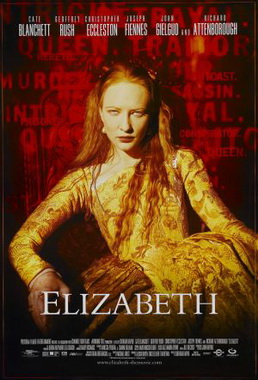
— Queen Elizabeth I (Cate Blanchett) in Elizabeth (1998)
I have to admit that I always feel guilty about the fact that I love movies about British royal history. After all, I have roots in Northern Ireland and I was raised Catholic. If anything, I should refuse to watch films about British royalty on general principle. I should be writing more reviews of films like Bloody Sunday.
But I can’t help myself. Whether it’s because I enjoy looking at all of the costumes or I just have a thing for movies set in drafty old castles, I have a weakness for films about British royalty. (And I will also admit that I sat through the entire royal wedding and I have a bit of a girlcrush on both Pippa and Kate Middleton. As I said, I just can’t help myself.)
Of course, some of it definitely has to do with the fact that I’m an unapologetic history nerd. I am fascinated with how people lived in the past. And, of course, anyone who shares my obsession understands that, when it comes to history, there’s both the official story and the truth. The official story is something that’s passed down over the centuries. It’s what we learn in school. The truth, however, is always far more obscure. The truth is what historians piece together from what little gossipy evidence has managed to survive the passage of time.
We all know that the official story of Queen Elizabeth I is that she was England’s greatest Queen, she defeated the Spanish Armada, and she never married. She was the “Virgin Queen,” forsaking love to serve her nation. That’s the official story but is it the truth?
That’s the question at the heart of the 1998 Best Picture nominee Elizabeth. Now, don’t get me wrong. I’m not arguing that Elizabeth represents the truth. Historically, the film is messy and full of speculation that is less based on evidence and more on the desire to keep things cinematic. But still, Elizabeth is an interesting film specifically because it takes a historical figure and dares to suggest that she may have been human before she became an icon.
Cate Blanchett gives a great performance in the role of Elizabeth. When we first meet her, she’s a somewhat silly girl who is less concerned with politics and religion and more concerned with her boyfriend, Robert Dudley (Joseph Fiennes). Elizabeth is also the protestant half-sister of Catholic Queen Mary (Kathy Burke). Mary is planning on ordering Elizabeth’s execution but dies of stomach cancer before she gets around to singing the order.
Suddenly, Elizabeth is Queen of England. Young and insecure, she is, at first, manipulated by advisors like William Cecil (Richard Attenbrough), who pressures her to marry the cross-dressing Henry III (Vincent Cassel) of France. Meanwhile, the Pope (John Gielgud) signs an order calling for Elizabeth’s death. Catholic nobleman Thomas Howard (Christopher Eccleston) and mysterious priest John Ballard (Daniel Craig) conspire to assassinate Elizabeth. With even Robert Dudley giving her reason to distrust him, Elizabeth discovers that her only ally is the enigmatic and ruthless “spymaster,” Francis Walsingham (Geoffrey Rush). It all ultimately ends in a sequence that basically transports the finale of The Godfather to the Elizabethan era.
I really should not like Elizabeth. It’s undoubtedly an anti-Catholic film, though it’s nothing compared to the histrionic anti-Catholicism of its sequel, Elizabeth: The Golden Age. But I can’t help myself, I enjoyed Elizabeth. It was impossible for me not to relate to Cate Blanchett’s passionate performance. (And there was just something so incredibly hot about the way Joseph Fiennes, with his intense eyes, would stare at her.) When you ignore the film’s protestant bias and just concentrate on the performances and the gorgeous production design, you can’t help but love Elizabeth.
The way I work, I generally try to avoid giving up too much by way of “spoilers” when it comes to reviewing movies that are still playing simply because I’m never sure how much anybody out there who might be reading this stuff wants to know about any given flick before they’ve actually seen it. Call it common courtesy, I guess, if you’re feeling generous, or weak-kneed fear of the always-on-the-alert hordes of internet “spoiler police” if you’re not, but nevertheless, it’s something I try to adhere to, however tough the going may get.
And Thor : The Dark World makes it very tough indeed. The simple fact is, you just can’t heap all the criticism on this film that it so richly deserves without giving away numerous key plot points, so here’s what I’m gonna do instead : for those of you who want a meticulously-detailed, blow-by-blow analysis of how and why this big-budget boondoggle fails every single logic test known to humankind, I humbly suggest you follow this link to a lengthy review by the ever-reliable Julian Darius over at the Sequart website : http://sequart.org/magazine/32555/id-need-a-lobotomy-to-enjoy-thor-the-dark-world/ . Julian’s one of the more articulate and intelligent writers the web has to offer on all things comic-related, and while his grammar and syntax are occasionally a bit uncharacteristically all over the map in this particular piece, I get it : he had a lot to vent about, and sometimes ya just gotta let off steam. In any case, his analysis is absolutely spot-on here and, if anything, he’s being too kind to this putrid mess of a movie.
For those of you who want a short, “spoiler”- free summation of why this film sucks so badly though, , here’s the bare essentials — Thor : The Dark World is built on so many glaringly obvious logical inconsistencies, ten-trillion-to-one coincidences, rehashed story elements that worked much better in the first film, plot holes that are big enough for an entire army of Asgardian warriors to charge though, and problems brought on by the idiotic actions of the title character himself that it well and truly boggles the imagination. This is, in short, a complete and utter celluloid train wreck that requires such a heaping dose of suspension of disbelief that even people who can accept the most outlandish premises imaginable will have a hard time coming to grips with this one. It also doesn’t help that the characterization of most of the leading players seems to have taken a leap back toward the dark ages, the dialogue is hopelessly inane from start to finish, and that director Alan Taylor (a seasoned TV veteran, and it shows) brings exactly none of the Shakespearean-rooted vision of Kenneth Branagh to the proceedings and opts, instead, to film things in the rapidly-evolving (and hopelessly uniform) Marvel “house style” best exemplified by the likes of Jon Favreau and Joss Whedon. Sure, their Iron Man and Avengers films, respectively, have earned tons of fan accolades (not to mention box office dollars), but let’s be honest — the directorial work on either of those properties is virtually (okay, who are we kidding, completely) indistinguishable from the other. So, hey, welcome to the lowest-common-denominator club, I guess, Alan.
On the plus side, the CGI is pretty cool here throughout, though, and since that’s probably what half the audience (at least) for these things is there for, said half (again, at least) of the audience should walk away feeling quite satisfied.
For those of us who like a movie that at least tries to make sense, though (or fails to so earnestly that watching it becomes a kind of sublime pleasure in its own right), there just ain’t much of offer here. Natalie Portman goes from intelligent astrophysicist to love-struck schoolgirl the minute Thor hits the scene (we later learn she’s only continued with her career at all in hopes of running into him again — there goes a few decades’ worth of tepid progress for female characters in genre cinema in about one second flat) and spends the rest of the film making puppy-dog eyes but not doing much else; Chris Hemsworth plays up the dull nobility of his character with none of the reckless humanity we saw in the first film (even though he organizes mass treason here — again); Tom Hiddleston wildly accentuates the effeminate qualities of Loki in a way that pretty much screams “you can’t trust this guy, he’s obviously queer“; Anthony Hopkins mails in his performance from behind a shining suit of armor; Rene Russo fulfills her one character requirement by d— whoops, that’s right, “spoliers”! ; Kat Dennings essentially plays the same character she does on TV’s Two Broke Girls ; and Stellan Skarsgard does his best to make sure we all know nervous breakdowns are nothin’ but harmless fun, his character having gone mad due to the purportedly “traumatic” events he endured in The Avengers (a bit of a reach given that even its most fervent partisans would admit that’s essentially a big-budget “popcorn movie” with little to no actual thematic depth whatsoever — they just think it’s a particularly well done “popcorn movie”). In short, if you’re getting the idea that Thor : The Dark World is risible, superficial nonsense with some deeply offensive takes on gender roles, (alluded to) homosexuality, and mental illness, then congratulations! You’re exactly correct.
Christopher Eccleston does his best, I suppose, considering the mountain of makeup he’s buried beneath, as chief villain Malekith, but given the preposterous nature of the character he’s asked to portray (head of the evil “Dark Elves,” who alone has the power to track down a mystical force powerful enough to unmake all of creation called the Aether — except for, ya know, that time he lost sight of it for literally eons when it was purportedly “shielded” from him in a wide-open cave — and even if you buy that, you’d have a tough time explaining why he couldn’t trace it while it was being taken right there), I guess there’s only so much the poor guy can do. Still, I give him credit for at least appearing to want to do more than simply go through the motions here. It’s more than I can say for anybody else, apart from Idris Elba, who does inanimate stoicism better than anyone in his role as Heimdall. Not that he’s really got that much to do, mind you, but he stands around with a hell of a lot of conviction.
At the end of the day, though, I dunno — Thor : The Dark World is still a Marvel studios product, which means that it won’t get nearly the critical scrutiny it should and that legions of loyal followers will proclaim their undying love for it even though it is, by any standard of bias-free critical measure, an absolute clusterfuck of a movie. They, like the Asgardians in the film, will still see Thor himself as a heroic figure even though his decision to bring Portman’s Jane Foster character to his mythic home ensures its invasion by enemy hordes, and they’ll no doubtpraise the film for its forced moments of flat, shoehorned-in “humor” (although even I have to admit the cameo-of-sorts by Chris Evans as Captain America is fun) and equally-forced “dark and somber” tone. This will probably be proclaimed as a “mature” and even “sophisticated” film in many quarters, and needless to say, those of us willing to call bullshit on it will be vilified by Dinsey’s unpaid internet army.
No matter. The simple truth is that Thor : The Dark World is a movie that insults it’s audience’s intelligence in ways that even Roger Corman would never dream of, and goes about its dull and tepid business with less interest and heart than Roger and his barely-compensated filmmakers, actors, and crew ever brought to the proceedings. It’s easily and unquestionably one of the absolute worst films of the year — hell, of the last several years —even if only a few of us have the guts to say so in public. Dis/Mar thinks you’e a sucker with no taste or intelligence who will blindly queue up for anything they churn out. They hold their audience in contempt and at this point are openly daring you to keep forking over your cash for their garbage. How long are you willing to prove them right, and keep playing along?
For decades, the zombie film genre has been defined by the rules established by the grandfather of the modern zombie story, George A. Romero. His 1968 landmark horror film Night of the Living Dead transformed what had once been a gothic creature rooted in the voodoo folklore of Haiti and the Caribbean into an apocalyptic force symbolizing social collapse and human weakness. The film not only terrified audiences but also laid the foundational blueprint for every zombie movie that followed. Romero’s zombies weren’t merely monsters — they were a reflection of humanity’s fears, prejudices, and inner decay. His influence has remained so pervasive that, even today, filmmakers working in horror are inevitably responding to his legacy, whether they realize it or not.
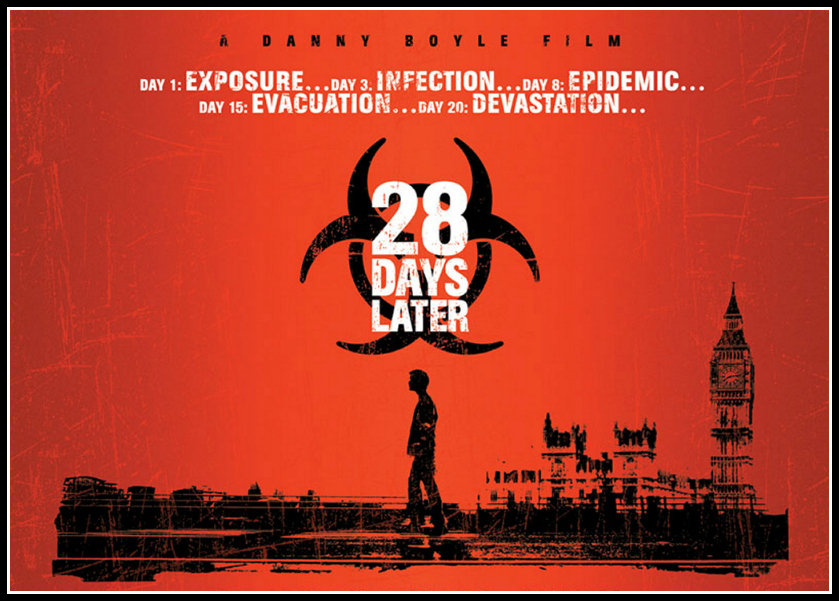
Through the years, there have been numerous attempts to deviate from Romero’s formula. The most prominent early success came in the 1980s with the Return of the Living Dead series — a clever horror-comedy franchise that infused dark humor and punk aesthetics into the genre. Yet even that beloved cult entry eventually lost steam. True reinvention did not arrive until 2002, when British filmmaker Danny Boyle and screenwriter Alex Garland collaborated on 28 Days Later, a project that both revitalized the zombie genre and split its devoted fan base down the middle. Was it truly a “zombie” film, or something else entirely? That very debate remains unresolved more than twenty years later.
Boyle’s film begins not with a supernatural curse or the reanimation of the dead, but with a catastrophic act of human arrogance. A group of naïve animal-rights activists break into a research laboratory to rescue chimpanzees subjected to bureaucratic cruelty. However, they find that these animals have been injected with a rage-inducing virus — the product of bioengineering rather than black magic. One of the activists, horrified by what she witnesses, ignores the pleas of a desperate scientist and frees a chimp, unleashing a pandemic that will decimate Britain within weeks. This opening sequence is both economical and horrifying: the origins of the apocalypse come from compassion twisted into recklessness. Boyle establishes his tone immediately — quick editing, grainy digital video, and an oppressive sense of realism create a world that feels disturbingly possible.
The narrative then leaps forward twenty-eight days. In a now-iconic sequence, the protagonist Jim (played by Cillian Murphy) awakens from a coma in an abandoned London hospital. His disorientation mirrors that of the audience: sterile hallways littered with trash, flickering lights, a haunting silence broken only by the hum of wind through the empty city. When Jim emerges into the sunlight, the camera captures a London entirely devoid of people, its majestic landmarks standing as hollow monuments to civilization’s sudden collapse. This is one of cinema’s most unforgettable depictions of isolation. The haunting score by John Murphy and the use of Godspeed You! Black Emperor’s instrumental “East Hastings” heighten the apocalyptic stillness, transforming London into a ghost metropolis.
Jim’s bewilderment only deepens when he seeks refuge in a church — a setting traditionally associated with salvation — only to find it desecrated by carnage. His presence awakens a horde of infected individuals who charge at him with terrifying speed. Unlike Romero’s slow, lumbering undead, Boyle’s infected are human beings transformed by a virus that amplifies their aggression to animalistic extremes. They move like predators, sprinting at prey with berserk fury. Jim narrowly escapes thanks to two survivors, Selena (Naomie Harris) and Mark (Noah Huntley), who introduce him to the brutal new rules of existence: infection spreads through blood contact, turning victims within seconds, and hesitation means death.
The trio’s uneasy alliance soon crumbles after Mark becomes infected, forcing Selena to kill him without hesitation. This harrowing moment establishes her as one of the film’s strongest and most pragmatic characters — a refreshing departure from the damsel archetype that has long haunted horror cinema. Jim and Selena later encounter Frank (Brendan Gleeson), a good-natured taxi driver, and his teenage daughter Hannah (Megan Burns), who have been surviving in a fortified apartment building. Together they form a fragile surrogate family and travel in search of a military broadcast promising safety and a potential cure.
Boyle deftly blends moments of human warmth amid horror. Scenes like the group’s scavenging trip through an abandoned grocery store — a darkly comic echo of Dawn of the Dead’s consumer satire — offer glimpses of joy and normalcy. The countryside sequences, shot with a painterly eye, contrast the urban decay of London with the serene beauty of a world reclaiming itself from human control. Nature, the film quietly suggests, endures long after people have vanished.
Their journey leads them to a fortified mansion commanded by Major Henry West (Christopher Eccleston), a British officer whose soldiers claim to have “the answer to infection.” The supposed sanctuary quickly reveals a darker truth. West’s band of men have descended into moral depravity, promising their commander that the promise of “women” will restore morale. The film shifts from survival horror to psychological thriller as the real threat emerges — not the infected outside, but the monstrousness within human beings when order collapses. In this descent into militaristic patriarchy and madness, Boyle channels the spirit of Romero’s Day of the Dead, where the military’s illusion of control becomes the true source of terror.
Boyle and Garland’s reinvention of the zombie mythos was revolutionary. Longtime fans of Romero’s shambling undead initially resisted the notion that 28 Days Later even qualified as a zombie movie. After all, its creatures weren’t reanimated corpses but living people overtaken by an uncontrollable virus. Yet their function within the story — relentless, dehumanized embodiments of contagion and rage — served the same thematic role as zombies always had: mirrors for society’s breakdown. The debate over whether the infected “count” as zombies is less important than the fact that Boyle redefined the genre’s emotional and kinetic language. His infected didn’t just pursue victims; they hunted them. Their blistering speed and screams injected pure chaos into what had once been slow, creeping dread.
The technical and artistic choices heightened the film’s intensity. Shot largely on digital video with handheld cameras, 28 Days Later looked raw and immediate, more like found footage than polished fiction. This realism bridged the gap between old-school horror and the new century’s fixation on viral outbreaks and global instability. Coming in the post-9/11 era, its images of deserted cities and military lockdowns felt eerily prescient, foreshadowing later fears of pandemics and authoritarian control.
The performances ground the film emotionally. Cillian Murphy’s portrayal of Jim evolves from bewildered innocence to hardened survivor, serving as the audience’s emotional compass. Naomie Harris delivers one of the genre’s most capable female performances, blending vulnerability with ferocity. Brendan Gleeson, always magnetic, brings compassion and tragedy to Frank — a man whose paternal instincts ultimately lead to heartbreak. Christopher Eccleston’s Major West stands as a chilling embodiment of human corruption in crisis: the soldier who insists he is saving civilization while replicating its worst impulses.
Despite being produced on a modest budget of roughly eight million dollars, Boyle’s film achieved a scale and impact far greater than its resources suggested. The empty London shots — achieved by closing key streets at dawn for only minutes at a time — remain astonishing feats of logistical precision and cinematic audacity. More importantly, the film’s minimalist production enhanced its believability. Everything about 28 Days Later feels lived-in, grimy, and plausible.
Two decades on, 28 Days Later continues to stand as one of the most influential horror films of the 21st century. Its success reinvigorated a genre that had grown stale and inspired a wave of imitators across film, television, and video games, from Zack Snyder’s Dawn of the Dead remake to AMC’s The Walking Dead. Beyond its cultural impact, it remains a haunting meditation on rage — personal, societal, and political. Boyle and Garland transformed horror into a canvas for existential dread, exploring how quickly civility unravels when survival becomes the only law.
Whether one calls it a zombie film or not hardly matters anymore. 28 Days Later breathed new life into the undead myth, shattering old rules and redefining what modern horror could be. The debate it sparked continues, but one truth is undeniable: the genre has never been the same since Jim first walked through that silent, ruined London — a world devoured not by the dead, but by the terrifying rage of the living.




 Through the Shattered Lens