Made-For-TV Movie Review: The Cartier Affair (dir by Rod Holcomb)


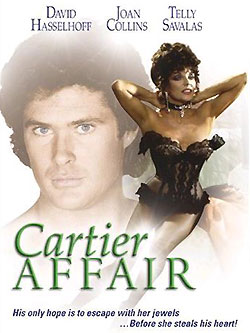
In 1984’s The Cartier Affair, David Hasselhoff plays Curt Taylor.  He has spent the last few years in prison, having been convicted of selling deeds to fake oil wells.  He has passed the time by watching a soap opera that stars actress Cartier Rand (Joan Collins).  He has also managed to get in debt to the local prison mob boss, Phil Drexler (Telly Savalas).

When Curt learns that he’s being released from prison, Drexler informs him that he’s still expected to find a way to pay off his debt.  On the outside, Curt discovers that even his parole officer (Ed Lauter) works for Drexler!  Curt is assigned to become the private secretary of Cartier Rand and to steal her jewelry.  In order to get the job, Curt has to pretend to be gay.  That’s the only way that Cartier’s boyfriend (Charles Napier) would be willing to accept the idea of a male private secretary.

(Wouldn’t it just be simpler for Curt to rob a bank or something?)

Once he’s a part of the household staff, Curt discovers that Cartier is more than just the star of his favorite soap opera.  She’s someone who is tired of reciting melodramatic dialogue and kissing her co-stars.  She has serious ambitions.  Curt is immediately attracted to her and soon, Cartier is attracted to Curt.  But, of course, Curt is pretending to be gay and, to his horror, Cartier sets Curt up with one of her gay friends.

Meanwhile, the bad guys want their money….

The first half of the film is taken up by scenes of people mistaking Curt for being gay and there are more than a few moments and jokes that a film wouldn’t be allowed to get away with today.  A scene where Curt finds himself in a gay bar is cringey because, rather than asking us to laugh at Curt for panicking about finding himself in the rather innocuous location, the film asks us to instead laugh at the sight of men slow-dancing with other men.  Early on in the film, there’s a few scene where Hasselhoff overplays his attempts to come across as being gay.  Fortunately, Hasselhoff soon stops doing that and his performance improves as the film goes on.

The film gets slightly better during the second half, when Cartier learns the truth about Curt and the two of them somewhat implausibly go on the run from the bad guys.  They end up getting chased out to the desert, trading one-liners all the way, and I do have to admit that Collins and Hasselhoff displayed a surprising amount of chemistry during those scenes.

The film is tonal mishmash that doesn’t really work.  It tries to parody the type of soap operas that made Cartier Rand a star and it also tries to be a relatively exciting chase film but it keeps getting bogged down in plot points that ultimately feel rather superfluous.  My main issue that, if Drexler really wanted to get him money from Curt, it seems like he would have come up with a less complicated scheme, like robbing a bank or fencing stolen goods or something like that.  Instead, Curt is supposed to go undercover, pretend to be gay, and rob one of the most famous women on the planet.  I mean, Hell, he could have just broken into a jewelry store and gotten it all done in one night.  That said, Hasselhoff and Collins have a bit of charm to them.  It’s a shame they didn’t co-star in a better film.

Late Night Retro Television Review: Pacific Blue 2.9 “Genuine Heroes”


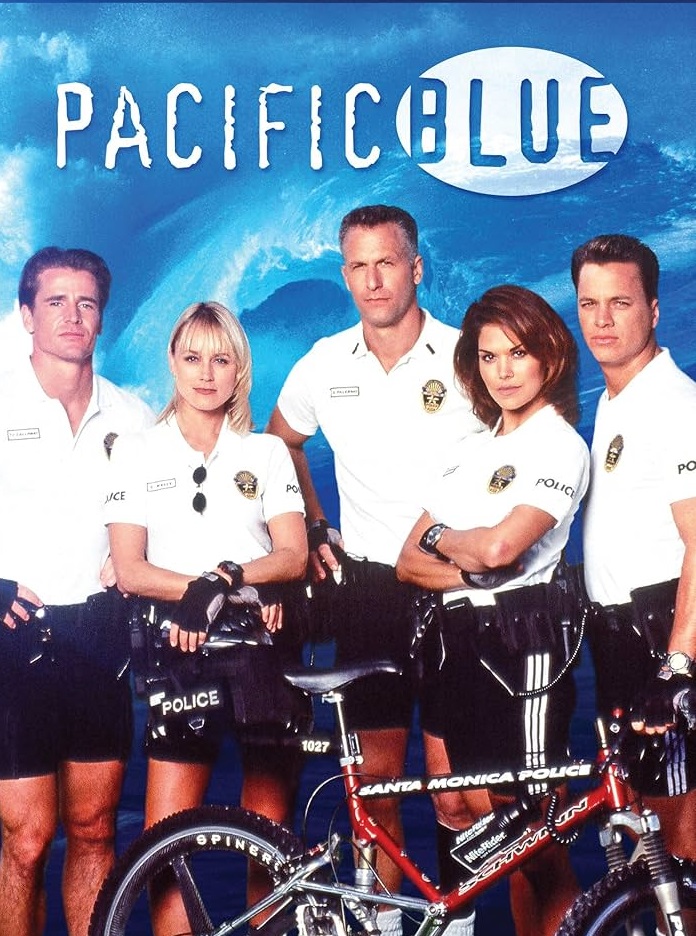
Welcome to Late Night Retro Television Reviews, a feature where we review some of our favorite and least favorite shows of the past! On Tuesdays, I will be reviewing Pacific Blue, a cop show that aired from 1996 to 2000 on the USA Network!  It’s currently streaming everywhere, though I’m watching it on Tubi.

This week, the cast of Pacific Blue gets outacted.

Episode 2.9 “Genuine Heroes”

(Dir by Terrence O’Hara, originally aired on October 20th, 1996)

Pacific Blue makes an unforgivable mistake in this episode by giving a plum guest-starring role to Charles Napier.  When your show is populated by boring regular characters and actors who are distinguished by their almost total lack of screen charisma, the last thing you want to do is bring in a certifiable badass character actor like Charles Napier.  If Lt. Palermo and the bicycle crew seem charmless during a normal episode, just imagine how much worse they look when compared to Napier.

Napier plays Tyrone Justice, a Texas bounty hunter who has come to Santa Monica to track down a bank robber and his girlfriend.  The members of the bike patrol are like, “We’re not going to let you cause any trouble down here,” and it’s kind of hard not to smirk because Tyrone Justice is Charles Freaking Napier.  He wears a leather jacket and carries a shotgun.  The bike patrol wears shorts and those stupid plastic helmets and spends all of their time riding their bicycles.  Like, seriously, shut up, bike patrol.

Meanwhile, VJTV (which I guess is the show’s version of MTV) is shooting on the beach for spring break.  Del Toro has a crush on VJTV personality Ginger Delvecchio (Angelica Bridges).  Cory rolls her eyes whenever Del Toro sees Delvecchio, complaining that Delvecchio’s career is due solely to her sex appeal and how she looks in a bikini.  (This argument perhaps would have worked better if delivered on a show that didn’t open every episode with stock footage of women in bikinis.)  Cory complaining feels out of character.  Usually, Kelly is the member of the bike patrol who is written to be  an annoying straw feminist.  At the end of the episode, Ginger leaves VJTV for a show that is obviously meant to be Baywatch.  Seeing as how Pacific Blue itself is an obvious rip-off of Baywatch, all of the smirks and sighs feel a bit hypocritical.

Anyway, this episode was pretty dumb.  It’s impossible to take people who ride bicycles seriously.  When the bike patrol arrested Charles Napier, I had to laugh.  There’s no way Charles Napier would ever surrender to some douchebag on a bicycle.


Felony (1994, directed by David A. Prior)


In New Orleans, a drug raid gone wrong leads to eleven cops being gunned down and then blown up.  The disastrous raid was being filmed for a Cops-like reality show  The show’s producer, Bill Knight (Jeffrey Combs) finds himself being pursued through New Orleans by a collection of rogue intelligence agents, cops, and gangsters, all of whom want the tape of the massacre.

It’s a simple direct-to-video premise and the film’s plot hits every chase film cliche, while keeping the action moving at a decent pace.  Bill Knight is not supposed to be a typical action hero.  He’s just a television producer who was in the wrong place at the wrong time.  Yet Knight proves himself to be as indestructible as any Arnold Schwarzenegger hero.  He gets shot, twice.  He falls from a great height.  He crashes through a window.  He repeatedly gets hit over the head.  And yet, his injuries never seem to really slow him down or even hurt that much.  He does hook up with a nurse (Ashley Laurence) but still, it’s hard to believe anyone could take that much punishment and keep running.  Jeffrey Combs, the brilliant star of films like Re-Animator, is miscast as Knight but he’s still always entertaining to watch.

In fact, the cast is the main thing that Felony has going for it.  David Prior was able to assemble a true group of B-movie all-stars.  Lance Henriksen and David Warner are the evil intelligence agents who are determined to kill Knight.  (Warner finally gets to handle a grenade launcher and we’re all the better for it.)  Leo Rossi and Charles Napier are the two New Orleans cops who are investigating the drug raid.  Joe Don Baker is the rogue intelligence agent who dresses like a cowboy and who is trying to clean up everyone else’s mess.  The cast keeps the action moving and there are enough eccentric personalities in this film that it’s always watchable.  I think this might be the only film to feature Joe Don Baker and Lance Henriksen performing opposite each other.  If nothing else, it deserves to be watched for that!

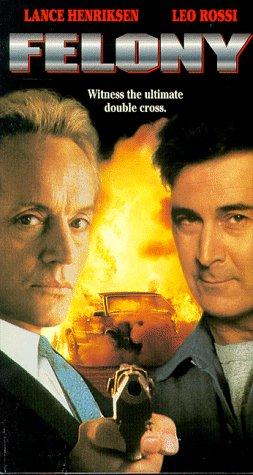
(The cover for Felony features Lance Henriksen and Leo Rossi but not Jeffrey Combs, even though Combs is the lead in the film and Rossi’s role is actually pretty small.  Henriksen also doesn’t have blonde hair in the movie.  There are plenty of double crosses in the movie but I can’t think of any that really qualify as the “ultimate double cross.”)

Even with its miscast lead and its cliche-heavy plot, Felony is what direct-to-video action movies should be all about, fact-paced action and a cast unlike any other,


Raw Justice (1994, directed by David Prior)


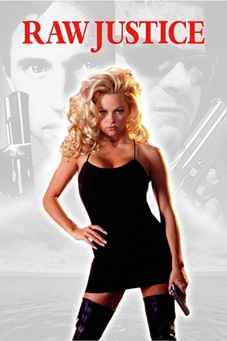
When his daughter is strangled, New Orleans Mayor David Stiles (Charles Napier) hires ex-cop-turned-bounty-hunter Mace (David Keith) to keep an eye on the main suspect, Mitch McCullum (Robert Hays).  What the mayor doesn’t know is that his daughter’s murder was ordered by Deputy Mayor Jenkins (Stacy Keach) and now, both Mace and Mitch are being stalked by a crooked cop named Atkins (Leo Rossi).  Also getting involved in this mess is a hooker with a heart of gold named Sarah (Pamela Anderson), who is angry because Mace earlier stole his clothes while trying to get the jump on a bail jumper.  Sarah and Mitch soon fall in love.  Mace is good with a gun and Mitch turns out to know karate (because he watched a lot of Bruce Lee movies growing up) but the film’s high point is when one of the bad guys is taken out with a giant novelty dart.

The plot is dumb and David Keith comes across as being a discount version of Patrick Swayze but this film does give the always likable Robert Hays a good role and fans of Pamela Anderson (and you know who you are) will definitely appreciate at least two scenes in the movie.  Actually, Pamela Anderson isn’t bad in Raw Justice.  She’s mostly there for her looks but she still has a likable and energetic screen presence.  Otherwise, this is a typical low-rent David Prior production, complete with action scenes featuring guns that never run out of bullets (unless it’s convenient for the plot) and a score that is pretty much the same guitar riff over and over again.  It’s not exactly good but it is entertaining if you’re in the right mood.

This film was also released under the title Good Cop Bad Cop, which doesn’t make much sense because neither Keith nor Hays is playing  a cop.

Love on the Shattered Lens: Something Wild (dir by Jonathan Demme)


1986’s Something Wild opens with Charlie Driggs (Jeff Daniels) eating lunch in a New York diner.

Charlie is a stockbroker.  He wears a suit.  He’s quiet and mild-mannered.  He just got a promotion at work.  He carries a picture of his kids in his wallet.  Everything about Charlie shouts that he’s a nice guy who is extremely conventional in his outlook and behavior.  But then, Charlie sneaks out of the diner without paying and is spotted by a woman (Melanie Griffith) who says that her name is Lulu.

Dressed in black and with a brunette bob that makes her look like Louis Brooks (and which is later revealed to be a wig), Lulu chases after Charlie.  She offers him a ride back to his job, downtown.  However, when Charlie gets in the car, Lulu instead speeds off towards New Jersey.  Lulu grabs Charlie beeper and throws it away.  (I guess that was the 80s equivalent of stealing someone’s phone.)  She stops off at a liquor store and robs the place while Charlie unknowingly waits out in the car.  She takes him to a motel and, after handcuffing to the bed, has sex with him and calls his office….

And then the film takes an unexpected turn.  What started out as one of those NSFW stories that occasionally cropped up on Internet message boards suddenly turns into a quirky slice of Americana.  Lulu and Charlie head to Pennsylvania for Lulu’s high school reunion.  Lulu reveals that her real name is Audrey and she’s actually blonde.  Audrey introduces Charlie to her family as being her husband and Charlie plays along with her.  At the reunion, Charlie turns out to be just as skillful a liar as Audrey.  But there’s nothing particularly mean-spirited about their lies.  Audrey wanted to be able to brag about having a wonderful husband at her reunion and Charlie, whose wife left him for a dentist, wanted to pretend that he was still married and still a regular part of his children’s lives.  The reunion itself is a masterful set piece, one in which director Jonathan Demme balances his trademark quirky humor with a genuine love for small town American.  With the old school bands playing in front of an American flag, Demme transforms the reunion into a metaphor for everything good about this country.  It’s a place where two lonely people can find each other.  The weekend may have started out like a middle-aged man’s fantasy but Charlie finds himself falling in love with the real Audrey.  It’s very sweet and humorous and it makes you feel good about life in general….

And then Ray shows up and the film takes another unexpected turn.  Played by Ray Liotta, Ray is Audrey’s ex-husband.  He’s a charmer, as one might expect from a character played by a young Ray Liotta.  Ray is friendly with Charlie, telling him stories about how wild Audrey was in high school.  It’s only as the night progresses that it becomes obvious that Ray is a sadistic sociopath and he wants Audrey back.

The violence in the film’s second half is a bit jarring.  After the good-natured, screwball comedy of the film’s first 50 minutes, it’s shocking to suddenly see Ray pistol-whipping a clerk and then breaking Charlie’s nose.  At the same time, meeting Ray allows us to know what it was that attracted Audrey to Charlie.  Charlie is the opposite of Ray, a good man who truly cares about other people.  Ray is the type of bad boy who is very attractive when you don’t know any better.  Charlie is the guy who seems conventional but, underneath it all, turns out to be something wild as well.

Directed by Jonathan Demme, Something Wild has a good eye for the quirkiness of America.  It portrays the world out of New York with love and none of the condescension that tends to show up in so many other road trip movies.  Daniels, Griffith, and the much-missed Ray Liotta all gives performance that take the viewer by surprise.  None of them are who we originally assume them to be and Griffith’s deconstruction of the type of character who would later be termed a “manic pixie dream girl” is probably her best and most honest performance.  Even Ray, for all his violent tendencies, has moments of humanity.  Something Wild is a celebration of life, rebellion, and love.  Like Charlie and Audrey, it’s more than worth taking a chance on.

Film Review: Swing Shift (dir by Jonathan Demme)


1984’s Swing Shift begins in 1941.  Kay (Goldie Hawn) and Jack Walsh (Ed Harris) are a young married couple in California.  At first glance, they seem to have the perfect life.  Jack works all day and comes home and has a beer and tells his wife how much he loves her.  Kay spends her day cleaning up around the house and when her husband comes home, she sits down next to him and tells him how much she loves him.  Whenever their neighbor, Hazel (Christine Lahti), walks by their bungalow, Jack mutters that she’s a tramp.  Hazel sings in a sleazy nightclub and dates a shady fellow named Biscuit (Fred Ward) and that’s just not what respectable people do!

When the Japanese bomb Pearl Harbor, Jack enlists in the Navy.  Kay suggests that she could get a job while he’s gone but Jack is firm.  He doesn’t want his wife working.  However, after Jack leaves, Kay is motivated by both boredom and her patriotic duty to apply for a job in an armaments factory.  With all of the men overseas fighting, their wives have been implored to do their part for the war effort.

Kay works the swing shift, along with Hazel and a trumpet player named Lucky (Kurt Russell).  (Lucky sweetly declines to explain why he’s called Lucky.)  Despite some early antagonism, Hazel and Kay becomes friends.  Kay starts to come out of her shell, especially where Lucky is concerned.  How will Jack react when he returns home?

The late director Jonathan Demme described directing Swing Shift as being one of the worst experiences of his career.  Demme’s original cut of the film was an ensemble piece that was a drama with comedic moments.  Star Goldie Hawn was reportedly not happy with Demme’s original cut and the film was essentially taken away from the director.  Screenwriter Robert Towne was brought in to write some additional scenes.  (Even before Towne was brought in, at least four writers had written a draft of the script and the screenplay itself was finally credited to a non-existent “Rob Morton.”)  Some scenes were reshot.  The film itself was reedited.  The end result was a film that focused primarily on Kay and made her relationships with Hazel, Jack, and Lucky far less complex.  Jonathan Demme walked away from the film, retaining his directorial credit but pointedly requesting that the film not be advertised as a “Jonathan Demme film.”  Later in life, Demme declined to discuss either Swing Shift or the experience of working with Goldie Hawn.

Watching the studio cut of Swing Shift on Prime, I could understand many of Demme’s objections.  It’s a film that’s full of good performances and some stylish visuals but it really doesn’t have much narrative momentum and, especially when it comes to Kay’s friendship with Hazel, it does feel like certain scenes are missing.  Hazel is remarkably quick to forgive someone who she believes has spent years calling her a tramp.  As well, there’s a lot of interesting characters in the background, many of whom are played by regular members of the Jonathan Demme stock company.  (Charles Napier, Susan Peretz, Holly Hunter, Roger Corman, Lisa Peilkan, Sudie Bond, and Stephen Tobolowsky all have small roles.)  Watching the film, one gets the feeling that they all probably had more to do in Demme’s original cut.

That said, I have to admit that I still enjoyed the studio cut of Swing Shift, flaws and all.  A lot of that is due to the performances of Hawn and Russell.  (Christine Lahti received a Supporting Actress Oscar nomination for her performance in this film.  She’s okay, though I don’t really think she deserved a nomination over someone like Elizabeth Berridge in Amadeus or Tuesday Weld in Once Upon A Time In America.)  Hawn does a wonderful job portraying Kay’s transformation from being a rather meek housewife to someone who can put a plane together without a moment’s hesitation.  Hawn and Russell began their legendary romance on the set of Swing Shift and their chemistry is strong enough to carry the film over plenty of rough spots.  At its best, Swing Shift inspired me to wonder what I would have done if I had been alive in the 1940s.  Would I have ended up cutting my hair and working in a factory?  Would I have waited at home from my ‘husband or sweetheart” (as the film refers to them) to come home?  Or would I have run off with Lucky and followed him from town to town?  Swing Shift is a good film that could have been great and, by many accounts, actually was great before it was recut.  (Even with the reediting, enough of Demme’s trademark humanity comes through to make the scenes in the factory memorable.)  In the end, Swing Shift isn’t perfect but I still enjoyed it.

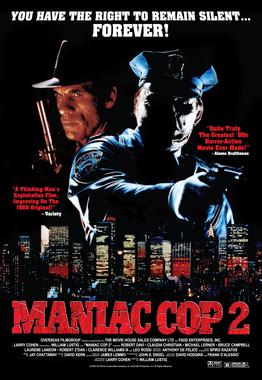
Maniac Cop 2 (1990, directed by William Lustig)


Maniac Cop 2 picks up where the first Maniac Cop ended.

The NYPD thinks that the undead maniac cop Matt Cordell (Robert Z’Dar) has been destroyed but he is actually still alive and killing civilians and cops in New York.  He has even teamed up with a serial killer named Steven Turkell (Leo Rossi, ranting and raving like a pro).  Jack Forrest (Bruce Campbell) and Theresa Malloy (Laurene Landon) both return from the first film but both of them are killed by Cordell before the movie is even halfway over.  Maniac Cop 2 is not playing around.

With Jack and Theresa gone, it falls to Detective Sean McKinney (Robert  Davi) and Officer Susan Riley (Claudia Christian) to discover what the rest of the audience already knows, that Cordell is seeking revenge against the system that abandoned him in prison.  The new police commissioner, Ed Doyle (Michael Lerner), is determined to cover up what happened but Cordell is even more determined to have his vengeance.  Working with Turkell, Cordell heads to the prison where he was unjustly incarcerated and murdered.

Maniac Cop 2 is a marked improvement on the first film.  Cordell is no longer a lumbering and slow monster.  He is now a ruthless, Terminator-style executioner who, in the film’s best-known scene, wipes out an entire police precinct in a matter of minutes.  Cordell is so ruthless that he won’t even stop when he’s on fire.  His partnership with Turkell adds a new twist to the Maniac Cop saga.  Turkell views Cordell as his partner-in-crime but Cordell is only interested in getting his revenge.  (Turkell was originally meant to be Frank Zito, the main character from Lustig’s Maniac.  When Maniac star Joe Spinell died before shooting began, the role was changed to Leo Rossi’s Steven Turkell.)

Stepping into the shoes of the main investigation, Robert Davi gives one of his best performances.  As opposed to the boring heroes of the first film (sorry, Bruce!), Davi’s Sean McKinney is just as obsessive and ruthless as Cordell.  Cordell sets fire and McKinney uses those fires to light his cigarettes.

William Lustig has described Maniac Cop 2 as being his best film and he’s probably right.  It is definitely the best of the Maniac Cop films and the only one to fully take advantage of its premise.

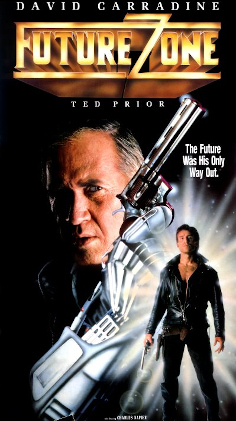
Future Zone (1990, directed by David Prior)


David Carradine is back as super glove-wearing bounty hunter John Tucker in this sequel to Future Force!

Once again, it’s the future.  In the future, everyone drives a car that was made in the 70s and spends most of their time in the abandoned warehouses that are meant to represent their places of business.  Hard-drinking John Tucker meets and starts to work with the newest C.O.P.S. recruit, Billy (Ted Prior).  Billy can shoot just as fast as Tucker and seems to know all about Tucker and his wife, Marion (Gail Jensen).  That’s because Billy is from the future.  As he explains it, some “friends of mine built a time portal,” and Billy used it to come back to the past and save Tucker from being killed by a bunch of criminals.  Why is Billy so concerned about saving John Tucker?  Did I mention that Marion is pregnant?

Future Zone is just as dumb as Future Force but it is set apart from the first film by its use of time travel.  The best part of the movie is that neither John nor Marion are surprised to hear that Billy’s friends just happened to build a time portal.  Nobody asks why they built a time portal or even how they built a time portal.  The time portal is the most important thing about the movie but everyone shrugs off its existence.  Are time portals a common thing in the future?  Does everyone have a time portal?  How does the time portal work?  How is Billy able to go into the past at exactly the right moment?  When it is time for him to go back to his time, how does he let his friends know?  These are all good questions that no one asks.

The other thing that no one asks is why Tucker doesn’t wear his super glove all the time.  His super glove can do anything, from shooting lasers to blocking bullets.  If I had a super glove, I would wear it all the time.  Tucker keeps it in the trunk of his car and only summons it at the last possible moment.  Why even have a super glove if you’re not going to use it?

International Horror Film Review: Body Count (dir by Ruggero Deodato)


Sitting in the middle of the forest, there’s a camp ground.  Rumor has it that the camp was built on the site of an ancient Native American burial ground and that’s why grouchy Robert Ritchie (David Hess) and his wife Julia (Mismy Farmer) were able to afford it as such as reasonable price.  I guess that could be true and maybe the part about the curse is true, too….  Well, no matter!  People love to camp and the forest is lovely and there’s no way that this camp ground won’t be a success!

In fact, the only thing that could stop it from being a popular vacation location would be if two teenagers were mysteriously murdered one night….

Which, of course, is exactly what happens!  The daughter of a local doctor (played by John Steiner, of all people) goes off with her boyfriend and both of them are murdered!  (Though we’re told that the two of them are high school students and, when we first see them, they’re at basketball practice, both victims appear to be in their early 30s.  When the actress playing the doctor’s daughter first approached him, I immediately assumed that she was playing his wife.  I was actually a little bit stunned when she said, “Bye, Daddy.”)

Anyway, the unsolved murder pretty much ruins any hope of the camp ground being successful.  15 years later, Robert is paranoid and convinced that a Native shaman is sneaking around the forest and looking for campers to kill.  Meanwhile, Julia is so frustrated with her increasingly unstable husband that she’s having an affair with the sheriff (Charles Napier).  The sheriff is so busy shtupping Julia that it often falls upon Deputy Ted (Ivan Rassimov, who had the best hair of all the Italian horror actors) to actually enforce the law.  Meanwhile, the doctor is still mourning the death of his daughter and wandering around the forest.

Eventually, a bunch of obnoxious 30-something teenagers arrive, looking for a place to park their camper and ride their dirt bikes.  Despite the history of murder and the general grouchiness of Robert Ritchie, they decide to say at the campground.  Soon, a masked killer is carving people up.  Is it the spirit of the Native shaman or is it something else?  Who will survive and what will be left of them?

This 1986 Italian film was directed by none other than Ruggero Deodato, the man behind films like Cannibal Holocaust and The House On The Edge of the Park (which starred Body Count’s David Hess).  As one might expect from a Deodato film, the emphasis is on blood and atmosphere.  Deodato, who always had a good eye for properly ominous locations, gets a lot of mileage out of that spooky forest, which really does look like exactly the place where a masked killer would chose to hang out.  While the kills are tame by Deodato standards, they’re still icky enough to make you cringe.  I’m sorry but if the scene involving the body hanging from the hook doesn’t freak you out, then you’ve obviously become dangerously desensitized and you probably should probably take a break from watching movies like this.

Of course, the main appeal of Body Count is to see a cast of Italian horror and exploitation veterans going through the motions of starring in an American-style slasher film.  David Hess, Ivan Rassimov, John Steiner, Charles Napier, and Mimsy Farmer are all such wonderfully eccentric performers that they’re worth watching even when they’re stuck in one-dimensional roles.  David Hess, especially, does a good job as the unhinged Robert Ritchie and the film makes good use of Hess’s image.  The film understand that we’re so used to watching David Hess kill people on screen that our natural instinct is to suspect the worst when we see him in Body Count.  I also liked the performance of John Steiner, largely because Steiner always came across like he couldn’t believe that, after a distinguished theatrical education, he somehow ended up an Italian horror mainstay.  And, of course, Ivan Rassimov had the best hair in the Italian horror genre.

Body Count is on Prime.  The story’s not great but it’s worth watching just for the horror vets in attendance.

The Incredible Hulk Returns (1988, directed by Nicholas Corea)


Scientist David Banyon (Bill Bixby) has a secret.  His real name is David Banner and he has spent the last ten years in hiding, traveling up and down the highway and searching for a cure to a very strange condition.  As the result of getting dosed with gamma rays, David Banner sometimes transforms into an angry green monster known as the Hulk (Lou Ferrigno).  The world believes that David Banner is dead and Banner must let them continue to believe that until he can find a cure for the monster within.

The Incredible Hulk Returns is a continuation of the old Incredible Hulk television series, which was the first (and, until the MCU came along, only) successful attempt to build a live action show around a Marvel super hero.  Premiering in 1978, The Incredible Hulk ran for 5 seasons and got good ratings and, for a comic book series, surprisingly decent reviews.  However, it was also expensive to produce and it was abruptly cancelled in 1982, before the show got a chance to wrap up David’s story.  When The Incredible Hulk ended, David Banner was still alone and hitchhiking from town to town.  Six years later, The Incredible Hulk Returns caught up with David and tried to sell viewers on a “new” Marvel hero as well.

David “Banyon” is now living in California and working at the Joshua-Lambert Research Institute.  It’s been two years since he last turned into the Hulk.  He controls his rage by being careful not to get involved in any dangerous situations.  He also has a girlfriend, Dr. Maggie Shaw (Lee Purcell).  David is designing the Gamma Transponder, which he thinks will cure him of his condition.  Life’s good until Donald Blake (Steve Levitt) shows up.

A student of Banner’s, Blake recognizes his former teacher and approaches him with a crazy story.  When Blake was in Norway, he stumbled across a tomb that contained a hammer that contained the spirit of Thor, a Viking warrior who was banished to Earth by Odin.  To prove that he’s telling the truth, Blake commands Thor to emerge from the hammer.  When Thor (played by Eric Kramer) does, he makes such a mess in the laboratory that David transforms into the Hulk.

Thor is not Banner’s only problem.  Jack LeBeau (Tim Thomerson!) and Mike Fouche (Charles Napier!!) want to steal the Gamma Transponder and turn it into a weapon.  Also, reporter Jack McGee (Jack Colvin) s back in town and still obsessed with proving that the Hulk exists.

The Incredible Hulk Returns may be a continuation of David Banner’s story but the main reason it was filmed was so it could serve as a backdoor pilot for a Thor television series.  The Thor TV series never happened and, for those who are used to Chris Hemsworth’s comedic take on Thor, it’s jarring to see Eric Kramer playing the role like a third-tier professional wrestler.  For fans of The Incredible Hulk TV series, it’s even more jarring to see the Hulk fighting alongside a viking.  Unlike the comic book, the TV series usually tried to ground its stories in reality, with Banner’s transformations into the Hulk serving as the show’s only concession to its comic book origins.  The villains played by Thomerson and Napier both seem like typical bad guys from the show’s heyday but Thor just doesn’t belong.  Fans of the show will resent Thor taking the spotlight away from David Banner and the Hulk while fans of Thor will notice that this version of Thor is apparently not the god of thunder but instead just an egotistical viking who got on Odin’s nerves.

Bill Bixby was always The Incredible Hulk‘s not-so-secret weapon, taking and playing his role very seriously.  He continues to do that in The Incredible Hulk Returns but how seriously can anyone come across when they’re speaking to Thor?  By the end of the movie, Thor and Blake head off on their own adventures while Banner resumes hitchhiking.  Thor and Blake would not be seen again but David Banner’s adventures would continue in The Trial of the Incredible Hulk.