Welcome to Retro Television Reviews, a feature where we review some of our favorite and least favorite shows of the past! On Mondays, I will be reviewing Miami Vice, which ran on NBC from 1984 to 1989. The entire show can be purchased on Prime!
There’s another serial killer haunting the streets of Miami. We all know what that means. It’s time to put either Trudy or Gina in harm’s way again.
Episode 5.7 “Asian Cut”
(Dir by James Contner, originally aired on January 13th, 1989)
Someone is murdering prostitutes and carving symbols into their skin. The seemingly friendly Prof. Halliwell (David Schramm) confirms that the symbols are Asian in origin. Crockett and Castillo suspect that the murderer might be a knife-obsessed Japanese gangster named Tegoro (Cary-Hiroyui Tagawa) but it turns out that they’re wrong. Gina and Trudy work undercover as escort and Trudy meets Carlos (Alfredo Alvarez Calderon), a man with a kink for being beaten. Carlos wants to introduce Trudy to a friend of his, someone who is something of an expert on torture and who learned the majority of his techniques while he was serving in the CIA during the Vietnam War….
Yep, the murderer is Prof. Halliwell!
This episode was thoroughly unpleasant. That’s not necessarily a bad thing when it comes to episodes about serial killers and David Schramm did a good job of switching from being goofy to deadly. However, in this case, it was hard not to think about the fact that, in five seasons, Gina and Trudy haven’t really gotten to do much other than pretend to be escorts and get threatened by serial killers. For once, Gina was the one providing support while Trudy was the one put in jeopardy but it still otherwise felt very, very familiar. Even the twist that the killer was a former CIA agent who specialized in torturing enemy combatants felt just a bit too predictable. (On Miami Vice, anyone who is former CIA and not named Castillo always turns out to be a murderer.) The torture scenes were so drawn out that they ultimately felt a bit gratuitous.
Welcome to Retro Television Reviews, a feature where we review some of our favorite and least favorite shows of the past! On Mondays, I will be reviewing Miami Vice, which ran on NBC from 1984 to 1989. The entire show can be purchased on Prime!
This week, the Yakuza invades Miami.
Episode 4.9 “The Rising Sun of Death”
(Dir by Leon Ichaso, originally aired on May 27th, 1988)
Castillo is concerned. The murder of an American businessman leads him to suspect that the Yakuza has come to Miami and it turns out that he’s right. Riochi Tanaka (James Hong), a World War II war criminal-turned-mobster, is trying to take over the Miami underworld. While corrupt Homicide Detective Haskell (R. Lee Ermey) tries to convince everyone that the Yakuza is just a myth, Castillo teams up with Japanese detective Kenji Fujitsu (Cary-Hiroyuki Tagawa) to takes down Tanaka and his right-hand man, Agawa (Danny Kamekoa). Needless to say, this leads to a fight with samurai swords, a lot of talk of honor, and a seppuku to close the case.
This episode hit every Yakuza cliche and the plot itself felt as if it had been put together at the last minute. (This is one of those episodes where every plot hole is dismissed as being a cultural difference.) We’re expected to believe that Tanaka could outsmart the Allies during World War II but he couldn’t outsmart the Miami Vice Squad. As well, of the major Japanese characters, only one was played by Japanese actor. Danny Kamekoa is a Hawaiian while James Hong is of Chinese descent.
That said, this episode was shot and filmed with a lot of style and it found an excuse to play Billy Idol’s FleshForFantasy during one of the early scenes. There’s something to be said for that. Neither Crockett nor Tubbs really did much in this episode but we did get to see Crockett house hunting with Cailtin. It’s mentioned that everyone thinks that Caitlin’s new husband is named Sonny Burnett instead of Sonny Cockett. That’s fine …. except for the fact that Sonny Crockett has previously been established as a bit of a minor celebrity, a college football star who would have gone on to the NFL if he hadn’t injured his knee. Every time this show tries to convince me that Crockett has fooled everyone into thinking he’s Sonny Burnett, it just further convinces me that there’s no way Crockett and Tubbs should still be doing undercover assignments.
This episode was stylish but empty but, considering some of the other episodes that have aired during this season, at least it was entertaining.
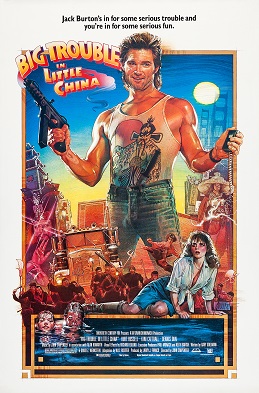
Jack Burton (Kurt Russell) is not a complicated person. He drives a truck for a living. He’s loyal to his friends. He likes a good beer and a pretty girl. He tries to do the right thing so when the fiancée of his best friend, Wang Chi (Dennis Dun), is kidnapped, he teams up with Wang to rescue her. And when Jack’s truck gets stolen after he runs over an evil, ancient Chinese sorcerer named Lo Pan (James Hong), Jack just wants to get his truck back. Instead, Jack finds himself in the middle of an ancient battle between good and evil as Lo Pan searches for a green-eyed woman to sacrifice so that he can defeat a curse that was put upon him centuries ago.
Big Trouble In Little China is one of John Carpenter’s most exuberant films. It mixes kung fu action with special effects and a good dose of physical humor from Kurt Russell. When Lisa and I watched this movie a few months ago, Lisa commented that this film was Kurt Russell’s “Bruce Campbell movie,” and the more I think about it, the more I agree. Russell plays Jack with a mix of cockiness and klutziness that should be very familiar to anyone who has followed the adventures of Ash Williams. While Dennis Dun gets to do the typically heroic stuff that you would expect from the star of a movie like this, Russell is just someone who wants to get his truck back and who is consistently weirded-out by the magic around him. Carpenter makes sure that the movie is full of action as he pays tribute to the kung fu films that he watched when he was still in film school. James Hong is great villain and the rest of the cast, including Kim Cattrall as lawyer Gracie Law, all match the energy of Russell, Hong, and Dun. Complete with flying swordsmen, demons with glowing eyes, and a lightning-wielding warrior that probably inspired Mortal Kombat‘s Raiden, Big Trouble In Little China is a fun slice of 80s action.
Unfortunately, the film was not appreciated when it was first released. Stung by the critical reaction to the film, Carpenter abandoned working for the studios and instead become an independent filmmaker. Big Trouble In Little China, however, has stood the test of time and has become better appreciated with age. Today, it’s rightly viewed as one of Carpenter’s best films.
Ray Mercer (Peter Weller) has just gotten out of prison and already, he and his wife Rebecca (Tia Carrere) are heading to Nevada for a quicky divorce. However, a stopover in Las Vegas leads to Ray having a run of luck in a casino owned by Charles Atlas (Dennis Hopper). Ray and Rebecca start to reconsider their divorce but their reconciliation is temporarily put on hold when the casino is robbed by a bunch of thieves led by Martin Kove. Because of Ray’s criminal history, the police (led by David Alan Grier) consider Ray to be the number one suspect. Ray and Rebecca try to escape from the casino and clear Ray’s name, leading to a night on nonstop action and an explosive climax at the Hoover dam.
One thing that you can say about Top of the World is that it certainly isn’t boring. The action starts earlier and lasts nonstop until the end of the movie. No sooner has Ray escaped from one scrape than he finds himself in another. Despite the low-budget, the action scenes are often spectacularly staged and exciting to watch. Another thing that you can say about Top of the World is that, for a B-movie, it certainly has a packed cast. Along with Weller, Carrere, Hopper, Grier, and Kove, the movie also finds room for Peter Coyote, Joe Pantoliano, Ed Lauter, Gavan O’Herlihy, Eddie Mekka, Cary-Hiroyuki Tagawa, and even Larry Manetti of Magnum P.I. fame. This movie paid off a lot of mortgages and probably funded more than a few vacations.
One thing you can’t say about Top of the World is that it makes any sense. It doesn’t. There are so many holes in the plot that you could fly a helicopter through them and that’s exactly what this film does. But with the nonstop action and the entertaining cast, most people won’t mind. I certainly didn’t!
In The Art of War, Wesley Snipes plays Neil Shaw, an UN operative who is framed for the assassination of a Chinese diplomat and who must uncover the real conspiracy while also proving his innocence. Proving his innocence means engaging in a lot of conflict while using investigation techniques that were cribbed from the Mission Impossible films.
Featuring a lot of war but not much art, The Art of War has a few good action scenes and an overly convoluted storyline that sometimes makes the film feel like a retread of another film in which Snipes was framed for a crime he did not commit, U.S. Marshals. It’s hard to take seriously any action hero who works for the United Nations but Wesley Snipes is credible in the action scenes and he could deliver a one-liner with the best of them. (Of all the bad things you can say about the IRS, the worst is that it put one of our best action stars in prison. Unforgivable!) The supporting cast is good, featuring Donald Sutherland, Maury Chaykin, Anne Archer, and Michael Biehn. The final battle between Snipes and the person who is revealed to be the main villain is exciting but, overall, The Art of War is overlong and overcomplicated. Neil Shaw is cool but he’s no Blade.
In celebration of the 77th birthday of the great Director John Carpenter, I decided to watch his 1998 film VAMPIRES, starring one of my favorite actors in James Woods. I specifically remember the first time I ever read that this movie was being made and that it would star Woods. It was 1996, and I had just been hired to work for a company called Acxiom Corporation in Conway, Arkansas. It was at this job that I first had access to this new thing called the Worldwide Web. As far as I know, it was the first time I had ever looked at the internet. Of course, I immediately started completing searches on some of my favorite actors, including James Woods, when I came across VAMPIRES as a movie currently in production. These were the first times in my life that I was able to find out about new film projects without looking in a magazine or watching shows like Entertainment Tonight.
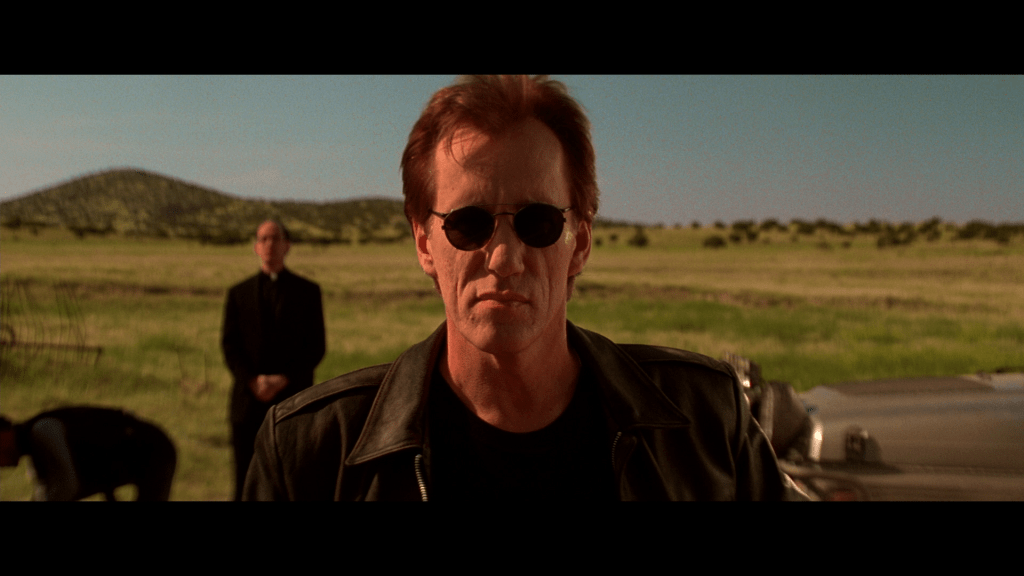
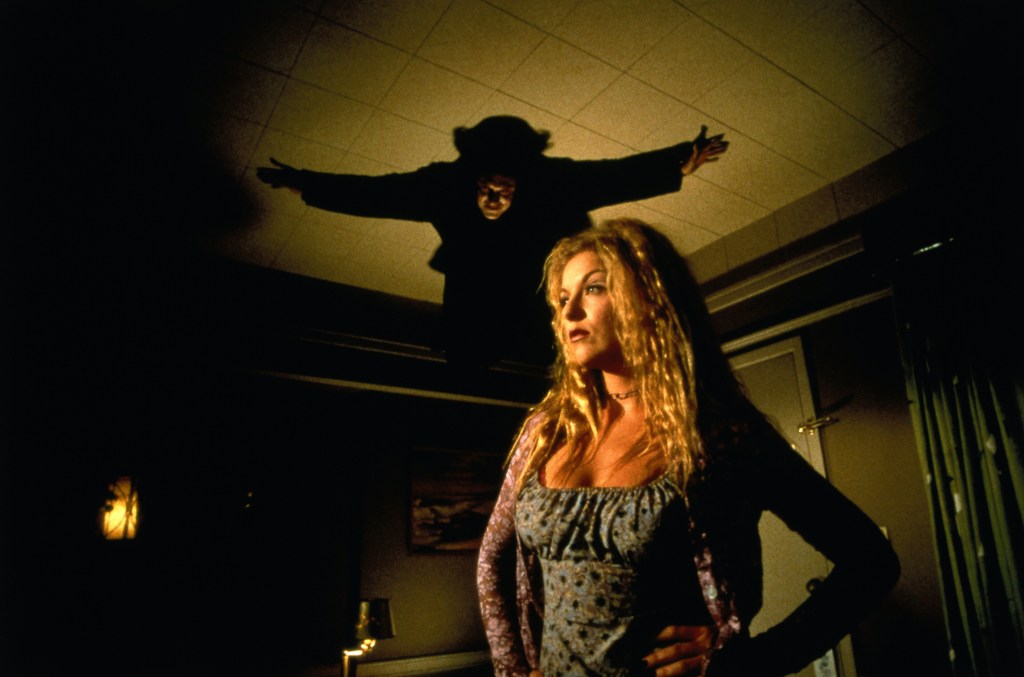
In VAMPIRES, James Woods stars as Jack Crow, the leader of team of vampire hunters who get their funding from the Vatican. We’re introduced to the team when they go into a house in New Mexico and proceed to impale and burn a nest of vampires. While the rest of the team celebrates the mission that night in a hotel filled alcohol, drugs, and whores, Jack can’t escape the feeling that something isn’t right, as he doesn’t believe they got the “master vampire” of the group. Unfortunately, Jack is right to worry. As they’re partying, the master vampire Valek (Thomas Ian Griffith) interrupts the fun and proceeds to kill everyone there, with the exception of Jack, his partner Tony (Daniel Baldwin), and Katrina (Sheryl Lee), a prostitute he decided to just bite on. Valek isn’t just a regular old master vampire, either. As it turns out, he’s the original vampire, and he’s on a quest to find the Berziers Cross, an ancient Catholic relic, that will allow him and other vampires to walk in the daylight. Against this backdrop, Jack, Tony, and a priest named Adam (Tim Guinee) use Katrina, who now has a psychic link with Valek, to try to kill the ultimate master vampire Valek, his cleric accomplice Cardinal Alba (Maximillian Schell), and just hopefully, save mankind in the process!
I know that VAMPIRES is not the most well-known or beloved John Carpenter film. He’s done so many great movies, but VAMPIRES is special to me as it was the first of his films that I ever saw in the movie theater. And the opening 30 minutes of the film is as badass as it gets. Carpenter is a master of the set-up. There’s lots of slow motion as Carpenter’s guitar riffs rock the soundtrack and the camera moves in on James Woods, with his cool sunglasses and black leather jacket, just before his team goes in and destroys a vampire nest at the beginning of the film. I also think the set-up of Thomas Ian Griffith as Valek is awesome, as he strolls up to the hotel room while the vampire hunters celebrate, completely unaware of the carnage about to befall them. Griffith has never looked cooler than he did in his long black coat and long hair, both blowing in the wind. These were awesome moments that illustrated Carpenter’s ability to project a sense of visual cool and power that I was mesmerized with. I wanted to see what happens next. And as a 25-year-old man at the time of VAMPIRE’s Halloween release in 1998, I also gladly admit that I really enjoyed the beauty of a 31-year-old Sheryl Lee. I would have definitely done everything I could do to save and protect her. The remainder of the film may have not been able to keep the same momentum as those first 30 minutes, but it’s a solid, enjoyable film, buoyed by the intense performance of Woods!
Vampires (1998)
Directed by John Carpenter
Shown: Thomas Ian Griffith, Sheryl Lee
There are several items of trivia that interest me about VAMPIRES:
John Carpenter had a good working relationship with James Woods on the set, but they had a deal: Carpenter could film one scene as it is written, and he would film another scene in which Woods was allowed to improvise. The deal worked great, and Carpenter found that many of Woods’ improvised scenes were brilliant.
VAMPIRES was John Carpenter’s only successful film of the 1990’s. Its opening weekend box office of $9.1 million is the highest of any John Carpenter film.
The screenplay for VAMPIRES is credited to Don Jakoby. Jakoby has some good writing credits, including the Roy Scheider film BLUE THUNDER (1983), the Cannon Films “classic” LIFEFORCE (1985), and the Spielberg produced ARACHNAPHOBIA (1990). The reason Don Jakoby interests me, however, is the fact that he had his name removed from the film I’ve seen more than any other, that being DEATH WISH 3 (1985), starring Charles Bronson. Even though Jakoby provided the script for DEATH WISH 3, due to the drastic number of changes, Jakoby insisted his name be removed. The script is credited to the fake “Michael Edmonds” instead.
As I was typing up my thoughts on VAMPIRES today, I learned of the death of the director David Lynch. This brings special poignancy to the fact that John Carpenter cast Sheryl Lee after seeing her on Lynch’s T.V. series TWIN PEAKS (1990).
Frank Darabont, who directed one of the great films of all time, THE SHAWSHANK REDEMPTION (1994), has a cameo as “Man with Buick.” Fairly early in the film, after Crow, Montoya, and Katrina crash their truck escaping the hotel massacre, they encounter the man at a gas station and forcefully take the Buick. This is a strong sign of just how respected John Carpenter was by other great filmmakers at the time.
John Carpenter has directed some absolute classics like ASSAULT ON PRECINCT 13 (1976), HALLOWEEN (1978), ESCAPE FROM NEW YORK (1981), THE THING (1982), and BIG TROUBLE IN LITTLE CHINA (1986). There’s no wrong way to celebrate a man who has brought such joy into our lives through his work. Today, I’m just thankful that he has been given the opportunity to share his talents with us!
Framed on charges of dumping toxic waste, Morgan (Billy Zane) accepts a CIA mission to travel to the fictional African country of Zambeze and to track down his former friend, Jim Scott (Robert Downey, Jr.). Scott is an ex-CIA agent who faked his own death and who is now leading a revolution against the oppressive government of Zambeze. Scott knows the location of several barrels of uranium. Also searching for the uranium is the ruthless Mr. Chang (Cary-Hiroyuki Tagawa). Morgan teams up with Dr. Kim Woods (Lisa Collins) but soon discovers that he has to be careful of who to trust.
There is a surprisingly lot of talent in the cast of this film. Along with Zane, Downey, Collins, and Tagawa, Ron Silver appears as the shady political operative who joins Morgan in Zambeze. The cast may be good but it doesn’t take long to see that everyone in this film was there mostly for the money. No one brings their A-game to Danger Zone and both Downey and Silver often look like they’re struggling to deliver their lines with a straight face. Downey, especially, gives a self-amused performance, delivering his lines in a thick and indecipherable Southern accent.
(It is easy to forget that there was a time when Robert Downey, Jr’s career was regularly cited as being the ultimate Hollywood cautionary tale. Everyone knew he was talented but, in the 90s, his well-publicized struggle with drug addiction and the time that he spent in jail made him practically uninsurable and unhirable. He ended up appearing in a lot of films like this one before he eventually got clean and reinvented himself as the face of the MCU. In the 90s, most people would probably have been shocked to hear that Downey would eventually win an Oscar and receive a standing ovation as he accepted it.)
Danger Zone does have some good action scenes. The movie ends with an attack on a train that is actually pretty exciting. Unfortunately, the rest of the film suffers from bad acting and an incoherent plot that makes Danger Zone almost impossible to follow. You can fly into the Danger Zone but you won’t want to stay.
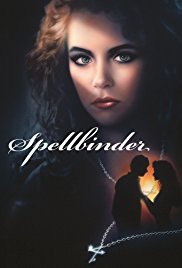
Jeff Mills (Tim Daly) is an attorney who might be unlucky in love but who still owns a copy of every movie that Frank Capra has ever directed. (There is even a scene where two of his friends are seen looking at his movie collection and saying, “He’s got every movie Capra ever made!”) Miranda (Kelly Preston) is the beautiful and mysterious woman who Jeff saves from an abusive boyfriend. Within minutes of meeting her, Jeff invites Miranda to say with him in his apartment. For Jeff, it is love at first sight but his friends (Rick Rossovich and Diana Bellamy) worry that Jeff is getting in over his head with a woman about whom he knows nothing. Weird things start to happen in Jeff’s apartment and a woman (Audra Lindley) shows up in his office, taunting him about how she dug up his mother’s bones and used them in a black magic ceremony. Eventually, Miranda confesses that she is on the run from a Satanic coven that was planning on sacrificing her but is she telling the whole truth?
Spellbinder is an enjoyably daft movie, especially if you are a fan of Kelly Preston. It’s not that the rest of the cast isn’t good but this really is Preston’s show and her mix of All-American beauty and otherworldly sexiness is put to good use as the enigmatic Miranda. It is easy to believe that Jeff would fall in love with her despite not knowing much about her. The movie also has a few good scare scenes, like one in which the faces of all the members of the coven suddenly appear crowded around a window, staring in. A slickly made example of how Hollywood made money off of the Satanic panic of the 1980s, Spellbinder is essentially The Wicker Man set in Los Angeles and is more entertaining than Neil LaBute’s actual remake. (Even if it doesn’t have any bees.)
How is it that, this weekend, so much hype is being given to War Dogs and Ben-Hur — two films that you knew weren’t going to be any good from the minute you first saw their trailers — while one of the best films of the year is running the risk of being overlooked?
I just got back from seeing Kubo and The Two Strings and I am insisting that, if you haven’t already, you go out and see it right now. If you’re busy today, I understand. See it on Sunday. You can even see it on Monday if you have to. But the important thing is that you see it soon. For the most part, 2016 in cinema has almost been as bad as 2016 in politics. The year has been dominated by big spectacles, the majority of which do not even attempt to create any sort of emotional connection with the audience. Don’t get me wrong — there have been some good films but not hardly enough. Fortunately, Kubo and the Two Strings is the type of film that, if people actually go and see it, can help to redeem an entire year.
In short, I want to wake up on Monday and I want to read that Kubo and The Two Strings won the weekend. Make it happen!
Kubo and The Two Strings is an animated film and yes, you need to see it in a theater and yes, you need to see it in 3D. It’s one of the most visually stunning films that I’ve seen this year and, even better, it’s a film that actually has a heart. When I watched Kubo and The Two Strings, I found myself both laughing and crying and feeling a renewed excitement about the potential of cinema.
Somewhat appropriately, this magical film is about magic, not just spell-casting magic but also the magic that we all have within our soul and locked away in our memories. Taking place in ancient Japan, it tells the story of Kubo (voiced by Art Parkinson), a one-eyed child who lives in a cave with his sickly mother. Most of the time, his mother is so out-of-it that she can only sit at the cave entrance and stare out at the distant ocean. But occasionally, she is lucid enough that she remembers her past and she tells stories about how Kubo’s father was a mighty warrior who battled monsters and went on heroic quests. She also remembers that Kubo’s grandfather is an evil demon, who is searching for his grandson and who hopes to take away his other eye.
Kubo supports his mother by going into a nearby village and, through the use of origami, magic, and music, telling stories to the townspeople. His mother always warns Kubo not to say out after sunset. Inevitably, however, Kubo does just that and soon, his demonic aunts appear in the village. (The aunts, who are voiced by Rooney Mara, are truly scary.) The village is destroyed and Kubo’s mother sacrifices her life to save him.
This, of course, all leads to Kubo going on a quest of his own. He has to find his father’s armor so that he can defeat his grandfather. Helping him in his quest is Monkey (Charlize Theron) and Beetle (Matthew McConaughey, providing comic relief to an occasionally grim film). But really, the quest is less about finding the armor and more about Kubo both growing up and coming to terms with the loss of his parents. Yes, Kubo and The Two Strings may be an animated film and it may be a fantasy and it may feature bits of comedy but it’s a film that inspires very real emotions. It’s a film that made me cry and it earned every single tear.
(Seriously, I dare you to watch the final five minutes of Kubo and The Two Strings without tearing up.)
Visually, this is an amazing film. The images are often beautiful, sometimes frightening, and occasionally awe-inspiring. Kubo’s aunts are pure nightmare fuel and his confrontation with his grandfather (voice by Ralph Fiennes) is magical in more ways than one. Even beyond that, Kubo and the Two Strings creates a world that feels as real as our own. It not only visualizes and celebrates film magic but also real-life magic as well.
Kubo and the Two Strings is a great and magical film and it’s one of the best of the year so far. If you haven’t seen it, go out and see it. If you’ve already seen it, go see it again. Don’t wait for it to come out on Blu-ray. Don’t say, “I’ll see it on cable.” Don’t wait for Netflix. See it on a big screen and see it now.
Seriously, don’t miss your chance to experience this movie the way it was meant to be experienced!
Nurse Evelyn Johnson (Kate Beckinsale) in Pearl Harbor (2001)
The “this” that Evelyn Johnson is referring to is the Japanese attack on Pearl Harbor. You know, the date will live in infamy. The attack that caused the United States to enter World War II and, as a result, eventually led to collapse of the Axis Powers. The attack that left over 2,000 men died and 1,178 wounded. That attack.
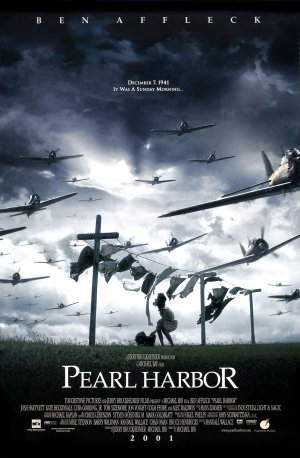
In the 2001 film Pearl Harbor, that attack is just one of the many complications in the romance between Danny (Ben Affleck), his best friend Rafe (Josh Hartnett), and Evelyn (Kate Beckinsale). The other complications include Danny briefly being listed as dead, Danny being dyslexic before anyone knew what dyslexia was (and yet, later, he’s still seen reading and writing letters with absolutely no trouble, almost as if the filmmakers forgot they had made such a big deal about him not being able to do so), and the fact that Rafe really, really likes Evelyn. Of course, the main complication to their romance is that this is a Michael Bay film and he won’t stop moving the camera long enough for anyone to have a genuine emotion.
I imagine that Pearl Harbor was an attempt to duplicate the success of Titanic, by setting an extremely predictable love story against the backdrop of a real-life historical tragedy. Say what you will about Titanic (and there are certain lines in that film that, when I rehear them today, make me cringe), Leonardo DiCaprio and Kate Winslet had genuine chemistry. None of that chemistry is present in Pearl Harbor. You don’t believe, for a second, that Ben Affleck and Josh Hartnett are lifelong friends. You don’t believe that Kate Beckinsale is torn between the two of them. Instead, you just feel like you’re watching three actors who are struggling to give a performance when they’re being directed by a director who is more interested in blowing people up than in getting to know them.
Continuing the Titanic comparison, Pearl Harbor‘s script absolutely sucks. Along with that line about “all this” happening, there’s also a scene where Franklin D. Roosevelt (Jon Voight) reacts to his cabinet’s skepticism by rising to his feet and announcing that if he, a man famously crippled by polio and confined to a wheelchair, can stand up, then America can win a war.
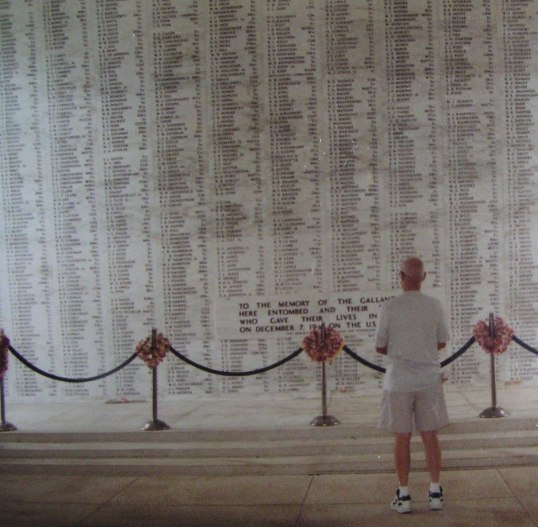
I’ve actually been to Pearl Harbor in Hawaii. I have gone to the USS Arizona Memorial. I have stood and stared down at the remains of the ship resting below the surface of the ocean. It’s an awe-inspiring and humbling site, one that leaves you very aware that over a thousand men lost their lives when the Arizona sank.
I have also seen the wall which lists the name of everyone who was killed during the attack on Pearl Harbor and until you’ve actually been there and you’ve seen it with your own eyes, you really can’t understand just how overwhelming it all is. The picture below was taken by my sister, Erin.
If you want to pay tribute to those who lost their lives at Pearl Harbor, going to the Arizona Memorial is a good start. But avoid Michael Bay’s Pearl Harbor at all costs.




 Jeff Mills (Tim Daly) is an attorney who might be unlucky in love but who still owns a copy of every movie that Frank Capra has ever directed. (There is even a scene where two of his friends are seen looking at his movie collection and saying, “He’s got every movie Capra ever made!”) Miranda (Kelly Preston) is the beautiful and mysterious woman who Jeff saves from an abusive boyfriend. Within minutes of meeting her, Jeff invites Miranda to say with him in his apartment. For Jeff, it is love at first sight but his friends (Rick Rossovich and Diana Bellamy) worry that Jeff is getting in over his head with a woman about whom he knows nothing. Weird things start to happen in Jeff’s apartment and a woman (Audra Lindley) shows up in his office, taunting him about how she dug up his mother’s bones and used them in a black magic ceremony. Eventually, Miranda confesses that she is on the run from a Satanic coven that was planning on sacrificing her but is she telling the whole truth?
 Through the Shattered Lens