Guilty Pleasure #88: Lifeforce (dir. by Tobe Hooper)


Hey, hey, wait just one second. Lifeforce is a movie everyone treasures. Here’s Arleigh’s take on the film. Check that out first and then double back here if you like.

Lifeforce (1985, dir by Tobe Hooper)

Tobe Hooper’s Lifeforce is one of those films that had a lot of play in my Grandmother’s house, primarily because of my younger Aunt, Puddin. Puddin was the other movie lover on my Dad’s side of the family, the youngest of his generation. While she couldn’t fully make the connections between actors or directors the way my father could, she loved films all the same. With films like Marnie, West Side Story, Conan the Barbarbian, she spent most of her free time immersed in movies. If you wanted to see her swoon, mention Sean Connery, Tyrone Power or Arnold Schwarzenegger in her presence. She had a habit of using movies she watched often as white noise when cleaning around the house. As a result, we saw Lifeforce a lot growing up. She adored the film mainly because the two heroes in it barely made any mistakes, but most importantly for Henry Mancini’s score. Besides, It’s a Cannon film. You know it’s good. 

Lifeforce is the story of one of the greatest buddy pairings in of the 1980s. Yeah, Beck and Gallagher did awesome stuff in The Hidden. Riggs and Murtaugh solved the cases no matter how thin the leads were, and even with all his technology, Alex Murphy still needed Lewis for backup. These all pale in comparison to Lifeforce‘s Colonel Carlsen (Steve Railsback, Helter Skelter) and Colonel Caine (Peter Firth, The Hunt for Red October). The two characters’ laser focus and quick thinking help to keep the film moving, despite how crazy things can and do get. They also manage to have each other’s back in nearly every situation. They aren’t without troubles, however. Poor Carlsen is plagued with nightmares of making out with naked space vampires. 

Halley’s Comet returns close to Earth. With it comes an incredibly large umbrella shaped ship that is discovered by the crew of the Churchill. Col. Carlsen, along with the other astronauts, find a series of sleeping humanoid bodies inside and bring 3 (two males and one female) on board. When the Churchill’s signal is lost, the Columbia is sent out to retrieve them. The crew is lost, Carlsen is missing, but the 3 alien bodies are brought back home to Earth for study. This goes about as well as one would hope, with the Space Girl (Mathilda May, Becoming Collette) waking up and causing havoc throughout the local Space Institute before walking away naked, into the night. Anyone she comes into contact with and kisses becomes an energy vampire, requiring a transfusion, else they shrivel and turn into dust. 

Since we’re dealing with space vampires, I should inform you now that there’s quite a bit of nudity and maybe just a wee bit of sexual tension in Lifeforce. The lines between Rabid and Showgirls comes kind of close in all this. When Carlsen forces a possible suspect to divulge the location of the Space Girl, slapping her up a bit, he tells Caine he should leave. Caine’s response is that he’s “a natural voyeur”. Does much of it make sense? No. Was it entertaining? Sure. The third act of Lifeforce is the best part, with all of London just a mess. Despite all this, Carlsen & Caine split up to save the day. 

The cast for the film is nice. In addition to Railsback and Firth, we’ve got a Dune crossover with both Freddie Jones and Patrick Stewart on hand. We also have a small cameo with Dragonslayer’s John Hallam as a nurse. The best role other than the leads go to Frank Finlay and to Mathilda May. Finley’s Doctor Fallada is kind of a Van Helsing like character, piecing together all of the clues so our heroes can take the proper action. May, though she’s not given a lot to say (or to wear, for that matter) makes for an impressive villain that talks with her eyes.

The effects for Lifeforce came by way of John Dykstra, who worked on Firefox and The Empire Strikes Back. He’d later go on to work on Invaders From Mars for Hooper. Musically, Henry Mancini’s score helps to carry the film along. Honestly, I’ve only ever known him from the Pink Panther scores, so I quite enjoyed it. I always let the end credits play through for the music. Overall, Lifeforce is a great watch if vampires are your thing and nudity isn’t too much of a problem. In my mind, The Adventures of Carlsen & Caine would rival some of the best supernatural tales.

In examining this, I also found that there are some connections between this and Hammer Films’ Five Million Years to Earth (a.k.a. Quatermass and the Pit). I’m still on the look out for that one. 

In Tobe Hooper’s Lifeforce, Col. Carlsen & Col. Caine aren’t playing around.

Previous Guilty Pleasures

  1. Half-Baked
  2. Save The Last Dance
  3. Every Rose Has Its Thorns
  4. The Jeremy Kyle Show
  5. Invasion USA
  6. The Golden Child
  7. Final Destination 2
  8. Paparazzi
  9. The Principal
  10. The Substitute
  11. Terror In The Family
  12. Pandorum
  13. Lambada
  14. Fear
  15. Cocktail
  16. Keep Off The Grass
  17. Girls, Girls, Girls
  18. Class
  19. Tart
  20. King Kong vs. Godzilla
  21. Hawk the Slayer
  22. Battle Beyond the Stars
  23. Meridian
  24. Walk of Shame
  25. From Justin To Kelly
  26. Project Greenlight
  27. Sex Decoy: Love Stings
  28. Swimfan
  29. On the Line
  30. Wolfen
  31. Hail Caesar!
  32. It’s So Cold In The D
  33. In the Mix
  34. Healed By Grace
  35. Valley of the Dolls
  36. The Legend of Billie Jean
  37. Death Wish
  38. Shipping Wars
  39. Ghost Whisperer
  40. Parking Wars
  41. The Dead Are After Me
  42. Harper’s Island
  43. The Resurrection of Gavin Stone
  44. Paranormal State
  45. Utopia
  46. Bar Rescue
  47. The Powers of Matthew Star
  48. Spiker
  49. Heavenly Bodies
  50. Maid in Manhattan
  51. Rage and Honor
  52. Saved By The Bell 3. 21 “No Hope With Dope”
  53. Happy Gilmore
  54. Solarbabies
  55. The Dawn of Correction
  56. Once You Understand
  57. The Voyeurs 
  58. Robot Jox
  59. Teen Wolf
  60. The Running Man
  61. Double Dragon
  62. Backtrack
  63. Julie and Jack
  64. Karate Warrior
  65. Invaders From Mars
  66. Cloverfield
  67. Aerobicide 
  68. Blood Harvest
  69. Shocking Dark
  70. Face The Truth
  71. Submerged
  72. The Canyons
  73. Days of Thunder
  74. Van Helsing
  75. The Night Comes for Us
  76. Code of Silence
  77. Captain Ron
  78. Armageddon
  79. Kate’s Secret
  80. Point Break
  81. The Replacements
  82. The Shadow
  83. Meteor
  84. Last Action Hero
  85. Attack of the Killer Tomatoes
  86. The Horror at 37,000 Feet
  87. The ‘Burbs

Join #MondayMuggers For THE DELTA FORCE!


Hi, everyone!  Guess is who is guest hosting the #MondayMuggers live tweet tonight?  That’s right …. me!

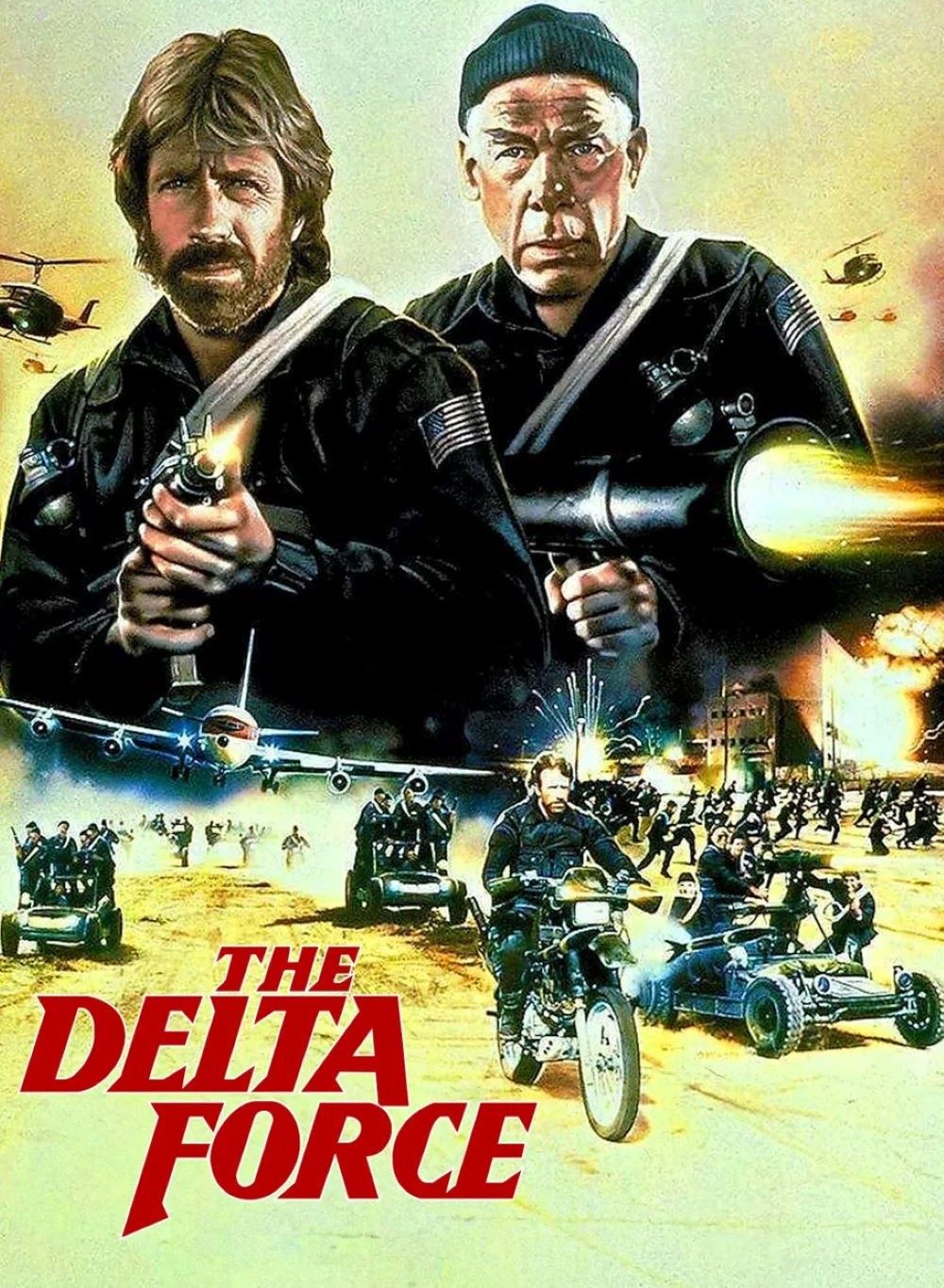
Tonight’s movie will be The Delta Force (1986), starring Chuck Norris, Lee Marvin, Robert Forster, George Kennedy, Robert Vaughn, Steven James, Hanna Schygulla, Shelley Winters, Martin Balsam, Bo Svenson, Joey Bishop, Susan Strasberg, Kim Delaney …. well, you get the idea.  There’s a lot of people in this movie!  Jedadiah Leland swears that this is the greatest film ever made.  We’ll find out tonight!

You can find the movie on Prime and then you can join us on twitter at 9 pm central time!  (That’s 10 pm for you folks on the East Coast.)  See you then!

DEATH WISH 4: THE CRACKDOWN – a missed opportunity in my life!


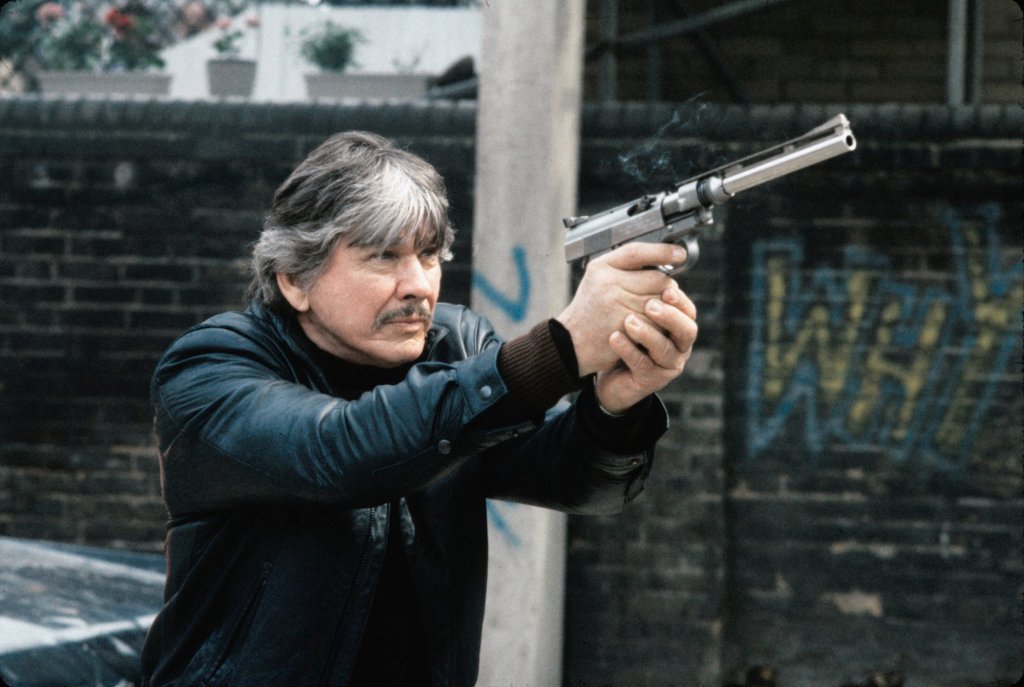
I’m on Day 4 of my discussion of Charles Bronson’s DEATH WISH series in chronological order. This series has brought me countless hours of entertainment over the last 40 years, so enjoy and let me know your thoughts!

DEATH WISH 4: THE CRACKDOWN was a bit of a missed opportunity in my early years of Bronson fandom. Let me explain. In the mid-80’s I became Charles Bronson’s biggest fan, an honor I possibly share with a few others. As a part of that fandom, a 14-year-old Brad would scour every available source for information about my hero, which at that time was mainly the entertainment section of the Arkansas Democrat, my grandma’s tabloids, and, when I could get a ride, the magazine rack at the Hastings Entertainment Superstore. This in-depth search for information eventually lead to me discovering that DEATH WISH 4: THE CRACKDOWN would be playing at the movie theater in Conway, AR in November of 1987. I was so excited that I might actually get to see Charles Bronson on the big screen for the first time ever. Unfortunately, there were several factors working against me. First, it was rated R, so I was completely dependent on an adult taking me. Second, it was released in November which was in the heart of basketball season, and the only thing that was above Bronson in my life was the basketball court, especially since my dad was my coach. And third, my parents would only consider taking me to the movies on “dollar night,” which was Tuesday and almost always conflicted with my basketball game schedule. I remember driving by the theater and seeing DEATH WISH 4: THE CRACKDOWN listed on the marquee and longing to go see it.  Alas, the stars, and the factors above, all aligned against me, and I would not be able to watch the film during its 2-week run in Conway, Arkansas. At this point in his career, Cannon would give Bronson’s films a short theatrical release and then release them to the home video market where Bronson was still a true moneymaking superstar.  DEATH WISH 4 earned the equivalent in today’s dollars of around $20,000,000 at the box office before going on to sale over 100,000 VHS cassettes to rental stores. It was Bronson’s most successful rental release of the franchise.  

DEATH WISH 4: THE CRACKDOWN opens with Paul Kersey (Charles Bronson) having nightmares about the man he has become after a decade of meting out vigilante justice. He has moved back to Los Angeles where he keeps himself busy with his work as an architect, as well as his relationship with his new lady friend, Karen (Kay Lenz). When Karen’s daughter Erica dies of a drug overdose, Kersey immediately finds the drug dealer who sold her the stuff and shoots him dead. Unfortunately, soon after it seems that someone has pictures of Kersey doing his vigilante deeds, and he finds himself being coerced by millionaire Nathan White (John P. Ryan) into pitting the two primary criminal drug organizations against each other in a turf war in an attempt to get them to take each other out. Nathan White’s own granddaughter had been destroyed by drugs, and this is his way of getting back at the criminals responsible for her death. Kersey begins killing drug dealers, suppliers, day laborers, security detail, you name it; if you’re associated with drugs in any way, whether it be at a video store, fish packing plant, fine restaurant, or skyscraping apartment complex, you are fair game for death. Kersey is able to sufficiently convince the heads of the competing drug organizations that they are at war with each other. This all culminates at the oil fields, where Kersey, armed with a high-powered rifle, is perched above the meeting of the two gangs. With one fateful shot, he is able to ignite the all-out war he and Nathan White have been looking for. Finally, the streets of Los Angeles are free from the drugs that are sucking the life out of its citizens, right. Or are they?

It was on VHS in April of 1988 that I finally got to see DEATH WISH 4: THE CRACKDOWN. It’s the first movie in the series not directed by Michael Winner. J. Lee Thompson took over the reins and created a slick action film that lacked the odd, but interesting touches that Winner provided, but made up for it with stronger craftmanship. DEATH WISH 4 is a balls to the wall action extravaganza that barely rests long enough for the audience to catch their breath. My personal favorite scene of the film is the oil field shootout that produced some really cool, iconic images of Bronson walking with his rifle as he was finishing off the bad guys. I’ve heard DEATH WISH 4 referred to as the “lost Death Wish” film because it is spoken of less than parts 1, 2, or 3, and that may even be true, but it’s actually a very strong entry in the series.  

As Paul Harvey might say, this is the “rest of the story” of me finally getting to see Charles Bronson on the big screen.  After DEATH WISH 4 ended its run, I don’t know of another Bronson film playing at my local theater from that point forward, and I would have to settle to watch MESSENGER OF DEATH, KINJITE, THE INDIAN RUNNER, and DEATH WISH V all on home video. Then, in the summer of 2022, I became aware that the Mahoning Drive-In in Lehighton, PA was programming a Charles Bronson night featuring THE MECHANIC, MR. MAJESTYK and DEATH WISH 3.  My wife and I drove 17 hours from our home in Arkansas to watch those three movies on the big screen.  It was the greatest “movie-night” of my life and something I’ll never forget.  So, all’s well that ends well!

BONUS: Jesse Dabson had a part in DEATH WISH 4: THE CRACKDOWN. Jesse was interviewed on the THIS WEEK IN CHARLES BRONSON PODCAST, where he told my partner Eric Todd, and fellow Buchinsky Boys Chris Manson and Ryan Voss, about his experiences working on DEATH WISH 4, as well as other projects like PLATOON LEADER and ONE FALSE MOVE. Give it a listen if you get a chance!

DEATH WISH 3 – The movie I’ve watched more than any other!


I’m on Day 3 of my discussion of Charles Bronson’s DEATH WISH series in chronological order. This series has brought me countless hours of entertainment over the last 40 years, so enjoy and let me know your thoughts!

DEATH WISH 3 is a very important movie to me. I recently closed my celebration of Charles Bronson’s 103rd birthday movie marathon on November 3rd with another viewing of DEATH WISH 3, the film that turned me into the only Charles Bronson superfan in Toad Suck, Arkansas. After a day of celebratory viewings of CHATO’S LAND, 10 TO MIDNIGHT (on VHS), FROM NOON TIL THREE, COMBAT: HERITAGE (on VHS), THE SEA WOLF (on VHS), and the original DEATH WISH, I had no choice but to watch DEATH WISH 3, a movie I have watched well over 100 times over the course of my life. DEATH WISH 3 is one of only four Charles Bronson films that I have seen on the big screen, as I was able to watch it at the Mahoning Drive-In in Lehighton, PA in June of 2022.

The third entry in the DEATH WISH franchise begins with Paul Kersey (Charles Bronson) riding a Go Big Red Trailways bus into New York City. Since this is an odd numbered DEATH WISH film, it takes place in New York. The even numbered films take place in Los Angeles. Kersey looks kind of grumpy as he rides into town. I would definitely avoid sitting next to him if I was a passenger on the same bus that day. We learn that Kersey’s coming into town to visit his old buddy, Charlie. Unfortunately, his arrival coincides with members of a violent street gang breaking into Charlie’s apartment and beating him to death. Just after the punks go running away from the scene of the crime, Kersey walks into Charlie’s apartment to find the man clinging to his last breath of life and asking Kersey to “take care of his things, until I get back.” Some of Charlie’s neighbors had called the police a little earlier, and they arrive just in time to find Kersey standing over the body, so they arrest him for his old buddy’s murder. This seems reasonable since Kersey is the only person wearing a sports jacket and button up shirt in this gang infested area. Kersey is taken to the police station where a group of cops commence to beating the crap out of him in hopes of getting a confession. After a few punches to the gut by the cops and the old “you can have water if you tell us what we want to know” routine, Lt. Richard Shriker (Ed Lauter) enters the room and promptly asks “Who’s this dude?” You see, Kersey is going under the alias Paul Kimble, but Shriker recognizes the dude as Paul Kersey, the vigilante from the original DEATH WISH. Shriker goes on to explain that he was with the New York PD the night they brought in a vigilante with a bullet in his leg who was out like a light. Having the vigilante in town again, light bulbs immediately go off over Shriker’s head and he quickly hatches a plan. It seems a gang of criminals, led by Mandy Fraker (Gavan O’Herlihy) has taken over the community and police have been powerless to stop them. First, it’s really hard to catch the gang members because some of them can run really fast, and second, when they finally do catch them, the gang members have lawyers who can get them off. Lt. Shriker decides he’ll let Kersey out of jail, but only if Kersey is willing to resume his vigilante ways, shoot some of the creeps, and even throw some street info the police department’s way so they can get a few busts. Paul Kersey immediately agrees even though he seems kind of tired. You can’t help but wonder if Kersey might be needing the release that only can be achieved through violence against creeps. In short order, Kersey sets up shop in his old buddy’s apartment so he can take care of his things, gets to know the local residents, waits for an arsenal of African big game pistols and rocket launchers to arrive via UPS, makes love to public defender Kathryn Davis (Deborah Raffin), and eats all sorts of local delicacies like stuffed cabbage and broiled chicken. As an added bonus, the neighborly Bennett (Martin Balsam) just happens to have a couple of Browning machine guns in his closet that he was somehow able to smuggle home from World War II. It’s against this backdrop that Kersey sets out to wage a one-man war against the violent gang that has turned the corner of Sutter and Belmont into hell on earth!

There’s not much I can say about DEATH WISH 3 that hasn’t already been said.  It’s a wild, over the top action film that would mark the 6th and final film that Bronson would work on with director Michael Winner.  It would also be Charles Bronson’s last film that would rise to #1 at the U.S. box office when it premiered on November 1st, 1985.  It features some fun performances, especially from Ed Lauter as Lt. Shriker, Gavan O’Herlihy as gang leader Mandy Fraker, and Kirk Taylor as the gang member known as the Giggler who “can really move,” but who’s still not fast enough to outrun a bullet! A pre-Bill and Ted’s Alex Winter also plays a gang member named Hermosa, continuing the series tradition of casting actors as street creeps who would go on to be a bigger star a few years down the road. DEATH WISH 3 is not a great movie in the traditional sense, but it’s one of the most enjoyable movies ever made if you’re in the right frame of mind. 

DEATH WISH 3 is the movie most responsible for my obsession with Charles Bronson. I received it as a Christmas present in 1986 when I was thirteen years old, and I proceeded to watch it almost daily for months. It was the only Bronson film I owned on VHS so I would watch it almost every night unless I had a basketball game, or I had been able to rent a different Bronson film from the video store.  I know every line in the film and no other movie holds more nostalgic value in my life. DEATH WISH 3 is a 5-star movie in my book in so many ways that have nothing to do with critical acclaim. As long as I’m breathing, long live DEATH WISH 3!!!

BONUS: We completed a roundtable a few weeks back on the THIS WEEK IN CHARLES BRONSON PODCAST, where we spend the entire episode discussing what we love about DEATH WISH 3. I had a blast on the episode with my partner in crime Eric Todd, as well as fellow “Buchinsky Boys” Chris Manson & David Mittelberg. We even throw some love TSL’s way during the episode. Give it a listen if you get the chance!

The TSL’s Grindhouse: Bolero (dir by John Derek)


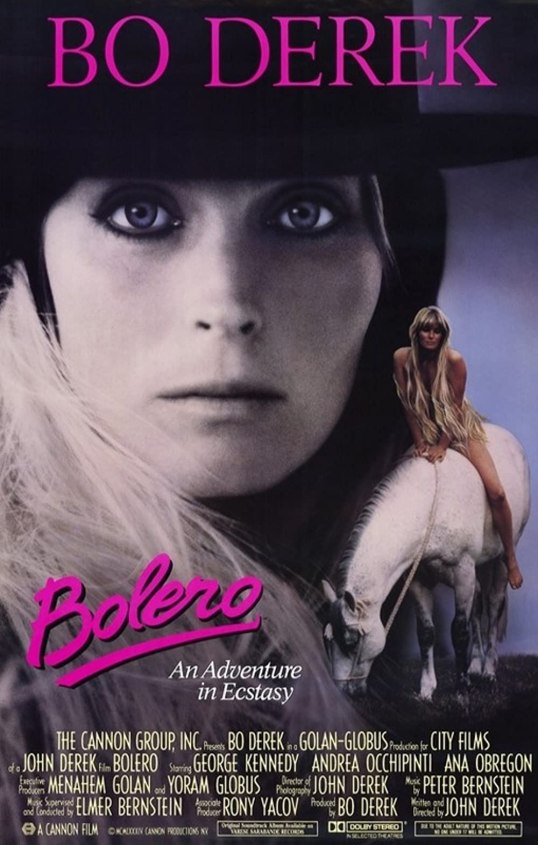
The 1984 film, Bolero, tells the story of  Ayre “Mac” MacGillvary (Bo Derek) and her best friend, Catalina (Anna Obregon).  They’re young, they’re rich, they’ve just graduated from college, and, despite the fact that they both appears to be in their early 40s, they’re determined to lose their virginities to the most perfect lovers that they can find.

Because the film is taking place in the 1920, Mac and Catalina first travel to the Middle East in hope of finding a Rudolph Valentino-style sheik.  Accompanying them is Mac’s chauffeur and protector, Cotton (a clearly embarrassed George Kennedy).  Though Mac does manage to find a sheik (played by Greg Benson), her efforts to lose her virginity to him prove to be a failure.  Though the Sheik is willing, he indulges a bit too much with his hookah and ends up passing out right before the consummating the act.

Well, if a sheik can’t do it, how about a bullfighter?  Mac and Catalina leave the Middle East for Spain and it’s there that Mac catches the eyes of Angel (Andrea Occhipinti), a celebrated bullfighter.  Mac decides that Angel will be the one to take her virginity but it turns out that, once again, nothing as is easy as it should be.  It turns out that Angel already has a lover and he’s been with her since she was a teenager.  And a 14 year-old Gypsy named Paloma (played by Olivia d’Abo) has already decided that she is going to be Angel’s next lover, which is incredibly icky even before the film makes it even ickier,  

While Mac is trying to seduce Angel, Catalina is trying to seduce a Scottish attorney named Robert Stewart (Ian Cochrane).  “What do you wear under your skirt?” Catalina asks.  “It’s a kilt!” Stewart yells because he’s Scottish.  Anyway, Catalina eventually does get an answer to her question so yay Catalina!

As for Mac, she does eventually manage to win Angel’s attention but then …. OUCH!  Angel gets gored by a bull and yes, he gets wounded exactly where you think that he gets wounded.  Suddenly, Angel can no longer get it up but fear not.  “We’re going to make that thing work,” Mac says, before she then takes up bullfighting herself.  It all eventually leads to a scene that makes heavy use of dry ice and a neon light that misspells the word ecstasy. 

Bolero is one of those sex-obsessed films that tries so hard to be erotic that it actually goes in the opposite direction and becomes so firmly anti-erotic that one gets the feeling it could be used as a torture device in a George Orwell novel.  “The Anti-Sex League sentences you to watch Bolero!”  A huge part of the problem is that, even though everyone in the film is certainly attractive, there’s still next to no chemistry between Bo Derek and any of her potential lovers.  The film was directed by Bo’s then-husband, John Derek and, somewhat perversely, John continually films her in the least flattering ways possible.  John also tries to introduce some humor into the film — at one point, it turns into a silent film, complete with title cards — but it all falls flat.  Finally, the gored bullfighter is played by a very handsome Italian actor named Andrea Occhipinti who I immediately recognized as being the same actor who played the killer in Lucio Fulci’s The New York Ripper.  Though it was a bit unfair to Occhipinti (whose likable blandness was exactly what made him such a subversive choice to play the killer in Fulci’s film), I was worried every moment that Mac was left alone with him.  (Occhipinti is now one of Italy’s most respected film producers.) 

Produced by Cannon Films, Bolero was apparently a huge flop when it was released.  Bolero was considered to be so bad that it led to MGM announcing that they would no longer help to distribute any other Cannon Films.  I can’t really blame MGM.  Even when viewed decades later, Bolero is a dull romp that’s fit only for the Anti-Sex League.

The TSL’s Grindhouse: Revenge of the Ninja (dir by Sam Firstenberg)


After his wife and most his family is murdered by a rival clan, ninja Cho Osaki (Sho Kosugi) leaves Japan for the United States.  Not only is he leaving his home country but he’s also abandoning his ninja heritage.  As he explains to his mother (Grace Oshita), he no longer has any use for the violent old ways.  From now on, he just wants to sell dolls!

In America, Cho prospers and his mother continues to teach Cho’s young son, Kane (Kane Kosugi), how to defend himself.  When Kane is confronted by a bunch of bullies while walking home from school, he kicks their asses while his grandmother watches approvingly.  GO, KANE!  Seriously, there’s nothing wrong with a movie that opens with a bunch of obnoxious 11 year-olds getting beaten up by a 9 year-old.

Cho has found success opening art galleries and selling dolls.  He’s proven that he doesn’t need to be an elite assassin in order to be happy.  However, Cho’s mother doesn’t trust Cho’s business partner, Braden (Arthur Roberts).  She says that there’s something obviously evil about Braden but Cho doesn’t agree.  Well, it turns out that mom’s right!  Braden is evil.  He’s using the dolls to smuggle heroin into the country!  When the local mob boss (Mario Gallo) refuses to agree to Braden’s terms, Braden decides to wage war on the Mafia. It turns out that Braden is a ninja himself!

When members of the Mafia turning up dead in weird ways, the police bring in a local martial arts instructor named Dave (Keith Vitali).  Confused by the murders, Dave decides to consult with a friend of his to determine whether or not a ninja could be responsible.  That friend just happens to turn out to be Cho, who confirms that there is obviously a ninja in America but who also refuses to fight that ninja because Cho has abandoned the violence of the past and, as he explains it, he’s got a new art gallery opening soon.  Of course, what Cho doesn’t know is that the ninja is his own business partner….

The 1983 film Revenge of the Ninja has an overly complicated plot but the story that it tells is relatively simple.  Cho is done being a ninja.  Then, his family and his girlfriend Cathy (Ashley Ferrare) end up getting caught in the middle of a turf war between Braden and the Mafia and Cho is forced to break his pledge to lead a life of non-violence.  Revenge of the Ninja was produced by Cannon films.  It was preceded by Enter the Ninja, which featured Kosugi as a villain who fought Franco Nero, and it was followed by Ninja III: The Domination, in which Kosugi played a ninja assassin whose spirit ended up possessing a young aerobics instructor.  Of the three Cannon Ninja films, Revenge of the Ninja is the least interesting, as it doesn’t feature a star as charismatic as Franco Nero or a plot twist as wild as an aerobics instructor getting possessed.  Revenge of the Ninja does, however, feature several exciting fight scenes and Sho Kosugi’s athletic prowess goes a long way to making up for the fact that he’s not a particularly expressive actor.  Fans of low-budget but kinetic martial arts action should get a kick and a punch out of Revenge of the Ninja.

Finally, Revenge of the Ninja may not be the best ninja film ever made but it is a Cannon Film and therefore, it’s worth watching.

Thunder Alley (1985, directed by J.S. Cardone)


Richie (Roger Wilson) is an Arizona farm boy who can play the guitar like a riot and who, after he joins a band called Magic, discovers that success is a hideous bitch goddess.

Thunder Alley was a Cannon production and it features all of the usual rock movie clichés.  Though Richie is reluctant to join Magic and leave his family behind, he soon emerges as the most talented member of the band and he starts to overshadow the arrogant lead singer, Skip (Leif Garrett).  Donnie (Scott McGinnis), who is Richie’s best friend in the band, gets hooked on cocaine while Richie struggles to resist groupie temptation and remain loyal to his sweet girlfriend, Beth (Jill Schoelen).  The band depends on their road manager, Weasel (Clancy Bown), to get them on stage in time and to protect them from dishonest club owners.

As predictable as it may be, Thunder Alley is one of the better films to be distributed by Cannon Films in the 80s, which is saying something when you consider that Thunder Alley doesn’t feature Michael Dudikoff, Chuck Norris, or Charles Bronson.  The thing that sets Thunder Alley apart from so many other similar films is that, when you actually see Magic perform and hear their music, you actually believe that the band could be a success.  This isn’t one of those films where everyone is feigning enthusiasm for a band that sounds terrible.  Instead, Magic actually sounds like a band that could have gone all the way in 1985.  The scenes of them going from one cheap motel to another while coming together as a band feel as authentic and real as the scenes of Skip angrily realizing that Richie has replaced him as the face of Magic.

Though he was probably cast because he was one of the stars of Porky’s, Roger Wilson was also an actual musician and he’s credible whenever he’s performing on stage.  The same can be said of former teen pop idol Leif Garrett, who plays an actual rock and roller in Thunder Alley and who is surprisingly convincing in the role.  Sporting an impressive beard, Clancy Brown is the ideal road manager while Jill Schoelen brings a lot of life to her small role as Richie’s loyal girlfriend.

For a film that is all about sex, drugs, and rock and roll, Thunder Alley has an innocent side.  Even after he becomes a star and he’s got groupies going crazy every time he steps up to a microphone, Richie’s main concern is making sure that he gets home in time to help his father with the harvest.  Thunder Alley not only asks how far you would go to be a star but also suggests that there’s nothing wrong with choosing, instead, to be a loyal boyfriend or a good son.  Thunder Alley brings it own earnest approach to all of the usual rock and roll clichés and suggests that, with the right combination of talent and hard work, you can have it all, the farm and the stage.

Of course, it helps if you’ve got Clancy Brown looking out for you.


Allan Quatermain and The Lost City Of Gold (1987, directed by Gary Nelson)


Having previously discovered and escaped King Solomon’s mines, Allan Quatermain (Richard Chamberlain) and Jesse Huston (Sharon Stone) are now living in a domestic bliss in Africa.  They’re planning on eventually returning to America so that they can get married but it turns out that Allan has one more quest that he has to complete before he can truly settle down.

When Allan receives information that his long last brother is not only still alive but has also discovered a fabled Lost City of Gold, Allan sets out to discover the city for himself.  Traveling with Jesse and an old friend named Umslopogaas (James Earl Jones!), Allan makes his way across the Sahara, survives a battle with a group of native, and manages to find both the city and his brother!

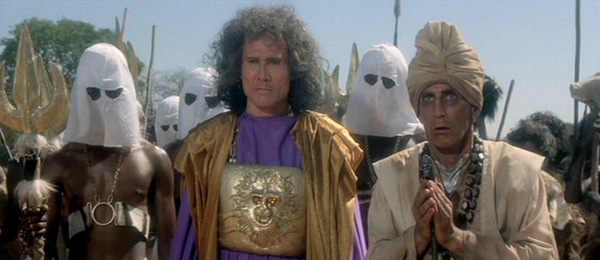
However, all is not well in the City of Gold.  Queen Nyelptha (Aileen Marson) is on the verge of going to war with Queen Sorais (Cassandra Peterson, a.k.a Elvira, Mistress of the Dark!!).  Manipulating both of the queens is the evil high priest, Agon (Henry Silva!!!!).  To save the City of Gold and his future marriage, Allan will first have to figure out a way to defeat Agon.

Allan Quatermain and the Lost City Of Gold was filmed back-to-back with King Solomon’s Mines.  The two films were released within a year of each other and, while King Solomon’s Mines was a minor box office success, Allan Quatermain and the Lost City of Gold was not.  I wasn’t expecting much when I watched the film but, believe it or not, Allan Quatermain and the Lost City of Gold is not that bad.  It’s a definite improvement on King Solomon’s Mines.  Richard Chamberlain is more believable as Quatermain in the sequel and he and Sharon Stone share the minimum amount of chemistry to be somewhat believable as a couple in love.  If that sounds like I’m damning with faint praise, it’s still an improvement over King Solomon’s Mines, where the two of them often seemed as if they couldn’t stand to be anywhere near each other.  Best of all, Allan Quatermain and the Lost City of Gold has Henry Silva in a ridiculous costume and that automatically makes the film worth watching.

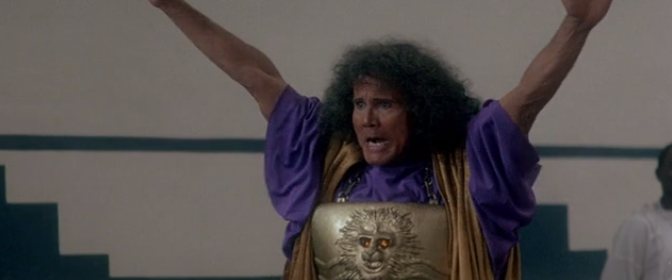
Henry Silva, everyone.

Like King Solomon’s Mines, Allan Quatermain and The Lost City of Gold adds a large dose of intentional humor to its adventure story.  Fortunately, the comedy here is better executed than in the previous film.  There’s less mugging on Chamberlain’s part and some of the dialogue is genuinely amusing.

Of course, Allan Quatermain and The Lost City of Gold is not without its flaws.  This is a low-budget Cannon film that often tries too hard to duplicate the success of the Indiana Jones films without ever showing much understanding of what made those films successful in the first place.  Allan Quatermain and the Lost City of Gold can’t hold a candle to the classic adventure films of the past.  But, for a low-budget Cannon film starring Richard Chamberlain as a rugged, jungle explorer, it’s actually a lot of fun.

Plus, did I mention Henry Silva?

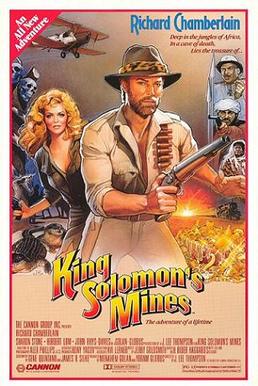
King Solomon’s Mines (1985, directed by J. Lee Thompson)


After her archaeologist father disappears while searching for the fabled mines of King Solomon, Jesse Houston (Sharon Stone) hires famed explorer Allan Quartermain (Richard Chamberlain) to help her find him.  After walking around in the jungle and exploring a nearby village, Allan and Jesse discover that her father has been kidnapped by a German military expedition who want to use King Solomon’s treasure to fund their war effort.  Working with the Germans is Allan’s old enemy, Dogati (John Rhys-Davies).  Allan and Jesse find themselves in a race against time to find the mines before the Germans.  Along the way, they steal an airplane, fight German soldiers on a train, and nearly get cooked alive in a giant cauldron.

Because this is a Cannon film and it was made at the height of Indiana Jones’s popularity and it stars John Rhys-Davies and it has a score that sounds like it was written by someone trying too hard to be John Williams, you might be tempted to think that King Solomon’s Mines is a rip-off of Raiders of the Lost Ark.  However, there are some crucial differences between Raiders and King Solomon’s Mines.  For instance, Raiders of the Lost Ark took place during World War II.  King Solomon’s Mines takes place during World War I.  Raiders of the Lost Ark had angels that melted a man’s face.  King Solomon’s Mines has a lava pit that makes you explode if you fall into it.  Raiders of the Lost Ark has a big fight in an airfield while King Solomon’s Mines has a big fight at an airfield …. well, wait, I guess they do have a few things in common.

Probably the biggest difference between Raiders of the Lost Ark and King Solomon’s Mines is that Raiders had Harrison Ford and Karen Allen while King Solomon’s Mines has to make due with Richard Chamberlain and Sharon Stone.  (If the imdb trivia section is to be believed, Sharon Stone was cast because Menahem Golan mistook her for Kathleen Turner.)  Along with generating zero romantic sparks, neither Chamberlain nor Stone come across as if they’ve ever even seen a jungle, much less explored one.  The only time that the two of them are credible as anything other than actors slumming on Cannon’s dime is when they’re yelling at each other.  There’s also a scene where they’re trying to steal an airplane and Chamberlain tells Stone to “reach between your legs and grab it.”  That was funny, I guess.

Along with trying to be an adventure, King Solomon’s Mines also tries to be a comedy.  As a general rule, Cannon films are great when they’re unintentionally funny but not so much when they actually try to be funny.  The film’s idea of comedy is Richard Chamberlain having to do an impromptu jig while someone shoots at his feet.  Add in a healthy dose of casual racism as Allan and Jesse run into a tribe in Africa who want to cook them in a giant stew pot and you’ve got a film so bad that you’ll hardly believe it could have been produced by the same people who gave us Delta Force, which is, of course, the greatest film ever made.

Golan and Globus had enough confidence in King Solomon’s Mines that they shot a sequel before the first film was even released.  Tomorrow, I will force myself to watch and review Allan Quartermain and The Lost City of Gold.  And, after that, I’ll probably go sit in a corner and think about what I’ve done.

Sahara (1983, directed by Andrew V. McLaglen)


The year is 1927 and famed automobile designer R.J. Gordon (Steve Forrest) dies before he can enter his latest creation into the Trans-African Auto Race across the Sahara Desert.  Wishing to keep her father’s dream alive and prove that she’s just as good a driver as the boys, R.J.’s daughter, Dale (Brooke Shields), enters the race in his place.  Since women are not legally allowed to compete, Dale has to pretend to be a man.  She does this by wearing a fake mustache, which she tosses off as soon she drives over the start line.  It has to be seen to be believed.

Dale and her team set out on the race and they quickly get caught up in a tribal war between two separate factions of Bedouins.  Dale is captured by the lascivious Rasoul (John Rhys-Davies), who attempts to have his way with her.  Fortunately, Dale is rescued by Rasoul’s nephew, Sheikh Jafar (Lambert Wilson).  Jafar is enchanted by Dale’s beauty and wants her to marry him.  Dale eventually agrees but, the morning after the wedding, she sneaks out of Jafar’s tent, jumps back in her car, and rejoins the race.  When she gets captured by the other Bedouins, they force her to stand on a rock while surrounded by panthers.  Like Brooke with a mustache, it has to be seen to be believed.

Sahara was produced by Cannon Pictures.  Menahem Golan, who gets a story credit along with his usual producers credit on this film, was a self-described fan of Rudolph Valentino and Sahara was his attempt to pay homage to Valentino’s performance in The Sheik, as well as cashing in on the adventure zeitgeist that had been launched by the box office success of Raiders of the Lost Ark.  With a budget of $15 million, Sahara was one of Cannon’s most expensive films and the end result was a mix of high production values and typical Golan-Globus goofiness.  The desert cinematography may be impressive but this is still a strangely old-fashioned movie starring Brooke Shields as a race car driver who speeds through the desert without once getting a hair out of place.  As attractive as she was, Brooke was never much of an actress and requiring her to show more than one emotion at a time, as Sahara often does, seems like the ultimate act of hubris.  Say what you will about the films that Cannon made with Bronson and Norris, the two Chucks always seemed like they were perfectly cast.  Shields also has no chemistry with Lambert Wilson, who looks embarrassed at having to pretend to be Rudolph Valentino.  On the plus side, Raiders of the Lost Ark alumni Rhys-Davies and Ronald Lacey are both present in the film and seem to know better than to take any of it seriously.  Rhys-Davies especially always seems to be on the verge of laughing at his terrible dialogue.

Though the view may be impressive, the script is bad and the lead actors are lost.  Avoid Sahara at all costs.