In 1957, the Commission — the governing board that regulated organized crime in America — seemed like it was on the very of collapsing. Bugsy Siegel was dead. Lucky Luciano had been exiled to Sicily. Meyer Lansky was more concerned with running his casinos in Cuba than with keeping track of who was angry with who in America. The ruthless Vito Genovese was moving in on everyone’s business and was suspected of being behind the assassination of Albert Anastasia and the shooting of Frank Costello.
Genovese, looking to solidify his control and perhaps bring some peace to the warring factions, called for a summit in upstate New York, at the estate of Joseph Barbara. Bosses from across the country gathered in Apalachin, New York. It started out as a nice weekend, with stories being told and fish being grilled. But then, suddenly, the cops showed up and 50 of the country’s most powerful mobsters made a run for it. Many of them ducked into the woods, where they were subsequently rounded up by the cops.
In the end, several mobsters were arrested and convicted of various crimes. All of those convictions were overturned on appeal. However, the arrests revealed to America that the Mafia wasn’t just an urban legend. Up until the bust at Apalachin, FBI director J. Edgar Hoover insisted that there was no such thing as the Mafia. After the bust, Hoover not only acknowledged that the Mafia existed but he also started a special division of the FBI to deal with it.
(Not that it did much good, of course. Being exposed still didn’t stop the Mafia from fixing the vote in Illinois during the 1960 presidential election.)
The 2019 film Mob Town details the events leading up to the Apalachin Conference. Robert Davi is properly intimidating as the ruthless Vito Genovese. The film’s director, Danny A. Abeckaser, plays Joseph Barbara while Jami-Lyn Sigler plays Barbara’s wife, tasked with putting together a dinner for a growing list of guests. Josephine Barbara goes from being happy about her husband working his way up the ranks of the mob to growing increasingly frustrated as the number of expected bosses rises from 30 to 50 and I have to say that I could very much relate to Josephine. Finally, David Arquette plays Edgar Croswell, the New York state trooper who figured out that something big was happening at the Barbara place. Croswell spends most of the film trying to get people to take him seriously. At the end of the film, he gets a congratulatory call from President Eisenhower. I’m enough of a history nerd that I appreciate any film that ends with a congratulatory call from President Eisenhower.
Mob Land was obviously made for a low-budget and it doesn’t always move as quickly as one might like. When Croswell isn’t trying to expose the mob, he’s pursuing a romance with Natalie (Jennifer Esposito) and Arquette’s permanently dazed expression doesn’t always make him the most convincing state trooper. It’s an uneven movie that traffics in almost every mob cliche but I can’t be too critical of it. Robert Davi was a more convincing Genovese than Robert De Niro was in Alto Knights. I appreciated the scenes of the Barbaras trying to get their place ready for the meeting. That was mob action to which I could relate.
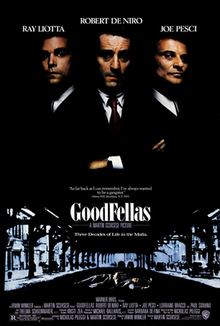
First released in 1990 and continuously acclaimed ever since, Goodfellas did not win the Oscar for Best Picture.
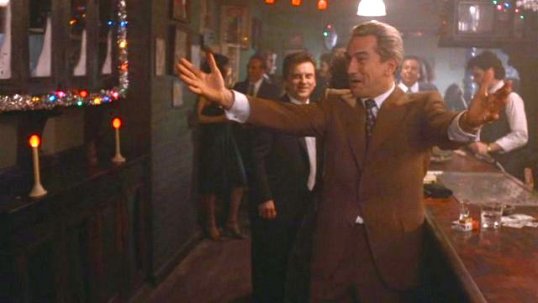
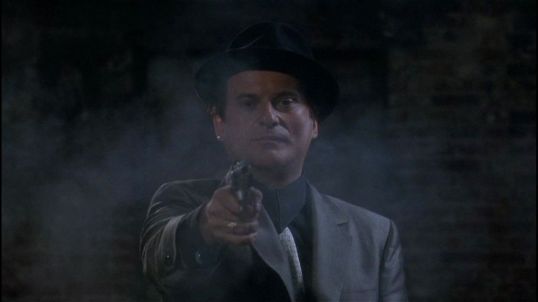
I’m always a bit surprised whenever I remember that. Goodfellas didn’t win Best Picture? That just doesn’t seem right. It’s not the other films nominated that year were bad but Goodfellas was so brilliant that it’s hard to imagine someone actually voting for something else. Seriously, it’s hard to think of a film that has been more influential than Goodfellas. Every gangster film with a soundtrack of kitschy tunes from the 6os and 70s owes huge debt to Goodfellas. Every actor who has ever been cast as a wild and out-of-control psycho gangster owes a debt to Joe Pesci’s performance as Tommy DeVito. When Ray Liotta passed away two years ago, we all immediately heard him saying, “I always wanted to be a gangster.” Robert De Niro’s Jimmy Conway remains the epitome of the ruthless gangster. For many, Paul Sorvino’s neighborhood godfather redefined what it meant to be a crime boss. Lorraine Bracco made such an impression as Karen Hill that it somehow seemed appropriate that she was one of the first people cast in The Sopranos, a show that itself would probably have not existed if not for Goodfellas. Frank Sivero, Samuel L. Jackson, Tobin Bell, Debi Mazer, Vincent Gallo, Ileana Douglas, Frank Vincent, Tony Sirico, Michael Imperioli, Tony Darrow, Mike Starr, Chuck Low, all of them can be seen in Goodfellas. It’s a film that many still consider to be the best of Martin Scorsese’s legendary career. Who can forget Robert De Niro smoking that cigarette while Sunshine of Your Love blared on the soundtrack? Who can forget “Maury’s wigs don’t come off!” or “Rossi, you are nothing but whore!?” Who can forget the cheery Christmas music playing in the background while De Niro’s Jimmy Conway grows more and more paranoid after pulling off the biggest heist of his career?
Plus, it’s a Christmas movie!
And yet, it did not win Best Picture.
Myself, whenever I’m sitting behind a garbage truck in traffic, I immediately start to hear the piano coda from Layla. For that matter, whenever I see a helicopter in the sky, I flash back to a coke-addled Henry Hill getting paranoid as he tries to pick up his brother from the hospital. Whenever I see someone walking across the street in the suburbs, I remember the scene where Henry coolly pistol-whips the country club guy and then tells Karen to hide his gun. I always remember Karen saying that she knows that many of her best friends would have run off as soon as their boyfriend gave them a gun to hide but “it turned me on.” It would have turned me on as well. Henry might be a gangster and his friends might be murderers but he doesn’t make any apologies for who he is, unlike everyone else in the world.
But it did not win Best Picture.
How many people have imitated Joe Pesci saying, “How am I funny?” How many times did Pesci and Frank Vincent have to listen to people telling them to “go home and get your fucking shinebox?” A lot of people remember the brutality of the scene where Pesci and De Niro team up to attack Vincent’s crude gangster but I always remember the sound of Donavon’s Atlantis playing on the soundtrack.
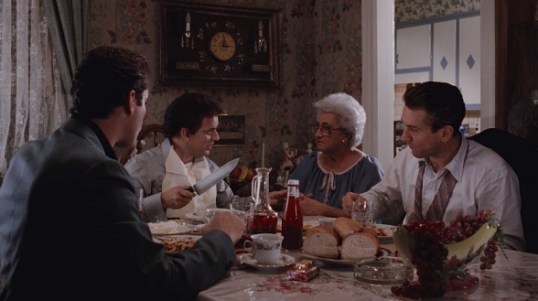
And then there’s Catherine Scorsese, showing up as Tommy’s mom and cooking for everyone while Vincent struggles to escape from the trunk of a car. “He is content to be a jerk,” Tommy says about Henry Hill. Just a few hours earlier, Tommy was apologizing to Henry for getting blood on his floor.
Goodfellas is a fast-paced look at organized crime, spanning from the 50s to the early 80s. Ray Liotta plays Henry Hill, who goes from idolizing gangsters to being a gangster to ultimately fearing his associates after he gets busted for dealing drugs. It’s a dizzying film, full of so many classic scenes and lines that it feels almost pointless to try to list them all here or to pretend like whoever is reading this review doesn’t remember the scene where the camera pans through the club and we meet the members of the crew. (“And then there was Pete The Killer….”) Goodfellas is a film that spend two hours showing us how much fun being a gangster can be and then thirty minutes showing us just how bad it can get when you’re high on coke, the police are after you, and you’ve recently learned that your associates are willing to kill even their oldest friends. No matter how many times I watch Goodfellas, I always get very anxious towards the end of the film. With the music pounding and the camera spinning, with Henry looking for helicopters, and with all of his plans going wrong over the course of one day, it’s almost a relief when Bo Dietl points that gun at Henry’s head and yells at him, revealing that Henry has been captured by the cops and not the Gambinos. Karen desperately running through the house, flushing drugs and hiding a gun in her underwear, always leaves me unsettled. It’s such a nice house but now, everything is crashing down.
There’s a tendency to compare Goodfellas to The Godfather, as their both films that re-imagine American history and culture through the lens of the gangster genre. I think they’re both great but I also think that they are ultimately two very different films. If The Godfather is sweeping and operatic, Goodfellas is the film that reminds us that gangsters also live in the suburbs and go to cookouts and that their wives take care of the kids and watch movies while the FBI searches their home. If The Godfather is about the bosses, Goodfellas is about the blue collar soldiers. The Godfather represents what we wish the Mafia was like while Goodfellas represents the reality.
Goodfellas is one of the greatest films ever made but it lost the Best Picture Oscar to Dances With Wolves, a film that left audiences feeling good as opposed to anxious. To be honest, Martin Scorsese losing Best Director to Kevin Costner feels like an even bigger injustice than Goodfellas losing Best Picture. One can understand the desire to reward Dances With Wolves, a film that attempts to correct a decades worth of negative stereotypes about Native Americans. But Scorsese’s direction was so brilliant that it’s truly a shame that he didn’t win and that Lorraine Bracco didn’t win Best Supporting Actress. It’s also a shame that Ray Liotta wasn’t nominated for playing Henry Hill. At least Joe Pesci won an Oscar for redefining what it meant to be a gangster.
Goodfellas is proof that the best film doesn’t always win at the Oscars. But it’s also proof that a great film doesn’t need an Oscar to be remembered.
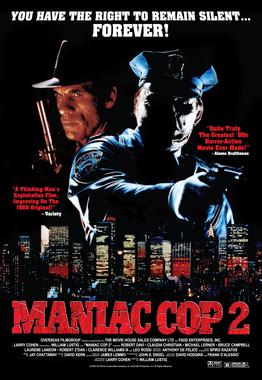
Maniac Cop 2 picks up where the first Maniac Cop ended.
The NYPD thinks that the undead maniac cop Matt Cordell (Robert Z’Dar) has been destroyed but he is actually still alive and killing civilians and cops in New York. He has even teamed up with a serial killer named Steven Turkell (Leo Rossi, ranting and raving like a pro). Jack Forrest (Bruce Campbell) and Theresa Malloy (Laurene Landon) both return from the first film but both of them are killed by Cordell before the movie is even halfway over. Maniac Cop 2 is not playing around.
With Jack and Theresa gone, it falls to Detective Sean McKinney (Robert Davi) and Officer Susan Riley (Claudia Christian) to discover what the rest of the audience already knows, that Cordell is seeking revenge against the system that abandoned him in prison. The new police commissioner, Ed Doyle (Michael Lerner), is determined to cover up what happened but Cordell is even more determined to have his vengeance. Working with Turkell, Cordell heads to the prison where he was unjustly incarcerated and murdered.
Maniac Cop 2 is a marked improvement on the first film. Cordell is no longer a lumbering and slow monster. He is now a ruthless, Terminator-style executioner who, in the film’s best-known scene, wipes out an entire police precinct in a matter of minutes. Cordell is so ruthless that he won’t even stop when he’s on fire. His partnership with Turkell adds a new twist to the Maniac Cop saga. Turkell views Cordell as his partner-in-crime but Cordell is only interested in getting his revenge. (Turkell was originally meant to be Frank Zito, the main character from Lustig’s Maniac. When Maniac star Joe Spinell died before shooting began, the role was changed to Leo Rossi’s Steven Turkell.)
Stepping into the shoes of the main investigation, Robert Davi gives one of his best performances. As opposed to the boring heroes of the first film (sorry, Bruce!), Davi’s Sean McKinney is just as obsessive and ruthless as Cordell. Cordell sets fire and McKinney uses those fires to light his cigarettes.
William Lustig has described Maniac Cop 2 as being his best film and he’s probably right. It is definitely the best of the Maniac Cop films and the only one to fully take advantage of its premise.
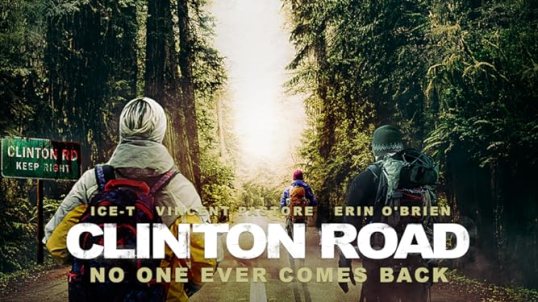
2019’s Clinton Road features what might be my favorite Eric Roberts cameo appearance.
Roberts appears standing outside a club in New Jersey. He’s speaking to the woman who is working the door and trying to convince her that he should be allowed into the club, even though she doesn’t think that he’s on the list. He explains that he’s Eric Roberts. The woman replies that he’s not the Eric Roberts that she knows but then, suddenly, she realizes that he is Eric Roberts the movie star! She apologizes profusely. Eric says its okay and gives her a fist bump. Everyone waiting to get into the club applauds.
Seriously, that is the extent of Eric Roberts’s role in Clinton Road. It comes out of nowhere and it has nothing to do with the actual plot of the film. Why is Eric Roberts waiting outside of some club in New Jersey? Who knows? He’s just there and he’s a cool dude and everyone loves him. As with so many of his cameos, one gets the feeling that Roberts just happened to see some people shooting a movie and he decided to be a part of it.
Eric Roberts is not the only well-known actor to make a brief appearance in Clinton Road. The film itself was directed by actor Richard Grieco and it’s obvious that he asked some of his well-known friends to help out. The manager of the club is played Ice-T and he shows up long enough to tell the urban legend of the vanishing hitchhiker. The owner of the club is Vincent Pastore, who played Pussy on TheSopranos. Private investigator-turned-character actor Bo Dietl shows up, playing the mayor of the town and barking orders at people. Everyone gets a chance to be, at least briefly, the center of attention but none of them play characters who actually have anything to do with the film’s main story.
That story is about Michael (played by former American Idol contestant, Ace Young), a fireman whose wife disappeared while walking down Clinton Road, a haunted rural road in New Jersey. (For the record, Clinton Road is real and, as this film states, it’s the center of many urban legends.) Michael is ready to move on and marry his new girlfriend, Kayla (Lauren LaVera). However, Michael’s former sister-in-law, Isabella (Katie Morrison), convinces Michael to go out to Clinton Road with her and make one last effort to contact his wife’s spirit. Accompanying them is a medium named Begory (James DeBello), Begory’s girlfriend, Gianna (Erin O’Brien), and Michael’s brother, Tyler (former Big Brother houseguest Cody Calafiore). Tyler is loudly skeptical of Begory’s claims to be able to speak to the dead but it soon becomes clear that the group is not alone on Clinton Road.
To my surprise, I ended up liking Clinton Road. It’s a very low-budget film and the plot doesn’t always make sense but it was obviously made by people who both loved New Jersey and who loved the legends that have sprung up around Clinton Road. The atmosphere was ominous, the imagery was often surreal, and, when they did appear, the spirits were effectively creepy. The fact that the characters all had an attitude that was more appropriate to The Sopranos than to a standard lost-in-the-woods horror film only served to make the film all the more entertaining. If you’re going to set your horror film in New Jersey, you might as well go all out and make the most New Jersey horror film imaginable.
I enjoyed this film. I just hope Eric Roberts didn’t make the mistake of turning down Clinton Road on his way home.
Previous Eric Roberts Films That We Have Reviewed:
Suck it, The Big Short. The Wolf of Wall Street is the best film to be made about Wall Street this century.
Martin Scorsese’s 2013 financial epic tells the true story of a group of rather sleazy people who got rich and who basically, to quote Robert De Niro from an earlier Scorsese film, “fucked it all up.” Jordan Belfort (Leonardo DiCaprio, giving what I still consider to be the best performance of his career) is the son of an accountant named Max (Rob Reiner). Fresh out of college, Jordan gets a job on Wall Street. Under the mentorship of the eccentric (but rich) Mark Hanna (Matthew McConaughey), Jordan discovers that the job of a stock broker is to dupe people into buying stock that they might not need while, at the same time, making a ton of money for himself. With the money comes the cocaine and the prostitutes and everything else that fuels the absurdly aggressive and hyper-masculine world of Wall Street. Jordan is intrigued but, after the stock market crashes in 1987, he’s also out of a job.
Fortunately, Jordan is never one to give up. He may no longer be employed on Wall Street but that doesn’t mean that he can’t sell stocks. He gets a job pushing “penny stocks,” which are low-priced stocks for very small companies. Because the price of the stock is so low, the brokers get a 50% commission on everything they sell. Because Jordan is such an aggressive salesman, he manages to make a fortune by convincing people to buy stock in otherwise worthless companies. As Jordan’s boss (played, in an amusing cameo, by Spike Jonze) explains it, what they’re doing isn’t exactly regulated by the government, which just means more money for everyone! Yay!
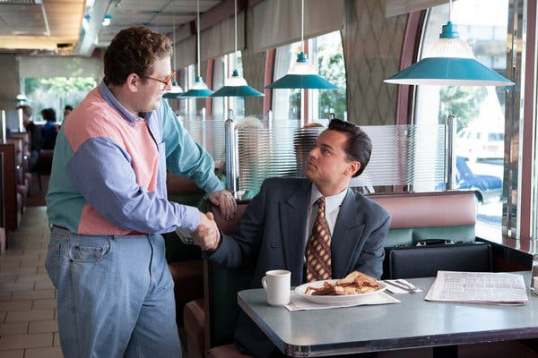
Working with his neighbor, Donny Azoff (Jonah Hill, at his most eccentric), Jordan starts his own brokerage company. Recruiting all of his friends (the majority of whom are weed dealers who never graduated from high school), Jordan starts Stratton Oakmont. Using high-pressure sales tactics and a whole lot of other unethical and occasionally illegal techniques, Jordan soon makes a fortune. When Forbes Magazine publishes an expose that portrays Jordan as being little more than a greedy con man, Stratton Oakmont is flooded by aspiring stock brokers who all want to work for “the wolf of Wall Street.”
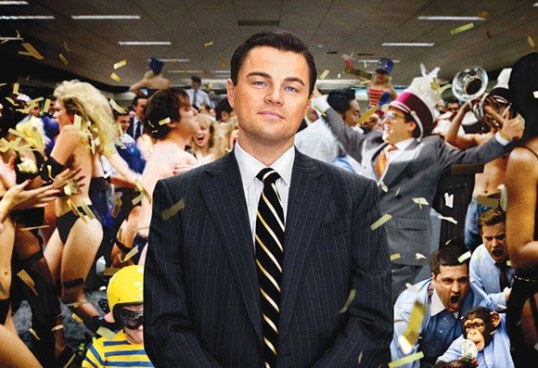
And, for a while, Jordan has everything that he wants. While the Stratton Oakmont offices become a den of nonstop drugs and sex, Jordan buys a huge mansion, a nice car, and marries a model named Naomi (Margot Robbie). His employees literally worship Jordan as he begins and ends every working day with inspirational (and often hilariously profane) sermons, encouraging his people to get out there and sell no matter what. Of course, making that much money, Jordan has to find a way to hide it from the IRS. Soon, with the help of Naomi’s aunt (Joanna Lumley), he is smuggling millions of dollars into Switzerland where a banker (Jean Dujardin, who is both hilariously suave and hilariously sleazy a the time) helps him hide it all.
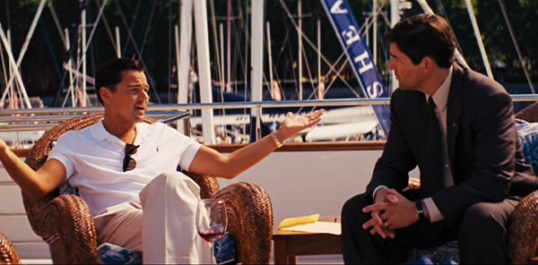
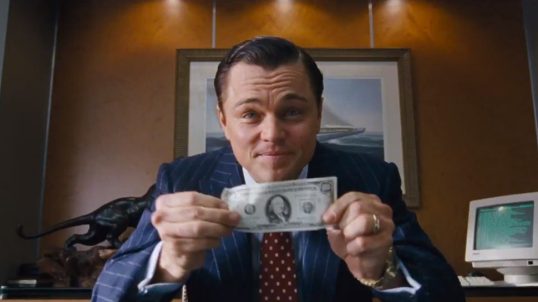
When Jordan learns that the FBI and SEC are looking into his dealings, Jordan invites Agent Patrick Denham (Kyle Chandler) to come visit him on his yacht and, in a scene that launched a thousand memes, the two of them have a friendly conversation that’s largely made up of passive aggressive insults. Jordan taunts Denham over the fact that Denham washed out when he tried to get a job on Wall Street. Denham laughingly asks Jordan to repeat something that sounded like it may have been a bribe. When Denham leaves the boat, Jordan taunts him by tossing a wad of hundred dollars bills into the wind….
And here’s the thing. Yes, the media and our political class tells us that we’re supposed to hate that Jordan Belforts of the world. One can imagine Bernie Sanders having a fit while watching Jordan brag about how he cheated the IRS. If Adam McKay or Jay Roach had directed this film, one can imagine that they would have used the yacht scene to portray Jordan Belfort as pure evil. (McKay probably would have tossed in Alfred Molina as a waiter, asking Belfort if he wants to feast on the lost future of the children of America.) But the truth of the matter is that most viewers, even if they aren’t willing to admit it, will secretly be cheering for Jordan when he throws away that money. DiCaprio is so flamboyantly charismatic and Scorsese, as director, so perfectly captures the adrenaline high of Jordan’s lifestyle that you can’t help but be sucked in. He may be greedy and unethical but he just seems to be having so much fun! Just as how Goodfellas and Casino portrayed life in the mafia as being an intoxicating high (as well as being more than a little bit dangerous), The Wolf of Wall Street refrains from passing easy judgment and it steadfastly refuses to climb onto a moral high horse. Jordan narrates his own story, often talking directly to the camera and almost always defending his actions. As a director, Scorsese is smart enough to let us make up own minds about how we feel about Jordan and his story.
Of course, when Jordan falls, it’s a dramatic fall. That said, it’s not quite as dramatic of a fall as what happened to Ray Liotta in Goodfellas or Robert De Niro in Casino. No one gets blown up, for instance. But Jordan does lose everything that gave his life meaning. By the end of the film, he’s been reduced to giving seminars and challenging attendees to sell him a pen. (“Well,” one hapless gentleman begins, “it’s a very nice pen…..”) During the film’s final scenes, it’s not so much a question of whether Jordan has learned anything from his fall. Instead, the movie leaves you wondering if he’s even capable of learning. At heart, he’s the wolf of Wall Street. That’s his nature and it’s really the only thing that he knows how to do. He’s a bit like Ray Liotta living in the suburbs at the end of Goodfellas. He’s alive. He has his freedom and a future. But he’s still doesn’t quite fit in. Much like Moses being denied the opportunity to physically enter the Promised Land, Jordan’s punishment for his hubris is to spend his life in exile from where he truly belongs. And yet, you know that Jordan — much like Henry Hill — probably wouldn’t change a thing if he had the chance to live it all over again. He’d just hope that he could somehow get a better ending while making the same decisions.
Unlike something like The Big Short, which got bogged down in Adam McKay’s vapid Marxism, The Wolf of Wall Street works precisely because it refuses to pass judgment. It refuses to tell us what to think. I imagine that a lot of people watched The Wolf of Wall Street and were outraged by the way Jordan Belfort made his money. I imagine that an equal number of people watched the film and started thinking about how much they would love to be Jordan Belfort. The Wolf of Wall Street is a big, long, and sometimes excessive film that dares the audience to think of themselves. That’s one reason why it’ll be remembered after so many other Wall Street films are forgotten.
The Wolf of Wall Street was nominated for best picture of the year. It lost to 12 Years A Slave.

 Through the Shattered Lens