Titanic In Retrospect


Recently, I tried to rewatch an obscure art film from 1997 called Titanic.  From the time I was 12 until I was 16, I watched this movie a lot and, without fail, I cried and cried at the movie’s end.  (Admittedly, it was pretty easy to make me cry back then.)  I decided to rewatch it because I was curious as to whether or not Titanic could still make me cry. 

For those of you who aren’t into art films, here’s a quick synopsis and review of Titanic.

The film’s plot: Bill Paxton and an obnoxious fat guy are held hostage on a submarine by a senile old biddy who insists on telling them the story of how she lost her virginity 98 years ago.

Meanwhile, in London, Leonardo DiCaprio steals some poor kid’s sketch book and then sneaks onto a cruise ship where, pretending to be an artist, he seduces and murders lonely widows. 

Also on the cruise ship is Kate Winslet.  Kate’s engaged to Billy Zane but she’s unhappy about it because — well, there’s some men you fuck and there’s some men you marry and let’s just say that you don’t marry Billy Zane.  Once the boat sets sail, Kate decides to jump overboard.  However, just before she can jump, she’s spotted by Leo.  Leo quickly tosses a burlap sack containing the corpse of Lady Astor into the Atlantic and then rescues Kate.

Kate rewards him by taking him down to her cabin and showing him a painting by Someone Picasso.  (Early on in the film, Billy correctly says that Someone Picasso will never amount to anything and that’s true.  Someone was always overshadowed by his older brother Pablo.)  Leo looks at the painting and says, “Look at what he does with color here.”  As a former Art History major, that line made me smile.  That’s the type of statement that is regularly uttered by people who can’t think of anything else to say.  When a guy looks at a painting and says, “Look at what he does with color here,” what he’s actually saying is, “Look, babe, I went to the damn art museum with you so there better be a blow job in my immediate future.”

Leo has dinner with Billy and Kate.  Leo says, “I’m just a tumbleweed blowing in the wind.”  Over at the next table, a shifty young man named Bob Dylan overhears and thinks, “That would make a good song.  But the little man must die so nobody knows I stole that line from him…”

Anyway, Leo eventually slips Kate a rohypnol, convinces her to pose naked while he secretly tapes her for Youtube, and then proceeds  to have sex with her in the back seat of a car.  Afterward, Kate says, “Do you want to hang out tomorrow?”  Leo replies, “Uhmm…I might be busy.  I’ll call you.”  “My God,” I said as I watched all this, “it’s like reliving my freshman year of college all over again.”

Anyway, 8 more hours pass.  All the rich passengers on the ship do rich things while all the poor passengers get drunk and trash the lower levels of the boat.  Suddenly, without warning, the boat is besieged by the living dead.  Billy Zane insists that they would be safer in the basement.  Leo disagrees while Kate says, “So, you think you can just fuck me and leave!?  No way!”

12 more hours pass.  The living dead manage to rip a hole in the side of the boat.  Billy chases Leo and Kate around the Titanic as it sinks.  “I hope you’ll be very happy together!” he screams.  Meanwhile, up top, two rich guys put on tuxedos and one of them says something like, “We’re going to die like gentlemen.”  Which I guess is what they end up doing though, honestly, it sounds to me like the guy’s just being a smartass.

Eventually, Kate and Leo end up sitting on an iceberg together.  Kate wonders if this is a dream.  Leo proceeds to spin a top on the ice to find out.  Suddenly, Bob Dylan floats by in a rowboat.  “This machine kills fascists!” he shouts as he shoots Leo with a crossbow.  Leo sinks into the water.  Bob Dylan smirks.  “How does it feel to be on your own?” he asks.

The end.

A quick review: I guess the easiest way to review Titanic is to answer my original question.  Does the film still make me, at the age of 24, cry like it did when I was 12?  No, it does not.  To be honest, the only tears that I shed while rewatching Titanic were tears of shame and boredom.  This is the movie that I once thought was the greatest thing ever?  True, I was young and stupid but still…

On the plus side, Kate Winslet gives a good performance even if her character is basically just a sexist male fantasy.  Billy Zane is also a lot of fun as her jilted suitor.

On the negative side, there’s everything else.  The script — written by Someone Cameron — is full of laughably bad lines and plotwise, the film has all the depth of a lanced boil.  The romantic elements of the plot made me cry back when I was 12 because I didn’t have a whole lot of real world experience to compare Titanic’s fantasy against.  Now, at the age of 24, I’ve actually had to deal with my fair share of guys who say actually do make dumbfug statement about things like being a tumbleweed blowing in the wind (not to mention being king of the world).  I’m not saying that a good movie can’t present a romantic idealization of reality.  I’m just saying that a good movie can do that without insulting the viewer’s intelligence like Titanic does.

One last note — Leo DiCaprio has become a great actor.  But, in Titanic, he just comes across like a shrill poseur.

I Learned Something Today Conclusion: Just because you and a million others think that a movie is great today, that doesn’t mean that the movie’s going to be anywhere near as good 12 years later.  In this age of Avatar and the Social Network, that’s a lesson that I think many self-appointed film “gurus” would do well to consider before they throw a hissy fit just because a complete stranger on the Internet disagrees with them.

Avatar 2: Na’vi Holocaust


Dear James Cameron,

Hi, my name is Lisa Marie Bowman and I hate just about every movie you’ve ever made.  Well, that’s not totally true.  First off, I haven’t seen every movie you’ve ever made.  And I have to admit that when I was 12, I would cry and cry whenever I saw Titanic.  So, let’s just say that I hate Avatar and I thought it was kinda fun to watch your ex-wife kick your ass at the Oscars earlier this year.

From my research, it appears that you take issue with people who disagree with you or who dare to suggest that you might not be the greatest filmmaker since DeMille.  So, let me just add that this letter is being written by me and me only.  When you send out your army of Orcs to punish the heretic at Through The Shattered Lens, they need only come for me.  I may think you’re just a cranky, old dumbfug toadsucker but that’s my opinion and mine alone.

See, here’s what Arleigh had to say about Avatar.

And here’s what I said.

See, good people can have differing opinions.  Unfortunately, just judging from some of your comments in the past, I don’t think you quite understand that.  Maybe that explains why, rather than defend your movie, you always seem to end up accusing your critics of supporting global warming and the war in Iraq.  Maybe that’s why the few Oscars that Avatar won were all accepted by balding little eunuchs who spent their whole acceptance speech praising your name as if they knew that if they didn’t, you’d end up going all psycho killer on them.

But I’m getting off topic.

This letter was inspired by the news that you’re apparently planning on setting the sequel to Avatar underwater.

Wow, that sounds really, really …. boring.

Listen, James, I’m going to help you out.  Here’s my plotline for Avatar 2, which, trust me, is a lot more interesting than anything you’re planning on doing.

The film opens on Earth.  As you explained in the first film, there “is no green” on Earth.  But there are television networks and there are documentary crews.  One of these networks has recently sent a group of young filmmakers to Pandora.  Their assignment?  To track down the Na’vi and to make a documentary about these “brutal savages” and their life on the green hell that is Pandora.

(Yes, James, this film is a prequel.  Perhaps you could have Jake’s brother getting murdered in the background of one of the opening New York City shots.)

However, a week after the documentary crew first arrived on Pandora, all contact with them has been lost.  The television networks hires a portly anthropology professor to go to Pandora and find out what has happened.  Before the professor leaves on his mission, he is informed that the documentarians frequently staged the very atrocities that their films are known for.

Our anthropology professor — let’s call him Nick, since I know you like to dumb things down — goes to Pandora.  With the help of a native guide, he manages to track down the Na’vi and win their trust.  Taken to the Na’vi village, he discovers that the remains of the documentary crew are hanging from the Soul Tree.  He realizes that they were captured and eaten by the Na’vi.  However, the Na’vi did not destroy any of the film crew’s cameras.  The footage of their final days in the jungles of Pandora has been preserved.  Nick steals the footage and manages to make it back to “civilization” even as hordes of angry Na’vi chase after him (not mention Sigourney Weaver who can do a cameo somewhere around here).

While all this is going on, the film will occasionally pause to show grainy stock footage of various jungle animals being killed in various sickening ways.

Nick returns to Earth with the film.  Sitting in a dark theater with the television executives, Nick views the footage.

Now, James, this is the tricky part.  The “found footage” will dominate the last 40 minutes of Avatar 2.  It’s important that the footage look so authentic that, for decades after, various dumbfugs will swear that they’re watching actual footage of actual people being eaten on camera.  So, you’re going to have to abandon the 3-D for this part of the film.  Instead, you’ll have to develop a multi-billion dollar process that will make the film look damaged.  I’m talking about random scratches, unsynchronized sound, solarization, the whole deal. 

As for the footage itself, this is what will make Avatar 2 special.  We’ll see how the documentary crew staged “reality.”  We’ll watch as they set a Na’Vi village on fire and how they arrogantly assumed that they’re superior to the natives.  Finally, however, the Na’Vi will strike back and, in the film’s final moment, we’ll watch as the documentarians are eaten by the Na’Vi while their own cameras silently record the massacre.

We’ll call it Avatar 2: Na’Vi Holocaust.

I think it could be a winner.

Love,

Lisa Marie

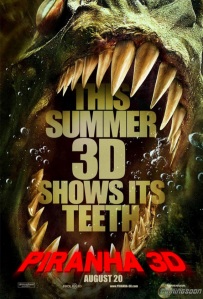
Review: Piranha 3-D (directed by Alexandre Aja)


Yesterday, I had two concerns about going to see the new horror film, Piranha 3-D.

First off, I know that 3-D has been hailed as “the future of movies” and that apparently, Webster’s is considering whether to recognize 3Dgasm (which is the response that certain film goers have to 3-D regardless of whether the movie itself is actually good or if it’s just Avatar) for inclusion in the next edition of the dictionary.  However, 3-D often makes me sick to my stomach and I mean that literally.  3-D makes me feel car sick.  Considering that I love movies, if 3-D is the “future” than I’m probably being punished for something.  That’s right.  Avatar was just a result of my bad karma. 

As for the second concern, I can’t swim and I am terrified of being underwater.  Hanging onto the edge while wading in the shallow side of my uncle’s swimming pool is about as submerged as I can get without having a major freak out.  It’s not just drowning that scares me.   When I was 17, my family spent the summer in Hawaii and my sisters (being the meanies that they are) had a lot of fun with the fact that I’d spend hours lying out on the beach but I refused to even step into the ocean.  It made sense to me.  There were jellyfish and sharks and those weird little black coil things just floating around in the ocean.  Thanks to seeing Piranha 3-D, I now know that there are also cute little fish that will eat you.

I dealt with my fear of the water by asking my sister Erin (who can actually swim because she’s cool and I’m not) to see the movie with me and to keep me calm if I started to have a panic attack.  She agreed and she did an admirable job.  She also helped me deal with my fear of 3-D when, during the coming attractions, she said, “Why don’t you take a Dramamine?”  Now, according to Erin, the only reason she said this was because apparently I was “going on and on” about it.  That’s not how I remember it but I just happened to have some Dramamine in my purse and I quickly popped a few.

If you’ve ever taken Dramamine then you know the way that it works is by basically kicking your ass until you pass out for a few hours.  (I occasionally resort to using it whenever I’m getting hit with insomnia.)  Within minutes of taking it, the Dramamine was saying, “Sleep, Lisa…”  “But I want to see the movie,” I replied.  “That wasn’t a request,” the pill responded.  “Dammit, will you two shut up!?” Erin snapped.  (That may have not actually happened.) 

The point of all this is that I stayed awake through the entire movie, despite having taken the most powerful sleeping pill in existence.  True, my mind did go a little bit goofy (Erin says I was “babbling” through the entire film) but it never shut down.  That’s the type of movie Piranha 3-D is.  The story moves so quickly and the mayhem is so over-the-top and excessive that the brain never gets a chance to relax enough to check out.

Piranha 3-D begins with an earthquake in Arizona.  The earthquake opens up a passageway to an underground lake.  As look would have it, the underground lake is full of a bunch of prehistoric piranha.  These piranha quickly move up to an above-ground lake where they promptly eat Richard Dreyfuss.  Having gotten a taste of Dreyfuss, they apparently decide to eat every other human being they come across and who can blame them?

Actually, the bloody and graphic demise of Richard Dreyfuss was the first clue I had that this film was going to work.  Needless to say, Dreyfuss is the last surviving star of the original killer fish movie, Jaws.  In Jaws, Dreyfuss is plays a character named Matt Hooper.  In Piranha, he’s just named Matt.  By introducing him and then promptly killing him off, Piranha lets us know that it understands the legacy of previous horror blockbusters (like Jaws) but that it has no intention of respecting it.  In other words, this scene lets us know early on that the film is on the side of the fish.

Anyway, it turns out that its spring break and as a result, Lake Victoria, Arizona is full of stupid, drunken college students who are determined to hang out in the water no matter how many people get eaten.  Sheriff Julie Forrester (Elisabeth Shue) struggles to maintain order on the streets with the help of her loyal deputy (a very likeable Ving Rhames).  Julie is also a single mother and, the morning after ol’ Richard Dreyfuss gets devoured, her oldest son Jake (Steven R. McQueen, grandson of the star of Enemy of the People) blows off his baby-sitting duties and agrees to help sleazy Derrick Jones (Jerry O’Connell) film the latest installment of Girls Gone Wild on the lake.  Sleazy, speedo-clad Derrick (and the fact that O’Connell looks really good in it doesn’t make that red speedo any less ludicrous) attempts to initiate Kelly (Jessica Szhor), the “good” girl who Jake likes into the world of straight-to-video, jailbait porn.  Kelly, by the way, kinda has a boyfriend, a guy named Todd who will eventually end up killing a lot of people with a motorboat.  Even before this, we know he’s a bad guy because he’s named Todd.  Nobody named Todd or Tad is ever good in a horror movie.

Director Alexandre Aja doesn’t take much time introducing his cast of characters and he takes even less time in letting the fish devour them.  So, no, the characters aren’t exactly all that developed.  But it doesn’t matter really.  With what little they have to work with, the cast works wonders.  They know exactly what type of film that they’re in and they know why they are there and they embrace their roles as piranha fodder with an impressive sense of commitment.  Best of all is O’Connell who turns sleazy, coke-fueled egomania into some sort of art form.

The real star of the film, of course, is director Alexandra Aja who takes a mainstream genre piece and who, much like his fellow French director, Jean Rollin, transforms it into a piece of pure grindhouse exploitation.  Aja may use the clichés of the genre but he never blindly embraces them.  Instead, he uses them to comment on both the genre and the audiences expectations of what those cliches mean.  Aja takes everything we’ve come to expect — the blood and gore, the standard plot device of Shue’s children being stranded out on the lake, and the sudden death of nameless extras — and he then pushes them just a little further than the audience is expecting,  As a result, he not only comments on those expectations but he forces the audience to question them as well.

This is never more apparent than in the film’s climatic piranha attack.  This is when the piranha finally get around to attacking all of the swimmers at once.  This is the scene that we all know is coming and that we’ve all been expecting and Aja does not disappoint.  Things start out as you might expect.  Close-up of bikinis.  Drunk idiots in the water.  A wet t-shirt contest.  Rhamas and Shue come up in a boat and start yelling, “Everybody out of the water!”  Because they’re a bunch of drunk dumbfugs, everyone responds by jumping into the water.  Cut to an ominous piranha point-of-view shot.  Suddenly, one woman — floating out in an inntertube — shouts, “Something bit me!”  And suddenly, all Hell breaks loose.

This is the scene you knew was coming and you’ve seen it a hundred times before.  What makes it memorable here is just how far director Aja takes things.  These fish don’t just bite their victims.  They literally devour them while the camera lingers over every piece of flesh that floats through the ocean.  As everyone struggles to get out of the water, they get their skulls split open by passing boats.  In the background, we see various feet, hands, and other body parts randomly floating in the water.  One older man pulls his friend’s torso onto the beach and cradles it while screaming, “I love you, man!  I love you!”  As Shue tries to pull people out of the water, we see a teenager that’s already on the boat start to shake as his life expires.  As I mentioned before, Todd tries to escape by forcing his motorboat through the crowd of terrified swimmers and graphically dismembers a lot of people in the process.  It’s an incredibly graphic sequence, one that starts out as fun but which just keeps going and going,  Director Aja understands that the audiences is expecting — probably even looking forward to — seeing a little blood.  So, instead he assaults us with a lot of blood and he does so in such a way that the audience is forced to question why a little blood is fun but a lot of blood is disturbing.  It’s as if Aja is saying, “You wanted to see people die, well — here they are, dead.  You feel better now?”

As for the 3-D, Aja proves himself to be one of the few filmmakers to understand that 3-D is not the future of movies.  It’s just another gimmick to be exploited and exploit it he does.  However, he does so brilliantly and he is so shameless about it that watching Piranha 3-D simply serves to reiterate just how silly the whole 3-D craze really is.  Every short is a tracking shot.  The CGI piranha float across the screen, stopping momentarily to stare straight out at the audience and almost wink.  The men in the audience seemed to be especially happy about all the boobs that literally seem to swing out of the screen and across the theater but they were a bit less enthused when a disembodied penis came floating out of the screen.  By not only fully embracing the ludicrous possibilities of 3-D but by also doing so without any shamefaced attempts to justify its use, Piranha 3-D is perhaps the greatest 3-D movie ever made.

Del Toro and Cameron to Climb “The Mountains of Madness”


It looks like the unnamed horror project Guillermo Del Toro was quite coy about during this past week’s San Diego Comic-Con may turn out to be one of his dream projects finally getting a chance to be up on the big-screen. Mike Fleming over at Deadline has reported that Del Toro’s next directing project since leaving The Hobbit will indeed be his long-gestating project to adapt H.P. Lovecraft’s classic scifi novella, At The Mountains of Madness.

He will not be going alone in this project as best buddy and confidant James Cameron has also joined Del Toro on his dream project as producer. Fresh off of the humngous success of Avatar has made Cameron the King of Hollywood once again and his name and clout should be able to give Del Toro the necessary muscle to get Universal not just to move the project forward but give Del Toro the budget he wants and the hands-off treatment he works best under.

Fleming also reports that the film will be in 3D which makes sense with Cameron being on-board and someone who can give Del Toro all the assistance he needs with the 3D tech Cameron has developed from his work with Avatar. The fact that Cameron will let his name be used in the promoting of the film speaks volumes as Cameron is known to be very choosy as to which projects he lends his name out to that he doesn’t direct.

There will be some moans and groans to the mention of 3D. Del Toro has never dismissed 3D, but didn’t see himself as having a particular project that worked best with it. Like any visually-gifted filmmaker, Del Toro knows how to use the tools of his trade both new and old so I don’t think Cameron’s 3D film-tech will be something he wouldn’t want to try out. Plus, if there was ever a story to be adapted onto the big-screen that would not just work well with Cameron’s 3D tech but also look beautiful it would have to be a Lovecraft tale and especially one with a setting and plot that’s not just epic but cosmic in scale. From the massive vistas of the non-Euclidean structures of the Elder Gods to the Plateau of Leng which may or may not have been the base for Cthulhu and his Star-spawns. Plus, we can’t forget the amorphous beings the “Shoggoths” which definitely would become even more terrifying in 3D.

I really hope that this project moves forward and with the speed with which Del Toro works I won’t be surprised if during San Diego Comic-Con in 2011 we get to see good footage of the film as a sneak-peek for a 2012 release.

Source: Deadline

2010: The Year In Film So Far


Everyone views history in their own individual way.  Some people remember past years by what they saw on the evening news (hence, 2004 becomes “the year Bush was reelected”) but I define them by what was playing at the nearest movie theater.  Ask me when I was born and I won’t tell you, “1985.”  Instead, I’ll tell you that I was born the same year that Terry Gilliam’s Brazil was butchered by Sid Shienberg.  For me, the quality of a year is determined by the quality of the movies that were released during those twelve months.  You may have hated 2009 because of the economy.  I hated it because it was the year of the overrated movie, the year in which otherwise sensible people ignored great films like An Education, A Serious Man, District 9, and Inglorious Basterds (which, praised as it was, deserved considerably more) in favor of Avatar and The Hurt Locker.

2010, however, is shaping up to be a far better year.  Though a final judgment can’t be passed on 2010 until 2011, here’s a few thoughts on the year so far.

Best Film (so far): Exit Through The Gift Shop, a quasi-documentary that might just be one of the most perfectly executed mindfucks in modern history.  Runners-up: The Girl With The Dragon Tattoo, Fish Tank, Please Give, Winter’s Bone, A Prophet, Toy Story 3, and Inception.

Best Male Performance of the year so far: John Hawkes, in Winter’s Bone.  Hawkes has been overshadowed by Jennifer Lawrence but he dominates every scene that he appears in.  Just consider the scene where he “talks” his way out of a traffic stop. Runners-ups: John C. Reilly in Cyrus, Ben Stiller in Greenberg, Leonardo DiCaprio in Inception and Shutter Island, and Sam Rockwell in Iron Man 2.

Best Female Performance of the year so far: Noomi Rapace as the Girl With The Dragon Tattoo and The Girl Who Played With Fire.  Rapace is my new role model, a Ms. 45 for the 21st century.  Runners-up: Jennifer Lawrence in Winter’s Bone, Katie Jarvis for Fish Tank, Rebecca Hall in Please Give, Greta Gerwig in Greenberg, and Chloe Grace Moretz in Kick-Ass.

Best Ending: The final shot of Inception.

Best Horror Film: The Wolf Man, which should have been oh so bad but instead turned out to be oh so good with Anthony Hopkins and Hugo Weaving both giving brilliant supporting performances. 

Best Bad Movie: Sex and the City 2.  Yes, if I’m going to be honest, it was a horrible movie.  But it was fun. the clothes were to die for, and the film managed to bring new depths of shallowness to the examination of the oppression of women in the Middle East.

Worst Film Of The Year (so far): Chloe.  Oh, Atom Egoyan, poor baby, what have you done, sweetheart?  You made a trashy, campy softcore movie and then you forgot that these things are supposed to be fun!  Runner-up: Robin Hood, because the entire freaking movie was a lie.  However, it did feature Oscar Isaac screaming, “Outlawwwwww!” and that saves it from being named the worst.

Worst Horror Film So Far: The Black Waters On Echo’s Pond.  So.  Fucking.  Bad.

The Get-Over-It-Award For The First Half Of 2010: The makers of Prince of Persia, who just had to try to turn an otherwise entertainingly mindless action film into yet another half-assed cinematic allegory for the Invasion of Iraq.  Ben Kingsley will probably be playing thinly disguised versions of Dick Cheney for the rest of his life.  I was against the Invasion of Iraq from the start but seriously, I’m so bored with every movie released using it as a way to try to fool the audience into thinking that they’re seeing something more worthwhile than they are.

The Read-The-Freaking-Book-Instead Award: The Killer Inside Me.  A lot of viewers are disturbed by the violent way that the main character deals with the women in his life.  I’m more disturbed by the fact that all the women in his life are presented as being simpering idiots.  The original novel is by Jim Thompson and it is a classic.

The worst ending of 2010 so far: Splice with the Killer Inside Me as a strong runner-up.

Future Film I’m Not Looking Forward To: Roland Emmerich’s Gusher, an ecological thriller based on the BP oil spill, starring Will Smith as the President, Dev Patel as the governor of Louisiana, Paul Bettany as the head of the evil oil company, and Ben Kingsley as Dick Cheney who will be seen cackling as oil-drenched doves wash up on the shores of California.  (How did the oil get to California?  Emmerich magic.)  Of course, the nominal star of the movie will be Jake Gyllenhaal as the young engineer who says stuff like, “This well is going to blow!” and who is trying to reconcile with his estranged wife (played by — does it really matter?  Let’s just say Emily Blunt gets the role this time around).  And let’s not forget Robert Duvall, who will play a grizzled old-timer who says a lot of grizzled old-timer stuff.  Look for it in 2012.

My prediction for which film will be the most overrated of 2010: The Social Network, which has not opened yet but Sasha Stone at awardsdaily.com seems to think that it’s a slam dunk for greatness which is usually a pretty good indication that the end result is going to be a predictable, bourgeois crapfest.

So, that’s 2010 so far.  It’s shaping up to be a good year.  I’m still looking forward to the release of Blue Valentine, Animal Kingdom, Get Low, The Disappearance of Alice Creed, The Last Exorcism, Wall Street, and the rerelease of Godard’s classic Breathless, which is one of my favorite movies and now I’m going to get a chance to see it in a theater!  Life is good.

10 Reasons Why I Hated Avatar


(The opinions in this review are mine and mine alone.  They reflect the feelings of Lisa Marie Bowman and not the feelings of any other editor on this site.  To prove that the opinions below are solely mine, check out this very positive review of Avatar that was posted on this very site last December.)

In case you didn’t already know this from my previous reviews, I’m going to confess something here.  I hated Avatar.  It was probably my least favorite film of 2009.  How much did I hate Avatar?  Well, I didn’t care much for The Hurt Locker either but I still cheered when it won best picture because it meant that Avatar didn’t. 

Most of my friends and family loved Avatar and, I’m proud to say, that none of them have allowed our difference of opinion to effect our relationship.  Indeed, most Avatar fans have been very tolerant of my dissenting views.  However, there’s always an exception.  From the 1st time I ever openly admitted to disliking Avatar, I have had to deal with a small but vocal group of people who not only disagree but apparently feel that I’ve committed a crime against humanity.  So, why bring it up now?  Because on Thursday, Avatar is going to be released on DVD and Blu-ray.  In honor of that event, here are 10 reason why I personally hated Avatar

1) Ironically enough, most people who love Avatar will probably agree with the majority of my criticisms.  They’ll argue that yes, the story is predictable and yes, James Cameron is heavy-handed as both a writer and a director but none of that matters because of all the brilliant visual effects.  They’ll argue that Cameron made a whole different world, Pandora, come to life.  To a certain extent, they’re right.  Cameron does manage to make Pandora believable and wow, Pandora certainly turns out to be a boring planet.  Seriously, does that jungle cover the entire freaking planet?  However, regardless of my personal feelings about Pandora, James Cameron is hardly the 1st director to make an alien world believable.  Peter Jackson did it with his Lord of the Rings trilogy and the same can, arguably, be said of the Narnia films.  Even earlier, Mario Bava did it with Planet of the Vampires and he did it with a lot less money.  Of course, none of these films were in 3-D but so what?  Just because the mundane appears to be inches in front of your nose doesn’t make it any less mundane.
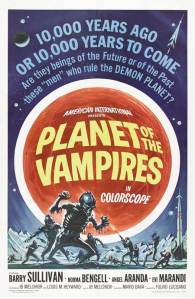
2) Speaking of mundane, wouldn’t you be let down if, when you first met the members of a totally alien race, they all turned out to be a bunch of movie stereotypes?  The Na’vi appear to have developed their entire culture as the result of a steady diet of Hollywood westerns, New Age self-help books, and some 16 year-old’s half-assed understanding of what it means to be a Pagan.  I remember when I first saw Avatar, it was impossible for me not to compare it unfavorably with District 9, a film that addressed many of the same themes and issues as Avatar but did it with a much lower budget and a much more intelligent script.  This was especially evident when one compares Avatar’s Na’vi with District 9’s prawns.  While the prawns were believable as both individual characters and as representatives of a totally alien race, the Na’vi are essentially the reflections of James Cameron’s sophomoric noble savage fantasies.

3) District 9 wasn’t the only great science fiction film to come out in 2009.  There was also Moon, which featured a great performance by Sam Rockwell and excellent direction from Duncan Jones.  When /Film asked Jones for his opinion of Avatar, Jones replied, “…at which point in the film did you have any doubt what was going to happen next?”  It’s a good question. 

In all honesty, I’m a horror girl.  I haven’t seen much science fiction and therefore, I’m not as well acquainted with the genre’s clichés as I am with horror.  However, I can still say that, at no point, did anything that happened in Avatar take me by surprise.

Of course, some of my favorite movies were (and are) very predictable.  Georges Polti argued that there were really only 36 basic plots available to use in fiction so its understandable that you’re going to come across the same one used several times.  However, a predictable plot can be forgiven if maybe that plot features at least a few interesting characters or maybe an occasional unexpected line of dialogue.  Avatar, however, can’t even manage this.  Our hero is an impulsive man of action.  The villains are all evil because … well, they just are.  In the manner of most oppressed races in American film, the Na’vi are noble savages who require a white guy to come save them.  The only lines of dialogue that I remember are the ones that made me roll my eyes.  I’m talking about stuff like a bunch of 22nd century marines being greeted with “You’re not in Kansas anymore.”  Well, that and “I see you,” which was apparently included in the script so that it could serve as the title of a syrupy theme song.

4) Strangely enough, even though the movie took absolutely no narrative risks, it was still full of plot holes and things that just didn’t make much sense. 

For instance, why does Quaritich promise to give Jake back his legs (“your real ones”)?  I mean, does Quaritich have them sitting in a freezer somewhere? 

As part of his deal with Quaritich, Jake agrees to make videos about the Na’vi.  Oddly enough, it appears that he’s still making the videos even after he turns against Quaritich and you have to wonder exactly why.  Also, Jake records many of these videos in an isolated, apparently one-room outpost occupied by him and two other scientists yet the scientists are later shocked and outraged when told that Jake was making the videos.  Okay, what did they think he was doing all that time?  Were they just not listening to what he was saying? 

What exactly was the backstory of Sigourney Weaver’s character and when exactly did she join Sully in the Na’vi camp?   And why were the Na’vi willing to let her into their tribe when they would only grudgingly accepted Sully even after the Goddess selected him?  I mean, if Weaver already had such a great relationship with the Na’vi, it seems like she could have saved a lot of time by just taking Sully straight to them.  (Editor’s Note: According to the comments below, this issue actually was addressed in the film. — LMB)

Sully, after the final battle, decides to stay on Pandora and he might as well since the Tree of Souls (good God!) transferred his soul into his Na’vi body.  But what’s in it for Max and Norm?  We seem them at the end (though really, Norm should be dead) standing there pointing guns at all the humans that are leaving.  Norm, at least, could still probably hang out in his avatar but what about Max?  Why is Max, who has had nothing to do with Na’vi, so quick to join the revolution?

I’m sure a lot of this is because scenes were edited out and I know that Cameron has a reputation for reinserting those scenes once his movies come out on DVD and blu-ray.  Well, more power to him.

5) The film suffers from a really bad case of the white man’s burden disease.  This is another one of those films where a caucasian character befriends an oppressed minority and, with remarkably little dissent, manages to appoint himself as the leader of that minority.  It’s a fantasy, one in which members of the bourgeoisie (like James Cameron) can live out their childhood fantasies of being outlaws without having to worry about  (unlike actual “outlaws,”) being punished for taking their stand.

Once again, it’s hard not to compare Avatar with District 9.  Both of them feature lead characters who are transformed into aliens.  The difference is that, with the exception of one brief scene, Jake Sully accomplishes the transformation rather easily and quickly becomes the best Na’vi there is while in District 9, poor Sharlto Copley is terrified by the process and, even though it does lead to him understanding the prawns (and ironically, learning how to show a little humanity), the movie never pretends that Copley isn’t losing his own individuality in the process of transforming.

6) The lead character is named Jake Sully.  Did James Cameron get frustrated and just use a Random Generic Movie Hero Name Generator to come up with that?  I wonder if Nick Sully was Cameron’s 2nd choice.  It’s not that there’s anything wrong with either name.  It’s just that it feels so generic.  Of course, the leader character is going to be named Jake and, of course, he’s not going to be an intellectual and, of course, Sigourney Weaver’s going to spend the whole movie making sarcastic comments about how stupid he is.  Speaking of which…

7) Sigourney plays Dr. Grace Augustine.  Her character and her performance are typical of a rather annoying Hollywood tradition, that of portraying any “strong” female as a total and complete bitch.  If you want the audience to know they’re supposed to take a woman seriously, have that woman spend the entire movie pissed off about something, as if the only way a woman can be strong is by sacrificing anything that might make her unique.  Now, there’s a lot I could say about why, from a cultural perspective, American movies often seem to be so conflicted about how to portray any woman who is neither an Eve nor a Lillith.  But in the case of Avatar, its hard not to feel that it comes down to screenwriter Cameron’s inability to make any of his characters interesting unless something nearby is exploding.

8 ) And while we’re on the subject of misunderstood women…okay, let’s say you discover a planet and this planet is a lush, beautiful paradise.  Why the Hell would you then call it Pandora?  Yes, I understand that newly discovered planets are usually named after mythological figures.  But there’s still usually some sort of vague logic behind the names.  For instance, Mars was named after the God of War because of its red hue.  Venus was often considered to be the most beautiful star in the sky.  Mercury has the fastest orbit.  Jupiter’s the biggest planet.  Pluto (before it got downgraded) was considered the darkest and coldest of the planets.  Pandora, however, was the woman who opened up the jar that released everything terrible, evil, and destructive into the world.  Why would anyone name a planet after her?  It’s possible, of course, that all the good names were taken.  Of course, it’s also possible that this is just another example of how thuddingly obvious Avatar is in its symbolism and subtext.

9) Speaking of obvious, what about the villain played by Stephen Lang?  More specifically, what about that accent?  It’s true that Cameron doesn’t exactly encourage his villains to be subtle.  Just check out Billy Zane in Titanic.  Zane, however, at least appeared to be having a little fun at his director’s expense.  He, alone among the cast, seemed to realize that Titanic was a silly melodrama and so he gave something of a silly performance.  It’s no great secret that it’s often more important to have a good villain than to have a good hero.  A good villain usually has some sort of motivation beyond just being the villain.  This is something that Cameron has never seemed to be able to grasp.  Whenever I see a military figure show up in a James Cameron movie, I get the same feeling that I get whenever a preacher shows up in a Stephen King novel.  Automatically I know that they’re going to turn out to be evil and I find myself dreading having to even waste the time with the “shocking” discovery of that evil. 

10) Perhaps most importantly, this is a movie that wants to preach peace but celebrate war.  Avatar contains all the trendy environmental messages that you’d expect from a Hollywood film but — even though director Cameron seems to be in a state of denial about it — the film’s heart is with its villanous soldiers.  Much as how Titanic, for all the rhetoric about the passengers in third class, was really only interested in portraying the lives (and deaths) of those in first class, Avatar spends a lot of time talking about trees but is much more interested in blowing them up with the destruction of the Home Tree serving as the money shot.

To be honest, I don’t mind a little hypocrisy when it comes to movies.  Most exploitation films celebrate hypocrisy.  The filmmakers knew it and, for the most part, the audiences knew it.  The fact that a movie like Child Bride could be advertised as “an important movie every parent must see!” became something of a shared joke between the filmmaker and his audience.  Rather than being hypocritical, the exploitation filmmaker is simply inviting his audience to join in a conspiracy against the forces of dullness.

Unfortunately, Avatar is not an exploitation film.  If Avatar was simply a B-movie, none of the my previous complaints would matter.  They would add to the film’s rogue charm.  Avatar, however, is too expensive to be considered an exploitation film.  And James Cameron, as he proved when he went ballistic over Kenneth Turan’s negative review of Titanic and as he has continued to prove with his recent comments regarding global warming, does not have the sensibility of a B-movie maker.  Arguably, he once did.  This is a man who, after all, did the special effects for Galaxy of Terror and made his directorial debut with Piranha IIThe Terminator was a great B-movie, right down to the accusations of plagiarism from Harlan Ellison.  However, as he’s become the most financially succesful director in history, Cameron has lost that B-movie sensibility. 

In other words, James Cameron takes himself seriously now and that, ultimately, is the main reason I hated Avatar.  It just takes itself too damn seriously.

Yes, I’ve read quite a few favorable reviews that have argued that Avatar‘s sole purpose is to entertain and that people like me who occasionally expect unique characters and an interesting story should just lie back and enjoy it.  I’ve seen the term “popcorn epic” used in quite a few reviews. 

I’m sorry but I’m not buying it.  If Avatar was truly setting out to be a “popcorn epic,” than I’d be a lot more willing to cut it some slack.  However, when the script contains lines about how on Earth, humans have “destroyed all the green,” and when the villains are accused of launching a “shock and awe” campaign, it’s ludicrous to then argue that Avatar isn’t setting itself up to be judged by a higher standard. 

It becomes hard to escape the fact that Cameron, regardless of how well he handles the special effects, has essentially made a stupid movie about deep issues.

As I said before, the majority of the people I know love Avatar.  I don’t hold it against them or think any less of them because, ultimately, movies are a subjective experience.  Whether or not a movie is good has less to do with the actual movie and more to do with the person watching it.

It would be nice to have the same courtesy extended to me .  Since I first revealed my opinion of Avatar on a non-Avatar related message board, I have found myself frequently attacked by little fanboys who apparently cannot handle the fact that one human being didn’t enjoy Avatar.  I’ve been told that, as a female, I can’t be expected to understand Avatar.  I’ve been accused of being “unimaginative,” “a snob,” “a bitch,” and my personal favorite “the type of cunt who cried at the end of the Blind Side.” 

I realize the risk I’m taking by openly admitting my dislike of Avatar but then again, movies are supposed to inspire conversation and not just pavlovian agreement.  So, in conclusion, I’ll just admit that yes, I am female and yes, I did cry at the end of The Blind Side, and yes, I hated Avatar.

Review: The Black Waters Of Echo’s Pond (dir. by Gabriel Bolongna)


I’m going to start this review with a disclaimer.  Yesterday, I nearly died trying to see this movie.  As I was driving to the theater, I nearly collided with another car.  One of us (okay, it me) wasn’t paying attention and ran a stop sign.  We handled the near accident with the usual mix of car horns and profanity and, my heart still racing, I drove on to the theater and saw The Black Waters of Echo’s Pond.

As a result of my near death experience, I sat through this movie with one thought in my head: was seeing it worth losing my life?  While there are some movies (Suspiria, Beyond the Darkness, Zombi 2, and the Living Dead Girl, for example) that I would happily sacrifice a few years in order to see on the big screen, Black Waters is not one of them.

The film actually starts out well with a 9-minute prologue.  An archeological expedition in Turkey discovers an ancient tomb.  Inside the tomb, they find a map that is somehow linked to the Greek God Pan.  For nine minutes, we’re treated to clunky exposition (“Why, it’s what we’ve been here looking for!”  “Professor, do you mean that it’s the ancient map of Pan’s Arcadia?”  “Yes, the same Pan who was the Greek God of fertility and…”) and it seems like this movie might actually turn out to be a fun, cheerfully stupid take on the old Mummy movies that Hammer Studios released in the late 60s.

No such luck.  All the members of the expedition are promptly killed off-screen.  We jump forward to the “present day” and the entire movie quickly goes downhill.

In the present day, nine college friends get together to spend a weekend in an isolated mansion on an even more isolated island.  Why they would want to do this is never really addressed nor do you ever believe that any of the characters have a shared history or would actually be friends if not for the fact that the film demands it.  While there are some talented actors in the cast, they have absolutely no chemistry when they’re on screen together.  Since the rest of the film is pretty much dependent upon us believing that these people are all old friends, this lack of chemistry pretty much dooms the entire movie. 

(Add to that, the men in this group all appear to be having the worst bad hair day in recorded history.)

Once they’re in the mansion, the power promptly dies.  While attempting to find a fuse box, one of the friends instead discovers a board game.  Our group proceeds to play the game and soon, they’re seeing visions of murder, illicit sexual activity, and a big-horned demon.  However, none of them find this to be all that curious because they are 1) stoned and 2) incredibly stupid.

As I watched them play this cursed Jumanji death game, I found myself wondering if nobody in this film had ever seen a horror movie before.  Surely, if they had, they would realize that getting together in an isolated location, joking about sex, smoking weed, and then playing with the mysterious game that was previously walled up in the cellar is a good way to guarantee that you’re not going to be alive in the morning. 

To a certain extent, you have to be willing accept a lot of stupidity on the part of the characters in a horror film.  After all, we all know that our poor victims are always going to end up running up a flight of stairs in order to escape the killer (as opposed to going out the front door) and we forgive them for that because we know that if their actions were logical, then there would not be a movie.  However, the victims of the Black Waters of Echo’s Pond simply require us to forgive too much. 

Anyway, the game quickly starts to get weird as everyone draws cards that require them to answer increasingly personal questions.  Old resentments boil up to the surface.  One guy admits to wanting to have sex with both his girlfriend and her sister while the token responsible girl finds herself compelled to flirt with the token slut.  All of this goes on until finally, one member of the group snaps and, while everyone else is busy getting it on, proceeds to cut his best friend in half with a chainsaw.  (And no, nobody in the house hears the screams or the chainsaw because, as I mentioned earlier, they’re all incredibly stupid.)

Once that first murder is committed, everyone is soon trying to kill everyone else.  In this regard the film is remarkably similar to Mario Bava’s classic Bay of Blood (a.k.a. Twitch of the Death Nerve).  However, the constant carnage in the Bava film worked because Bava made it clear that his many murderers were all working independently from each other with just their own greed to motivate them.  Whereas in Black Waters, it is made clear from the start that everyone has been possessed by Pan.  In short, the murders have nothing to do with the people being killed or those who do the killing.  And while the murders are nicely brutal and bloody (I hate bloodless horror films), they don’t have any meaning beyond the mechanics of the film.

Pan (or at least I assume that its meant to Pan because it looks more like a Minotaur than anything else) shows up fairly early in the movie and he is an impressive creature with a goat’s head that features glowing eyes and long, dirty talons at the end of his fingers.  Still, I think it was a mistake on the part of the filmmaker’s to reveal him as early (and as often) as the film does.  Once Pan shows up, the movie loses all of its mystery.  We now know, for sure, that all the ensuing mayhem is the result of Pan’s supernatural malevolence.  By revealing Pan as early as it does, the film sacrifices whatever chance it may have had to be truly scary.  Instead Pan, just becomes another faceless killer and the movie, which has been advertised as a “psychological thriller,” loses its edge.

Outside of Pan, the cast is largely forgettable and they’re certainly not helped by how unlikable the majority of the characters are.  A few members of the cast do occasionally manage to offer up a few good (or, at least, memorable) moments but their efforts are sabotaged by some of the most leaden dialogue I’ve ever heard.  (It’s not a good sign that the film feels like it was dubbed into English even though it’s not.) 

The Babysitter twins from the Planet Terror segment of Grindhouse show up for instance and, even though their characters are wildly inconsistent, they both bring a lot of energy to their roles.  Incidentally, one of them gets the worst the line of the dialogue in the entire film when she says, “Shakespeare is Shakespeare!  B-movies are porn!”

Robert Patrick plays Pete, the grizzled old-timer who gets to do the whole “Some people say the killer is still out there…” thing.  It’s not much of a role but Patrick has fun with it.

Speaking of horror film tropes, Mircea Monroe plays Veronique, the token slut.  From the minute she shows up on-screen, you know she’s doomed because she’s flirtatious, openly bisexual, and likes to show off her boobs.  (Come to think of it, if I ever find myself in a slasher film, I am fucked!)  It’s a thankless role but Monroe does her best with it and actually give Veronique a personality that goes beyond the puritan stereotype of the slasher film slut.  Her best scene is her last.  The look of mournful resignation on her face make her final fate rather sad and suggests the type of film that Black Waters could have been.

The two nominal leads are played Danielle Harris and James Duval and they both occasionally manage to transcend the shallowness of their roles.  Harris, of course, is a horror film veteran who could play her role in her sleep.  To her credit, she doesn’t.  James Duval is best known for playing Frank the Bunny in Donnie Darko.  Here, he plays ne’er-do-well Rick.  If for no other reason, the movie is worth seeing just for the way Duval delivers the line “Shit!  We’re fucked!”  It’s a line that he repeats several times and he says it with just the right combination of genuine frustration and stoner pathos.

In many ways, Black Waters On Echo’s Pond feels a lot like one Lucio Fulci’s post-Manhattan Baby efforts.  You have no doubt that the movie was made by talented people and you keep wanting it to be better than it actually is.  You find yourself clinging onto the few isolated moments that are actually effective and hoping that maybe they’ll carry you to the light at the end of the tunnel.  Unfortunately, by the end of the movie, you realize that the light was actually the train that’s just bisected you because you were too stupid to jump off the tracks.

Ultimately, the main problem with The Black Waters of Echo’s Pond is that it just is not a scary movie.  I can usually forgive a lot from a horror movie as long as there’s a handful of shocking “jump” moments.  Unfortunately, Black Waters doesn’t feature a single one.  While the gore effects are occasionally impressive, it takes more than blood to make a horror movie.  All the material was there for this to be a fun little B-movie (and not a porno, regardless of what that Babysitter Twin claims) but it just doesn’t happen.

I recently posted some of my feelings about this film over on a message board.  I quickly received a reply from a gentleman who disagreed with me.  He informed me that not only did I not have the slightest idea how difficult it is to make a movie but by criticizing this film, I was failing to support “independent film.”  “Why don’t you just go spend more of your money on Avatar again?” he asked.  Well, for the record, I hated Avatar and I do support independent film.  Just because this movie was made outside of the studios, that doesn’t make it a good film.  If you want to see a good, independent horror and/or fantasy film, go track down Baghead or Primer.  Leave the Black Waters of Echo’s Pond undisturbed.

Battle Angel possible next Cameron 3D-epic


With the success of Avatar there’s an ongoing speculation as to what will be James Cameron’s follow-up project. This is a man whose last two films has made a combined 4.2billion dollars (unadjusted) worldwide in theater box-office. There’s already talk of him doing a sequel (or prequel) to Avatar with him as producer and someone else directing.  The one project which seems to be popping up again and gaining traction as Cameron’s next directing gig is the film adaptation of the classic manga title, Battle Angel Alita.

Jon Landau, producer of Cameron’s last two film’s, have spoken to MTV Splashpage about the possibility that Cameron will make the film adaptation of Battle Angel Alita as his next 3D-epic with script collaborator Laeta Kalogridis helping flesh out the screenplay. If the film does become the next Cameron gig then the script will concentrate on the early volumes of the nine-volume manga. A part of the series where the character of Alita has lost her memories and no idea of where she came from and who she really is. One aspect of using this part of the series’ as the core part of the script includes Alita’s time as a participant in the Motorball games. Motorball being a combination Rollerball and NASCAR but with cyborg participants. As the Youtube video of an example of how Motorball looks like it would definitely translate into an awesome sequence in Cameron’s hands and in 3D.

Everyone who has read about Avatar and it’s history knows by now that Cameron originally wanted to do this film adaptation of Battle Angel Alita as his follow-up to Titanic but decided against it when he realized the technilogy to properly do it wasn’t ready. Cameron opted for Avatar instead and used that film to develop and test the tech he needed for Alita. Now that his new film techniques and equipment have succeeded with flying colors there should really be no reason why Cameron should delay adapting Battle Angel Alita.

I, for one, think this manga and Cameron are perfect for each other. Strong female character, dynamic action story and one that needs a filmmaker at home in doing a huge film heavy on tech. Sounds like a Cameron film to me.

Source: MTV Splashpage

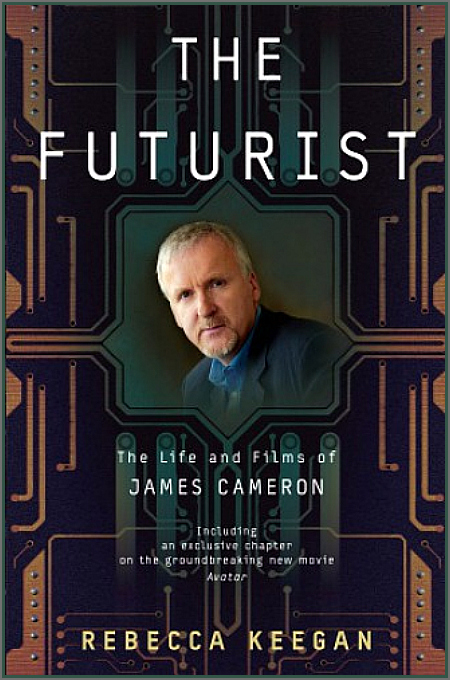
Review: The Futurist – The Life and Films of James Cameron (by Rebecca Keegan)


2009 will probably go down as the year James Cameron returned from a self-imposed exile from feature-lenght filmmaking. It has been 12 years since his last major film for a big Hollywood studio. Titanic became the all-time box-office king with Cameron winning accolades and awards for his efforts. He was no flushed with money which has allowed him to take a break from making films audiences have come to expect from him. Instead he decided to go back to his first true-love growing up in Chippewa, Canada. Cameron went exploring the deepest parts of the ocean not just as a filmmaker but a scientists, researcher and explorer. This time of his life after proclaiming himself “King of the World” in the 1998 Academy Awards shows the dichotomy of James Cameron’s life and personality: the artist and scientist in one body.

It is the task of Rebecca Keegan’s biography of this modern-day renaissance man to give an insight as to how the two sides of Cameron made him the success he is today and one of the pioneers in filmmaking. The Futurist will look back to his childhood and, with unprecedented access to Cameron’s family, close friends, associates and, best of all, James Cameron himself, show us a glimpse at the very reclusive filmmaker. The book doesn’t overly fawn over Cameron’s talents and achievements, but if there was a man deserving such attention it would be Cameron.  Keegan never really points out and concentrate on the negatives of Cameron’s life and personality, but does allow these traits to show how committed and focused an individual Cameron was when it came to his work and demanded nothing less from those who worked with him.

The book details how Cameron’s parents may have had a major influence in how he turned out in life. Born of a father who was a mechanical engineer and an artist of a mother with a self-reliance and powerful personality which would imprint the young Cameron at an early age. In fact, Keegan devotes the early sections of the book to showing how gifted the Cameron brood was from Jim’s parents to his four other siblings. But in the end, it was Cameron who was the take-charge of the litter. Even at an early age it was he who led the other kids on his projects (which included building a plane from scraps and junk around the neighborhood). Right from the beginning Keegan was able to show us the many experiences and influences that both lead to him being one of the world’s foremost filmmakers to one also renowned for his dictatorial-style on the film set.

The Futurist really offers just a glimpse on the life of Cameron. It is a life that could almost be a primer for all young people dreaming to be filmmakers themselves or just whatever they want to do in life with something they love. Keegan’s casual writing style doesn’t have the dry, academic tone of most biographies. She almost treats the biography’s many chapters as a behind-the-scenes look into every film project Cameron has been a part of. From his early days as model builder in Roger Corman’s New World Pictures right up to his latest project for 20th Century Fox, Avatar. While each film discussed was already quite interesting for a fan of the filmmaker and those films, I was even more interested in finding out how Cameron’s own dedication and laser-like focus on each project showed both the genius and madman aspect of the man. Here was an individual so intelligent that he could converse with artists and scientists and keep up, if not, hold his own.

One specific anecdote in the biography which shows a lot about Cameron as a modern renaissance man was his time between Titanic and Avatar. This was a part of Cameron’s life where the scientist in him took precedence. He was working on a Mars film project and had come to work with NASA engineers and scientists on future plans to try and reach the Red Planet. Having access to unofficial papers and technical papers on such a project, Cameron was able to come up with a hybrid Mars lander which would also double as the rover. He submitted the plans and design specs to this “lander rover” to the NASA team who ended up more than impressed. A similar-looking lander rover would soon land on a later Mars mission and all thanks to the outside the box thinking Cameron was able to add to the scientists who had been working for years on the project. One of the NASA engineers was so impressed that he was heard to have commented that if Cameron wasn’t a filmmaker he definitely would’ve turned out to be an exceptional engineer.

It’s that admiration from those who have worked with Cameron which comes up more than once in Keegan’s book. She shows not just his artistic side but his love of science and research. Cameron definitely comes off as the know-it-all in the room. Whether one sees that as a negative or a positive it doesn’t change the fact that he probably does know it all and do it better than most in a room of contemporaries. We learn from Keegan’s inside-look at Cameron’s life how he could easily be a one-man film set. Most filmmakers, even great ones, rarely pick up a camera or become a major part of the editing process. Cameron could do everything that needs to be done on a set minus the acting. The Futurist also goes to great lenghts to point out that while Cameron was great at pretty much anything the needs to be done to make a film as a writer he admits to her how much he struggles at it. He sees the writing side of the film equation as something he wished he could do better and always trying to improve at it. This goes towards the many criticisms about Cameron’s film being cardboard cutouts of stories already done and done better. It goes to explain Cameron’s need to control every aspect of his film projects that he only trusts himself and, maybe close friends, to write the script for his films.

He wants to film his stories, his ideas and not other people. It definitely shows how many in Hollywood could equate that with him being very egocentric in how he deals with his peers. Some may admire this trait and others may see it as a man over his head and banking on the simple taste of the general population to make his films succeed. While I do not subscribe to the latter, I do think that much of the backlash he has received with his last two films go back to his ego and superiority over others. It is not easy for people who think they know what they talk about when it comes to film and everything that goes in making one be made to feel stupid when he makes it known. But then he has made a habit of being vindicated in the end despite these trait flaws. As the saying goes, “Sometimes the truth hurt.” James Cameron definitely comes across in the book as a no-nonsense, bullshit-free dictator who is smarter than everyone else.

In the end, Rebecca Keegan’s The Futurist is an engaging look-inside the mind of the man who has proclaimed himself “King of the World” and who others have called under their breath as a tyrannical dictator of a filmmaker. While the book could’ve been much longer and gone into even more detail about Cameron, his life and his films Keegan has definitely laid down the groundwork on any future Cameron biographies both official and unofficial. There’s definitely more to learn about this unique blending of romantic artists and dedicated science genius in one mind and body. For fans of James Cameron this book is definitely a must-have and read. For those just wanting to know more about this pioneer filmmaker then this book is a great primer to learning more about him.