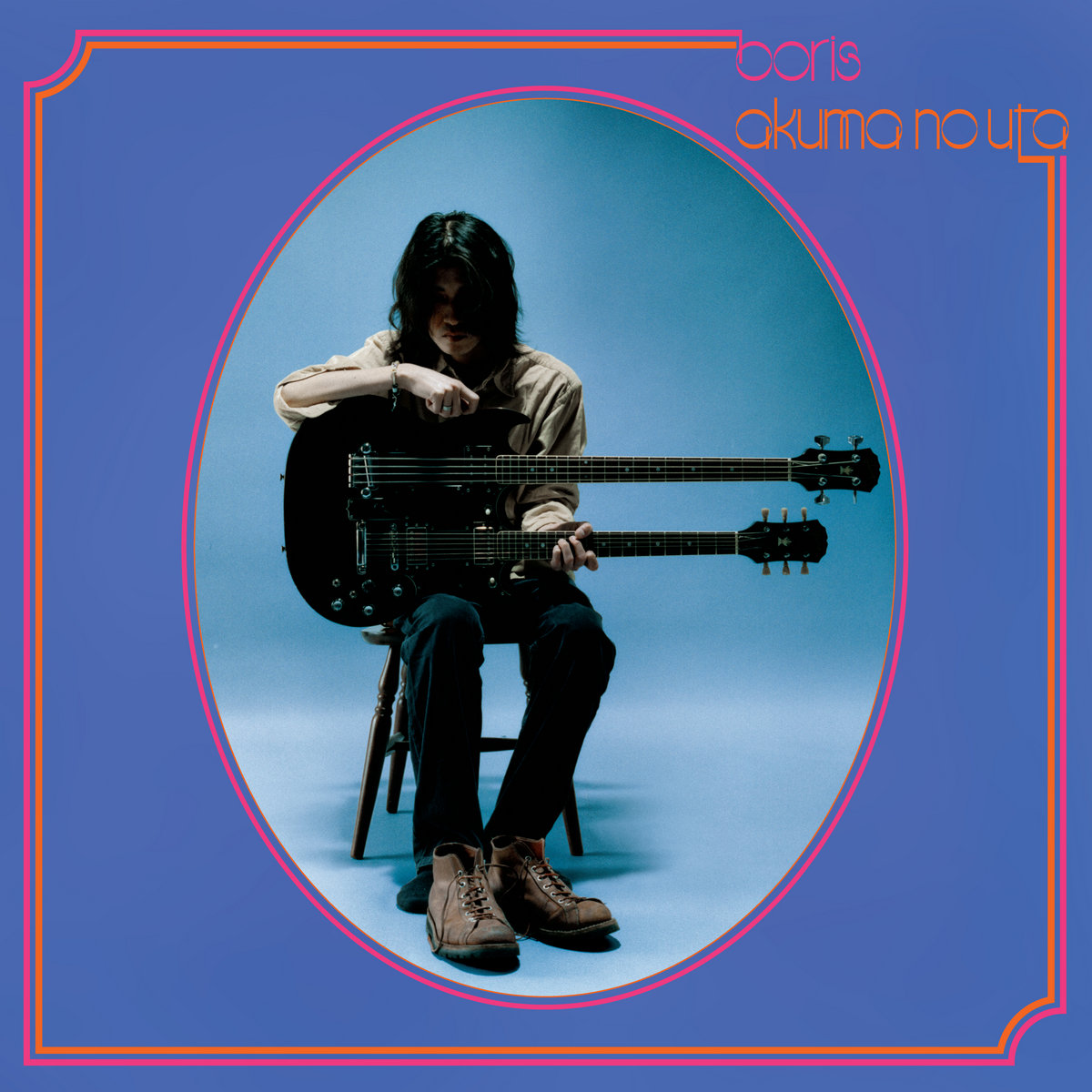
Retro Music Review: Akuma no Uta (by Boris)


So, you want to talk about Boris’s Akuma no Uta. Where do you even start with a band like Boris? They’re one of those groups that defies easy description, a Japanese power trio that has spent decades exploring the absolute outer limits of heavy, distorted sound. They’ve done albums that are just one long, droning track, records that are pure noise, and others that are surprisingly poppy. But Akuma no Uta, released back in 2003, is something special. It’s often cited as the perfect entry point for the uninitiated, and honestly, it’s easy to see why. It’s the sound of a band taking all their wildest, heaviest ideas and distilling them into a concise, 39-minute punch to the gut that still somehow manages to be incredibly listenable. I have to give full credit where it’s due here—this record didn’t just fall into my lap by accident. It came highly recommended by TSL writer necromoonyeti, and I will always thank him for introducing me to this power trio. Without that nudge, I might have spent years circling the Boris discography, intimidated by its sheer size and weirdness, never quite knowing where to dive in. So, necromoonyeti, if you’re reading this, you absolutely changed my listening habits for the better.

Right from the jump, the album announces its intentions, though maybe not in the way you’d expect. The opening track, Introduction, is a masterclass in trolling the listener in the best possible way. On the CD and streaming versions, it stretches out to nearly ten minutes of slowly building drone, feedback, and amp hum. It’s the sound of a massive, slumbering beast slowly waking up, a wall of sound that’s more about atmosphere and tension than riffs. You sit there, waiting for the song to “start,” and for a while, it doesn’t. This was apparently a deliberate move on the band’s part, a very “Boris” thing to do, essentially making you earn the payoff that’s about to come. It’s meditative, hypnotic, and maybe a little bit frustrating on the first listen, but by the time the track fades into a wash of white noise, you’re completely locked into the album’s unique frequency. It’s a brilliant, subversive way to set the stage for the chaos that follows. I remember messaging necromoonyeti about this very track, half-confused and half-intrigued, and he just told me to be patient. Best advice I could have gotten.

And then, the chaos arrives. Ibitsu hits with the force of a freight train, completely shedding the droning patience of the intro for pure, punk-edged sludge fury. It’s an explosion of tight, angry riffage that’s over before you can fully process the whiplash. This is where you hear the Melvins and Black Sabbath influence loud and clear, but it’s filtered through a distinctly Boris lens of sheer, overwhelming volume. Furi follows in a similar vein, keeping the energy high and the riffs thick and fast, a one-two punch of raw aggression that just completely kicks the door down. The sheer momentum of these tracks is absurd, with guitar solos and drum fills that sound like they’re tearing the very fabric of the recording to shreds. Without that initial recommendation, I might have bailed during Introduction, never making it to this glorious pummeling, and that would have been a tragedy.

But the true centerpiece, the track that everyone who listens to this album comes away talking about, is Naki Kyoku. This is where Boris shows their full range and cements their status as something more than just another heavy band. The song begins with a breathtakingly beautiful, clean guitar loop that’s a direct homage to the album’s cover art, a cheeky parody of Nick Drake’s Bryter Layter. For the first few minutes, you’re lulled into a state of serene, shoegaze-inspired bliss. It’s absolutely gorgeous, and it feels like a completely different band. And then, just when you’ve settled into the calm, the song switches gears and lets loose with a crushing, doom-laden riff that feels like a personal affront to the preceding quiet. This contrast, this sudden and brutal shift from beauty to pure heaviness, is what makes the track so legendary. It builds and builds in a post-rock style, layering guitars and intensity until it reaches a fantastic, euphoric peak, capped off with what many fans consider one of the greatest guitar solos ever recorded. It’s an eleven-and-a-half-minute odyssey that never gets boring for a second, a perfect encapsulation of Boris’s ability to be both devastatingly heavy and achingly beautiful. Every time I hit that transition, I think back to necromoonyeti’s description of it as “life-changing,” and honestly, he undersold it.

The album doesn’t let up after that epic journey. Ano Onna No Onryou brings things back down to earth with a more straightforward, catchy, and almost garage-punk feeling, though it’s still heavier than just about anything else out there. It’s a great palate cleanser before the closing title track, Akuma no Uta. This final song is a masterpiece of pure, unadulterated doom. It opens with the sound of a tolling bell before unleashing a riff that’s so distorted and loud that it feels like the drums are about to collapse under the sonic pressure. It’s a slow, sludgy, and utterly suffocating track that perfectly closes out the experience. It even has a brief, sudden burst of speed that shows they’re not done keeping you on your toes, before sinking back into that glorious, monstrous mire of sound.

Akuma no Uta is an album that sounds like it’s constantly on the verge of breaking apart, due in no small part to its famously brick-walled production. For some, this lack of dynamic range can be a bit much, feeling like there’s no breathing room and even triggering tinnitus. But for most, it’s an essential part of the record’s overwhelming charm. It sounds like it was recorded at a volume so high that the microphones were screaming in protest, and that’s exactly the point. It captures the pure, physical feeling of standing in front of a massive stack of amplifiers, feeling the sound waves hit you. It adds to the raw, energetic, and slightly dangerous feel of the whole affair. This record is a testament to Boris’s fearless diversity and refusal to be pinned down, effortlessly blending doom, sludge, punk, shoegaze, and drone into a single, cohesive statement. It’s a perfect storm of sonic experimentation and raw power. If you’re looking for a life-changing, meditative experience, Boris has other albums for that, but if you want a thrilling, overstimulating, and incredibly fun ride through the very best of heavy music, Akuma no Uta is pretty much unmatched. And I owe that discovery entirely to necromoonyeti—seriously, man, thank you for pointing me toward this absolute monster of an album.

My Top 10 Metal Albums of 2013


It’s that time again. In spite of 2013 being pretty much the worst year of my life, I found it a lot easier to select a top 10 list than in 2012. Odd-numbered years almost always seem to produce a wider selection of good music, and I can confidently state that each of these at least border on excellence. Here goes:

10. Ihsahn – Das Seelenbrechen (track: Regen)

There was never a bad Emperor album. Ihsahn’s solo career hasn’t been quite as consistent. The Adversary was an outstanding start, but I barely noticed angL. After was a blast, Eremita something of a bore. Well, what do you know; the cycle continues, and Das Seelenbrechen is outstanding. Eremita seemed all about rhythmic grooves and eclectic interludes, neither of which painted a grand picture for me to take hold of. Das Seelenbrechen, without reducing any of the progressive rock peculiarities for which Ihsahn is famous, reinvests its tension in song structure and the subtler stuff of atmospheric appeal. At times it delves heavily into the world of drone metal, with Tobias Ørnes Andersen pulling off his best Atsuo impression and Ihsahn showing that his unique vocals are pretty well suited for the genre as they stand. The most impressive track on the album might be “Pulse”, if only for the fact that Ihsahn was able to stray so far from his comfort zone and still pull off an excellent song, but my personal favorite has to be “Regen”.

9. Ash Borer – Bloodlands (track: Oblivion’s Spring)

I missed out on Ash Borer’s acclaimed 2011 debut and the 2012 full-length to follow, but the Bloodlands “EP” (it’s still 35 minutes long) found itself well embedded in my subconscious this year. Like many of my selections, I never really sat down and gave it my undivided attention from start to finish. It was a busy year, and most of my albums were experienced as background music rather than a main event. I was kind of surprised to find just how many times I’d listened to this album throughout the year. It was never really on my radar, but I kept playing it time and time again. A twisted, bleak, highly atmospheric recording, Bloodlands successfully captures a traditional black metal vibe that is neither overly passionate nor distractingly aggressive. It’s a pleasant break from the otherwise welcome trend towards a less sinister, more humanizing approach to the genre.

8. Westering – Joy (track: This Will Quiet Us)

Joy is definitely the weirdest album I’ve heard this year that actually worked. Bryan Thomas’s second release as Westering is a cracked window peering into folk, industrial, and maybe even 80s pop scenes, sensible to melodic appeal yet firmly rooted in black metal tradition. To label it another “shoegaze black metal” album would hardly do it justice; the warbling walls of distortion don’t angelicize the metal, but rather demonize the more direct pop elements, creating a final product basked in darkness yet awkwardly catchy and familiar.

7.Ensemble Pearl – Ensemble Pearl (track: Island Epiphany)

It’s sad that this album has gone almost completely unnoticed in 2013. It’s sad that people regard it as another Boris album, or as “Boris and Sunn O))) Part 2”. Because, while it shares much in common with Altar, the cast is quite different and the end product surprisingly even better than its predecessor. While Atsuo Mizuno and Stephen O’Malley reunite, Takeshi and Wata are out, as well as Greg Anderson. Michio Kurihara steps up to the plate along with a fellow I’ve never head of–Bill Herzog–to complete the lineup. The sound these four have managed to assemble is flawless. Smooth as glass and black as night, Ensemble Pearl is a compelling example of music’s capacity to paint a scene more vivid than sight can ever offer.

6. Paysage d’Hiver – Das Tor (track: Macht des Schicksals)

Like Ash Borer, Paysage d’Hiver provided ideal background music for me throughout the year. With a similar appreciation for late 90s/early 2000s atmospheric black metal aesthetics, Das Tor presents a significantly noisier, more trance-inducing break from current metal trends. I fell in love with this album’s capacity for endless repetition as the backdrop for work, reading, and just about any other activity that requires concentration. This particular style of black metal has always really zoned me in and helped me to focus, and Paysage d’Hiver’s take on it is substantially better than most.

5. Mechina – Empyrean (track: Anathema)

Fear Factory’s 1998 opus, Obsolete, was the last industrial death metal album to really blow me away. A lot of bands go there, but few, at least in my experience, are willing to fully nerd out into uncompromised sci-fi fantasy. There is something about the death metal mentality that inclines most bands to play with their nuts out, and it rarely works in their favor. Mechina don’t fall for that. They have no qualms whatsoever about employing clean vocals, dramatic symphonics, and operatic hymns to serve their end. Empyrean paints a lush vision of a futuristic world of technology and galactic combat on the brink of apocalypse. Really stellar stuff. … ha..ha… hmm…

4. Summoning – Old Mornings Dawn (track: Old Mornings Dawn)

It took Summoning seven years to release a new album. I would not be surprised if they were hard at work on it that whole time. Not quite as perfect as Let Mortal Heroes Sing Your Fame, Old Morning Dawn is nevertheless an instant essential within the Summoning discography, never wavering an inch from the solid sound they forged a decade ago. I can’t think of too many albums I’ve anticipated for this long that didn’t let me down (Falkenbach’s Tiurida in 2011 might be the most recent exception), and for that, coming from one of my favorite bands ever, Old Mornings Dawn easily slides in towards the top of my chart.

3. Cara Neir – Portals to a Better, Dead World (track: Peridot)

I remember when I was first getting into black metal and a friend of mine was doing the same with screamo. They seemed like two incommensurable paths at the time. We’d trade the best of what we found, and I love a lot of screamo because of it, but that was his genre and this was mine. There just wasn’t all that much in common between Carpathian Forest and City of Caterpillar.

Times have changed, and much for the better. I’ve tossed around “screamo” and “black metal” in the same sentence before (Roads to Judah), but this is certainly the most raw realization of the two as one that I have heard so far. Portals to a Better, Dead World is another fine product of a new era of metal artists informed beyond their flagship genre. It might not achieve the fame of Deafheaven’s Sunbather, but the two go hand in hand.

2. Deafheaven- Sunbather (track: Dream House)

And that brings us to the most hyped metal album of 2013. Sunbather turned more heads than Roads to Judah, and certainly more than Liturgy’s Aesthethica or Krallice’s Diotima back in 2011. But while the mainstream world regrettably failed to recognize that year as the grand coalescence of heavy metal’s mid-2000s paradigm shift, on Sunbather we reap its fruits. This album is not the novelty many would like to make of it; it is an affirmation of things already come to pass, and a glorious one at that. Music seems to come in sequences of waves, the reluctant undertow of their predecessors slowly dissipating beneath the growing weight of those rushing to shore. Sunbather basks in a new era of aesthetics and ingenuity first dreamed by the likes of Ulver, pressed into form by Agalloch and Alcest, and finally swept into the mainstream three years ago. Love it while it lasts, and amuse yourself with the die-hards that will rip this to shreds rather than embrace it.

1. Peste Noire – Peste Noire

And then there was one. I proclaimed Peste Noire the best album of 2013 about an hour after it leaked back in June, and nothing since has come even close to shaking that resolve. I’ve been doing a “top 10 album” list now every year since 2002, and Peste Noire is the only band to ever take the #1 spot twice, but never mind that. Ballade cuntre lo Anemi francor has absolutely nothing on what you will experience here. Let’s try “top 10 metal albums ever recorded”. I have never heard anything quite this clever, filthy, intelligent, and depraved in my life. Famine’s “black ‘n’ roll” sound has never been better, and Peste Noire can rightly be regarded as the refinement of all of the finest features of his past four albums rolled out into one.

The album is heavily enhanced by Famine’s new willingness to tell us what it’s all about. Up through the release of L’Ordure à l’état Pur in 2011, it was anyone’s guess what Famine’s peculiar album antics were all about. He was completely inaccessible as an individual, and his lyrics have always been in French. The man behind the music has since emerged full-formed as an internet personality, conducting interviews, approving lyric translations, and responding to forum inquiries in surprisingly fluent English. He’s revealed himself as an extremely culturally and musically informed character with a sardonic sense of humor that seems to abate the more offensive features of his image, and he completely reformed my view on L’Ordure à l’état Pur–an album I’d initially disregarded, but have since grown to love.

I tried to give Peste Noire a fair review over the summer, but I couldn’t quite do it justice. This article does. Skip to 20 minutes in the above video if you care to hear my favorite track on the album: “Niquez Vos Villes”.

Enjoy, and Happy New Year!

Song of the Day: Naki Kyoku (by Boris)


TSL writer necromoonyeti randomly recommended “Naki Kyoku” by Boris to me out of the blue one day and just said, “you’re gonna love this.” No buildup, no explanation—just that confidence. And honestly, it didn’t take long to see why. The track doesn’t hit you all at once; it kind of eases in, like it knows it’s going to win you over eventually.

What really hooked me is how the song balances this heavy, almost suffocating atmosphere with something strangely delicate underneath. The guitars feel thick and immersive, but they’re not trying to overwhelm you—they just kind of surround you. There’s this hazy, dreamlike quality to it, like you’re drifting through something emotional you can’t quite put into words, but you definitely feel it.

If you’re expecting Boris to go full-on loud or abrasive, this track flips that expectation. It’s way more restrained, but somehow just as intense. Instead of chaos, it leans into mood and slow-building weight. It feels introspective, almost like the song is asking you to sit with it rather than react to it, and that makes it stick in a different way than their heavier stuff.

Honestly, it’s one of those songs you don’t fully get on a casual listen—you kind of have to give it space. Throw it on late at night with headphones and just let it play out. It’s subtle, but once it clicks, it really lingers. That recommendation ended up being dead-on.