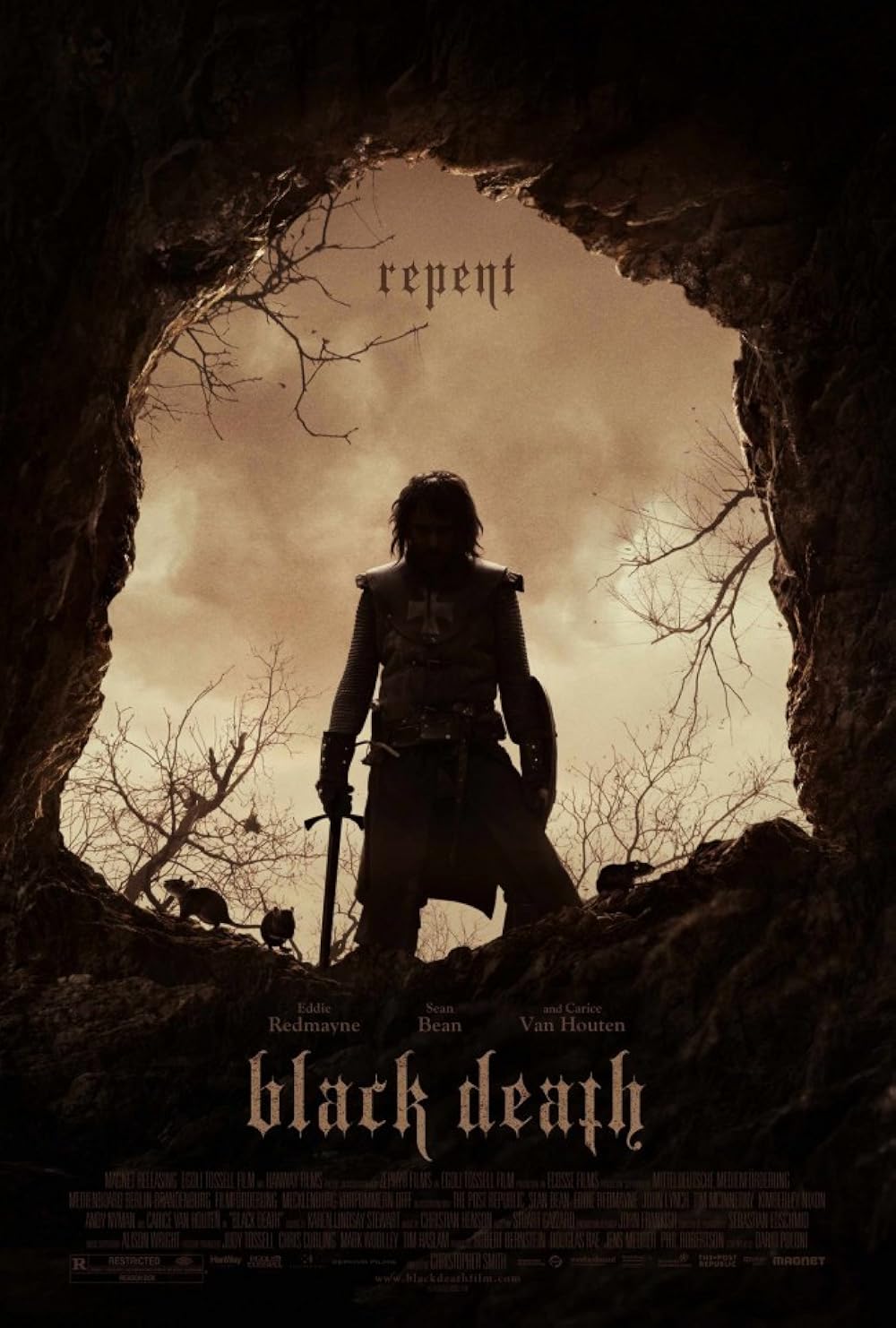
“I believe hunting necromancers and demons serves men more than it serves God.” — Osmund
British filmmaker Christopher Smith has always been something of an under-the-radar presence, steadily putting out films that show flashes of talent without quite breaking into the mainstream. By the time Black Death arrived in 2011 (after its 2010 UK debut), Smith had already built a modest body of work that hinted at a filmmaker sharpening his voice. Looking back now, though, Black Death feels less like a stepping stone and more like a high-water mark—arguably the point where his growth as a director peaked before his later efforts settled into something more pedestrian or simply passable.
Set in 1348 England during the height of the plague, the film follows Osmund, a young monk caught between his religious vows and his love for a woman named Avrill. It’s a familiar internal conflict, but one that Black Death treats with a surprising amount of weight. Osmund’s indecision isn’t just romantic hesitation—it’s a crisis of identity, faith, and fear in a world that feels like it’s actively collapsing. When Avrill gives him a week to choose, that ticking clock hangs over everything that follows, even as the narrative shifts into something darker.
Enter Ulric (Sean Bean), a hardened knight tasked with investigating a remote village rumored to be untouched by the plague—and possibly harboring a necromancer. Osmund volunteers to guide Ulric and his men through the marshes, seeing the journey as both an escape and a test. What follows is less a traditional quest and more a gradual stripping away of certainty, as each step toward the village drags the characters deeper into moral ambiguity.
The journey itself is marked by violence, disease, and small but telling moments of cruelty. One of the film’s most effective scenes involves a woman accused of witchcraft. Ulric appears, at first, to intervene with compassion, only to execute her himself in the name of expediency. It’s a cold, efficient act that encapsulates the film’s worldview—belief, in any form, can justify brutality when it’s held too tightly.
Once the group reaches the village, Black Death shifts gears into something more unsettling. The horror here isn’t loud or overt; it’s quiet, controlled, and deeply psychological. The village’s apparent immunity to the plague raises more questions than it answers, and Smith resists the urge to provide easy explanations. Instead, the film leans into ambiguity, letting tension build through implication rather than spectacle.
At its core, the film is less about the plague itself and more about how people interpret it. Is it divine punishment? A test of faith? Or something else entirely? Smith, working from Dario Poloni’s script, explores how both religious and secular authorities manipulate these interpretations to maintain control. The result is a world where truth becomes secondary to belief—and where belief itself becomes a weapon.
Osmund stands at the center of this conflict, pulled between Ulric’s rigid, punitive worldview and the village’s more enigmatic philosophy. Eddie Redmayne plays him with a quiet restraint that borders on opacity in the first half, but that pays off once the story reaches its turning point. As Osmund begins to unravel, Redmayne lets more complexity seep in, turning what initially feels like a passive character into something far more unstable and unpredictable.
Sean Bean, as expected, delivers a commanding performance. His Ulric is not a cartoonish zealot, but a man whose certainty makes him dangerous. He believes completely in what he’s doing, and that conviction gives his actions a disturbing legitimacy. It’s one of those performances where the lack of doubt is what makes the character so unsettling.
Visually, Black Death commits fully to its bleakness. The mud-soaked landscapes, the gray skies, the ever-present sense of decay—it all reinforces the film’s oppressive tone. Smith’s direction here is notably controlled, favoring atmosphere and tension over flashy technique. The violence, rendered with practical effects, is harsh and immediate without feeling gratuitous, adding to the film’s grounded realism.
There’s an unmistakable echo of Witchfinder General in how the film approaches its themes, particularly in its refusal to draw clean moral lines. Like that earlier classic, Black Death presents a world where righteousness and cruelty often occupy the same space, and where faith can be both a source of strength and a tool of destruction.
What makes Black Death stand out within Smith’s filmography—especially in hindsight—is how confidently it balances all of these elements. The thematic ambition, the performances, the atmosphere, the restraint in its storytelling—it all comes together in a way that his later films haven’t quite matched. Where Black Death feels deliberate and probing, much of his subsequent work has leaned more toward the functional, lacking the same sense of purpose or depth.
That’s not to say Smith lost his technical ability, but the edge—the sense that he was really digging into something uncomfortable and meaningful—feels dulled in comparison. Black Death captures a moment where everything aligned: a strong script, a committed cast, and a director pushing himself beyond straightforward genre conventions.
The result is a film that works on multiple levels. It’s a grim historical horror piece, a character study, and a meditation on faith and control, all wrapped in a stark, unforgiving atmosphere. More importantly, it stands as a reminder of what Christopher Smith was capable of at his peak—even if that peak, in retrospect, came earlier than expected.

