Film Review: Short Cuts (dir by Robert Altman)


Opening with a swarm of helicopters spaying for medflies and ending with an earthquake, 1993’s Short Cuts is a film about life in Los Angeles.

An ensemble piece, it follows several different characters as they go through their own personal dramas.  Some of them are married and some of them are destined to be forever single but they’re all living in varying states of desperation.  Occasionally, the actions of one character will effect the actions of another character in a different story but, for the most part, Short Cuts is a portrait of people who are connected only by the fact that they all live in the same city.  There are 22 principal characters in Short Cuts and each one thinks that they are the star of the story.

Jerry Kaiser (Chris Penn) cleans the pools of rich people while, at home, his wife, Lois (Jennifer Jason Leigh), takes care of their baby and works as a phone sex operator.  Jerry’s best friend is a makeup artist named Bill (Robert Downey, Jr.) who enjoys making his wife, Honey (Lili Taylor), looks like a corpse so that he can take her picture.  One of her photographs is seen by a fisherman (Buck Henry) who has already discovered one actual corpse that weekend.  He and his buddies, Vern (Huey Lewis) and Stuart (Fred Ward), discovered a dead girl floating in a river and didn’t report it until after they were finished fishing.  (The sight of Vern unknowingly pissing on the dead body is one of the strongest in director Robert Altman’s filmography.)

Stuart’s wife, Claire (Anne Archer), is haunted by Stuart’s delay in reporting the dead body.  A chance meeting Dr. Ralph Wyman (Matthew Modine) and his wife, artist Marian (Julianne Moore), leads to an awkward dinner between the two couples.  Claire works as a professional clown and Ralph ends up wearing her clown makeup while his marriage falls apart.

Earlier, Claire was stopped and hit on by a smarmy policeman named Gene Shepard (Tim Robbins), who just happens to be married to Marian’s sister, Sherri (Madeleine Stowe).  Gene is already having an affair with Betty Weathers (Frances McDormand), the wife of a helicopter pilot named Stormy (Peter Gallagher).  When Stormy discovers that Betty has been cheating, he takes a creative revenge on her house.

Doreen Pigott (Lily Tomlin) lives in a trailer park with her alcoholic husband, Earl (Tom Waits).  Driving home from her waitressing job, Doreen hits a young boy.  The boy says he’s okay but when he gets home, he passes out.  His parents, news anchorman Howard Finnegan (Bruce Davison) and his wife, Anne (Andie MacDowell), rush him to the hospital, where his doctor is Ralph Wyman.  As Howard waits for his son to wake up, he has a revealing conversation with his long-estranged father (Jack Lemmon, showing up for one scene and delivering an amazing monologue).  Meanwhile, a baker named Andy (Lyle Lovett) repeatedly calls the Finnegan household, wanting to know when they’re going to pick up their son’s birthday cake.

Based on the short stories of Raymond Carver and directed by Robert Altman, Short Cuts can sometimes feel like a spiritual descendent of Altman’s Nashville.  The difference between this film and Nashville is that Short Cuts doesn’t have the previous film’s satiric bite.  As good as Nashville is, it’s a film that can be rather snarky towards it character and the town in which it is set.  Nashville is used as a metaphor for America coming apart at the seams.  Short Cuts, on the other hand, is a far more humanistic film, featuring characters who are flawed but, with a few very notable exceptions, well-intentioned.  If Nashville seem to be a portrait of a society on the verge of collapse, Short Cuts is a film about how that society ended up surviving.

It’s not a perfect film.  There’s an entire storyline featuring Annie Ross and Lori Singer that I didn’t talk about because I just found it to be annoying to waste much time with.  (The Ross/Singer storyline was the only one not to be based on a Carver short story.)  The conclusion of Chris Penn’s storyline wasn’t quite as shocking as it was obviously meant to be.  But, flaws and all, Altman and Carver’s portrait of humanity does hold our attention and it leaves us thinking about connections made and sometimes lost.  Seen today, Short Cuts is a portrait of life before social media and iPhones and before humanity started living online.  It’s a time capsule of a world that once was.

14 Days of Paranoia #6: The Player (dir by Robert Altman)


1992’s The Player tells the story of Griffin Mill (Tim Robbins).

It’s not easy being Griffin Mill.  From the outside, of course, it looks like he has the perfect life.  He’s a studio executive with a nice house in Hollywood.  He’s young.  He’s up-and-coming.  Some people, especially Griffin, suspect that he’ll be the president of the studio some day.  By day, he sits in his office and listens to pitches from respected screenwriters like Buck Henry.  (Henry has a great idea for The Graduate II!)  During the afternoon, he might attends dailies and watch endless takes of actors like Scott Glenn and Lily Tomlin arguing with each other.  Or he might go to lunch and take a minute to say hello to Burt Reynolds.  (“Asshole,” Burt says as Griffin walks away.)  At night, he might go to a nice party in a big mansion and mingle with actors who are both young and old.  He might even run into and share some sharp words with Malcolm McDowell.

But Griffin’s life isn’t as easy as it seems.  He’s constantly worried about his position in the studio, knowing that one box office failure could end his career.  He fears that a new executive named Larry Levy (Peter Gallagher) is after his job.  Two new screenwriters (Richard E. Grant and Dean Stockwell) keep bugging him to produce their downbeat, no-stars anti-capitol punishment film.  His girlfriend (Cynthia Stevenson) wants to make good movies that mean something.  Even worse, someone is sending Griffin threatening notes.

It doesn’t take long for Griffin to decide that the notes are coming from a screenwriter named Dave Kahane (Vincent D’Onofrio).  Griffin’s attempt to arrange a meeting with Dave at a bar so that Griffin can offer him a production deal instead leads to Griffin murdering Dave in a parking lot.  While the other writers in Hollywood mourn Dave’s death, Griffin starts a relationship with Dave’s artist girlfriend (Great Scacchi) and tried to hide his guilt from two investigating detectives (Whoopi Goldberg and Lyle Lovett).  Worst of all, the notes keep coming.  The writer, whomever they may be, is now not only threatening Griffin but also seems to know what Griffin did.

After spend more than a decade in the industry wilderness, Robert Altman made a critical and commercial comeback with The Player.  It’s a satire of Hollywood but it’s also a celebration of the film industry, featuring 60 celebrities cameoing as themselves.  Everyone, it seems, wanted to appear in a movie that portrayed studio execs as being sociopathic and screenwriters as being whiny and kind of annoying.  The Player both loves and ridicules Hollywood and the often anonymous men who run the industry.  Largely motivated by greed and self-preservation, Griffin may not love movies but he certainly loves controlling what the public sees.  In the end, only one character in The Player sticks to her values and her ideals and, by the end of the movie, she’s out of a job.  At the same time, Griffin has a social life that those in the audience can’t help but envy.  He can’t step out of his office without running into someone famous.

The Player is one Altman’s most entertaining films, with the camera continually tracking from one location to another and giving as a vision of Hollywood that feels very much alive.  Tim Robbins gives one of his best performances as Griffin Mill and Altman surrounds him with a great supporting cast.  I especially liked Fred Ward as the studio’s head of security.  With The Player, Altman mixes melodrama with a sharp and sometimes bizarre comedy, with dialogue so snappy that the film is as much a joy to listen to as to watch.  That said, the real attraction of the film is spotting all of the celebrity cameos.  (That and cheering when Bruce Willis saves Julia Roberts from certain death.)  Altman was a director who often used his films to explore eccentric communities.  With The Player, he opened up his own home.

Previous entries in 2025’s 14 Days Of Paranoia:

  1. The Fourth Wall (1969)
  2. Extreme Justice (1993)
  3. The Lincoln Conspiracy (1977)
  4. Conspiracy (2007)
  5. Bloodknot (1995)

Film Review: Groundhog Day (dir by Harold Ramis)


Happy Groundhog Day!  For the record, Punxsutawney Phil saw his shadow today so get ready for six more weeks of winter!

Oh, how I love Groundhog Day.  I really do.  It’s perhaps the silliest holiday that we have in America and I absolutely adore the whole thing.  I love the fact that people get dressed up for it.  I love that there are people who plan their entire weekend around seeing what the groundhog predicts.  I love that we all know there’s no way a groundhog can reasonably predict the weather but, for one day, we pretend like it can.  And while Groundhog Day itself had its beginning in Germany, the holiday really has become pure Americana.  It’s such an innocent holiday, or at least it is now that Bill de Blasio is no longer in a position to kill the magic groundhog.

(Boo de Blasio!  Boo!)

Of course, no Groundhog Day is complete without watching the 1993 comedy of the same name.  The film has become such a major part of American culture that even people who haven’t watched it know what it’s about.  (It’s a bit like It’s A Wonderful Life in that way.)  Bill Murray plays Phil Connors, a cynical weatherman who is sent to cover Groundhog Day in Punxsutawney and finds himself reliving the same day over and over again.  Every morning, it’s once again February 2nd.  Sonny and Cher’s I Got You Babe plays on the radio.  Phil is approached by Ned Ryerson (Stephen Tobolowsky), an annoying former classmate turned insurance salesman.  Phil steps in the same puddle.  He finds himself covering the same story and, again and again, he’s stranded by the same blizzard.  At first, Phil is angry.  Even multiple suicides can’t stop the cycle.  Kidnapping the groundhog can’t stop the cycle.  Then, he decides to take advantage of living the same day over and over again.  He gets to know the people in the town and realizes that they’re not so bad.  He saves the mayor (Brian Doyle-Murray) from choking at dinner but, in the film’s most poignant moment, realizes that an old homeless man is going to die regardless of how many times he tries to save him.  Phil learns how to learn the piano.  He learns how to speak French.  And, most importantly, he falls in love with Rita (Andie MacDowell).  Of course, when he tells Rita this, she assumes he’s just trying to take advantage of her.  Rita says that they barely know each other but what she doesn’t realize is that Phil has been spending day-after-day with her.

As you might have guessed I relate to Rita.  She loves the silliness of the holiday and so do I.  I also relate to Nancy Taylor (Marita Geraghty), just because of her determination to enjoy the day no matter what.  That said, this is totally Bill Murray’s film and this is one of his best performances, one in which he expertly mixes his trademark comedy with some very poignant drama.  One thing I like about this film is that Phil becomes a better man as a result of living the same day over and over again but it doesn’t totally change his personality.  At the end, he’s still the same sarcastic smartass that he was at the start of the film but he’s no longer a cynic.  He’s learned how to appreciate other people.  He’s fallen in love.  Much like George Bailey, he’s become the richest man in town.  This is a rare film where the main character is as interesting after he’s reformed as before.

It always breaks my heart a little to read that Bill Murray and director Harold Ramis had a difficult time working together while making this film.  It’s truly a perfect film and that’s due to both Murray’s performance and Ramis’s heartfelt direction.  I’m also glad that Ramis and Murray made up before Ramis passed away.  Life’s too short and sadly, unlike in the movies, we don’t always get a chance to go back and correct the past.

Groundhog Day is a holiday classic and may it continue to be watched for decades to come.

Ready or Not, Review by Case Wright (Dirs. Matt Bettinelli and Tyler Gillett)


R Or not.jpg

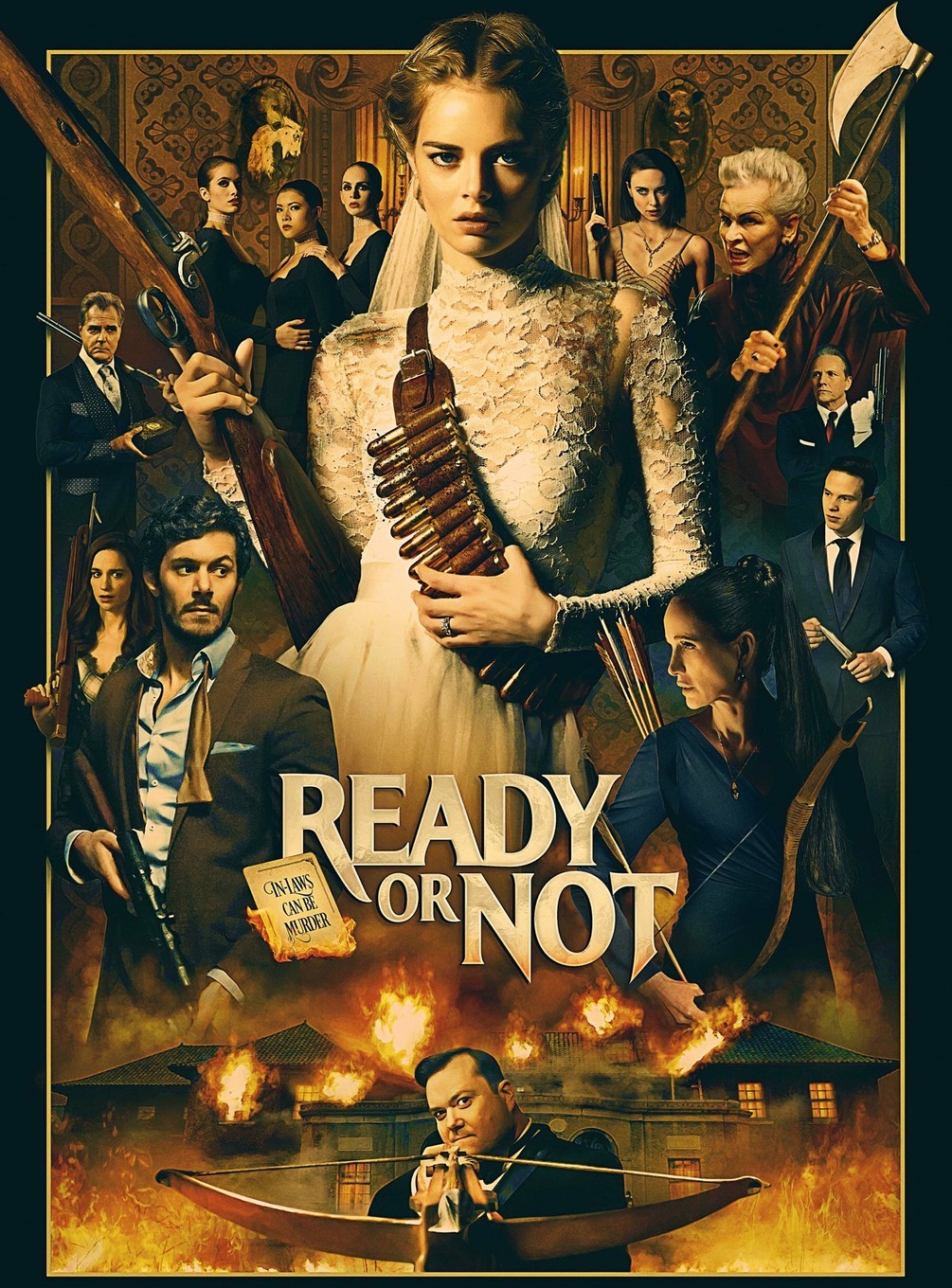
The will to survive is a strange thing. Why do some people give up their wallet or purse to a mugger freely and others snap and fight to the death? Back in the days when I could jog, I was in Central Park early on a Sunday and a mugger tried to take my little POS MP3 player.  I could’ve done the smart thing and given it up, but something just clicked and I started punching and punching.  His face was total shock and he wandered off.  He wasn’t threatening my life, but it didn’t matter if he were, I would’ve acted the same. And Yes, my 93 tracks ranging from Springsteen to Modest Mouse remain safe to this day.  Ready or Not tests whether Grace (Samara Weaving) has the will to survive and she didn’t even have an ipod to protect.

The people hunting people is almost a sub-genre, but this movie had style.  It’s got horrible and quasi-incompetent murderers, a tough but vulnerable heroine, and lots and lots of BLOOD!

Grace is set to marry into a family of rich asshats who treat her like garbage.  Well, except for Daniel (Adam Brody) the brother of Alex – the groom to be.  Daniel thinks she should leave because she’s too good for his worthless family.  Daniel has a point.  The aunt is a mean spirited jerk and all of the people who enter the family are pretty desperate in one way or the other, making them agreeable to participate in their lethal affairs.

Grace decides to marry Alex anyway even though the family’s shitty personalities are on full-display.  The honeymoon begins and Grace must choose a card because she is entering the family.  A creepy box has a playing card and determines which card; sometimes the game is Chess, Checkers, or Hide and Seek.  If Hide and Seek is chosen, the family will hunt the new entrant to the family and sacrifice him or her to Satan- In-Laws … Am I Right?!!!

Grace picks hide and seek and the game is a foot….dun dun dun! This kicks off a lot of suspense and humor as Grace fights her in-laws to the death.  Grace asks her new husband Daniel why he didn’t warn her that his family is a bunch psycho killers?  His response: You would’ve left me.  Daniel, you suck! We all hate you Daniel…A LOT!

The family hunts Grace all over the estate and she gets hurt and screams….and Screams…AND SCREAMS! Samara Weaving’s screams are THE BEST EVER.  They are a mixture of gutteral staccato and high pitched terror and they are legit real.  All other scream queens before her must hail the new Queen.   Here is an example of Samara’s amazing scream queen skills:

RIGHT?!!!! She’s is legit awesome – a throwback and beyond to the glory days of horror. She’s a mix of vulnerable and badass, cunning and funny, basically she rocks this entire movie! Everyone should go see this movie tonight!

Yes, this review is a little brief, but I don’t want to spoil too much.  Enjoy!


Lisa Reviews An Oscar Nominee: Four Weddings and a Funeral (dir by Mike Newell)


(With the Oscars scheduled to be awarded on March 4th, I have decided to review at least one Oscar-nominated film a day.  These films could be nominees or they could be winners.  They could be from this year’s Oscars or they could be a previous year’s nominee!  We’ll see how things play out.  Today, I take a look at the 1994 best picture nominee, Four Weddings and a Funeral!)

(SPOILERS)

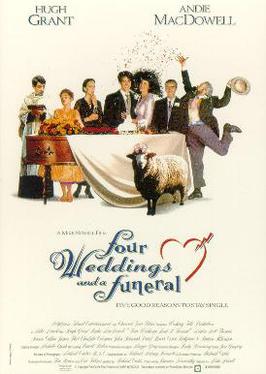
Four Weddings and a Funeral is truly an oddity.  It’s a romantic comedy that works wonderfully well, despite the fact that there’s next to no chemistry between the two leads.

Hugh Grant plays Charles, a neurotic bachelor who lives in London and who, despite having been in several relationships, has yet to marry.  As he’s explains it, he’s spent his life expecting love to hit him like a thunderbolt and it hasn’t happened yet.  Andie MacDowell plays Carrie, an American who has one of those vaguely defined magazine jobs that are so popular in romantic comedies.  Carrie and Charles meet over the course of … well, four weddings and a funeral.  From the minute they first meet, they are attracted to one another but the path of true love is never an easy one.  After spending the night with him, Carrie leaves for America.  When Charles meet her for a second time, she’s now engaged to Sir Hamish Banks (Corin Redgrave), a rather boring politician.

Hugh Grant is perfectly cast as Charles.  It can be easy to make fun of an actor like Grant, what with all the stammering and the carefully calculated charm.  But it works perfectly in Four Weddings and a Funeral, in which Grant manages to believable as both a hopeless romantic and a committed cynic.  Within moments of his first scene (in which Charles wakes up and realizes he’s late for a friend’s wedding), you forget that you’re watching Hugh Grant.  He is Charles.

On the other hand, Andie MacDowell never convinces us that she’s Carrie.  That’s not totally MacDowell’s fault, of course.  Carrie is an underwritten character, one who serves more as a plot device than anything else.  We’re never quite sure how she feels about Charles.  For that matter, we never understand why she’s marrying Hamish.  When she shows up at the film’s funeral, we’re left wondering if she’s really mourning or if she’s just showing up to be polite.  Carrie never comes to life and MacDowell never feels comfortable in the role.  When she gives a warmly received speech at her own wedding reception, the scene feels false because you never feel as if the words are coming from Carrie.

The film ends with Charles and Carrie finally getting together.  Charles both swears his love for her and asks if she’ll agree to never marry him.  We later see them in a snapshot, with a child.  But, despite all of that, you never believe that Charles and Carrie are going to stay together.  There’s just not enough chemistry between Grant and MacDowell to convince you that Carrie isn’t going to get bored and run off with whoever it is she meets at the next wedding she attends.

So, why does this film work so well?  It works because it’s a love story.  However, it’s not about the love between Charles and Carrie.  Not really.  Instead, it’s about the love between Charles and his friends.  Because of the way the film is structured, we only get to see how these people behave at weddings and a funeral.  We never really get to see what these people do for a living or what they’re like during the week.  In fact, we don’t even find out how they all became friends in the first place.

But it doesn’t matter.  The friendships feels real.  The friendships feels authentic.  You might not know how they all became friends but that doesn’t matter.  By the end of the movie, you feel as if you could go to London and possibly run into any of these people going about their daily lives.  They become real in a way that Carrie never does.

There’s Scarlett (Charlotte Coleman), who is Charles’s roommate and who gets flirty when she has too much to drink.

And then there’s David (David Bower), who is Charles’s younger brother.  Both the actor and the character are deaf.  One of the sweetest scenes in the film is when a woman who has been crushing on David attempts to show off her sign language skills.  Everything she signs is wrong but David’s sweet smile tells us all we need to know about how he feels towards her.

Fiona (Kristin Scott Thomas) and Tom (James Fleet) are siblings.  Fiona, who dresses in black, presents a hard exterior but, in one of the film’s more poignant scenes, she admits that the reason she’s never gotten married is because she’s been in love with Charles for ten years.  Tom is a goofy optimist, the type who never doubts that he’s going to find happiness no matter what.

Gareth (Simon Callow) and Matthew (John Hannah) are as close to being married as anyone within Charles’s clique of friends.  (Four Weddings and a Funeral was released twenty years before the legalization of same-sex marriage in the UK.  If someone views the film 50 years from now, they’ll probably wonder why, exactly, Matthew is always described, by those outside of his central group of friends, as merely being a “close friend” of Garth’s.)  Sadly, the funeral of the title is for the fun-loving Gareth.

It’s during the funeral, when Matthew reads a poem from Auden, that it becomes apparent that the heart of this film belongs not to Charles and Carrie but to their friends.  Ultimately, Four Weddings and a Funeral is a celebration of the bonds of friendship.  At the end of the movie, you’re happy, not because Charles and Carrie are finally together but because this unique and wonderful group of friends have all found each other.  Everyone should be so lucky.

Four Weddings and a Funeral was nominated for best picture but lost to Forrest Gump.

Sundance Film Review: sex, lies, and videotape (dir by Steven Soderbergh)


The Sundance Film Festival is currently taking place in Utah so, for this week, I’m reviewing films that either premiered, won awards at, or otherwise made a splash at Sundance!  Today, I take a look at 1989’s sex, lies, and videotape, which won both the Audience Award at the 1989 Sundance Film Festival and the Palme d’Or at Cannes!

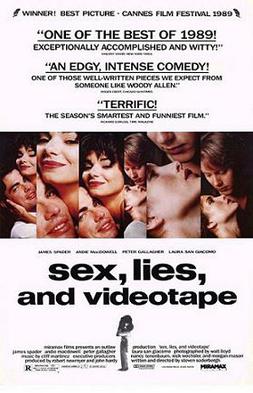
The directorial debut of Steven Soderbergh, sex, lies, and videotape is considered by many to be one of the most important independent American films ever made.  Not only was it a  success at the box office and nominated for an Oscar but it also won the Palme d’Or at Cannes.  According to Peter Biskind’s Down and Dirty Pictures, the success of sex, lies, and videotape is what convinced Hollywood that independent films could be big business.  The marketing of the film would set the template for almost every independent release that followed.

(One person who was definitely not a fan of sex, lies, and videotape was director Spike Lee.  When Lee’s Do The Right Thing lost the Palme to Soderbergh’s film, Lee was informed that the Canne jury felt Lee’s film wasn’t “socially responsible.”  “What’s so socially responsible about a pervert filming women!?” Lee reportedly responded.)

sex, lies, and videotape tells the story of four people in Baton Rouge, Louisiana.

Ann (Andie MacDowell) has a nice house, a successful husband, and an absolutely miserable marriage.  When the film opens, she’s having a session with her therapist (Ron Vawter) and talking about how unfulfilled she feels.  When the therapist asks her questions about her sex life, Ann laughs nervously.  She says that she likes sex but she doesn’t like to think about it.  She says she doesn’t see what the big deal is.  Later, she reveals that she’s never had an orgasm.

John (Peter Gallagher) is Ann’s husband.  He’s a lawyer.  He’s also a materialistic jerk and … well, that’s pretty much the sum total of John’s entire personality.

Cynthia (Laura San Giacomo) is John’s mistress.  She’s a bartender at a rather sleazy little establishment, where she apparently spends all of her time listening to a local drunk (Steven Brill) do a Marlon Brando impersonation.  She is uninhibited and fiercely sexual.  She’s the opposite of Ann, which is why John likes her.  Of course, she’s also Ann’s sister.  Cynthia and Ann have a strained relationship.  Ann describes Cynthia as being “loud.”  Cynthia views Anne as being judgmental.  Secretly, both wish that they could be more like the other.

And then there’s Graham (James Spader).  Graham was John’s friend in college, though it’s difficult to understand why.  Graham has recently returned to Baton Rouge and John, without talking to Ann, has invited Graham to visit them.  Graham is apparently a drifter.  (Ann describes him as being “arty.”)  While Ann is helping him find an apartment, Graham informs her that he’s impotent.  He can’t get an erection if anyone else in the room.

Ann subsequently discovers that Graham deals with his impotence by videotaping women discussing their sex lives.  The video camera allows Graham to keep his distance and not get emotionally involved.  (Of course, it also serves as a metaphor for directing a movie.)  Ann is freaked out by all of Graham’s tapes.  Cynthia is intrigued.  And John … well, John’s just a jerk.

sex, lies, and videotape is a film that’s largely saved by its cast.  Graham is a role that literally only James Spader could make intriguing.  Meanwhile, Peter Gallagher actually manages to bring some charm to John, who is the least developed character and who gets all of the script’s worst lines.  That said, the film really belongs to MacDowell and San Giacomo, who are totally believable as sisters and who, again, bring some needed depth to characters that, as written, could have been reduced to being mere clichés.  (In the scenes between MacDowell and San Giacomo, it was less about what they said than how they said it.)

As I already stated, this was Steven Soderbergh’s feature debut.  Soderbergh was 26 years old when he made this.  Seen today, it’s an uneven but ultimately intriguing film.  There are a few scenes where Soderbergh’s inexperience as a filmmaker comes through.  For instance, John is written as being such a complete heel (and, in his final scene, he wears a ludicrous bow tie that practically screams, “EVIL,”) that it occasionally throws the film off-balance.  You never believe that Graham would have been his friend, nor do you believe that Ann would have spent years putting up with his crap.  The film’s final scene between Cynthia and Ann also feels a bit rushed and perfunctory.  That said, this film shows that, from the start, Soderbergh was good with actors.  Visually, Soderbergh takes a low-key approach and allows the cast to be the center of attention.  It’s an actor’s film and Soderbergh wisely gets out of their way.  In particular, Spader and San Giacomo have a way of making the most heavy-handed dialogue sound totally and completely natural.

It’s hard to imagine Soderbergh directing something like sex, lies, and videotape today.  If the film were made today, Soderbergh wouldn’t be able to resist the temptation to use overexposed film stock and to give cameos to George Clooney as Ann’s therapist and Matt Damon as the drunk.  sex, lies, and videotape is a film that Soderbergh could only have made when he was young and still struggling to make his voice heard.  It’s a flawed by intriguing film.  If just for its historical significance, it’s a film that every lover of independent cinema should see at least once.

Previous Sundance Film Reviews:

  1. Blood Simple
  2. I Don’t Feel At Home In This World Anymore
  3. Circle of Power
  4. Old Enough
  5. Blue Caprice
  6. The Big Sick
  7. Alpha Dog
  8. Stranger Than Paradise

Embracing the Melodrama Part II #73: St. Elmo’s Fire (dir by Joel Schumacher)


St_elmo's_fire

Oh my God!  Aren’t rich, white people just like the worst!?

Actually, usually I would never say something like that.  I usually find class warfare to be tedious and I personally think poor people can be just as annoying as rich people.  I had no interest in the whole Occupy Wall Street thing and I once referred to V For Vendetta as being V For Vapid.

No, I may not be much of a class warrior but then again, that may be because I never met any of the characters at the center of the 1985 film St. Elmo’s Fire.  Seriously, if anything could turn me into a slogan-spouting, window-smashing revolutionary, it would be having to deal with any of the self-centered, entitled characters in St. Elmo’s Fire.

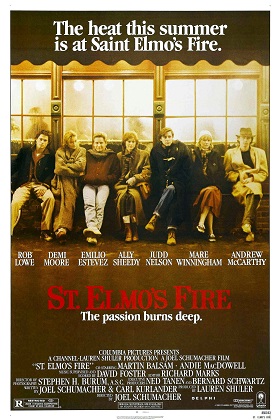
St. Elmo’s Fire is about a group of seven friends, three of whom are played by actors who co-starred in The Breakfast Club.  These friends all met at and are recent graduates from Georgetown University.  St. Elmo’s Fire follows them as they laugh, love, drink, do drugs, and try to figure out what they want to do with the rest of their lives.

For instance, there’s Billy (Rob Lowe), who has big hair and wears one dangling earring.  Billy was in a fraternity and spends most of the movie wishing that he still was.  Billy also plays the saxophone and he has a wife and a kid who he has pretty much abandoned … well, you know what?  I like Rob Lowe.  He seems like a fun guy and his DirectTV commercials were all classics but oh my God, does he ever give a bad performance in St. Elmo’s Fire.  Some of it is because Billy is not a very likable character.  He’s supposed to be the rough-around-the-edges, secretly sensitive rebel type but ultimately, he just comes across as being a loser.

And then there’s Jules (Demi Moore), who does too much cocaine and, as a result, finds herself fearing that she’s on the verge of being sold into a sexual slavery.  Jules doesn’t get to do much other than be rescued by the other characters.  Fortunately, when it looks like the group is drifting apart, Jules attempts to commit suicide and brings everyone back together.  Way to be a plot device, Jules!

Wendy (Mare Winningham) is the sweet but insecure virgin who has a crush on Billy.  Wendy works as a social worker and ends up getting insulted by the very people that she’s trying to help.  Winningham gives one of the film’s better performances but you can’t help but feel that Wendy deserves better friends.

Speaking of good performances, Andrew McCarthy also gives a pretty good one.  McCarthy plays Kevin Dolenz, the idealistic writer who everyone is convinced is gay because he hasn’t had sex in 2 years.  However, Kevin is actually in love with his best friend’s girlfriend.  As written, Kevin runs the risk of coming across as being insufferably moralistic but McCarthy gives a likable performance.  He turns Kevin into the nice guy that we all want to know.

And then there’s the Breakfast Club alumni.

Alec Newberry (Judd Nelson) was the vice-president of the Georgetown Democrats but now, because it pays better, he’s taken a job working for a Republican senator.  Alec’s girlfriend is Leslie (Ally Sheedy).  Alec obsessively cheats on Leslie, claiming that he can’t be loyal to her unless she’s willing to marry him.  The group of friends is largely centered around Alec and Leslie though it’s never really clear why.  Alec and Leslie are boring characters and, as a result, they’re a boring couple.

And then there’s Kirby (Emilio Estevez).  Estevez gives a likable performance but he often seems to be appearing in a different movie from everyone else.  Kirby is working on his law degree and he’s in love with a hospital intern named Dale (Andie MacDowell).  Unfortunately, Dale isn’t as interested in Kirby as he is in her so Kirby responds by stalking her and trying to change her mind.  There’s an earnestness and sincerity to Kirby that makes you like him, even if his behavior is actually rather creepy.

As for the film itself — well, it’s directed by Joel Schumacher and there’s a reason why Schmacher has the reputation that he does.  As a director, Schumacher is good at gathering together an attractive cast but he has close to no idea how to tell a compelling story.  St. Elmo’s Fire plods along, dutifully telling its story but providing little insight or surprise.

If you’ve read some of my previous reviews, you’re probably expecting this to be the point where I argue that St. Elmo’s Fire works as a time capsule.  But, honestly, this film doesn’t have enough insight to really work as a time capsule.  I mean, if you love 80s hair and 80s fashion, you might enjoy St. Elmo’s Fire but, then again, you could always just do a google image search and have the same basic experience.