Brad reviews HITCH (2005), starring Will Smith and Kevin James!


I guess you can call this the holiday season of love for me, as I turn my attention today toward the 2005 romantic comedy HITCH. Will Smith stars as Alex “Hitch” Hitchens, a somewhat legendary and highly discreet consultant based in New York City. His specialty… helping less than perfect, even slightly awkward, men win the hearts of beautiful women. His methods are very effective, but he only works with men who are genuinely in love and not just chasing a one-night stand. His latest lovelorn client, the sweet and clumsy tax accountant Albert Brennaman (Kevin James), is smitten with a famous heiress named Allegra Cole (Amber Valletta), a client of the tax firm he works for. As Hitch works his magic for Albert, he also meets the cynical, but extremely beautiful tabloid journalist Sara Melas (Eva Mendes). Hitch finds himself falling for Sara at the same time that she’s on the trail of an urban myth of a “Date Doctor,” mistakenly believing that he is exploiting the emotions of women in the city for his own personal gain. When Sara and Amber discover who Hitch really is, will the guys’ true love win the day, or will the ladies believe it was all just a sleazy, manipulative setup?

HITCH is one of my favorite romantic comedies, and I watch it every year, usually multiple times. I’m a romantic at heart, and I really enjoy a film that plays with the idea of characters who truly care about, and respect, each other. This dynamic plays out through several different relationships. My favorite is the genuine friendship that develops between Hitch and Albert Brennamen. Hitch recognizes the sincere feelings that Albert has for Allegra, and he then goes all in to help him win her heart. While Will Smith is effortlessly charming and in peak movie star form, unsurprisingly, the character I identify the most with is Kevin James as Albert. His character is so sweet and earnest in his pursuit of Allegra that you just can’t help but pull for him. Balance that part of his character with James’ excellent physical comedy, whether it be his natural clumsiness or his unfounded confidence in his dance moves, and James gives the performance that takes this movie over the top for me. When teaching Albert the dance moves that he should stick with when he’s out on a date with Allegra, Hitch utters the line, “Don’t you bite your lip. Stop it!” It was that moment when I realized that, like Albert, I never dance without biting my own lip!

While the fraternal love between Hitch and Albert is my favorite relationship in the film, I also like the romantic relationship that develops between Hitch and Sara. I appreciate the way both characters step out of their comfort zones and risk their own hearts for each other. This is not easy for either of them, as Hitch’s charm and confidence actually masks deep insecurities based on his past relationships. Sara, on the other hand, has allowed herself to become very cynical towards all men, building walls so tall that no man can climb them. The fact that they truly open themselves up to each other, even if there are some serious complications along the way, gave me a strong rooting interest in their happiness.

The last performance I wanted to highlight in HITCH is that of Jeffrey Donovan, who plays sleazy narcissist Vance Munson. Munson tries to hire Hitch to help him get a vulnerable woman into bed, and in a moment of pure audience satisfaction, he pays the price for his disrespect. About the time I watched HITCH, Donovan was starring in a T.V. series that I really enjoyed called BURN NOTICE. I’m a big fan of Donovan, and he’s perfect here as a man you love to hate. In a movie full of likable characters, Vance Munson was a needed counterpoint, and his A-hole character really stands out.

No movie is perfect, but if you’re in the mood for something that’s lighthearted, funny, and makes you want to fall in love, then HITCH is about as close as it gets.


What Lies Beneath (2000, directed by Robert Zemeckis)


Claire (Michelle Pfeiffer) is a former cellist who is still struggling to recover from a serious car accident and who has been at loose ends ever since her daughter left for college.  Claire’s husband, Norman (Harrison Ford), is a scientist and a college lecturer.  After their neighbor, Mary (Miranda Otto), disappears, Claire becomes convinced that Mary’s husband (James Remar) did something to her.  Claire also becomes convinced that Mary’s ghost is trying to contact her, by appearing in the lake and filling the bathtub up with water whenever Claire isn’t looking.  Norman tells Claire that she’s imagining things and pushes her to see a therapist.  As Claire investigates, she discovers that Norman knows more than he’s letting on.

What Lies Beneath is a long and drawn-out ghost story that Robert Zemeckis made because he had time to kill while the filming of Cast Away was on hiatus so Tom Hanks could lose weight and grow a beard.  That this movie was not a personal project for Zemeckis is reflected in his direction, which is surprisingly impersonal for a Zemeckis film.  The film is a showcase for Michelle Pfeiffer, who gives a good performance as the emotionally fragile Claire and holds the film’s many disparate elements together.  Harrison Ford sometimes seems disinterested but his casting still pays off when Norman gets to say and do some things that you normally would never expect Harrison Ford to do.

I remember seeing this in a theater in 2000 and being surprised by the ending.  Looking back on it today, I just can’t believe that I sat through the entire movie.

THE FAMILY MAN (2000) – Nicolas Cage gets a “glimpse” into a different life!


Nicolas Cage stars as Jack Campbell, a Wall Street hot shot, who puts his success in the business world above everything else in his life. We meet him on Christmas Eve as he’s trying to close a multi-billion dollar merger. He’s making everyone work late and even calls for a work session on Christmas Day. Jack’s administrative assistant gives him a phone message from his former girlfriend Kate (Tea Leoni), who he almost married about 15 years earlier. He’s surprised to hear from her, especially since he essentially chose his career over her all those years ago. That night as he stops at a grocery store on his way home, events transpire so that a desperate man named Cash (Dan Cheadle) pulls a gun on the clerk. Jack is able to use a calm demeanor and business sense to talk to Cash in a way that diffuses the situation and the two leave the store together. As they walk down the street, Jack tries to talk to Cash and help him. When Cash starts asking Jack about his life, Jack indicates that his life is great and he has everything he needs. Interestingly, this is where Cash mysteriously tells Jack that he’s going to do something for him, something he really needs…

The next morning, Christmas morning, Jack wakes up in a different home, he’s married to Kate, and they have two kids and a dog. He’s no longer an investment banker; now he’s a tire salesman. He no longer drives a Ferrari; now he’s drives a mini-van. In panic-mode, Jack runs out of the house as his in-laws arrive, fires up the mini-van, and drives to his office on Wall Street where nobody knows him, and they kick him out of the building. About that time, Cash pulls up in Jack’s Ferrari and tells him that he’s giving him the gift of a “glimpse” into what his life could have been if he had married Kate instead of focusing on himself and his career. So Jack heads back to try life in Jersey, wondering when the glimpse will come to an end. 

My wife and I are continuing to watch Christmas movies throughout the month of December to stay in the holiday spirit. THE FAMILY MAN is not necessarily a movie we watch every year, but I’m a fan of Nicolas Cage. I enjoy these types of films where a person sees what their lives could have been like if they had made different decisions at certain key points along the way. An easy comparison can be made to Frank Capra’s IT’S A WONDERFUL LIFE, which is my personal favorite Christmas movie, and it’s in my top 10 movies of all time. It’s not really an appropriate comparison though. These stories encounter their subjects in two very different places. In IT’S A WONDERFUL LIFE, George Bailey is at the end of his rope and thinking his family would have been better off if he had never been born. It takes Clarence to reveal just how important George has been to those he loves. In THE FAMILY MAN on the other hand, Jack Campbell is at the top of the world and standing at the precipice of his crowning achievement in his career. He believes his life is wonderful. Cash decides to teach him a lesson by offering a “glimpse” into a life that he could have had if he had chosen Kate and a family over his career. Would life with her be more fulfilling than all the money in the world? I think the sale is a lot easier for Clarence than Cash, and I also think that’s why I found the film to be less compelling. George Bailey’s decision was literally life with a family who dearly loves him, or death. Jack Campbell’s decision is if he wants a middle class life with a loving wife and two precious kids that he only just met, or if he wants to continue his prior life as the multi-millionaire mover and shaker with his pick of beautiful women.  It doesn’t help the film’s case either that Jack’s never really presented as being completely empty on the inside or unhappy, say, the way Bill Murray is in SCROOGED. While I personally enjoy the type of life that Jack is able to glimpse, his character’s specific choice is not as obvious, or earned, the way George Bailey’s is. 

Overall, as a man who wouldn’t trade my family for all the money in the world, I do appreciate what THE FAMILY MAN is going for. The execution doesn’t quite pull it off in a way that is completely satisfying, and ultimately explains why I don’t watch it every year as a holiday staple. 

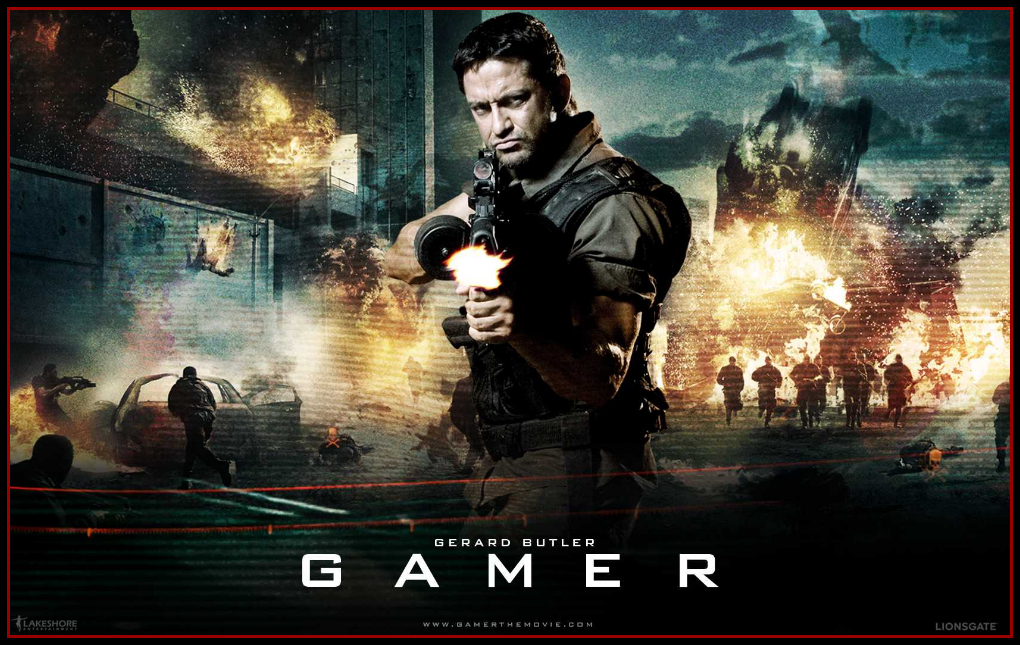
Review: Gamer (dir. by Neveldine/Taylor)


No one will ever mistake the writer-director duo of Neveldine/Taylor (Mark Neveldine and Brian Taylor) as the next Coen Brothers, but they definitely have made their mark in creating entertaining films which some have called exploitative, pandering to the lowest common denominator and exercises in excess. Maybe these critics are right, but they also seem to view the films by these two filmmakers through the narrow-minded lens of their elistist and so-called cineaste sensibilities. They won’t be the next Coen Brothers but they’re way ahead of other so-called filmmaker duos such as The Spierig Brothers (Undead and the pretentious and awful Daybreakers) or The Strause Brothers (AvP: Requiem and the awful Skyline). They came onto the scene with their cult classic action thrillers Crank and it’s sequel, Crank: High Voltage.

Their third film took the gaming influences so inherent in their first two films (which for all intents and purpose were video games that happened to be film) and went the next step. Gamer is all about a near-future world where two games with on-line social media foundations have become the rage of the entertainment world. One is a game called “Society” that looks to be the nightmare evolution of privacy advocates everywhere to the on-line virtual world Second Life and The Sims. It is the other game in this film which makes up the foundation of the film’s plot. “Slayers” takes the ultra-popular multiplayer on-line experiences of games such as Call of Duty and HALO to the next level by allowing gamers to actually control real people (inmates sentenced to death) to act as their avatars in a real-life battlefield arena with real weapons and real deaths.

These games which have become the obsession of hundreds of millions of people worldwide are the brainchild of the film’s antagonist. Michael C. Hall plays the creator of these games and his performance looks to combine the sociopathic charm of his Dexter character with that of Steve Jobs is the latter was openly honest about his douchebag tendencies. Playing his opposite is the character of Kable who happens to be the reigning champion of the game Slayers and who knows a secret that could tear down the billion-dollar empire created by Castle. Gerard Butler plays the desperate but very capable inmate Kable who just wants to survive past the final match and earn his freedom thus return to his wife and young daughter on the outside.

Gamer posits the question of how far are we willing to go to experience realism in our games and entertainment. With the game Society people pay to be able to control other people in a social setting (albeit in a controlled area). These so-called avatars will do anything and everything their real-life controllers tell them to do. In the film these avatars get paid to become virtual slaves and with most people signing up for the job being the socially desperate. Their situation is not so dissimilar from the condemned inmates who populate the game Slayers. The film hits the audience with a sledgehammer that these virtual entertainments have become popular worldwide because people have stopped looking at these “volunteers” as real people. Morality has been replaced by the need for instant gratification by way of these virtual on-line systems.

The film doesn’t make any apologies for the heavyhanded delivery of it’s message and also doesn’t skimp on the entertainment side of the equation. Neveldine/Taylor have shown that they have a certain flair for creating visual chaos and action on the screen. Their unique visual style does look like something out of a video game especially those from hyperrealistic shooters such as Call of Duty and its ilk. The filmmakers have always accomplished the high-quality visual look of their films despite the low to modest budget given to them by the studios they’re working for. Gamer is no exception and the film benefits from the decision by these two filmmakers to continue working with the Red One digital cameras thus allowing them to add in the visual effects right into the shot scenes the very same day of shooting.

It’s this very style of hi-tech guerrilla filmmaking which makes Neveldine/Taylor this current era’s Cormans. Unlike most low-budget filmmakers they don’t use the size of their budget to dictate how their films turn out visually, aurally and narratively. The first two this film succeeds in ways that makes an audience think the film was higher budgeted than it really was. The third would depend on the viewer whether the film succeeds or not. For those who seem intent on viewing every film as if they were made to be worthy of high awards and accolades would probably dismiss and hate this piece of exploitation cinema. Gamer succeeds in a narrative sense because it delivers on the promise of telling a story about a world where free will has been seconded to control in the need of a population in search of a the next virtual playground. It’s a heady premise that has been explored in past films such as the Matrix Trilogy and another film similar to this one which came out weeks later in Surrogates.

Gamer doesn’t have the philosophical and existential sermoning in combination with futuristic action sequences as the Wachowski Brothers’ trilogy, but it does have the same visceral action DNa as those three films and also more entertaining than the Bruce Willis vehicle Surrogates. This film will appeal to the very people who it condemns as sheep to the rising tide of on-line control in entertainment, but then that’s what all exploitation films tend to do best. Cater to the very people it uses as examples of what’s wrong in society and build an entertaining film around them and what they represent.

The film’s cast revolves around Gerard Butler and Michael C. Hall and the roles they play. Whether its Amber Valletta playing Kable’s desperate wife who has sold herself to become a controllable avatar in Society to try and earn enough to get her young daughter back or to Logan Lerman playing the role of Simon the gamer who controls Kable during the Slayer matches. They all do enough with their roles to keep their characters from becoming less than one-notes. Again, for some having a film with characters that are quite basic and one-note might make for a bad film, but when put into context of the story being told they’re quite good and needed to become motivators for Butler’s character.

In the end, Neveldine/Taylor have made a modern day exploitation and grindhouse film in Gamer without having to resort to the visual tricks used in the Rodriguez/Tarantino grindhouse homage film Grindhouse. A film doesn’t need to have film scratches, overexposed film stock, scratchy audio track or missing film reels to be grindhouse. It just have to espouse the very nature of the films which made up the kind of films which became prime example of grindhouse/exploitation cinema. Gamer won’t win any awards, but I suspect that more people who saw it were entertained by it’s blatant, in-your-face entertainment than would normally admit to it. It’s a film that has cult status and guilty pleasure written all over it.

Plus, this film is definitely worth at least a curiosity viewing if just to see the musical number performed by Michael C. Hall at the climactic sequence near the end of the film. I don’t think any film has ever combined gratuitous violence, musical dance numbers using bloodied death row inmates and Michael C. Hall singing Frank Sinatra’s “Ive Got You Under My Skin“. That sequence alone is worth a rental or Netflix Instant streaming.