4 Or More Shots From 4 Or More Films is just what it says it is, 4 shots from 4 of our favorite films. As opposed to the reviews and recaps that we usually post, 4 Shots From 4 Films lets the visuals do the talking!
Today, we pay tribute to the year 1982 with….
4 Shots From 4 1982 Films
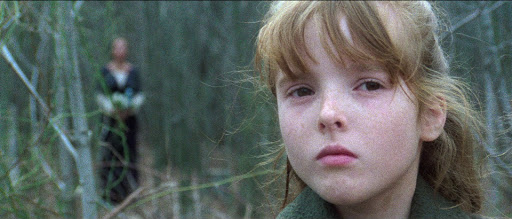
The House By The Cemetery (1982, dir by Lucio Fulci)
The New York Ripper (1982, dir by Lucio Fulci)
Friday the 13th Part II (1981, dir by Steve Miner)
Love him or hate him, no one better epitomized an era than David Lee Roth. There’s no one else like him and regardless of how he may sound or look now, he was one of the greatest frontmen in the history of rock and roll.
There’s no director credited for this video. Peter Angelus seems like a good guess.
Welcome to Late Night Retro Television Reviews, a feature where we review some of our favorite and least favorite shows of the past! On Thursdays, I will be reviewing Hunter, which aired on NBC from 1984 to 1991. The entire show is currently streaming on Tubi and several other services!
Today, we start a new series.
Episode 1.1 “Hunter”
(Dir by Ron Satlof, originally aired on September 18th, 1984)
Ah, Hunter.
Hunter is one of those shows that, up unitl now, I’ve never really specifically felt the need to track down and binge but I’ve still seen a handful episodes. Some of that is because Hunter is a mainstay on the nostalgia channels. If you fall asleep while watching an old episode of Fantasy Island, there’s a good chance that you’re going to wake up to an episode of Hunter. Hunter is also a mainstay on both Prime and Tubi. Again, if you fall asleep watching your favorite Eric Roberts movie, there’s a decent chance that you’re going to wake up to an episode of Hunter.
I have to admit that every episode I’ve seen has been entertaining. It’s the epitome of an 80s cop show, in all of its action-filled, simplistically-plotted glory. Rick Hunter (played by former football player Fred Dryer) is a cop who gets results by doing things his way. “His way” typically involves shooting a lot of people. (Hunter’s catch phrase? “Works for me.”) Hunter’s partner is Dee Dee McCall (Stepfanie Kramer), a cop who gets results by doing things her way. “Her way” typically involves going undercover and …. uhmm, shooting a lot of people. And while I am certainly aware of the dangers of police overreach and I generally don’t support shooting anyone without just cause, it’s still fun to watch Hunter and McCall break every regulation in the book. In almost every episode that I’ve seen, Hunter and McCall end up shooting so many people that the action ends up verging on self-parody. Fortunately, both Dryer and Kramer appeared to be in on the joke.
(From what I’ve seen, I should also mention that Fred Dryer appears to have been a slightly better actor than some of the other former pro athletes who have decided to go into acting. He may not have had a huge amount of range but he was still better than most of the basketball players who showed up on Hang Time. If nothing else, he was better at showing emotion than OJ Simpson.)
Hunter premiered with a 90-minute made-for-television movie. The action starts with Los Angeles Police Detective Rick Hunter crammed into a beat-up car that has definitely seen better days. Because Hunter is the son of a mobster, he’s not totally trusted by his fellow detectives. Because he’s a cop, he’s not totally trusted by the mob. And because he’s a shoot-first renegade, all of his partners end up going to the hospital. Captain Cain (Michael Cavanaugh) is trying to get him to quit the force and that means only allowing him to drive the department’s worst cars, not allowing Hunter to respond to most calls, and trying to partner him up with bowtie wearing moron, Bernie Terwilliger (James Whitmore, Jr.)
Hunter knows that LAPD regulations will allow him to pick his own partner if he can find someone willing to work with him. The problem is that no one wants to put their life on the line. Finally, Hunter tracks down Sgt. Dee Dee McCall, the widow of a fallen officer. Nicknamed the “Brass Cupake” (cringe!), Dee Dee is currently working undercover as a prostitute and is trying to take down Los Angeles’s biggest pimp, King Hayes (Steven Williams). Hunter has a proposition for her. Since neither wants a partner and they both prefer shooting first and asking questions later, why not pretend to work together? They’ll check in and out at the station together but, otherwise, they’ll separate and work their own cases once they hit the streets. McCall agrees.
Unfortunately, Captain Cain is not dumb. He figures out exactly what they’re doing and he tells them that he will have people watching them to make sure that they are actually working together. Luckily, McCall has just arrested King Hayes. Hunter shows up as McCall is handcuffing Hayes and immediately sees that Hayes’s bodyguard is driving his car straight at them.
“You want this guy?” Hunter asks.
“That would be nice,” McCall replies.
Hunter, much like Dirty Harry, proceeds to fire several bullets into the car windshield, causing the car to flip over.
With King Hayes and his bodyguard now taken care of, it’s time for Hunter and McCall to investigate the murders of two blonde women who both enjoyed hanging out at country western bars. McCall puts on a blonde wig and goes undercover at a honky tonk. Hunter is shocked to see that she is being stalked by Dr. Bolin (Brian Dennehy), the psychiatrist who the LAPD brought in to examine all of their detectives. As a viewer, I was not particularly surprised to discover that Dr. Bolin was the killer. You’re not going to cast an actor like Brian Dennehy on a show like Hunter and then just have him spend the entire episode sitting in his office. McCall and Hunter work together to stop Bolin before he kills again.
The pilot of Hunter was actually a lot of fun. The pilot may have been violent but it still had a sense of humor. The show understood that the sight of 6’6 Fred Dryer crammed into a dented station wagon would not only make the viewer smile but it would also go a long way towards humanizing Hunter as a character. He may be big and cocky and quick to shoot people but he also has terrible luck when it comes to cars, police radios, and bystanders. At one point, he even gets pepper-sprayed by Dee Dee’s neighbor. As for Dee Dee, I liked the fact that she was capable and tough without being a stereotypical action girl. I also appreciated that she and Hunter chose to work together. I feared, initially, that the pilot would be full of scenes featuring Hunter whining about having to work with a woman and I appreciated that the show went the opposite direction. From the start, Hunter respects Dee Dee as a cop and it’s made clear that she has nothing to prove to him. If anything, Hunter has to earn her respect.
Of course, the main appeal of Hunter is that both Dryer and Kramer looked good holding a gun and yelling at people to “freeze!” As opposed to the wishy washy police procedurals of today, the pilot of Hunter was absolutely shameless about giving the viewers what they wanted as far as bullets and car chases were concerned.
This was a good pilot. Watching it, I could understand why the show ended up running for 8 seasons. And, every Thursday, I’ll be reviewing Hunter. I look forward to the action!
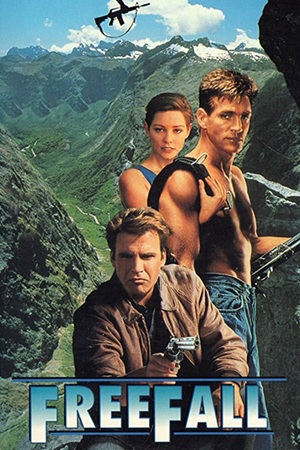
That is the question at the heart of 1994’s Freefall.
Played by Eric Roberts, Grant Orion claims to be a former Hollywood stuntman who now spends most of his time jumping off of cliffs and skydiving. When photographer Katy Mazur (Pamela Gidley) first spots Grant, he is climbing to the top of a cliff in Swaziland and jumping off. Katy, who has been sent to the country to get a photograph of a taita falcon, finds herself obsessively snapping his picture. Later, after she meets Grant, she ends up cheating on her fiancé with him. The fiancé in question is Dex Dellums (Jeff Fahey), who is not only engaged to marry Katy but who is also her editor. He’s the one who sent her to Swaziland in the first place.
Who is Grant Orion? (And who, in the world, actually has a name like Grant Orion?) After Grant saves Katy from some gunmen, he explains that he’s not only a former stuntman but he’s also an agent of Interpol. However, Dex claims that Grant is lying. Dex tells her that Grant is a former stuntman who was run out of Hollywood after a stunt went wrong and now, he’s basically a mercenary. Katy doesn’t know who to trust as violence breaks out all around her.
Freefall starts out as a standard erotic thriller, with Roberts and Gidley exchanging smoldering looks and uttering heated dialogue. Before long, though, it turns into a thriller with Katy not being sure who to trust. There’s a lot of gunfire. There’s a lot of over the top action. Some of the scenes of action are so over-the-top that the film almost feels like it might be a parody. The plot itself is next to impossible to follow but who needs a plot when you’ve got Eric Roberts and Jeff Fahey sharing the screen together? Roberts is all smoldering intensity while Fahey seems to be having the time of his life playing the smarmy Dex.
Along with getting the best out of Roberts and Fahey. director John Irvin also manages to get some truly beautiful shots of the mountains of Swaziland. Though the scenes of Roberts climbing the mountains were clearly done by a real stuntman (and not Grant Orion), they’re still effectively shot. When we first see Grant jump off the mountain, the imagery is breath-takingly beautiful. At times, it’s hard not to regret that the entire film wasn’t just about Grant jumping off of mountains. All of the gunfire gets in the way of the main attraction.
Today, we’re so used to seeing Eric Roberts in small cameo roles that it’s easy to forget that he started out his career in starring roles. Freefall is a silly film but it’s undeniably entertaining, in the way that the best direct-to-video erotic action thrillers often were. Don’t even try to follow the plot. Just enjoy the mountains and the scenes of Roberts and Fahey competing to see who can out-smolder the other.
Previous Eric Roberts Films That We Have Reviewed:
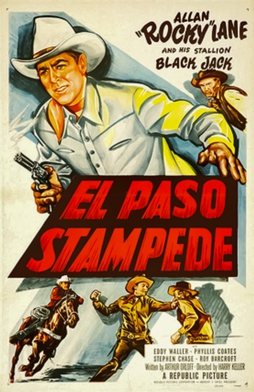
With the country distracted by the Spanish-American war, someone is stealing cattle on the border between Mexico and the United States. Federal marshal Rocky Lane (Allan Lane) is sent to investigate. He gets a job with Nugget Clark (Eddy Waller), a local feed merchant, and gets to know Nugget’s daughter, Alice (Phyllis Coates). As was usually the case with these B-westerns, it turns out that the band of onery outlaws is secretly being led by a villain who is an otherwise respectable member of society. When it comes to the Old West in these films, the biggest threat was not from the outlaws but instead from the greedy and corrupt settlers who wanted to get their own piece of the action and who were willing to sell out their own neighbors and sometimes their own country to get it. It falls to Rocky and Nugget to save the day, rescue Alice from the bad guys, and recover the cattle.
This was the last of the B-westerns to star Allan Lane as Rocky Lane and Eddy Waller as his sidekick. Unfortunately, the arrival of television made short programmers like this one obsolete. Kids could now just watch westerns on television instead of spending the day down at the theater. This was not a bad western for the Rocky Lane character to go out on, though. The plot is predictable but that’s to be expected for a 53-minute programmer like this one. However, Rocky is an appropriately square-jawed hero. He rides his horse, Black Jack, with authority and he looks convincing handling a gun and throwing a punch. There are actually some good shots involving the outlaws’s hideout, which just happens to be hidden behind a waterfall. For western fans, El Paso Stampede is a watchable and undemanding genre entry.
As I mentioned earlier, this was the last film to star Allan Lane. He appeared in a few more westerns after El Paso Stampede but it was always in supporting roles. Allan Lane appeared in 88 films, the majority of which were B-westerns like this one. Today, though, Lane is best-remembered for a role for which he wasn’t even given onscreen credit, providing the voice of the talking horse, Mr. Ed.
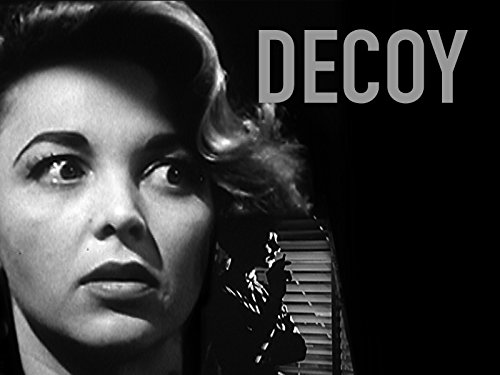
Welcome to Retro Television Reviews, a feature where we review some of our favorite and least favorite shows of the past! On Thursdays, I will be reviewing Decoy, which aired in Syndication in 1957 and 1958. The show can be viewed on Tubi!
This week, Casey is haunted by the past.
Episode 1.27 “The Sound of Tears”
(Dir by Marc Daniels, originally aired on April 14th, 1958)
A wealthy young man has been gunned down in a New York park. It falls to Casey to deliver the news to both the man’s mother (Muriel Kirland) and the man’s ex-fiancée, Wendy Jenkins (Suzanne Pleshette). At first, Wendy is the number one suspect but, as she investigates, Casey comes to suspect that the killer was actually Susan Connor (Molly McCarthy), a family friend who had fallen in love with the victim.
This is an interesting episode, in that it reveals a bit of Casey’s past. Usually, Casey doesn’t let her personal feelings get in the way of doing her job but, in this episode, she finds herself thinking about the day that a policewoman told her that her husband had been killed in the line of duty. Casey has a unique understanding of the pain that the three women are feeling and Beverly Garland does a good job of showing the anguish that Casey is going through.
Unfortunately, the rest of the episode isn’t quite as good as Garland’s performance. From the start, Susan is portrayed as being so obviously unhinged that it’s not really a surprise when she turns out to be the killer. None of the guest cast, including a young Suzanne Pleshette, are as convincing as Beverly Garland is in the lead role. Indeed, Charles Mendick — cast of Lt. Doyle — gives one of the worst performances that I’ve ever seen on this show.
On the plus side, this episode does feature some good location footage of 1950s New York. The noirish black-and-white imagery nicely fits the melancholy story. The cinematography captures the world in which Casey lives, one in which pain doesn’t just go away after a few years and the guilty are often as traumatized as those they victimize.
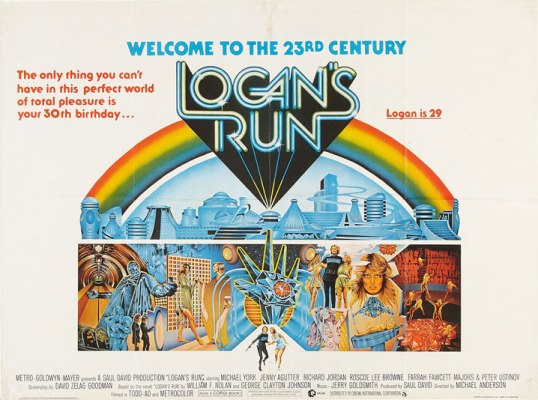
Hi, everyone! Tonight, on Mastodon, I will be hosting the #TubiThursday watch party! Join us for Logan’s Run (1976)!
You can find the movie on Tubi and you can join us on Mastodon at 9 pm central time! (That’s 10 pm for you folks on the East Coast.) We will be using #TubiThursday hashtag! See you then!
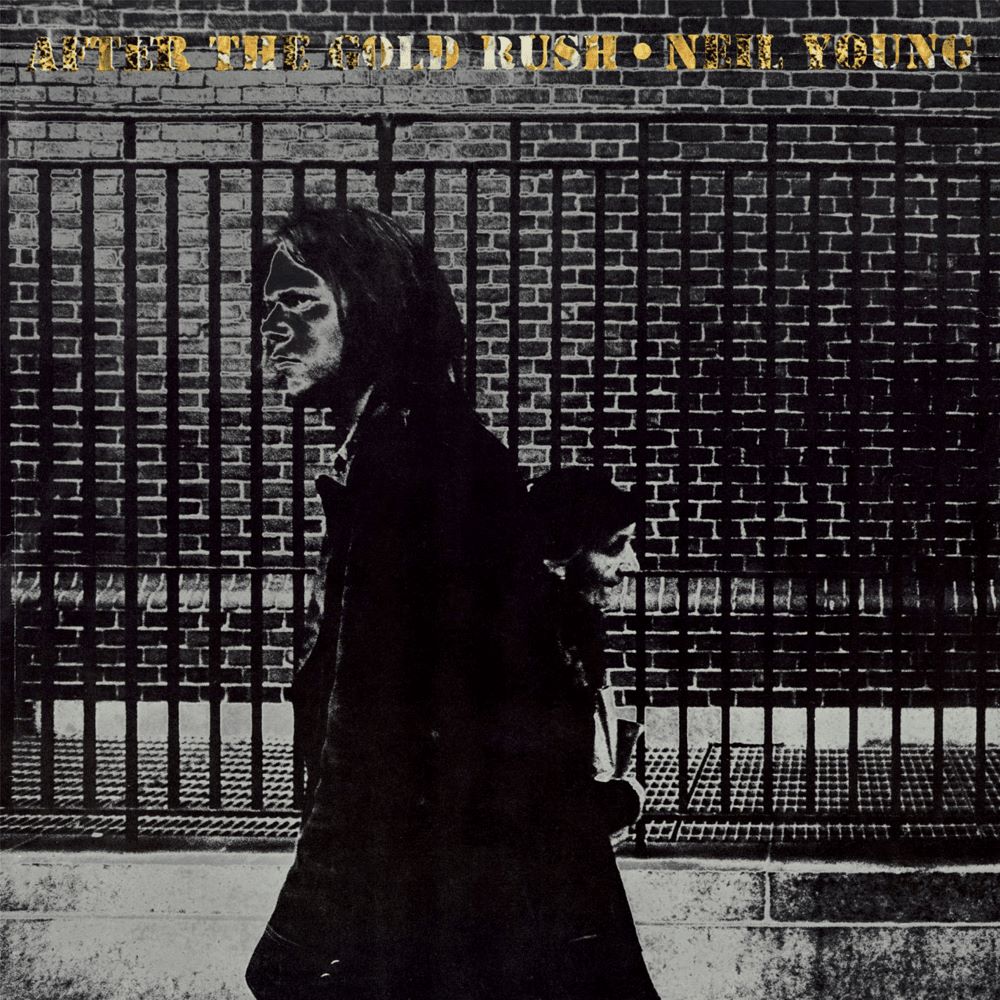
For the latest “Song of the Day,” Southern Man is one of those Neil Young songs that lands like a blunt, uncomfortable truth-telling moment. It’s not a feel-good Southern rock anthem or a nostalgic postcard; it’s a pointed protest song aimed at racism and the legacy of oppression in the American South. What makes it hit so hard is that Young doesn’t soften the message much. He comes across like a songwriter who’s less interested in being liked and more interested in saying something that needed to be said.
Musically, the song has that raw Neil Young edge that fans love: restrained at first, then emotionally rougher as it builds. His guitar work is a huge part of why the song sticks in your head. The solo kicks in around , and rather than being polished or technically showy, it feels almost off-the-cuff—like a burst of emotion caught in real time. There’s a looseness to it, closer to jazz improvisation than to rock precision, and that gives the solo a spontaneous, restless energy that mirrors the song’s anger and urgency.
The track also became a major flashpoint with Lynyrd Skynyrd. They took issue with how Young seemed to generalize the South, and that tension helped inspire Sweet Home Alabama, which famously pushes back at Young’s criticism. It’s one of rock’s most iconic call-and-response moments: one artist sending out a challenge, another answering with proud defiance. Despite the seemingly heated exchange, both parties had mutual respect—and the dialogue between their songs ended up fueling one of the most fascinating cultural conversations in rock.
What makes Southern Man resonate now is how its spirit of confrontation still feels fresh. Over fifty years later, its themes of racial injustice and accountability hit even harder against the backdrop of today’s social and political climate. The song sounds less like a relic of its time and more like a warning that we’re still living through the same struggles Young was shouting about. In that sense, Southern Man hasn’t just aged well—it’s become more relevant than it’s been in the last quarter-century.
Southern Man
Southern man, better keep your head Don’t forget what your good book said Southern change gonna come at last Now your crosses are burning fast
Southern man
I saw cotton and I saw black Tall white mansions and little shacks Southern man, when will you pay them back?
I heard screaming and bullwhips cracking How long? How long?
[guitar solo @2:56]
Southern man, better keep your head Don’t forget what your good book said Southern change gonna come at last Now your crosses are burning fast
Southern man
Lily Belle, your hair is golden brown I’ve seen your black man coming ’round Swear by God, I’m gonna cut him down!
I heard screaming and bullwhips cracking How long? How long?
Given how much I love the 1953 film, Roman Holiday, I’ve probably shared this scene before but that’s okay. It’s an incredibly charming scene and hey, April is the birth month of both Gregory Peck and Audrey Hepburn!


 Through the Shattered Lens