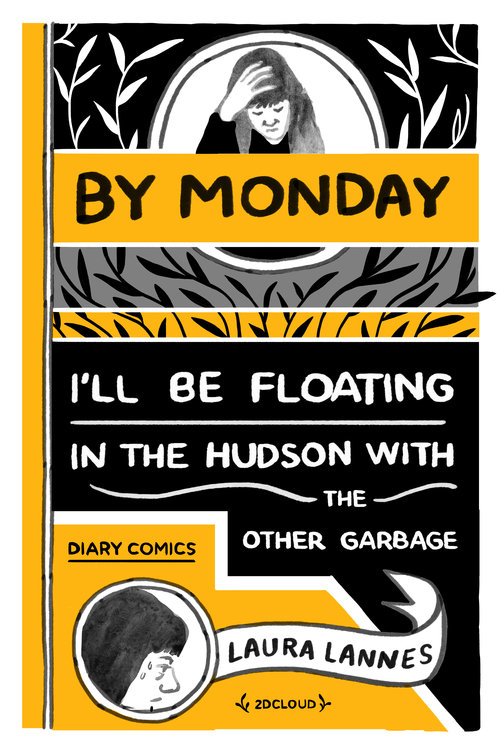
The work of cartoonist Laura Lannes is as raw as it gets. Rendered in tightly-framed watercolors that leave plenty of negative space for readers to fill in the “blanks” (both physical and metaphorical) for themselves, her 2dcloud-published graphic memoir By Monday I’ll Be Floating In The Hudson With The Other Garbage is something a whole lot more than the “simple” 30-day collection (covering the period of February-March, 2017) of diary strips it appears to be on the surface : it’s an examination not only of an emotionally turbulent period in the life of a 25-year-old New Yorker, but of how the process of putting these experiences down on paper allows its author/subject to regain control over the narrative of her own life — at precisely the moment when the parameters of said life seem entirely out of her control.
If you’re gonna “play” the autobio “game” successfully, sharp observational skills…
In cinema circles, an Auteur is described as “a filmmaker whose personal influence and artistic control over a movie are so great that the filmmaker is regarded as the author of the movie” (Wikipedia). I’ve looked at films as a three-way set of responsibilities. You have the writer, because without the story, there’s nothing. You’ve the Director, who takes that Writer’s vision and presents it on film, and then there’s the cinematographer, who makes sure that the Director’s work is well-lit and shot. I feel all three roles can tip the ownership of a film in anyone’s favor. A great story can be damaged by a bad director, and a good director can try to the make the best out of a bad story. On top of that, you could also have bad movies that look really good.
There are a number of directors out there who fit this designation. Brian DePalma, Guillermo del Toro, David Fincher, Terrence Malick (who shows up every half a decade with a film) David Cronenberg, Richard Linklater, Jean-Luc Godard (who I’m learning a lot about lately), the list is a large and heavily argued one. Each person has their own picks and favorites.
For me, Nicolas Winding Refn fits that role. With films like Valhalla Rising, Drive , Only God Forgives and The Neon Demon, it’s hard not to recognize the color contrasts and flow of his stories. In writing this, I also found out that Refn is colorblind, which makes what he’s done so far more amazing for me.
Refn’s latest project for Amazon Studios is a series called Too Old to Die Young. The most anyone really knows is that is supposedly “explores the criminal underbelly of Los Angeles by following characters’ existential journeys from being killers to becoming samurai in the City of Angels.”
Here’s a teaser starring Miles Teller, Callie Hernandez, Jena Malone, John Hawkes and William Baldwin. It appears to still carry that wild color scheme and may possibly be just as dark and brutal as his previous work. I’m curious as to whether they’ll stick with a standard approach or follow True Detective’s style of a single writer/director pair for all of the episodes. Either way, we’ll find out when it releases next year.
New York-based cartoonist Whit Taylor recently sent me a package of her superb wares, so let’s take them all in chronological order so you might be introduced (if you’re not already) to this unique and compelling voice who’s definitely making her presence felt on the independent/small press/self-publishing landscape. Ms. Taylor, this week’s column is all yours —
Ghost is a high-quality, squarebound, full-color little book that Taylor self-published in 2015 featuring a triptych of stories about her meeting three of her all-time heroes : Charles Darwin, Joseph Campbell, and — well, that would be telling. Suffice to say that her first two meetings help give her the fortitude necessary for the third, and that in the third she finds the inner strength to not only come to terms with some very harrowing and unpleasant experiences that have left an indelible mark upon her life, but to hopefully grow from them…
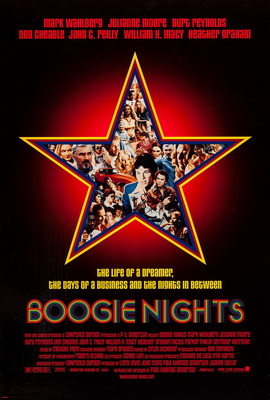
I would like to think that when the Palme d’Or is awards in Cannes, it’ll be half as exciting as when Dirk Diggler (Mark Wahlberg) picked up his second Best Actor trophy in Paul Thomas Anderson’s Boogie Nights.
Now, the scene below is actually the extended version of the scene that actually appeared in the movie. In the movie, you just see Jack Horner (Burt Reynolds) watching his latest film and then cut to Dirk picking up his award. In the extended version, we get to see everyone’s reaction to Dirk winning. They’re all there — Burt Reynolds, William H. Macy, Nina Hartley, John C. Reilly, Melora Waters, Luis Guzman, Julianne Moore, Heather Graham, Don Cheadle, Robert Ridgely (as the memorably corrupt Colonel), and, of course, the dearly missed Philip Seymour Hoffman.
I can understand why Anderson chose to go with a shortened version of this scene. Boogie Nights is a long film and obviously, it wasn’t totally necessary to see how everyone reacted to Diggler’s victory. (By that point, in the film, we already knew how everyone felt about him.) That said, I do prefer the extended version. If nothing else, it’s a reminder that Boogie Nights was more than just the story of Dirk Diggler. Instead, it was the story of a group of outcasts who became a family.
Anyway, let’s hope that whoever wins the Palme d’Or will be a bit more enthusiastic about it than Dirk.
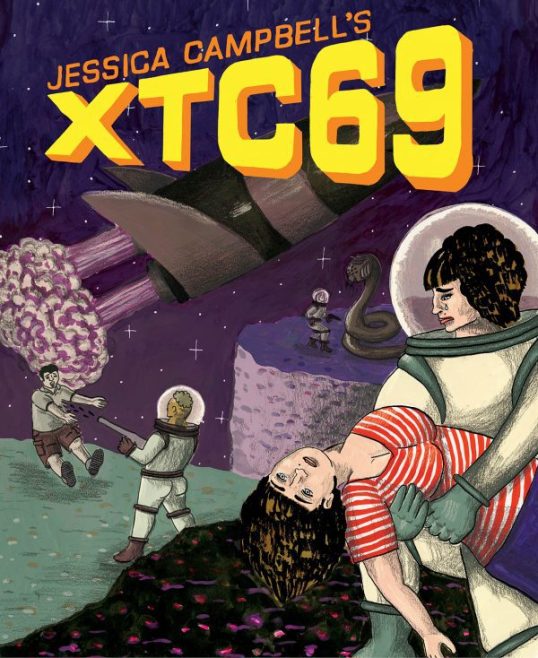
By now you’re well-familiar (or should be) with the laundry-list of societal problems that have “trickled down” into all forms of media, including comics, and also know that right near the top of said list is misogyny, which many of us fooled ourselves into thinking was on the way out — that is, until the biggest misogynist imaginable was elected president, and the once-appropriately-marginalized “alt right” and “edgelord” internet subcultures, both rife with unreconstructed sexism of the most sickening sort, seized on the opportunity of Donald Trump’s political ascendance to become more loud, brash, boorish, and obnoxious than ever. Their bullshit is just plain unavoidable now, and as “gamergate” and “comicsgate” have proven, no corner of the “information” superhighway is safe from misogyny’s malign influence. We’re literally saturated in a toxic stew of aggressive male chauvinism that churns and boils 24/7.
Cartoonist Jessica Campbell, thankfully, isn’t taking it laying…
You’ve gotta hand it to Ellen Forney : she’s got guts.
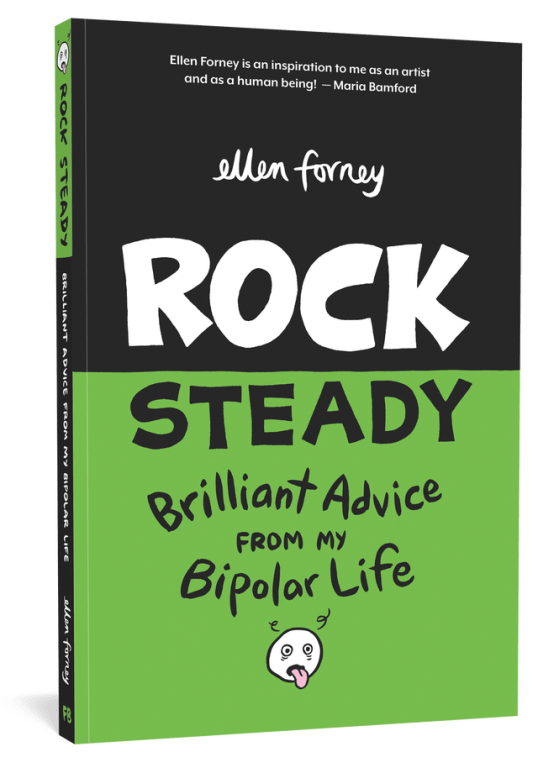
Any reader of her previous, highly personal and confessional graphic memoir, Marbles : Mania, Depression, Michelangelo, And Me would more than likely second that opinion, but it wasn’t her bravura work on that book that I had in mind when making that statement — nor, specifically, was I thinking of the contents of her just-released-by-Fantagraphics follow-up volume, Rock Steady. What the hell am I on about, then?
I’m “on about” her new book’s subtitle : Brilliant Advice From My Bipolar Life. Think about it for a second — if you were the author of a work, would you have the sheer self-confidence and spinal fortitude to put call it “brilliant” yourself? That kind of thing is usually left to the “pull-quote” blurbs the publisher slaps on the front and/or back cover, is it not? And it’s a…
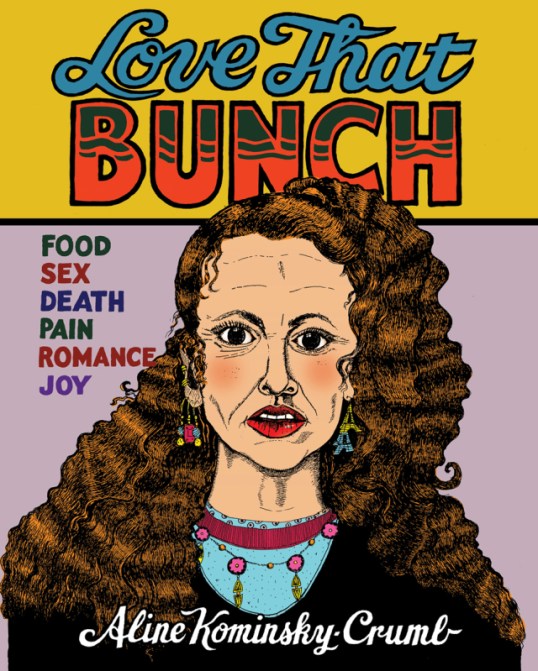
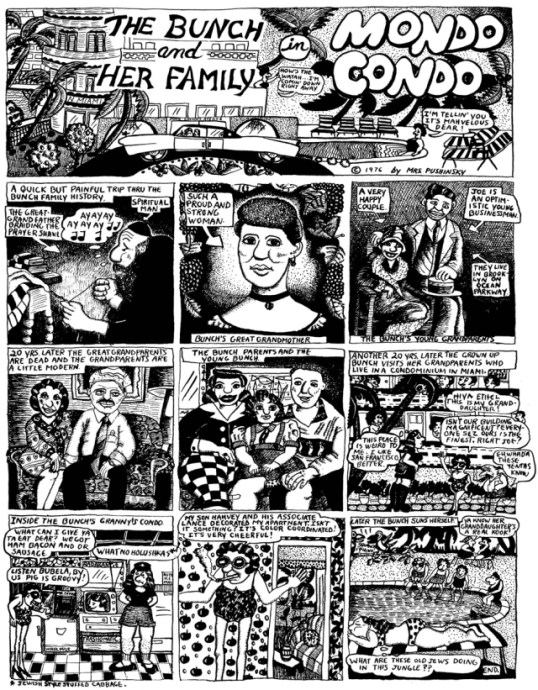
Don’t look now, but Aline Kominsky-Crumb is having what the media has, in recent years, come to call “a moment” — and those of us who have been following her extraordinary cartooning career over the decades can only say : “it’s about fucking time.”
Through no fault of her own, Kominsky-Crumb has almost always operated in her (in?) famous husband’s shadow to one degree or another, and while the arcs of their respective careers have definitely either dove-tailed or run parallel to each other from time to time — they were both involved with (hell, they both edited, albeit at different points in its run) legendary underground anthology Weirdo, they collaborated on Self-Loathing Comics back in the 1990s, etc. — in truth their work, even though they both have figured as prominent characters in each others’ strips, focuses on entirely separate sets of concerns. Sort of.
This past Saturday was Free Comic Book Day, but given that my main goal with these weekly columns is to inform you, the budget-conscious comics consumer, what’s worth spending your money on (or not), it seems counter-productive to waste much time discussing shit that you don’t have to pay for, so we’ll just stick with books that came out that had an actual price tag attached to them, with one (sort of) exception —
Lawrence “RawDog” Hubbard is back, with latter-day sidekick/collaborator William Clausen on art, for Real Deal #8, this time published under Fantagraphics’ auspices, and while the late, great H.P. “R.D. Bone” McElwee will always be missed, this balls-out extravaganza of urban ultra-violence is still pretty much my favorite comic book in the entire goddamn universe. This time out, psychotic hood antihero G.C. meets a Pacino-style version of the devil in the main feature, “Psyops,” while Clausen’s long-running…
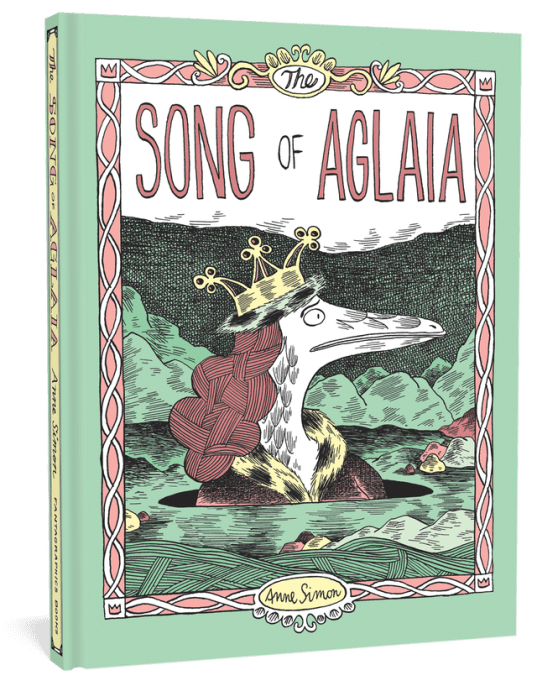
There are so many things going on in veteran French cartoonist Anne Simon’s graphic novel The Song Of Aglaia (originally serialized in a variety of European publications beginning in 2008, later collected in her home country under the title Le Geste D’Algae in 2012, and soon to be released in English for the first time by Fantagraphics) that it’s frankly impossible to pigeonhole it into a single category : part fairy-tale, part cautionary fable, part fantasy narrative, part feminist treatise, part satirical take on palace intrigue, part dark comedy, part family drama, part tragedy — in short, it’s a book that wears a lot of hats. The remarkable thing (okay, one of the remarkable things) about it, though, is that it wears them all with a sense of fierce, defiant, downright joyous aplomb.
I admit that I’m a newcomer to Simon’s work, having encountered it for the first…
I’ll let you in on a little secret : people have always been telling me to put a sock in it. I’ve been an annoyingly opinionated SOB my entire life, but now that I have some online outlets for my opining, I’m far more reserved in my daily interactions with folks. Even still, when you’ve got a side gig as a critic, plenty of people are still going to wish you’d shut up and go away. But what if you shut up — and don’t go away?
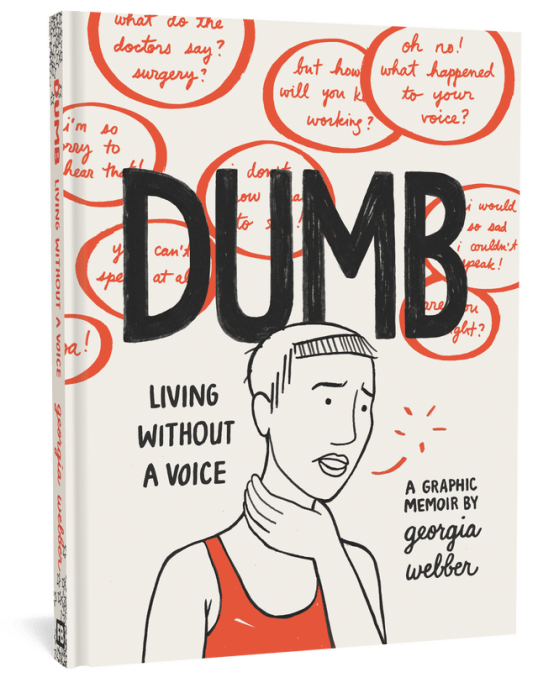
Canadian cartoonist Georgia Webber had to live through the answer to that question when a sudden and quite severe throat injury forced her into months of physically- and medically-mandated silence, and to call her experiences “devastating” is probably to sell them a bit too short — but they do make for fascinating, engrossing, and revelatory reading in her new (-ish, more on that…




 Through the Shattered Lens