I love the 1959 film, Attack of the Giant Leeches.
The set up is a classic one. In the humid bayous, a sweaty and unappealing store owner (Bruno VeSota) discovers that his much younger wife (the great Yvette Vickers) has been cheating on him. In one scene, he forces his wife and her lover to enter the swamp. It’s terrifying because the swamp is full of …. GIANT LEECHES! I’m a Southern girl. I’ve spent some time in the bayous. Let me tell you, swamps are creepy enough without the addition of giant leeches.
Full of sultry melodrama and bayou atmosphere, Attack of the Giant Leeches is one of the best of the giant monster films of the 50s. It’s amazing was radiation can do!
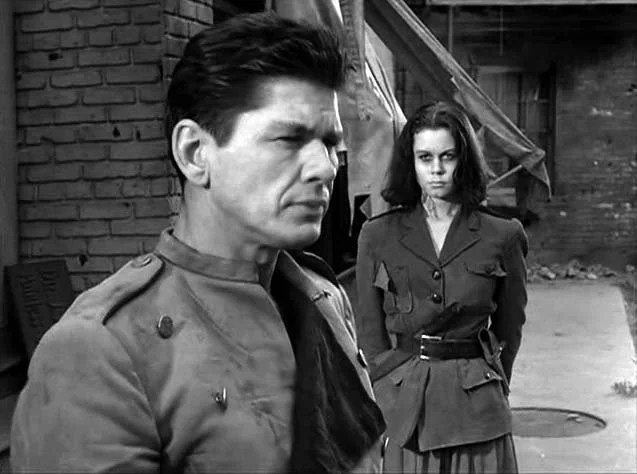
You know producer Buck Houghton had high hopes for the opening episode of Season 3 of THE TWILIGHT ZONE when it aired on September 15, 1961. It stars up and coming actors of the time, Charles Bronson and Elizabeth Montgomery, who were all over TV screens in the 50’s and early 60’s, with Bronson emerging as a strong character actor in movies as well. The two would be major stars within a few years, but they weren’t quite there yet.
This episode, titled “Two,” opens with “The Woman” (Elizabeth Montgomery), who is wearing a tattered dark military uniform, wandering into a bombed out, deserted city, and spotting the remains of a restaurant. Tired and hungry, she goes in and digs around until she finds an old can of chicken. As she’s opening the can, “The Man” (Charles Bronson), who’s wearing a tattered, light-colored uniform, walks in on her. Immediately attacking him with a combination of meat cleavers, bottles, pots and pans, The Man tries to hold her off until if becomes clear that he’s going to have to subdue her, which he does with one vicious punch that knocks her out cold. At this point it’s clear that these are the last two remaining survivors of a devastating war, on opposing sides no less, that completely destroyed the world. When The Man wakes The Woman up by dumping a pot of cold water on her face, he gives her back her chicken and tells her that there is no reason to fight anymore, as everyone else is dead. She doesn’t understand what he is saying so he walks off in frustration. The Woman doesn’t trust The Man, but she begrudgingly starts to follow him around to keep an eye on him. Will they kill each other? Will they join forces to survive? Could they even fall in love? Writer-Director Montgomery Pittman answers all of these questions over the course of the episode’s brisk 25 minutes.
The allegorical “Two” was a bold choice to open the popular TV show’s third season with its minimalist production set in a few sections of a single bombed-out town and featuring only two characters who barely even speak, especially Montgomery, who says two words throughout the entire episode. Not that much really happens either, so it’s the type of episode that lives or dies based on the performances of the lead actors, and Bronson and Montgomery both deliver outstanding work. Bronson, a dependable character actor at this point in his career, is especially good as The Man. His square-jawed stoicism unravels enough to reveal a weary vulnerability and desire for a connection with another person, even when they’re supposed to be mortal enemies. It’s ultimately a romantic part and Bronson kills it. For those who mostly know Bronson from his post DEATH WISH action star roles, parts like this are a revelation. Montgomery, still a few years away from beginning her iconic portrayal of Samantha in BEWITCHED, is quite beautiful even when she’s this grimy. Her performance as The Woman is even more challenging as it’s almost completely a physical performance, and she shines as her character transforms over the course of the episode.
Ultimately, “Two” may resolve its setup a little too quickly to be realistic, but I still enjoyed it immensely. The performances are outstanding and its hopeful denouement left me with a smile on my face.
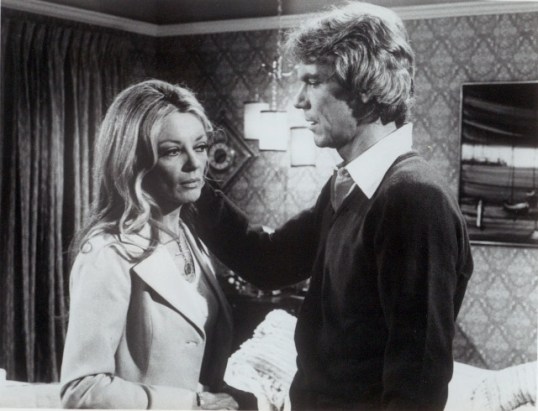
Tonight’s televised horror is The Cloning of Clifford Swimmer. Peter Haskell stars as Clifford Swimmer, an angry jerk who is unhappy with his marriage. He’s come up with a plan, though. He’s going to have himself cloned and then, after leaving his clone with his family, he’ll be free to live his life. However, Swimmer discovers that things never work that simply when it comes to creating a clone. This is a clever story with a great twist at the end.
It originally aired on November 1st, 1974 as a part of ABC’s The Wide World of Mystery. Unfortunately, whoever uploaded this film to YouTube has disabled playback so you’ll have to click on the link to watch it!
That Richard Burton is today best-remembered for his tumultuous marriages to Elizabeth Taylor and for his performances in several less-than-worthy films is unfortunate as Burton was also one of the most highly regarded staged actors of his generation. In fact, late in his life, Burton often expressed regret that he had ever left the stage for films to begin with.
In 1964, Burton played Hamlet on Broadway, in a production that was directed by John Gielgud. (Gielgud also provided the voice of the Ghost.) This is a video-recording of both that production and Burton’s acclaimed performance. Burton brings an intense and almost divine madness to the role. Watching, one can see why Burton would have preferred to have been remembered for this instead of for playing Mark Antony.
Six construction workers (played by Clint Walker, Carl Betz, Neville Brand, James Wainwright, James A. Watson, and Robert Urich) are boated to an isolated island off the coast of Africa. An oil company has assigned them to build an airstrip on the island. On the first day of work, they come across a meteorite buried in the ground. When one of the men tries to pick up the meteorite with the bulldozer, a blue light envelops the bulldozer and, at the same time, fatally injures Robert Urich. Possessed by the meteorite, the bulldozer starts to track the remaining workers down, killing them one-at-a-time. It’s a killdozer!
Based on a short story by Theodore Surgeon and made-for-television, Killdozer asks the question, “Have you ever seen a big, bulky bulldozer attempt to sneak up on someone?” Given that Killdozer is not fast and it’s not very agile, it should be easy to escape it but the construction keep doing dumb things, like getting drunk or trying to hide inside a copper tube instead of just running away. The surviving men wonder how they are going to make it until help eventually arrives. Maybe if you hear Killdozer coming, you should could just step to the side or maybe you could even run behind Killdozer. Instead, the construction workers keep trying to fight it head-on. Every time Killdozer pauses from noisily rolling across the island and sits still because it senses one of the workers might be nearby, I’m reminded that Killdozer is an absolutely ludicrous film but that it’s also wonderfully strange and that it’s also impossible to enjoy it on some level.
The cast is good and, for the most part, so is the straight-forward, waste-no-time direction. The Killdozer deserved an Emmy and maybe its own series but instead, it just had to settle for cult stardom.
Sinbad (Sergei Stolyarov) returns to his land after going on a great quest. He sees that half of the citizens are rich and happy and always dancing. He sees that the other half are poor and never happy. Those of us watching see that the film’s version of Persia looks a lot like Russia. Sinbad announces that he is going to capture the Bird of Happiness and bring it back to his people. He sets sail and is given help by the daughter of Neptune. Sinbad visits many lands and spend some time underwater, where Neptune offers him the hand of his daughters and there’s also an octopus hanging around and watching in the background. Sinbad never finds the Bird of Happiness but it doesn’t matter because he realizes that his people have all the happiness that they need in Persia.
The Magic Voyage 0f Sinbad may seem like a strange Sinbad film and that’s because it was never a Sinbad film in the first place. It was actually a Russian film called Sadko, about a young Russian man who tries to prove himself by finding the Bird of Happiness. In America, Sadko was even released under its original name and plot in 1953. No one paid much attention to it.
Then, in 1962, Roger Corman got his hands on the American distribution rights for the film and he decided to rerelease it. He changed the title to The Magic Voyage of Sinbad and he hired a young film student to write narration for the film and to also “translate” the film’s dialogue so that it could be dubbed into English. The very Russian Sadko instead became a film about Sinbad, the legendary Persian sailor.
The Corman version went on to become the better-known version, largely because it was featured on Mystery Science Theater 3000. Personally, I prefer the Corman version because the badness of the dialogue and the overly solemn narration go a long way toward making up for the fact that this is a 79-minute movie about someone searching for something and failing to find it. After making so many grand promises, Sinbad returns to his home and tells everyone that he actually lied and they don’t need the Bird of Happiness to be happy. The film ends abruptly, probably because the people rose up and tossed Sinbad in the ocean at that point.
As for that film student who wrote the script, Francis Ford Coppola later did alright for himself.
First released in 1983, Hostage is an Australian film about Christine (Kerry Mack) and Walter Maresch (Ralph Schicha).
Christine is a young woman who escapes from her abusive father by going on the road with a traveling carnival. She runs the dart-throwing booth. It’s a simple life but she’s happy with it. She has friends and she has freedom. When Walter, an enigmatic German drifter, joins the carnival, there’s an immediate attraction between him and Christine. Christine sleeps with him a few times but she makes it clear that she’s not looking for anything serious or permanent. Walter announces that, if Christine doesn’t marry him, he’s going to shoot himself. Christine rolls her eyes and leaves his trailer, just to hear a gunshot as she walks away. At the hospital, Walter refuses to get treated until Christine promises to marry him.
Christine does marry Walter, both to keep him from dying and also because she’s pregnant. Walter survives his gunshot wound and turns out to be the type of husband who alternates between being wildly romantic and being coldly abusive. Walter wants to have lot of a children. He’s upset when Christine gives birth to a girl. “The next one will be a son!” he announces. Walter also spends a lot of time complaining about how weak the Australians are compared to the Germans. And, of course, there’s another huge issue with Walter.
HE’S A NAZI!
Walter is a neo-Nazi. For whatever reason, it takes Christine forever to figure this out. Walter drags to Christine to Germany and then gets mad when Christine doesn’t stand along with all of his friends while watching The Triumph of the Will. Christine opens up Walter’s keepsake box and finds a picture of his father wearing a Nazi uniform and also an iron cross. Walter’s friends are all blonde Aryan types who are constantly talking about how Germany has lost its way. And yet Christine doesn’t really seem to get that Walter is a Nazi until Walter starts talking about blowing up buildings and robbing banks.
Eventually, back in Australia, Walter and Christine rob a string of banks and the tabloids are soon describing them as being a modern-day Bonnie and Clyde. Walter is happy but Christine just wants to grab her daughter and escape from him. That proves to be easier said than done. Walter’s not just a Neo-Nazi. He’s also totally insane….
Amazingly enough, this is based on a true story. Christine wrote about her ordeal and her book was adapted into Hostage, a film that may look like a typical exploitation film but which is actually a rather engrossing drama about a naive girl who finds herself trapped with a monster. The film is full of moments that stick with you, like when a policeman comes by Christine’s trailer and manages to totally miss her signals that she’s currently being held, at gunpoint, by Walter. Kerry Mack and Ralph Schicha both give strong performances as Christine and Walter. Schicha especially deserves a lot of credit for turning Walter into a believable villain as opposed to just a caricature. One reason why Walter is so dangerous is because he’s such an idiot and Schicha does a great job of showing what happens when stupidity mixes with confidence. In one of the film’s more over-the-top moments, Walter and his friend Wolfgang drag Christine to Turkey. At first, Walter and Wolfgang are cocky but the trip becomes a violent and (literally) bloody disaster.
Hostage brings a real nightmare to life. Sadly, even after she freed herself of Walter, Christine continued to live a difficult life. She died of hypothermia in 2019.
Unflinching, subversive, and dripping in corrosive dark humor, Sion Sono’s Cold Fish (2010) doesn’t just showcase Japan’s taste for genre-bending horror—it rips open the underbelly of polite society and exposes what writhes beneath. If I Saw the Devil was a descent into the abyss of revenge, Cold Fish is a fever-dream trek through manipulation, depravity, and the most repressed corners of the psyche. Built around the crucible of violence and sex, Sono’s film dares viewers to question not only the shape of evil, but whether the forces that awaken it could be lurking in anyone.
Before Cold Fish, Sono had already established himself as a subversive force in horror with his earlier film Suicide Club (2001), which helped him gain a loyal cult following and introduced him to the genre scene at large as an innovative and provocative filmmaker unafraid to challenge conventions. With Cold Fish, Sono refined his style, offering a tighter, more psychologically driven narrative that accelerates the intensity while probing deep societal anxieties.
Inspired by the real-life Saitama serial murders of the 1990s, committed by dog breeder Gen Sekine and his common-law wife Hiroko Kazama, Cold Fish draws chilling authenticity from these events. Sekine and Kazama ran a pet shop and poisoned several customers before dismembering their bodies to conceal the murders. Sono reimagines this disturbing history by transforming the pet shop into a tropical fish store and fictionalizing details while preserving the core themes of manipulation, complicity, and violence.
The story opens with Nobuyuki Syamoto, the definition of a beaten-down everyman: a tropical fish shop owner whose daughter openly hates her stepmother, whose marriage is half-drowned in silent resentment, and who drifts through life as little more than a shadow. From the outset, Syamoto’s passivity sets a tremulous undertone—terrible things are happening, but he isn’t doing much to stop them. That changes the moment his daughter Mitsuko is caught stealing and rescued by the charismatic Yukio Murata, proprietor of a flashier fish store. Murata’s manners and generosity are overwhelming, almost caricatured, yet there’s an edge of anticipation: something is amiss, and Sono lets the feeling gradually curdle beneath his gentle facade.
Murata’s initial charm morphs into coercive control as he manipulates the Syamoto family into his orbit. When Syamoto is coerced to become Murata’s “business partner,” the narrative takes its first graphic, kinetic turn: a sales pitch for a rare tropical fish goes lethally wrong. Murata poisons a buyer in cold blood, then erupts into violence, forcing Syamoto and his wife into complicity by helping dispose of the body. The shift is immediate and nightmarish—the performance by Denden (Murata) snaps from quirky salesman to a near-mythical monster, as terrifying for his unpredictability as for his casual approach to killing.
From here, Cold Fish dives into a spiral of murder, sexual domination, and psychological torture. Murata and his partner Aiko have murdered dozens, perfecting the art of erasing their victims. As the body count rises, Sono’s camera remains hauntingly restrained: eschewing frantic cuts for long takes, keeping his characters center-frame, locking viewers in Syamoto’s dread-soaked POV. We are forced to witness every mechanical step in the pair’s routine—the body disposal, the literal scattering of ashes, the casual cruelty.
What makes Cold Fish such a disturbing experience is not merely the gore (though the final act is blood-soaked chaos), but the way deviance is normalized, even made bureaucratic. Murata’s operation feels part nightmare, part dull corporate job. This banality breeds horror. At times, Sono punctuates scenes with black comedy: surf rock tunes play in the background as mutilated bodies are processed in Murata’s shop, and his wife’s participation has a twisted, deadpan humor that makes the violence doubly unsettling.
Syamoto’s trajectory is the film’s secret weapon. By trapping us in his perspective, Sono draws out the uncomfortable reality of learned helplessness, craven compromise, and the latent violence beneath a repressive facade. Syamoto isn’t a hero or anti-hero, but a study in desperation and dissolution. His initial submission slowly ferments into rage, and when he finally snaps, the violence is primal and cathartic—a vengeance that feels less like triumph and more like an act of obliteration. Instead of a neat moral arc, Sono’s script is obsessed with the ambiguity of retribution: what festers beneath apathy, what trauma does when left unaddressed, and what the need to act breeds when suppressed for too long.
This thematic preoccupation connects Cold Fish to the likes of I Saw the Devil: both movies use revenge not as justice, but as a mirror for corruption—how far can the ordinary man go before he becomes indistinguishable from the monsters tormenting him? Sono’s film is ultimately more nihilistic, using social commentary as a subtle undertow, with critiques of Japanese conformity, sexuality, and family decaying beneath the surface. The result is a film that is both emotionally exhausting and intellectually provocative.
Technically, Cold Fish offers Sono at his most focused. The cinematography is subtle but relentless, with natural camera movement amplifying character reactions rather than indulging in spectacle. The use of Mount Fuji as a backdrop for scenes of violence is striking and effective. Costume, color palette, and setting all speak of an ordinary world slowly overtaken by surreal terror. The score plays off these moments, with music choices ranging from nervy tension to surf-rock irony.
The performances are uniformly superb. Denden is magnetic as Murata—making each mood shift obvious, unpredictable, and horrifying. Mitsuru Fukikoshi’s portrayal of Syamoto is raw, fragile, and ultimately explosive. The supporting cast amplifies the film’s extremes without ever feeling cartoonish. Sono pushes them to the edge, finding both tragedy and queasy humor in their unraveling. The sound design, especially in scenes of dismemberment and violence, is overwhelming and intense—forcing the audience into a sensory trap that mirrors Syamoto’s psychological implosion.
Yet Cold Fish isn’t just an exercise in gore or cruelty—it’s an autopsy of repression, cowardice, and compulsion, watched through the lens of a culture known for its traditions of obedience. The film asks what drives people to murder, what keeps them silent, and what happens when those limits are breached. It never gives viewers easy sympathies or clean answers, and the ending is deliberately unnerving—Syamoto’s transformation is complete, but it isn’t heroic, nor is it redemptive.
For some, the film’s length and relentless tone will be too much. Others have pointed out its over-the-top final act, and some feel the excessive violence is hard to justify. However, these very qualities are what cement Cold Fish as a significant work in contemporary Japanese horror—it’s the sort of movie that claws at you for days, sticking in the brain with its grim humor and powerful sense of unease. Like I Saw the Devil, it’s less about catharsis than about exposing the permanent scars left by evil and revenge, and the horrifying possibility that what lurks under the surface of normality is just waiting for an invitation to come out.
Ultimately, Sion Sono’s Cold Fish is an important piece of modern horror—not simply for its brutality, but for its relentless psychological excavation and perverse humor. By channeling the real Saitama serial murders into a study of psychological torment and complicity, Sono creates a film that is designed to provoke, to disturb, and to make audiences ask where the boundaries of morality might finally break. For genre fans, it’s a bracing, unforgettable experience; for those who approach with caution, it’s both a warning and an invitation to glimpse the heart of darkness just beneath the surface.